• Home
  • About
  • DavidKitz.ca
  • Youtube Videos
  • Books by David
  • Books on Amazon.com

I love the Psalms

~ Connecting daily with God through the Psalms

I love the Psalms

Tag Archives: Bible

Reverence for God’s Holy Word

30 Monday Jun 2025

Posted by davidkitz in Psalm 119

≈ Leave a comment

Tags

Bible, faith, God, God's word, Jesus, permanence of God's Word, Prayer, Psalms, reverence, the LORD, unchanging nature of God

Today’s Devotion from Psalms 365 by David Kitz

Reading: Psalm 119:41-48

ו Waw

May your unfailing love come to me, LORD,
your salvation, according to your promise;
 then I can answer anyone who taunts me,
for I trust in your word.
 Never take your word of truth from my mouth,
for I have put my hope in your laws.
I will always obey your law,
for ever and ever.
I will walk about in freedom,
for I have sought out your precepts.
I will speak of your statutes before kings
and will not be put to shame,
for I delight in your commands
because I love them.
I reach out for your commands, which I love,
that I may meditate on your decrees
(NIV). *

Entrance to the Foster farm — Durham, ON

Reflection
We live in uncertain times. I am sure people have been saying words to that effect for generations, but it’s true. Developments in technology have been driving change at an ever increasing tempo. With major political and economic changes on the horizon, there seems to be more uncertainty than ever. The only thing that seems certain is that change will certainly happen.

In times like this, we need certainty. This world can’t offer us certainty, but God’s word can. Isaiah reminds us of the permanence of God’s word. “The grass withers and the flowers fall, but the word of our God endures forever” (Isaiah 40:8).

Jesus offers us the same assurance.  “Do not think that I have come to abolish the Law or the Prophets; I have not come to abolish them but to fulfill them. For truly I tell you, until heaven and earth disappear, not the smallest letter, not the least stroke of a pen, will by any means disappear from the Law until everything is accomplished. Therefore anyone who sets aside one of the least of these commands and teaches others accordingly will be called least in the kingdom of heaven, but whoever practices and teaches these commands will be called great in the kingdom of heaven” (Matthew 5:17-19).

Jesus fully endorsed a reverence for God’s holy word. This is the reverence that we see expressed here in Psalm 119. We can place our trust in God’s word because it’s not changing with the times. It stands eternal. Good and evil continue as they always have. They war against each other. In uncertain times, we need God’s word in our minds and on our lips more than ever. May this be our prayer:  Never take your word of truth from my mouth, for I have put my hope in your laws (v. 43).

Response: Father God, help me grow in my love for your word. Help me to read, meditate and apply it to my daily life. I reach out for your commands, which I love, that I may meditate on your decrees (v. 48). Amen.

Your Turn: Are you spending time daily in God’s word? How has meditating on God’s word helped you?

Para la publicación de Salmos 365 de hoy en español haga clic aquí.

bgbg_v4.3_1501818
* NEW INTERNATIONAL VERSION, COPYRIGHT ©1973, 1978, 1984, 2011 BY BIBLICA

Please pray for peace to return to Israel, Gaza, Iran, and Ukraine!

Volume I of Psalms 365: Develop a Life of Worship and Prayer won the Best Book of the Year Award from The Word Guild and Volume II has won the Best Devotional of the Year Award. For those who love God’s word, this three-book series is an ideal way to daily meet with the Lord. To purchase or for a closer look click here.

A gripping read from David Kitz.
Is a return-to-Jesus revival possible in our time?
This book points the way forward.
For details click here.

The LORD Will Rebuild

29 Sunday Jun 2025

Posted by davidkitz in Psalm 102

≈ Leave a comment

Tags

Bible, compassion, God's favor, nations, praise the LORD, Prayer, rebuild, the LORD, Zion

I will praise the LORD!


The LORD Rebuilds

Psalm 102:12-17

But you, LORD, sit enthroned forever;
    your renown endures through all generations.
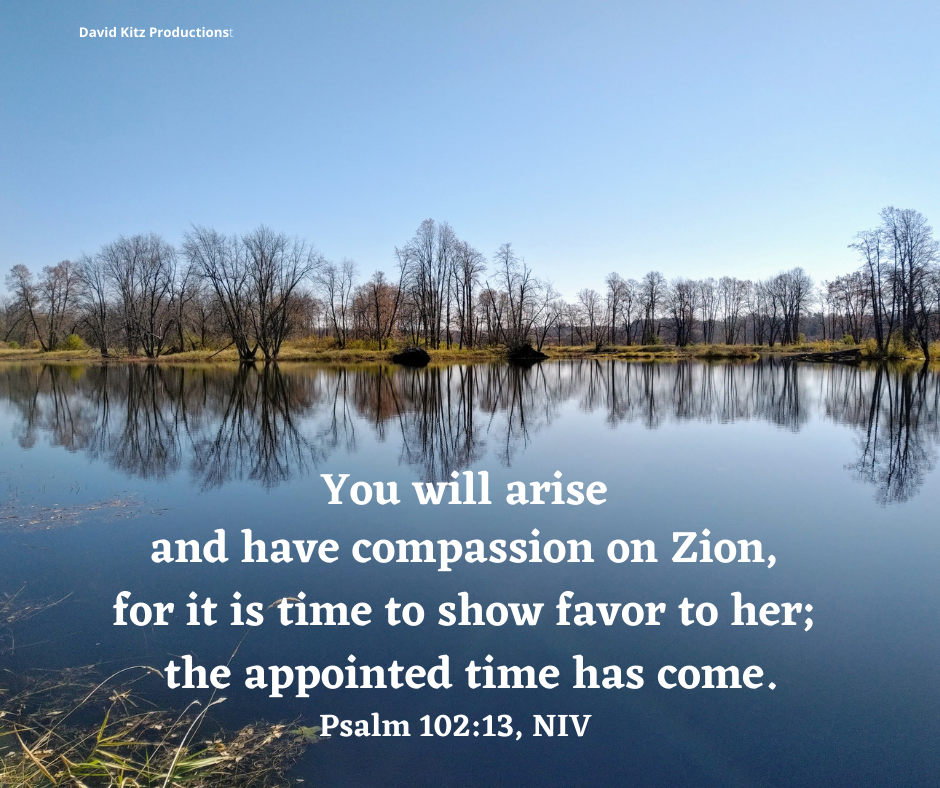
You will arise and have compassion on Zion,
    for it is time to show favor to her;
    the appointed time has come.
For her stones are dear to your servants;
    her very dust moves them to pity.
The nations will fear the name of the LORD,
    all the kings of the earth will revere your glory.
For the LORD will rebuild Zion
    and appear in his glory.
He will respond to the prayer of the destitute;
    he will not despise their plea.
*

Para la publicación de Salmos 365 de hoy en español haga clic aquí.

bgbg_v4.3_1501818
* NEW INTERNATIONAL VERSION, COPYRIGHT ©1973, 1978, 1984, 2011 BY BIBLICA

Please pray for peace to return to Israel, Gaza, and Ukraine!

Volume I of Psalms 365: Develop a Life of Worship and Prayer won the Best Book of the Year Award from The Word Guild and Volume II has won the Best Devotional of the Year Award. For those who love God’s word, this three-book series is an ideal way to daily meet with the Lord. To purchase or for a closer look click here.

A gripping read from David Kitz.
Is a return-to-Jesus revival possible in our time?
This book points the way forward.
For details click here.

The Name of the LORD

29 Sunday Jun 2025

Posted by davidkitz in Psalms, Psalms Alive!

≈ Leave a comment

Tags

Bible, Jesus, Lord of lords, praise, praise the LORD, Prayer, Psalms, silence, Son of God, the LORD, the name of the LORD, worship

Psalm 113:1-3

Praise, O servants of the LORD,
praise the name of the LORD.
Let the name of the LORD be praised,
both now and forever more.
From the rising of the sun to the place where it sets,
the name of the LORD is to be praised.

At the time of this writing another Christmas has come and gone. I am sitting across from our family Christmas tree as I write this chapter. Snow is gently falling outside my living room window. It’s that relaxing time of year, the festive interlude between Christmas Day and New Year’s Day. It’s a time to get your spiritual battery recharged, before the onslaught of the work routine returns along with the coming of a new year. As long as I can avoid big box stores and shopping malls, it’s a peaceful time. I can spend extra time with the LORD and with family.

Praise the LORD!

Yes, praise the LORD for those relaxing times, when the pace of life slows down. We live in a rushed world, where quiet times and silent moments get crowded to the margins of our existence.

Silence? Silence is a rare experience in our rapid fire, entertainment-hyped world. I wonder if Silent Night is such a popular carol, because silence is a commodity we rarely experience, but inwardly we long for it.

The people of the ancient world knew silence. It surrounded them like a huge comforting blanket. They did not awaken to the blare of the radio or the din of urban traffic. But even so, they purposefully set apart times to get away and seek the LORD. Even the Son of God needed those times. After feeding the five thousand, Jesus did not throw a party with his disciples to celebrate his miracle. No, we read that “he went up on a mountainside by himself to pray (Matthew 14:23).

Jesus longed to commune with his Father. He needed silent nights for that. He needed alone times.

How about you? If Jesus needed those quiet times—alone with God times—I know I most certainly do. And the starting point for any meaningful time with the LORD is the point of praise. We are to “enter his gates with thanksgiving and his courts with praise; give thanks and praise his name” (Psalm 100:4).

That is precisely how Psalm 113 begins. It starts with praise:

Praise the LORD! Praise, O servants of the LORD, praise the name of the LORD. Let the name of the LORD be praised, both now and forever more. From the rising of the sun to the place where it sets, the name of the LORD is to be praised.

And who precisely are we to praise? Both in Psalm 100 and Psalm 113 the admonition is crystal clear. We are to praise the name of the LORD. Shout to the LORD, all the earth. Worship the LORD with gladness; come before him with joyful songs (Psalm 100:1-2).

Now it must be noted that the psalmist did not instruct us to praise the name of the Lord. He instructed us to praise the name of the LORD. Did you catch the distinction? There is a huge difference between the words, Lord and LORD that we can easily skip over or dismiss.  

With enough money and influence, almost anyone can become a lord—a British lord. Conrad Black, the newspaper baron, renounced his Canadian citizenship in order to become Lord Black of Crossharbour. Along with the title of lord, comes a seat in the House of Lords in the British Parliament.

In this world there are many lords, and would-be lords, but there is only one LORD. The LORD is the Lord of both the heavens and the earth. His kingdom reign has no beginning or end; it is eternal. His dominion knows no bounds. The LORD is truly Lord of all, including Crossharbour. His seat, the throne of the universe, lies beyond the highest heavens. His glory never ceases. It is never tarnished by scandal, never debouched by sin. He is without peer. He is the LORD of lords.

In most Bible translations the word LORD is actually a kind of acronym. The capitalized letters of the word LORD stand for the Divine Name, the Hebrew language “Tetragrammaton.” The Hebrews considered the Name too sacred to be spoken—a practice which is still followed among worshipping Jews today. An exact transliteration of the Hebrew word for LORD into English would yield YHWH. Biblical scholars and experts in linguistics agree that with the addition of Hebrew vowel markers, this word would most likely be pronounced Yahweh. However, instead of speaking out the word Yahweh, Hebrew speakers would substitute the word Adonai, which means Lord. The name Yahweh was deemed too holy to be spoken by human lips. In deference to this tradition, and in honor of the sacred Name, modern translators have substituted the capitalized word LORD for YHWH.

Accordingly, the opening verses of Psalm 113 could also be rendered thus:

Praise YHWH! Praise, O servants of YHWH, praise the name of YHWH. Let the name of YHWH be praised, both now and forever more. From the rising of the sun to the place where it sets, the name of YHWH is to be praised.

How sacred is the name of the LORD to you? Does it roll off your tongue with little meaning, or in your mind and heart is it truly linked to the LORD of Lords? Do you reverence His Name as his chosen people do? His glory and his character are resident within his Name, the sacred name of the LORD. Do you speak his Name thoughtlessly?

This is after all, the LORD, whose name means I AM. He is the self-existent One, without beginning or end. He is the One, who when asked, declared his identity to Moses. God said to Moses, “I AM WHO I AM. This is what you are to say to the Israelites: ‘I AM has sent me to you'” (Genesis 3:14).

It was this same Moses who came down Mount Sinai with the Ten Commandments etched on tables of stone. One of those commands reads as follows:

You shall not misuse the name of the LORD your God, for the LORD will not hold anyone guiltless who misuses his name (Exodus 20:7).

In the spirit realm invocation is a power laden term. To invoke someone’s name simply means to give voice to that name. If you call out my name in a public gathering, you will quickly get my attention. Our ears are always tuned to hear our own name. I may be surrounded by indecipherable babble but toss my name into the midst of that babble, and I’ll pick up my ears every time—not only that—I’ll come right over to find out what is being said about me. That is the power of invocation.

The same is true in the spirit realm. We even have a common saying to express this truth, “Speak of the Devil, and he’ll show up.”

If the power of invocation works with me, and it works with the Devil, who is not omnipresent, then you can be certain that it works with the name of the LORD. Speak his Name, and He will show up. In Psalm 35, David declares, “The eyes of the LORD are on the righteous and his ears are attentive to their cry.” And David goes on to assert, “The righteous cry out, and the LORD hears them; he delivers them from all their troubles” (Psalm 34:15, 17).

The prophet Joel takes this truth one step further, while speaking of the troubled times before the LORD’s return, he states, “And everyone who calls on the name of the LORD will be saved” (Joel 2:32).

Amid this world’s babble, the LORD will always hear his name. He will show up. He will eavesdrop on every conversation, when his name is mentioned. He will hear every whispered prayer. He will stop by every meal, where grace is spoken. He is there, by your side, even when death comes knocking. Just speak his name.

This is the power of invocation; it is the power resident in his name—the name of the LORD. Therefore, it behoves us to use his name aright, not flippantly or as swear word. That is the Devil’s game, and we play on his side when we besmirch or desecrate the holy Name. I have no time or respect for those who misuse my name. Why would we expect the LORD Almighty to be any different?

But my ears are always open to praise. It puts a smile on my face. Would it be any different with the LORD? When we gather to praise the LORD, He will be present at the mention of his name. A variant reading of Psalm 22:3 declares, “Yet you are holy, enthroned on the praises of Israel.”

I rather like the thought of making a place for the LORD among us. As we praise his name, He comes to be with us. He pulls up a chair and sits with us for a time. He is enthroned on our praise. Through our praise we make room for Him in our lives. Our praises, whether spoken or sung, form an open invitation to Him. It is as though we are saying, “LORD, come sit with us for a while. Come be enthroned among us.”

The Lord is on his heavenly throne — photo by David Kitz

So let his praise resound. Let the name of the LORD be praised, both now and forever more.

 Our praises join with others to form a continuum of praise for the LORD. It is a continuum that stretches back to the dawn of time. Can you imagine Adam waking on that first morning to a beautiful dawn in the Garden of Eden? He stretches, and then in thanksgiving he raises his hands and his voice in praise to his Creator. We join our voices with Adam and Eve, our first parents, when we too praise our Creator. We join our voices in praise with Abraham, the father of all who are justified by faith. We join with David, who danced before the LORD with all his might in celebration of the mercy of God. We blend our praise with the prophet Isaiah, who saw the LORD high and exalted, with six-winged seraphs calling out, “Holy, holy, holy is the LORD Almighty; the whole earth is full of his glory” (Isaiah 6:3).

 This eternal praise continuum extends back to include all the heavenly hosts from before the earth took form. It encompasses all of creation, both past and present, the birds, the animals and the sea creatures. It draws all of life into worship. Let everything that has breath praise the LORD (Psalm 150:6).

It includes the women, who Jesus met on the best morning since creation—resurrection morning. Jesus greeted them, and then these women “came to him, clasped his feet and worshipped him (Matthew 28:9).

Oh, what a moment of praise! It still resounds. It will resound throughout history. We are united in our praise with Thomas, who touched the wounds of the living Christ. Then overwhelmed, he exclaimed in humble worship, “My Lord and my God!” (John 20:28).

Our praise for the LORD unites with the praises of the martyrs throughout the ages. It echoes from the catacombs and the arches of the Roman Coliseum, through the Middle Ages and the Reformation, right onto the back pages of today’s newspaper. We bow our knees in unison with all these who suffer for his Name. We bow with them in worship. We bow to the King of kings and the LORD of lords.

In praise to the LORD, we join with Handel to declare that our Messiah has come and his Kingdom reign will never cease. Praise the LORD! Strike up the chorus. Hallelujah! He is our Ode to Joy.

Purple stars bring backyard joy — photo by David Kitz

The glory of his name is not bound by the confines of time and place. It supersedes national boundaries. The LORD, who parted the Red Sea, also parted the Iron Curtain. He took his own special sledgehammer to the Berlin Wall. He is LORD of the nations, whether they acknowledge him or not.

In the face of Christ, we see the LORD. In his name we have redemption. The apostle Paul declares, “God exalted him to the highest place and gave him the name that is above every name, that at the name of Jesus every knee should bow, in heaven and on earth and under the earth, and every tongue confess that Jesus Christ is Lord, to the glory of God the Father” (Philippians 2:9-11).

Now we join with the psalmist and declare, “From the rising of the sun to the place where it sets, the name of the LORD is to be praised.”

Yes, praise the LORD! Praise his name. Praise Deity clothed in humanity, who in the temple courts confessed his name, “I tell you the truth… before Abraham was born, I AM!” (John 8:58).

On bended knee we confess, “Jesus Christ is Lord.”

Yes, He is LORD!

Bringing Life to the Psalms

  1. Were you aware of the distinction between the words, LORD and Lord, before you read this chapter? Does this knowledge affect your use of the name of the LORD?
  2. The great, “I am,” statements of Christ recorded in John’s Gospel are a direct link to Yahweh, who is the Great I AM. John’s Gospel most clearly portrays the deity of Christ. Take a moment to read Jesus’ bold confession of his deity in John 8:48-59.
  3. We are instructed to pray in Jesus’ name. Take a moment to read those instructions afresh as found in John 14:5-14.
  1. Are you aware of the power of invocation? Be assured the LORD has ears to hear and He will show up. He will honor his name.

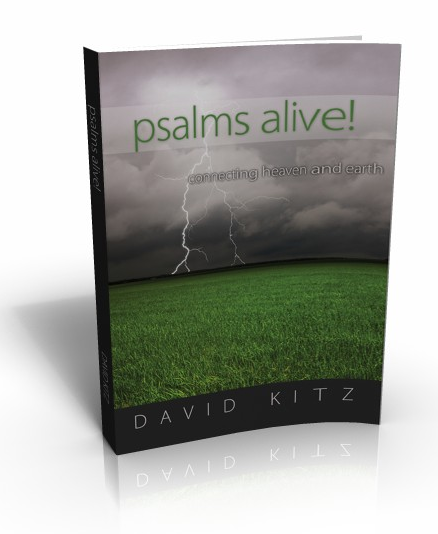
Today’s post is Chapter 18 from the book Psalms Alive! Connecting Heaven & Earth by David Kitz. To find out more or purchase click here.


The Faithful in the Land

28 Saturday Jun 2025

Posted by davidkitz in Psalm 101

≈ Leave a comment

Tags

Bible, blameless, praise the LORD, Prayer, Psalms, slander, the LORD

I will praise the LORD!


A Call for Right Living

Psalm 101:5-8

Whoever slanders their neighbor in secret,
    I will put to silence;
whoever has haughty eyes and a proud heart,
    I will not tolerate.
My eyes will be on the faithful in the land,
    that they may dwell with me;
the one whose walk is blameless
    will minister to me.
No one who practices deceit
    will dwell in my house;
no one who speaks falsely
    will stand in my presence.
Every morning I will put to silence
    all the wicked in the land;
I will cut off every evildoer
    from the city of the LORD.
*

Para la publicación de Salmos 365 de hoy en español haga clic aquí.

bgbg_v4.3_1501818
* NEW INTERNATIONAL VERSION, COPYRIGHT ©1973, 1978, 1984, 2011 BY BIBLICA

Please pray for peace to return to Israel, Gaza, and Ukraine!

Volume I of Psalms 365: Develop a Life of Worship and Prayer won the Best Book of the Year Award from The Word Guild and Volume II has won the Best Devotional of the Year Award. For those who love God’s word, this three-book series is an ideal way to daily meet with the Lord. To purchase or for a closer look click here.

A gripping read from David Kitz.
Is a return-to-Jesus revival possible in our time?
This book points the way forward.
For details click here.

The Hidden Word

24 Tuesday Jun 2025

Posted by davidkitz in Psalm 119, Psalms

≈ 5 Comments

Tags

Bible, God's word, Jesus, Prayer, Psalms, pure heart, sexual immorality, the LORD

Today’s quote and prayer from
“Psalms 365: Develop a Life of Worship and Prayer”
by David Kitz.


Reading: Psalm 119:9-16

Father God,
I want to live my life
according to your Word.
I seek you with all my heart;
do not let me stray from your commands.
I have hidden your word in my heart
that I might not sin against you. 

Amen.

— — — —

“Are you still so dull?” 
Jesus asked them.

“Don’t you see that whatever enters the mouth
goes into the stomach and then out of the body?

But the things that come out of a person’s mouth
come from the heart, 
and these defile them.

For out of the heart come evil thoughts—
murder, adultery, sexual immorality,
theft, false testimony, slander.

These are what defile a person; 
but eating with unwashed hands does not defile them.”
(Matthew 15:16-20 NIV)*

Para la publicación de Salmos 365 de hoy en español haga clic aquí.

bgbg_v4.3_1501818
* NEW INTERNATIONAL VERSION, COPYRIGHT ©1973, 1978, 1984, 2011 BY BIBLICA

Please pray for peace to return to Israel, Gaza, Iran, and Ukraine!

Volume I of Psalms 365: Develop a Life of Worship and Prayer won the Best Book of the Year Award from The Word Guild and Volume II has won the Best Devotional of the Year Award. For those who love God’s word, this three-book series is an ideal way to daily meet with the Lord. To purchase or for a closer look click here.

A gripping read from David Kitz.
Is a return-to-Jesus revival possible in our time?
This book points the way forward.
For details click here.

You Welcomed the Message

23 Monday Jun 2025

Posted by davidkitz in Psalm 119

≈ Leave a comment

Tags

Bible, Christianity, faith, God, Jesus

Today’s quote and prayer from
“Psalms 365: Develop a Life of Worship and Prayer”
by David Kitz.


Reading: Psalm 119:1-8

Father God,
like the psalmist
I want to fall in love with your Word.
Here is the purpose to my desire.
I want to live a blameless life
that brings honor to my Creator
because you are good.
Amen.

— — — —

For we know,
brothers and sisters loved by God,
that he has chosen you,
 because our gospel came to you
not simply with words
but also with power,
with the Holy Spirit
and deep conviction.
You know how we lived among you
for your sake.
 
You became imitators of us
and of the Lord,
for you welcomed the message
in the midst of severe suffering
with the joy given by the Holy Spirit.
 
And so you became a model
to all the believers in Macedonia and Achaia.
 
The Lord’s message rang out from you
not only in Macedonia and Achaia—
your faith in God has become known everywhere.
Therefore
we do not need to say anything about it,
 
for they themselves report
what kind of reception you gave us.
They tell how you turned to God
from idols to serve the living and true God,
 
and to wait for his Son from heaven,
whom he raised from the dead—
Jesus, who rescues us from the coming wrath.

(1 Thessalonians 1:4-10 NIV)*

Para la publicación de Salmos 365 de hoy en español haga clic aquí.

bgbg_v4.3_1501818
* NEW INTERNATIONAL VERSION, COPYRIGHT ©1973, 1978, 1984, 2011 BY BIBLICA

Please pray for peace to return to Israel, Gaza, Iran, and Ukraine!

Volume I of Psalms 365: Develop a Life of Worship and Prayer won the Best Book of the Year Award from The Word Guild and Volume II has won the Best Devotional of the Year Award. For those who love God’s word, this three-book series is an ideal way to daily meet with the Lord. To purchase or for a closer look click here.

A gripping read from David Kitz.
Is a return-to-Jesus revival possible in our time?
This book points the way forward.
For details click here.

Obedience to God’s Word

23 Monday Jun 2025

Posted by davidkitz in Psalms

≈ Leave a comment

Tags

Bible, devotion, faith, Heart, holiness, Law, obedience, Prayer, Psalm119, purpose, Reflection, Righteousness, Scripture, word, worship

Today’s Devotion from Psalms 365 by David Kitz

Reading: Psalm 119:1-8
א Aleph
Blessed are those whose ways are blameless,
who walk according to the law of the LORD.
Blessed are those who keep his statutes
and seek him with all their heart—
they do no wrong
but follow his ways.
You have laid down precepts
that are to be fully obeyed.
Oh, that my ways were steadfast
in obeying your decrees!
Then I would not be put to shame
when I consider all your commands.
I will praise you with an upright heart
as I learn your righteous laws.
I will obey your decrees;
do not utterly forsake me (NIV). *

Reflection
We are about to start a twenty-two-day journey through Psalm 119, the longest Psalm in the Bible. This is also an acrostic poem, which in this case means each stanza of this poetic psalm begins with a different letter of the Hebrew alphabet. The section above for instance, begins with the letter Aleph, which roughly corresponds to our letter A. Also, within each alphabetic stanza are eight verses, which all begin with the same Hebrew letter. In this way the psalm’s composer works his way through the entire twenty-two letters of the Hebrew alphabet. This psalm is a truly remarkable literary composition, which was originally structured to be memorized, like the alphabet. Alas, for the English reader, much of the elaborate, intricate beauty of this psalm is lost the moment it is translated from its original tongue.

The theme of this psalm is consistent throughout. It is a poetic testimony in praise of God’s holy, unchanging word. Here we find the alpha and omega of the psalms—a literary tribute to the A-to-Z wonder of God’s word. Every letter trumpets the salutary goodness of God’s written word.

From the beginning of this poetic masterpiece the author recognizes his need. His life needs to be governed by the law of the LORD. His goal and heart’s desire is to lead a blameless life. God’s blessing comes to such a person. Blessed are those whose ways are blameless, who walk according to the law of the LORD. Blessed are those who keep his statutes and seek him with all their heart—they do no wrong but follow his ways (v. 1-3).

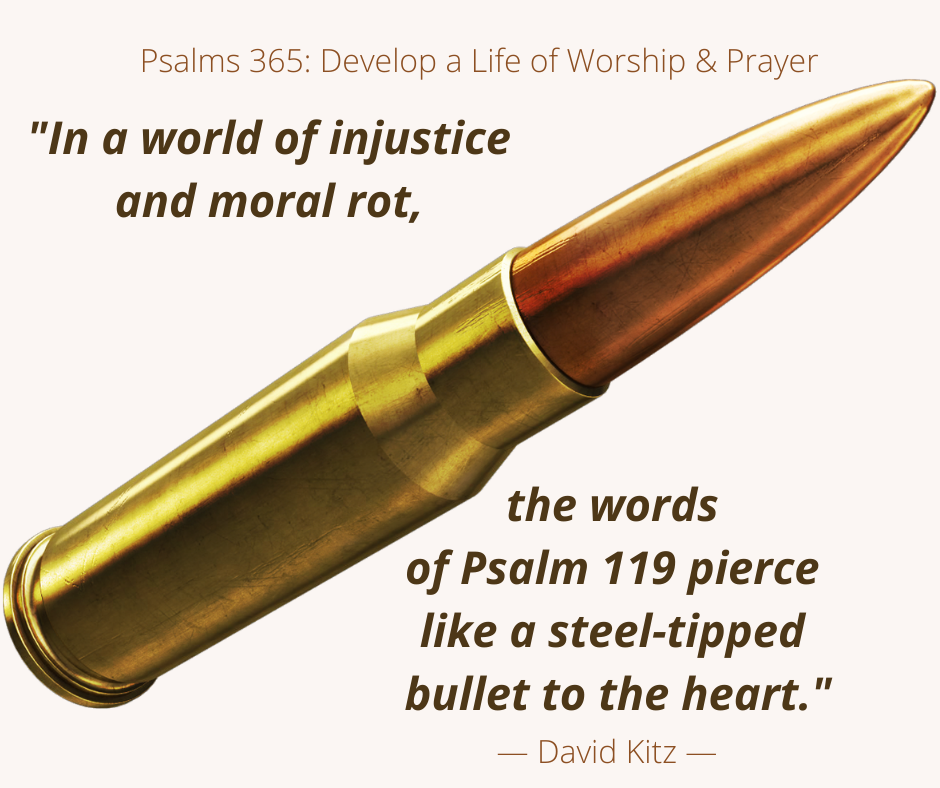
In a world of injustice and moral rot the words of Psalm 119 pierce like a steel-tipped bullet to the heart. The need for all humanity to follow his ways, rather than our own selfish ways has never been greater.

Response: LORD God, like the psalmist I want to fall in love with your Word. Here is the purpose to my desire. I want to live a blameless life that brings honor to my Maker because you are good. Amen.

Your Turn: Is holy living one of your goals? Do you see value in leading a blameless life before God?

Para la publicación de Salmos 365 de hoy en español haga clic aquí.

bgbg_v4.3_1501818
* NEW INTERNATIONAL VERSION, COPYRIGHT ©1973, 1978, 1984, 2011 BY BIBLICA

Please pray for peace to return to Israel, Gaza, and Ukraine!

Volume I of Psalms 365: Develop a Life of Worship and Prayer won the Best Book of the Year Award from The Word Guild and Volume II has won the Best Devotional of the Year Award. For those who love God’s word, this three-book series is an ideal way to daily meet with the Lord. To purchase or for a closer look click here.

A gripping read from David Kitz.
Is a return-to-Jesus revival possible in our time?
This book points the way forward.
For details click here.

The LORD Rules over All

22 Sunday Jun 2025

Posted by davidkitz in Psalms, Psalms Alive!

≈ Leave a comment

Tags

Bible, circumstances, constancy of God, David, God, Jesus, Martin Rinkart, praise, praise the LORD, Prayer, Psalms, sacrifice of praise, sing praise, worship, worship amid suffering

Psalm 103:19-22

The LORD has established his throne in the heavens,
and his kingdom rules over all.
Praise the LORD you his angels,
you mighty ones who do his bidding,
who obey his word.
Praise the LORD all his heavenly hosts,
you his servants who do his will.
Praise the L
ORD, all his works everywhere in his dominion.
Praise the LORD, O my soul.

Psalm 103 is a sandwich, or if you prefer, a big beefy hamburger. By that I mean this psalm begins with a personal call to praise the LORD, and it ends, as we see from the passage above, with what amounts to a universal call to praise the LORD. Between these calls to worship, we find a great big helping of God’s goodness. In between we discover the why—the reasons why—we should be overflowing with praise to the LORD.

David experienced God’s saving grace, goodness, love and forgiveness over and over again. Consequently, his heart was full to bursting with praise. Herein is the why of praise; the reason for praise rests in God, not in us, or our circumstances.

But Psalm 103 is not just a beefy hamburger. It is also an express train—a big steam locomotive. There is a distinct momentum to this psalm, which can be missed by breaking it into sections. It begins with David addressing his soul. It would appear, at the start, to be a sluggish soul that is somewhat reluctant to praise God. But this reluctance begins to melt away as David recounts the LORD’s great goodness. One by one David declares the character qualities of the LORD. As each attribute is portrayed, David’s sense of awe and his desire to praise God picks up momentum. By the end of this psalm, David’s praise has become an express train, loaded with divine purpose and headed full speed for glory!

Shinkansen (bullet train) photo by David Kitz

His final call to worship in the above stanza is a great cry for all to get aboard this express train of praise. Now with a full head of steam, in exultant praise, I can hear him shouting, “Hop on board, one and all. Praise the LORD! We are heaven bound!”

Many see praise and worship as a purely cathartic response to the manifest goodness of God. Something good happens to us. Unexpectedly, we get a thousand-dollar payment in the mail. Quite naturally our response is praise to God.

For many people, praise to God never progresses beyond this natural, cathartic level. If God does not bless, no praise is forthcoming. Our praise for the LORD becomes or simply remains circumstance dependent. But that was not the case with David. His praise extended beyond simple catharsis. He taught his soul to praise the LORD in all circumstances. True biblical praise and worship is after all a spiritual exercise, a discipline we grow in, just as we grow in the discipline of prayer.

The LORD, the object of our praise, does not change with our circumstances. He is forever the same. Jesus Christ is the same yesterday and today and forever (Hebrews 13:8). He is constant, hence our praise and worship of him should be constant, unaffected by weather conditions, world events, the gyrations of the stock market, our swings of mood or our personal situation.

Of course, this constancy in praise is something the natural man simply rebels against. Our world needs to be right in order for us to praise God aright, or so we reason. The only problem with this logic is that the world has never been right since the Fall. Death, disease, war and misery have been raining down on the children of Adam, since wilful disobedience to God first took root among us. And this is one weather forecast, for all humanity, that is not about to change—not until Christ returns.

If we are waiting for a perfect world before we lift our voice in praise to God, we will never praise Him. In fact, if our eyes are on the world, or on ourselves, there will always be grounds to withhold our praise. But then, the whole purpose of praise and worship is to lift up our eyes. We desperately need to get our eyes off ourselves, off the world, and onto God our Maker.

Photo by Thirdman on Pexels.com

Martin Rinkart was a man who could be forgiven for cursing God. But rather than cursing his Creator, or withholding worship, he composed the ageless hymn of praise, Now Thank we all our God. Pastor Rinkart (1586-1649) was caught up in the horrors of the Thirty Years’ War. For a full year his hometown, Eilenburg in Saxony, was besieged as war raged round about. The triple scourge of war, disease and famine ravaged the community. Death was everywhere. The walled city was swamped by destitute refugees. Three times it was overrun by pillaging armies. As the crisis worsened, Rinkart’s pastoral colleagues succumbed to the plague; only he was left to conduct the funerals. In that horrific year, 1637, he conducted more than 4,000 funerals, as many as fifty in a single day. One of those funerals was for his own dear wife.

Yet it was this man, Martin Rinkart, who composed these words of praise:

            Now thank we all our God
            With heart and hands and voices
            Who wondrous things hath done
            In whom this world rejoices;
            Who from our mothers’ arms
            Hath blessed us on the way
            With countless gifts of love
            And still is ours today.

Martin Rinkart did not live in a perfect world. But his eyes saw beyond the death and destruction that lay before him. He lifted his eyes above the world, and beyond himself. And when he did, he beheld God. He saw Him as LORD over all, and a God to be thanked and praised for countless gifts of love. Amid the most desperate situation imaginable, Pastor Rinkart fixed his gaze on the LORD his Maker. Then this humble pastor did a most remarkable thing—a Spirit-directed thing. He raised his voice in praise to God.

In a world run amok, the first casualty all too often is our faith in God. The chaos of disaster leads us to question the very existence of God. The god of order and control would not—should not—unleash tsunamis of war and disease on this world. We reason, “What kind of god is this? Why would an all-powerful god permit this? Why would he not spare those dear to me?”

Photo by Pixabay on Pexels.com

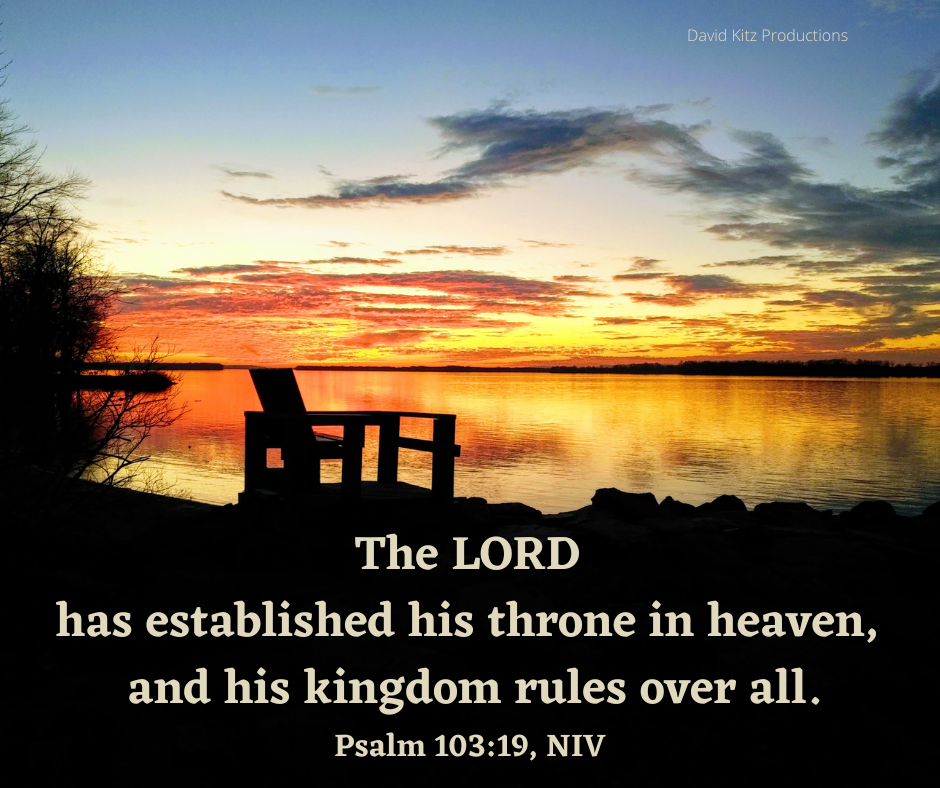
But Martin Rinkart the hymnist, and David the psalmist, knew the true God, a god who exists beyond our narrow definitions of order and control. Both these men knew the LORD of all the earth. Here in Psalm 103, David declared, “The LORD has established his throne in the heavens, and his kingdom rules over all.”

That divine rule, and that eternal kingdom, truly encompasses all, including disasters. Yes, He is LORD over disasters too, over war, over hurricanes, over floods and droughts, over both feasts and famines, joys and sorrows. He is LORD of all.

This declaration of God’s kingdom rule collides head on with my own preconceived notions of how the world should be. In my world death should never steal a friend away. In my world abundance should be a preordained right. In my world sickness should have no foothold, cancer should hold no sway. In my world all stories should have happy endings.

I want an ideal world like that. I want the real world to conform to my desired ends. And when God does not meekly comply, by granting me my ideal vision of the world, I stamp my foot and shake my fist at Him. In reality, when I do that, I am announcing that I want to be God. I want to be LORD. A refusal to bow in worship before God, is a declaration of my desire to be the sole ruler of my life, and the Creator my own world apart from God.

In a world run amok, Martin Rinkart did not stamp his foot and shake his fist at God; he lifted his voice in praise. Praise to God in the midst of tragedy aligns us afresh with the LORD of the universe. It re-establishes and reasserts his direct rule over us. Along with David we declared, “The LORD has established his throne in the heavens, and his kingdom rules over all.”

God in His wisdom has not given me my ideal world. He has given me His world—the real world—where sorrow mingles with joy, where the curse and the blessing of Eden coexist, where life and death dance nimbly together.

Man praying to God.

Prayer is my attempt before God to change this present world. And this world is in desperate need of change. God and I are in agreement on that point. That’s why He sent His Son. The world can be changed by God through prayer. What an astonishing truth! My prayers can change the world. God can as a consequence of my prayers, intervene and stunningly alter the natural course of events. I have seen Him do astonishing miracles. He is after all, who says He is. He is LORD.

But if God does not intervene, if my prayers are not answered, if no miracle comes, He is still LORD. He is still to be praised. This inalterable fact remains, “The LORD has established his throne in the heavens, and his kingdom rules over all.”

After 4,000 funerals, after his hopes and dreams lay buried, for Martin Rinkart, God was still God. He was still LORD over all. He was still worthy of all praise and so he wrote:

            O may this bounteous God 
            Through all our life be near us,
            With ever joyful hearts
            And blessed peace to cheer us;
            And keep us in his grace,
            And guide us when perplexed,
            And free us from all ills
            In this world and the next.[1]

How shallow is your praise? Do you believe your world needs to be right before you praise God? Lift up your eyes for a moment. Lift them to the One, who was lifted up for you. Lift your eyes to the Father, who did not spare His Son, but sent him into a messed-up world to die upon a cross. Fix your eyes on Him, the bloodied fount of redemption. Fix your eyes on the one who said, “I am the way, the truth and the life” (John 14:6).

Then, lift your voice in praise to God.
How shallow is your praise? Do you believe you need to feel right in order to praise right? After all, wouldn’t we be hypocritical if we were outwardly exuberant in praise to God, but our heart was not in it? Now in this instance, when we are speaking of our heart, we really mean our feelings. But if we see praise as a biblical command, our feelings are inconsequential. We are to praise God regardless of our feelings. Feelings come and go, but the goodness of God stands secure and unchanging. 

As residents of North America, we are a pampered lot. We live in affluence, materially rich, but mired in deep spiritual poverty. Gratification must be instant. Personal comfort trumps all other considerations. What do we know of hardship? In this sheltered atmosphere, praise for God grows like a spindly hothouse plant. Untested by hardship or the cold winds of adversity, our faith lacks depth. Our worship remains shallow.

If the music isn’t right on Sunday, we are incapable of praise. What an outrageous affront to God! True worship is so much more than a lip-synced ditty. It goes deeper. It flows higher. It breaks through our emotional indifference and reaches the heart of God.

The deepest praise is sacrificial. It floats heavenward on a sea of suffering. It confounds all logic and rises above whim or emotion.

Through Jesus, therefore, let us continually offer to God a sacrifice of praise—the fruit of lips that confess his name (Hebrews 13:15).

True worship is born of the Spirit. Along with David, it invites all of heaven—all of creation to join in the chorus of praise.

Praise the LORD you his angels, you mighty ones who do his bidding, who obey his word. Praise the LORD all his heavenly hosts, you his servants who do his will. Praise the LORD, all his works everywhere in his dominion. Praise the LORD, O my soul!  

Bringing Life to the Psalms

  1. What does it mean to offer a sacrifice of praise? Have you faced times of hardship when you found it difficult to praise God? Were you able to offer praise?
  2. Read a biographical portrait of Martin Rinkart. There are several internet sites that provide a closer look at this man who knew how to praise God through adversity.
  3. Read or sing Rinkart’s great hymn, Now Thank we all our God. It’s a wonderful way to set free the wellspring of praise within you.
  1. Reread Psalm 103. Is it a hamburger, an express train, or both? Can you think of another metaphor that helps our minds to capture the magnificence of this psalm? What is God saying to you as you read this psalm?

[1] Now Thank We All Our God, words by Martin Rinkart (1586-1649), 1636. Translated by Catherine Winkworth (1827-1878), 1858 MIDI: Nun danket alle Gott (later form of melody by Johann Cruger, (1598-1662).


Today’s post is Chapter 17 from the book Psalms A
live! Connecting Heaven & Earth by David Kitz. To find out more or purchase click here.
 

A Healthy Dose of Godly Fear

03 Tuesday Jun 2025

Posted by davidkitz in Psalm 111

≈ Leave a comment

Tags

Bible, consequences of sin, faith, fearing God, God, godly fear, holy, Jesus, Old Testament, Prayer, Psalms, Ten Commandments, the LORD

Today’s Devotion from Psalms 365 by David Kitz

Reading: Psalm 111

Praise the LORD!
I will give thanks to the L
ORD with my whole heart,
    in the company of the upright, in the congregation.
Great are the works of the L
ORD, studied by all who delight in them.
Full of honor and majesty is his work,
    and his righteousness endures forever.
He has gained renown by his wonderful deeds;
    the L
ORD is gracious and merciful.
He provides food for those who fear him; he is ever mindful of his covenant.
He has shown his people the power of his works,
    in giving them the heritage of the nations.
The works of his hands are faithful and just; all his precepts are trustworthy.
They are established forever and ever,
    to be performed with faithfulness and uprightness.
He sent redemption to his people; he has commanded his covenant forever.
    Holy and awesome is his name.
The fear of the L
ORD is the beginning of wisdom;
    all those who practice it have a good understanding.
    His praise endures forever
(NIV). *

The eyes of the LORD are on those who fear him — photo by David Kitz

Reflection
If the beginning of wisdom is the fear of the LORD, what is the end point or objective of this inducement to wisdom? I have often heard it argued that the fear of the LORD, which is frequently extolled in the Old Testament, has little to do with the common meaning for fear. We are to reverence or be in awe of the LORD, not be afraid of Him. To an extent this is true; however, I suspect we often push this fearless approach to God too far. The Lion of the Tribe of Judah is not toothless. He has claws.

A healthy dose of godly fear can prevent a massive case of sin enslavement and heartache.

The reaction of God’s people when the Ten Commandments were given at Mount Sinai is well worth noting. When the people saw the thunder and lightning and heard the trumpet and saw the mountain in smoke, they trembled with fear. They stayed at a distance and said to Moses, “Speak to us yourself and we will listen. But do not have God speak to us or we will die” (Exodus 20:18-19).

The very human fear expressed in this Exodus passage went well beyond a sense of awe and wonder. This was knee-buckling, heart-racing fear—the kind of fear that makes us dread doing anything that might offend this all-knowing, all-seeing, holy God. That’s a healthy fear—a fear that helps us to live and walk straight. Why would God want to induce this kind of fear?

God wants us to fear Him because He loves us. He wants to spare us from the agony of the terrible consequences of sin. A healthy fear of God leads us to an awe-induced love for Him. Now that’s wisdom.

Response: Father God, help me see your love for me in your commandments. In love, you correct me when I stray. Grant me understanding that comes through a healthy fear and love for you. Amen.

Your Turn: What does fearing God mean to you? Is God your chum, your friend, or your master?

Para la publicación de Salmos 365 de hoy en español haga clic aquí.

bgbg_v4.3_1501818
* NEW INTERNATIONAL VERSION, COPYRIGHT ©1973, 1978, 1984, 2011 BY BIBLICA

Please pray for peace to return to Israel, Gaza, and Ukraine!

Volume I of Psalms 365: Develop a Life of Worship and Prayer won the Best Book of the Year Award from The Word Guild and Volume II has won the Best Devotional of the Year Award. For those who love God’s word, this three-book series is an ideal way to daily meet with the Lord. To purchase or for a closer look click here.

A gripping read from David Kitz.
Is a return-to-Jesus revival possible in our time?

This book points the way forward.
For details click here.

Light Shines on the Righteous

01 Sunday Jun 2025

Posted by davidkitz in Psalm 97

≈ Leave a comment

Tags

Bible, hate evil, love the LORD, praise the LORD, Psalm 97, the LORD, the righteous, Zion

I will praise the LORD!

Even in darkness light dawns for the upright — photo by David Kitz

Psalm 97:8-12

Zion hears and rejoices
    and the villages of Judah are glad
    because of your judgments, LORD.
For you, LORD, are the Most High over all the earth;
    you are exalted far above all gods.
Let those who love the LORD hate evil,
    for he guards the lives of his faithful ones
    and delivers them from the hand of the wicked.
Light shines on the righteous
    and joy on the upright in heart.
Rejoice in the LORD, you who are righteous,
    and praise his holy name.
*

Para la publicación de Salmos 365 de hoy en español haga clic aquí.

bgbg_v4.3_1501818
* NEW INTERNATIONAL VERSION, COPYRIGHT ©1973, 1978, 1984, 2011 BY BIBLICA

Please pray for peace to return to Israel, Gaza, and Ukraine!

Volume I of Psalms 365: Develop a Life of Worship and Prayer won the Best Book of the Year Award from The Word Guild and Volume II has won the Best Devotional of the Year Award. For those who love God’s word, this three-book series is an ideal way to daily meet with the Lord. To purchase or for a closer look click here.

A gripping read from David Kitz.
Is a return-to-Jesus revival possible in our time?
This book points the way forward.
For details click here.

← Older posts
Newer posts →

Psalms 365: Develop a Life of Worship & Prayer

Psalms 365 Volume II

Psalms 365 vol 3
— Psalms 365 Volume III

Now available:

Psalms

Recent posts

  • The Land is Satisfied September 25, 2026
  • Divorce September 24, 2026
  • Clothed with Splendor and Majesty September 24, 2026
  • Causing to Stumble September 23, 2026
  • Robot Worshippers September 23, 2026
  • Whoever Is Not Against Us Is for Us September 22, 2026
  • Dust the LORD Loves September 22, 2026

Calendar

September 2026
M T W T F S S
 123456
78910111213
14151617181920
21222324252627
282930  
« Aug    

Blog Posts

Comments

  • davidkitz on Divorce
  • davidkitz on Divorce
  • Eileen Guyadeen on Divorce

Blog at WordPress.com.

Privacy & Cookies: This site uses cookies. By continuing to use this website, you agree to their use.
To find out more, including how to control cookies, see here: Cookie Policy
  • Subscribe Subscribed
    I love the Psalms
    Join 1,357 other subscribers

    Have a WordPress.com account? Log in now.

  • I love the Psalms
    View site in Reader
    Manage subscriptionsSign upLog in
    Report this content
    Collapse this bar
Loading Comments...