• Home
  • About
  • DavidKitz.ca
  • Youtube Videos
  • Books by David
  • Books on Amazon.com

I love the Psalms

~ Connecting daily with God through the Psalms

I love the Psalms

Tag Archives: Moses

The Return of the Dynamic Duo

28 Sunday Sep 2025

Posted by davidkitz in The Elisha Code

≈ Leave a comment

Tags

Bible, born again, David Kitz, Elijah, Elisha, gospel, Jesus, Jewish heritage, John the Baptist, Kingdom of God, Moses, repentance, salvation, the LORD, theology

When they had crossed, Elijah said to Elisha,
“Tell me, what can I do for you before I am taken from you?”

“Let me inherit a double portion of your spirit,” Elisha replied.

“You have asked a difficult thing,” Elijah said,
“yet if you see me when I am taken from you, it will be yours—
otherwise, it will not.”
(2 Kings 2:9-10, NIV)

The more things change, the more they stay the same.[i] This common expression captures within it the seed truth that history tends to repeat itself. Human nature, social norms and patterns of behavior stay the same across the continuum of time and space. Consequently, though the individual players, time, and location may differ, outcomes frequently are the same or fall into a familiar pattern. For this very reason, Bible stories remain relevant today, despite being written ages ago to people of a different language and culture.  
            In today’s culture when we use the term dynamic duo, several pictures, or scenarios immediately spring to mind. Batman and Robin from DC Comics popularized the term, but throughout history, and within our own experience we have all encountered dynamic duos—individuals who work together well to accomplish a common purpose.
           Can we identify dynamic duos in the Old Testament? We certainly can. Moses and his young successor Joshua spring to mind.
            The prophets Elijah and Elisha are a dynamic duo whose miraculous powers and exploits rival the adventures of the finest superheroes in the Marvel Universe. First-century Jewish teens reading accounts of their miraculous feats would be immediately drawn to them. Furthermore, the last book of the Old Testament ends with the promise of Elijah’s return.    

“See, I will send the prophet Elijah to you before that great and dreadful day of the Lord comes. He will turn the hearts of the parents to their children, and the hearts of the children to their parents; or else I will come and strike the land with total destruction” (Malachi 4:5-6, NIV).

            And if Elijah is returning, then Elisha, or an Elisha-like figure cannot be far behind. As the New Testament era dawns, the stage is set for the return of the dynamic duo. There is nothing quite like a sequel. In this case it’s a prophetic, dynamic-duo sequel that returns after an absence of about seven centuries. Imagine the anticipation.
           Is it any wonder then that Elijah’s name appears twenty-eight times in the gospels? Aside from Peter, none of the apostles are named as frequently as Elijah. It is quite extraordinary for a hero from a previous era to be referenced so frequently. Yet the expectation of Elijah’s arrival was palpable. Jesus was often incorrectly identified as the Elijah who is to come.[ii] With the start of Christ’s ministry, and his demonstration of miraculous powers, the burning question within the first-century Jewish community was “Has Elijah returned?”
             In the eleventh chapter of Matthew’s Gospel answers that question directly. He identifies who the new Elijah—the second Elijah really is.

           And when John had heard in prison about the works of Christ, he sent two of his disciples and said to Him, “Are You the Coming One, or do we look for another?”
          Jesus answered and said to them, “Go and tell John the things which you hear and see: The blind see and the lame walk; the lepers are cleansed and the deaf hear; the dead are raised up and the poor have the gospel preached to them. And blessed is he who is not offended because of Me.”
          As they departed, Jesus began to say to the multitudes concerning John: “What did you go out into the wilderness to see? A reed shaken by the wind? But what did you go out to see? A man clothed in soft garments? Indeed, those who wear soft clothing are in kings’ houses. But what did you go out to see? A prophet? Yes, I say to you, and more than a prophet. For this is he of whom it is written:
                    ‘Behold, I send My messenger before Your face,
                    Who will prepare Your way before You.’
          “Assuredly, I say to you, among those born of women there has not risen one greater than John the Baptist; but he who is least in the kingdom of heaven is greater than he. And from the days of John the Baptist until now the kingdom of heaven suffers violence, and the violent take it by force. For all the prophets and the law prophesied until John. And if you are willing to receive it, he is Elijah who is to come. He who has ears to hear, let him hear!
(Matthew 11:2-15, NKJV)

          So, there we have the answer to the question on everyone’s mind at that time. John the Baptist is Elijah who is to come. The first member of the New Testament dynamic duo has been identified.    

What does Jesus’ identification of John the Baptist as the new Elijah really mean?

It does not mean John is the reincarnation of Elijah. Elijah’s body was whisked away to heaven in a whirlwind on a chariot of fire.[iii] Centuries later, he returns with Moses to meet with Jesus on the Mount of Transfiguration.[iv]

Chapel of the Transfiguration, Grand Teton National Park — Photo courtesy of Matthew Taylor

            Clearly, John and Elijah are two distinct persons from two distinct historical eras. In fact, when he was questioned about his identity, John denied being the Christ or Elijah.[v] However, Jesus rightly identified John the Baptist as moving and ministering in the spirit of Elijah. He fulfilled the prophecy of Malachi.[vi]
            Elijah’s ministry was a ministry of repentance. His assignment from the LORD was to draw the backslidden people of Israel (the northern kingdom) back to worshipping the one true God. Israel had fallen into the grievous sin of idolatry under the rule of King Ahab and his evil consort Jezebel. Many had bowed their knees to Baal, the male fertility god, and partaken in the worship of the female deity Ashtoreth.
            John the Baptist had a similar assignment. He too was to draw the Jewish nation back to God. But in the New Testament era, the sins of the nation were of a more subtle nature. The worship of Yahweh had become cold and formal while the sinful heart was unchanged.

The Lord says:
“These people come near to me with their mouth
    and honor me with their lips,
    but their hearts are far from me.
Their worship of me is based on merely human rules they have been taught
(Isaiah 29:13, NIV).

This corrupt condition of the heart is what John came to address. He did so with a clarion call to repentance followed by baptism. Furthermore, he insisted no one can claim safety from the coming wrath due to their lineage or national heritage.

Produce fruit in keeping with repentance. And do not think you can say to yourselves, ‘We have Abraham as our father.’ I tell you that out of these stones God can raise up children for Abraham. The ax is already at the root of the trees, and every tree that does not produce good fruit will be cut down and thrown into the fire. (Matthew 3:8-10, NIV).

          What root was John attacking with the above statement? He was hacking away at the presumption of salvation by virtue of national origin. The Sadducees and Pharisees who John was addressing trusted in their Jewish heritage as being sufficient for eternal salvation. Apparently, your birth certificate doesn’t qualify you for entrance into the Kingdom of God. God is looking for a repentant heart—a changed heart. 
                With these words, John was laying the groundwork for Jesus’ core message of salvation through regeneration. We must be born again as Jesus revealed in his conversation with Nicodemus.[vii] And the first step in that regenerative process begins with repentance, initially championed by John,[viii] reiterated by Jesus,[ix] and preached by the apostles.[x]
                Today, we speak of disruptive technology changing the way business and society operate. John’s message was disruptive theology. His message attempted to completely change how Jewish society of that time viewed their relationship with God. Many Jewish people saw themselves as citizens in God’s Kingdom simply because they were children of Abraham. John’s mission was to shatter that misperception. Something more was needed then, and it is needed now. Salvation begins with a repentant heart. And like Elijah of old, John was calling the nation to repent and turn back to God.
                Jesus addressed the same topic in his John 8:12-59 temple discourse with the Jewish religious leadership. In that heated discussion, Jesus’ opponents trumpeted their Abrahamic pedigree, while rejecting the testimony of the Son of God. God is always looking for the fruits of repentance in our lives. But there was an absence of fruit in these religious leaders.
                It was John the Baptist who first raised this issue with the Pharisees and Sadducees. If we are not simply born into the Kingdom by natural birth, as the religious leadership claimed, how then do we gain entrance? Jesus provides the answer:

          “Very truly I tell you, no one can enter the kingdom of God unless they are born of water and the Spirit. Flesh gives birth to flesh, but the Spirit gives birth to spirit. You should not be surprised at my saying, ‘You must be born again’ (John 3:5-7, NIV).

                This disruptive theology was introduced by John and advanced to the next level through the ministry of Jesus. John and Jesus truly worked as a dynamic duo. Furthermore, all four Gospel writers recognized John’s foundational contribution. It’s striking that though each Gospel is focused on the life and ministry of Jesus, none of the Gospel writers begin their account with Jesus. They all begin with John. He truly was the forerunner and the way-maker for our Savior.
                Many of the underpinnings of the Christian faith were introduced by John. Repentance followed by baptism is a prime example. Baptism, with roots in the Jewish mikvah, a ceremonial washing rooted in the Books of Moses, was an innovation introduced and popularized by John. Baptism represents a soul transforming innovation that was, with only slight modification, incorporated directly into Christ’s teaching and the Great Commission.

           Go therefore and make disciples of all the nations, baptizing them in the name of the Father and of the Son and of the Holy Spirit, teaching them to observe all things that I have commanded you; and lo, I am with you always, even to the end of the age.” Amen. (Matthew 28:19-20, NKJV).

                Baptism is a living picture of new birth. It is the defining symbol and sacrament of the born-again experience. John laid the groundwork for the gospel of Christ. He worked like a bulldozer leveling the way for Christ.[xi] He destroyed the argument that salvation was race based and in so doing he paved the way for Jesus’ teaching on spiritual rebirth.
                It logically follows that if salvation is not based on lineage or race, but rather on a spiritual rebirth, then that experience of rebirth is open to all humanity and not the sole domain of the Jewish people.
                Both John and Jesus were looking for fruit—the transformative fruit of repentance.[xii] And through the work of the Holy Spirit, that fruit could be found among both Jews and Gentiles. It was no longer confined to the Jewish nation. All could potentially be grafted into the vine through faith in Jesus.
                Jesus identified John the Baptist as the new Elijah. Who then is the new Elisha?

Chapter 2 Endnotes
[i] “plus ça change, plus c’est la même chose”, Jean-Baptiste Alphonse Karr, 1849. 

[ii] Matthew 16:13-14

[iii] 2 Kings 2:11-12

[iv] Matthew 17:1-13, Mark 9:2-13, Luke 9:28-36

[v] John 1:19-28

[vi] “See, I will send the prophet Elijah to you before that great and dreadful day of the Lord comes. He will turn the hearts of the parents to their children, and the hearts of the children to their parents; or else I will come and strike the land with total destruction” (Malachi 4:5-6, NIV).

[vii] John 3:1-21

[viii] Matthew 3:1-2, Mark 1:4, Luke 3:2-3,

[ix] Matthew 4:17, Mark 1:14-15

[x] Acts 2:36-39, Acts 3:19

[xi] Matthew 3:3

[xii] Matthew 3:8, Matthew 7:15-20, Matthew 21:33-46

This is the fourth weekly excerpt from the award-winning book 
The Elisha Code & the Coming Revival 

A soul-gripping read.
Is a return-to-Jesus revival possible in our time?
This book points the way forward.
For details click here.

A Superior Covenant

13 Wednesday Aug 2025

Posted by davidkitz in Psalm 132, Psalms

≈ Leave a comment

Tags

Bible, covenant, God's covenant, heaven, Jesus, King David, King Jesus, mediator, Moses, promises, Psalms, worship

Today’s quote and prayer from
“Psalms 365: Develop a Life of Worship and Prayer”
by David Kitz

Reading: Psalm 132:11-18

Father God,
 I thank you for your son, Jesus.
He is the descendant of King David
who fulfilled your covenant
and now he reigns forever.
King Jesus,
I am your servant.
Reign in my life today.
Amen.

— — — —

They serve at a sanctuary that is a copy
and shadow of what is in heaven.
This is why Moses was warned
when he was about to build the tabernacle:
“See to it that you make everything
according to the pattern shown you on the mountain.”

But in fact the ministry Jesus has received
is as superior to theirs
as the covenant of which he is mediator
is superior to the old one,
since the new covenant is established
on better promises.
(Hebrews 8:5-6 NIV
)*

Para la publicación de Salmos 365 de hoy en español haga clic aquí.

bgbg_v4.3_1501818
* NEW INTERNATIONAL VERSION, COPYRIGHT ©1973, 1978, 1984, 2011 BY BIBLICA

Please pray for peace to return to Israel, Gaza, Iran, and Ukraine!

Volume I of Psalms 365: Develop a Life of Worship and Prayer won the Best Book of the Year Award from The Word Guild and Volume II has won the Best Devotional of the Year Award. For those who love God’s word, this three-book series is an ideal way to daily meet with the Lord. To purchase or for a closer look click here.

A gripping read from David Kitz.
Is a return-to-Jesus revival possible in our time?
This book points the way forward.

Whoever Is for the LORD

29 Tuesday Jul 2025

Posted by davidkitz in Psalm 124

≈ Leave a comment

Tags

Aaron, Bible, confession, Moses, Prayer, Psalms, redeemed, thankful, the LORD

Today’s quote and prayer from
“Psalms 365: Develop a Life of Worship and Prayer”
by David Kitz.


Reading: Psalm 124

Father God,
 I am so thankful
that you are on my side,
on the side of your redeemed people.
This is my confession:
Our help is in the name of the LORD,
the Maker of heaven and earth.

Amen.

— — — —

Moses saw that the people were running wild
and that Aaron had let them get out of control
and so become a laughingstock to their enemies.
So he stood at the entrance to the camp
and said,
“Whoever is for the LORD,
come to me.”
And all the Levites rallied to him.
(Exodus 32:25-26
NIV)*

Para la publicación de Salmos 365 de hoy en español haga clic aquí.

bgbg_v4.3_1501818
* NEW INTERNATIONAL VERSION, COPYRIGHT ©1973, 1978, 1984, 2011 BY BIBLICA

Please pray for peace to return to Israel, Gaza, Iran, and Ukraine!

Volume I of Psalms 365: Develop a Life of Worship and Prayer won the Best Book of the Year Award from The Word Guild and Volume II has won the Best Devotional of the Year Award. For those who love God’s word, this three-book series is an ideal way to daily meet with the Lord. To purchase or for a closer look click here.

A gripping read from David Kitz.
Is a return-to-Jesus revival possible in our time?
This book points the way forward.

The Miraculous Conundrum

20 Sunday Jul 2025

Posted by davidkitz in Psalms, Psalms Alive!

≈ Leave a comment

Tags

Bible, deliverance, Egyptians, Exodus, Israel, Jesus, miracles, miraculous powers, Moses, Psalms, salvation, the LORD, wonders

Psalm 114:5-8

Why was it, O sea, that you fled,
O Jordan, that you turned back,
you mountains, that you skipped like rams,
you hills like lambs?
Tremble, O earth, at the presence of the LORD,
at the presence of the God of Jacob,
who turned the rock into a pool,
the hard rock into springs of water.

“Why, Daddy? Why?” A four-year-old’s favourite question is, “Why?”

And why wouldn’t it be? A four-year-old is living in the age of discovery. Everything is new; everything is calling out to be discovered. Exploration is the activity of the day. And always the question asked is, “Why?”

“Why is the sky blue? Why do girls wear dresses? Why did that egg break? Why?”

Photo by Emma Bauso on Pexels.com

Here in Psalm 114, the psalmist has some why questions as well. “Why did the sea flee? Why did the Jordan River turn back? Why did those mountains and hills seem to skip and dance? Why?”

Why, indeed?

The answer of course is because of the jaw-dropping, eye-popping, heart-stopping power of God. God caused the sea to flee. He caused the Jordan to turn back. He caused mountains and hills to skip about and frolic like yearling lambs set free from the stall. What an awesome display!

What an awesome God!

Psalm 114 is all about the overwhelming power of God. It is a grand portrayal of the pivotal event in the Old Testament Scriptures. Here within a few short verses, we catch a panoramic view of God’s might on display, starting with Israel’s escape from Egypt to their arrival in the Promised Land. Our miracle-working God puts on a magnificent show. What an exhibition!

In the preview to this main event, the LORD, the God of Jacob, humiliated the gods of Egypt. The ten plagues devastated the land. The Nile turned to blood. The source of life for the nation became a stench—a source of death. Every plague crippled the pride of Egypt. Each one struck down a ruler of darkness from the nation’s demonic pantheon. The plagues left no doubt as to who was in charge—who was the Lord over Egypt. The LORD God was Lord. Pharaoh and his wizards were powerless before this wonder-working God of Israel.

But the LORD was not finished with the ten plagues. This was only the preliminary round—the warm-up. The main event was still to come.

With Pharaoh’s army in hot pursuit, Moses stretched out his staff, and the sea fled. A path was opened through the deep, and the children of Israel made good their escape. When the army of Pharaoh continued the chase across the seabed, the LORD threw them into confusion.

The water flowed back and covered the chariots and horsemen—the entire army   of Pharaoh that had followed the Israelites into the sea. Not one of them survived. But the Israelites went through the sea on dry ground, with a wall of water on their right and on their left. (Exodus 14:28-29)

Photo by Pixabay on Pexels.com

What an awesome display of power! Aside from the miracle of creation, this Old Testament miracle is viewed as the measuring rod—the gold standard—by which all other supernatural events are compared. In the Hebrew Scriptures, this event has no comparison; it is unparalleled. The whole nation saw this. They experienced this supernatural phenomenon. God confounded nature. Water formed a wall. The Almighty suspended what we call normal.

Why was it, O sea, that you fled?

 The immediate answer to this question is simple, yet profound. The sea fled because of the power of God. In exultation Moses boasts,

“Your right hand, O LORD, was majestic in power. Your right hand, O LORD, shattered the enemy. By the blast of your nostrils the waters piled up. The surging waters stood firm like a wall; the deep waters congealed in the heart of the sea. Who among the gods is like you, O LORD? Who is like you—majestic in holiness, awesome in glory, working wonders?” (Exodus 15:6, 8, 11).

But why did the miracle-working LORD make the sea flee? Was it simply to display His awe-inspiring power? Was it simply to create a bit of excitement among the million or more mortals, who were eyewitnesses to this divine wonder?

In the Exodus account, the reason for this miraculous intervention is stated very clearly. Here then is the reason for this display of raw power:

That day the LORD saved Israel from the hand of the Egyptians, and Israel saw the Egyptians lying dead on the shore. And when the Israelites saw the great power of the LORD displayed against the Egyptians, the people feared the LORD and put their trust in him and in Moses his servant. (Exodus 14:30-31)

My Lighthouse in the Storm – photo by Eric E. Wright

This power display had one primary purpose. That purpose was salvation. The LORD wanted to save people—His covenant people—from the vicious clutches of oppression and a tyranny. In short, the LORD works wonders so that He can save people—so He can bring them into His Kingdom—so they can escape the sin systems of this world and come under His loving rule.

So why did the sea flee? The LORD sent the sea fleeing so that He could save people.

But from the above passage in Exodus, we can see that this miraculous intervention had two secondary effects. It caused people to stand in awe of the LORD, and it prompted them to put their trust in Him and His servant Moses. Suddenly, the LORD had everyone’s attention. It was impossible to deny the existence of this wonder-working God. Everyone in Israel saw and experienced this fear-prompting miracle. Furthermore, for every Israelite, the message in the miracle was crystal clear. God is all-powerful. And this awe-evoking God truly cares about me. The LORD cares so much that for a brief time, He suspended the laws of nature so that I could walk free.

What an awesome God! What a loving God! Is it any wonder then that the people put their trust in the LORD? They saw His divine character displayed. They were not just witnesses to His power. They were recipients of His love and mercy. God intervened into the affairs of a nation, Egypt, the ancient superpower, to bring them to the point of freedom. Then God intervened into the course of nature. He parted the sea to bring them to full liberty. What a deliverance! What a wonderful God!

“Why was it, O sea, that you fled, O Jordan, that you turned back, you mountains, that you skipped like rams, you hills like lambs?”

On the day of their deliverance, for the common Hebrew the answer to this question would read something like this. “God worked wonders to save me. He made the sea flee just for me. That’s why all this happened!”

That was the testimony of every slave who walked out of Egypt. And that same God works wonders today for the same reason—to save people and to bring them “out of darkness into his marvellous light” (1 Peter 2:9).

Photo by Hernan Pauccara on Pexels.com

God works wonders; He works wonders today. But for me, there was a time when this miracle-working power of God was a huge stumbling block. For some people faith seems to come easily or naturally. They read God’s word and readily believe it; they hear the preacher and believe the message he brings. But as a young person, for me just the opposite was true. I was born with the mind of a sceptic. Reading Biblical accounts of miracles did not inspire faith. These stories raised all kinds of questions and doubts. If there was one disciple I could identify with, it was Thomas. We had a similar world view.

So, you say God works miracles. Don’t tell me. Show me. That was my attitude. Though I had read the entire Bible by age eleven, I had a difficult time believing it. It simply did not align with the world as I saw and experienced it. Miracles did not occur in my world. Why should I believe they happened two thousand years ago? That was my line of reasoning in my teen years, and even now I see this as a perfectly logical position for an unbeliever to take.

When I talked to adults or church leaders about this question of miracles, they would brush off my doubts with a blithe remark about how miracles happened back then, in Bible times, but they did not happen anymore. This did nothing to set my sceptic’s mind at ease. If miracles happened then, why didn’t they happen now? If God never changes and if “Jesus Christ is the same yesterday, today and forever” (Hebrews 13:8), then it logically follows that the supernatural should be happening today, unless of course, the biblical miracles never happened in the first place.

I found myself in a miraculous conundrum. Did they happen, or did they not? Should I believe the Bible or not? I wavered on this question for quite some time. In the end I resolved to believe, not because of evidence, but because of love. I found the love of Christ as displayed on the cross too compelling. It was too overwhelming to walk away from. I decided to believe because I loved the story of His great love. He gripped me at the cross. With nail-pinned hands, he took hold of me. I decided to believe.

In my teen years, the decision was finally made. I would follow Him, but the miraculous conundrum remained. The dispensational position on miracles made no sense to me. Why would miracles take place back then, but not now? Why? Why indeed?

We settle on second best, if our faith rests solely on a decision. Decisions can change. Doubts can assail. The human mind is fickle, easily swayed by this or that argument. Inwardly I longed for a firmer foundation, one based on hard evidence and a rock-solid conviction. There is a substantial difference between believing and knowing. I longed to know God, not just believe in His existence.

Fortunately, we serve a living God, who responds to the cry of our heart. If we seek after Him, He will respond. We have the sure promise of His word on that point.

“‘You will seek me and find me when you seek me with all your heart. I will be found by you,’ declares the LORD.” (Jeremiah 29:13-14)

And when we find the LORD, we find the God of power. The LORD responded to Jeremiah’s questioning mind with this statement, “I am the LORD, the God of all mankind. Is anything too hard for me?” (Jeremiah 32:27)

Of course, nothing is too hard for the LORD. He can send the sea fleeing. If you are earnest in seeking Him, and you want evidence of his existence, He will supply it. If in humility you seek a demonstration of His power, He is not weak. He will answer. In fact, he longs to fill His disciples with power—power that will strengthen our witness and bring others to salvation. Again, we have Jesus sure promise on that point.

“But you will receive power when the Holy Spirit comes on you; and you will be my witnesses in Jerusalem, and all Judea and Samaria, and to the ends of the earth.” (Acts 1:8)

The miracle working power of God resides in the Holy Spirit, and when as a young man I experienced a personal Pentecost, something very transformational happened inside me. In an instant I moved from believing in God to knowing God. For me the evidence was in, and a rock-solid conviction stood where my uncertain faith had formerly rested. I knew Jesus was alive. He sent His Spirit to affirm my faith.

Photo by Vlad Cheu021ban on Pexels.com

The wonder-working power of God will do that. Doubters are silenced when God shows up. And yes, miracles have followed. On several occasions, I have experienced divine healing, supernatural guidance, and best of all I have been empowered to be His witness. The miracle of salvation has come to others. And this miracle-working God is not finished yet. What He began in Egypt, He will complete in the Promised Land. As He turned back the Jordan for Israel, He will turn back the Jordan for me as well. He welcomes his people home. He is my provision and my provider for the journey, even as He was for Israel, and He will be for your provision and your provider as well.

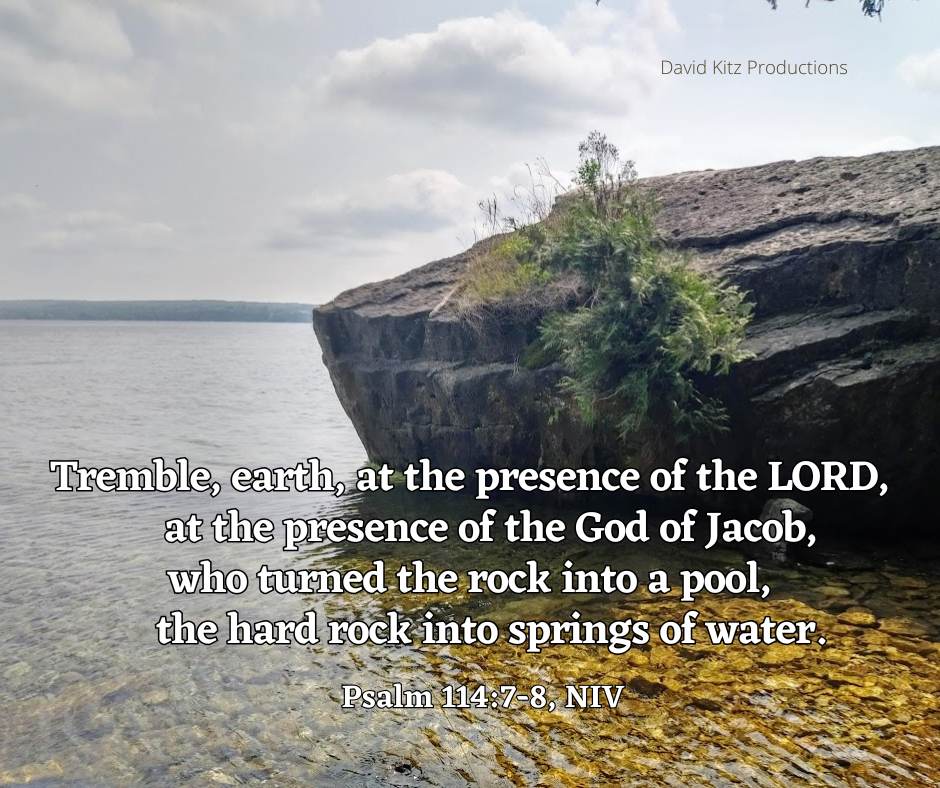
Tremble, O earth, at the presence of the LORD, at the presence of the God of Jacob, who turned the rock into a pool, the hard rock into springs of water.

Over the years this bit of earth in human skin has had many occasions to tremble before the presence of the LORD. He is my provision for the journey even when the way is hard. By His Holy Spirit, He turns the barren rock into pools of refreshing. In the desert He is my spring of living water.

Even today Jesus calls out, “‘If a man is thirsty, let him come to me and drink. Whoever believes in me, as the Scripture has said, streams of living water will flow from him.’ By this he meant the Spirit, whom those who believed in him would later receive.” (John 7:37-39)

Jesus, the miracle worker, calls us to the source of power. Now what about you? What sea lies before you, blocking your way? Does your God still work miracles? Let’s watch that sea flee.

Bringing Life to the Psalms

  1. God affirms our faith in Him with signs following. Read Mark 16:14-20. Have you experienced God’s miracle working power in your life? Have you seen it in others? Many believers have a strong faith without experiencing sign and wonders. Yet others will not believe in God unless the miraculous occurs. How do you account for this difference?
  2. “Now to each one the manifestation of the Spirit is given for the common good” (1 Corinthians 12:7). How has God manifested the Holy Spirit’s presence in your life?
  3. Is your faith decision-based or conviction-based? Are you convinced in your faith, or do you still experience doubts? Remember God loves skeptics too. Have you experienced a transition from believing to knowing? Is this a valid way to look at the faith journey?
  4. Reread Psalm 114. What is God saying to you by His Spirit through this psalm?

Today’s post is Chapter 21 from the book Psalms Alive! Connecting Heaven & Earth by David Kitz. To find out more or purchase click here.


He Removed Our Transgressions

19 Saturday Jul 2025

Posted by davidkitz in Psalm 103

≈ 2 Comments

Tags

compassionate, forgiveness of sins, Moses, Psalms, Righteousness, slow to anger, the LORD, undeserved grace

I will praise the LORD!

As far as the east is from the west — Photo by David Kitz

Psalm 103:6-12

The LORD works righteousness
    and justice for all the oppressed.
He made known his ways to Moses,
    his deeds to the people of Israel:
The LORD is compassionate and gracious,
    slow to anger, abounding in love.
He will not always accuse,
    nor will he harbor his anger forever;
he does not treat us as our sins deserve
    or repay us according to our iniquities.
For as high as the heavens are above the earth,
    so great is his love for those who fear him;
as far as the east is from the west,
    so far has he removed our transgressions from us.
*

Para la publicación de Salmos 365 de hoy en español haga clic aquí.

bgbg_v4.3_1501818
* NEW INTERNATIONAL VERSION, COPYRIGHT ©1973, 1978, 1984, 2011 BY BIBLICA

Please pray for peace to return to Israel, Gaza, and Ukraine!

Volume I of Psalms 365: Develop a Life of Worship and Prayer won the Best Book of the Year Award from The Word Guild and Volume II has won the Best Devotional of the Year Award. For those who love God’s word, this three-book series is an ideal way to daily meet with the Lord. To purchase or for a closer look click here.

A gripping read from David Kitz.
Is a return-to-Jesus revival possible in our time?
This book points the way forward.
For details click here.

The Timing of God

13 Sunday Jul 2025

Posted by davidkitz in Psalms, Psalms Alive!

≈ Leave a comment

Tags

baptized, burning bush, dead men, Egypt, Egyptians, God, Moses, perfect timing, Peter, Psalms, Red Sea, the LORD, timing

Psalm 114:1-4

When Israel came out of Egypt,
the house of Jacob from a people of foreign tongue,
Judah became God’s sanctuary,
Israel his dominion.
The sea looked and fled,
the Jordan turned back;
The mountains skipped like rams,
the hills like lambs.

All day, I just wanted to get out. The park across the street beckoned. On sunny days it only seems natural to want to get outside—at least for part of the day. In January sunny warm days are a rarity in Ottawa, and this particular day was a real gem. There was no snow on the ground—an unheard-of phenomenon for this part of the country—at what is normally the coldest time of year. The thermometer was on the plus side of the ledger, and from dawn onward, warm sunshine was pouring down. Best of all, this January gem had landed on the weekend.

But a variety of chores and obligations kept me indoors. Finally at three thirty in the afternoon I was able to escape the confines of our home. But it was too late. Only moments before I stepped outside, the sun disappeared behind a thick cloud. Within an hour it sank below the horizon. My much-anticipated sunlit stroll through the park never happened. Actually, the stroll took place, but it transpired in an ever-deepening midwinter gloom.

Time works that way; it always works that way. If we don’t seize the moment, the moment escapes, never to be recaptured. We can try to make amends, or rearrange our schedule, but time is an unforgiving tyrant. It marches on, the sun sets. We will never have that day, hour, minute or moment again. We seize it or lose it. We catch the sun’s rays, when it shines, or we reap the gathering gloom.

Furthermore, events that occur in time can affect all of eternity. Catch the right moment and you change the course of the world. Seize the apex moment with God, and all of human history will be transformed. That familiar old maxim is true. Timing is everything

Here in Psalm 114 we find an apex moment. Moses seized that apex moment—the ideal instant in time—and as a consequence a nation was set free. Israel, the nation, was born in that apex moment.

“When Israel came out of Egypt, the house of Jacob from a people of foreign tongue, Judah became God’s sanctuary, Israel his dominion.”

Moses was first summoned by God at the burning bush, and despite his hesitance, he responded to the LORD’s call. His full obedience to that call resulted in his people’s deliverance from the yoke of cruel oppression. There was a perfect timing—a divine timing—in all this. Deliverance did not come a moment too soon or arrive a moment too late. The LORD is always right on time.

We are the ones who are impatient, who miss the moment, who come too early or show up too late. Young Moses suffered from this problem too. His timing was off. He harboured ambitions of delivering his people. He wanted to rescue them. And why not? He saw their desperate need. He wanted to help. He was both a son of Pharaoh’s daughter, and a son of Israel. Moses bridged these two communities. Surely, as a man of position and influence raised in Pharaoh’s household, he could use that influence to bring about change. But unfettered ambition can be impetuous. After murdering an Egyptian taskmaster, Moses fled in fear for his life.

The burning bush, Regina, SK — photo by David Kitz

Moses had jumped the gun. On his own strength, he had raced ahead of God. He was fuelled by good intentions, but his ill-conceived attempt at helping his people ended in disaster and disgrace. For forty years he lived as a guilt-ridden fugitive in the Desert of Sinai. His self-generated efforts were out of sync with God. Forty years is a long time. Sometimes it takes a long time to get right timing—to get into God’s timing.

Finally, when the time was right, it was God who got Moses. Now that is a strange reversal. Typically, we see a need, and we then go and enlist God to help us rectify the situation. But here it was God who initiated the project. This rescue mission was the LORD’s idea, and it would be done His way, on His timetable, under His leadership. The LORD made this perfectly clear in his introductory remarks to Moses at the burning bush. Speaking of the suffering Israelites He says, “I have come down to rescue them from the hand of the Egyptians and to bring them up and out of that land into a good land, a land flowing with milk and honey” (Exodus 3:8).

Unlike Moses’ earlier clumsy attempt at national deliverance, this time, this was solely the LORD’s rescue mission; it was His project. Moses was invited to join the operation, or he could sit on the sidelines.

The formerly eager Moses almost chose the sidelines.

Take a moment to consider this. How many needs do you see? How many well-intentioned projects do you take on? And now ask yourself, how many of these projects are first conceived in the heart of God? How many are initiated by Him? There is a vast difference between what is self-initiated and that which is God-initiated. Has the LORD summoned you to the burning bush? Or are you busy trying to enlist Him to your well-intentioned causes?

There is no room for personal ambition at the burning bush. Perhaps that was the reason for Moses’ reluctance to sign on for this divine rescue mission. He had already tried and failed to bring deliverance, and now the LORD wanted him to take up the cause again. But this time Moses would not be in charge. The LORD would be calling all the plays. Personal pride would need to be sent to the sidelines.

I doubt that among the descendants of Israel, the LORD could have found a more reluctant leader than Moses. Moses spent a full chapter and a half in the Book of Exodus trying to wheedle his way out of this divine assignment. Finally, in Exodus 4:13 we read: “Moses begged, ‘LORD, please send someone else to do it'” (CEV).

If I was Moses and the LORD had tapped me for this assignment, I too may have been reluctant. I might have had a few choice questions for the LORD. I think the first question would have been, “Where have you been for the last eighty years? It’s nice for you to show up now, LORD, but this suffering has been going on for a very long time. My people have been whipped and mistreated, and their babies have been tossed in the Nile. Where have you been, LORD? I think your timing is off.

And where were you, LORD, when I tried to get something going forty years ago? I could have used your help back then. Now you show up forty years after the fact. Suddenly you’re a convert to the cause—a late comer. Welcome on board. But aside from your heavenly status, I am not sure why you should be the one in charge of this Hebrew rescue mission?”

They were all baptized into Moses in the cloud and in the sea (1 Corinthians 10:2). Photo by David Kitz

These questions may be crudely put, but I suspect that below the surface they were percolating in Moses’ mind. Fortunately for the Hebrews, I was not living in Moses’ skin, or they might still be stuck in the slime pits of Egypt.

But this was a different Moses, than the rash young man, who fled to the Sinai Desert forty years earlier. Perhaps it was time spent in the wilderness that liberated Moses from the tyranny of self. His personal agenda now lay buried under the shifting sands of time. Youthful self-assurance yielded at last to the Master’s plan. When this hard earthen vessel finally removed his shoes in submission, the LORD could use him. The old Moses was dead—dead and buried. The new Moses—the Moses of the burning bush—was at last pliable in the Master’s hands. 

Forty years earlier Moses had buried the Egyptian taskmaster beneath the sands of Egypt. Now the self-confident, I’ll-do-it-myself Moses, the do-it-my-way Moses was finally laid to rest beneath the desert sands of Sinai. 

God is accustomed to using dead men. In fact, it can be argued that they are His preferred instruments to accomplish His purpose in the world. Dead men don’t take credit for the sovereign work of God. They don’t swell with pride. Dead men don’t argue with the Master over His chosen course of action. Dead men don’t frighten easily. They don’t shrink back when they are asked to do the impossible. Dead men don’t give up when the going gets tough. Only dead men are fully in sync with God’s timing.

God can use dead men. He did not use Abraham to become the father of the faithful until the apex moment—until Abraham was “as good as dead … so from this one man … came descendants as numerous as the stars in the sky and as countless as the sand on the seashore (Hebrews 11:12).

Figuratively, Isaac the son of promise needed to die on the hill of sacrifice. Out of death came life—life in harmony with God. Jacob’s grasping ambition died at Peniel. Joseph’s dreams of glory died a thousand deaths before Israel and his sons bowed before the master of all of Egypt. When at last the strong arm of the flesh is dead and buried, there is room for the life of God to spring forth.

Headstrong, impetuous Peter needed to hear the third crow from the rooster before his heart broke. Only then was he fully ready to yield to the master’s touch. All his self-deceiving, self-aggrandising ambition needed to die. His rancid sinful nature was a stench in the very nostrils of God. The old man—the old egotistical Peter—was finally buried in the tomb right along with the body of Jesus. The old man was dead.

Future Site of a Mass Resurrection, Landestreu Cemetery, Landestreu, SK — photo by Donald Adam

A new life awaited. The resurrected Jesus raised a new Peter to a new life—a life infused with the Spirit of God—a new life moving in God’s perfect timing.

The grave is the best place for our bloated sinful nature. It is always out of sync with God. It loves to dictate to God. The sinful nature, by its very nature, always feels it knows best. Like the pre-Pentecost Peter, our fleshly nature always believes it lives and moves in God’s timing. But the only god it serves is the god of self.

No one understood this truth better than Paul the apostle. The old Paul—Saul of Tarsus—died on the road to Damascus. So, it was this new man—the new Paul—who wrote, “I have been crucified with Christ and I no longer live, but Christ lives in me. The life I live in the body, I live by faith in the Son of God, who loved me and gave himself for me” (Galatians 2:20).

When Moses died to himself and his worldly ambitions, God could use him for His eternal purpose. He became a vessel of honor, fit for the master’s use. The new Moses was infused with life and power from on high. It was the new Moses who led Israel out of Egypt.

“When Israel came out of Egypt, the house of Jacob from a people of foreign tongue, Judah became God’s sanctuary, Israel his dominion.”


Have you come out of Egypt? Have you left the world and its enticements behind?
Or are you still under pharaoh’s jurisdiction, within Satan’s domain? Are you a slave to the same old taskmasters? Have you crossed the Red Sea? In 1 Corinthians 10, Paul likens this passing through the sea to Christian baptism.

Or don’t you know that all of us who were baptized into Christ Jesus were baptized into his death? We were therefore buried with him through baptism into death in order that, just as Christ was raised from the dead through the glory of the Father, we too may live a new life (Romans 6:3-4).

When we come out of Egypt, God can come in. When the old man is dead and buried, the new life of Christ can be formed within us. When we have crossed the sea, our hearts become God’s sanctuary, His habitation. We have renounced the world and its ways; we are now citizens in His dominion. When God comes in, everything changes.

“When … Judah became God’s sanctuary, Israel his dominion … the sea looked and fled, the Jordan turned back; the mountains skipped like rams, the hills like lambs.”


When God is present, He changes everything.
When our time is aligned with God’s time, we are in the apex moment. Anything is possible. The seas flee—the sea of worry, the sea of doubt, the sea of guilt. They all flee away at the presence of the LORD. Mountains of heartache and trouble begin to skip away. They skip right out of sight. The God of the impossible casts them into the heart of the sea.

When God is present my needs are met; God’s purpose is accomplished. There is joy. I am God’s dwelling place—His sanctuary. He has dominion here. The old, rancid, sinful man is dead—dead and buried. Christ has arisen in me. I am in God’s timing. It is as Jesus says, “Everything is possible for him who believes” (Mark 9:23).

Resurrection Sunrise, Durham, ON –David Kitz

The Son is shining. The LORD is here.

Bringing Life to the Psalms

  1. Have there been instances in your life where you have caught the apex moment with God? Reflect on those times. Were there preconditions of the heart or your attitude that brought you into right timing with God? What is the role of God’s sovereign grace during such times?
  2. Many believers have not been baptized. Have you buried the old man—your sinful nature—through baptism? Have you been resurrected with Christ to a new life? Are you still struggling with sin? Baptism can act as a clear break with the old life. Take time to read Romans 6:1-14. New life begins on the other side of the sea.
  3. Are you trying to enlist God to your well-intentioned causes? Have you taken on tasks without hearing from God first? Examine your life in the light of God’s calling. Weed out what has not been planted by God. We are all called to fulfill God’s purpose for our lives. Remember, if the LORD is giving you an assignment, He will direct and empower you. It may be your assignment, but it will always be His project—His mission. Be sure to do it His way.

Today’s post is Chapter 20 from the book Psalms Alive! Connecting Heaven & Earth by David Kitz. To find out more or purchase click here.


The Messiah Had to Suffer

27 Friday Jun 2025

Posted by davidkitz in Psalm 119, Psalms

≈ 2 Comments

Tags

Jesus, Messiah, Moses, Prayer, prophets, Psalms, scriptures, word of God, worship

Today’s quote and prayer from
“Psalms 365: Develop a Life of Worship and Prayer”
by David Kitz.


Reading: Psalm 119:33-40

Father God,
I want to see you.
Open my eyes to your wonders around me.
Teach me your ways
in practical life altering steps
that draw me close to you.
Open your Word to me.
Amen.

— — — —

He [Jesus] said to them, 
“How foolish you are,
and how slow to believe all
that the prophets have spoken!

Did not the Messiah have to suffer these things
and then enter his glory?”

And beginning with Moses 
and all the Prophets, 
he [Jesus] explained to them
what was said in all the Scriptures
concerning himself.
(Luke 24:30-32 NIV)*

Para la publicación de Salmos 365 de hoy en español haga clic aquí.

bgbg_v4.3_1501818
* NEW INTERNATIONAL VERSION, COPYRIGHT ©1973, 1978, 1984, 2011 BY BIBLICA

Please pray for peace to return to Israel, Gaza, Iran, and Ukraine!

Volume I of Psalms 365: Develop a Life of Worship and Prayer won the Best Book of the Year Award from The Word Guild and Volume II has won the Best Devotional of the Year Award. For those who love God’s word, this three-book series is an ideal way to daily meet with the Lord. To purchase or for a closer look click here.

A gripping read from David Kitz.
Is a return-to-Jesus revival possible in our time?
This book points the way forward.
For details click here.
Meditate on the Holiness of God

15 Sunday Jun 2025

Posted by davidkitz in Psalm 99, Psalms

≈ Leave a comment

Tags

Aaron, holiness, holy, holy mountain, Moses, praise the LORD, Prayer, priests, Psalms, Samuel, worship

I will praise the LORD!

Psalm 99:6-9

Moses and Aaron were among his priests,
    Samuel was among those who called on his name;
they called on the LORD
    and he answered them.
He spoke to them from the pillar of cloud;
    they kept his statutes and the decrees he gave them.
LORD our God,
    you answered them;
you were to Israel a forgiving God,
    though you punished their misdeeds.
Exalt the LORD our God
    and worship at his holy mountain,
    for the LORD our God is holy.
*

Para la publicación de Salmos 365 de hoy en español haga clic aquí.

bgbg_v4.3_1501818
* NEW INTERNATIONAL VERSION, COPYRIGHT ©1973, 1978, 1984, 2011 BY BIBLICA

Please pray for peace to return to Israel, Gaza, and Ukraine!

Volume I of Psalms 365: Develop a Life of Worship and Prayer won the Best Book of the Year Award from The Word Guild and Volume II has won the Best Devotional of the Year Award. For those who love God’s word, this three-book series is an ideal way to daily meet with the Lord. To purchase or for a closer look click here.

A gripping read from David Kitz.
Is a return-to-Jesus revival possible in our time?
This book points the way forward.
For details click here.

The LORD Descended on It in Fire

06 Friday Jun 2025

Posted by davidkitz in Psalm 114

≈ Leave a comment

Tags

gratitude for salvation, Jesus, meeting with God, Moses, Mount Sinai, Prayer, Psalms, the LORD, voice of God

Today’s quote and prayer from
“Psalms 365: Develop a Life of Worship and Prayer”
by David Kitz.


Reading: Psalm 114

Father God,
thank you for going all out to save me
through the death and resurrection
of your Son, Jesus.
What a display of your love and power!
Help me to love, fear, and trust you
more and more.
Amen.

— — — —

On the morning of the third day
there was thunder and lightning,
with a thick cloud over the mountain,
and a very loud trumpet blast.
Everyone in the camp trembled.

Then Moses led the people
out of the camp to meet with God,
and they stood at the foot of the mountain.

Mount Sinai was covered with smoke,
because the LORD descended on it in fire.
The smoke billowed up from it
like smoke from a furnace,
and the whole mountain trembled violently.

As the sound of the trumpet grew louder and louder,
Moses spoke and the voice of God answered him.
(Exodus 19:16-19 NIV)*

Para la publicación de Salmos 365 de hoy en español haga clic aquí.

bgbg_v4.3_1501818
* NEW INTERNATIONAL VERSION, COPYRIGHT ©1973, 1978, 1984, 2011 BY BIBLICA

Please pray for peace to return to Israel, Gaza, and Ukraine!

Volume I of Psalms 365: Develop a Life of Worship and Prayer won the Best Book of the Year Award from The Word Guild and Volume II has won the Best Devotional of the Year Award. For those who love God’s word, this three-book series is an ideal way to daily meet with the Lord. To purchase or for a closer look click here.

A gripping read from David Kitz.
Is a return-to-Jesus revival possible in our time?
This book points the way forward.
For details click here.

From Judgment to Restoration

14 Wednesday May 2025

Posted by davidkitz in Psalms

≈ 1 Comment

Tags

disobedience, faithfulness, forgiveness, God, idolatry, justice, mercy, Moses, rebellion, repentance, Righteousness, sin, the LORD

Today’s Devotion from Psalms 365 by David Kitz

Reading: Psalm 106:28-39
They yoked themselves to the Baal of Peor
and ate sacrifices offered to lifeless gods;
they aroused the LORD’s anger by their wicked deeds,
and a plague broke out among them.
But Phinehas stood up and intervened,
and the plague was checked.
This was credited to him as righteousness
for endless generations to come.
By the waters of Meribah they angered the LORD,
and trouble came to Moses because of them;
for they rebelled against the Spirit of God,
and rash words came from Moses’ lips.
They did not destroy the peoples as the LORD had commanded them,
but they mingled with the nations and adopted their customs.
They worshiped their idols, which became a snare to them.
They sacrificed their sons and their daughters to false gods.
They shed innocent blood, the blood of their sons and daughters,
whom they sacrificed to the idols of Canaan,
and the land was desecrated by their blood.
They defiled themselves by what they did;
by their deeds they prostituted themselves (NIV). *

Reflection
Psalm 106 began with with praise, but in verse three it transitioned to this opening thought, “Blessed are those who act justly, who always do what is right.”

Now there’s a mind-blowing concept. Talk about setting the bar completely out of reach! Nobody—I repeat—nobody always does right and acts justly in every situation. Human fallibility and self-interest dictate to the contrary.

The psalmist then goes on to recount a litany of Israel’s sins. By my estimation there are nine major transgressions outlined in Israel’s history through this psalm. There’s a failure to remember God’s kindness. There’s rebellion, wickedness, idolatry, envy, sensual craving, impatience, ingratitude, unbelief, outright disobedience, bloodshed, human sacrifice, and further rebellion.

What is truly remarkable about this psalm is not Israel’s sinful ways; sinful ways are common to all humanity. What is truly mind-boggling is God’s faithfulness and readiness to forgive. He hears us in our distress. He seeks out the lost and wayward. He welcomes back the sin infested prodigals knowing full well where they have been. That’s the wonder of our God. He is always, always, always ready to forgive, when we are ready to admit the error of our ways. Now that’s a reason for praise!

Response: Father God, I acknowledge that my people and my nation have been caught up in sinful ways. Please be merciful to us. We are deserving of your judgment. Forgive us through your son Jesus. Amen.

Your Turn: Like Phinehas are you ready to take a stand against sin in your life and your community? What can you do today to show appreciation for the Lord’s mercy?

Para la publicación de Salmos 365 de hoy en español haga clic aquí.

bgbg_v4.3_1501818
* NEW INTERNATIONAL VERSION, COPYRIGHT ©1973, 1978, 1984, 2011 BY BIBLICA

Please pray for peace to return to Israel, Gaza, and Ukraine!

Volume I of Psalms 365: Develop a Life of Worship and Prayer won the Best Book of the Year Award from The Word Guild and Volume II has won the Best Devotional of the Year Award. For those who love God’s word, this three-book series is an ideal way to daily meet with the Lord. To purchase or for a closer look click here.

A gripping read from David Kitz.
Is a return-to-Jesus revival possible in our time?
This book points the way forward.
For details click here.

← Older posts

Psalms 365: Develop a Life of Worship and Prayer

Psalms 365 Volume II

Psalms 365 vol 3
— Psalms 365 Volume III

Psalms

Recent posts

  • May the LORD Grant All Your Requests December 20, 2025
  • A Horn of Salvation December 19, 2025
  • Ready for the King of Glory December 19, 2025
  • My Spirit Rejoices in God My Savior December 18, 2025
  • Joining the Generation That Seeks God December 18, 2025
  • Why Am I So Favored December 17, 2025
  • How Can You Find the Good Life? December 17, 2025

Calendar

December 2025
M T W T F S S
1234567
891011121314
15161718192021
22232425262728
293031  
« Nov    

Blog Posts

Comments

  • davidkitz on Joining the Generation That Seeks God
  • cjsmissionaryminister on God Sent His Son
  • cjsmissionaryminister on The God of the Broken

Blog at WordPress.com.

Privacy & Cookies: This site uses cookies. By continuing to use this website, you agree to their use.
To find out more, including how to control cookies, see here: Cookie Policy
  • Subscribe Subscribed
    • I love the Psalms
    • Join 1,377 other subscribers
    • Already have a WordPress.com account? Log in now.
    • I love the Psalms
    • Subscribe Subscribed
    • Sign up
    • Log in
    • Report this content
    • View site in Reader
    • Manage subscriptions
    • Collapse this bar
 

Loading Comments...