
• Home
  • About
  • DavidKitz.ca
  • Youtube Videos
  • Books by David
  • Books on Amazon.com

I love the Psalms

~ Connecting daily with God through the Psalms

I love the Psalms

Tag Archives: Pilate

Make the Tomb Secure

03 Saturday Apr 2021

Posted by davidkitz in The Soldier Who Killed a King

≈ 1 Comment

Tags

centurion, crucifixion, Pilate, tomb

A journey to the cross is a journey to repentance. It’s a journey to deep personal change. Will you take this journey with me?

Date: Seven in the morning, Saturday, April 8, 30 A.D.
Annas meets with Pontius Pilate and asks that Jesus’ tomb be guarded.

Pilate was seated even as I saw him yesterday. He wore a rather haggard look, as though he had slept on the bloodstained rocks of Golgotha. He motioned for the temple delegation to step forward. I waited at the back of the room in a repetition of the governor’s late-day interview with Joseph of Arimathea.
Annas bowed and began. “Sir, we remember that while he was still alive that deceiver said, ‘After three days I will rise again.’”
A strange tingle ran through me as he said this. Pilate rubbed his hands.
Annas continued. “So give the order for the tomb to be made secure until the third day. Otherwise, his disciples may come and steal the body and tell the people that he has been raised from the dead.” Then he concluded by lifting a bony finger and saying, “This last deception will be worse than the first.”
On hearing this, Pilate sighed deeply, then beckoned me forward. There was worry in his eyes. “The centurion here, Marcus Longinus, is fully acquainted with the case of the Galilean prophet. He oversaw his crucifixion.” Then he addressed me directly. “Is that not so?”
I nodded. “Yes, sir. It is as you say.”
With that he raised his hands and motioned both parties together. Then, speaking directly to all of us, he said, “Take a guard. Go, make the tomb as secure as you know how.” Rubbing his guilt-stained hands once more, the Badger got up and skulked off. Free WW-e FACEBOOK-2 (2)Annas was jubilant. With eagerness in his voice, he turned to address me. “How soon can you have your troops at the tomb?”
“We should be there in about an hour.”
“Excellent! These two gentlemen will meet you there. They will ensure that all is in order. Understood?”
“Yes. Understood,” I said. Then I addressed the Pharisees. “Do you know which tomb? Do you know where it is?”
Annas answered for them. “Ah, they know it well.” He gave a contemptuous snort. “The traitor’s tomb, Joseph of Arimathea!”
“I will bring my men and meet you there then.” I gave a slight bow with my head. The chamberlain saw us to the door, and then I was off, back to my home.
I shook my head several times in disbelief as I trudged back. Every time I tried to extricate myself from this Messiah pit, this kingdom of God affair, this abysmal hole, I would find myself sucked in even deeper. And now it had happened again. Was there no escape?
Would I ever be allowed to speak my mind before Pilate?

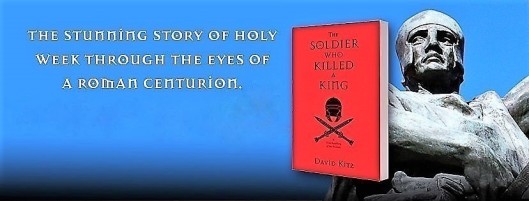
For book purchases, or a closer look at The Soldier Who Killed a King try Amazon or christianbook.com.

To download a free study guide for this high-impact, 288-page, bible-based novel visit: https://www.davidkitz.ca/centurion.php/free study guide PDF
Here’s a journey to the cross and the open tomb you will never forget.

Crucify him!

02 Friday Apr 2021

Posted by davidkitz in Good Friday, Psalms

≈ Leave a comment

Tags

Barabbas, crucifixion, crucify, Jesus, Pilate

Luke 23:1-25

Then the whole assembly rose and led him off to Pilate. And they began to accuse him, saying, “We have found this man subverting our nation. He opposes payment of taxes to Caesar and claims to be Messiah, a king.”

So Pilate asked Jesus, “Are you the king of the Jews?”

“You have said so,” Jesus replied.

Then Pilate announced to the chief priests and the crowd, “I find no basis for a charge against this man.”

But they insisted, “He stirs up the people all over Judea by his teaching. He started in Galilee and has come all the way here.”

On hearing this, Pilate asked if the man was a Galilean. When he learned that Jesus was under Herod’s jurisdiction, he sent him to Herod, who was also in Jerusalem at that time.

backlit cemetery christianity clouds

Photo by Pixabay on Pexels.com

When Herod saw Jesus, he was greatly pleased, because for a long time he had been wanting to see him. From what he had heard about him, he hoped to see him perform a sign of some sort. He plied him with many questions, but Jesus gave him no answer. The chief priests and the teachers of the law were standing there, vehemently accusing him. Then Herod and his soldiers ridiculed and mocked him. Dressing him in an elegant robe, they sent him back to Pilate. That day Herod and Pilate became friends—before this they had been enemies.

Pilate called together the chief priests, the rulers and the people, and said to them, “You brought me this man as one who was inciting the people to rebellion. I have examined him in your presence and have found no basis for your charges against him. Neither has Herod, for he sent him back to us; as you can see, he has done nothing to deserve death. Therefore, I will punish him and then release him.”

But the whole crowd shouted, “Away with this man! Release Barabbas to us!” (Barabbas had been thrown into prison for an insurrection in the city, and for murder.)

Wanting to release Jesus, Pilate appealed to them again. But they kept shouting, “Crucify him! Crucify him!”

For the third time he spoke to them: “Why? What crime has this man committed? I have found in him no grounds for the death penalty. Therefore I will have him punished and then release him.”

But with loud shouts they insistently demanded that he be crucified, and their shouts prevailed. So Pilate decided to grant their demand. He released the man who had been thrown into prison for insurrection and murder, the one they asked for, and surrendered Jesus to their will.

* New International Version, Copyright ©1973, 1978, 1984, 2011 by Biblica

Think on these things.


Reading 35 for Lent from “The Soldier Who Killed a King”

11 Thursday Apr 2019

Posted by davidkitz in Books by David Kitz, The Soldier Who Killed a King

≈ 1 Comment

Tags

Christ, Messiah, miracles, Pilate, prophet, repentance

A journey to the cross is a journey to repentance. It’s a journey to deep personal change. Will you take this journey with me?

Date: Eight in the morning, Saturday, April 8, 30 A.D.
Marcus Longinus, the Roman centurion, on his way to set a guard at the tomb, considers the possibility of Jesus rising from the dead.

On the surface I protested being drawn into this, the high priest’s plan of preemptive precaution, but within me, I was filled with dark apprehension. These measures had merit. This guarding of the tomb might well be warranted.
I did not fear his disciples. There had been no sign of them, no sign of armed uprising. No, it was the prophet himself that I feared.
This notion of him rising from the dead did not strike me as all that far fetched. On the surface the Christ’s prediction seemed impossible— utterly impossible—totally preposterous. But then in life he had been a total master of the impossible. The example of the blind Bartimaeus sprang to mind. This Messiah had tossed off miracles like he was tossing off the covers from his bed. Could he now toss off the shroud of death?
There was something far larger at work here. This was more than the raving of a lunatic. Why else would the sun refuse to shine as he hung dying? Why else would the earth shudder with his last breath? No, he was the Son of God. My very own words came back to haunt me. Anything was possible; nothing could be ruled out!
I remembered the worried look I saw on Pilate’s face just this morning, when Annas had raised this matter. Without saying a word I knew we both were of the same mind on this. He too thought a resurrection could occur. Why else his prompt response?

This was more than the raving of a lunatic. Why else would the sun refuse to shine as he hung dying? Why else would the earth shudder with his last breath? No, he was the Son of God.


Oh yes, and then there was the rubbing of the hands. Guilt stains are not so easily removed. I should know. After all these years the blond-haired girl still visits me quite regularly on those soul- tormenting nights.
Only the high priest’s men seemed sure of themselves, cocky in their victory, but not cocky enough to throw all caution to the wind. Why else post a guard? But winds can change, and all this might yet blow up in their faces.
Free WW-e FACEBOOK-2 (2)

To download a free study guide for this high-impact, bible-based novel visit: https://www.davidkitz.ca/centurion.php/free study guide PDF

For book purchases of The Soldier Who Killed a King try Amazon or christianbook.com.

Reading 32 for Lent from “The Soldier Who Killed a King”

06 Saturday Apr 2019

Posted by davidkitz in Lent, Psalms, The Soldier Who Killed a King

≈ 1 Comment

Tags

centurion, crucifixion, Golgotha, Messiah, Pilate

A journey to the cross is a journey to repentance. It’s a journey to deep personal change. Will you take this journey with me?

Date: Seven in the morning, Saturday, April 8, 30 A.D.
Annas meets with Pontius Pilate and asks that Jesus’ tomb be guarded.

Pilate was seated even as I saw him yesterday. He wore a rather haggard look, as though he had slept on the bloodstained rocks of Golgotha. He motioned for the temple delegation to step forward. I waited at the back of the room in a repetition of the governor’s late- day interview with Joseph of Arimathea.
Annas bowed and began. “Sir, we remember that while he was still alive that deceiver said, ‘After three days I will rise again.’”
A strange tingle ran through me as he said this. Pilate rubbed his hands.
Annas continued. “So give the order for the tomb to be made secure until the third day. Otherwise, his disciples may come and steal the body and tell the people that he has been raised from the dead.” Then he concluded by lifting a bony finger and saying, “This last deception will be worse than the first.”
On hearing this, Pilate sighed deeply, then beckoned me forward. There was worry in his eyes. “The centurion here, Marcus Longinus, is fully acquainted with the case of the Galilean prophet. He oversaw his crucifixion.” Then he addressed me directly. “Is that not so?”
I nodded. “Yes, sir. It is as you say.”
With that he raised his hands and motioned both parties together. Then, speaking directly to all of us, he said, “Take a guard. Go, make the tomb as secure as you know how.” Rubbing his guilt- stained hands once more, the Badger got up and skulked off. Free WW-e FACEBOOK-2 (2)Annas was jubilant. With eagerness in his voice, he turned to address me. “How soon can you have your troops at the tomb?”
“We should be there in about an hour.”
“Excellent! These two gentlemen will meet you there. They will ensure that all is in order. Understood?”
“Yes. Understood,” I said. Then I addressed the Pharisees. “Do you know which tomb? Do you know where it is?”
Annas answered for them. “Ah, they know it well.” He gave a contemptuous snort. “The traitor’s tomb, Joseph of Arimathea!”
“I will bring my men and meet you there then.” I gave a slight bow with my head. The chamberlain saw us to the door, and then I was off, back to my home.
I shook my head several times in disbelief as I trudged back. Every time I tried to extricate myself from this Messiah pit, this kingdom of God affair, this abysmal hole, I would find myself sucked in even deeper. And now it had happened again. Was there no escape?
Would I ever be allowed to speak my mind before Pilate?

To download a free study guide for this high-impact, bible-based novel visit: https://www.davidkitz.ca/centurion.php/free study guide PDF

For book purchases of The Soldier Who Killed a King try Amazon or https://www.christianbook.com

Reading 24 for Lent from “The Soldier Who Killed a King”

29 Friday Mar 2019

Posted by davidkitz in Lent, The Soldier Who Killed a King

≈ 1 Comment

Tags

Caiaphas, Herod, Jesus, Lent, Messiah, Pilate, repentance

A journey to the cross is a journey to repentance. It’s a journey to deep personal change. Will you take this journey with me?

Date: Seven in the morning, Friday, April 7, 30A.D.
Jesus trial before Pontius Pilate continues.

In due course we all resumed our previous positions. At this point I fully expected Pilate to pronounce the prisoner guilty of high treason. After all, this Messiah had freely confessed to being a king. But I can only guess that Jesus’s words did have an impact on the governor. Upon taking his seat, Pilate announced, “I find no basis for a charge against him.”
A murmur arose from beyond the pikemen.
Caiaphas was livid. He let fly with a torrent of accusations, the last of these being that Jesus had threatened to destroy the temple and then rebuild it in three days.
Showing extraordinary patience, Pilate let the high priest rage. When Caiaphas’s fury was spent, Pilate turned to Jesus and asked, “Don’t you hear the testimony they are bringing against you?”
Free WW-e FACEBOOK-2 (2)
But Jesus answered him not a word. His silence itself became a challenge. Pilate had cleared him. Why should he answer to these further allegations?
Though stunned by this silence, Pilate repeated his position. “I find no basis for a charge against him.”
Once again discontent began to rumble through the crowd on the street.
At this point I expected the trial to end and the prisoner to be released. Let the crowds rage. Rome had spoken.
But Annas stepped smartly into the breach. “He stirs up the people all over Judea by his teaching. He started in Galilee and has come all the way here.”
“Is he a Galilean?” Pilate asked. “Under Herod’s jurisdiction?”
“Yes,” the flustered Caiaphas confessed, not knowing where this questioning might lead. “Then to Herod he should go,” was Pilate’s prompt response. “Why drag me into this?” He sneered at the high priest.
The governor seemed weary of the whole affair, and for the third time that morning, he found a way to dodge and retreat.
This trial was over.
The dark-eyed Badger rose from his judgment seat. He walked over to Jesus, the accused, and with a rather cunning smile and a nod, he said, “Off to Herod you will go, man of truth.”

To download a free study guide for this high-impact, bible-based novel visit: https://www.davidkitz.ca/centurion.php/free study guide PDF

For book purchases of The Soldier Who Killed a King try Amazon or https://www.christianbook.com

Reading 23 for Lent from “The Soldier Who Killed a King”

28 Thursday Mar 2019

Posted by davidkitz in Lent, The Soldier Who Killed a King

≈ 1 Comment

Tags

Jesus, king of the Jews, kingdom, Lent, Pilate, repentance

A journey to the cross is a journey to repentance. It’s a journey to deep personal change. Will you take this journey with me?

Date: Six fifty in the morning, Friday, April 7 A.D.
Jesus trial before Pontius Pilate continues.

When we entered the judgment hall, the dark-eyed Badger was seething. He knew Caiaphas was using him. He had said so to the assessor. He let fly a string of profanity. “He has me trapped!” he snarled. “Trapped like a rat in a stone water jar.” And with that he tossed the list of charges onto his desk.
James ThtThen he turned to Jesus in the center of the room. He looked him over, walked fully around him. Pilate sighed and nervously ran his fingers through his thinning hair. He made a smacking sound with his lips and asked, “Are you the king of the Jews?”
“You have said so,” came his equivocal answer.
This answer left the governor rocking on his heels. He brought a finger to his lips in pensive thought.
Jesus was not making an acquittal any easier.
But after a moment Jesus continued. “Is that your own idea, or did others talk to you about me?”
“Am I a Jew?”
 Pilate shot back with an ample measure of haughty contempt. “Your own people and chief priests handed you over to me.” He continued the questioning. “What is it you have done?”
“My kingdom is not of this world,” Jesus said, and to drive home this point, he added, “If it were, my servants would fight to prevent my arrest by the Jewish leaders. But now my kingdom is from another place.”
Certain words that Claudius had spoken came echoing back into my mind. He had been convinced that this kingdom Jesus spoke of was somehow different from kingdoms as we know them. Now I heard it from this would-be Messiah’s mouth. He was no armed insurrectionist, and he had offered the actions of his followers as proof.
But Pilate seized on that word—kingdom. “You are a king, then!” Pilate deduced.
With calm, clear deliberation the prophet spoke. “You say that I am a king. In fact, the reason I was born and came into the world is to testify to the truth. Everyone on the side of truth listens to me.”
It almost seemed from this response that Jesus was operating from, and speaking on,Biblical fiction winner 2017 some higher plane—a dimension I had witnessed him operate from during the healings at the temple. He was inviting Pilate to join him in discovering this higher ground of truth.
Pilate would not be moved. They were speaking past each other.
“What is truth?” Pilate shrugged. The question was rhetorical. He had no intention of being dragged into a philosophical discussion with this prophet of the Jewish masses. Once again, the Badger retreated.
Grabbing the list of charges from off his desk, he motioned for us to follow him back outside.

To download a free study guide for this high-impact, bible-based novel visit: https://www.davidkitz.ca/centurion.php/free study guide PDF

For book purchases of The Soldier Who Killed a King try Amazon or https://www.christianbook.com

Reading 22 for Lent from “The Soldier Who Killed a King”

27 Wednesday Mar 2019

Posted by davidkitz in Lent, The Soldier Who Killed a King

≈ 1 Comment

Tags

Caesar, Caiaphas, Jesus, Lent, Pilate, repentance

A journey to the cross is a journey to repentance. It’s a journey to deep personal change. Will you take this journey with me?

Date: Six thirty in the morning, Friday, April 7 A.D.
Jesus trial before Pontius Pilate begins.

The governor peered over the heads of the men directly in front of him. He scanned the assemblage on the street, took in the significance of it all, and then cleared his throat. “Where is the man?”
Jonathon turned quickly. On reaching the first step, he beckoned beyond our pikemen to three of his own temple guards, who then advanced with their prisoner—Jesus of Nazareth.
Picture Cent-helmetHe was a mess, almost unrecognizable. His hair was matted. He had been spat upon. The spittle was drying in his beard. There were red welts on his face and neck, a blood- oozing gash above his left eye, a discernible limp to his gait.

It was apparent that during the night they’d had their way with him.
He was escorted to a position directly before me. Intuitively I knew he was my man now, my charge.
A twitch of Pilate’s eyebrow hinted his surprise at the condition of the man.
“Loose him,” he directed with a slight wave of his hand.
Two temple guards hastened to unfasten the leather strap binding Jesus’s arms to his torso. The third man freed the prisoner’s hands. With a second wave of his hand, Pilate dismissed the temple guards, who repositioned themselves on the first step and stood facing the proceedings.
Pilate took a seat on the throne of judgment, which had been brought out for him by two attendants. Raising the scroll in his left hand, he asked, “What charges are you bringing against this man?”
It was clear from this gesture that he was referring to the charges written on the scroll he now clutched in his hand. Undoubtedly he had read these charges himself, and in all likelihood had discussed them
with the assessor standing to his right. But he wanted the high priest to articulate them. “If he were not a criminal, we would not have handed him over to you,” Caiaphas said with a huff.
A rather cheeky response, I thought.
“Take him yourselves and judge him by your own law,” Pilate answered.
Here Annas interjected, “But we have no right to execute anyone.”
A devious response if there ever was one. The temple, in fact, routinely acted as bothbiblical-fiction-award-2017_orig judge and executioner in religious matters and had been granted full authority to do so. Death by stoning was commonplace. I had witnessed Annas himself cast the first stone at some hapless adulteress within the first week of my arrival here ten years ago. No, the temple had the right to execute, and these crafty fellows could surely find grounds to execute this man. They just didn’t want the blood on their hands. They did not want to be blamed for the death of this rabbi. For many he had become the hope of the nation. No, they wanted us to do the job, to act as their executioners. They wanted him judged and executed under Roman law. What Caiaphas said next made this abundantly clear.
“We have found this man”—he aimed a bony finger at Jesus—“subverting our nation. He opposes payment of taxes to Caesar and claims to be Messiah, a king.”
Now here was a capital offense—a capital offense under Roman law.
The Weasel had backed the Badger into a corner, and he was relishing the moment. These charges would need further examination. But Pilate would not proceed in full view of a gloating high priest, urged on by his consorts and a handpicked audience. He retreated.
He abruptly arose from his throne, fixed his eyes on me, and said, “Bring the man.” He motioned with a jerk of his head toward the great doors behind us and then marched off into his residence.
I stepped down to escort Jesus, but he was already in motion. It became clear that the steps were painful for him. I put my hand to his elbow.

To download a free study guide for this high-impact, bible-based novel visit: https://www.davidkitz.ca/centurion.php/free study guide PDF

For book purchases of The Soldier Who Killed a King try Amazon or https://www.christianbook.com

Reading 20 for Lent from “The Soldier Who Killed a King”

25 Monday Mar 2019

Posted by davidkitz in Lent, Psalms, The Soldier Who Killed a King

≈ Leave a comment

Tags

Caiaphas, Herod Antipas, Lent, Pilate, repentance

A journey to the cross is a journey to repentance. It’s a journey to deep personal change. Will you take this journey with me?

Date: Mid afternoon on Thursday, April 6th, 30 A.D.
In today’s reading, Governor Pontius Pilate gives a brief speech formally welcoming Herod the tetrarch to Jerusalem.

At last the two mounted commanders arrived before Pilate’s chariot. They were motioned to take their position on either side. After a brief confusion of feet, the royal litter managed to turn sideways so the royal couple could face the governor as he stood upon his imperial chariot. The trumpeters sounded the fanfare. When the last note had echoed off the marble wall, Pilate unrolled the parchment handed to him by an attendant. He cleared his throat and began his oration.
Free WW-e FACEBOOK-2 (2)
“It was under the rule of the great and wise Emperor Caesar Augustus that this magnificent temple behind us began to take shape. He recognized the desire of the Jewish people for a central place to worship. It was Herod the great Idumean king who oversaw the construction of this masterpiece of the empire, and today it stands as a symbol of Roman respect for the unity and diversity of all the peoples of the empire. It is only fitting today that I, as the emperor’s representative, welcome the son of this master builder, Herod Antipas, the tetrarch of Galilee and Perea.”
With a wave of his hand, Pilate signaled the sounding of a second trumpet fanfare. As the first note was sounded, he stepped off the chariot and then graciously lent a hand to his wife. Thus accompanied by his mate, he swaggered over to the royal litter to personally greet Herod and Herodias, who both stood to meet them.
Greetings were exchanged, none of which I could discern from a distance. After a brief discussion Claudia joined Herodias in the royal litter. Herod barked out some orders. The litter bearers stood to their feet and headed off in the direction of the governor’s residence. Apparently the ladies would have their own time together.
At a leisurely pace Pilate escorted Herod over to where the priestly delegation waited.Soldier book
It was an unusual sight, these three hostile, inflated men exchanging greetings and meaningless pleasantries. Herod Antipas, Pontius Pilate, and Joseph Caiaphas; the Fox, the Badger, and the Weasel. All three were kings in their own right, within their own jurisdiction. All three craved more power, absolute power, while fiercely holding one another in check.
Pilate turned to me and gave a quick, tight nod. I signaled up to Claudius, and the great Golden Gate, the Messiah Gate, was hoisted, granting entrance to the three competing kings.
Only the fourth king, the people’s king—the donkey king—only he was absent.

To download a free study guide for this high-impact, bible-based novel visit: https://www.davidkitz.ca/centurion.php/free study guide PDF

For book purchases of The Soldier Who Killed a King try Amazon or https://www.christianbook.com

Excerpt 31 for Lent from The Soldier Who Killed a King

31 Saturday Mar 2018

Posted by davidkitz in Books by David Kitz, Christ's Passion, Lent, The Soldier Who Killed a King

≈ 1 Comment

Tags

Annas, Golgotha, Joseph of Arimathea, Lent, Longinus, Marcus, Messiah, Pilate, Pontius Pilate, repentance, The Soldier Who Killed a King

A journey to the cross is a journey to repentance. It’s a journey to deep personal change. Will you take this journey with me?

Date: Seven in the morning, Saturday, April 8, 30 A.D.
Annas meets with Pontius Pilate and asks that Jesus’ tomb be guarded.

Pilate was seated even as I saw him yesterday. He wore a rather haggard look, as though he had slept on the bloodstained rocks of Golgotha. He motioned for the temple delegation to step forward. I waited at the back of the room in a repetition of the governor’s late- day interview with Joseph of Arimathea.
Annas bowed and began. “Sir, we remember that while he was still alive that deceiver said, ‘After three days I will rise again.’”
A strange tingle ran through me as he said this. Pilate rubbed his hands.
Annas continued. “So give the order for the tomb to be made secure until the third day. Otherwise, his disciples may come and steal the body and tell the people that he has been raised from the dead.” Then he concluded by lifting a bony finger and saying, “This last deception will be worse than the first.”
On hearing this, Pilate sighed deeply, then beckoned me forward. There was worry in his eyes. “The centurion here, Marcus Longinus, is fully acquainted with the case of the Galilean prophet. He oversaw his crucifixion.” Then he addressed me directly. “Is that not so?”
I nodded. “Yes, sir. It is as you say.”
With that he raised his hands and motioned both parties together. Then, speaking directly to all of us, he said, “Take a guard. Go, make the tomb as secure as you know how.” Rubbing his guilt- stained hands once more, the Badger got up and skulked off. Free WW-e FACEBOOK-2 (2)Annas was jubilant. With eagerness in his voice, he turned to address me. “How soon can you have your troops at the tomb?”
“We should be there in about an hour.”
“Excellent! These two gentlemen will meet you there. They will ensure that all is in order. Understood?”
“Yes. Understood,” I said. Then I addressed the Pharisees. “Do you know which tomb? Do you know where it is?”
Annas answered for them. “Ah, they know it well.” He gave a contemptuous snort. “The traitor’s tomb, Joseph of Arimathea!”
“I will bring my men and meet you there then.” I gave a slight bow with my head. The chamberlain saw us to the door, and then I was off, back to my home.
I shook my head several times in disbelief as I trudged back. Every time I tried to extricate myself from this Messiah pit, this kingdom of God affair, this abysmal hole, I would find myself sucked in even deeper. And now it had happened again. Was there no escape?
Would I ever be allowed to speak my mind before Pilate?

American readers click this link to purchase The Soldier Who Killed a King.

Canadian readers click this link to purchase The Soldier Who Killed a King directly from the author.


Excerpt 27 for Lent from The Soldier Who Killed a King

27 Tuesday Mar 2018

Posted by davidkitz in Books by David Kitz, Christ's Passion, Lent

≈ 1 Comment

Tags

blood, Caesar, Caiaphas, Christ, crucify, David Kitz, Golgotha, high priest, innocent, Jesus, king, Lent, Messiah, Pilate, repentance, trial of Jesus, verdict

A journey to the cross is a journey to repentance. It’s a journey to deep personal change. Will you take this journey with me?

Date: Eight forty in the morning, Friday, April 7 30A.D.
The trial of Jesus ends. The verdict is delivered.

Pilate was already seated, ready to pronounce judgment. A thin smile was now on his face. The cunning Badger would make the most of his final moves. When Jesus was in position, he began. Once more he motioned in the direction of the Christ, and to all assembled he announced, “Here is your king.”
“Take him away!” came the instant response. “Take him away! Crucify him!”
There was vehement insistence coming from the crowd. Some began to hurl dust in theBiblical fiction winner 2017 air. This was verging on a riot, a point that was surely obvious to the governor, yet he played them on.
“Shall I crucify your king?” Pilate called back to the throng.
“We have no king but Caesar,” the Weasel spat back.
The Badger’s eyebrows shot up.
The governor smiled and nodded. It was a smile of triumphant satisfaction. We have no king but Caesar. The Badger mulled over these words. I knew he had waited years for these words. After all he had endured in this place, wasn’t it well worth hearing this confession from the high priest’s mouth?
Ironically, the governor had Jesus to thank for the high priest’s sudden conversion and submission to imperial Rome. This declaration would never have come forth from the Weasel’s lips, except to secure the conviction of the good Galilean. Caiaphas was willing to stoop before Rome in order to spill the blood of this prophet. Here was the true measure of his hatred for the Northern Messiah.
Pilate knew all this, and he drew a good measure of perverse satisfaction from it. He understood his foe.
He called for his personal attendant to bring a basin of water. Now he would lay the blame where the bloody blame belonged. With the attendant holding the basin before him, Pilate made a great show of washing his hands before the crowd, and with insistence in his voice, he declared, “I am innocent of the blood of this man.”
Here was the feint, the great pretend.
Next came the dodge.
With water still dripping from his hands, he looked out over the crowd and declared, “You yourselves see to it.”
He spoke as though he had abdicated—bore no responsibility for the blood that now trickled down Jesus’s back. He absolved himself of that and of all that would soon flow on Golgotha.
This Badger could throw a bit of dirt.
Free WW-e FACEBOOK-2 (2)
It was fitting for Annas the aged priest to respond. It was he who answered for the people. With his finger pointed at Jesus and his gaze fixed on him, he replied, “His blood be on us.” Then he paused as though looking down through the generations of time. “And on our children,” he added with a cold, sardonic stare.
Out on the street the people answered, “Yes!” They nodded their agreement with this verdict.

American readers click this link to purchase The Soldier Who Killed a King.

Canadian readers click this link to purchase The Soldier Who Killed a King directly from the author.

← Older posts
Newer posts →

Psalms 365: Develop a Life of Worship and Prayer

Psalms 365 Volume II

Psalms 365 vol 3
— Psalms 365 Volume III

Psalms

Recent posts

  • Teach Me Your Paths February 18, 2026
  • Who holds you up? February 18, 2026
  • A Lesson from the Flowers February 17, 2026
  • Do not fret February 17, 2026
  • Minds Set on Things Above February 16, 2026
  • What are the desires of your heart? February 16, 2026
  • The Abundance of Your House February 15, 2026

Calendar

February 2026
M T W T F S S
 1
2345678
9101112131415
16171819202122
232425262728  
« Jan    

Blog Posts

Comments

  • K.L. Hale on Teach Me Your Paths
  • davidkitz on An Unflattering View of Yourself
  • davidkitz on A Lesson from the Flowers

Blog at WordPress.com.

Privacy & Cookies: This site uses cookies. By continuing to use this website, you agree to their use.
To find out more, including how to control cookies, see here: Cookie Policy
  • Subscribe Subscribed
    • I love the Psalms
    • Join 1,385 other subscribers
    • Already have a WordPress.com account? Log in now.
    • I love the Psalms
    • Subscribe Subscribed
    • Sign up
    • Log in
    • Report this content
    • View site in Reader
    • Manage subscriptions
    • Collapse this bar
 

Loading Comments...