• Home
  • About
  • DavidKitz.ca
  • Youtube Videos
  • Books by David
  • Books on Amazon.com

I love the Psalms

~ Connecting daily with God through the Psalms

I love the Psalms

Tag Archives: Psalms of Ascent

Discovering Your Identity

15 Friday Aug 2025

Posted by davidkitz in Psalm 134, Psalms

≈ Leave a comment

Tags

Bible, Creator, devotion, family, House of God, identity, Jesus, Prayer, Psalms, Psalms of Ascent, the LORD, worship

Today’s Devotion from Psalms 365 by David Kitz

Reading: Psalm 134

A song of ascents.

Praise the LORD, all you servants of the LORD
who minister by night in the house of the L
ORD.
Lift up your hands in the sanctuary
and praise the L
ORD.
May the LORD bless you from Zion,
he who is the Maker of heaven and earth
(NIV). *

Photo by brenoanp on Pexels.com

Reflection
This is the fifteenth and final psalm in the Songs of Ascent series. This psalm is the pilgrims’ farewell offering of worship to the LORD.  After a week or more in Jerusalem, the time has arrived for the pilgrims to return to their homes. But on the evening before they set out on the return journey, they make one last visit to Mount Zion and the great Temple of the LORD. There they lift their hands in praise to the God of Israel. Early next morning, they will begin the arduous journey back home. But for now, it’s time to bless the LORD and offer thanks.

It is likely that the twelve-year-old Jesus sang this psalm with his parents on the final evening of their Passover pilgrimage to Jerusalem. On the following day the family departed for Nazareth where Joseph would resume his trade as a carpenter. When they left the next morning, they assumed Jesus was traveling with them in the large company of other pilgrims from their hometown. See Luke 2:41-52.

Typically, we read this account of the lost twelve-year-old Jesus from the viewpoint of a parent. We identify with the stress of losing a child in a big city. We would title this story, “Mary and Joseph find lost Jesus.” But the story reads quite differently, when we view it from the perspective of a child trying to discover who he really is. Viewed from Jesus’ perspective the title of the story might well be, “Lost Boy finds Himself” or “Lost Boy Discovers His Divinity.”

How did Jesus discover he was the son of God? Some believers might well reason that the answer is obvious. Jesus is God; therefore, he is omniscient. The all-knowing Jesus would surely know that he was God’s son. But many theologians would beg to differ. They view the humanity of Christ as all pervasive. Jesus was 100% human and as such he needed to learn and discover his identity even as any child does.

If through the incarnation Jesus fully took on humanity, then the boy Jesus needed to discover his divine identity. It may have been written into every fiber of his being, but he still needed to discover it, just as any young musical prodigy needs to explore and discover his or her gift. All divine gifts must be discovered and developed to reach their maximum potential.

How do we discover our true identity? From the account in Luke, the boy Jesus apparently discovered his true identity in the House of God. Perhaps it began as he lifted his hands in worship. We cannot fully discover who we are until we discover who God is. We must know our Creator to know ourselves. Self-understanding begins with knowing whose we are. You and I belong to the Father.

Response: Father God, I thank you for loving me and inviting me into your family. Lord Jesus, thank you for purchasing my redemption. Holy Spirit, I thank you for the confirmation that I am your child. Amen.

Your Turn: Do you know whose you are? How is God the Father shaping your identity?

Para la publicación de Salmos 365 de hoy en español haga clic aquí.

bgbg_v4.3_1501818
* NEW INTERNATIONAL VERSION, COPYRIGHT ©1973, 1978, 1984, 2011 BY BIBLICA


Please pray for peace to return to Israel, Gaza, and Ukraine!

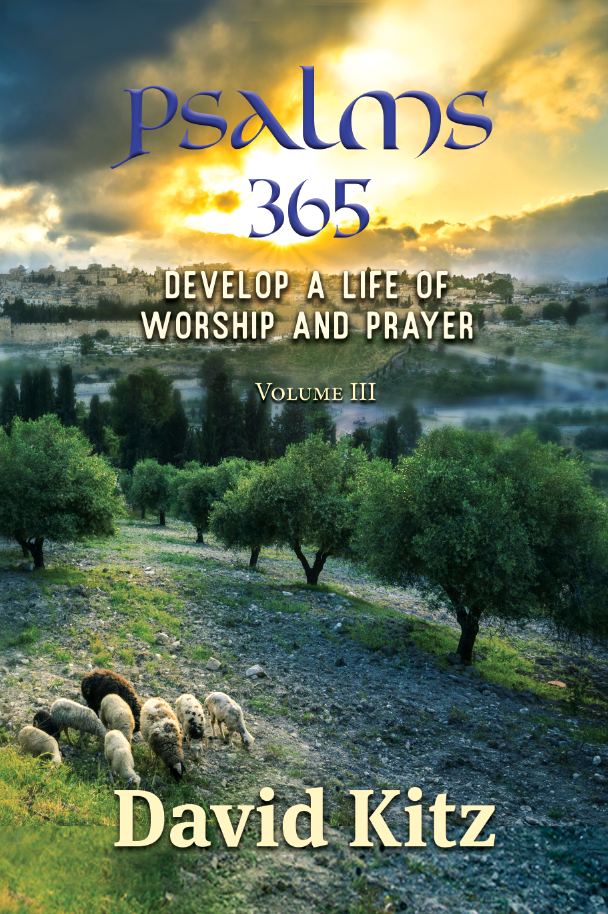
Volume I of Psalms 365: Develop a Life of Worship and Prayer won the Best Book of the Year Award from The Word Guild and Volume II has won the Best Devotional of the Year Award. For those who love God’s word, this three-book series is an ideal way to daily meet with the Lord. To purchase or for a closer look click here.
A gripping read from David Kitz.
Is a return-to-Jesus revival possible in our time?
This book points the way forward.
For details click here.

Bringing God Home

12 Tuesday Aug 2025

Posted by davidkitz in Psalm 132

≈ Leave a comment

Tags

child of God, Christ, city of David, clothed in righteousness, David, Prayer, priests, Psalms, Psalms of Ascent, redeemed, the LORD, Zion

Today’s Devotion from Psalms 365 by David Kitz

Reading: Psalm 132:6-10
We heard it in Ephrathah,
we came upon it in the fields of Jaar:
“Let us go to his dwelling place,
let us worship at his footstool, saying,
‘Arise, LORD, and come to your resting place,
you and the ark of your might.
May your priests be clothed with your righteousness;
may your faithful people sing for joy.’”
For the sake of your servant David,
do not reject your anointed one (NIV). *

Reflection
David’s commitment and zeal for the presence of the LORD drew others to worship God. That’s what the opening lines of today’s reading are saying: We heard it in Ephrathah, we came upon it in the fields of Jaar: “Let us go to his dwelling place, let us worship at his footstool…” (v. 6-7).

We should never underestimate the power of our personal witness for Christ. Our zeal for God and love for His house can act as a magnet to draw others to worship Him. David’s self-denial in pursuit of God resulted in others discovering the power and grace of the LORD. By bringing the Ark of the Covenant to Zion, the City of David, David was declaring he wanted the LORD in his home. He wanted Him close at hand—at the center of the government he was establishing over the land. See 2 Samuel 6.

Do we want God in our home? Is the LORD at the command center of your life and your daily affairs? Genuine worship brings God to the center. It removes the distance between us and God. The Psalms of Ascent are all about removing the distance between us and our Creator. They’re about drawing near.

The psalmist goes on to offer this prayer. “‘May your priests be clothed with your righteousness; may your faithful people sing for joy’” (v. 9).

How are you dressed as you approach God? Apparently, clothing matters. It matters because as a redeemed child of God you are serving as a priest of the Most High. Peter reminds us of our corporate calling and responsibility. But you are a chosen people, a royal priesthood, a holy nation, God’s special possession, that you may declare the praises of him who called you out of darkness into his wonderful light (1 Peter 2:9).

So then as priests offering sacrifices of praise, we have an opportunity to approach God. But how should we be clothed, you ask? St. Paul provides the answer: So in Christ Jesus you are all children of God through faith, for all of you who were baptized into Christ have clothed yourselves with Christ (Galatians 3:26-27). As a blood-bought believer you are clothed with the righteousness of Christ. That’s a garment that never grows old or wears out.

Response: Father God, I thank you for covering me with a garment of righteousness. It’s the supreme righteousness of Jesus. Help me to serve and worship you daily with a grateful heart. Amen.

Your Turn: Are you drawing near to God? Do you see yourself as part of a royal priesthood?

Para la publicación de Salmos 365 de hoy en español haga clic aquí.

bgbg_v4.3_1501818
* NEW INTERNATIONAL VERSION, COPYRIGHT ©1973, 1978, 1984, 2011 BY BIBLICA


Please pray for peace to return to Israel, Gaza, and Ukraine!

Volume I of Psalms 365: Develop a Life of Worship and Prayer won the Best Book of the Year Award from The Word Guild and Volume II has won the Best Devotional of the Year Award. For those who love God’s word, this three-book series is an ideal way to daily meet with the Lord. To purchase or for a closer look click here.

A gripping read from David Kitz.
Is a return-to-Jesus revival possible in our time?
This book points the way forward.
For details click here.

Solid and Immovable

17 Monday May 2021

Posted by davidkitz in Psalm 125, Psalms

≈ 8 Comments

Tags

Mount Zion, mountains, permanence, Psalms of Ascent

Reading: Psalm 125
A song of ascents.
Those who trust in the LORD are like Mount Zion,
which cannot be shaken but endures forever.
As the mountains surround Jerusalem,
so the L
ORD surrounds his people
both now and forevermore.
The scepter of the wicked will not remain
over the land allotted to the righteous,
for then the righteous might use
their hands to do evil.
LORD, do good to those who are good,
to those who are upright in heart.
But those who turn to crooked ways
the L
ORD will banish with the evildoers.
Peace be on Israel (NIV).*

2018-05-15e

He brought me into a spacious place — photo by David Kitz

Reflection
If someone compared you to a mountain, would you take it as a compliment, or would you be offended? Your answer to that question may depend on your gender. I suspect very few women would like being compared to a mountain. Though I am a male, becoming a mountain of a man has never been one of my ambitions. Nevertheless, Psalm 125 begins by comparing those who trust in the LORD to Mount Zion. Those who trust in the LORD are like Mount Zion, which cannot be shaken but endures forever.

This is the sixth psalm in the Songs of Ascent series, and clearly the psalmist is inspired by his surroundings. He beholds the beauty of Jerusalem, its citadels and the mountains around it. There is something reassuring about a mountain. Mountains have stood the test of time. They have endured when human endeavors have come and gone. In a world of transition, the mountains remain; they stand firm.

Are you like a mountain—solid and immovable? You ask—how can I be? Without the LORD, this is truly impossible. But the psalmist provides us with this assurance: As the mountains surround Jerusalem, so the LORD surrounds his people both now and forevermore.

We only have permanence because of the LORD. He has you surrounded. Are you going through hell and high water? He has you surrounded. Are you facing opposition? He has you surrounded. Is there trouble on every side? He has you surrounded. As the mountains surround Jerusalem, so the LORD surrounds his people both now and forevermore.

Again this psalm reassures us that the LORD is on our side. He is working on our behalf. The scepter of the wicked will not remain over the land allotted to the righteous, for then the righteous might use their hands to do evil.

Response: Father God, I trust in you. I trust that you are working on my behalf. Help me to become steadfast, immovable, always abounding in the work of the Lord (1 Corinthians 15:58, NKJV). Amen.

Your Turn: Are you becoming steadfast? Do you have enduring faith? What are you doing to ensure your faith endures.

* New International Version, Copyright ©1973, 1978, 1984, 2011 by Biblica

Volume II of Psalms 365: Develop a Life of Worship and Prayer by award-winning author David Kitz is available now. For a closer look at Volumes I and II click here.

Where Does My Help Come from?

11 Tuesday May 2021

Posted by davidkitz in Psalm 121, Psalms

≈ 9 Comments

Tags

Jerusalem, pilgrimage, pilgrims, Psalms of Ascent

Reading: Psalm 121
A song of ascents.
I lift up my eyes to the mountains—
where does my help come from?
My help comes from the L
ORD,
the Maker of heaven and earth.
He will not let your foot slip—
he who watches over you will not slumber;
indeed, he who watches over Israel
will neither slumber nor sleep.
The LORD watches over you—
the L
ORD is your shade at your right hand;
 the sun will not harm you by day, nor the moon by night.
The LORD will keep you from all harm—
he will watch over your life;
the L
ORD will watch over your coming and going
both now and forevermore
(NIV).*

img_20210506_0909382

Creek-crossing bridge — photo by David Kitz

Reflection
Psalm 121 is the second Song of Ascents, and as such it was a psalm, which was intended for use by pilgrims as they journeyed to Jerusalem. This particular psalm was most often sung or chanted as the pilgrims set out from Jericho. As they lifted up their eyes, the sharply rising hill country of Judah stretched off into the distance. Hill after hill rose up before them. Jesus often made this journey to Jerusalem from his youth (see Luke 2:41-52) until his final Passover pilgrimage (see Luke 19).

This final portion of the pilgrimage was truly an ascent. From the Dead Sea plain the road to Jerusalem climbs nearly five thousand feet—1600 meters. This is truly an ascent—an ascent from the Dead Sea plain, the lowest point on the earth’s surface, to the heights of Mount Zion.

For the bone-weary pilgrims, who had already walked more than one hundred kilometers (60 miles) from Galilee, the sight of those distant hills must have brought a measure of aching discouragement. Here was a looming challenge. Could they make this final ascent? The opening question of this psalm was not a matter of poetic whimsy. It was spoken in earnest. I lift up my eyes to the mountains—where does my help come from?

The weary pilgrim may well be asking, “Having come this far, can I complete this journey? Do I have enough energy—enough stamina to climb those hills? Will I be able to reach Zion? I am exhausted now—before I even start the ascent. I can’t do this on my own. Where does my help come from?”

The psalmist’s answer resounds off those ancient hills. Even today, it echoes down through the ages and reverberates through the chambers of the heart. My help comes from the LORD, the Maker of heaven and earth.

Response: Father God, I am on a lifelong journey—a pilgrimage to the heavenly Jerusalem. When I become weary, give me strength.  I need your help. I know my strength comes from you, LORD. Amen.

Your Turn: Do you need strength? Have you become weary at times in serving the Lord?

* NEW INTERNATIONAL VERSION, COPYRIGHT ©1973, 1978, 1984, 2011 BY BIBLICA

Volume II of Psalms 365: Develop a Life of Worship and Prayer by award-winning author David Kitz is available now. For a closer look at Volumes I and II click here.

Psalms of Ascent

10 Monday May 2021

Posted by davidkitz in Psalm 120, Psalms

≈ 9 Comments

Tags

peace, Psalm of lament, Psalms, Psalms of Ascent

Reading: Psalm 120
A song of ascents.
I call on the LORD in my distress,
and he answers me.
Save me, L
ORD, from lying lips
and from deceitful tongues.
What will he do to you,
and what more besides,
you deceitful tongue?
He will punish you with a warrior’s sharp arrows,
with burning coals of the broom bush.
Woe to me that I dwell in Meshek,
that I live among the tents of Kedar!
Too long have I lived
among those who hate peace.
I am for peace;
but when I speak, they are for war
(NIV).*

img_20210507_0905136

Petrie Island in early May — photo by David Kitz

Reflection
Psalm 120 is the first in a series of fifteen psalms that are called Songs of Ascent. Each psalm begins with this statement or title: A Song of Ascents. Some of the psalms also add this phrase: Of David.

Of course, this title begs the question, what are the Songs of Ascent? And furthermore, to what are we ascending? This compilation of fourteen psalms was composed for the use of pilgrims who were making their way to worship at the temple in Jerusalem. These are psalms of pilgrimage. They are called Songs of Ascent, or Psalms of Ascent, because Jerusalem is built on a high point in the land of Israel. Specifically, the temple compound was constructed at the summit of Mount Zion, so pilgrims were literally and figuratively ascending to worship at the House of God.

This first psalm in the series is really a lament. The psalmist is living in a distant place—a place far from God. All of us begin our pilgrimage—our journey to God—from a distant place. Just like the prodigal we find ourselves in a distant land, a land where there is no peace. Sin has its fleeting pleasures, but it brings no lasting peace, no deep contentment. We have wandered far from the Father’s warm embrace. The psalmist laments, “Woe to me that I dwell in Meshek, that I live among the tents of Kedar!”

The Songs of Ascent are all about drawing near to God. They are about going to the heart of worship and finding peace—true peace in the arms of God. But first we must recognize where we are. We are dwelling in Meshek—in a world far from the LORD. We need to acknowledge our true condition. Change happens when we recognize the truth about ourselves and our need for a Savior. Only then can we begin our journey toward peace.

Have faith in this promise. I call on the LORD in my distress, and he answers me.

Response: Father God, today I am continuing my journey toward you. Lord Jesus, I need you as my Savior. Help me set aside those things that hinder my journey to intimacy with you. Amen.

Your Turn: Are you living in Meshek? Have you begun your pilgrimage to arms of the Father?

* New International Version, Copyright ©1973, 1978, 1984, 2011 by Biblica

Volume II of Psalms 365: Develop a Life of Worship and Prayer by award-winning author David Kitz is available now. For a closer look at Volumes I and II click here.

Clothed with Christ’s Righteousness

27 Friday Dec 2019

Posted by davidkitz in Devotionals, Psalm 132, Psalms

≈ Leave a comment

Tags

clothed, praise, Psalms of Ascent, Righteousness, worship

Reading: Psalm 132
(Verses 6-10)
We heard it in Ephrathah,
we came upon it in the fields of Jaar:
“Let us go to his dwelling place,
let us worship at his footstool, saying,
‘Arise, L
ORD, and come to your resting place,
you and the ark of your might.
May your priests be clothed with your righteousness;
may your faithful people sing for joy.’”
For the sake of your servant David,
do not reject your anointed one
(NIV).

IMG_20180205_093121_hdr

Snowy arch — photo by David Kitz

Reflection
David’s commitment and zeal for the presence of the LORD drew others to worship God. That’s what the opening lines of today’s reading are saying: We heard it in Ephrathah, we came upon it in the fields of Jaar: “Let us go to his dwelling place, let us worship at his footstool…”

We should never underestimate the power of our personal witness for Christ. Our zeal for God and love for His house can act as a magnet to draw others to worship Him. David’s self-denial in pursuit of God resulted in others discovering the power and grace of the LORD. By bringing the Ark of the Covenant to Zion, the City of David, David was declaring that he wanted the LORD in his home. He wanted Him close at hand—at the center of the government he was establishing over the land. See 2 Samuel 6.

Do we want God in our home? Is the LORD at the command center of your life and your daily affairs? Genuine worship brings God to the center. It removes the distance between us and God. The Psalms of Ascent are all about removing the distance between us and our Creator. They’re about drawing near.

The psalmist goes on to offer this prayer. “‘May your priests be clothed with your righteousness; may your faithful people sing for joy.’”

How are you dressed as you approach God? Apparently, clothing matters. It matters because as a redeemed child of God you are serving as a priest of the Most High. The apostle, Peter reminds us of our corporate calling and responsibility. But you are a chosen people, a royal priesthood, a holy nation, God’s special possession, that you may declare the praises of him who called you out of darkness into his wonderful light (1 Peter 2:9).

So then, as priests offering sacrifices of praise, we have an opportunity to approach God. But how should we be clothed, you ask? St. Paul provides the answer. So in Christ Jesus you are all children of God through faith, for all of you who were baptized into Christ have clothed yourselves with Christ (Galatians 3:26-27). As a blood-bought believer you are clothed with the righteousness of Christ. That’s a garment that never grows old or wears out.

Response: Father God, I thank you for covering me with a garment of righteousness. It’s the supreme righteousness of Jesus. Help me to serve and worship you daily with a grateful heart. Amen.

Your Turn: Are you drawing near to God? Do you see yourself as part of a royal priesthood?

A Psalm for the Christmas Child

25 Wednesday Dec 2019

Posted by davidkitz in Christmas, Devotionals, Psalm 131, Psalms

≈ 5 Comments

Tags

child, children, humility, meek, Psalms of Ascent

Reading: Psalm 131
A song of ascents. Of David.
My heart is not proud, LORD,
my eyes are not haughty;
I do not concern myself with great matters
or things too wonderful for me.
But I have calmed and quieted myself,
I am like a weaned child with its mother;
like a weaned child I am content.
Israel, put your hope in the LORD
both now and forevermore
(NIV).

2017-12-30b

Through the spruce boughs — photo by David Kitz

Reflection
In my personal quiet time this morning I highlighted this verse. When pride comes, then comes disgrace, but with humility comes wisdom (Proverbs 11:2).

The wisdom that comes with humility is a rare commodity in today’s world. It appears that the crude bravado of boasting egocentrics is winning the day. Every field of human endeavor has its loudmouthed champions—men who heap scorn on meeker souls.

But Jesus has a message that runs completely contrary to this approach. In his Sermon on the Mount, he said, “Blessed are the meek, for they will inherit the earth” (Matthew 5:5). On another occasion, the disciples asked Jesus this question, “Who, then, is the greatest in the kingdom of heaven?”

This is Jesus’ response.  “Truly I tell you, unless you change and become like little children, you will never enter the kingdom of heaven. Therefore, whoever takes the lowly position of this child is the greatest in the kingdom of heaven. And whoever welcomes one such child in my name welcomes me.” (See Matthew 18:1-5).

Jesus turns this world’s operating system on its head. He heaps honor on the weak, the humble and the vulnerable. He praises the soul of the weaned child—the one who takes the position of humility. Of course, Jesus is right. The folly of the proud ends in disgrace, but the humility of the meek ends in honor, and a glorious inheritance.

Your eternal destiny is determined by your humility. These words of Jesus are an ominous warning:  “Truly I tell you, unless you change and become like little children, you will never enter the kingdom of heaven.” 

I need to become like the weaned child of Psalm 131. On Christmas Day we are reminded that Jesus became that weaned child–that child in a manger.

Can I truthfully say these words? My heart is not proud, LORD, my eyes are not haughty. Have I calmed and quieted myself? Am I like a weaned child with its mother? Am I content? Becoming like the weaned child requires change. I need to change. Jesus asks me to change. How about you? 

Response: Father God, help me to change. I want to become more like Jesus. He was the servant of all.  Help me to avoid the pitfall of pride. Teach how to quiet my soul and be content in you. Amen.

Your Turn: Are you learning to quiet your soul before God?

Merry Christmas to all!

A Psalm for Christmas Eve

24 Tuesday Dec 2019

Posted by davidkitz in Devotionals, Psalm 130, Psalms

≈ 6 Comments

Tags

hope in God, Messiah, Psalms of Ascent, redeem, Redeemer, redemption

Reading: Psalm 130
(Verses 5-8)
I wait for the LORD, my whole being waits,
and in his word I put my hope.
 I wait for the L
ORD
more than watchmen wait for the morning,
more than watchmen wait for the morning.
Israel, put your hope in the LORD,
for with the L
ORD is unfailing love
and with him is full redemption.
He himself will redeem Israel
from all their sins
(NIV).

img_20191204_2025006

The light of the world has come and is coming — photo by David Kitz

Reflection
Psalm 130 can be divided into three distinct sections: the confessional approach, the wait, and the LORD’s response. In yesterday’s reading, we looked at the confessional approach. The psalmist came before his God and poured out his heart. In desperation he pleaded for mercy and forgiveness. At the same time he acknowledged the extreme mercy of God. He knows full well that this God forgives the undeserving.

Now, the psalmist waits: “I wait for the LORD, my soul waits, and in his word I put my hope. My soul waits for the LORD more than watchmen wait for the morning, more than watchmen wait for the morning.”

This is the step that is most frequently missing in our communion with God. We cannot wait; we rush on. We have things to do, people to see, a life to live. We have no time to wait for the LORD’s response. But without waiting, we cannot hear the LORD speaking to our hearts. The rush of life takes over. We do not hear our Savior speak the words of divine pardon. Prayer is reduced to one way communication. We speak into the silence, and allow no time for the God of silence to answer back.

But in his time of silence, the psalmist heard from God. In this third section of the psalm, the author is no longer addressing the LORD in prayer. Now he is addresses us. The wait is over. God has spoken, and now the psalmist rises to his feet. He has a message from the LORD for us—the Israel of God.

Israel, put your hope in the LORD, for with the LORD is unfailing love and with him is full redemption. 

For Israel, there was a long wait. The promised Messiah was a long time in coming. The centuries slipped by. Generation after generation passed on, but the word of the LORD stood firm. A Redeemer was coming. With an uncanny accuracy the Old Testament prophets foretold the coming of the Christ. Many of those prophetic words are found within the Psalms.

The Lord Jesus is our fount of hope—our Redeemer. He is love and the source of unfailing love. It is he who with his blood redeemed us, body, soul and spirit. In the person of Jesus, God took on human flesh. On the cross he fulfilled these words. “He himself will redeem Israel from all their sins.”

Response: Father God, I thank you for your prophetic word because it points to Jesus. Lord Jesus, thank you for laying down your life to redeem me, and all those who bow before you in repentance. Amen.

Your Turn: Are you taking time to listen for the voice of God in prayer?

Crying Out of the Depths

23 Monday Dec 2019

Posted by davidkitz in Devotionals, Psalm 130, Psalms

≈ 3 Comments

Tags

forgiveness, God's mercy, holiness, mercy, Psalm 130, Psalms of Ascent

Reading: Psalm 130
A song of ascents.
(Verses 1-4)
Out of the depths I cry to you, LORD;
LORD, hear my voice.
Let your ears be attentive
to my cry for mercy.
If you, LORD, kept a record of sins,
L
ORD, who could stand?
But with you there is forgiveness,
so that we can, with reverence, serve you
(NIV).

IMG_20180205_093331_hdr

A winter wonderland, Racette Park, Orleans, ON — photo by David Kitz

Reflection
Psalm 130 is a perfect example of a psalm that brings us into the private inner sanctum of communion with God. Here is a portrait of a fallen man—a man on his knees before his Maker, the eternal One. Hear him now as he agonizes in prayer, “Out of the depths I cry out to you, O LORD; O LORD, hear my voice. Let your ears be attentive to my cry for mercy.”

The opening lines of this psalm leave little doubt as to what has transpired. The psalmist has failed; he has missed the mark. He has transgressed, yet again. There is an abject poverty of spirit reflected in these words—a poverty that almost makes us cringe.

We do not know what sin, or list of sins has brought the psalmist to this wretched state. The transgression is left unstated. Was it anger, malice, or unbridled lust? Was it pride, greed or willful dishonesty? Was this a transgression of the mind, of the tongue, of action or inaction? God knows.

I am always somewhat skeptical of those who claim they could never commit this or that sin. I think we rarely comprehend the depravity of our own hearts. Pushed into wrong circumstances, in the wrong environment, with the wrong peer group, who can plumb the depths to which a man or woman may sink? I can identify with the psalmist. I have added my own pile of dung to this world’s heap of moral filth. I too have found myself in the psalmist’s position, sobbing out these words, “Out of the depths I cry out to you, O LORD; O LORD, hear my voice. Let your ears be attentive to my cry for mercy.“

But despite my failings, despite my moral poverty, this great God—this God of holiness—is approachable. He is a God of mercy. The psalmist reminds himself and the LORD of His merciful nature with these words: If you, LORD, kept a record of sins, LORD, who could stand? But with you there is forgiveness, so that we can, with reverence, serve you.

I need daily reminders of God’s forgiveness and mercy. God the moral accountant is also the LORD of forgiveness. No one does forgiveness better than God. When we confess our sins, He destroys the record. What accountant does that?

Response: Father God, I thank you for forgiveness. I have failed you many times, but you are rich in mercy. You are a patient God. Thank you for destroying the record of my sins. Thank you for the blood Jesus shed so I could be washed clean. Amen.

Your Turn: Have you been guilty of digging up the record of your sins—sins that have been forgiven?

Plowmen Have Plowed my Back

20 Friday Dec 2019

Posted by davidkitz in Devotionals, Psalm 129, Psalms

≈ 3 Comments

Tags

chosen people, Holocaust, oppressed, persecution, Psalms of Ascent

Reading: Psalm 129
A song of ascents.
“They have greatly oppressed me from my youth,”
let Israel say;
“they have greatly oppressed me from my youth,
but they have not gained the victory over me.
Plowmen have plowed my back
and made their furrows long.
But the L
ORD is righteous;
he has cut me free from the cords of the wicked.”
May all who hate Zion
be turned back in shame.
May they be like grass on the roof,
which withers before it can grow;
a reaper cannot fill his hands with it,
nor one who gathers fill his arms.
May those who pass by not say to them,
“The blessing of the L
ORD be on you;
we bless you in the name of the L
ORD” (NIV).

black metal train rails

Concentration Camp, Photo by Pixabay on Pexels.com

Reflection
A few years back I had a conversation with a Jewish friend about what it means to be numbered among God’s chosen people. I found his response quite surprising.

“Most people see being God’s chosen as a great honor or a blessing. The reality is quite different. The reality is persecution. The reality is envy and hatred by your neighbors. The reality is six million dead in the Holocaust. We are God’s chosen people. Is that a blessing? Sometimes it feels like a curse.”

Psalm 129 reflects the truth of my friend’s words: “They have greatly oppressed me from my youth, but they have not gained the victory over me. Plowmen have plowed my back and made their furrows long.” 

Often we make the assumption that being chosen by God will bring great blessing. But being called and chosen does not mean trouble free. The apostle Paul was God’s called and chosen messenger to the Gentiles, but fulfilling his mission involved tremendous suffering, beatings, imprisonment and ultimately martyrdom. See 2 Corinthians 11:22-33.

Paul makes this observation about his calling: For it seems to me that God has put us apostles on display at the end of the procession, like those condemned to die in the arena. We have been made a spectacle to the whole universe, to angels as well as to human beings (1 Corinthians 4:9).

Genuinely following Jesus in the world today can lead directly to persecution. Amnesty International reports that 80% of the systemic persecution in the world today is targeted at Christians. There is often a price to pay for being God’s chosen.

Response: Father God, I pray for those who are facing severe persecution, whatever their faith may be. But I pray especially for my brothers and sisters in Christ. Have mercy on them for Jesus sake. Amen.

Your Turn: Do you see yourself as chosen by God? He has called you to be His child by regeneration.

← Older posts

Psalms 365: Develop a Life of Worship and Prayer

Psalms 365 Volume II

Psalms 365 vol 3
— Psalms 365 Volume III

Psalms

Recent posts

  • Ready for the King of Glory December 19, 2025
  • My Spirit Rejoices in God My Savior December 18, 2025
  • Joining the Generation That Seeks God December 18, 2025
  • Why Am I So Favored December 17, 2025
  • How Can You Find the Good Life? December 17, 2025
  • The Power of the Most High December 16, 2025
  •  The Earth Turns to the LORD December 16, 2025

Calendar

December 2025
M T W T F S S
1234567
891011121314
15161718192021
22232425262728
293031  
« Nov    

Blog Posts

Comments

  • davidkitz on Joining the Generation That Seeks God
  • cjsmissionaryminister on God Sent His Son
  • cjsmissionaryminister on The God of the Broken

Blog at WordPress.com.

Privacy & Cookies: This site uses cookies. By continuing to use this website, you agree to their use.
To find out more, including how to control cookies, see here: Cookie Policy
  • Subscribe Subscribed
    • I love the Psalms
    • Join 1,378 other subscribers
    • Already have a WordPress.com account? Log in now.
    • I love the Psalms
    • Subscribe Subscribed
    • Sign up
    • Log in
    • Report this content
    • View site in Reader
    • Manage subscriptions
    • Collapse this bar
 

Loading Comments...