
• Home
  • About
  • DavidKitz.ca
  • Youtube Videos
  • Books by David
  • Books on Amazon.com

I love the Psalms

~ Connecting daily with God through the Psalms

I love the Psalms

Tag Archives: repentance

Reading 7 for Lent from “The Soldier Who Killed a King”

12 Tuesday Mar 2019

Posted by davidkitz in Lent, The Soldier Who Killed a King

≈ 4 Comments

Tags

Jesus, Lent, miracle, repentance, The Soldier Who Killed a King

A journey to the cross is a journey to repentance. It’s a journey to deep personal change. Will you take this journey with me?

It is the morning of the second day of Passover Week. In today’s reading, Marcus the centurion, disguised in his civilian clothes, is enthralled as he watches Jesus heal a beggar boy. 

Having witnessed the temple cleansing, this crowd had a strong sense of expectation. What would he do now? That was the unspoken question on everyone’s mind.
In fact, for quite some time he did nothing. He simply stood there scanning the sea of faces. Then his eyes lit on a young lad, perhaps age twelve, standing to my far right. I hadBiblical fiction winner 2017 seen this beggar boy about the city many times. Their eyes engaged for a moment. The prophet gave a slight nod of his head—a signal for the boy to advance. He did so with haste. His right leg dangled loose like the limp rags he was wearing. The staccato scrape of his crutch on the stone floor echoed through the hushed courtyard. Eager determination marked his every move. In moments he stood before Jesus. His right leg was easily six inches shorter than the healthy left leg. The absence of any muscle in this stunted limb was painfully obvious, even at a distance.
Like a father, Jesus placed his hands on the boy’s shoulders, looked into his eyes, and in a firm voice commanded, “Stretch out your leg!”
The boy’s leg began to twitch and stir. Then it kicked forward. Once, twice, three times. With each kick the stone pavement grew closer. The toes stretched forward; the heel pressed down. On the fourth kick, contact was made. Two more kicks, and he had a solid footing. Now he began to jump up and down, up and down, on both feet. Muscle—muscle that hadn’t been there moments before—began to appear in his leg. The wooden crutch clattered lifelessly to the floor. He was free.
With one voice the crowd began to cheer and applaud. “Blessed is he who comes in the name of the Lord!”
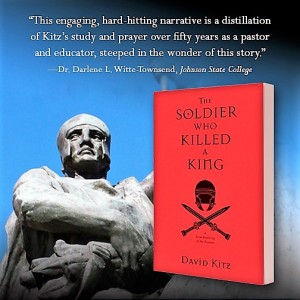
Soldier bookThe ecstatic smile on this lad’s face I will never forget. He glowed. He danced. He danced on the spot a few more times, as if to confirm the miracle was real. Then he buried his head in Jesus’s chest and clung to him in a thank- you hug that lasted a full minute. When he raised his head to look into the Galilean’s eyes, tears streamed down his face. Joy tears. Thank- you tears.

“I can walk!”
“You can walk,” Jesus confirmed.
In fact, for the rest of the morning, he did very little walking. He bounced, jumped, skipped, and ran, but seldom only walked.

To download a free study guide for this high-impact, bible-based novel visit: https://www.davidkitz.ca/centurion.php/free study guide PDF

For book purchases of The Soldier Who Killed a King try Amazon or https://www.christianbook.com

Reading 6 for Lent from The Soldier Who Killed a King

11 Monday Mar 2019

Posted by davidkitz in Books by David Kitz, Lent

≈ 1 Comment

Tags

cleansing the temple, house of prayer, Jesus, Lent, Prayer, repentance

A journey to the cross is a journey to repentance. It’s a journey to deep personal change. Will you take this journey with me?

In today’s reading, Marcus Longinus the centurion, disguised in his civilian clothes, joins the throng of Jesus followers as enters the temple courts. It is the morning of the second day of Passover Week.

There were more of this prophet’s followers awaiting his arrival within the temple grounds. Our numbers may have swelled to well over a thousand at this point. Keeping him in view from within this multitude of craning necks was a challenge.
We poured into the Court of the Gentiles, with Jesus taking the lead. It quickly became clear that he did not like what he found there. 4485 SHARABLE-1
This whole area had been converted into a market for the duration of the Passover celebration. There were currency exchange tables, caged fowl available for sacrifice, and goods of various and sundry quality arranged for the pilgrims’ perusal.
I could well imagine the eager anticipation among the merchants with the arrival of such a large crowd. But this prophet had no intention of leading a shopping expedition.
With a loud, anger-edged voice, he declared for all to hear, “It is written, ‘My house shall be called a house of prayer,’ but you”—his hand slashed through the air to encompass the assembled entrepreneurs—“have made it a ‘den of thieves’!”
Then seizing the nearest table, he sent it, and all that was upon it, clattering onto the paving stones. The prophet swung around, and without stopping to admire the havoc he had caused, he grabbed a money changer’s table, and with one quick move he sent a thousand coins rolling in every direction. The next banker’s hoard met with the same fate.
Pandemonium and panic now fully broke loose.
Benches stacked eight feet high with dove cages were next in line. Cages toppled. Birds flapped. Feathers flew. Within moments scores of birds had been released by the prophet’s followers.
Frightened merchants rushed for the exits, clutching all that their arms could hastily gather. Within short minutes the entire Gentile court had been cleared of both buyers and sellers.
The transformation was astonishing, the effect upon his followers electrifying. They were in his hands. They loved the sheer power of the moment. With single- handed raw courage he had swept aside the outward clutter of both wealth and religious tradition.
I was impressed. The man had convictions and would act on them.
Timid temple guards skittered about the perimeter of the courtyard, dumbfounded by what they had witnessed, yet fully knowing they were powerless to act before the prophet’s adoring throng. This was a coup. In just moments they had lost control—lost it to the leader of a Galilean mob. Explaining this would not be easy.
The crowd pressed in closer, sensing Jesus was about to speak. “My house,” he said, and he gestured to the marble floors and columns that surrounded him. “My house will be called a house of prayer for all nations. This is why there is a temple. This is why I have come . . . that we might draw near.”

To download a free study guide for this high-impact, bible-based novel visit: https://www.davidkitz.ca/centurion.php/free study guide PDF

For book purchases of The Soldier Who Killed a King try Amazon or https://www.christianbook.com

Reading 5 for Lent from “The Soldier Who Killed a King”

10 Sunday Mar 2019

Posted by davidkitz in Books by David Kitz, Lent

≈ 1 Comment

Tags

Christ, Hosanna, Jesus, Lent, repentance, Son of David

A journey to the cross is a journey to repentance. It’s a journey to deep personal change. Will you take this journey with me?

In today’s reading, Marcus Longinus the centurion, disguised in his civilian clothes, is waiting by the city gate for the arrival of Jesus. It is the morning of the second day of Passover Week.

Then someone ahead of me pointed and yelled, “That’s him! He’s coming!”
Necks craned. I raised my hand to shade my eyes. Just over the brow of the hill, a figure in white rabbinical robes was beginning his descent into the Kidron Valley. It soon became apparent he was not alone. A clutch of young bearded men surrounded him, and trailing behind was an assortment of wives, children, and barking dogs of both types, canine and human. The whole entourage may have numbered a hundred twenty. There was no donkey today and, to my relief, no thronging thousands. I’m sure there was a collective sigh of relief above the gate as well.
The near-giddy anticipation of these spectators was something I had not expected. I wasFree WWe SHARABLE-1 (2) surprised to find myself caught up in it. The front edges of the crowd by the wall surged forward to line the roadside. Meanwhile, others continued to pour through the gate.
The man to my left stepped forward, planting his foot on my toes. I grunted in pain and instinctively pushed my thumb and knuckles into his ribs. This brought the desired relief, and the man turned to face me. It was the man with the boy on his shoulders.
“My toes!” I gestured.
“Sorry, my friend.”
I felt slightly embarrassed by the gruffness of my response. “You’re waiting to see Jesus,” I offered, stating the obvious.
“Yeah. The kids are crazy about him.” He nodded in the direction of the brood to my right. “It’s all they talked about since we came yesterday.”
I could tell from his accent that he was from Galilee, so I continued. “Do you know much about him? See, I’m a Passover pilgrim from Alexandria in Egypt. All I know is what I saw yesterday.”
“That was incredible!” he enthused. “Did you see him come in on the donkey? That’s fulfillment of a prophecy.”
Then he took on a more distant, thoughtful look, and he began to quote. “Rejoice greatly, Daughter Zion! Shout, Daughter Jerusalem!” And now his eyes brightened. “See, your king comes to you, righteous and victorious.” He slowed for emphasis, and with his free hand stabbed the air. “Lowly and riding on a donkey, on a colt, the foal of a donkey.”
It always amazed me how these people memorized their Scriptures. “So, do you think he’s”—I hesitated—“the Christ?”
“Shh!” He gestured with a finger to his lips and a glance to the wall. “Or the stones will hear.”
He continued. “There is no one like him. He drives out demons. He heals the sick. Even the dead have been raised. And yesterday”—his voice raced with excitement— “yesterday I saw this with my own eyes. He healed a man born blind.”
Seeing my interest, he pressed on.
“In the morning, we were leaving Jericho, the whole throng from Galilee, and by the side of the road was this blind beggar. He was yelling, ‘Jesus, Son of David, have mercy on me!’ Jesus stopped and touched the man’s eyes.”
He made as though he would touch my eyes.
“And he was healed!” His own bright eyes beamed at me as he smiled broadly. The boy on his shoulders also joined in his father’s enthusiasm as for the first time he smiled down at me.
We began to reposition ourselves, for the object of our conversation was now drawing near.
He nudged my shoulder. “And when he speaks, it’s like God is talking to me. None of the rabbis speak like him. It’s like he has seen heaven and heard the voice of the Holy One.” A girl in her teens near the front edge of the crowd shouted, “Hosanna to the Son of David!”
Soon others joined in. The masses surged around him, and together we squeezed through the Messiah Gate and pressed on toward the temple.

To download a free study guide for this high-impact, bible-based novel visit: https://www.davidkitz.ca/centurion.php/free study guide PDF

For book purchases of The Soldier Who Killed a King try Amazon or https://www.christianbook.com

Reading 4 for Lent from “The Soldier Who Killed a King”

09 Saturday Mar 2019

Posted by davidkitz in Books by David Kitz, Lent

≈ 1 Comment

Tags

Galilee, Jesus of Nazareth, Lent, miracles, repentance, Romans

A journey to the cross is a journey to repentance. It’s a journey to deep personal change. Will you take this journey with me?

In today’s reading, Marcus the centurion, disguised in his civilian clothes, is in a discussion about Jesus with Timaeus, a linen merchant from Damascus.

“As for this Jesus of Nazareth?” He shrugged. “I know only a little more than you. My brother here in Jerusalem knew nothing about him. Had never heard the name. But I heard of him once, about a year ago, in Damascus.”
“In Damascus?”
“Yes. I’m in the linen trade.” He put his hand to an elaborately embroidered sleeveBiblical fiction winner 2017 and stroked the pattern. “We supply market stalls in Galilee. One of our sellers there told me of this prophet. He had seen him in Galilee.”
“So what did he say about him?”
“Actually, he told me quite a lot, but I don’t know how much I can believe. He said this Jesus worked miracles.”
“Miracles? What do you mean, miracles?”
“He said Jesus drove out demons, healed the sick. He told me about this one time he went out to hear this prophet, if that’s what he is. Jesus was on this hillside. Thousands had come to hear him speak. Matthias—that’s the man’s name—he said he had never heard anyone speak like him. ‘It was like heaven was talking.’ He kept saying that. ‘It was like heaven was talking.’”
Timaeus spread his arms heavenward in mock imitation. “Poor Matthias!” He shook his head.
“So was that the miracle? The way he talked?”
“No, no. It’s not that, though Matthias kept going on about ‘the kingdom of God.’ Whatever that is. I suppose he got that from this Jesus. Anyway, after they had been there all day—he said there were more than five thousand people—this prophet told them all to sit down in groups of fifty or a hundred. Then he prayed and started breaking bread. He fed that whole crowd. Every last one of them.”
“What’s so miraculous about that?”
“Matthias said he only had five loaves and two fish when he started. He was watching him, and Jesus just kept on breaking bread until the whole crowd was fed. Five thousand people.”
“Five thousand people?”
“More than five thousand people.” He shrugged incredulously. “Look, I wasn’t there. I’m just repeating this fool’s story. Matthias kept saying, ‘It was like he was giving himself to us! Like it came from inside him!’”
Now I was incredulous. I paused in my walk and asked, “What did he mean by that?”
“I swear by the altar, I have no idea.”
“So what do you make of this Matthias and his story?”
“Matthias? He’s a nutcase. And he’s from a fine family in Capernaum.” He frowned, shaking his head. “I know them well. It’s hard to believe he’d get into something like this. He’s following this prophet around the country. It’s all he talks about. He was probably up some tree yesterday breaking off palm branches.” He spat out the words in utter disgust.
“And Jesus of Nazareth?” He raised a stout index finger and waved it in my face. “There’s the real nutcase! There’s no nut like a religious nut! And this kingdom of God talk. It’ll end in disaster.”
He glanced about to see if other ears were listening.
I continued in a more hushed voice. “How do you mean? Do you think the Romans will get involved?”
“Look, I’m no prophet, but by the throne I swear.” He looked me square in the eyes. “You don’t preach about a kingdom in this place and get away with it. Rome will see to that!”
4485 TWITTER

To download a free study guide for this high-impact, bible-based novel visit: https://www.davidkitz.ca/centurion.php/free study guide PDF

For book purchases of The Soldier Who Killed a King try Amazon or https://www.christianbook.com

Reading 3 for Lent from The Soldier Who Killed a King

08 Friday Mar 2019

Posted by davidkitz in Books by David Kitz, Lent, Psalms

≈ 1 Comment

Tags

Lent, Marcus, Messiah, prophet, repentance

A journey to the cross is a journey to repentance. It’s a journey to deep personal change. Will you take this journey with me?

In today’s reading, Marcus the centurion, meets with his fellow centurion, Renaldo, to discuss their response to what they see as the threat of a Jewish uprising led by a messianic prophet from Galilee.

“We have to do something. This Jewish prophet is too dangerous.”
“That’s why I came over. I have a plan. It came to me last night.”
“What about Flavio?” Renaldo resumed stroking Keeper. The dog’s silky ears twitched beneath his gentle hand.

DSC_0060

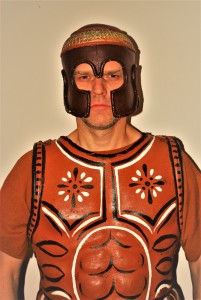
Roman centurion — Andrew Nicholls

“Forget Flavio. He’ll be drunk for the rest of the week. Herod’s coming down about midweek. There’ll be a big wine- swilling bash for the upper crust. He’ll sober up just long enough so he can bow and scrape for Pilate at the right moment. Forget him. We have to save our own hides.”
“All right. So what’s this plan?”
“It’s not some great master scheme, but I do have a few ideas.”
“Yes, get on with it,” he said with obvious interest.
“Well, the way I see it, we have way too little information about whatever is going on here. If there’s some Passover plot being hatched, we need to be the first to know about it. Not like yesterday. I don’t like surprises. Especially Jewish Messiah surprises.”
Renaldo scowled in agreement. “So why the trunk?” he asked.
I had set it down after our greeting, and now it was Keeper, sniffing about it, that brought it to Renaldo’s attention.
“This is one way I can get some information.”
I opened the trunk and pulled out several items of clothing, among them a Jewish prayer shawl and several phylacteries. Holding one of the fringed garments to myself, I announced, “Today I am Benjamin. Benjamin from Alexandria, and I’ve come to celebrate the Passover here, in the holy city, Jerusalem.”
All this was done with a thick Aramaic accent and a mock reverence that left Renaldo slapping his thigh in laughter.
“Marcus, Marcus! Only you could pull this off!” Then he added in a more thoughtful tone, “I could look in on some of our usual sources. They’re bound to know a thing or two about this donkey man.”
“Now you’re thinking.” With a glance to the eastern sky, I added, “Look, we don’t have much time. The sun’s almost up. All my men know their assigned duties, so if you could just look in on them at the barracks, that would be great. I should be back in uniform by noon, and I could meet you there to discuss what we’ve found.”
“No problem . . . Benjamin!” he said, shaking his head and grinning, no doubt contemplating the sight of me in religious garb.
I began to place the clothing back in the trunk, and then I turned to my friend. “Oh,Soldier book by the way, Renaldo, could you check in on Claudius at the Golden Gate? I expect our visiting prophet will be coming back into town by the same way today. Claudius might need a hand.”
“No problem, Marcus.” And then he added in a more serious tone, “Now, you be careful.”
“Yes, well,” I said, sighing, “I think we’ve all got to be careful.”
I swung the trunk up under my arm. With a quick wave of my free hand, I said, “I’m off for an appointment with Jesus of Nazareth.”
To download a free study guide for this high-impact, bible-based novel visit: https://www.davidkitz.ca/centurion.php/free study guide PDF

For book purchases of The Soldier Who Killed a King try Amazon or https://www.christianbook.com

Reading 2 for Lent from The Soldier Who Killed a King

07 Thursday Mar 2019

Posted by davidkitz in Books by David Kitz, Lent

≈ 1 Comment

Tags

Jesus, Lent, Messiah, repentance, revolutionary, The Soldier Who Killed a King

A journey to the cross is a journey to repentance. It’s a journey to deep personal change. Will you take this journey with me?

Soldier bookI could see him clearly now. Donkey or not, he had the look of a man who knew exactly what he was doing. Those about him might not know or understand, but he knew. He had a destination in mind, a purpose. You could see it on his face.
“Hosanna to the Son of David!”
“Blessed is he who comes in the name of the Lord!”
“Hosanna in the highest heaven!”
There was something else different about him. At the time I didn’t know what it was. I couldn’t put it into words for a long time. I think I noticed it because I had watched all those other men come into Rome in their triumphal processionals. They were conquerors, but still they were hollow men, feeding off the adulation of the crowd, thirsting but never satisfied. You could see them vainly drink it in, hoping it would somehow fill the empty soul.
This donkey-riding king wasn’t drinking from the crowd. I somehow sensed he was full already, and what he had within must have come from a different source.
“Hosanna in the highest heaven!”
“Hosanna to the Son of David!”
“Blessed is he who comes in the name of the Lord!”
Just at that moment a strange feeling seemed to rise within me. Maybe it was the joy of the crowd. I had expected anger. Maybe it was the children waving palm branches or the spontaneity of the singing? I don’t know. For one moment it all seemed to come together. It seemed right somehow. Like heaven and earth had finally, for a moment, come into agreement—an agreement that had never been achieved before.
“Hosanna in the highest heaven!”
He was much closer now.
“Hosanna to the Son of David!”
He was now within the shadow of the gate.
“Blessed is he who comes in the name of the Lord!”
At that moment he looked up. For an instant our eyes met. Then I heard a voice—clearly heard a voice say, “I have a future for you.”
I was confused.
I turned to Claudius and said, “What did you mean by that?”
“What did I mean by what?” He had a blank look on his face.
“By what you said about—about the future?”
“I didn’t say anything about the future, sir. I didn’t say anything.”4485 SHARABLE-1
I was totally baffled. Was I hearing voices? This whole thing was making no sense, no sense at all. Passover pilgrims weren’t supposed to come into the city this way. We had a revolutionary on the loose—riding a donkey. And now I was hearing things?
I rubbed the sweat from my forehead, hoping for some clarity to emerge.
I had a hundred men whose lives were in danger from this Jewish Messiah and his horde of followers. That was what mattered.
By this time the donkey man had passed under the gate and was heading in the direction of the temple in the heart of the city.
I signaled for Claudius to follow as I raced down the stairs of the gatehouse. I emerged onto the street and grabbed the first two-legged bit of Jewish scum I saw. Pressing him against the stone wall, I demanded, “Who is that man?”
I pointed at the retreating figure on the donkey.
The poor wretch was in shock and seemed quite unable to get out a word.
Claudius reached for his sword.
“Je- Jesus of Nazareth,” he stammered and then quickly added, “the prophet from Nazareth in Galilee.”
I loosened my grip. Then in a voice loud enough for all near to hear, I announced, “Well, there is one thing I do know. We’re going to have to keep an eye on that man.”

To download a free study guide for this high-impact, bible-based novel visit: https://www.davidkitz.ca/centurion.php/free study guide PDF

For book purchases of The Soldier Who Killed a King try Amazon or https://www.christianbook.com

Ash Wednesday: The Journey Begins

06 Wednesday Mar 2019

Posted by davidkitz in Books by David Kitz, Lent

≈ 1 Comment

Tags

Jerusalem, Lent, Passover, pilgrims, repentance, Son of David

A journey to the cross is a journey to repentance. It’s a journey to deep personal change. Will you take this journey with me?

Four in the afternoon, Sunday, April 2, AD 30
It was never like this before. biblical-fiction-award-2017_orig
I have been posted in Jerusalem for ten years now, but in all that time, I have never seen a Passover crowd like this.
It wasn’t the numbers. I had seen that before.
The Passover pilgrims always come plodding into the city in reverent caravans. Some of them chant psalms. Others are silent, looking bone-weary as they trudge, like fretful herdsmen with children in tow. Undoubtedly, many are relieved that their holy city is finally in view.
But this year it was different. There was this man—at the center of the whole procession. There had never been a central figure before. Every movement within that huge throng seemed focused on him.
Squinting in a futile attempt to get a better view, I gave Claudius a backhanded slap to the shoulder and demanded, “What are they doing?”
“They’re climbing the trees, sir.”
“I can see that!” I snapped. “But what are they doing?”
“They seem to be tearing off the palm branches, sir.”
“What is going on here?” I said it more to myself than to any of the men standing near me. An uncomfortable feeling crept into me as the procession advanced.
“They don’t usually do this?” Claudius questioned.
“No . . . They’ve never done this before.” There was worry in my voice. Claudius had been recently assigned to this place, the festering armpit of the empire, and I was at a loss to explain what was happening before us. We were standing on the wall above the gate of Jerusalem, and less than a half mile away, we could see the jubilant pilgrims surging toward us in alarming numbers.
“They’re laying the palm branches on the road in front of that man—the man on the donkey.”
Until Claudius said it, I hadn’t noticed the donkey. Its small size and the frenzy of activity round about must have obscured this detail in the picture before me. What an odd way for this man to come. I could make no sense of it.
“They’re throwing down their cloaks before him.”
The sweat- glistened bodies of several men were clearly visible. Outer garments were being cast down before this man as a sign of homage. At the same time the rhythmic chanting of their voices became more distinct.
What were they singing? Could I pick up the words?
     “Hosanna to the Son of David!”
     “Blessed is he who comes in the name of the Lord!”
     “Hosanna in the highest heaven!”
That’s when it hit me like a barbarian’s club. I realized what I was witnessing. It was a triumphal entry—the entry of a king.
It was the words. The words they were now boisterously shouting. He was their Messiah. The Son of David! The one they were waiting for! The one who would rid them of the Romans. He would set up his glorious Jewish kingdom, here, in Jerusalem! This is what I had been warned about since the day I first set foot on this cursed Judean soil. And we, I and my men and the garrison in the city, were all that stood in their way.

To download a free study guide for this high-impact, bible-based novel visit: https://www.davidkitz.ca/centurion.php/free study guide PDF

For book purchases of The Soldier Who Killed a King try Amazon or https://www.christianbook.com

Troubled by Sin?

20 Wednesday Feb 2019

Posted by davidkitz in Psalm 38, Psalms

≈ 5 Comments

Tags

blaming God, consequences of sin, Psalm 38, repentance, sin

Reading: Psalm 38
(Verses 17-22)
For I am about to fall,
and my pain is ever with me.
I confess my iniquity;
I am troubled by my sin.
Many have become my enemies without cause;
those who hate me without reason are numerous.
Those who repay my good with evil
lodge accusations against me,
though I seek only to do what is good.
LORD, do not forsake me;
do not be far from me, my God.
Come quickly to help me,
my Lord and my Savior
(NIV).

20190204_2008575

Winter night — photo by David Kitz

Reflection
Today’s reading is the concluding portion of Psalm 38. As noted previously, this entire psalm is a lament over sin, and the trouble and affliction it has brought into David’s life. Rather than blaming others or blaming God, David takes responsibility for his self-inflicted difficulties. In anguish of spirit he cries out, “I confess my iniquity; I am troubled by my sin.”

Are you troubled by your sin, or do you revel in it? Have the consequences of sin started to bite. The writer of the Book of Hebrews tells us that Moses “chose to be mistreated along with the people of God rather than to enjoy the fleeting pleasures of sin” (Hebrews 11:25). There are pleasures in sin for a season, but the long term consequences are pain and death. It would appear from a full reading of this psalm that David is suffering some of the consequences of his misguided sin.

But David has the correct response. He confesses his sin and throws himself upon the mercies of God. Hear his humble plea, “LORD, do not forsake me; do not be far from me, my God. Come quickly to help me, my Lord and my Savior.”

God’s ears are always open to that kind of prayer. We may believe that we have fallen too far –that our sin is too great –that we have sunk too low. But God hears our cry and His grace is sufficient. His mercy knows no bounds. The blood of Christ flows to the lowest valley. He can cleanse the vilest heart, if we call out to Him.

Repentance is a wonderful gift, perhaps the greatest gift of all. At various times in his life David fell into the grip of sin. But David knew how to repent and as a result he found favor in the eyes of God. Discover the gift of repentance today. It’s more than feeling sorry for yourself. It’s a 180-degree turn from pursuing sin to pursuing God.

Response: LORD God, grant me the gift of repentance. I am thankful that Jesus died on the cross to wash me clean. Hallelujah! I want to pursue you, Lord. You are my help and my righteousness. My salvation comes from you. Amen.

Your Turn: Are you troubled by sin? Have you found a remedy?

Confession Breaks the Dam

10 Thursday Jan 2019

Posted by davidkitz in Bible, Devotionals, Psalm 32, Psalms

≈ 2 Comments

Tags

confession, guilt, Holy Spirit, Prayer, repentance, sin, worship

Reading: Psalm 32
Of David. A maskil.
(Verses 1-5)
Blessed is the one
whose transgressions are forgiven,
whose sins are covered.
Blessed is the one
whose sin the L
ORD does not count against them
and in whose spirit is no deceit.
When I kept silent,
my bones wasted away through my groaning all day long.
For day and night your hand was heavy on me;
my strength was sapped as in the heat of summer.
Then I acknowledged my sin to you
and did not cover up my iniquity.
I said, “I will confess my transgressions to the L
ORD.”
And you forgave the guilt of my sin
(NIV).|

20180518a

Along Policeman Creek, Canmore, Alberta — photo by David Kitz

Reflection
A right relationship with God is like a flowing stream. In such a relationship there is a natural giving to God that includes prayer, worship, time spent in His word, and periods of quiet communion. In turn, God by the Holy Spirit pours His peace, love and joy into our lives. And just as trees naturally line a river bank, there is a verdant fruitfulness that comes to the believer as that refreshing current is allowed to flow.

Sin acts like a boulder hindering the flow of God’s Spirit in our lives. As more and more un-repented sin piles up, a dam is formed. Suddenly prayer stops. Worship and thanksgiving that once cascaded so freely from our lips comes to a halt. The word of God becomes boring, and we find other interests. Times of quiet communion with our Maker are replaced by a search for other things like constant entertainment.

This is the state of David’s soul at the start of this psalm. The flow has stopped. Where was the overflowing cup experience of Psalm twenty-three? At this point David’s cup—his soul—is sitting stagnant. And in the natural realm any liquid left unstirred becomes foul as time goes by. David’s spiritual life was turning into a swamp because of unconfessed sin.

But there was a turning point for David: Then I acknowledged my sin to you and did not cover up my iniquity. I said, “I will confess my transgressions to the LORD.”

Confession breaks the dam. David verbally brought his sin out in the open before God. He acknowledged what God knew all along. You see David’s sin and my sin are never hidden from God. Our sin is always in plain sight of the LORD. But praise God! He forgives the guilt of our sin when we break the spiritual dam through confession. Repentance restores the flow.

Response: LORD God, have mercy on me. I acknowledge my sin to you and do not cover up my iniquity. I need your forgiveness. I put my trust in the redeeming sacrifice of your Son, Jesus. Amen.

Your Turn: Has unconfessed sin dammed up the flow of prayer and worship in your life?

The Homesick Captive

17 Friday Aug 2018

Posted by davidkitz in Bible, Devotionals, Psalm 137, Psalms

≈ 6 Comments

Tags

Babylonian exile, God's judgment, idolatry, mercy, Nebuchadnezzar, repentance

Reading: Psalm 137
(Verses 1-6)
By the rivers of Babylon we sat and wept
when we remembered Zion.
There on the poplars we hung our harps,
 for there our captors asked us for songs,
our tormentors demanded songs of joy;
they said, “Sing us one of the songs of Zion!”
How can we sing the songs of the LORD
while in a foreign land?
If I forget you, Jerusalem,
may my right hand forget its skill.
May my tongue cling to the roof of my mouth
if I do not remember you,
if I do not consider Jerusalem my highest joy
(NIV)

20180629_1755245[3574]

The Erechtheum on the Acropolis, Athens, Greece — photo by David Kitz

Reflection
It’s difficult to pinpoint the time in history when many of the Psalms were written. Many scholars believe that the Old Testament was compiled over a period of about 900 to 1,000 years. As for the Book of Psalms, there is considerable evidence to suggest that psalms were collected from three distinct periods: the reign of King David (1 Chronicles 23:5), the rule of Hezekiah (2 Chronicles 29:30), and during the leadership of Ezra and Nehemiah (Nehemiah 12:24).[1]

Psalm 137 is distinct, because we can tell from its content that this psalm was written early during the period of the Babylonian exile. Memories of Nebuchadnezzar’s destruction of Jerusalem in 586 BC were still fresh—etched with bitterness and pain in the mind of the author.

There are two great pivot points in the history of Old Testament Israel. The first is the liberation of Israel from Egypt and the conquest of the holy land. The second is the destruction of Jerusalem and the temple, and the subsequent seventy-year exile in Babylon. The mercy and power of God brought about the first pivotal event. The disobedience and idolatry of man set in motion the catastrophe of the second event.

From its inception the Jewish nation flirted with idolatry. While Moses was receiving the Ten Commandments, the people were reveling before a golden calf. King Solomon set up idols in Jerusalem so his foreign wives could worship their gods. See 1 Kings 11:1-8. This duplicity continued generation after generation until the Babylonians swept in and destroyed Jerusalem. Harsh judgment brought change. Will harsh judgment bring change in us, or will the mercy of God bring us to repentance?

Response: Father God, I don’t want to learn things the hard way. I want to be quick to obey you. Help me to learn from the lessons of history. You are the one, true God. I worship you. Amen.

Your Turn: How faithful are you to the LORD? Do other interests draw you away?

[1] K.R. “Dick” Iverson, Spirit Filled Life Bible, New King James Version, Jack W. Hayford, General Editor, Thomas Nelson Publishers, Nashville, TN, 1991, p. 750.

← Older posts
Newer posts →

Psalms 365: Develop a Life of Worship & Prayer

Psalms 365 Volume II

Psalms 365 vol 3
— Psalms 365 Volume III

Now available:

Psalms

Recent posts

  • The Conclusion of King Solomon’s Prayer June 5, 2026
  • Peter Declares That Jesus Is the Messiah June 4, 2026
  • King Solomon’s Prayer June 4, 2026
  • The Yeast of the Pharisees and Sadducees June 3, 2026
  • Resurrection Truths June 3, 2026
  • The Demand for a Sign June 2, 2026
  • The Elder’s Prayer June 2, 2026

Calendar

June 2026
M T W T F S S
1234567
891011121314
15161718192021
22232425262728
2930  
« May    

Blog Posts

Comments

  • Resurrection Truths | Talmidimblogging on Resurrection Truths
  • atimetoshare.me on Rock of refuge in a changing world
  • davidkitz on Rock of refuge in a changing world

Blog at WordPress.com.

Privacy & Cookies: This site uses cookies. By continuing to use this website, you agree to their use.
To find out more, including how to control cookies, see here: Cookie Policy
  • Subscribe Subscribed
    • I love the Psalms
    • Join 1,354 other subscribers
    • Already have a WordPress.com account? Log in now.
    • I love the Psalms
    • Subscribe Subscribed
    • Sign up
    • Log in
    • Report this content
    • View site in Reader
    • Manage subscriptions
    • Collapse this bar

Loading Comments...