• Home
  • About
  • DavidKitz.ca
  • Youtube Videos
  • Books by David
  • Books on Amazon.com

I love the Psalms

~ Connecting daily with God through the Psalms

I love the Psalms

Tag Archives: Roman centurion

Excerpt 3 for Lent from “The Soldier Who Killed a King”

21 Wednesday Feb 2018

Posted by davidkitz in Books by David Kitz, Lent

≈ 4 Comments

Tags

centurion, David Kitz, Jesus of Nazareth, Jewish prophet, Lent, Marcus, Messiah, Passover, repentance, Roman centurion, The Soldier Who Killed a King

A journey to the cross is a journey to repentance. It’s a journey to deep personal change. Will you take this journey with me?

In today’s reading, Marcus the centurion, meets with his fellow centurion, Renaldo, to discuss their response to what they see as the threat of a Jewish uprising led by a messianic prophet from Galilee.

      “We have to do something. This Jewish prophet is too dangerous.”
“That’s why I came over. I have a plan. It came to me last night.”
“What about Flavio?” Renaldo resumed stroking Keeper. The dog’s silky ears twitched beneath his gentle hand.

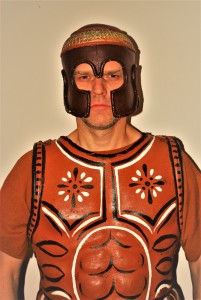
DSC_0060

A Roman centurion — Andrew Nicholls

“Forget Flavio. He’ll be drunk for the rest of the week. Herod’s coming down about midweek. There’ll be a big wine- swilling bash for the upper crust. He’ll sober up just long enough so he can bow and scrape for Pilate at the right moment. Forget him. We have to save our own hides.”
“All right. So what’s this plan?”
“It’s not some great master scheme, but I do have a few ideas.”
“Yes, get on with it,” he said with obvious interest.
“Well, the way I see it, we have way too little information about whatever is going on here. If there’s some Passover plot being hatched, we need to be the first to know about it. Not like yesterday. I don’t like surprises. Especially Jewish Messiah surprises.”
Renaldo scowled in agreement. “So why the trunk?” he asked.
I had set it down after our greeting, and now it was Keeper, sniffing about it, that brought it to Renaldo’s attention.
“This is one way I can get some information.”
I opened the trunk and pulled out several items of clothing, among them a Jewish prayer shawl and several phylacteries. Holding one of the fringed garments to myself, I announced, “Today I am Benjamin. Benjamin from Alexandria, and I’ve come to celebrate the Passover here, in the holy city, Jerusalem.”
All this was done with a thick Aramaic accent and a mock reverence that left Renaldo slapping his thigh in laughter.
“Marcus, Marcus! Only you could pull this off!” Then he added in a more thoughtful tone, “I could look in on some of our usual sources. They’re bound to know a thing or two about this donkey man.”
“Now you’re thinking.” With a glance to the eastern sky, I added, “Look, we don’t have much time. The sun’s almost up. All my men know their assigned duties, so if you could just look in on them at the barracks, that would be great. I should be back in uniform by noon, and I could meet you there to discuss what we’ve found.”
“No problem . . . Benjamin!” he said, shaking his head and grinning, no doubt contemplating the sight of me in religious garb.
I began to place the clothing back in the trunk, and then I turned to my friend. “Oh,Soldier book by the way, Renaldo, could you check in on Claudius at the Golden Gate? I expect our visiting prophet will be coming back into town by the same way today. Claudius might need a hand.”
“No problem, Marcus.” And then he added in a more serious tone, “Now, you be careful.”
“Yes, well,” I said, sighing, “I think we’ve all got to be careful.”
I swung the trunk up under my arm. With a quick wave of my free hand, I said, “I’m off for an appointment with Jesus of Nazareth.”


Holy Week Through the Eyes of a Roman Centurion

28 Saturday Oct 2017

Posted by davidkitz in book review, Books by David Kitz, Psalms

≈ Leave a comment

Tags

Barabas, Biblical fiction, Easter, Jesus, King Herod, Longinus, Pontius Pilate, Roman centurion, terrorist

A stunning story of Holy Week through the eyes of a Roman centurion

Watch the triumphal entry of the donkey-riding king through the eyes of Marcus Longinus, the centurion charged with keeping the streets from erupting into open rebellion.

Look behind the scenes at the political plotting of King Herod, known as the scheming Fox for his ruthless shrewdness.

Get a front-row seat to the confrontation between the Jewish high priest Caiaphas and the Roman governor Pontius Pilate.

Understand as never before the horror of the decision to save a brutal terrorist in order to condemn the peaceful Jew to death.

If you’ve heard the story of Passion Week so often it’s become stale, now is the time to rediscover the terrible events leading from Jesus’s humble ride into the city to his crucifixion. The Soldier Who Killed a King will stun you afresh with how completely Christ’s resurrection changed history, one life at a time.

A Review by Laura Davis Soldier book
I love Biblical Fiction and this story, written from the perspective of the Roman centurion who nailed Jesus to the cross, is a keeper. We don’t often get a glimpse into the minds of those who had contact with Jesus, and the author, David Kitz, did an excellent job in drawing me into the story.

Kitz did an incredible job of making me feel like I was there. I could clearly see the blood on the centurion’s hand and feel his anger over having to kill what he considered, an innocent man. I never considered before how the soldiers would have reacted at having to release a known terrorist – Barabas – in favour of a “harmless” prophet from Galilee. And when Marcus (the centurion) realizes who Jesus really is and his subsequent transformation because of it, well . . . you almost forget it is fiction.

I loved this story and you will too! A great novel to read at Easter, but more importantly at any time of the year.


Absolutely Stunning!

27 Wednesday Sep 2017

Posted by davidkitz in book review, Books by David Kitz, Psalms

≈ 2 Comments

Tags

author, book, Christ, crucified, crucifixion, David Kitz, movie, Roman centurion, The Soldier Who Killed a King

An Amazon Book Review by CafinatedReads2009

When it comes to fiction books that are centered around Biblical times, it takes a really good author to hook me into the story line. Don’t get me wrong, I love reading my Bible, however, not every author can create a story that brings the Biblical portion off the book pages and to the reader like a movie screen. David Kitz, however, truly hooked me with this book, and took me on a first-class whirlwind ride through history.

I absolutely felt every emotion of this book, watching, most often on the edge of my seat, Soldier bookas Christ was crucified. This book really brings to life the Biblical and the historical detail. As I watched the Roman centurion who was tasked with awful task, I found myself with tears in my eyes, both for him, and for Christ. It was a heart-wrenching, gut twisting, thought provoking story of sacrifice and pain.

This book……anything less than a 5 star review would be a disgrace. The style of which David Kitz wrote this novel is stunning and captivating.

This book is definitely not for everyone though. If you are a reader of Biblical fiction, if you want to see what happened during that eventful week in time, then this book is for you. You will not be disappointed and you will want more! I know I am already ready for another beautifully written novel of Biblical times by this superbly talented author! Grab The Soldier Who Killed a King and be prepared for a jaw dropping experience of watching the crucifixion come into play.

REVIEW OF: The Soldier Who Killed a King

31 Thursday Aug 2017

Posted by davidkitz in Books by David Kitz, Psalms

≈ 6 Comments

Tags

author, Barabbas, Bible, Canadian Bible Society, centurion, Christian, crucifixion, David Kitz, Easter, gospel, historic novel, historical research, Jesus, Passion Week, plot, Roman centurion, terrorist, The Soldier Who Killed a King

REVIEW OF: The Soldier Who Killed a King
SUB-TITLE: A True Retelling of the Passion
PUBLISHER: Kregel Publishing, 2017, 285 pages Soldier book
CLASSIFICATION: Historical Christian fiction
ISBN: 978-0-8254-4485-2
AUTHOR: David Kitz

BY: Wilf Wight, Director, (retired)
Eastern Ontario District
Canadian Bible Society

Maybe it is because I am left-handed, or maybe it demonstrates impatience, but when I first pick up any book, I invariably flip to the concluding pages. Call me a cheater if you will, but I am looking for a conclusion worthy of the time required to read the book! When I turned to the back of The Soldier Who Killed a King, the concluding pages of this story accomplished what every well-written book should do. The author reached back into the plot for a brief review and then projected the reader toward the future. In this case, the plot obviously had elements of violence and suffering which were being transformed through forgiveness and healing. And the future held promise of hope and excitement.

My attention next is concentrated on the first couple of chapters. Has the author grasped my attention in the opening paragraphs? Was sufficient detail given to introduce the plot, while only hinting at more intrigue to follow? Were the characters being carefully introduced in a way that begged my investigation? Yes, the author passed the basic tests. He had been successful in reaching out to me and I wanted to read this book!

Our western world has had major exposure to the Christian Gospel and most readers know at least something of what has come to be known as Holy Week, the week between Palm Sunday and Easter. However, the Bible makes only passing reference to two of the main characters in the story, the Centurion (military officer) who carried out the crucifixion and Barabbas (the convicted murderer) released by the authorities. The author seizes upon this opportunity to give them personalities, develop their thoughts and articulate their opinions. This proved to be a clever and effective tool to experience the unfolding of the drama in a fresh perspective.

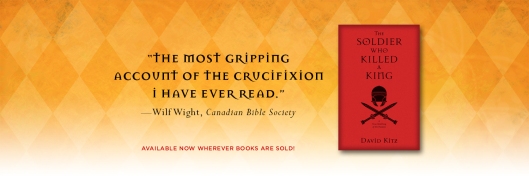
For readers who have the mistaken idea that the biblical account is far removed from reality, here is fiction that will help them discover truth. As the author effectively paints the picture of the process of first century justice, political influence and compromise become realities. We cringe as the sentence is carried out by the most cruel and violent method. This is the most gripping account of the crucifixion that I have ever read! One could almost hear the hammer fall, feel the pain, sense the dishonor and share the guilt of that scene. After reading the description of the crucifixion of the first two victims, I hesitated, in fact halted.  I was not sure if I wanted to tackle the third one—that of the Christ. And yet, despite the graphic description of this horrible experience, the author accomplished his goal without resorting to gross descriptions of the mangled human body.

We are confronted with the enigma of the Christ. He is the one who has demonstrated miraculous power to heal the lame and restore sight to the blind. He is the one who gently took children on his knee to teach them. Yet he set aside the exercise of his powers to submit to the terror of the Cross. The terrorist, Barabbas, was released—set free from prison and back into society—as the peoples’ alternative choice. And the sentence was carried out under Pilate’s  orders by the Soldier. Through the eyes of these two characters we see another perspective, which does not usually come to the mind of the worshiper during Passion Week.

One device the author uses effectively is the introduction of each chapter with a day and time orientation. In this way the unfolding of the drama is situated on the calendar. Those who know the biblical account realize that Friday is coming but that is not the end of the story because Easter Sunday will be the revelation of the resurrected Christ.

As we approach the chapter dealing with Easter Sunday, the reader is rewarded with the hope and excitement of an amazing new day. The darkness of the crucifixion is not forgotten but rather dims in the light of the resurrection. The despair of death is replaced by the hope of new life. The willing submission of Jesus, the Donkey King, to the soldiers is now recast as the power of the One who can forgive and restore.

The concluding pages of the story bring us to a climax, so well-crafted and tensioned that I dare not give it away.

The epilogue provides further details of the main characters of the plot, gleaned from historical research. The endnotes reference biblical and other texts, which document the main course of events. The author has done his homework. His account of these events is well researched and credible.

4485 TWITTER


The Soldier Who Killed a King

19 Saturday Aug 2017

Posted by davidkitz in Books by David Kitz, Psalms

≈ 5 Comments

Tags

5 star review, biblical, Biblical fiction, Christ, crucifixion, David Kitz, emotion, Roman centurion, soldier, The Soldier Who Killed a King

The ebook version of my Passion of Christ novel is available for just $0.99 for the next 24 hours on Amazon.

Here is a look at the most recent Amazon review:

4485-e BLOG 160x375When it comes to fiction books that are centered around Biblical times, it takes a really good author to hook me into the story line. Don’t get me wrong, I love reading my Bible, however, not every author can create a story that brings the Biblical portion off the book pages and to the reader like a movie screen. David Kitz, however, truly hooked me with this book, and took me on a first-class whirlwind ride through history. 

I absolutely felt every emotion of this book, watching, most often on the edge of my seat, as Christ was crucified. This book really brings to life the Biblical and the historical detail. As I watched the Roman Centurion who was tasked with awful task, I found myself with tears in my eyes, both for him, and for Christ. It was a heart-wrenching, gut twisting, thought provoking story of sacrifice and pain. 

This book……anything less than a 5 star review would be a disgrace. The style of which David Kitz wrote this novel is stunning and captivating. This book is definitely not for everyone though. If you are a reader of Biblical fiction, if you want to see what happened during that eventful week in time, then this book is for you. You will not be disappointed and you will want more! I know I am already ready for another beautifully written novel of Biblical times by this superbly talented author! Grab this book and be prepared for a jaw dropping experience of watching the crucifixion come into play. 

CafinatedReads2009


Read a Chapter

08 Thursday Jun 2017

Posted by davidkitz in Books by David Kitz, Psalms

≈ Leave a comment

Tags

centurion, Christ's Passion, David Kitz, donkey, historic novel, Hosanna, Jerusalem, Jesus of Nazareth, Kregel, palm branches, Passion Week, Passover, Roman centurion, Son of David

Four in the afternoon, Sunday, April 2, AD 30

It was never like this before.

I have been posted here, in Jerusalem for ten years now, but in all that time I had never seen a Passover crowd like this. It was not the numbers. I had seen that before.

What made the big difference was the person at the center of it all. You see there had never been a central figure before. The Passover pilgrims just came plodding into the city in reverent caravans. Some of them would be chanting psalms. Others were silent; looking bone weary as they trudged, like fretful herdsmen with children in tow. Undoubtedly many were relieved that their holy city was finally in view.

Soldier bookBut, this year it was different. There was this man – at the center of the whole procession. Every movement within that huge throng seemed focused on him.

Squinting in a futile attempt to get a better view, I gave Claudius a backhanded slap to the shoulder and demanded, “What are they doing?”

“They’re climbing the trees, sir.”

“I can see that!” I snapped impatiently, “But what are they doing?”

“They seem to be tearing off the palm branches, sir.”

“What is going on here?” I said it more to myself than to any of the men standing near me. An uncomfortable feeling crept into me as the procession advanced.

“They don’t usually do this?” Claudius questioned.

“No.  . . .  They’ve never done this before.” There was worry in my voice.

Claudius had been recently assigned to this place, the festering armpit of the Empire, and I was at a loss to explain what was happening before us. We were standing on the wall above the gate of Jerusalem, and there less than a half mile ahead of us, we could see the jubilant pilgrims surging toward us, in numbers that were alarming.

“They’re laying the palm branches on the road in front of that man – the man on the donkey.”

Until Claudius said it, I had not noticed the donkey. Its small size, and the frenzy of activity round about, must have obscured this detail in the picture before me. What an odd way for this man to come? I could make no sense of it.

“They’re throwing down their cloaks before him.”

The sweat-glistened bodies of several men were clearly visible. Outer garments were being cast down as a sign of homage before this man. At the same time the rhythmic chanting of their voices became more distinct.

What were they singing? Could I pick up the words?

“Hosanna to the Son of David!
Blessed is he who comes in the name of the Lord!
Hosanna in the highest!”[i]

That’s when it hit me like a barbarian’s club. I realized what I was witnessing. It was a triumphal entry – the entry of a king.

It was the words.  The words they were now boisterously shouting. He was their Messiah. The son of David! The one they were waiting for! The one who would rid them of the Romans. He would set up his glorious Jewish kingdom, here, in Jerusalem! This is what I had been warned about since the day I first set foot on this cursed Judean soil.

And we, I and my men, and the garrison in the city, were all that stood in their way.

This crowd of thousands was sweeping down the Mount of Olives into the Kidron Valley and then on toward us. They advanced like a huge human wave about to collide with the rock hewn palisades on which we stood.

Would they sweep us away?

My initial curiosity had grown into worry. Now in an instant my worry turned to alarm. Instinctively, everything within me shouted, “Stand! Resist! Be a Roman!”

We had soldiers posted all about the city, especially along the pilgrim route. My own hundred men were among the first to be deployed. During Jewish feasts like this we made certain we were highly visible. I dreaded what might happen if this crowd ran wild. Rioting could erupt, and with an impassioned throng such as this riots have a way of quickly turning deadly.

For several moments a debate raged in my mind. Should I order the gate closed to keep this rabble with their pretender king out of the city? Or, should I let everything proceed – let it proceed as though somehow, we had not taken note of what was going on?

“Stand! Ready for orders!” I shouted above the swelling din. The sentinels on the wall snapped to attention.

I hastily scanned the crowd for any sign of weapons, any hint of armed treachery. To my surprise I saw none. They were paying no attention to us. Everyone was caught up with hailing this man, the man on the donkey.

The front edges of the crowd had now reached the first platoon of eight men that I had positioned by the roadside about four hundred yards before the gate. But they ignored them, sweeping past the clump of soldiers, without so much as creating a ripple, like a round stone in a swift flowing stream.

At that moment I knew it made no sense to lower the gate. It would only enrage this crowd that was already fully aroused and moving as one.

Let them come. We’ll handle them and their king inside the city.

Their king. On a donkey. I could only shake my head in disbelief.

I had watched many a triumphal entry, while growing up in Rome, and the conquering hero always rode a gallant war horse. And as a boy, I too had  dreams of personal glory. But a donkey? It could only happen here, I thought with an incredulous grin.

I could see him clearly now. Donkey or not, he had the look of a man who knew exactly what he was doing. Those about him might not know, or understand, but he knew. He had a destination in mind, a purpose. You could see it on his face.

“Hosanna to the Son of David!
Blessed is he who comes in the name of the Lord!”
Hosanna in the highest!”

There was something else that was different about him. At the time I did not know what it was. I could not put it into words for a long time. I think I noticed it because I had watched all those other men come into Rome in their triumphal processionals. They were conquerors, but still they were hollow men, feeding off of the adulation of the crowd, thirsting but never satisfied. You could see them vainly drink it in, hoping it would somehow fill the empty soul.

He was not drinking from the crowd. I somehow sensed he was full already, and what he had within, must have come from a different source.

“Hosanna in the highest!
Hosanna to the Son of David!
Blessed is he who comes in the name of the Lord!”

Just at that moment a strange feeling seemed to rise within me. Maybe it was the joy of the crowd. I had expected anger. Maybe it was the children waving the palm branches, or the spontaneity of the singing? I don’t know. For one moment it all seemed to come together. It seemed right somehow. Like heaven and earth had finally, for a moment, come into agreement – an agreement that had never been achieved before.

“Hosanna in the highest!”
He was much closer now.
“Hosanna to the Son of David!”
He was now within the shadow of the gate.
“Blessed is he who comes in the name of the Lord!”

At that moment he looked up. For an instant our eyes met. Then I heard a voice – clearly heard a voice say, “I have a future for you.”

I was confused.

I turned to Claudius and said, “What did you mean by that?”

“What did I mean by what?” He had a blank look on his face.

“By what you said about – about the future?”

“I didn’t say anything about the future, Sir. I didn’t say anything.”

Now I was totally baffled. Was I hearing voices? This whole thing was making no sense, no sense at all. Passover pilgrims are not supposed to come into the city this way. We’ve got a revolutionary on the loose – riding a donkey. And now I’m hearing things?

I rubbed the sweat from my forehead, hoping for some clarity to emerge out of all this.

I had a hundred men whose lives were in danger from this Jewish messiah, and his horde of followers. That’s what mattered now.

By this time the donkey man had passed under the gate and was heading in the direction of the temple in the heart of the city.

I signaled for Claudius to follow, as I raced down the stairs of the gatehouse. As I emerged onto the street, I grabbed the first two-legged bit of Jewish scum I saw. Pressing him against the stone wall I demanded, “Who is that man?” At the same time I pointed at the retreating figure on the donkey.

The poor wretch was in shock and seemed quite unable to get out a word.
Claudius reached for his sword.

“Je – Jesus of Nazareth!” He stammered and then quickly added, “The prophet from Nazareth in Galilee.”

I loosened my grip. Then in a voice loud enough for all near to hear I announced, “Well there is one thing I do know. We’re going to have to keep an eye on that man.”

  • For the month of June The Soldier Who Killed a King is available for preorder from Kregel Publishing for the early bird price of $10.99. The worldwide release date is July 25th.
  • Place your order today: http://www.kregel.com/fiction/the-soldier-who-killed-a-king/

Foreword

06 Tuesday Jun 2017

Posted by davidkitz in Books by David Kitz, Psalms

≈ 4 Comments

Tags

Barry Buzza, David Kitz, donkey, eyewitness, Foursquare Church, geopolitical center, kingdom, pagan, religious bigots, Roman centurion, Roman tyranny, soldier, tyranny

What would it have been like to live in the geopolitical center of the first-century world, when donkeys and camels were the cars and trucks, conversations over goblets of wine were the social media, and religious conflict influenced every facet of life? What would it have been like to live under the pagan, political domination of Roman tyranny, while also under the oppressive ritualistic control of hypocritical religious bigots? What would it have been like to live in the very week that this dark, confused world was invaded by heaven—a week when history shifted from BC to AD?

Soldier bookThis gripping story offers its readers a front-row seat from which we can view the action. It’s a hidden camera on the helmet of a primary witness of the history-altering drama when the Sovereign of the Universe, quietly riding a lowly donkey, overthrew the pomp and dominion of the most powerful kingdom this world had ever known. More than that, it’s a look into the mind and heart of a man, not unlike you or me, who wrestled with the meaning and purpose of life.

As you read the thoughtful eyewitness account of Marcus Longinus, the Roman centurion, the soldier who killed a king, you’ll feel his anxiety and anguish as well as exult in his ultimate answers because—despite the differences of time and culture—his story is our story.

Dr. Barry Buzza
President Emeritus
Foursquare Gospel Church of Canada

For the month of June The Soldier Who Killed a King is available for preorder from Kregel Publishing for the early bird price of $10.99. The worldwide release date is July 25th.

Place your order today: http://www.kregel.com/fiction/the-soldier-who-killed-a-king/
Newer posts →

Psalms 365: Develop a Life of Worship and Prayer

Psalms 365 Volume II

Psalms 365 vol 3
— Psalms 365 Volume III

Psalms

Recent posts

  • Generosity Is Never out of Season February 19, 2026
  • Givers & Takers February 19, 2026
  • Teach Me Your Paths February 18, 2026
  • Who holds you up? February 18, 2026
  • A Lesson from the Flowers February 17, 2026
  • Do not fret February 17, 2026
  • Minds Set on Things Above February 16, 2026

Calendar

February 2026
M T W T F S S
 1
2345678
9101112131415
16171819202122
232425262728  
« Jan    

Blog Posts

Comments

  • davidkitz on Teach Me Your Paths
  • K.L. Hale on Teach Me Your Paths
  • davidkitz on An Unflattering View of Yourself

Blog at WordPress.com.

Privacy & Cookies: This site uses cookies. By continuing to use this website, you agree to their use.
To find out more, including how to control cookies, see here: Cookie Policy
  • Subscribe Subscribed
    • I love the Psalms
    • Join 1,385 other subscribers
    • Already have a WordPress.com account? Log in now.
    • I love the Psalms
    • Subscribe Subscribed
    • Sign up
    • Log in
    • Report this content
    • View site in Reader
    • Manage subscriptions
    • Collapse this bar
 

Loading Comments...