I will praise Him!
-

Where evening fades — photo courtesy of Eric Wright

08 Saturday Apr 2017
Where evening fades — photo courtesy of Eric Wright
13 Monday Mar 2017
Reading: Psalm 136
(Verses 17-26)
to him who struck down great kings,
His love endures forever.
and killed mighty kings—
His love endures forever.
Sihon king of the Amorites
His love endures forever.
and Og king of Bashan—
His love endures forever.
and gave their land as an inheritance,
His love endures forever.
an inheritance to his servant Israel.
His love endures forever.
He remembered us in our low estate
His love endures forever.
and freed us from our enemies.
His love endures forever.
He gives food to every creature.
His love endures forever.
Give thanks to the God of heaven.
His love endures forever (NIV).
Reflection
In recent months I have transitioned from attending an established church to involvement in a new church plant. In many respects the change has been refreshing. This new church has a clear focus on reaching the lost in our city, specifically those who are trapped in addictions. Almost weekly new converts are coming forward to put their trust in Christ. The church itself is a place of transition, as deadly habits are broken, and the healing power of Jesus is applied to long festering inner wounds.

Jesus said, “I am the gate” (John 10:9) — photo by David Kitz
So how does this connect with our reading from Psalm 136? In his description of Israel, the psalmist makes this statement: He remembered us in our low estate… and freed us from our enemies.
We serve a God who rescues us at our lowest point, in our low estate. In our foolish pride, we would never turn to God. But when we hit bottom—when there is no way forward, put up—then we turn to the Lord. You see, Christ has been patiently waiting for us to acknowledge our need. But Jesus doesn’t rescue the proud. He doesn’t save those who see no need for salvation. He only comes to the humble—those who admit they need a lift from the hole they find themselves in.
Sadly, there are many who sit in fine churches that have never discovered their low estate. Actually, they have become experts at hiding it. We all have a secret addiction to sin. Even St. Paul wrote, “For I do not do the good I want to do, but the evil I do not want to do—this I keep on doing” (Romans 7:19). The only one who can turn us around is Jesus, our Savior. See Romans 7:25.
Response: Father God, I admit my need for Jesus, my Savior. His love endures forever. Amen.
Your Turn: Why do we hide our sins rather than confess them? Does pride hold us back?
19 Sunday Feb 2017
Posted in Psalms, Sunday's Psalm

Sunset photo courtesy of Liz Kranz
14 Tuesday Feb 2017
Tags
Israel, Jesus, Messiah, Prayer, prophetic, redeem, Redeemer, redemption, Savior, the LORD, waiting, waiting on God
Reading: Psalm 130
(Verses 5-8)
I wait for the LORD, my whole being waits,
and in his word I put my hope.
I wait for the LORD
more than watchmen wait for the morning,
more than watchmen wait for the morning.
Israel, put your hope in the LORD,
for with the LORD is unfailing love
and with him is full redemption.
He himself will redeem Israel
from all their sins (NIV).
Reflection
Psalm 130 can be divided into three distinct sections: the confessional approach, the wait, and the LORD’s response. In yesterday’s reading, we looked at the confessional approach. The psalmist came before his God and poured out his heart. In desperation he pleaded for mercy and forgiveness. At the same time he acknowledged the extreme mercy of God. He knows full well that this God forgives the undeserving.

Joy comes in the morning — photo by David Kitz
Now, the psalmist waits: “I wait for the LORD, my soul waits, and in his word I put my hope. My soul waits for the LORD more than watchmen wait for the morning, more than watchmen wait for the morning.”
This is the step that is most frequently missing in our communion with God. We cannot wait; we rush on. We have things to do, people to see, a life to live. We have no time to wait for the LORD’s response. But without waiting, we cannot hear the LORD speaking to our hearts. The rush of life takes over. We do not hear our Savior speak the words of divine pardon. Prayer is reduced to one way communication. We speak into the silence, and allow no time for the God of silence to answer back.
But in his time of silence, the psalmist heard from God. In this third section of the psalm, the author is no longer addressing the LORD in prayer. Now he is addresses us. The wait is over. God has spoken, and now the psalmist rises to his feet. He has a message from the LORD for us—the Israel of God.
Israel, put your hope in the LORD, for with the LORD is unfailing love and with him is full redemption.
For Israel, there was a long wait. The promised Messiah was a long time in coming. The centuries slipped by. Generation after generation passed on, but the word of the LORD stood firm. A Redeemer was coming. With an uncanny accuracy the Old Testament prophets foretold the coming of the Christ. Many of those prophetic words are found in the Psalms. The Lord Jesus is our fount of hope—our Redeemer. He is love and the source of unfailing love. It is he who with his blood redeemed us, body, soul and spirit. In the person of Jesus, God took on human flesh. On the cross he fulfilled these words. “He himself will redeem Israel from all their sins.”
Now that’s a heaven sent valentine!
Response: Father God, I thank you for your prophetic word because it points to Jesus. Lord Jesus, thank you for laying down your life to redeem me, and all those who bow before you in repentance. Amen.
Your Turn: Are you taking time to listen for the voice of God in prayer?
30 Monday Jan 2017
Tags
God, lament, peace, peace with God, pilgrim, pilgrimage, prodigal, Psalms, Psalms of Ascent, Savior
Reading: Psalm 120
A song of ascents.
I call on the LORD in my distress,
and he answers me.
Save me, LORD, from lying lips
and from deceitful tongues.
What will he do to you,
and what more besides,
you deceitful tongue?
He will punish you with a warrior’s sharp arrows,
with burning coals of the broom bush.
Woe to me that I dwell in Meshek,
that I live among the tents of Kedar!
Too long have I lived
among those who hate peace.
I am for peace;
but when I speak, they are for war (NIV).
Reflection
Psalm 120 is the first in a series of fourteen psalms that are called Songs of Ascent. Each psalm begins with this statement or title: A Song of Ascents. Some of the psalms also add this phrase: Of David.

The pilgrim’s journey — photo by David Kitz
Of course, this title begs the question, what are the Songs of Ascent? And furthermore, to what are we ascending? This compilation of fourteen psalms was composed for the use of pilgrims who were making their way to worship at the temple in Jerusalem. These are psalms of pilgrimage. They are called Songs of Ascent, or Psalms of Ascent, because Jerusalem is built on a high point in the land of Israel. Specifically, the temple compound was constructed at the summit of Mount Zion, so pilgrims were literally and figuratively ascending to worship at the House of God.
This first psalm in the series is really a lament. The psalmist is living in a distant place—a place far from God. All of us begin our pilgrimage—our journey to God—from a distant place. Just like the prodigal we find ourselves in a distant land, a land where there is no peace. Sin has its fleeting pleasures, but it brings no lasting peace, no deep contentment. We have wandered far from the Father’s warm embrace. The psalmist laments, “Woe to me that I dwell in Meshek, that I live among the tents of Kedar!”
The Songs of Ascent are all about drawing near to God. They are about going to the heart of worship and finding peace—true peace in the arms of God. But first we must recognize where we are. We are dwelling in Meshek—in a world far from the LORD. We need to acknowledge our true condition. Change happens when we recognize the truth about ourselves and our need for a Savior. Only then can we begin our journey toward peace.
Have faith in this promise. I call on the LORD in my distress, and he answers me.
Response: Father God, today I am continuing my journey toward you. Lord Jesus, I need you as my Savior. Help me set aside those things that hinder my journey to intimacy with you. Amen.
Your Turn: Are you living in Meshek? Have you begun your pilgrimage to arms of the Father?
06 Sunday Nov 2016
Posted in Psalms, Sunday's Psalm
31 Monday Oct 2016
Tags
breath, death, eternal life, Jesus Christ, life, Psalms, Savior, spirit, the LORD
Reading: Psalm 104
(Verses 27-35)
All creatures look to you
to give them their food at the proper time.
When you give it to them, they gather it up;
when you open your hand, they are satisfied with good things.
When you hide your face, they are terrified;
when you take away their breath, they die and return to the dust.
When you send your Spirit, they are created,
and you renew the face of the ground.
May the glory of the LORD endure forever;
may the LORD rejoice in his works—
he who looks at the earth, and it trembles,
who touches the mountains, and they smoke.
I will sing to the LORD all my life;
I will sing praise to my God as long as I live.
May my meditation be pleasing to him,
as I rejoice in the LORD.
But may sinners vanish from the earth
and the wicked be no more.
Praise the LORD, my soul. Praise the LORD (NIV).
Reflection
Yesterday, my wife and I attended the funeral of my brother-in-law, Victor. He was a man of deep faith, who was always active in the church. At no point was he ashamed to call himself a follower of his Lord and Savior, Jesus Christ. Victor loved his Savior and I am sure his spirit rejoiced to see Jesus face to face.

You renew the face of the ground — photo by David Kitz
There is a line from today’s reading from Psalm 104 which is particularly relevant as we think about life and death: when you take away their breath, they die and return to the dust. When you send your Spirit, they are created, and you renew the face of the ground.
In context of this psalm, the author was speaking of all creatures, in other words the animal kingdom, but these words apply to all that breathes the breath of life, including humans. For Victor, who struggled for every breath during the last years of his life, the words of this psalm had true meaning. But the second part of this psalm reading is also pertinent in the context of a funeral: When you send your Spirit, they are created.
I believe in the resurrection of the dead. The grave is not the final end for those who have placed their faith in Christ. A great re-creation will happen. The grave could not hold Jesus, and a day is coming when it will not hold Victor or any who have died in the faith. For the Lord himself will come down from heaven, with a loud command, with the voice of the archangel and with the trumpet call of God, and the dead in Christ will rise first (1 Thessalonians 4:16).
Response: Father God, send your reviving Spirit. Come, Lord Jesus. I long for your return. Amen.
Your Turn: Do you believe in the resurrection of the dead?
14 Friday Oct 2016
Reading: Psalm 102
A prayer of an afflicted person who has grown weak
and pours out a lament before the LORD.
(Verses 1-11)
Hear my prayer, LORD;
let my cry for help come to you.
Do not hide your face from me when I am in distress.
Turn your ear to me; when I call, answer me quickly.
For my days vanish like smoke;
my bones burn like glowing embers.
My heart is blighted and withered like grass;
I forget to eat my food.
In my distress I groan aloud and am reduced to skin and bones.
I am like a desert owl, like an owl among the ruins.
I lie awake; I have become like a bird alone on a roof.
All day long my enemies taunt me;
those who rail against me use my name as a curse.
For I eat ashes as my food and mingle my drink with tears
because of your great wrath,
for you have taken me up and thrown me aside.
My days are like the evening shadow;
I wither away like grass (NIV).
Reflection
If you have watched a friend or family member wither away due to the devastating effects of cancer, then you should have no difficulty identifying with the thoughts expressed here in this psalm. An enemy (cancer) is gnawing away at their very being. A sense of hopelessness and despair can easily settle in.
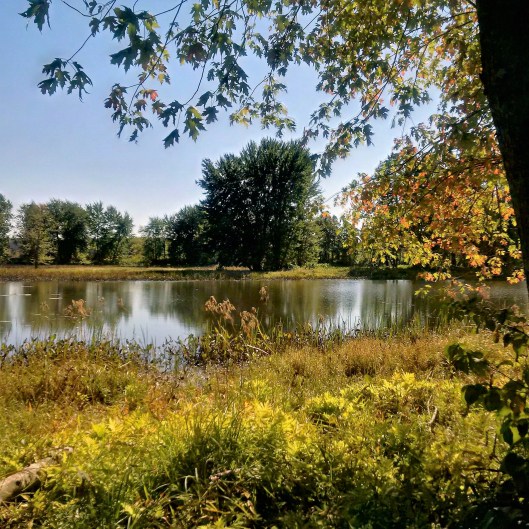
Petrie Island Park, Ottawa, ON — photo by David Kitz
This is when we need God the most, but in our distress He can seem strangely distant. Our cries seem to fall on deaf ears.
But…
But God is still there. Our faith may be shaken, but our LORD remains. Death may come knocking, but our LORD remains. Friends and family may forsake us, but Jesus remains by our side. Bad news does not take God by surprise. Though He is not the author of the bad news, our Lord knows what’s coming around the next bend in the road. He is prepared though we may not be. The Lord’s provisions are in place. Trust Him for that.
When the bottom falls out of your life, God is there to catch you. Trust Him for that. Though I may wither away like grass, I have a Savior who will receive me. Trust Him for that.
Response: Father God, when bad news comes I look to you. I call to you! Be my help when all human help and hope are gone. Lord Jesus, you are my Savior. In this moment I trust you for that! Amen.
Your Turn: Have you received bad news recently? Have you taken it all to the Lord?
04 Tuesday Oct 2016
Tags
blood, God, Jesus, Petrie Island, Psalm, resurrection, salvation, Savior, sing, the cross
Reading: Psalm 98
A psalm.
Verses 1-6
Sing to the LORD a new song,
for he has done marvelous things;
his right hand and his holy arm
have worked salvation for him.
The LORD has made his salvation known
and revealed his righteousness to the nations.
He has remembered his love
and his faithfulness to Israel;
all the ends of the earth have seen
the salvation of our God.
Shout for joy to the LORD, all the earth,
burst into jubilant song with music;
make music to the LORD with the harp,
with the harp and the sound of singing,
with trumpets and the blast of the ram’s horn—
shout for joy before the LORD, the King (NIV).
Reflection
Once again in Psalm 98 the psalmist calls us to break forth with a new song of praise to our God. This call to worship is a frequent theme in many psalms. In this case the cause for worship is well worth noting. We are to worship in music and song because of the salvation of our God. The LORD has made his salvation known and revealed his righteousness to the nations. He has remembered his love and his faithfulness to Israel; all the ends of the earth have seen the salvation of our God.

Petrie Island sunset — photo by David Kitz
To some extent these words trouble me. What salvation is the psalmist talking about? Is he referring to the miraculous redemption and rescue of Israel from slavery in Egypt? That’s the most significant act of national salvation in the Old Testament. On the other hand, the psalmist could be referring to the restoration of the Jewish nation after the destruction of the temple and the Babylonian captivity. Again this is a very significant event that was witnessed by the surrounding nations. Since we do not have a timeline or date for when this psalm was written, we are left guessing the answer.
For the New Testament believer we see the fulfillment of this psalm in the salvation that was won for us by Christ at the cross. There the ancient powers of sin, hell and the grave were defeated. Death itself was vanquished through the resurrection of Jesus. In reality, the true enemies of the people of God are not foreigners or foreign nations. Our enemies are spiritual; they lurk within—within us. Salvation from those enemies was purchased at the cross with the precious blood of Jesus.
Now here is a bizarre twist. Salvation arrives when we stop fighting. It arrives with our surrender. It arrives when we surrender our lives to our Savior and kneel before our King on a cross. That’s a salvation worth singing about!
Response: LORD God, I am so grateful for the salvation you purchased for me through the blood of Jesus. I want all the ends of the earth to know about that great salvation. Thank you, Jesus. Amen.
Your Turn: Have you knelt before the King on a cross? Take some time to do that now.


 I love the Psalms