• Home
  • About
  • DavidKitz.ca
  • Youtube Videos
  • Books by David
  • Books on Amazon.com

I love the Psalms

~ Connecting daily with God through the Psalms

I love the Psalms

Tag Archives: servant

A Thank Offering to You

09 Sunday Nov 2025

Posted by davidkitz in Psalm 116

≈ 2 Comments

Tags

Jerusalem, praise the LORD, Prayer, Psalms, sacrifice, servant, servant of the LORD, the LORD, vows

I will praise the LORD!


Psalm 116:15-19

Precious in the sight of the LORD
    is the death of his faithful servants.
Truly I am your servant, LORD;
    I serve you just as my mother did;
    you have freed me from my chains.
I will sacrifice a thank offering to you
and call on the name of the LORD.
I will fulfill my vows to the LORD
in the presence of all his people,
in the courts of the house of the LORD—
in your midst, Jerusalem.
Praise the LORD. *


Para la publicación de 
Salmos 365 de hoy en español haga clic aquí.

bgbg_v4.3_1501818
* NEW INTERNATIONAL VERSION, COPYRIGHT ©1973, 1978, 1984, 2011 BY BIBLICA

Please pray for peace to return to Israel, Gaza, and Ukraine!

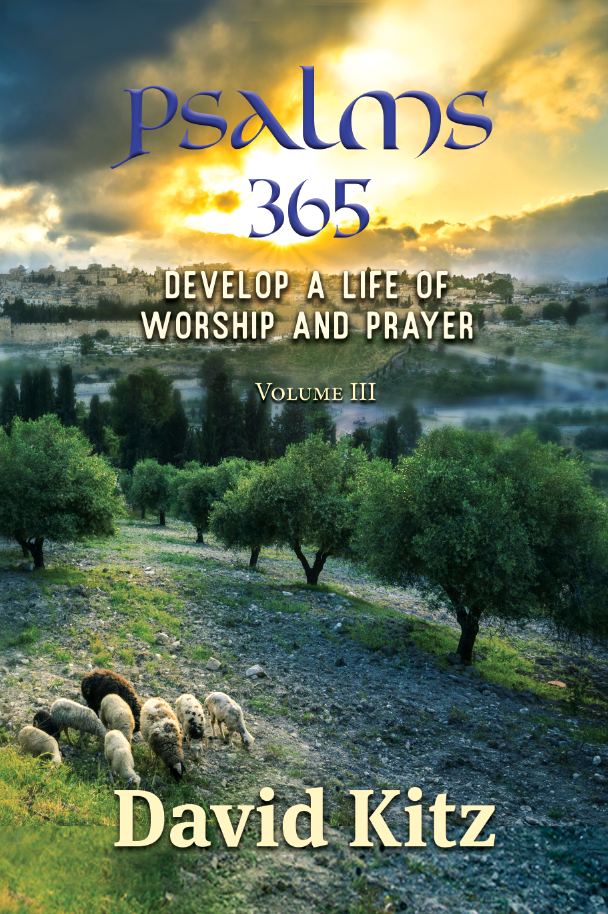
Volume I of Psalms 365: Develop a Life of Worship and Prayer won the Best Book of the Year Award from The Word Guild and Volume II has won the Best Devotional of the Year Award. For those who love God’s word, this three-book series is an ideal way to daily meet with the Lord. To purchase or for a closer look click here.

Coming soon…

James—the brother of Jesus—who was this man? What evidence do we have that this “brother of our Lord” even existed?

David Kitz digs deep into archeology, family dynamics, church history, and the biblical texts. What emerges from his research is a portrait of a decisive, pivotal leader who embodied the will and character of Jesus Christ.

But how did James—James the unbeliever—transform to become a leader who changed the course of world history? In these pages you will uncover the answer and rediscover for yourself the life-changing power of the gospel.

To view further details or purchase directly from the author click here.

He Who Is Least

09 Sunday Nov 2025

Posted by davidkitz in The Elisha Code

≈ Leave a comment

Tags

Banting, Bible, born again, Christianity, diabetes, evangelical, faith, God, gospel, humble, humility, insulin, Jesus, John the Baptist, Kingdom of God, Matthew, Old Testament, paradox, rebirth, servant, serve

On that day you, Jerusalem, will not be put to shame
for all the wrongs you have done to me,
because I will remove from you your arrogant boasters.
Never again will you be haughty on my holy hill.
But I will leave within you the meek and humble.
The remnant of Israel will trust in the name of the L
ORD
.
(Zephaniah 3:11-12, NIV)

The previous chapter concluded with Paul declaring he came to the Corinthians “in weakness with great fear and trembling” (1 Corinthians 2:3), but despite his weakness, God mightily used him to demonstrate the Spirit’s power.
There is something quite contradictory or paradoxical about Paul’s statement in 1 Corinthians 2:3-5, but this paradox of strength in weakness follows a consistent pattern in Paul’s epistles. He begins his first letter to the Corinthians by highlighting one of these apparent contradictions.

Brothers and sisters, think of what you were when you were called. Not many of you were wise by human standards; not many were influential; not many were of noble birth. But God chose the foolish things of the world to shame the wise; God chose the weak things of the world to shame the strong. God chose the lowly things of this world and the despised things—and the things that are not—to nullify the things that are, so that no one may boast before him (1 Corinthians 1:26-29, NIV).

Paul is telling us that God and his Kingdom operate on entirely different principles than the values and philosophies of this world. God uses and shows favor to those who are weak, foolish, and of low status in the eyes of the world. God’s Kingdom is a totally upside-down Kingdom according to the world’s perspective.

Paul elaborates further on the contradictory, paradoxical nature of God’s Kingdom in his second letter to the Corinthians when he states, “That is why, for Christ’s sake, I delight in weaknesses, in insults, in hardships, in persecutions, in difficulties. For when I am weak, then I am strong” (2 Corinthians 12:10).
This call for humility and submission is not confined to Paul’s letters. Peter explicitly calls for the same.

All of you, clothe yourselves with humility toward one another, because,

“God opposes the proud
but shows favor to the humble.”

Humble yourselves, therefore, under God’s mighty hand, that he may lift you up in due time. (1 Peter 5:5b-6).

James repeats this call for humility in his epistle. In fact, in their appeal James and Peter quote the same verse, Proverbs 3:34. (See James 4:6-7.)

The apostles’ teaching and lived experience simply reflected the teaching of their Lord and master Jesus Christ. Jesus’ life was a continual paradox. He was born in a stable, yet his birth was heralded by angels, the appearance of a star, and the arrival of magi from foreign lands. Then, he began his ministry with a manifesto that sets the operating principles of our world on its head.

“Blessed are the poor in spirit for theirs is the kingdom of heaven.
Blessed are those who mourn, for they will be comforted.
                                        
Blessed are the meek, for they will inherit the earth.
                                         
Blessed are those who hunger and thirst for righteousness, for they will be filled.
                                       
Blessed are the merciful, for they will be shown mercy.
                                                
Blessed are the pure in heart, for they will see God.
                                             
Blessed are the peacemakers, for they will be called children of God.
                                                

Blessed are those who are persecuted because of righteousness, for theirs is the kingdom of heaven” (Matthew 5:3-10)

Jesus’ ministry centered on the poor, the sick, the oppressed and afflicted. Peter described Jesus’ life work with these words, “God anointed Jesus of Nazareth with the Holy Spirit and power, and how he went around doing good and healing all who were under the power of the devil, because God was with him” (Acts 10:38).

Jesus was the eternal Creator of all things, yet through the miracle of incarnation he willingly subjected himself to the frailties and limitations of humanity. That included the humiliation of suffering the death of a criminal on a cruel Roman cross.

This upside-down perspective is at the heart of the Elisha code as revealed in the eleventh chapter of Matthew. In the previous chapters of this book, we recounted how the miracles of Jesus run parallel to the miracles of the prophet Elisha. In fact, there is a striking similarity in the content, style, and tenor of the ministries of Jesus and Elisha.
Furthermore, in Matthew eleven, Jesus definitively states that John the Baptist “is the Elijah who is to come” (Matthew 11:14). Again, there is a remarkable similarity in the intent, tone, and scope of the ministries of John and Elijah. So then, chapter eleven of Matthew establishes the link between the Old Testament prophetic duo of Elijah and Elisha and the New Testament duo of John the Baptist and Jesus Christ.

But in his description of John, Jesus goes on to make a statement that is rather puzzling and frequently misunderstood or misinterpreted.

Truly I tell you, among those born of women there has not risen anyone greater than John the Baptist; yet whoever is least in the kingdom of heaven is greater than he (Matthew 11:11, NIV).

The first part of this statement is very straight forward though quite startling. Clearly, Jesus held John in the highest regard—higher than any human past or present. Higher than Abraham. Higher than Moses. Higher than David. Higher than any of the Old Testament prophets. Jesus places John the Baptist at the head of the list, above all who ever lived. That is quite the honor!

But then Jesus goes on to say, “yet whoever is least in the kingdom of heaven is greater than he.”
So, who then is greater than John?

Evangelicals have puzzled over the meaning of this statement. Some have come up with a rather elaborate interpretation that relies heavily on dispensational theology. They reason that John was not born again; therefore, he is not included in the kingdom of heaven. Hence, anyone who is born again under the New Testament dispensation is greater than John.

However, this dispensational interpretation runs into several obstacles when we compare it with the whole of Scripture.

First, let’s be unequivocally clear. Spiritual rebirth is essential to anyone’s entrance into the kingdom of God. Jesus said, “Most assuredly, I say to you, unless one is born again, he cannot see the kingdom of God” (John 3:3). We must come into relationship with God—be born into his kingdom to be citizens of the kingdom.

Monarch Butterfly — photo by David Kitz

Jesus’ statement in John 3:3 raises other questions concerning the believers of the Old Testament era. Will we see them in heaven? Are they citizens of the kingdom?

There is ample biblical evidence that John the Baptist and all the great saints of the Old Testament are citizens of the Kingdom. In fact, in Luke’s Gospel, Jesus said just that.

“There will be weeping and gnashing of teeth, when you see Abraham and Isaac and Jacob and all the prophets in the kingdom of God, and yourselves thrust out. They will come from the east and the west, from the north and the south, and sit down in the kingdom of God. And indeed there are last who will be first, and there are first who will be last” (Luke 13:28-30).

Moreover, in Matthew 11, Jesus identifies John as being greater than all the prophets.

Then what did you go out to see? A prophet? Yes, I tell you, and more than a prophet. This is the one about whom it is written: “‘I will send my messenger ahead of you, who will prepare your way before you’” (Matthew 11:9-10).

If the patriarchs and prophets of the old covenant are included in the kingdom of God, then surely John who Jesus identifies as being greater than them all is included as well.

Furthermore, Hebrews 11 makes it abundantly clear that great Old Testament heroes of the faith will be present with us in glory. In fact, they are part of a great cloud of witnesses cheering us on (Hebrews 12:1-3).

So from these scriptures it is clear that the Old Testament heroes of the faith are all citizens of the kingdom. But Jesus said they cannot be citizens of the kingdom unless they are born again (John 3:3). How can they be born again when that teaching had not been introduced yet? In John 3, Jesus provides the answer to that conundrum.

“The wind blows where it wishes, and you hear the sound of it, but cannot tell where it comes from and where it goes. So is everyone who is born of the Spirit” (John 3:8).

Rebirth happens by the Spirit, and it has been happening from the very beginning. The day may come when we will meet with Enoch, Moses, and David in the kingdom.

The wind of the Spirit was blowing in the hearts of John the Baptist and the Old Testament citizens of the spiritual kingdom, and they were born again by the Spirit. This must be so, or Jesus could not say what he said in Luke 13:28-30 where he identifies them as sitting down in the kingdom of God. (They could not be sitting down in the kingdom of God unless they were born again.)

Moreover, there are not two kingdoms of God, one for the Old Testament believers and one for the New Testament born-again believers. There is only one eternal, spiritual kingdom of God, and we will all sit together in it.

Jesus is after all the great unifier of Jews and Gentiles just as Paul states.

 In reading this, then, you will be able to understand my insight into the mystery of Christ, which was not made known to people in other generations as it has now been revealed by the Spirit to God’s holy apostles and prophets. This mystery is that through the gospel the Gentiles are heirs together with Israel, members together of one body, and sharers together in the promise in Christ Jesus. (Ephesians 3:4-6)

Jesus introduced us to the teaching and the understanding of being born again, but that does not mean spiritual rebirth was not happening before he introduced that teaching. Isaac Newton introduced us to the concept of gravity, but that does not mean the laws of gravity were not working until he introduced them.

Similarly, Dr. Frederick Banting and Dr. Charles Best discovered insulin in 1921, and in January 1922 they injected insulin into a dying fourteen-year-old, type one diabetic named Leonard Thompson. The transformation in Leonard’s body was nothing short of miraculous. Until that time a diagnosis of type one diabetes was viewed as a death sentence. Most patients died within weeks or months.

Where land ends, Bruce Peninsula National Park — photo by Karen Kitz

We too like Leonard Thompson are under a death sentence. We suffer from a deadly condition called a sinful nature. The cure for this condition is spiritual rebirth at the hands of the Great Physician, Jesus Christ.

Insulin was doing its life-sustaining work in human bodies long before Banting and Best discovered it. In the same way, the Spirit was at work drawing people like Moses and David into relationship with the heavenly Father long before Jesus had his conversation with Nicodemus in John 3. And Old Testament people like Deborah, Ruth, Esther, and Jeremiah responded in faith as the Spirit of God touched their lives. They too came into a life altering relationship with God—a relationship that we now call being born again.

Logic dictates that these Old Testament saints must have experienced rebirth, or they could not sit down in the kingdom of God as Jesus declares they will in Luke 13:28-30.

Consequently, Jesus’ statement in Matthew 11:11 about “he who is least in the kingdom of God” is not about setting up a distinction between those who are born again, and those who are not born again, or drawing a distinction between the Old Testament and New Testament dispensations. Rather, it’s a passage about humility, where Jesus takes on the identity of being the one who is least in the Kingdom of God.

Now let’s again look at Matthew 11:11 with fresh eyes.

Truly I tell you, among those born of women there has not risen anyone greater than John the Baptist; yet whoever is least in the kingdom of heaven is greater than he (Matthew 11:11, NIV).

After stating that John is the greatest man who ever lived, Jesus asserts that the one who is least in the kingdom is greater than John. So, who then is greater than John?

Surely, we can all agree that Jesus is greater than John. He is after all the king of the kingdom. But in true contradictory, paradoxical fashion Jesus casts himself as being least in the kingdom of God. Jesus takes on that identity because he came to serve, suffer, and die.

So then, Matthew 11:11 is a passage that portrays Jesus humbling himself and taking the lowest position though he is King of all. This is the ultimate paradox expressed in a brilliant turn of phrase—so brilliant its meaning has eluded more than a few theologians.

Paul beautifully describes Christ’s humiliation and subsequent exaltation with these familiar words:

Who, being in very nature God,
did not consider equality with God something to be used to his own advantage;
rather, he made himself nothing
by taking the very nature of a servant,
being made in human likeness.
And being found in appearance as a man,
he humbled himself by becoming obedient to death—
even death on a cross!

Therefore God exalted him to the highest place
and gave him the name that is above every name,
that at the name of Jesus every knee should bow,
in heaven and on earth and under the earth,
and every tongue acknowledge that Jesus Christ is Lord,
to the glory of God the Father
(Philippians 2:6-11, NIV).

With his statement in Matthew 11:11, Jesus is making himself nothing and taking on the very nature of a servant just as Paul describes.
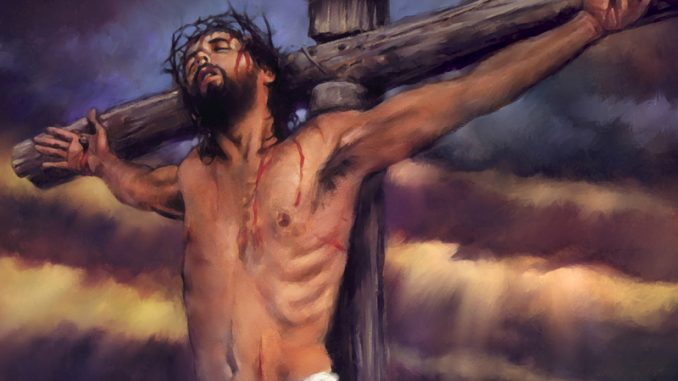
Furthermore, this self-deprecation follows a pattern that we see repeated in Matthews Gospel. Jesus repeatedly tells reverse stories, paradoxical parables where the first will be last. See Matthew 18:1-5, Matthew 19:30, Matthew 20:16, Matthew 20:28. These passages assert that Jesus and his kingdom work on principles and values that are the opposite of those found in the world. The poor have true wealth. The weak are strong. The despised are honored. Matthew 11:11 fits into this pattern of reversal with Jesus taking the lowest or least position.

But why is this emphasis on humility significant? What is the application for us today? Humility is at the core of the Elisha Code. We too need to follow in the footsteps of Jesus. We too need to humble ourselves and serve as he did.

The world will not be won to Christ by millionaire evangelists and pastors crisscrossing the globe in their private jets and preaching a gospel of prosperity and self-fulfillment. The world will be won by the meek—those who know how to humble themselves and serve—serve at the cost of their lives as the first century apostles did. That is the Jesus way—the way of the cross.

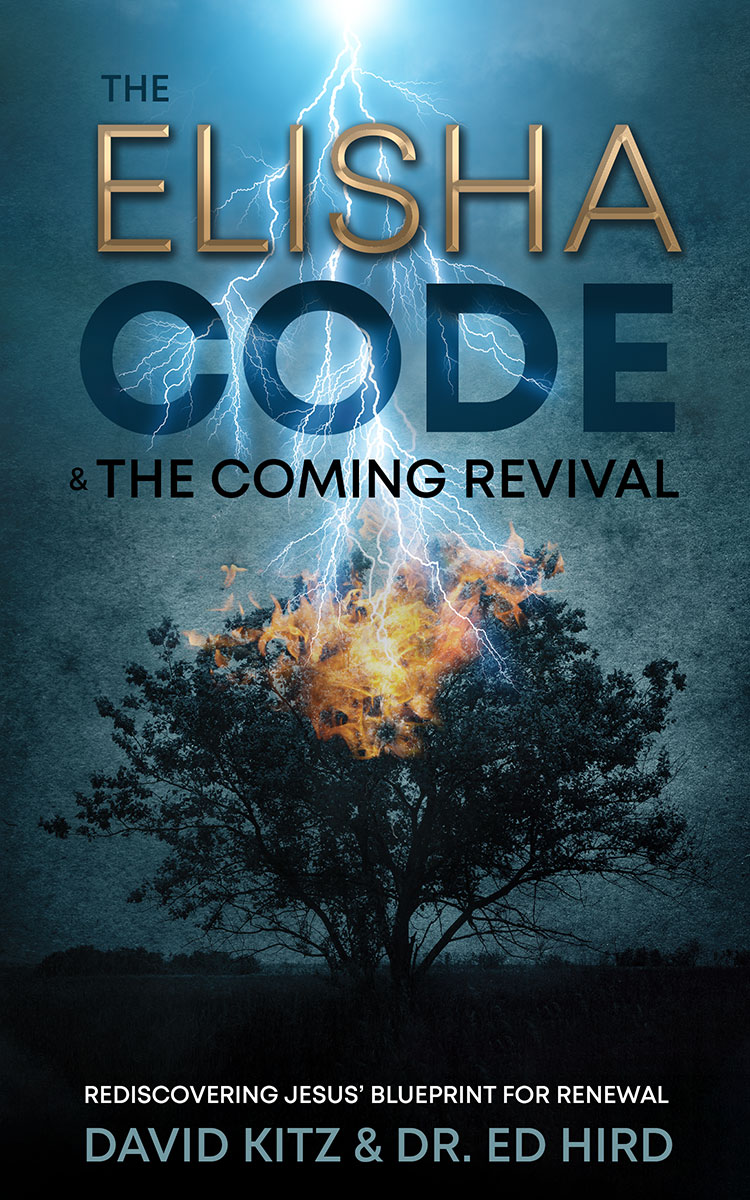
This is the nineth weekly excerpt from the award-winning book 
The Elisha Code & the Coming Revival 

A soul-gripping read.
Is a return-to-Jesus revival possible in our time?
This book points the way forward.
For details click here.

Open Wide Your Hearts

28 Monday Jul 2025

Posted by davidkitz in Psalm 123

≈ Leave a comment

Tags

affection, Bible, correction, Father God, opening your heart, Prayer, Psalms, receiving instruction, servant, the LORD

Today’s quote and prayer from
“Psalms 365: Develop a Life of Worship and Prayer”
by David Kitz.


Reading: Psalm 123

Father God,
I come before you now.
I lift up my eyes to you,
to you who sit enthroned in heaven.

Be merciful to me.
Speak to me.
Correct me if I need correction.
Give me direction.
I am ready to receive instruction from you.
I am your servant.
Amen.

— — — —

 We have spoken freely to you, Corinthians,
and opened wide our hearts to you.

We are not withholding our affection from you,
but you are withholding yours from us.

As a fair exchange—
I speak as to my children—
open wide your hearts also.

(2 Corinthians 6:11-13 NIV)*

Para la publicación de Salmos 365 de hoy en español haga clic aquí.

bgbg_v4.3_1501818
* NEW INTERNATIONAL VERSION, COPYRIGHT ©1973, 1978, 1984, 2011 BY BIBLICA

Please pray for peace to return to Israel, Gaza, Iran, and Ukraine!

Volume I of Psalms 365: Develop a Life of Worship and Prayer won the Best Book of the Year Award from The Word Guild and Volume II has won the Best Devotional of the Year Award. For those who love God’s word, this three-book series is an ideal way to daily meet with the Lord. To purchase or for a closer look click here.

A gripping read from David Kitz.
Is a return-to-Jesus revival possible in our time?
This book points the way forward.

The Best Possible Servant

13 Friday Jun 2025

Posted by davidkitz in Psalm 116

≈ Leave a comment

Tags

God, gratitude, Jesus, Passover, Prayer, Psalms, servant, service to others, serving God, the LORD

Today’s quote and prayer from
“Psalms 365: Develop a Life of Worship and Prayer”
by David Kitz.


Reading: Psalm 116:15-19

LORD God,
I want to serve you.
Today, please show me
how I can be the best possible servant
to you and those around me.
Open my eyes to the needs of others.
I want to serve with a heart
filled with gratitude and joy.
Amen.

— — — —

It was just before the Passover Festival.
Jesus knew that the hour had come for him
to leave this world and go to the Father.
Having loved his own who were in the world,
he loved them to the end.

The evening meal was in progress,
and the devil had already prompted Judas,
the son of Simon Iscariot, to betray Jesus.

Jesus knew that the Father had put all things
under his power,
and that he had come from God
and was returning to God;
so he got up from the meal,
took off his outer clothing,
and wrapped a towel around his waist.

After that, he poured water into a basin
and began to wash his disciples’ feet,
drying them with the towel
that was wrapped around him.

(John 13:1-5 NIV)*

Para la publicación de Salmos 365 de hoy en español haga clic aquí.

bgbg_v4.3_1501818
* NEW INTERNATIONAL VERSION, COPYRIGHT ©1973, 1978, 1984, 2011 BY BIBLICA

Please pray for peace to return to Israel, Gaza, and Ukraine!

Volume I of Psalms 365: Develop a Life of Worship and Prayer won the Best Book of the Year Award from The Word Guild and Volume II has won the Best Devotional of the Year Award. For those who love God’s word, this three-book series is an ideal way to daily meet with the Lord. To purchase or for a closer look click here.

A gripping read from David Kitz.
Is a return-to-Jesus revival possible in our time?
This book points the way forward.
For details click here.
This World’s Operating System

15 Friday Mar 2024

Posted by davidkitz in Psalm 131, Psalms

≈ Leave a comment

Tags

child, disciples, Jesus, kingdom of heaven, Prayer, Psalms, servant, the greatest

Today’s quote and prayer from
“Psalms 365: Develop a Life of Worship and Prayer”
by David Kitz.
Psalm 131 -365 (2)

Reading: Psalm 131

Father God,
help me to change.
I want to become more like Jesus.
He was the servant of all.
Help me to avoid the pitfall of pride.
Teach me how to quiet my soul
and be content in you.

Amen.

At that time the disciples came to Jesus and asked,
“Who, then, is the greatest in the kingdom of heaven?”

He called a little child to him,
and placed the child among them.
 

And he said:
“Truly I tell you,
unless you change and become like little children,
you will never enter the kingdom of heaven.

Therefore, whoever takes the lowly position
of this child is the greatest in the kingdom of heaven.

And whoever welcomes one such child
in my name welcomes me.
(Matthew 18:1-5, NIV)*

* NEW INTERNATIONAL VERSION, COPYRIGHT ©1973, 1978, 1984, 2011 BY BIBLICA

BGBG_v4.3_150[1818]

Please pray for peace to return to Israel, Gaza, and Ukraine!

Volume I of Psalms 365: Develop a Life of Worship and Prayer won the Best Book of the Year Award from The Word Guild and Volume II has won the Best Devotional of the Year Award. For those who love God’s word, this three-book series is an ideal way to daily meet with the Lord. To purchase or for a closer look click here.

Gratitude and Joy

19 Friday Jan 2024

Posted by davidkitz in Psalm 116

≈ 1 Comment

Tags

gratitude, joy, Prayer, Psalms, servant, serving God

Today’s quote and prayer from
“Psalms 365: Develop a Life of Worship and Prayer”
by David Kitz.Psalm 116_15-19 -365

Reading: Psalm 116:15-19

Father God,
I want to serve you.
Today please show me
how I can be the best possible servant
to you and those around me.
Open my eyes to the needs of others.
I want to serve with a heart filled with gratitude and joy. 

Amen.

* NEW INTERNATIONAL VERSION, COPYRIGHT ©1973, 1978, 1984, 2011 BY BIBLICA

BGBG_v4.3_150[1818]

Please pray for peace to return to Israel, Gaza, and Ukraine!

Volume I of Psalms 365: Develop a Life of Worship and Prayer won the Best Book of the Year Award from The Word Guild and Volume II has won the Best Devotional of the Year Award. For those who love God’s word, this three-book series is an ideal way to daily meet with the Lord. To purchase or for a closer look click here.TheElishaCodeCVR5

To purchase or for a closer look click here.

The Death of His Faithful Servants

29 Monday Aug 2022

Posted by davidkitz in Psalm 116, Psalms

≈ 2 Comments

Tags

funeral, servant, servant of Lord

Reading: Psalm 116:15-19
Precious in the sight of the LORD
    is the death of his faithful servants.
Truly I am your servant, L
ORD;
    I serve you just as my mother did;
    you have freed me from my chains.
I will sacrifice a thank offering to you
    and call on the name of the L
ORD.
 I will fulfill my vows to the L
ORD
    in the presence of all his people,
 in the courts of the house of the LORD—
    in your midst, Jerusalem.
Praise the LORD (NIV).*

img_20220726_2022159

Photo by David Kitz

Reflection
Funerals are fascinating occasions for a whole variety of reasons. Recently I have had an opportunity to attend a number of these end-of-life events. There is something bittersweet about most funerals—bitter due to the loss of a loved one—sweet because often fond memories are recalled.

The end of a life here on earth gives us an opportunity to reflect on the values that the deceased portrayed, and by extension it allows us to examine the values and qualities that shape our own lives. Our lives paint a portrait. What sort of portrait will it be?

Apparently, the LORD takes note when one of His own passes on from this life. Precious in the sight of the LORD is the death of his faithful servants. Truly I am your servant, LORD; I serve you just as my mother did; you have freed me from my chains.

The word servant is significant in the passage above. It is repeated twice along with its verb form serve. Now here is a question for you. Who are you serving? Are you a servant of the LORD or are you serving only yourself?

Those who serve only themselves should expect few at their bedside as they draw their last breath. All too often their last days are spent in loneliness and bitter resentment—not so for those who spent their lives in the service of others and the LORD. They can expect to be surrounded by family and friends because they have poured out their lives in service. We reap what we sow, and when the Grim Reaper comes, those who have sown generously will be rewarded generously. God, Himself will be present!

Now we should note that genuine service to others is service to the Lord. In essence, Jesus said just that when in his parable of the final judgment he declared, “Truly I tell you, whatever you did for one of the least of these brothers and sisters of mine, you did for me” (Matthew 25:40).

Response: LORD, I want to serve you. Today please show me how I can be the best possible servant to you and those around me. Open my eyes to the needs of others. I want to serve with a heart filled with gratitude and joy. Amen.

Your Turn: Are you living a life of service? What does serving God mean for you?

* NEW INTERNATIONAL VERSION, COPYRIGHT ©1973, 1978, 1984, 2011 BY BIBLICA

BGBG_v4.3_150[1818]

Please pray for the people of Ukraine!

Volume I of Psalms 365: Develop a Life of Worship and Prayer won the Best Book of the Year Award from The Word Guild and for those who love God’s word, it’s an ideal way to daily meet with the Lord. For a closer look at Volumes II and III click here.

To Quiet my Soul

26 Wednesday May 2021

Posted by davidkitz in Psalms, Psalms 365: Develop a Life of Worship and Prayer

≈ Leave a comment

Tags

contentment, Psalm 131, servant

Today’s quote and prayer from
“Psalms 365: Develop a Life of Worship and Prayer”
by David Kitz
365 operating system 131

Psalms 131

Father God,
help me to change.
I want to become more like Jesus.
He was the servant of all.
Help me to avoid the pitfall of pride.
Teach me how to quiet my soul
and be content in you.
Amen.

Volume II of Psalms 365: Develop a Life of Worship and Prayer by award-winning author David Kitz is available now. For a closer look at this #1 new release click here. For a look back at Volume I click here.

The Death of his Faithful Servants

30 Tuesday Mar 2021

Posted by davidkitz in Psalm 116, Psalms

≈ 4 Comments

Tags

death, funeral, servant, service, serving God

Reading: Psalm 116
(Verses 15-19)
Precious in the sight of the LORD
is the death of his faithful servants.
Truly I am your servant, L
ORD;
I serve you just as my mother did;
you have freed me from my chains.
I will sacrifice a thank offering to you
and call on the name of the L
ORD.
 I will fulfill my vows to the L
ORD
in the presence of all his people,
in the courts of the house of the LORD—
in your midst, Jerusalem.
Praise the LORD (NIV).*

img_20190617_1922003

Iris blossom — photo by David Kitz

Reflection
Funerals are fascinating occasions for a whole variety of reasons. Before the pandemic, I have had an opportunity to attend a number of these end-of-life events. There is something bittersweet about most funerals—bitter due to the loss of a loved one—sweet because often fond memories are recalled.

The end of a life here on earth gives us an opportunity to reflect on the values that the deceased portrayed, and by extension it allows us to examine the values and qualities that shape our own lives. Our lives paint a portrait. What sort of portrait will it be?

Apparently, the LORD takes note when one of His own passes on from this life. Precious in the sight of the LORD is the death of his faithful servants. Truly I am your servant, LORD; I serve you just as my mother did; you have freed me from my chains.

The word servant is significant in the passage above. It is repeated twice along with its verb form serve. Now here is a question for you. Who are you serving? Are you a servant of the LORD or are you serving only yourself?

Those who serve only themselves should expect few at their bedside as they draw their last breath. All too often their last days are spent in loneliness and bitter resentment—not so for those who spent their lives in the service of others and the LORD. Prior to this pandemic, they could expect to be surrounded by family and friends because they have poured out their lives in service. We reap what we sow, and when the Grim Reaper comes, those who have sown generously will be rewarded generously. God, Himself will be present!

Now we should note that genuine service to others is service to the Lord. In essence, Jesus said just that when in his parable of the final judgment he declared, “Truly I tell you, whatever you did for one of the least of these brothers and sisters of mine, you did for me” (Matthew 25:40).

Response: LORD, I want to serve you. Today please show me how I can be the best possible servant to you and those around me. Open my eyes to the needs of others. I want to serve with a heart filled with gratitude and joy. Amen.

Your Turn: Are you living a life of service? What does serving God mean for you?

* New International Version, Copyright ©1973, 1978, 1984, 2011 by Biblica

The first volume of Psalms 365: Develop a Life of Worship and Prayer by award-winning author David Kitz is now available. For a closer look at this 262-page daily devotional book click here.

Looking to the Hand of the Master

12 Thursday Dec 2019

Posted by davidkitz in Devotionals, Psalm 123, Psalms

≈ 3 Comments

Tags

looking to God, master, mercy, servant, slave

Reading: Psalm 123
A song of ascents.
I lift up my eyes to you,
to you who sit enthroned in heaven.
As the eyes of slaves look to the hand of their master,
as the eyes of a female slave look to the hand of her mistress,
so our eyes look to the L
ORD our God,
till he shows us his mercy.
Have mercy on us, LORD, have mercy on us,
for we have endured no end of contempt.
We have endured no end
of ridicule from the arrogant,
of contempt from the proud
(NIV).

photo of person s open hands

Photo by Luis Quintero on Pexels.com

Reflection
Like every parent, I have had moments when I have needed to correct my children. In my professional life as a teacher, correcting a child’s behavior was a daily, sometimes minute-to-minute occurrence. In such situations eye contact is crucial. If the child does not make eye contact with you, you are wasting your breath. Your advice—your admonition—your warning—is going nowhere. You might as well speak to the wind. But in such situations, it is essential that you speak to the heart of the child.

The eyes are the window of the heart. When someone is avoiding eye contact, in reality they are hiding their heart. They are closing their heart to you.

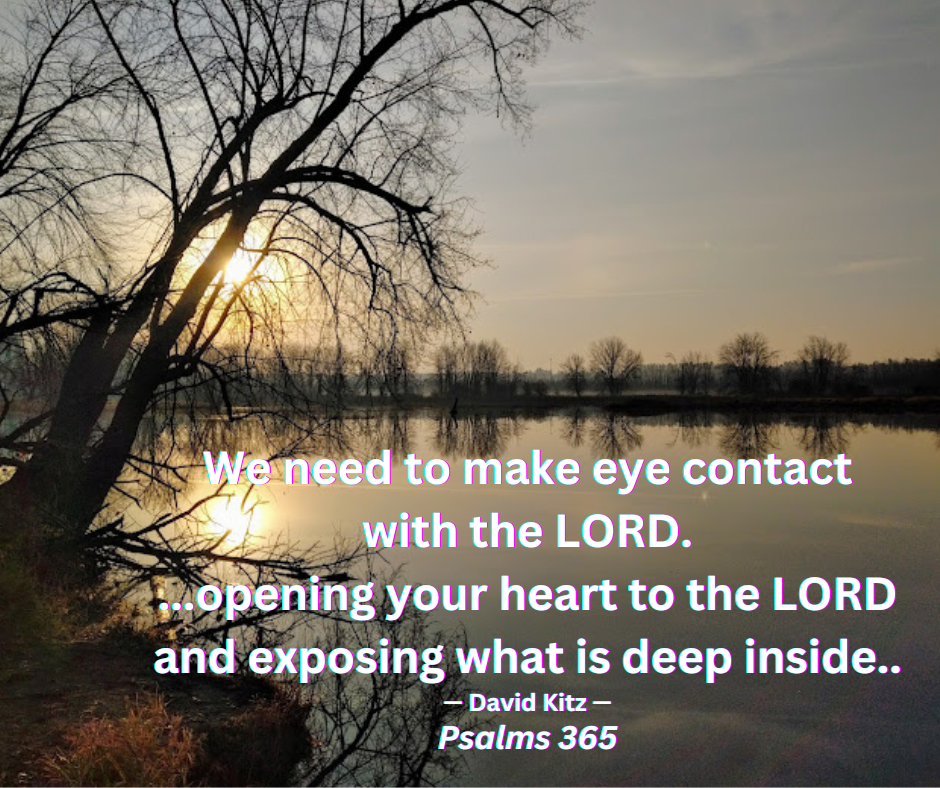
Of course the same principle is true when we consider our relationship with God. We need to make eye contact with the LORD. That’s why there is something truly intimate about this psalm. It’s all about making eye contact with God. It’s about opening your heart to the LORD and exposing what is deep inside you. You are showing when you lift your eyes to Him that you are ready to receive instruction. Yes, and correction too, if that is needed.

So the psalmist speaks these words: I lift up my eyes to you, to you who sit enthroned in heaven. He takes the position and the posture of a slave—a humble servant. He is looking for mercy—hoping for grace and blessing from the hand of His master.

This is perhaps the most intimate of the Songs of Ascent. Having come a great distance, the pilgrim is now in the LORD’s house. He has drawn nigh in the fullest sense. The pilgrim lifts his eyes—not to an idol, but to the LORD—the One who fills all, formed all, and transcends all. With eyes wide open he exposes his heart to God. He waits expectantly for the LORD’s instruction.

Prayer at its best is modeled for us in this psalm. It’s prayer with our eyes and our ears wide open to God. We are looking to Him for mercy, comfort, strength and direction.

Response: Father God, I come before you now. I lift up my eyes to you, to you who sit enthroned in heaven. Be merciful to me. Speak to me. Correct me, if I need correction. Give me direction. I am ready to receive instruction from you. I am your servant. Amen.

Your Turn: Are you drawing nigh to God? How do you make eye contact with the Lord?

← Older posts

Psalms 365: Develop a Life of Worship and Prayer

Psalms 365 Volume II

Psalms 365 vol 3
— Psalms 365 Volume III

Psalms

Recent posts

  • May the LORD Grant All Your Requests December 20, 2025
  • A Horn of Salvation December 19, 2025
  • Ready for the King of Glory December 19, 2025
  • My Spirit Rejoices in God My Savior December 18, 2025
  • Joining the Generation That Seeks God December 18, 2025
  • Why Am I So Favored December 17, 2025
  • How Can You Find the Good Life? December 17, 2025

Calendar

December 2025
M T W T F S S
1234567
891011121314
15161718192021
22232425262728
293031  
« Nov    

Blog Posts

Comments

  • davidkitz on Joining the Generation That Seeks God
  • cjsmissionaryminister on God Sent His Son
  • cjsmissionaryminister on The God of the Broken

Blog at WordPress.com.

Privacy & Cookies: This site uses cookies. By continuing to use this website, you agree to their use.
To find out more, including how to control cookies, see here: Cookie Policy
  • Subscribe Subscribed
    • I love the Psalms
    • Join 1,377 other subscribers
    • Already have a WordPress.com account? Log in now.
    • I love the Psalms
    • Subscribe Subscribed
    • Sign up
    • Log in
    • Report this content
    • View site in Reader
    • Manage subscriptions
    • Collapse this bar
 

Loading Comments...