• Home
  • About
  • DavidKitz.ca
  • Youtube Videos
  • Books by David
  • Books on Amazon.com

I love the Psalms

~ Connecting daily with God through the Psalms

I love the Psalms

Tag Archives: Songs of Ascent

My Cry for Mercy

30 Monday Jul 2018

Posted by davidkitz in Bible, Devotionals, God's word, Psalm 130, Psalms

≈ Leave a comment

Tags

confess, forgiveness, God's mercy, Lord, sins, Songs of Ascent

Reading: Psalm 130
A song of ascents.
(Verses 1-4)
Out of the depths I cry to you, LORD;
LORD, hear my voice.
Let your ears be attentive
to my cry for mercy.
If you, LORD, kept a record of sins,
L
ORD, who could stand?
But with you there is forgiveness,
so that we can, with reverence, serve you
(NIV).

IMG_20180717_0904579

Ottawa River wetlands — photo by David Kitz

Reflection
Psalm 130 is a perfect example of a psalm that brings us into the private inner sanctum of communion with God. Here is a portrait of a fallen man—a man on his knees before his Maker, the eternal One. Hear him now as he agonizes in prayer, “Out of the depths I cry out to you, O LORD; O LORD, hear my voice. Let your ears be attentive to my cry for mercy.”

The opening lines of this psalm leave little doubt as to what has transpired. The psalmist has failed; he has missed the mark. He has transgressed, yet again. There is an abject poverty of spirit reflected in these words—a poverty that almost makes us cringe.

We do not know what sin, or list of sins has brought the psalmist to this wretched state. The transgression is left unstated. Was it anger, malice, or unbridled lust? Was it pride, greed or wilful dishonesty? Was this a transgression of the mind, of the tongue, of action or inaction? God knows.

I am always somewhat skeptical of those who claim they could never commit this or that sin. I think we rarely comprehend the depravity of our own hearts. Pushed into wrong circumstances, in the wrong environment, with the wrong peer group, who can plumb the depths to which a man or woman may sink? I can identify with the psalmist. I have added my own pile of dung to this world’s heap of moral filth. I too have found myself in the psalmist’s position, sobbing out these words, “Out of the depths I cry out to you, O LORD; O LORD, hear my voice. Let your ears be attentive to my cry for mercy.“

But despite my failings, despite my moral poverty, this great God—this God of holiness—is approachable. He is a God of mercy. The psalmist reminds himself and the LORD of His merciful nature with these words: If you, LORD, kept a record of sins, LORD, who could stand? But with you there is forgiveness, so that we can, with reverence, serve you.

I need daily reminders of God’s forgiveness and mercy. God the moral accountant is also the LORD of forgiveness. No one does forgiveness better than God. When we confess our sins, He destroys the record. What accountant does that?

Response: Father God, I thank you for forgiveness. I have failed you many times, but you are rich in mercy. You are a patient God. Thank you for destroying the record of my sins. Thank you for the blood Jesus shed so I could be washed clean. Amen.

Your Turn: Have you been guilty of digging up the record of your sins—sins that have been forgiven?


A Family Blessing

26 Thursday Jul 2018

Posted by davidkitz in Bible, Devotionals, God's word, Psalm 128, Psalms

≈ 3 Comments

Tags

blessings, children, family, fruitful, holidays, pilgrims, Songs of Ascent

Reading: Psalm 128
A song of ascents.
Blessed are all who fear the LORD,
who walk in obedience to him.
You will eat the fruit of your labor;
blessings and prosperity will be yours.
Your wife will be like a fruitful vine
within your house;
your children will be like olive shoots
around your table.
Yes, this will be the blessing
for the man who fears the L
ORD.
May the LORD bless you from Zion;
may you see the prosperity of Jerusalem
all the days of your life.
May you live to see your children’s children—
peace be on Israel
(NIV).

2018-06-08a

Blooming clematis — a fruitful vine — photo by David Kitz

Reflection
I got an unexpected call from my son this morning. “Can we have lunch together today?” he asked.

“Sure,” I responded without hesitation. Who can say no to such a request? We went out to a pizza place for their buffet lunch. We enjoyed a leisurely conversation. There was no urgency to our discussion. He shared a few minor work frustrations, while I did the same. This was simply a father and son enjoying each other’s company, talking a little sports and discussing whatever came to mind.

According to Psalm 128, I was appreciating one of the olive shoots around my table. Now that’s a unique way to view your son or daughter. Children are a blessing, and when adult children enjoy spending time with their parents that’s a double blessing. At a time when many adult children are estranged from their parents or separated by long distances, the opportunity to spend time together at the drop of a hat is a real blessing. As a parent you are enjoying the fruit of your labor. You are reaping the rewards from years spent pouring into the lives of your children.

This is the ninth psalm of the series of psalms known as Songs of Ascent or Psalms of Ascent. These were psalms used by pilgrims as they made the annual trek to Jerusalem for celebrations such as the Feast of Tabernacles or the Passover. In some respects, these ancient holy days roughly correspond to our present day holidays such as Easter, Thanksgiving and Christmas. Families today often make long journeys to celebrate together what at their core are religious holidays. Family togetherness is a central feature of such events. We should not be surprised then that this entire psalm highlights the blessings of family unity.

It should be noted that the blessings of family begin with obedience and the fear of the LORD.

Response: Father God, I love my family. I am so blessed to have children who love you, Lord. Watch over them, I pray. Keep their hearts tender before you. Help them to daily hear your voice. Amen.

Your Turn: Are you estranged from family members? Can you build a bridge back to that loved one?

Building a House of Lasting Worth

25 Wednesday Jul 2018

Posted by davidkitz in Bible, Devotionals, God's word, Psalm 127, Psalms

≈ Leave a comment

Tags

builder, children, gold, heritage, Solomon, Songs of Ascent, temple

Reading: Psalm 127
A song of ascents. Of Solomon.
Unless the LORD builds the house,
the builders labor in vain.
Unless the L
ORD watches over the city,
the guards stand watch in vain.
In vain you rise early
and stay up late,
toiling for food to eat—
for he grants sleep to those he loves.
Children are a heritage from the LORD,
offspring a reward from him.
Like arrows in the hands of a warrior
are children born in one’s youth.
Blessed is the man
whose quiver is full of them.
They will not be put to shame
when they contend with their opponents in court
(NIV).

IMG_20180629_1825564-ANIMATION (2)

The Parthenon, Athens, Greece — photo by David Kitz

Reflection
There are fifteen Songs of Ascent. Four of them are attributed to David, but only this one is attributed to David’s son, Solomon. It is very fitting that King Solomon should be credited with penning this psalm. The psalm begins with this sentence: Unless the LORD builds the house, the builders labor in vain. 

Solomon was the greatest builder of the Old Testament era. He built the magnificent temple of the LORD in Jerusalem. On this project, he spared no expense. Solomon covered the inside of the temple with pure gold, and he extended gold chains across the front of the inner sanctuary, which was overlaid with gold (1 Kings 6:21).

In addition to the temple, Solomon built an enormous palace for himself, as well as stables for his horses and chariots. (See 1 Kings 10:26). Solomon was an expert at construction and on vanity (see the Book of Ecclesiastes) yet he states, “Unless the LORD builds the house, the builders labor in vain. Unless the LORD watches over the city, the guards stand watch in vain.”

So then, where is lasting value? There is lasting value in our children. The grand construction project of lasting worth is the life of a child—the soul of a child. Are we pouring a foundation that is built on the solid rock of Christ’s teaching? Are we overlaying the inside of that temple with pure gold? Are we instilling values of honesty, charity and self-worth? The real treasure is in the heart of a child—a child that will carry those values to the next generation.

Solomon reminds us: Children are a heritage from the LORD, offspring a reward from him. They are the arrows that are targeted at the third generation. Now there is a construction project worthy of a king.

Response: Father God, I want to see the true worth of my children. Help me to pass on values and lessons of faith to them. I thank you for them. They are a gift from you of immeasurable worth. Amen.

Your Turn: Are you overlaying the sanctuary of your child’s heart with pure gold?

Please Restore our Fortunes, LORD

24 Tuesday Jul 2018

Posted by davidkitz in Bible, Devotionals, Psalm 126, Psalms

≈ 7 Comments

Tags

harvest, Holy Spirit, joy, Prayer, restore, Songs of Ascent, sowing tears

Reading: Psalm 126
A song of ascents.
When the LORD restored the fortunes of Zion,
we were like those who dreamed.
Our mouths were filled with laughter,
our tongues with songs of joy.
Then it was said among the nations,
“The L
ORD has done great things for them.”
The L
ORD has done great things for us,
and we are filled with joy.

Restore our fortunes, LORD,
like streams in the Negev.
Those who sow with tears
will reap with songs of joy.
Those who go out weeping,
carrying seed to sow,
will return with songs of joy,
carrying sheaves with them
(NIV).

20180706 (2)

Like streams in the Negev — photo by David Kitz

Reflection
This is a psalm that has two parts—two sharply contrasting perspectives. It begins with jubilation, but it transitions to sober reflection and a prayer for restoration.

The historical context of this psalm is readily identifiable. The psalmist is commenting on the joyous return of the exiles following the seventy-year Babylonian captivity—an event that occurred in the sixth century before the birth of Christ. When the LORD restored the fortunes of Zion, we were like those who dreamed. Our mouths were filled with laughter, our tongues with songs of joy.

The LORD had brought back the people of Israel and they were filled with joy. Have you experienced the glorious liberating power of God in your life? Have you experienced the pure joy of the Lord as you realized your sins are forgiven? And oh joy—this God you serve is as near as your next breath!

I remember a time like that—a time when I was filled with the Holy Spirit. The joy I experienced was so all encompassing that I remember waking in the morning with my face muscles aching because of the smile that had been permanently etched there.

But alas, we can’t live on that mountain-top high forever. In our pilgrimage with God, we eventually reach this line in Psalm 126: Restore our fortunes, LORD, like streams in the Negev. The Negev is the parched desert region to the south of the land of Judah. Streams in the Negev are intermittent. A raging torrent one day becomes a mere trickle on the next day, and then nothing on the third day. The boisterous river of joy turns into a dry gulch—a blank line on the desert floor. Then we join with the psalmist and pray. Restore our fortunes, LORD. Our prayer becomes a plea for a return to the joy of harvest. 

Response: Father God, I thank you for times of great joy, when we experience your salvation and your felt presence. Help me to sow the seeds of your gospel message today. Amen.

Your Turn: What season are you in? What season is your church in? Is it seed planting time or harvest?

Making Eye Contact with God

19 Thursday Jul 2018

Posted by davidkitz in Devotionals, God's word, Psalm 123, Psalms

≈ 1 Comment

Tags

correction, eye contact, instruction, mercy, Songs of Ascent, the LORD

Reading: Psalm 123
A song of ascents.
I lift up my eyes to you,
to you who sit enthroned in heaven.
As the eyes of slaves look to the hand of their master,
as the eyes of a female slave look to the hand of her mistress,
so our eyes look to the L
ORD our God,
till he shows us his mercy.
Have mercy on us, LORD, have mercy on us,
for we have endured no end of contempt.
We have endured no end
of ridicule from the arrogant,
of contempt from the proud
(NIV).

2018-07-11a

Petrie Island morning — photo by David Kitz

Reflection
Like every parent, I have had moments when I have needed to correct my children. In my professional life as a teacher, correcting a child’s behavior was a daily, sometimes minute-to-minute occurrence. In such situations eye contact is crucial. If the child does not make eye contact with you, you are wasting your breath. Your advice—your admonition—your warning—is going nowhere. You might as well speak to the wind. But in such situations, it is essential that you speak to the heart of the child.

The eyes are the window of the heart. When someone is avoiding eye contact, in reality they are hiding their heart. They are closing their heart to you.

Of course the same principle is true when we consider our relationship with God. We need to make eye contact with the LORD. That’s why there is something truly intimate about this psalm. It’s all about making eye contact with God. It’s about opening your heart to the LORD and exposing what is deep inside you. You are showing when you lift your eyes to Him that you are ready to receive instruction. Yes, and correction too, if that is needed.

So the psalmist speaks these words: I lift up my eyes to you, to you who sit enthroned in heaven. He takes the position and the posture of a slave—a humble servant. He is looking for mercy—hoping for grace and blessing from the hand of His master.

This is perhaps the most intimate of the Songs of Ascent. Having come a great distance, the pilgrim is now in the LORD’s house. He has drawn nigh in the fullest sense. The pilgrim lifts his eyes—not to an idol, but to the LORD—the One who fills all, formed all, and transcends all. With eyes wide open he exposes his heart to God. He waits expectantly for the LORD’s instruction.

Prayer at its best is modelled for us in this psalm. It’s prayer with our eyes wide open to God. We are looking to Him for mercy, comfort, strength and direction. 

Response: Father God, I come before you now. I lift up my eyes to you, to you who sit enthroned in heaven. Be merciful to me. Speak to me. Correct me, if I need correction. Give me direction. I am ready to receive instruction from you. I am your servant. Amen.

Your Turn: Are you drawing nigh to God? How do you make eye contact with God?

Praying for the Peace of Jerusalem

18 Wednesday Jul 2018

Posted by davidkitz in Devotionals, God's word, Psalm 122, Psalms

≈ 3 Comments

Tags

House of God, Jerusalem, Jesus Christ, peace, pilgrimage, Songs of Ascent

Reading: Psalm 122
A song of ascents. Of David.
I rejoiced with those who said to me,
“Let us go to the house of the L
ORD.”
Our feet are standing in your gates, Jerusalem.
Jerusalem is built like a city
that is closely compacted together.
That is where the tribes go up—
the tribes of the L
ORD—
to praise the name of the L
ORD
according to the statute given to Israel.
 There stand the thrones for judgment,
the thrones of the house of David.
Pray for the peace of Jerusalem:
“May those who love you be secure.
May there be peace within your walls
and security within your citadels.”
For the sake of my family and friends,
I will say, “Peace be within you.”
For the sake of the house of the L
ORD our God,
I will seek your prosperity
(NIV).

2018-07-07a

“May those who love you be secure.” — photo by David Kitz

Reflection
This third psalm in the Song of Ascents series is a psalm of arrival. The pilgrims have arrived at Jerusalem the destination of their pilgrimage. The following statement makes it clear that the weary travelers have arrived: Our feet are standing in your gates, Jerusalem. Jerusalem is built like a city that is closely compacted together. That is where the tribes go up—the tribes of the LORD—to praise the name of the LORD according to the statute given to Israel.

It should be noted that this pilgrimage to Jerusalem was not merely an event for the occasional tourist. As the psalmist states, he came to praise the name of the LORD according to the statute given to Israel. In fact, this pilgrimage to the holy city was required according to the Law of Moses. Three times a year all your men are to appear before the Sovereign Lord, the God of Israel. I will drive out nations before you and enlarge your territory, and no one will covet your land when you go up three times each year to appear before the Lord your God (Deuteronomy 34-23-24).

Our Lord and Savior, Jesus Christ, frequently made this journey to fulfill the requirements of the Law. The first reference to this pilgrimage is found in the account of the twelve-year-old Jesus remaining in the city after his parents had left to return to Galilee (Luke 2:41-50). His last pilgrimage to celebrate the Passover ended with his crucifixion and resurrection.

With the psalmist we join in praying for the peace of Jerusalem, and peace within the church of God.

Response: Father God, we pray for your peace—the shalom of God. May your peace come to Jerusalem, and to all of Israel, and especially to all the followers of your dear son, Jesus, the living Christ. Amen.

Your Turn: Do you regularly pray for peace in the house of the LORD our God?

Where Does my Help Come From?

17 Tuesday Jul 2018

Posted by davidkitz in Devotionals, God's word, Psalm 121, Psalms

≈ 2 Comments

Tags

hills, Jericho, Jerusalem, pilgrimage, pilgrims, Songs of Ascent, strength

Reading: Psalm 121
A song of ascents.
I lift up my eyes to the mountains—
where does my help come from?
My help comes from the L
ORD,
the Maker of heaven and earth.
He will not let your foot slip—
he who watches over you will not slumber;
indeed, he who watches over Israel
will neither slumber nor sleep.
The LORD watches over you—
the L
ORD is your shade at your right hand;
 the sun will not harm you by day, nor the moon by night.
The LORD will keep you from all harm—
he will watch over your life;
the L
ORD will watch over your coming and going
both now and forevermore
(NIV).

IMG_20180629_1744524 (2)

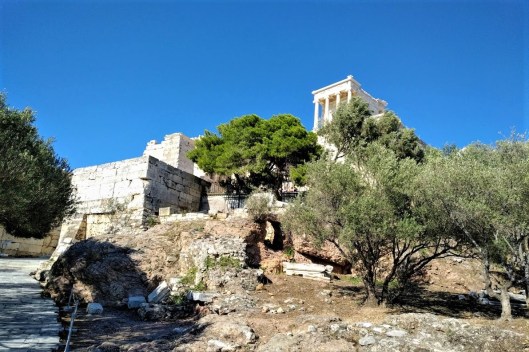
The ascent to the Acropolis, Athens, Greece — photo by David Kitz

Reflection
Psalm 121 is the second Song of Ascents, and as such it was a psalm, which was intended for use by pilgrims as they journeyed to Jerusalem. This particular psalm was most often sung or chanted as the pilgrims set out from Jericho. As they lifted up their eyes, the sharply rising hill country of Judah stretched off into the distance. Hill after hill rose up before them. Jesus often made this journey to Jerusalem from his youth (see Luke 2:41-52) until his final Passover pilgrimage (see Luke 19).

This final portion of the pilgrimage was truly an ascent. From the Dead Sea plain the road to Jerusalem climbs nearly five thousand feet—1600 meters. This is truly an ascent—an ascent from the Dead Sea plain, the lowest point on the earth’s surface, to the heights of Mount Zion.

For the bone-weary pilgrims, who had already walked more than one hundred kilometers (60 miles) from Galilee, the sight of those distant hills must have brought a measure of aching discouragement. Here was a looming challenge. Could they make this final ascent? The opening question of this psalm was not a matter of poetic whimsy. It was spoken in earnest. I lift up my eyes to the mountains—where does my help come from?

The weary pilgrim may well be asking, “Having come this far, can I complete this journey? Do I have enough energy—enough stamina to climb those hills? Will I be able to reach Zion? I am exhausted now—before I even start the ascent. I can’t do this on my own. Where does my help come from?”

The psalmist’s answer resounds off those ancient hills. Even today, it echoes down through the ages and reverberates through the chambers of the heart. My help comes from the LORD, the Maker of heaven and earth. 

Response: Father God, I am on a lifelong journey—a pilgrimage to the heavenly Jerusalem. When I become weary, give me strength.  I need your help. I know my strength comes from you, LORD. Amen.

Your Turn: Do you need strength? Have you become weary at times in serving the Lord?

An Introduction to the Songs of Ascent

16 Monday Jul 2018

Posted by davidkitz in Devotionals, God's word, Psalm 120, Psalms

≈ 1 Comment

Tags

lament, Mount Zion, peace, pilgrimage, pilgrims, Songs of Ascent

Reading: Psalm 120
A song of ascents.
I call on the LORD in my distress,
and he answers me.
Save me, L
ORD, from lying lips
and from deceitful tongues.
What will he do to you,
and what more besides,
you deceitful tongue?
He will punish you with a warrior’s sharp arrows,
with burning coals of the broom bush.
Woe to me that I dwell in Meshek,
that I live among the tents of Kedar!
Too long have I lived
among those who hate peace.
I am for peace;
but when I speak, they are for war
(NIV).

2018-07-02 (2)

What are the Songs of Ascent? Early morning in Grey Nuns Park, Orleans, ON — photo by David Kitz

Reflection
Psalm 120 is the first in a series of fifteen psalms that are called Songs of Ascent. Each psalm begins with this statement or title: A Song of Ascents. Some of the psalms also add this phrase: Of David.

Of course, this title begs the question, what are the Songs of Ascent? And furthermore, to what are we ascending? This compilation of fourteen psalms was composed for the use of pilgrims who were making their way to worship at the temple in Jerusalem. These are psalms of pilgrimage. They are called Songs of Ascent, or Psalms of Ascent, because Jerusalem is built on a high point in the land of Israel. Specifically, the temple compound was constructed at the summit of Mount Zion, so pilgrims were literally and figuratively ascending to worship at the House of God.

This first psalm in the series is really a lament. The psalmist is living in a distant place—a place far from God. All of us begin our pilgrimage—our journey to God—from a distant place. Just like the prodigal we find ourselves in a distant land, a land where there is no peace. Sin has its fleeting pleasures, but it brings no lasting peace, no deep contentment. We have wandered far from the Father’s warm embrace. The psalmist laments, “Woe to me that I dwell in Meshek, that I live among the tents of Kedar!”

The Songs of Ascent are all about drawing near to God. They are about going to the heart of worship and finding peace—true peace in the arms of God. But first we must recognize where we are. We are dwelling in Meshek—in a world far from the LORD. We need to acknowledge our true condition. Change happens when we recognize the truth about ourselves and our need for a Savior. Only then can we begin our journey toward peace.

Have faith in this promise. I call on the LORD in my distress, and he answers me. 

Response: Father God, today I am continuing my journey toward you. Lord Jesus, I need you as my Savior. Help me set aside those things that hinder my journey to intimacy with you. Amen.

Your Turn: Are you living in Meshek? Have you begun your pilgrimage to arms of the Father?

Our Eyes Look to the LORD

08 Sunday Jul 2018

Posted by davidkitz in Bible, God's word, Psalm 123, Psalms

≈ Leave a comment

Tags

arrogant, mercy, praise, ridicule, Songs of Ascent, the LORD

I will praise Him!

L Kranz Swan
Trumpeter Swan — photo courtesy of Liz Kranz

A song of ascents.

I lift up my eyes to you,
    to you who sit enthroned in heaven.
As the eyes of slaves look to the hand of their master,
    as the eyes of a female slave look to the hand of her mistress,
so our eyes look to the LORD our God,
    till he shows us his mercy.
Have mercy on us, LORD, have mercy on us,
for we have endured no end of contempt.

We have endured no end of ridicule from the arrogant,
of contempt from the proud.

(Psalm 123:1-4, NIV)

Self-Denial

16 Thursday Feb 2017

Posted by davidkitz in Psalm 132, Psalms

≈ 11 Comments

Tags

David, Grey Nuns Park, Jesus, Mount Zion, Ottawa, pray, Prayer, Psalms of Ascent, self-denial, Songs of Ascent, stronholds, surrender, the LORD, Zion

Reading:                                        Psalm 132

A song of ascents.

(Verses 1-5)

LORD, remember David
and all his self-denial.

He swore an oath to the LORD,
he made a vow to the Mighty One of Jacob:
“I will not enter my house or go to my bed,
I will allow no sleep to my eyes
or slumber to my eyelids,
till I find a place for the L
ORD,
a dwelling for the Mighty One of Jacob”
(NIV).

Reflection

This is the thirteenth psalm in the Songs of Ascent series. With this psalm, the author returns to a familiar theme—the glory of God’s presence in Zion. It is what has drawn the pilgrims to this holy place. They have come to worship and meet with God.

img_20170209_162239

Icy sunset, Grey Nuns Park, Ottawa, ON — photo by David Kitz

But this psalm has a different approach. It recounts the history of Zion and how this particular place was chosen as the site for Israel to worship God. It all began with David. At the prompting of the LORD, David chose Mount Zion to set up the Tabernacle of the LORD. But before Mount Zion could become a place of worship the stronghold of Zion had to be conquered. It was in enemy hands. Nevertheless, David captured the fortress of Zion—which is the City of David (2 Samuel 5:7).

In this psalm we hear of David’s vow. “I will not enter my house or go to my bed, I will allow no sleep to my eyes or slumber to my eyelids, till I find a place for the LORD, a dwelling for the Mighty One of Jacob”

In David’s case, finding a place for the LORD required self-denial. It involved a physical battle. There is a spiritual battle that we too need to fight so the LORD can occupy His rightful place in our lives. The enemy does not leave the strongholds in our mind without a fight. We must take action to evict him.

We live in a world where self-denial is rare, and often frowned upon. Our society pushes the easy life—the comfortable life—the path of least resistance. Self-denial in pursuit of a relationship with God is a foreign concept. In many churches fasting and prayer is a lost discipline.

Jesus encountered the same problem with his own disciples. While he was praying fervently in the Garden of Gethsemane, his disciples were fast asleep. “Simon,” he said to Peter, “are you asleep? Couldn’t you keep watch for one hour?” See Mark 14:32-42.

This inability to pray for an hour is an indicator that at our core we have not surrendered fully to God. Other things are more important. There is no self-denial. That TV show is more important. The game is more important. Perhaps our Zion is still occupied by the enemy and the LORD is not enthroned there.

Response: LORD God, help me to change. I want to put you first in my life. Come and occupy the throne of my life. I want my thoughts, words and actions to be governed by you, Lord Jesus. Amen.

Your Turn: Do you find self-denial difficult? Do you practice a variety of spiritual disciplines?

← Older posts
Newer posts →

Psalms 365: Develop a Life of Worship and Prayer

Psalms 365 Volume II

Psalms 365 vol 3
— Psalms 365 Volume III

Psalms

Recent posts

  • Do you have a picture of God? January 30, 2026
  • This Is My Body January 29, 2026
  • Tasting God January 29, 2026
  • Much Superior to the Angels January 28, 2026
  • Praise Always for Answered Prayer January 28, 2026
  • All About Hope January 27, 2026
  • It Is Good to Wait Quietly January 26, 2026

Calendar

January 2026
M T W T F S S
 1234
567891011
12131415161718
19202122232425
262728293031  
« Dec    

Blog Posts

Comments

  • cjsmissionaryminister on Tasting God
  • davidkitz on Tasting God
  • pastorpete51 on Tasting God

Blog at WordPress.com.

Privacy & Cookies: This site uses cookies. By continuing to use this website, you agree to their use.
To find out more, including how to control cookies, see here: Cookie Policy
  • Subscribe Subscribed
    • I love the Psalms
    • Join 1,383 other subscribers
    • Already have a WordPress.com account? Log in now.
    • I love the Psalms
    • Subscribe Subscribed
    • Sign up
    • Log in
    • Report this content
    • View site in Reader
    • Manage subscriptions
    • Collapse this bar
 

Loading Comments...