• Home
  • About
  • DavidKitz.ca
  • Youtube Videos
  • Books by David
  • Books on Amazon.com

I love the Psalms

~ Connecting daily with God through the Psalms

I love the Psalms

Monthly Archives: March 2019

Reading 21 for Lent from “The Soldier Who Killed a King”

26 Tuesday Mar 2019

Posted by davidkitz in Lent, The Soldier Who Killed a King

≈ 1 Comment

Tags

Jesus of Nazareth, Lent, Messiah, Pontius Pilate, repentance

A journey to the cross is a journey to repentance. It’s a journey to deep personal change. Will you take this journey with me?

Date: Five forty-five in the morning, Friday, April 7 A.D.
In today’s reading, a messenger from Pontius Pilate arrives at the home of Marcus Longinus, the Roman centurion, with the news that Jesus has been arrested.

“Sir, I have just come from the governor. You are to report to the Praetorium immediately. Jesus of Nazareth has been arrested. The high priest has brought him before the governor for judgment.”
“Is that so?” I said in a state of consternation. “Who sent you?”
“The governor himself. He said you were familiar with the Galilean.”
I blew a short puff of air through my nostrils. All of Jerusalem was somewhat familiar with the Galilean.
“So he wants me there immediately?”
“Immediately, sir.” He shifted from one foot to the other and then, as if to justify thisCentur. Sw response, he added, “The high priest and a big delegation, maybe three hundred men, maybe more, arrived at the palace door at first light. They had the prisoner—Jesus—with them.”
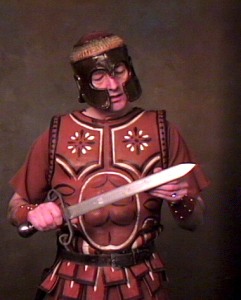
“Tell the governor I’m on my way.”
With a quick nod of my head, I dismissed the messenger. Instantly he turned and began his run back to the governor’s residence. I took one step back inside the gate and began barking orders.
“You, you, and you!” I stabbed my index finger in the direction of the most dressed and prepared-looking soldiers. “Strap on your swords and follow me. Now!”
Then, addressing the other soldiers, I announced, “The rest of you, meet me at the Praetorium as soon as you are ready.”
“Claudius”—I nodded in his direction—“you are in charge. I’ll give everyone their assignment for the day when they get there.”
I stepped back through the gate and began covering the ground with long, quick strides. My three recruits had to run to catch up. With each stride a new thought came jogging into my head. Stupid Arius! Why didn’t he tell me the messenger was from Pilate? I would have moved a good deal faster.
Obviously my concerns about the prophet had moved up the chain of command. Flavio must have informed Pilate about my worries and the actions I had taken, hence this unusual move—a direct summons by the governor. I harbored the hope that he would consult directly with me on the matter. Three hundred men! Three hundred men at first light? The Weasel must have had a busy night. It takes a good deal of effort to set your troops in array. Caiaphas must have been hatching this plot for a good long while. 4485 TWITTER

But the Weasel caught his prey! What a sweet bit of treachery that must have been. I wondered how he pulled that off. Now the high priest would move in for the kill. We would see if he could slaughter his own Passover lamb. The people! If the pilgrims, especially the Galilean pilgrims, knew their Messiah had been seized, there could be a mass revolt. That must be why the Weasel had done his dirty work in the dark of the night. And furthermore, he had played out this drama at the zenith of the festival, while minds and hearts were on faith, home, and family. Here was a cunning scheme worthy of the Fox, played out by the Weasel.
Undoubtedly most of the population would still be unaware of these developments, even as I had been caught off guard. Off guard but not surprised. I could smell this coming.
My conversation with Renaldo at the bathhouse came echoing back. It gave me an eerie feeling knowing I had spoken like some prophetic oracle. It made me wonder from where that insight had really come.
“By Jupiter! I forgot the spikes.” I wheeled around while reaching out my hand to halt the soldier at my side. Addressing him directly, I said, “I forgot them—the spikes. They’re in a pouch hanging on a peg in my bedchamber. My wife, she’ll know where they are. Ask her to get the pouch for you. Then bring it to me at the Praetorium. Oh, and tell the other men to hurry. This is urgent.” I fixed my eyes on him to stress the importance of this last statement and then added, “Now run.”

To download a free study guide for this high-impact, bible-based novel visit: https://www.davidkitz.ca/centurion.php/free study guide PDF

For book purchases of The Soldier Who Killed a King try Amazon or https://www.christianbook.com

Are You Forgetting God?

26 Tuesday Mar 2019

Posted by davidkitz in Devotionals, Psalm 50, Psalms

≈ 3 Comments

Tags

covenant, God, Psalm 50, salvation, wrath of God

Reading: Psalm 50
(Verses 16-23)
But to the wicked person, God says:
“What right have you to recite my laws
or take my covenant on your lips?
You hate my instruction
and cast my words behind you.
When you see a thief, you join with him;
you throw in your lot with adulterers.
You use your mouth for evil
and harness your tongue to deceit.
You sit and testify against your brother
and slander your own mother’s son.
When you did these things and I kept silent,
you thought I was exactly like you.
But I now arraign you
and set my accusations before you.
“Consider this, you who forget God,
or I will tear you to pieces, with no one to rescue you:
Those who sacrifice thank offerings honor me,
and to the blameless I will show my salvation”
(NIV).

53906712_10102411590979951_1966131312511156224_o

Balmaha, Scotland, — photo courtesy of Jan Jablonski

Reflection
I have a tendency to be forgetful. As I leave the house, it is not uncommon for me to forget some rather important items such as my wallet or my mobile phone. On our recent trip to Japan, my wife would often help me run through a checklist of essential items as we set out on an excursion. Wallet, rail pass, mobile phone and passport, all were needed. I dare not forget any of these.

But there is something more important than all of these ‘essentials’. In his conclusion to Psalm 50, the psalmist Asaph reminds us not to forget God. How often have you set out on your day only to realize that you forgot God at home? Did He even make it home with you? Maybe He’s still at church? Have you had God with you lately? Have you forgotten Him completely as you went about your business?

Forgetting God is no small matter. Here is the LORD’s response to those who forget Him: “Consider this, you who forget God, or I will tear you to pieces, with no one to rescue you: Those who sacrifice thank offerings honor me, and to the blameless I will show my salvation”

We all want to see the salvation of God, but it starts with not forgetting Him. When we do, we run the risk of becoming objects of His wrath. The wrath of God is not a popular topic these days, but a lack of popularity does not negate its reality. When we choose to ignore God, there are unpleasant consequences. This applies personally and nationally. When we turn our back on the author of our salvation, terrible things happen. When we embrace Him with thanksgiving, joy will be our portion.

Response: LORD God, let me never forget your great love for me. I want to take you with me today and every day. I am thankful for the promise of your presence. Amen.

Your Turn: Do you sometimes forget God as you begin your day?

Reading 20 for Lent from “The Soldier Who Killed a King”

25 Monday Mar 2019

Posted by davidkitz in Lent, Psalms, The Soldier Who Killed a King

≈ Leave a comment

Tags

Caiaphas, Herod Antipas, Lent, Pilate, repentance

A journey to the cross is a journey to repentance. It’s a journey to deep personal change. Will you take this journey with me?

Date: Mid afternoon on Thursday, April 6th, 30 A.D.
In today’s reading, Governor Pontius Pilate gives a brief speech formally welcoming Herod the tetrarch to Jerusalem.

At last the two mounted commanders arrived before Pilate’s chariot. They were motioned to take their position on either side. After a brief confusion of feet, the royal litter managed to turn sideways so the royal couple could face the governor as he stood upon his imperial chariot. The trumpeters sounded the fanfare. When the last note had echoed off the marble wall, Pilate unrolled the parchment handed to him by an attendant. He cleared his throat and began his oration.
Free WW-e FACEBOOK-2 (2)
“It was under the rule of the great and wise Emperor Caesar Augustus that this magnificent temple behind us began to take shape. He recognized the desire of the Jewish people for a central place to worship. It was Herod the great Idumean king who oversaw the construction of this masterpiece of the empire, and today it stands as a symbol of Roman respect for the unity and diversity of all the peoples of the empire. It is only fitting today that I, as the emperor’s representative, welcome the son of this master builder, Herod Antipas, the tetrarch of Galilee and Perea.”
With a wave of his hand, Pilate signaled the sounding of a second trumpet fanfare. As the first note was sounded, he stepped off the chariot and then graciously lent a hand to his wife. Thus accompanied by his mate, he swaggered over to the royal litter to personally greet Herod and Herodias, who both stood to meet them.
Greetings were exchanged, none of which I could discern from a distance. After a brief discussion Claudia joined Herodias in the royal litter. Herod barked out some orders. The litter bearers stood to their feet and headed off in the direction of the governor’s residence. Apparently the ladies would have their own time together.
At a leisurely pace Pilate escorted Herod over to where the priestly delegation waited.Soldier book
It was an unusual sight, these three hostile, inflated men exchanging greetings and meaningless pleasantries. Herod Antipas, Pontius Pilate, and Joseph Caiaphas; the Fox, the Badger, and the Weasel. All three were kings in their own right, within their own jurisdiction. All three craved more power, absolute power, while fiercely holding one another in check.
Pilate turned to me and gave a quick, tight nod. I signaled up to Claudius, and the great Golden Gate, the Messiah Gate, was hoisted, granting entrance to the three competing kings.
Only the fourth king, the people’s king—the donkey king—only he was absent.

To download a free study guide for this high-impact, bible-based novel visit: https://www.davidkitz.ca/centurion.php/free study guide PDF

For book purchases of The Soldier Who Killed a King try Amazon or https://www.christianbook.com
Judgment Day is Coming

25 Monday Mar 2019

Posted by davidkitz in Devotionals, Psalm 50, Psalms

≈ 3 Comments

Tags

crucifixion, God's judgment, judgment, justice, summons, the LORD

Reading: Psalm 50
A psalm of Asaph.
(Verses 1-6)
The Mighty One, God, the LORD,
speaks and summons the earth
from the rising of the sun to where it sets.
From Zion, perfect in beauty,
God shines forth.
Our God comes and will not be silent;
a fire devours before him,
and around him a tempest rages.
He summons the heavens above,
and the earth, that he may judge his people:
“Gather to me this consecrated people,
who made a covenant with me by sacrifice.”
And the heavens proclaim his righteousness,
for he is a God of justice
(NIV).

53556600_10102411588724471_8891070223889727488_o (1)

Balmaha, Scotland — photo courtesy of Jan Jablonski

Reflection
Psalm 50 begins by reminding us that Judgment Day is coming. A great summoning will take place. We will all gather before the throne of God. Rich and poor, the powerful and the weak, the living and the dead—all will gather before the LORD. None are excused. The Mighty One, God, the LORD, speaks and summons the earth from the rising of the sun to where it sets. 

On the day before his crucifixion Jesus elaborated at some length on this great summoning. For some it will be a day of joy and gladness; for others it will be a day of dread and sorrow. “When the Son of Man comes in his glory, and all the angels with him, he will sit on his glorious throne. All the nations will be gathered before him, and he will separate the people one from another as a shepherd separates the sheep from the goats. He will put the sheep on his right and the goats on his left” (Matthew 25:31-33).

What kind of day will it be for you?

It will certainly be a day of justice. The world is crying out for justice. All too often in this world—in this life—there is no such thing. The innocent suffer, while the perpetrators get off free. They gloat in their pride, while swaddled in luxury. On that great day—that Judgment Day—the tables will be turned. The great Judge of all the earth will see to that. And so He should. Since the fall of man, the world is crying out for justice.

It is well worth noting that in his account of Judgment Day, Jesus decides if we will enter into bliss or torment based on how we treat others. He states, “The King will reply, ‘Truly I tell you, whatever you did for one of the least of these brothers and sisters of mine, you did for me’ (Matthew 25:40).

Response: LORD God, help me to live my life in joyous preparation for that great summoning when wrong will be made right. Help me to be merciful so that I will receive your mercy in Jesus’ name. Amen.

Your Turn: How can we prepare our hearts and live our lives aright in the knowledge that Judgment Day is coming?

Reading 19 for Lent from The Soldier Who Killed a King

24 Sunday Mar 2019

Posted by davidkitz in Lent, The Soldier Who Killed a King

≈ 1 Comment

Tags

Caesar, Caiaphas, Herod, Lent, Pontius Pilate, repentance

A journey to the cross is a journey to repentance. It’s a journey to deep personal change. Will you take this journey with me?

In today’s reading, the rivalry and tension between the Governor Pontius Pilate, and Joseph Caiaphas, the high priest are on full display. The two leaders are waiting for the official arrival of Herod the tetrarch. Date: Mid afternoon on Thursday, April 6th, 30 A.D.

When all were in position, I called for the lowering of the heavy, grated iron gate. From now on, the Passover celebrants would be forced to use an alternate entrance or exit.
In short order the toga-clad governor, Pontius Pilate, arrived on his gold-ornamented chariot. The gate was raised. By the governor’s side stood Claudia Procula lavishly dressed in full-length scarlet. Her bejeweled opulence contrasted sharply with the poverty common to most women of this province. The chariot took a position allowing the ruling couple to look out to the Mount of Olives, in readiness for the approaching king.
The only missing player was Caiaphas. In due time his delegation arrived, and the enormous gate was hauled up once more on creaking chains, only to be lowered again when the priestly party had exited.
4485 TWITTER
Pilate had been gazing down the road stretched out before him when Caiaphas arrived, and it was only the coarse rattle coming from the gate chains behind him that alerted him to the approach of the high priest and his delegation. He turned, stepped down from the chariot, and briskly strode over to the dumbfounded cleric. The expression on Caiaphas’s face said it all. He clearly did not expect to see Pilate here. He had intended this to be a discreet, private tour and consultation.
“You’re expecting someone?” Pilate brusquely inquired.
An uncomfortable pause followed. Caiaphas cast a hasty glance at those accompanying him, adjusted the folds in his robe, cleared his rusty throat, and replied, “Yes, King Herod requested a tour of the great temple.”
“Did he now?” There was a coldness in Pilate’s voice that betrayed the utter contempt he felt toward this Jewish leader. “Ahh!” He gestured grandly. “There is no king in these parts. I know of no king.” Then spotting me on horseback nearby, the governor turned and in mock sincerity called out, “Centurion. Is there a king around here?”
“We have no king here but Caesar,” I answered, joining in the sport.
“The centurion says there is no king but Caesar. Do you have some other king I’m unaware of? Perhaps I should meet this king.”
By now the high priest was well beyond flustered. He had stepped into a trap. Surrounded by Roman troops and cut off from the safety of the temple’s hallowed sanctum, he was now being hectored by his chief political rival. It seemed more than he could endure. He began to tremble uncontrollably, whether from fear or anger I could not tell.
“Your Excellency”—he swallowed hard—“I was referring to the . . . te-tetrarch of Galilee.” 
“The te-tetrarch?” Pilate mimicked not only the high priest’s tremulous stammer, but also the rusty-gate scratch of his voice. “Is that so? Well, the tetrarch is no king. And he certainly isn’t your king.” Then with slow, icy deliberation, Pilate said, “There is no king here but Caesar. Did you hear that?”
This was no rhetorical question. “Yes, Your Excellency. I heard.”Biblical fiction winner 2017
“Do you, any of you”—he scanned the delegation—“have any other king?”
The cowering dogs dutifully answered, “No, we have no other king.”
Caiaphas, however, was silent. A fact well noted by the governor.
Then Pilate took a step closer to the trembling priest, pointed a bony finger in his face, and hissed, “Now don’t forget that, you old goat, or your blood will be running down the Kidron! Did you hear that?”
“I . . . I am your servant, Your Excellency,” Caiaphas rasped.
“Ha!” Pilate laughed an icy laugh in a show of disdain for that remark. Then he turned on his heels and marched back to his chariot, where once more he joined his wife.
For a full minute there was stunned silence from the religious delegation, and then suddenly they all began to speak at once in a huddle of hushed tones like schoolboys after a tongue-lashing from the headmaster.
But there was murder in the high priest’s eye. Nothing childish there. From my vantage point I could see that. He didn’t have the means, but he most certainly had the intent.
I am sure that if the gate had been open, the delegation would have returned to the safety of the sanctuary to plot their revenge, but that option was not open to them. They were trapped in this pocket, surrounded by hated foreign troops, subject to the whim and ridicule of their enemy, awaiting the arrival of their pretentious savior king.
Long, awkward moments passed. But they were saved from this interminable purgatory by Herod’s arrival.

To download a free study guide for this high-impact, bible-based novel visit: https://www.davidkitz.ca/centurion.php/free study guide PDF

For book purchases of The Soldier Who Killed a King try Amazon or https://www.christianbook.com

Praise the LORD, my Soul

24 Sunday Mar 2019

Posted by davidkitz in Bible, Psalm 146, Psalms

≈ 1 Comment

Tags

blessed, hope, praise, praise the LORD, trust

I will praise Him!

20180901_1048024 (2)

I will meditate on your wonderful works — photo by David Kitz

Praise the LORD.

Praise the LORD, my soul.

I will praise the LORD all my life;
    I will sing praise to my God as long as I live.
Do not put your trust in princes,
    in human beings, who cannot save.
When their spirit departs, they return to the ground;
    on that very day their plans come to nothing.
Blessed are those whose help is the God of Jacob,
    whose hope is in the LORD their God.

(Psalm 146:1-5, NIV)

Reading 18 for Lent from The Soldier Who Killed a King

23 Saturday Mar 2019

Posted by davidkitz in Lent, The Soldier Who Killed a King

≈ 1 Comment

Tags

Jesus, Jesus of Nazareth, king, Lent, Messiah, miraculous, repentance

A journey to the cross is a journey to repentance. It’s a journey to deep personal change. Will you take this journey with me?

In today’s reading, Marcus, the centurion, rides back into Jerusalem on horseback. As he rides his mind turns over his thoughts about Jesus of Nazareth. Date: Near noon on Thursday, April 6th, 30 A.D.

We continued on to the fortress, but my mind was on the Northern Messiah. His penetrating eyes haunted my thoughts. There was a power there that I had no ability to fathom. I was reminded of Ruth’s words. Ruth was one of our household servants, a Jewish girl. When at the supper table I had told Zelda about Jesus and his miraculous powers, Ruth’s eyes brightened. I asked her if she knew anything about this man.
biblical-fiction-award-2017_orig“Oh, yes,” she’d said. “Almost a year ago he healed a blind beggar from the Lower City. Jesus made some mud, put it on the beggar’s eyes, and sent him to wash in the Pool of Siloam. When he washed, he could see. It was a miracle. I’ve seen this man myself. I know it’s true,” she earnestly avowed.
When I’d asked her about this power Jesus had and where it came from, she bowed her head and answered, “From God.”
But she seemed somehow uncomfortable with her answer. She added, “It must be from God. He does good things. But our leaders aren’t sure. They think it may be demon power. But demons don’t heal the sick.”
Maybe the religious leaders were right. Maybe it was demonic power that made the blind see. It seemed preposterous. But why had I heard this voice? Why did this man trouble me so? Thinking of him seemed to stir up nothing but torment within me, and I didn’t even know why. I felt strangely attracted to him, yet at the same time repelled.
Then there was this talk about the kingdom of God. Maybe Timaeus was right about this prophet. The words of the wealthy merchant came back to me: “You don’t talk about a kingdom in this place and get away with it. Rome will see to that!”
Maybe we would see to it. Maybe we should see to it soon. But Jesus’s enemies were the same pompous, self-serving leaders I despised. He had aligned himself with the common man, with the poor, the oppressed, the sick and suffering. And he didn’t just champion their cause for personal benefit like some crass politician lobbying for the emperor’s favor. No, he healed them. He fed them. He walked with them, ate with them. He was one of them. He was their king, whether he wore a crown or not. I saw that clearly when he entered on the donkey. He was the donkey king. A horse would have put him above the crowd. A horse would have meant elevating himself like all the other egotistical men who led in this upside-down world.
In his case others would have to do the elevating.
The meaning of his entry on Sunday came clear to me now. It was a perspective gained from my comfortable perch on the back of my own noble steed.
By the time I reached the fortress for the second time in the week, I resolved to shut this Messiah out of my mind. He didn’t fit any of my categories for human behavior or religious thought. He was beyond understanding, an unwelcome intruder into my city and my thought life.
4485 FACEBOOK-1

To download a free study guide for this high-impact, bible-based novel visit: https://www.davidkitz.ca/centurion.php/free study guide PDF

For book purchases of The Soldier Who Killed a King try Amazon or https://www.christianbook.com

The LORD Watches Over All

23 Saturday Mar 2019

Posted by davidkitz in Bible, Psalm 145, Psalms

≈ 1 Comment

Tags

faithful, praise, praise the LORD, righteous, the LORD

I will praise Him!

2018-06-10

Wild flowers — photo by David Kitz

The LORD is righteous in all his ways
    and faithful in all he does.
The LORD is near to all who call on him,
    to all who call on him in truth.
He fulfills the desires of those who fear him;
    he hears their cry and saves them.
The LORD watches over all who love him,
    but all the wicked he will destroy.

My mouth will speak in praise of the LORD.
    Let every creature praise his holy name
    for ever and ever.

(Psalm 145:17-21, NIV)


Reading 17 for Lent from The Soldier Who Killed a King

22 Friday Mar 2019

Posted by davidkitz in Lent, The Soldier Who Killed a King

≈ Leave a comment

Tags

Caesar, Caiaphas, centurion, Jesus, Lent, repentance, tax collector

A journey to the cross is a journey to repentance. It’s a journey to deep personal change. Will you take this journey with me?

In today’s reading, Marcus, the centurion, meets with Jonas the tax collector. They discuss the news of the week, namely the huge stir that Jesus has caused in Jerusalem since his triumphal entry into the city. Date: Early morning April 6th, 30 A.D.

As I descended the stairs of the gate, I caught sight of Jonas and his son, unoccupied at the customs booth. With a quick wave of my hand, I signaled my intention to speak with him, and after taking the salute of the sentinels at the gate, I headed straight to the booth. “Good morning, you old goat!” I called out as I approached.
“Well, if it isn’t the top dog himself,” he shot back.
“It’s always good to see a man standing around doing nothing. It sets me at ease,” I said. “Ease?” His eyebrows shot up. “Oh yeah.” He nodded emphatically. “It’s been a week of ease all right. I’ve had my feet up all week.”
Of course, just the opposite was true, and it was true for both of us.
Free WW-e FACEBOOK-2 (2)
“Do you think we could have a short word?” With a jerk of my head, I motioned in the direction of the road leading down the Kidron Valley.
“Sure,” he answered, and then with a glance and a nod to his son, he transferred responsibility to him. A light mist still hung over the lowest reaches of the valley, but the early-morning sun was promising to burn it off. The swallows nesting along the crevices in the city wall were engaged in a full-throated competition with the songbirds in the trees along the brook. Traffic to and from the city was just beginning to stir.
When we had gone a few paces beyond the gate, I spoke. “I just wanted to say thanks for the help with the Barabbas case.”
“Oh, don’t mention it.” There was relief in his voice. “I thought you were going to warn me about some new plot.”
“No, there’s no new plot.” I hesitated. “Let me rephrase that. There’s no new plot that I know about. You never can be sure what’s being hatched in this crazy city.”
“Yeah, you’re right about that. I guess we learned that with Barabbas.” Jonas nervously bit on the corner whiskers of his mustache, and then continued. “Now, that Galilean prophet? I’ve been losing sleep over him all week.”
“Harmless as a dove,” I said. “Harmless as a dove.”
“How do you know?”
“I checked him out myself on Monday, right back there in the temple courts.” I made a quick double-pump motion with my upraised thumb aimed over my shoulder. “Then on Tuesday I had Claudius in there with the prophet.”
“You Romans have more nerve than brains.” He kicked a loose pebble off the pathway, looked up at me with a quizzical grin, and then with an incredulous shake of his head, he repeated, “More nerve than brains, that’s all I can say.”
“If we didn’t have nerve, we wouldn’t be running this place. Or any other place for that matter.”
He shrugged, furrowed his brow, and then cocked his head to one side. It was his way of reluctantly conceding my point.
“So he’s harmless?”
“Harmless to us.” With my index finger, I pointed first at myself, then at Jonas, and then back again. “Caiaphas, on the other hand”—I paused for effect—“now there’s a man who I’m sure hasn’t slept well all week.”
“So you think the old rusty gate has lost some sleep? Over what?”
“Money. Money and prestige. It can’t look too good having some roving up-country rabbi come in and take over your temple at the religious high point of the year.”
“I suppose not,” Jonas said. But then he added, “You know this prophet, Jesus of Nazareth, he’s been here before. He kicked out the money changers a few years back. Caused quite a stir then. But nothing like this. He’s got the temple guards running scared. That’s what my uncle told me.”
James Tht“Your uncle’s right. I saw that firsthand on Monday. So what else do you know about this Galilean?”
“My wife tells me he’s a friend of tax collectors and sinners. She told me one of his disciples was a tax collector before he met the prophet.”
“Ah, tax collectors and sinners?” I responded with a wink and a nod. “Maybe there is hope for the two of us yet.”
Jonas smiled back at me. “So, Marcus, where is this all headed? Some people think he’s the Messiah. You know that, don’t you?”
“Yes, we’re well aware of that. But he doesn’t oppose paying taxes to Caesar.” I gave my tax collector a supportive thumbs-up signal. “And he hasn’t spoken a word against Rome since he’s been here.”
“That’s not a surprise. He knows better. You and your boys would have him nailed up on Golgotha the moment he did.”
“You’re right about that,” I agreed. “But I honestly don’t think he’s got a quarrel with us. He’s going after the parading hypocrites in long, flowing robes, those killjoy Pharisees and teachers of the law. You know the ones—the religious police who run this place.”

To download a free study guide for this high-impact, bible-based novel visit: https://www.davidkitz.ca/centurion.php/free study guide PDF

For book purchases of The Soldier Who Killed a King try Amazon or https://www.christianbook.com

Redeemed from the Realm of the Dead

22 Friday Mar 2019

Posted by davidkitz in Psalm 49, Psalms

≈ Leave a comment

Tags

Jesus, Psalm 49, Redeemer, redemption, resurrection, trust in God

Reading: Psalm 49
(Verses 13-20)
This is the fate of those who trust in themselves,
and of their followers, who approve their sayings.
They are like sheep and are destined to die;
death will be their shepherd
(but the upright will prevail over them in the morning).
Their forms will decay in the grave,
far from their princely mansions.
But God will redeem me from the realm of the dead;
he will surely take me to himself.
Do not be overawed when others grow rich,
when the splendor of their houses increases;
for they will take nothing with them when they die,
their splendor will not descend with them.
Though while they live they count themselves blessed—
and people praise you when you prosper—
they will join those who have gone before them,
who will never again see the light of life.
People who have wealth but lack understanding
are like the beasts that perish
(NIV).

20180904_0712432

Weeping willow, Grey Nuns Park, Orleans, ON — photo by David Kitz

Reflection
Throughout Psalm 49 the psalmist is establishing a contrast between those who trust in themselves and the wealth they have accumulated, and those who put their trust in God. Death is the fate of all, rich and poor, wise and foolish. The grave spares no one. This is the fate of those who trust in themselves, and of their followers, who approve their sayings. They are like sheep and are destined to die; death will be their shepherd (but the upright will prevail over them in the morning).

I find great hope between the parentheses in the passage above. But the upright will prevail over them in the morning. A new day is coming—a day of resurrection—a day where justice will prevail at last. We can rest in hope that wrongs will be righted, truth will triumph over lies, and joy will snuff out sorrow. Yes, a new morning will dawn. A Redeemer is coming. Along with suffering Job believers can say, “I know that my redeemer lives, and that in the end he will stand on the earth. And after my skin has been destroyed, yet in my flesh I will see God” (Job 19:25-26).

The psalmist boldly declares where he has placed his faith: But God will redeem me from the realm of the dead; he will surely take me to himself. 

Is that where you have placed your faith? Do you put your trust in Jesus, the Redeemer, who purchased your redemption with his shed blood? Death is a certainty, but so is redemption for those who put their trust in the One who died and rose again.

Response: LORD God, I thank you that Jesus, my Redeemer, lives! I put my trust in you, now and for eternity. I rest in the hope that a new day will dawn when the dead in Christ will rise. Amen.

Your Turn: Is your heart ready for that glorious day? Have you bowed before your Redeemer?

← Older posts
Newer posts →

Psalms 365: Develop a Life of Worship and Prayer

Psalms 365 Volume II

Psalms 365 vol 3
— Psalms 365 Volume III

Psalms

Recent posts

  • The God of Turn-Arounds January 12, 2026
  • A Fortress of Salvation January 11, 2026
  • Finishing Well and Growing in Fruitfulness  January 11, 2026
  • I Call to You for Help January 10, 2026
  • Above All Gods January 9, 2026
  • The Need for a Place of Refuge January 9, 2026
  • David Dances before the LORD January 8, 2026

Calendar

March 2019
M T W T F S S
 123
45678910
11121314151617
18192021222324
25262728293031
« Feb   Apr »

Blog Posts

Enter your email address to follow this blog and receive notifications of new posts by email.

Comments

  • davidkitz on Above All Gods
  • davidkitz on Above All Gods
  • davidkitz on David Dances before the LORD

Blog at WordPress.com.

Privacy & Cookies: This site uses cookies. By continuing to use this website, you agree to their use.
To find out more, including how to control cookies, see here: Cookie Policy
  • Subscribe Subscribed
    • I love the Psalms
    • Join 1,381 other subscribers
    • Already have a WordPress.com account? Log in now.
    • I love the Psalms
    • Subscribe Subscribed
    • Sign up
    • Log in
    • Report this content
    • View site in Reader
    • Manage subscriptions
    • Collapse this bar
 

Loading Comments...