Tags
desperate, forgive, forgiveness, generations, glory, God, mercy, nations, Savior, sins
I will praise Him!

Crabapple blossoms in spring — photo by David Kitz

27 Saturday May 2017
Tags
desperate, forgive, forgiveness, generations, glory, God, mercy, nations, Savior, sins
Crabapple blossoms in spring — photo by David Kitz
26 Friday May 2017
Posted in Psalms
Tags
conversations with God, David, early, early birds, God, Heavenly Father, morning, Prayer, Psalm, the LORD, voice, waiting, waiting on God
Reading: Psalm 5
For the director of music. For pipes. A psalm of David.
(Verses 1-7)
Listen to my words, LORD, consider my lament.
Hear my cry for help, my King and my God, for to you I pray.
In the morning, LORD, you hear my voice;
in the morning I lay my requests before you
and wait expectantly.
For you are not a God who is pleased with wickedness;
with you, evil people are not welcome.
The arrogant cannot stand in your presence.
You hate all who do wrong;
you destroy those who tell lies.
The bloodthirsty and deceitful you, LORD, detest.
But I, by your great love, can come into your house;
in reverence I bow down toward your holy temple (NIV).
Reflection
Are you a morning person? Are you most productive in the morning hours, or do revive after the sunsets? Our bodies move according to their own internal rhythm. Some people love to rise with the chirp of the first songbird, while others are true night owls. Often my wife catches her second wind in the evening as I’m fading into sweet oblivion.

Manitoba sunrise, “Awake my soul” — photo by David Kitz
It would seem that David was a morning person. Here in Psalm 5, we read these words from David: In the morning, LORD, you hear my voice; in the morning I lay my requests before you and wait expectantly.
David was one of those early birds that began calling out to God at the break of day. He knew God was listening. He made sure that the LORD heard his voice.
Is the LORD hearing your voice in the morning? Are you calling out to Him? Of course, your heavenly Father is pleased to hear your voice at any time, day or night. Is He familiar with your call?
But there’s more to this than just calling out to God and laying out your requests. David waits expectantly. He expects God to respond. He is listening, watching and waiting for the LORD’s reply. Have you built some wait time into your prayer time?
All too often our conversations with God are one sided. They are one sided because we blurt out our requests and rush off into our day. We don’t wait expectantly for the LORD’s reply. We don’t allow Him time to respond.
Response: Heavenly Father, I call out to you. I lay out my requests. Teach me to wait expectantly for you. Open my ears to hear your voice. Amen.
Your Turn: Have you set aside a regular prayer time? What time works best for you?
25 Thursday May 2017
Tags
David, delusions, entertainment, eyes, face, face of God, false gods, heart searching, joy, looking, Ottawa River, porn, pornography, Psalm, shine, the LORD
Reading: Psalm 4
For the director of music. With stringed instruments. A psalm of David.
Answer me when I call to you,
my righteous God.
Give me relief from my distress;
have mercy on me and hear my prayer.
How long will you people turn my glory into shame?
How long will you love delusions and seek false gods?
Know that the LORD has set apart his faithful servant for himself;
the LORD hears when I call to him.
Tremble and do not sin;
when you are on your beds,
search your hearts and be silent.
Offer the sacrifices of the righteous and trust in the LORD.
Many, LORD, are asking, “Who will bring us prosperity?”
Let the light of your face shine on us.
Fill my heart with joy when their grain and new wine abound.
In peace I will lie down and sleep,
for you alone, LORD, make me dwell in safety (NIV).
Reflection
Where are you looking?

Sunset on the Ottawa River — photo by David Kitz
Think about it for a moment, where you look is where you go. If you are walking, you are looking where you are going. If you are driving, you are looking where you are going, and if you don’t fix your eyes on where you are going, your journey will surely come to an abrupt end—an accident. As you move through your day—as you move through life—where you look is where you go.
If you look to the internet for porn, you are sure to find it, and be trapped by it. If you look to television for entertainment, you are sure to find it. It too in subtle ways can ensnare and deaden the spirit. If you look to others, they will often disappoint you. As David points out in this Psalm, all too often we love delusions and seek false gods. We are looking in the wrong places and consequently we steer our life into the ditch.
In Psalm 4, David’s approach is totally different. He is looking to the LORD. He is calling out to God. He fears the LORD (trembles and does not sin). In silence he searches his heart and encourages us to do the same. Have you offered a sacrifice of righteousness recently? Right living has a cost. But it also pays enormous dividends.
As we trust in the LORD and look to Him, as a loving Father, He turns His face to us. The light of His face shines on us. Wow! That fills my heart with joy.
Response: Heavenly Father, today let the light of your face shine on me. Guide me in the way of truth. I want to look to you. Amen.
Your Turn: Has the light of God’s face shone on you recently? What was that like?
24 Wednesday May 2017
Posted in Psalms
Tags
Absalom, atheists, confidence, David, desperate, God, pray, Prayer, self-assured, sleep, tested, testing, the LORD, trouble, trust in God, World War I
Reading: Psalm 3
A psalm of David. When he fled from his son Absalom.
LORD, how many are my foes!
How many rise up against me!
Many are saying of me,
“God will not deliver him.”
But you, LORD, are a shield around me,
my glory, the One who lifts my head high.
I call out to the LORD,
and he answers me from his holy mountain.
I lie down and sleep;
I wake again, because the LORD sustains me.
I will not fear though tens of thousands assail me on every side.
Arise, LORD! Deliver me, my God!
Strike all my enemies on the jaw;
break the teeth of the wicked.
From the LORD comes deliverance.
May your blessing be on your people (NIV).
Reflection
When do you most need God?

An Abandoned Prairie Home— photo courtesy of Donald Adam
The answer to that question is easy—when I’m in deep trouble. It’s natural to call out to God when I’m in some great or urgent need. A returning veteran from the First World War said it best, “There are no atheists in the trenches. When the artillery shells start exploding to the right and left even unbelievers discover how to pray.”
The context of Psalm 3 is of great significance. David finds himself in the midst of a life threatening tragedy. He is fleeing from his palace in the nation’s capital, because his son is conspiring to murder him and seize the kingdom from his hands. Here is the great delta—the extreme low point in David’s life.
How does David respond? With utter confidence in God! Yes, he calls out to the LORD for deliverance, but he does so with complete assurance that God will answer. There isn’t the slightest hint of doubtful desperation in his voice. Having prayed to the LORD, he boasts in his ability to sleep, because he knows God will answer.
How could David be so confident—so self-assured? Actually, David’s assurance rested entirely on the LORD, not on himself. David had a wealth of experience with God. In his mind, the LORD was tried, tested, and true through the ups and downs of life.
He knew something we need to know. God will come through. He will bring salvation and deliverance!
Response: LORD God, save me from all my troubles. I put my confidence in you. You reach down to me at the low points in my life. You have never abandoned me. Amen.
Your Turn: Take a moment to reflect on the goodness of the LORD. Has He saved you from deep trouble in the past?
23 Tuesday May 2017
Tags
Christ, financial affairs, Jerusalem, king, Kiss, kissing, Messiah, messianic, monarch, prophetic, submission, submit, the LORD, Zion
Reading: Psalm 2
Why do the nations conspire and the peoples plot in vain?
The kings of the earth rise up and the rulers band together
against the LORD and against his anointed, saying,
“Let us break their chains and throw off their shackles.”
The One enthroned in heaven laughs; the Lord scoffs at them.
He rebukes them in his anger and terrifies them in his wrath, saying,
“I have installed my king on Zion, my holy mountain.”
I will proclaim the LORD’s decree:
He said to me, “You are my son; today I have become your father.
Ask me, and I will make the nations your inheritance,
the ends of the earth your possession.
You will break them with a rod of;
you will dash them to pieces like pottery.”
Therefore, you kings, be wise; be warned, you rulers of the earth.
Serve the LORD with fear and celebrate his rule with trembling.
Kiss his son, or he will be angry and your way will lead to your destruction,
for his wrath can flare up in a moment.
Blessed are all who take refuge in him (NIV).
Reflection
Kisses are so close-up and personal, so intimate. I don’t know about you, but I don’t kiss everyone I meet. Kisses are reserved for those special people in my life—people I know and trust—people I love.

Butchart Gardens, Victoria, BC — photo by David Kitz
Here in Psalm 2, kings and rulers are commanded to kiss the Son of God. What an odd command? What is the significance of this? The kiss in this case signals full submission to the supreme potentate. Kings and rulers are to submit to the overarching rule of Christ over themselves, their affairs and their entire domain.
Psalm 2 is the first of several messianic psalms scattered throughout the Book of Psalms. There is nothing subtle about the messianic message found here. The LORD has installed His anointed as king in Zion and furthermore this anointed one is identified as the Son of God. The term the LORD’s “anointed” is frequently translated as Messiah or Christ.
In the Book of Acts, we see the apostles viewed this psalm as the prophetic fulfillment of Christ’s mission during his last days in Jerusalem. The anointed Son of God was rejected by Herod and Pilate, the rulers of that time. They refused to kiss the Son. See Acts 4:23-31.
But what about me? Have I kissed the Son? Have I submitted to his will for my life? In my own small way, I too am a monarch, a ruler of my own domain. Today, will I allow him to rule over me, my conduct, my activities and my financial affairs?
Response: Dear Lord Jesus, thank you for your unconditional love. You want only the best for me. I yield to you. Help me to embrace your will and purpose for my life. I trust in you. I love you, Lord. With my lips I kiss the Son. Amen.
Your Turn: Have you kissed the Son? How can you show your love and loyalty to Jesus today?
22 Monday May 2017
Tags
Bible, Christ, disobedience, forgiveness, fruit, fruitful, grace, Mount Calvary, redemption, righteous, Tree of Knowledge of Good and Evil, Tree of Life, trees, wicked
Reading: Psalm 1
Blessed is the one
who does not walk in step with the wicked
or stand in the way that sinners take
or sit in the company of mockers,
but whose delight is in the law of the LORD,
and who meditates on his law day and night.
That person is like a tree planted by streams of water,
which yields its fruit in season
and whose leaf does not wither—
whatever they do prospers.
Not so the wicked!
They are like chaff that the wind blows away.
Therefore the wicked will not stand in the judgment,
nor sinners in the assembly of the righteous.
For the LORD watches over the way of the righteous,
but the way of the wicked leads to destruction (NIV).
Reflection
Have you ever noticed the prominent role that trees play in the Bible? The creation account in Genesis begins with God planting two very special trees in the Garden of Eden: the Tree of Life and the Tree of Knowledge of Good and Evil. After our first parent’s disobedience, we were banned from access the Tree of Life. But the amazing, good news of the Bible is that at the end of the book, in the last chapter of the Book of Revelation, God restores our access to the Tree of Life (Revelations 22:1-5).

The fresh green leaves of spring — photo by David Kitz
In a very real sense the Bible is a story about trees.
Here in the very first Psalm, the life of the righteous is compared to a fruit-bearing tree, flourishing by streams of water. The psalmist presents a picture of tranquil beauty. Is that a picture of my life? Sometimes I feel more like windblown chaff—rather worthless and lacking a sense of direction.
But that’s where the other tree at the heart of the Bible comes into play. It stands on a hill called Calvary. There my Savior bled and died. There he showed me my true worth. There my sins were washed away, never to be remembered again. That’s where I became righteous, not by works that I had done, but by the grace and forgiveness of Christ.
What a beautiful tree! The tree on Mount Calvary isn’t beautiful because of its leaves. It’s beautiful because of its fruit—the fruit of redemption purchased by the blood of Jesus. My righteousness is solely due to him.
Response: Dear Lord Jesus, thank you for your sacrifice. Help me to always remember that you are the true source of my righteousness. At your prompting help me to rid myself of the worthless chaff in my life. Wind of God, blow on me. Water of life, refresh my soul. May I be fruitful, Lord, for you. Amen.
Your Turn: Have you knelt before the tree on Mount Calvary?
21 Sunday May 2017
Posted in Books by David Kitz, Psalms
Tags
Caiaphas, centurion, David Kitz, Holy Week, Jesus, King Herod, Kregel, Longinus, Passion Week, Pontius Pilate, terrorist
A stunning story of Holy Week through the eyes of a Roman centurion
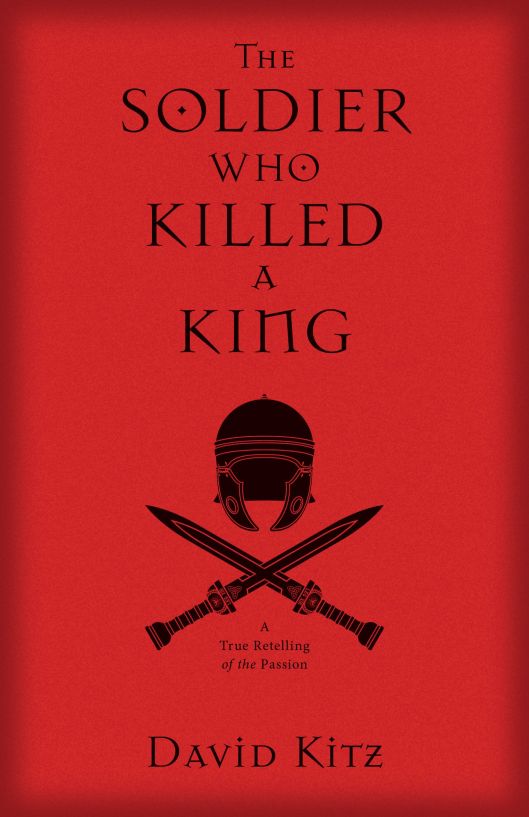
New from David Kitz and Kregel Publishing — now available for preorder
Watch the triumphal entry of the donkey-riding king through the eyes of Marcus Longinus, the centurion charged with keeping the streets from erupting into open rebellion.
Look behind the scenes at the political plotting of King Herod, known as the scheming Fox for his ruthless shrewdness.
Get a front-row seat to the confrontation between the Jewish high priest Caiaphas and the Roman governor Pontius Pilate.
Understand as never before the horror of the decision to save a brutal terrorist in order to condemn the peaceful Jew to death.
If you’ve heard the story of Passion Week so often it’s become stale, now is the time to rediscover the terrible events leading from Jesus’s humble ride into the city to his crucifixion. The Soldier Who Killed a King will stun you afresh with how completely Christ’s resurrection changed history, one life at a time.
To pre-order directly from the publisher click on the link below:
http://www.kregel.com/fiction/the-soldier-who-killed-a-king/
20 Saturday May 2017
Posted in Books by David Kitz, Psalms
Tags
American Bible Society, concertos, David Kitz, God, hymns, praise, praise choruses, Psalms, Psalms Alive!
The Psalms Speak to our Deepest needs!
Within the Psalms we hear the deepest longings of the human heart. Here we find the full range of human experience—an experience that brings us face to face with God. Our joys and triumphs are reflected here. Our spirits soar to the heavens, but we also plumb the depths of tragic despair. Is it any wonder then, that throughout the ages men and women have found refuge in the Psalms.

237 pages, trade paperback
In the Psalms we find the wellspring of praise. This has been the churches’ fount of worship, from ancient hymns, to stately concertos, to modern praise choruses, they all find their source in the Psalms.
“David Kitz paints pictures with words, taking lessons from Scripture and nature to offer us a three-dimensional, multi-sensory relationship with God.” — Robert L. Briggs, Executive Vice President, American Bible Society
Yes, my devotional study, Psalms Alive! Connecting Heaven and Earth is available for purchase. Click on the link below for reviews and more details.
http://www.davidkitz.ca/bookcart/index.php?route=product/product&product_id=62&search=psalms
19 Friday May 2017
Tags
breath, breath of God, breath of life, cymbals, dancing, hallelujah, Holy Spirit, Jesus, praise, Psalm, resurrection, the LORD
Reading: Psalm 150
Praise the LORD.
Praise God in his sanctuary;
praise him in his mighty heavens.
Praise him for his acts of power;
praise him for his surpassing greatness.
Praise him with the sounding of the trumpet,
praise him with the harp and lyre,
praise him with timbrel and dancing,
praise him with the strings and pipe,
praise him with the clash of cymbals,
praise him with resounding cymbals.
Let everything that has breath praise the LORD.
Praise the LORD (NIV).
Reflection
We have reached the crescendo—the conclusion and the high point of the Book of Psalms. Hallelujah and praise the LORD!

Petrie Island, Orleans, ON — photo by David Kitz
The word praise appears thirteen times in this final psalm. The number thirteen is suggestive of Jesus and his apostles. He is at the core—the very center of God ordained worship.
Eight forms or instruments of praise are listed in this psalm. Eight is the number of new beginnings. Seven suggests completeness, so we see that God rested on the seventh day. But eight signals a new start. In the same way, these eight means or instruments of praise do not represent a complete list. They simply suggest the varied ways in which we can express our praise to the LORD. We have only just begun to discover and explore the many ways in which we can show our gratitude to our Creator.
No one—no living being—is excluded from this call to praise. Let everything that has breath praise the LORD.
This call for all the breathing to praise the LORD is truly fitting. We received our original breath from the LORD. Then the LORD God formed a man from the dust of the ground and breathed into his nostrils the breath of life, and the man became a living being (Genesis 2:7). Now with our breath—our God-given breath—let us praise our Maker.
In the same way after his resurrection Jesus breathed on his disciples. Again Jesus said, “Peace be with you! As the Father has sent me, I am sending you.” And with that he breathed on them and said, “Receive the Holy Spirit” (John 20:21-22).
We need the breath of God in us—the breath of the Holy Spirit in us to live—to truly live in the overcoming power and joy of the psalms. For the Holy Spirit’s presence I will praise the LORD!
Response: LORD God, I praise you. You are my strength and my song. Help me to discover new ways to praise you because you are good. Let my entire life reflect your redemptive presence in me. Amen.
Your Turn: Why are you breathing? Is praising God an integral part of your purpose?
18 Thursday May 2017
Tags
crown of life, gender bias, God's word, heroes, Jesus, Old Testament history, praise, racial bias, rewriting history, Savior, spiritual warfare, sword of the Spirit, temptations, the LORD, word of God
Reading: Psalm 149
(Verses 1-5)
May the praise of God be in their mouths
and a double-edged sword in their hands,
to inflict vengeance on the nations
and punishment on the peoples,
to bind their kings with fetters,
their nobles with shackles of iron,
to carry out the sentence written against them—
this is the glory of all his faithful people.
Praise the LORD (NIV).
Reflection
In society today there are moves afoot to rewrite history. Old monuments are being torn down or neglected. Places and buildings are being renamed because past victories or policies are now seen as oppressive or unjust. Many of the heroes of the past have lost their luster. In many cases there is sound reasoning that goes into justifying this change. Let’s face it; not every conquest was undertaken with pure motives. Not every government policy in the past was without racial or gender bias.

Statue of King David, the shepherd king, Jerusalem — photo by Lois Morrow
But are we wise when we judge people from a different era with the moral positions and perspectives of today? Do we carry our own set of biases that color our view of history? Of course we do.
We encounter the same issues when we look back at Old Testament history. It’s difficult for New Testament believers to justify Old Testament vengeance, genocide and slaughter. And yes, there’s plenty of that recorded in our Bibles. Today’s reading from Psalm 149 touches on this very point. The psalmist urges the infliction of vengeance on the nations and punishment on the peoples, to bind their kings with fetters, their nobles with shackles of iron. As followers of a gentle Jesus, who taught us to love our enemies, how are we to interpret and apply this call to action?
First, let’s realize that we are living under a new and better covenant with Jesus as our Lord and Savior. When he was arrested, Jesus told Peter to put away his sword. We do well when we heed that advice. The eager warmongers among us often need to take a chill pill. Jesus showed no tendencies to war.
But we do have a battle to fight, and we urgently need a double-edged sword. St. Paul calls it the sword of the Spirit, which is the word of God (Ephesians 6:17b). How effective are you in handling the word of God? How effective are you in battling the spiritual forces and daily temptations that are arrayed against you? With the praises of God in your mouth, and the sword of the Spirit in your hand, are you propelling your way to victory in the daily grind of life? Are the joy and peace of God reigning in your life?
Blessed is the one who perseveres under trial because, having stood the test, that person will receive the crown of life that the Lord has promised to those who love him (James 1:12).
Response: LORD God, I want to grow in my love for your word. Help me to use it wisely and deftly to the advance of your Kingdom. Lord Jesus, help me gain victory over spiritual forces that oppose me. Amen.
Your Turn: Are you developing competence in using the sword of the Spirit, which is the word of God?

