I will praise Him!
-
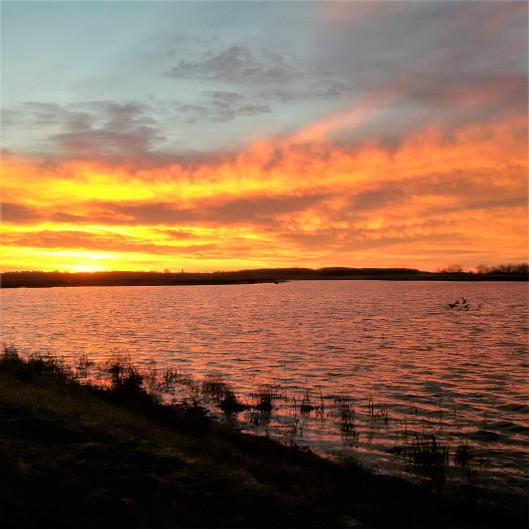
Manitoba sunrise — photo by David Kitz

18 Saturday Mar 2017
Posted in Psalms, Saturday's Psalm
Manitoba sunrise — photo by David Kitz
17 Friday Mar 2017
Tags
abandoned, abandoned houses, Chernobyl, David, decay, Fukushima, house, nuclear, nuclear exclusion zone, the LORD, vindication, wild boars
Reading: Psalm 138
(Verses 6-8)
Though the LORD is exalted, he looks kindly on the lowly;
though lofty, he sees them from afar.
Though I walk in the midst of trouble,
you preserve my life.
You stretch out your hand against the anger of my foes;
with your right hand you save me.
The LORD will vindicate me;
your love, LORD, endures forever—
do not abandon the works of your hands (NIV).
Reflection
There is something tragic about an abandoned house. An empty house has a missing soul. It was built to have souls—people—in it, so an absence of life invokes feelings of sadness in me. At one point hopes and dreams were alive in that house. It was a place of comfort and love—a refuge from nature’s elements. Perhaps it echoed with the voices of children at play, but now it sits empty and forlorn.

The Ruins, Mackenzie King Estate, Gatineau Park, QC — photo by David Kitz
I find it surprising how quickly a home or community deteriorates after it’s abandoned. Have you viewed videos or the haunting images of the abandoned communities around the Chernobyl and Fukushima nuclear plants? In a few short years everything constructed by humans has become completely overgrown, and it begins to decay and breakdown.
Turning to today’s reading, we see that David ends this psalm with both a confession of faith and a prayer: The LORD will vindicate me; your love, LORD, endures forever—do not abandon the works of your hands.
David lives in confidence that the LORD is with him and will vindicate him—will side with him in the battles of life. But he adds this petition—do not abandon the works of your hands.
What happens when God abandons us? I dread the thought. When the LORD no longer lives among us, our lives—our spiritual lives—begin to deteriorate like an abandoned house in a nuclear exclusion zone. Around Fukushima wild boars have taken over. With no one to oppose them, they have ravaged the countryside and have moved into the abandoned towns.
Will the LORD abandon us? There is little chance of that happening. The far greater concern is that we abandon the LORD. I have witnessed firsthand the devastation that occurs when that happens. When people who respond to the gospel turn their backs on their Savior, over time the outcome resembles the ravages of nature on an abandoned home.
We need to recall these words: Though the LORD is exalted, he looks kindly on the lowly; though lofty, he sees them from afar. Though I walk in the midst of trouble, you preserve my life.
Response: LORD God, I want you to be fully at home in my heart and my mind. Show me your kindness. My body is a temple for your Holy Spirit. Live in me and through me, Lord Jesus. Amen.
Your Turn: How do you feel about abandoned houses? Is your inner man (woman) occupied by God?
16 Thursday Mar 2017
Tags
embolden, First Commandment, God, gods, idols, infinite, invisible, kings, national gods, praise, the LORD, Yahweh
Reading: Psalm 138
Of David
(Verses 1-5)
I will praise you, LORD, with all my heart;
before the “gods” I will sing your praise.
I will bow down toward your holy temple
and will praise your name
for your unfailing love and your faithfulness,
for you have so exalted your solemn decree
that it surpasses your fame.
When I called, you answered me;
you greatly emboldened me.
May all the kings of the earth praise you, LORD,
when they hear what you have decreed.
May they sing of the ways of the LORD,
for the glory of the LORD is great (NIV)
Reflection
David was wholehearted in all that he did, so it should not surprise us that he begins Psalm 138 with this assertion: I will praise you, LORD, with all my heart; before the “gods” I will sing your praise.

Walking in a winter wonderland — photo by David Kitz
David, the shepherd king, wasn’t shy or reticent about offering praise to the LORD. He knew his God and was quick to give Him praise. He would even praise the LORD before foreign gods. Elsewhere in the psalms we see this declaration: For great is the LORD and most worthy of praise; he is to be feared above all gods. For all the gods of the nations are idols, but the LORD made the heavens (Psalm 96:4-5).
During David’s time each nation had its own national god. These national gods were represented by carved idols of wood, metal or stone. But Israel had no idol. They were strictly forbidden to make any image or likeness of the LORD (Yahweh). See the First Commandment, Exodus 20:3-6. This prohibition set Israel apart. They were the people with no visible god.
But why settle for a visible god, when you can have the invisible God who fills the entire universe? Why settle for a national god, when you can have the LORD who created the heavens and the earth? Inevitably, if we fashion our own god, we will create a god who is far too small. The true God is far bigger, far wiser, and far more just, and compassionate than we can ever imagine. How can we as finite creatures begin to fathom the infinite power and glory of God?
By His great mercy the LORD reveals Himself to us. He does that best through His Son. The Son is the image of the invisible God, the firstborn over all creation (Colossians 1:15). Jesus helps make the infinite God comprehensible to us, so we can join with David’s anthem of praise. May all the kings of the earth praise you, LORD, when they hear what you have decreed. May they sing of the ways of the LORD, for the glory of the LORD is great.
Response: LORD God, I praise you for your unfailing love and your faithfulness. Thank you for answering my prayers. You give me courage and greatly emboldened me to carry on. Amen.
Your Turn: How big is your God? Is He bigger than your problems?
15 Wednesday Mar 2017
Tags
Babylon, calamity, damage, destruction, Esau, Grey Nuns Park, harm, Jacob, Jerusalem, joy, Orleans, Schadenfreude
Reading: Psalm 137
(Verses 7-9)
Remember, LORD, what the Edomites did
on the day Jerusalem fell.
“Tear it down,” they cried,
“tear it down to its foundations!”
Daughter Babylon, doomed to destruction,
happy is the one who repays you
according to what you have done to us.
Happy is the one who seizes your infants
and dashes them against the rocks (NIV).
Reflection
German is a fascinating language. It’s a language that specializes in compound words—short words that are combined to form longer words. Some English language examples of compound words are homerun, overcoat and windshield.
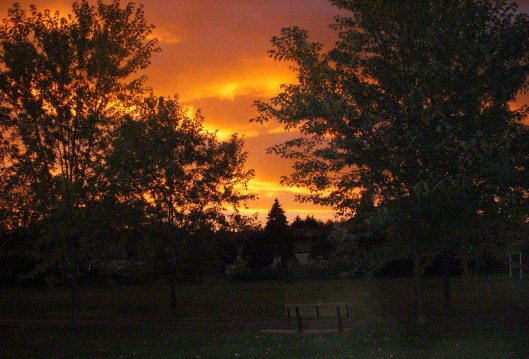
Sunrise in Grey Nuns Park, Orleans, ON — photo by David Kitz
Schadenfreude is a compound German word. Actually, it’s such a useful and descriptive word that it has migrated into the English language and it can be found in any quality English dictionary. Schaden means harm or damage. Freude means joy. Simply put schadenfreude means joy experienced at another person’s expense—rejoicing in someone else’s suffering or loss.
Today’s reading from Psalm 137 is all about schadenfreude. The Edomites celebrated the destruction of Jerusalem. Rather than mourn over their neighbor’s calamity, they joined in calling for the destruction of the Jewish capital.
This manifestation of schadenfreude was rooted in centuries of fraternal rivalry and envy. The Edomites were the descendants of Esau, while the people of Jerusalem were the descendants of Jacob. These two people groups were linked by heredity, language and culture, and yet generation after generation they continued this brothers’ feud.
This psalm is not the only biblical counsel for us to have to avoid rejoicing in other people’s harm: Do not gloat when your enemy falls; when they stumble do not let your heart rejoice, or the LORD will see and disapprove and turn his wrath away from them (Proverbs 24:17-18).
If the LORD is punishing the evildoer, we should not appear too smug. We are spared by the grace of God and not by our moral superiority. The self-righteous suffer from delusions of pride. It’s best not to identify with that camp. The opposite response is called for. Rather than crowing over someone else’s misfortune, we should be offering help or drawing lessons on how to avoid a similar calamity.
I need to replace my schadenfreude with the joy found in extending mercy, grace and compassion.
Response: LORD God, at times I have been guilty of schadenfreude. Help me to show compassion rather than smug indifference when I see others experience loss. Thank you for your ongoing mercy. Amen.
Your Turn: Have you experienced schadenfreude? How do you keep it in check?
14 Tuesday Mar 2017
Tags
Babylon, David Kitz, history, idolatry, Israel, Jewish nation, King Solomon, Moses, Old Testament, Psalms, Ten Commandments
Reading: Psalm 137
(Verses 1-6)
By the rivers of Babylon we sat and wept
when we remembered Zion.
There on the poplars we hung our harps,
for there our captors asked us for songs,
our tormentors demanded songs of joy;
they said, “Sing us one of the songs of Zion!”
How can we sing the songs of the LORD
while in a foreign land?
If I forget you, Jerusalem,
may my right hand forget its skill.
May my tongue cling to the roof of my mouth
if I do not remember you,
if I do not consider Jerusalem
my highest joy (NIV)
Reflection
It’s difficult to pinpoint the time in history when many of the Psalms were written. Many scholars believe that the Old Testament was compiled over a period of about 900 to 1,000 years. As for the Book of Psalms, there is considerable evidence to suggest that psalms were collected from three distinct periods: the reign of King David (1 Chronicles 23:5), the rule of Hezekiah (2 Chronicles 29:30), and during the leadership of Ezra and Nehemiah (Nehemiah 12:24).[1]

There on the poplars we hung our harps — photo by David Kitz
Psalm 137 is distinct, because we can tell from its content that this psalm was written early during the period of the Babylonian exile. Memories of Nebuchadnezzar’s destruction of Jerusalem in 586 BC were still fresh—etched with bitterness and pain in the mind of the author.
There are two great pivot points in the history of Old Testament Israel. The first is the liberation of Israel from Egypt and the conquest of the holy land. The second is the destruction of Jerusalem and the temple, and the subsequent seventy-year exile in Babylon. The mercy and power of God brought about the first pivotal event. The disobedience and idolatry of man set in motion the catastrophe of the second event.
From its inception the Jewish nation flirted with idolatry. While Moses was receiving the Ten Commandments, the people were reveling before a golden calf. King Solomon set up idols in Jerusalem so his foreign wives could worship their gods. See 1 Kings 11:1-8. This duplicity continued generation after generation until the Babylonians swept in and destroyed Jerusalem. Judgment brought change.
Response: Father God, I don’t want to learn things the hard way. I want to be quick to obey you. Help me to learn from the lessons of history. You are the one, true God. I worship you. Amen.
Your Turn: How faithful are you to the LORD? Do other interests draw you away?
[1] K.R. “Dick” Iverson, Spirit Filled Life Bible, New King James Version, Jack W. Hayford, General Editor, Thomas Nelson Publishers, Nashville, TN, 1991, p. 750.
13 Monday Mar 2017
Reading: Psalm 136
(Verses 17-26)
to him who struck down great kings,
His love endures forever.
and killed mighty kings—
His love endures forever.
Sihon king of the Amorites
His love endures forever.
and Og king of Bashan—
His love endures forever.
and gave their land as an inheritance,
His love endures forever.
an inheritance to his servant Israel.
His love endures forever.
He remembered us in our low estate
His love endures forever.
and freed us from our enemies.
His love endures forever.
He gives food to every creature.
His love endures forever.
Give thanks to the God of heaven.
His love endures forever (NIV).
Reflection
In recent months I have transitioned from attending an established church to involvement in a new church plant. In many respects the change has been refreshing. This new church has a clear focus on reaching the lost in our city, specifically those who are trapped in addictions. Almost weekly new converts are coming forward to put their trust in Christ. The church itself is a place of transition, as deadly habits are broken, and the healing power of Jesus is applied to long festering inner wounds.

Jesus said, “I am the gate” (John 10:9) — photo by David Kitz
So how does this connect with our reading from Psalm 136? In his description of Israel, the psalmist makes this statement: He remembered us in our low estate… and freed us from our enemies.
We serve a God who rescues us at our lowest point, in our low estate. In our foolish pride, we would never turn to God. But when we hit bottom—when there is no way forward, put up—then we turn to the Lord. You see, Christ has been patiently waiting for us to acknowledge our need. But Jesus doesn’t rescue the proud. He doesn’t save those who see no need for salvation. He only comes to the humble—those who admit they need a lift from the hole they find themselves in.
Sadly, there are many who sit in fine churches that have never discovered their low estate. Actually, they have become experts at hiding it. We all have a secret addiction to sin. Even St. Paul wrote, “For I do not do the good I want to do, but the evil I do not want to do—this I keep on doing” (Romans 7:19). The only one who can turn us around is Jesus, our Savior. See Romans 7:25.
Response: Father God, I admit my need for Jesus, my Savior. His love endures forever. Amen.
Your Turn: Why do we hide our sins rather than confess them? Does pride hold us back?
12 Sunday Mar 2017
Posted in Psalms, Sunday's Psalm
![IMG_20170308_090906[92]](https://davidkitz.blog/wp-content/uploads/2017/03/img_20170308_09090692.jpg?w=529)
Create in me a pure heart — photo by David Kitz
11 Saturday Mar 2017
Posted in Psalms, Saturday's Psalm
Tags
![IMG_20170308_090758[90]](https://davidkitz.blog/wp-content/uploads/2017/03/img_20170308_09075890.jpg?w=529)
God shines forth — photo by David Kitz
10 Friday Mar 2017
Tags
blood, death, dominion, faith, Jesus, Passover, Passover Lamb, redeemed, redemption, slavery, victory
Reading: Psalm 136
(Verses 10-16)
to him who struck down the firstborn of Egypt
His love endures forever.
and brought Israel out from among them
His love endures forever.
with a mighty hand and outstretched arm;
His love endures forever.
to him who divided the Red Sea asunder
His love endures forever.
and brought Israel through the midst of it,
His love endures forever.
but swept Pharaoh and his army into the Red Sea;
His love endures forever.
to him who led his people through the wilderness;
His love endures forever (NIV).
Reflection
Because of the responsive pattern employed by the psalmist, today’s reading from Psalm 136 begins as an incomplete sentence. When combined with yesterday’s reading, the full sentence reads: Give thanks to the Lord of lords, to him who struck down the firstborn of Egypt, and brought Israel out from among them with a mighty hand and outstretched arm.

He brought us out to bring us in — photo courtesy of Donald Adam
Whereas yesterday’s reading from Psalm 136 celebrates the wonders of God’s creation, today’s reading celebrates the wonders of God’s redemption of Israel. The LORD delivered the captive souls of Israel from hard labor and slavery in Egypt. Though the eldest child of the Egyptians perished, the Hebrew children were spared from the Angel of Death, because the blood of the Passover lamb was applied to the doorposts of their home. See Exodus 12.
At a grim Passover celebration 2,000 years ago, Jesus suffered and died on the cross as our Passover Lamb. When we place our faith in his sacrificial blood, we too are spared from death. Jesus tasted death on our behalf, so that we can live eternally with him. As believers we can rejoice and draw comfort from these words. “Where, O death, is your victory? Where, O death, is your sting?” The sting of death is sin, and the power of sin is the law. But thanks be to God! He gives us the victory through our Lord Jesus Christ (1 Corinthians 15:55-57).
Through the blood of Christ the power of Satan is broken and we are brought into the dominion of the Son of God. For he has rescued us from the dominion of darkness and brought us into the kingdom of the Son he loves, in whom we have redemption, the forgiveness of sins (Colossians 1:13-14).
Surely as redeemed children of God—children personally redeemed by the Son of God—we have this testimony: His love endures forever.
Response: Father God, I thank you for redeeming me with the sacred blood of Jesus. I have been adopted into your family. You are my heavenly Father. I can never thank you enough. Amen.
Your Turn: Are you living in a new kingdom, under a new king—King Jesus?
09 Thursday Mar 2017
Tags
creation, Creator, environment, gardening, God, love, nature, seasons, the LORD, wildlife, winter, worship
Reading: Psalm 136
(Verses 1-9)
Give thanks to the LORD, for he is good.
His love endures forever.
Give thanks to the God of gods.
His love endures forever.
Give thanks to the Lord of lords:
His love endures forever.
to him who alone does great wonders,
His love endures forever.
who by his understanding made the heavens,
His love endures forever.
who spread out the earth upon the waters,
His love endures forever.
who made the great lights—
His love endures forever.
the sun to govern the day,
His love endures forever.
the moon and stars to govern the night;
His love endures forever (NIV).
Reflection
Here are some straightforward facts about me. I love nature. I enjoy all four seasons. I love getting out of the house and hiking through the woods or riding my bicycle along nature trails. I am fascinated by the wildlife I encounter on these excursions. I like planting a backyard garden in spring, and harvesting the produce from it through the summer and fall. I feel knitted to the land and its seasons.
![IMG_20170308_090816[91]](https://davidkitz.blog/wp-content/uploads/2017/03/img_20170308_09081691.jpg?w=529)
A winter walk in God’s creation — photo by David Kitz
Psalm 136 extols the virtues of this awesome limitless God. His love endures forever. For a total of twenty-six verses the psalmist expounds on the goodness of the LORD. In response His people reply, “His love endures forever.”
Today’s reading lays the foundation for our worship. That foundation rests on the wonder of God’s creation. We are to give thanks to God because He alone does great wonders. By his understanding, [He] made the heavens, and spread out the earth upon the waters.
As you go through your day do you find moments where you give God thanks for the wonders of His creation? In an urban, man-made environment we can easily lose touch with nature and our Creator. We lose something precious—something fundamental to our well-being—when that happens.
Response: LORD God, help me to appreciate the wonder of your creation every day. Give me opportunities to see the beauty in it, because it’s a reflection of your magnificent character. Amen.
Your Turn: Do you enjoy nature? Does that appreciation of nature translate into love for God?

