• Home
  • About
  • DavidKitz.ca
  • Youtube Videos
  • Books by David
  • Books on Amazon.com

I love the Psalms

~ Connecting daily with God through the Psalms

I love the Psalms

Category Archives: Books by David Kitz

Excerpt 18 for Lent from The Soldier Who Killed a King

14 Wednesday Mar 2018

Posted by davidkitz in Books by David Kitz, Christ's Passion, Lent, Mid-Week Medtiation

≈ Leave a comment

Tags

blind, demon, God, Jesus, Jewish, king, Kingdom of God, Messiah, miraculous, Pool of Siloam, power, repentance

A journey to the cross is a journey to repentance. It’s a journey to deep personal change. Will you take this journey with me?

In today’s reading, Marcus, the centurion, rides back into Jerusalem on horseback. As he rides his mind turns over his thoughts about Jesus of Nazareth. Date: Near noon on Thursday, April 6th, 30 A.D.

We continued on to the fortress, but my mind was on the Northern Messiah. His penetrating eyes haunted my thoughts. There was a power there that I had no ability to fathom. I was reminded of Ruth’s words. Ruth was one of our household servants, a Jewish girl. When at the supper table I had told Zelda about Jesus and his miraculous powers, Ruth’s eyes brightened. I asked her if she knew anything about this man.
biblical-fiction-award-2017_orig“Oh, yes,” she’d said. “Almost a year ago he healed a blind beggar from the Lower City. Jesus made some mud, put it on the beggar’s eyes, and sent him to wash in the Pool of Siloam. When he washed, he could see. It was a miracle. I’ve seen this man myself. I know it’s true,” she earnestly avowed.
When I’d asked her about this power Jesus had and where it came from, she bowed her head and answered, “From God.”
But she seemed somehow uncomfortable with her answer. She added, “It must be from God. He does good things. But our leaders aren’t sure. They think it may be demon power. But demons don’t heal the sick.”
Maybe the religious leaders were right. Maybe it was demonic power that made the blind see. It seemed preposterous. But why had I heard this voice? Why did this man trouble me so? Thinking of him seemed to stir up nothing but torment within me, and I didn’t even know why. I felt strangely attracted to him, yet at the same time repelled.
Then there was this talk about the kingdom of God. Maybe Timaeus was right about this prophet. The words of the wealthy merchant came back to me: “You don’t talk about a kingdom in this place and get away with it. Rome will see to that!”
Maybe we would see to it. Maybe we should see to it soon. But Jesus’s enemies were the same pompous, self-serving leaders I despised. He had aligned himself with the common man, with the poor, the oppressed, the sick and suffering. And he didn’t just champion their cause for personal benefit like some crass politician lobbying for the emperor’s favor. No, he healed them. He fed them. He walked with them, ate with them. He was one of them. He was their king, whether he wore a crown or not. I saw that clearly when he entered on the donkey. He was the donkey king. A horse would have put him above the crowd. A horse would have meant elevating himself like all the other egotistical men who led in this upside-down world.
In his case others would have to do the elevating.
The meaning of his entry on Sunday came clear to me now. It was a perspective gained from my comfortable perch on the back of my own noble steed.
By the time I reached the fortress for the second time in the week, I resolved to shut this Messiah out of my mind. He didn’t fit any of my categories for human behavior or religious thought. He was beyond understanding, an unwelcome intruder into my city and my thought life.

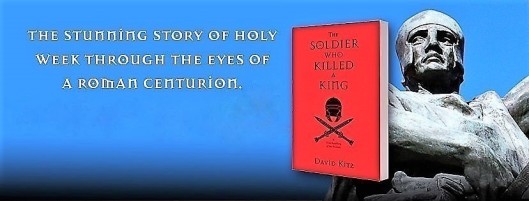
American readers click this link to purchase The Soldier Who Killed a King.

Canadian readers click this link to purchase The Soldier Who Killed a King directly from the author.


Excerpt 17 for Lent from The Soldier Who Killed a King

13 Tuesday Mar 2018

Posted by davidkitz in Books by David Kitz, Christ's Passion, Lent, The Soldier Who Killed a King

≈ 1 Comment

Tags

Barabbas, Caesar, Caiaphas, centurion, Golgotha, Jerusalem, Jesus, Kidron Valley, Messiah, prophet, repentance, Romans, Rome, sinners, tax collector, temple

A journey to the cross is a journey to repentance. It’s a journey to deep personal change. Will you take this journey with me?

In today’s reading, Marcus, the centurion, meets with Jonas the tax collector. They discuss the news of the week, namely the huge stir that Jesus has caused in Jerusalem since his triumphal entry into the city. Date: Early morning April 6th, 30 A.D.

As I descended the stairs of the gate, I caught sight of Jonas and his son, unoccupied at the customs booth. With a quick wave of my hand, I signaled my intention to speak with him, and after taking the salute of the sentinels at the gate, I headed straight to the booth. “Good morning, you old goat!” I called out as I approached.
“Well, if it isn’t the top dog himself,” he shot back.
“It’s always good to see a man standing around doing nothing. It sets me at ease,” I said. “Ease?” His eyebrows shot up. “Oh yeah.” He nodded emphatically. “It’s been a week of ease all right. I’ve had my feet up all week.”
Of course, just the opposite was true, and it was true for both of us.
Free WW-e FACEBOOK-2 (2)
“Do you think we could have a short word?” With a jerk of my head, I motioned in the direction of the road leading down the Kidron Valley.
“Sure,” he answered, and then with a glance and a nod to his son, he transferred responsibility to him. A light mist still hung over the lowest reaches of the valley, but the early-morning sun was promising to burn it off. The swallows nesting along the crevices in the city wall were engaged in a full-throated competition with the songbirds in the trees along the brook. Traffic to and from the city was just beginning to stir.
When we had gone a few paces beyond the gate, I spoke. “I just wanted to say thanks for the help with the Barabbas case.”
“Oh, don’t mention it.” There was relief in his voice. “I thought you were going to warn me about some new plot.”
“No, there’s no new plot.” I hesitated. “Let me rephrase that. There’s no new plot that I know about. You never can be sure what’s being hatched in this crazy city.”
“Yeah, you’re right about that. I guess we learned that with Barabbas.” Jonas nervously bit on the corner whiskers of his mustache, and then continued. “Now, that Galilean prophet? I’ve been losing sleep over him all week.”
“Harmless as a dove,” I said. “Harmless as a dove.”
“How do you know?”
“I checked him out myself on Monday, right back there in the temple courts.” I made a quick double-pump motion with my upraised thumb aimed over my shoulder. “Then on Tuesday I had Claudius in there with the prophet.”
“You Romans have more nerve than brains.” He kicked a loose pebble off the pathway, looked up at me with a quizzical grin, and then with an incredulous shake of his head, he repeated, “More nerve than brains, that’s all I can say.”
“If we didn’t have nerve, we wouldn’t be running this place. Or any other place for that matter.”
He shrugged, furrowed his brow, and then cocked his head to one side. It was his way of reluctantly conceding my point.
“So he’s harmless?”
“Harmless to us.” With my index finger, I pointed first at myself, then at Jonas, and then back again. “Caiaphas, on the other hand”—I paused for effect—“now there’s a man who I’m sure hasn’t slept well all week.”
“So you think the old rusty gate has lost some sleep? Over what?”
“Money. Money and prestige. It can’t look too good having some roving up-country rabbi come in and take over your temple at the religious high point of the year.”
“I suppose not,” Jonas said. But then he added, “You know this prophet, Jesus of Nazareth, he’s been here before. He kicked out the money changers a few years back. Caused quite a stir then. But nothing like this. He’s got the temple guards running scared. That’s what my uncle told me.”
James Tht“Your uncle’s right. I saw that firsthand on Monday. So what else do you know about this Galilean?”
“My wife tells me he’s a friend of tax collectors and sinners. She told me one of his disciples was a tax collector before he met the prophet.”
“Ah, tax collectors and sinners?” I responded with a wink and a nod. “Maybe there is hope for the two of us yet.”
Jonas smiled back at me. “So, Marcus, where is this all headed? Some people think he’s the Messiah. You know that, don’t you?”
“Yes, we’re well aware of that. But he doesn’t oppose paying taxes to Caesar.” I gave my tax collector a supportive thumbs-up signal. “And he hasn’t spoken a word against Rome since he’s been here.”
“That’s not a surprise. He knows better. You and your boys would have him nailed up on Golgotha the moment he did.”
“You’re right about that,” I agreed. “But I honestly don’t think he’s got a quarrel with us. He’s going after the parading hypocrites in long, flowing robes, those killjoy Pharisees and teachers of the law. You know the ones—the religious police who run this place.”

American readers click this link to purchase The Soldier Who Killed a King.

Canadian readers click this link to purchase The Soldier Who Killed a King directly from the author.


Excerpt 16 for Lent from The Soldier Who Killed a King

12 Monday Mar 2018

Posted by davidkitz in Books by David Kitz, Christ's Passion, Lent, Monday Meditation

≈ 2 Comments

Tags

Caiaphas, centurion, crucified, David Kitz, Jesus, Passion Week, Passover, Pharisees, Pilate, Roman, The Soldier Who Killed a King

A journey to the cross is a journey to repentance. It’s a journey to deep personal change. Will you take this journey with me?

In today’s reading, Marcus is in a discussion with his friend and fellow centurion, Renaldo. They are at the Roman bathhouse at the end of a long day. Date: Wednesday, April 5th, 30 A.D. 

I sat down again beside the pool and let my feet dangle in the tepid water. Renaldo put his hand on my shoulder as he eased himself down into a similar position.
“So what do you mean by that? How do you think this will end?” he asked.
“This Galilean prophet’s days may be numbered. He’s stirred up a hornet’s nest by kicking those merchants and money changers out of the temple. He’s offended and humiliated the high priest and his clan. He’s cut off a major source of their temple revenue. He called the Pharisees a brood of vipers. And if that’s not enough, he predicted that their power, their kingdom as he calls it, will be taken from them and then given to others.”
4485 TWITTER
I paused and kicked my right foot out straight, scattering a shower of drops onto the flat surface of the water. “You don’t say and do those kinds of things without creating some enemies. I’d say he’s sealed his own fate.”
With a furrowed brow, Renaldo asked, “Where’d you get this information?”
“Claudius. Claudius told me. Yesterday I had him sit in on one of the prophet’s teaching sessions. It was quite an eye- opener. Jesus doesn’t just heal the poor; he takes a skewer to the bloated rich. He’s publicly opposed the rich and powerful in this town, and his opposition has been right to their face. If nothing else, the man’s got courage.”
I drummed my fingers on the poolside tiles and then continued. “I tell you, Renaldo, they won’t stand for it. They’re probably hatching some plot to do away with him right now, as we’re sitting here talking.”
“Yeah, but he healed all those kids,” he said. “Doesn’t that show that the God of heaven is working through him?”
“The God of heaven? Do you honestly think that matters to them? This is all about money and power. That’s their real god. Jesus is a threat to their money and their positions of power. Healing a few poor kids, the offspring of the unclean—that isn’t going to mean a thing to them. You’re right. You hit the nail on the head. They’re puffed- up swine that care only about themselves. There isn’t a drop of mercy in them.” Then with scathing irony I added, “But they’re right. They’re always right. Right to the letter of the law.”
“So what do you think they’ll do?”
“I’m not sure. But I know what they won’t do. They won’t arrest him with that crowd around him. They know better than that. They’d have a bloody riot on their hands. There’s no doubt about that.”
Thought after thought came racing in as I considered the implications of my own words. “They might wait till after Passover when the crowds leave, but then Jesus would probably leave with the crowds and head right back to Galilee. Then he’d be out of their hands. No.” I hesitated and then briskly snapped my fingers. “I think they’ll try to act now, if they can. He’s humiliated them in front of the people. They won’t stand for that. Caiaphas won’t stand for it. Jesus has co- opted the high priest’s authority right within the temple courts. Blood will flow because of it. Mark my words. It will flow.”
“But what could they do to him? What crime has he committed?” Renaldo reasoned. “You know the Jews can’t condemn a man to death. They can’t have him crucified. They would have to bring him before Pilate.”
“Yes,” I said, “but accidents happen in the dark of the night. And Renaldo, I think you underestimate the old Weasel. If anyone can twist the law to his own liking, Caiaphas can. That Weasel can kill his prey in more than one way. The big question is, can he get his hands on the prophet?”
“So you really think there’ll be a confrontation?”
“Absolutely. From what I saw on Monday, the confrontation has already started. ItCentur Rep started when Jesus kicked out the merchants. Later, when I was there, the high priest’s men questioned him, but he wouldn’t back down. Then yesterday, according to Claudius, he humiliated Caiaphas and his delegation right in front of the crowd. Like I said, he called the Pharisees and the teachers of the law a pack of hypocrites and a brood of vipers. I’d call that a confrontation. And he didn’t do it out in the desert; he did it right in front of them, in front of the pilgrims, and right in their holy place. I tell you, the man’s got guts.”

“But”—I paused to emphasize my point—“I’m just waiting for the other side to strike back. And they will.”
I made a long, sweeping motion with a pointed index finger and then stabbed down spear-like into my friend’s bare ribs. “I’m sure they will.” Instinctively Renaldo recoiled, shrugged off my antics, and then said,
“But you don’t think he’s a threat to Rome?”
“Not from what I’ve seen or heard. But he is a threat to Caiaphas. Right now he’s their problem. And that’s where I want to leave him. If blood’s going to flow, I don’t want it getting on these hands.”

American readers click this link to purchase The Soldier Who Killed a King.

Canadian readers click this link to purchase The Soldier Who Killed a King directly from the author.


Excerpt 15 for Lent from The Soldier Who Killed a King

09 Friday Mar 2018

Posted by davidkitz in Books by David Kitz, Christ's Passion, Lent

≈ 1 Comment

Tags

Caiaphas, David Kitz, Jesus, Jesus of Nazareth, Kingdom of God, Lent, prophet, repentance, The Soldier Who Killed a King

A journey to the cross is a journey to repentance. It’s a journey to deep personal change. Will you take this journey with me?

In today’s reading, Marcus continues his conversation with his nephew, the young soldier Claudius. Claudius is reporting on the activities and the message of Jesus of Nazareth on Tuesday of Holy Week.

But Claudius wasn’t done.
“You know about this kingdom notion,” he said. “Jesus told another story, and it helped me catch what he was driving at. He talked about a landowner who planted a vineyard and then went away. He rented the land out to farmers, but when he sent servants to collect the rent, the farmers would beat the servants or kill them. Finally, in desperation he sent his own son to collect the rent, thinking the farmers would respect him. But the renters said, ‘Let’s kill him and the land will be ours.’ So they took the son outside the vineyard and killed him.
“Then Jesus asked the people around him what would happen to those renters when the owner came back. They answered that the landowner would kill those miserable renters and give the vineyard to someone else who would pay him on time.
“Jesus said they were right. And then he said, now catch this”—Claudius gestured with an upraised index finger—“‘The kingdom of God will be taken away from you and given to a people who will produce its fruit.’ Those were his very words.”
“So what did he mean by that?” I asked, quite mystified.
Free WWe SHARABLE-1 (2)“I wasn’t too sure myself at first. I knew he said this as a rebuke to the high priest and the religious establishment. Everyone there knew he was telling this story against them. But later I asked the man beside me what he thought Jesus meant by this parable. He said the landowner was God, the religious leaders were the renters, and the servants who came to collect the rent were the prophets of the past. We just weren’t sure who the son was. I suggested that Jesus himself might be the son. But he just looked at me like I was a complete idiot, shook his head, and said, ‘God doesn’t have a son.’ I kept my mouth shut after that.”
“Well then,” I surmised, “this prophet, this Jesus, really has set himself up in opposition to the religious authorities. If he’s publicly predicting the end of their rule, he has picked a fight with them.”
I sucked in a long, slow breath. “And, Claudius”—I nodded in his direction—“it’ll be a fight to the finish.”
I continued as my mind caught the implications of my own words. “Jesus may have the people or at least a good number of the common people on his side. But Caiaphas is nobody’s fool. He’s got money and power behind him. The son in that story, if that’s who Jesus is”—I gestured with an upraised open palm—“he might yet be taken out and killed.”

American readers click this link to purchase The Soldier Who Killed a King.

Canadian readers click this link to purchase The Soldier Who Killed a King directly from the author.

Excerpt 14 for Lent from The Soldier Who Killed a King

08 Thursday Mar 2018

Posted by davidkitz in Books by David Kitz, Christ's Passion, Lent, Psalms

≈ 1 Comment

Tags

baptize, Caesar, Holy Week, hypocrites, Jesus, Jesus of Nazareth, John the Baptist, Jordan River, Lent, repent, Rome

A journey to the cross is a journey to repentance. It’s a journey to deep personal change. Will you take this journey with me?

In today’s reading, Marcus is in conversation with his nephew, the young soldier Claudius. Claudius is reporting on the activities and the message of Jesus of Nazareth on Tuesday of Holy Week.

Claudius went on. “One thing I do know for sure: those fancy-robed religious leaders don’t like him much. Jesus had taught for a while this morning, when all of a sudden the high priest, along with maybe ten other officials, came marching in. They demanded to know by what authority he was doing these things.

DSC_0060

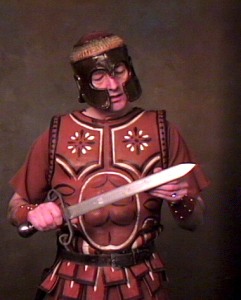
A Roman centurion

He didn’t answer them, but instead he asked them a question. He asked them, ‘By what authority did John baptize?’ They talked it over and then said, ‘We don’t know.’ So he said he wouldn’t answer their question either. They just turned around and left in a holy huff. You could really tell the crowd around Jesus just loved the way he handled these high and mighty holy types.” Claudius abruptly turned to me and asked, “Who was this John anyway?”
“A few years back he caused quite a stir. Thousands of people went out to the Jordan River to hear him. He insisted that people repent, turn from their sins, and then he would baptize them in the river. Even some of my own men went out to hear him. In the end, Herod the tetrarch had him beheaded.”
After reflecting a moment on the day’s events, I caustically commented, “That bloody old Fox hasn’t changed much.”
“Anyway,” Claudius continued, “from then on Jesus would teach for a while, and then some new high-powered delegation would arrive to question him. They weren’t sincere in their questions. It was like they were trying to trap him into saying something they could later use against him. That’s all I think they were after. But in the end Jesus always turned the tables on them. He exposed their real motives. He saw right through them.”
I felt a certain remembered discomfort when Claudius said those words. After all, Jesus’s eyes had shone a light on the darkness of my own soul. I don’t know why I felt so naked, so transparent before this man.
“But, Claudius, what makes you so sure he’s not here to kick out the Romans?”
“It was the way he answered one of those fancy-robed delegations. They asked him if it was lawful to pay taxes to Caesar. He called them hypocrites right to their faces. He accused them of trying to trap him. Then he asked for a coin. He demanded to know biblical-fiction-award-2017_origwhose portrait and inscription were on it. When they answered, ‘Caesar’s,’ he jumped on them—like a cat onto a nest of mice. ‘So give back to Caesar what is Caesar’s, and to God what is God’s,’ he told them. Even at a distance, I could see their mouths drop and their ears catch fire. They left like cowering dogs with their tails between their legs.”
Claudius became even more animated as he said, “The crowd—the crowd loved it. You could really tell the people loved seeing those phony religious officials get a taste of a little humility. I’m sure they haven’t tasted it for a good long while.”
Then to conclude, he said, “That’s why I don’t think he’s a threat to us. He’s not opposed to paying taxes. Nothing he said all day makes me think he’s got a quarrel with Rome. But he’s sure got the religious leaders worried and bothered. Later in the day he went after them full force. Called them hypocrites, blind guides, a brood of vipers!”
“Ooo! I’m sure they were pleased,” I said sarcastically.
This assessment confirmed what Renaldo and I had been thinking. I had heard the same thing reflected back to me by Flavio. This latest evidence on taxes lent considerable weight to the conclusion Claudius had drawn. But I still felt uneasy. Jesus simply struck me as such a huge, larger-than-life figure—the kind of person you don’t dismiss lightly, no matter what others say. I somehow felt that all we had done thus far was scratch the surface. I’m not sure I really understood him at all. How could I begin to fathom what he was trying to accomplish?

American readers click this link to purchase The Soldier Who Killed a King.

Canadian readers click this link to purchase The Soldier Who Killed a King directly from the author.

Excerpt 13 for Lent from The Soldier Who Killed a King

07 Wednesday Mar 2018

Posted by davidkitz in Books by David Kitz, Christ's Passion, Lent, Psalms

≈ 3 Comments

Tags

governor, Herod, Jerusalem, Lent, Marcus, Ottawa Citizen, Pontius Pilate, soldier, The Soldier Who Killed a King

A journey to the cross is a journey to repentance. It’s a journey to deep personal change. Will you take this journey with me?

In today’s reading, Marcus is among the detail of soldiers assigned to welcome Herod the Tetrarch to Jerusalem. As the royal procession is about to enter the city a disturbing incident takes place that reveals the character of the man that Jesus called a fox.

Suddenly, just ahead, among the bowing throng, a small copper bowl flashed in the sun. I sucked in a shallow breath and hoped it had gone unnoticed.
Herod’s hand shot out from the left side of the litter, just a few feet above and ahead of my horse’s ears.
“There! There!” he yelled. “Stop the litter!”
Flavio bellowed, “Halt!”
“Bring the boy over.” Herod gestured to the bodyguard next to me.
The guard beckoned with his hand, and the once crippled Lucas stepped forward. He wore a shy smile, but there was an eager glint in his eye.
“Is that a beggar’s bowl in your hand?” the king inquired.
“Yes, sir.”
“I didn’t come to feed beggars,” Herod said coldly. “Now, teach this boy not to beg from a king.” Herod again gestured to the guard.
With one hand the guard grabbed the boy’s free hand. With the other hand he raised his gleaming sword above his head.

OTT0304-KITZ1

Photo credit Jean Levac, Ottawa Citizen

With sudden terror in his eyes, Lucas instinctively yanked back.
The blade flashed down.
The boy fell back into the crowd as the guard triumphantly raised the severed, dripping hand above his head.
“Well done, Cestas!” Herod cheered. “Well done!”
I saw Lucas flee, white- faced and stumbling, clutching tight the bleeding stump.
“There are no beggars in Galilee,” the Fox announced to the crowd. “And if I ruled here, there would be none in Jerusalem.”
The onlookers were stunned—riveted to the spot. Herod paused, and after a brief search he pulled out the flimsy purple robe from among the cushions behind him. He made a great show of folding it carefully several times.
“Bring me your trophy.”
Biblical fiction winner 2017Cestas came forward and placed the small, severed hand in the folds of the purple robe, bowing graciously to his monarch.
“Ah, tribute for the governor.” Herod laughed coarsely. “Let’s be off!”
The remainder of the processional was uneventful. Following the trumpeters’ fanfare, Pontius Pilate and his wife, Claudia Procula, received the tetrarch graciously, with considerable pomp. The Roman governor politely inquired about the journey and made flattering comments about Herodias and her attire.

American readers click this link to purchase The Soldier Who Killed a King.

Canadian readers click this link to purchase The Soldier Who Killed a King directly from the author.

Excerpt 12 for Lent from “The Soldier Who Killed a King”

06 Tuesday Mar 2018

Posted by davidkitz in Books by David Kitz, Christ's Passion, Lent, Psalms

≈ 1 Comment

Tags

centurion, healed, Herod, Jesus of Nazareth, Lent, Marcus, Pilate, repentance, The Soldier Who Killed a King

A journey to the cross is a journey to repentance. It’s a journey to deep personal change. Will you take this journey with me?

In today’s reading, Marcus meets with his fellow centurion and friend, Renaldo. Renaldo has just seen the young boy Lucas who was healed in the temple courts on the previous day by Jesus of Nazareth.

“Marcus! Marcus!”
I spun around to see Renaldo emerging from the gateway stairway.
“Hey, Marcus! You were right. That boy really was healed.”
He voiced the words with such bald enthusiasm that I was completely disarmed.
“I just saw him. He was here—here at the gate.” He gestured down the gateway parapet4485 SHARABLE-2 to a point below us. “I saw him. I examined his leg. It’s completely healed. Just like the other one. It’s incredible!” he enthused. “He can jump! And run!”
“I told you. I told you, Renaldo,” I said while shaking my head.
“Yeah, but you don’t expect it,” he said as he justified his unbelief. “I mean, this kid’s been like this from birth. You see him the same way, day after day. And then one day . . . Boom! He’s completely different.”
“I told you. You didn’t believe me?” I uttered the words with a certain smug satisfaction.
“Well, you don’t expect it,” he repeated. “I mean, it’s one thing to hear it, but it’s quite something else to see it for yourself.”
“That’s exactly what I was trying to tell you. I said you’ve got to see this for yourself to understand.”
I sighed. Now I was beginning to realize why I wasn’t getting through.
“So it was Lucas,” I stated.
“It was Lucas!” Renaldo confirmed, shaking his head in a state of incredulous wonderment.
I changed the topic.
“Look, Renaldo, I would like to talk with you more about this, but we’ve both got some work to do. Word has just come in to Flavio. Herod has accepted Pilate’s invitation. He’ll be going directly to the Praetorium. Arriving at four. The Fish Gate route needs to be cleared. You know those temple traders have set up shop in there, and you’ve got to get them out. And the sooner, the better. Flavio says that’s your sector, so you’re on.” Renaldo took all this in stride. “Sure, Marcus. I’ll get right on it.”
I turned from him, but he called after me.
“Marcus. We need to talk more about this Jesus—this Jesus of Nazareth.”

American readers click this link to purchase The Soldier Who Killed a King.

Canadian readers click this link to purchase The Soldier Who Killed a King directly from the author.

Excerpt 11 for Lent from The Soldier Who Killed a King

05 Monday Mar 2018

Posted by davidkitz in Books by David Kitz, Christ's Passion, Lent, Psalms

≈ 1 Comment

Tags

governor, Jesus of Nazareth, king, King Herod, kingdom, Kingdom of God, Marcus, Messiah, pilgrims, prophet, Roman, The Soldier Who Killed a King, weapons

A journey to the cross is a journey to repentance. It’s a journey to deep personal change. Will you take this journey with me?

In today’s reading, Marcus the centurion meets with Flavio, the Roman tribune, who is his commanding officer. He lays out his concerns about a Galilean prophet that he sees as a dangerous threat—Jesus of Nazareth.

“Sometimes I think you worry too much, Marcus.”
“I worry because it’s my job to worry,” I shot back. “Barabbas is in prison because I worry.”
Flavio appeared to consider my reply as he swallowed another stringy morsel. “So what do you know about this prophet?”
“A lot of people think he’s the Messiah.”
“May all the gods help us! Another Roman-killing messiah!” Flavio jeered.
“This one just might be the real thing,” I said.
Centur. Sw“Ha!” he scoffed. “Bring him on!” He reached for his flagon. Finding it empty, he bellowed, “Where’s my wine?”
“Bloody incompetent servants,” he muttered. Then turning to me, he asked, “Does he have weapons?”
“No, not that I’ve seen.”
“Has he threatened us?”
“Not exactly.”
“Assaulted the tax collectors?”
“No.”
“Then leave the Jewish dog alone.”
The servant arrived with a bowl of hot, sticky cheese and placed it before me, along with two small barley loaves.
“Wine! Where’s the ruddy wine?” Flavio demanded of his harried attendant.
“He is preaching about a kingdom—the kingdom of God,” I countered.
“So let him preach.”
“Who do you think will be the king of this kingdom?” I reasoned. When Flavio remained silent, I answered my own question. “I’m sure it will be none other than Jesus of Nazareth. I don’t think there’s room for two kings in this town, and a Roman governor too.”
“I see your point,” Flavio said. He wiped a greasy hand across his mouth and thenbiblical-fiction-award-2017_orig rubbed the three days of stubble on his chin. “So he talks about a kingdom?”
“The coming kingdom,” I clarified. “It’s the whole point—the core of his message. So I’m told.”
The servant arrived with the wine. Flavio helped himself. Drank two- thirds of it in a massive gulp, then poured himself some more.
“And he has followers?” Flavio continued.
“Most of the Galilean pilgrims are firmly in his camp.”
“Galilee?” Flavio questioned. “He’s Herod’s man.” He paused to rub the tip of his nose. “I wonder what the Fox thinks of this Messiah.”

American readers click this link to purchase The Soldier Who Killed a King.

Canadian readers click this link to purchase The Soldier Who Killed a King directly from the author.

Bill Pink’s Review of The Soldier Who Killed a King

03 Saturday Mar 2018

Posted by davidkitz in book review, Books by David Kitz, Good Friday, Lent, Psalms

≈ 6 Comments

Tags

centurion, Christ, crucifixion, David Kitz, Easter, Jesus, King Herod, Marcus Longinus, Pontius Pilate, Savior, Scripture, Son of God, trial

It is hard to imagine a more ironic, more chilling dramatic exclamation than the confession of Jesus’ executioner, “Surely, He was the Son of God” (Matt. 27:54).  In The Soldier, David Kitz gives a name to the Roman executioner – Marcus Longinus. Then he gives us an hour-by-hour account of the week in Marcus’ life in the run-up to the fatal hammer blows that drove spikes into Jesus’ broken body.

4485 TWITTER

            As I began to read The Soldier, I wondered if it would be a fascinating documentary of the last week of Jesus’ ministry on Earth. Fascinating it is. The sights, sounds and smells of the Jewish Passover week come to life, from the noisy, smelly commerce in sacrificial animals to the literal river of red sacrificial blood flowing through the temple aqueducts.

Political forces delicately dance in Jerusalem. High Priest Caiaphas, Samaritan King Herod Antipas, and Roman Governor Pontius Pilate, cordial but venomous enemies, vie for control of the holy city. We see and hear the week unfold through Marcus’ eyes and ears. He fears for the very lives of his men as tumultuous crowds swell Jerusalem. Two were recently murdered by Zealot terrorists. Crowds quickly become mobs, and only the iron discipline of his small garrison insulates the city from disaster.

The Soldier soon becomes more than a documentary. Marcus becomes a man we know intimately as husband, father and brave military officer. We see his family and career jeopardized by the mental anguish of post traumatic stress disorder. Horrific visions of bloody murders populate Marcus’ dreams at night and force contemplation of suicide by day.

Jesus rides into this mix of professional anxiety and personal anguish on a donkey. From a great distance He picks Marcus out of a crowd of thousands and speaks audibly to him alone and to him specifically, saying, “I have a future for you.” During the week, Marcus is repelled by Jesus and drawn to Jesus. He fears Jesus’ power over the crowds. He is the dumbfounded eye witness to Jesus’ healing miracles. He rejoices while Jesus humiliates moneychangers and Pharisees. He hopes Jesus will be acquitted by Pilate. He feels almost personally betrayed when Jesus might have saved Himself, but deliberately does not.  Ordered to crucify Jesus, Marcus does so obediently and resolutely.

I could empathize with Marcus. Like Marcus, I was a career soldier. Like him, I had superiors I admired and those I did not. I had peers who were my friends and those I loathed.  I worried about missions I was given when they endangered subordinates I was responsible for, and, admittedly, when they jeopardized my career if they failed. Unlike Marcus, I have not literally whipped my Savior and pierced his flesh with nails. But like Marcus, my personal sins have caused Jesus to suffer pain on the cross.

The Soldier is a two-fold page turner. It is better than an exciting read. Those of usbiblical-fiction-award-2017_orig blessed with a lifetime of church have heard the story of Christ’s trial and crucifixion as often as our lives have seen Easter Sundays. We have read the Biblical account, in all four gospels, many times. Yet, as I turned the pages of The Soldier, eagerly, I also found myself compulsively turning the pages of the Bible to sort out exactly which details of that week Kitz lifts literally from Scripture and which tidbits his imagination supplies. The blend is seamless. For instance, the lame boy Christ heals in Scripture becomes Kitz’ Lucas, a three-dimensional character twice cursed by the world and twice miraculously loved by Christ. What Christian author hopes for more than for it to be said that his work sends readers scurrying into the pages of the Holy Bible?

We are all Marcus. All of us, like Marcus, have heard Jesus promise us a future. We have all been drawn to Jesus and been afraid of Jesus; we have rejoiced with Jesus, and we have all felt alone when our lives spiraled out of control in sin and remorse. Jesus has stretched out His hands to all of us, and, like Marcus, we have all driven spikes into them. When we read David Kitz’s The Soldier Who Killed a King, we too, confess, “Surely, He is the Son of God.”

American readers click this link to purchase The Soldier Who Killed a King.

Canadian readers click this link to purchase The Soldier Who Killed a King directly from the author.

Excerpt 10 for Lent from The Soldier Who Killed a King

02 Friday Mar 2018

Posted by davidkitz in Books by David Kitz, Christ's Passion, Lent

≈ 1 Comment

Tags

Barabbas, Jesus of Nazareth, repentance, terrorist, The Soldier Who Killed a King

A journey to the cross is a journey to repentance. It’s a journey to deep personal change. Will you take this journey with me?

In today’s reading, Marcus recruits his nephew, the young soldier Claudius, to spy on the activities of a man he sees as a dangerous threat—Jesus of Nazareth.

“Look, Claudius. We need to keep an eye on this man. I mean what I’m saying. All our lives could be in jeopardy.
“You’re a natural choice,” I reasoned. “Like I said, you’re a new face around here. You speak Aramaic very well—better than I do. And you’ve got a brain in your head. Right now, you’re the best man I have for the job.”
I could see he was thinking.
“Couldn’t we just get some paid informants or something?”

DSC_0060

“Ha! In a case like this, paid informants will tell you whatever you want to hear and collect afterward. How do you think I managed to nail Barabbas? It wasn’t with paid informants!” I scoffed at the idea. “No, he’ll feel the spikes on Friday because I went out and got the facts on him—myself.”
Determined to press home my point, I continued, “Look, there are times in this business when you’ve got to put your own life on the line. You got to dirty your own fingers. When good men like Hermes and Andreas go down, you don’t sit and polish your brass. You get out there and sniff out the stinking truth for yourself. You owe it to your men.”
I drew a deep breath and plunged on. “As for Barabbas, he’s a tin-pot hooligan. A brainless bloody terrorist!” I spat the words out. “Now Jesus . . . Jesus, on the other hand, there’s a different dog on the prowl. He’s got followers. He’s got a crowd around him. He’s got heaven on his side. You don’t let Jewish messiahs strut around under your nose and just ignore them.”

American readers click this link to purchase The Soldier Who Killed a King.

Canadian readers click this link to purchase The Soldier Who Killed a King directly from the author.

← Older posts
Newer posts →

Psalms 365: Develop a Life of Worship & Prayer

Psalms 365 Volume II

Psalms 365 vol 3
— Psalms 365 Volume III

Now available:

Psalms

Recent posts

  • Jesus Comes to Jerusalem as King June 24, 2026
  • Obedience on the Day of Battle June 24, 2026
  • Two Blind Men Receive Sight June 23, 2026
  • Are You Listening? June 23, 2026
  • A Mother’s Request June 22, 2026
  • A Path through the Sea June 22, 2026
  • James the Apostle to the Jews June 21, 2026

Calendar

June 2026
M T W T F S S
1234567
891011121314
15161718192021
22232425262728
2930  
« May    

Blog Posts

Enter your email address to follow this blog and receive notifications of new posts by email.

Comments

  • 777joyce on Miracle-Working Power
  • cjsmissionaryminister on Jesus Heals a Demon-Possessed Boy
  • davidkitz on Peter Declares That Jesus Is the Messiah

Blog at WordPress.com.

Privacy & Cookies: This site uses cookies. By continuing to use this website, you agree to their use.
To find out more, including how to control cookies, see here: Cookie Policy
  • Subscribe Subscribed
    • I love the Psalms
    • Join 1,355 other subscribers
    • Already have a WordPress.com account? Log in now.
    • I love the Psalms
    • Subscribe Subscribed
    • Sign up
    • Log in
    • Report this content
    • View site in Reader
    • Manage subscriptions
    • Collapse this bar

Loading Comments...