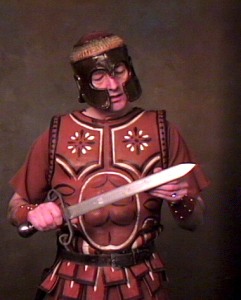
Excerpt 13 for Lent from The Soldier Who Killed a King

Tags

, , , , , , , ,

A journey to the cross is a journey to repentance. It’s a journey to deep personal change. Will you take this journey with me?

In today’s reading, Marcus is among the detail of soldiers assigned to welcome Herod the Tetrarch to Jerusalem. As the royal procession is about to enter the city a disturbing incident takes place that reveals the character of the man that Jesus called a fox.

Suddenly, just ahead, among the bowing throng, a small copper bowl flashed in the sun. I sucked in a shallow breath and hoped it had gone unnoticed.
Herod’s hand shot out from the left side of the litter, just a few feet above and ahead of my horse’s ears.
“There! There!” he yelled. “Stop the litter!”
Flavio bellowed, “Halt!”
“Bring the boy over.” Herod gestured to the bodyguard next to me.
The guard beckoned with his hand, and the once crippled Lucas stepped forward. He wore a shy smile, but there was an eager glint in his eye.
“Is that a beggar’s bowl in your hand?” the king inquired.
“Yes, sir.”
“I didn’t come to feed beggars,” Herod said coldly. “Now, teach this boy not to beg from a king.” Herod again gestured to the guard.
With one hand the guard grabbed the boy’s free hand. With the other hand he raised his gleaming sword above his head.
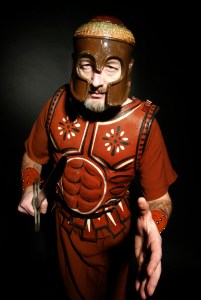
OTT0304-KITZ1

Photo credit Jean Levac, Ottawa Citizen

With sudden terror in his eyes, Lucas instinctively yanked back.
The blade flashed down.
The boy fell back into the crowd as the guard triumphantly raised the severed, dripping hand above his head.
“Well done, Cestas!” Herod cheered. “Well done!”
I saw Lucas flee, white- faced and stumbling, clutching tight the bleeding stump.
“There are no beggars in Galilee,” the Fox announced to the crowd. “And if I ruled here, there would be none in Jerusalem.”
The onlookers were stunned—riveted to the spot. Herod paused, and after a brief search he pulled out the flimsy purple robe from among the cushions behind him. He made a great show of folding it carefully several times.
“Bring me your trophy.”
Biblical fiction winner 2017Cestas came forward and placed the small, severed hand in the folds of the purple robe, bowing graciously to his monarch.
“Ah, tribute for the governor.” Herod laughed coarsely. “Let’s be off!”
The remainder of the processional was uneventful. Following the trumpeters’ fanfare, Pontius Pilate and his wife, Claudia Procula, received the tetrarch graciously, with considerable pomp. The Roman governor politely inquired about the journey and made flattering comments about Herodias and her attire.

American readers click this link to purchase The Soldier Who Killed a King.

Canadian readers click this link to purchase The Soldier Who Killed a King directly from the author.

Gaining a Heart of Wisdom

Tags

, , , , , , , , , , , ,

Reading:                                      Psalm 90

(Verses 7-12)
We are consumed by your anger
and terrified by your indignation.
You have set our iniquities before you,
our secret sins in the light of your presence.
All our days pass away under your wrath;
we finish our years with a moan.
Our days may come to seventy years,
or eighty, if our strength endures;
yet the best of them are but trouble and sorrow,
for they quickly pass, and we fly away.
If only we knew the power of your anger!
Your wrath is as great as the fear that is your due.
Teach us to number our days,
that we may gain a heart of wisdom (NIV).

Reflection
The finite nature of our lives here on planet earth should cause us to give serious thought to how we spend the days that we have been allotted. Once we reach the age of forty, roughly half of our life is over. Some claim it’s all downhill from that point forward. Life seems to speed up—to pass by quickly— as we careen toward our demise.

Violets 2017-04-28

Wood violets, Orleans, ON — photo by David Kitz

Moses concludes his prayer here in Psalm 90 with these words: Teach us to number our days, that we may gain a heart of wisdom.

No one wants to reach the end of their days and then realize that they have wasted their life. In our hearts, we all want to have a meaningful life filled with purpose. Much of that striving for success and our drive for a long list of accomplishments comes from a desire for meaning and purpose in life. Moses certainly had a string of achievements on his resume before the LORD called him home. He was after all the liberator of a nation. He was revered as a great leader and the great law giver. But was that due to Moses’ great ambition?

The Bible paints a different picture of Moses. When God called him into service, Moses resisted. The adopted son of Pharaoh was content to shepherd a few sheep on the backside of the desert. But God had other plans—bigger plans. This is what we are told about Moses. Now Moses was a very humble man, more humble than anyone else on the face of the earth (Numbers 12:3).

Perhaps true wisdom begins with humility—with knowing our place in the grand scheme of things. It starts as it did for Moses by hearing God’s call and ultimately being willing to obey, whatever that takes and wherever that takes us.

Response: LORD, teach me to number my days, so I may gain a heart of wisdom. Give me ears to hear what you are saying to me. I want to live a meaningful life filled with purpose coming from you. Amen.

Your Turn: Are you numbering your days or are they numbering you? Are you following God’s call and purpose for your life?

Excerpt 12 for Lent from “The Soldier Who Killed a King”

Tags

, , , , , , , ,

A journey to the cross is a journey to repentance. It’s a journey to deep personal change. Will you take this journey with me?

In today’s reading, Marcus meets with his fellow centurion and friend, Renaldo. Renaldo has just seen the young boy Lucas who was healed in the temple courts on the previous day by Jesus of Nazareth.

“Marcus! Marcus!”
I spun around to see Renaldo emerging from the gateway stairway.
“Hey, Marcus! You were right. That boy really was healed.”
He voiced the words with such bald enthusiasm that I was completely disarmed.
“I just saw him. He was here—here at the gate.” He gestured down the gateway parapet4485 SHARABLE-2 to a point below us. “I saw him. I examined his leg. It’s completely healed. Just like the other one. It’s incredible!” he enthused. “He can jump! And run!”
“I told you. I told you, Renaldo,” I said while shaking my head.
“Yeah, but you don’t expect it,” he said as he justified his unbelief. “I mean, this kid’s been like this from birth. You see him the same way, day after day. And then one day . . . Boom! He’s completely different.”
“I told you. You didn’t believe me?” I uttered the words with a certain smug satisfaction.
“Well, you don’t expect it,” he repeated. “I mean, it’s one thing to hear it, but it’s quite something else to see it for yourself.”
“That’s exactly what I was trying to tell you. I said you’ve got to see this for yourself to understand.”
I sighed. Now I was beginning to realize why I wasn’t getting through.
“So it was Lucas,” I stated.
“It was Lucas!” Renaldo confirmed, shaking his head in a state of incredulous wonderment.
I changed the topic.
“Look, Renaldo, I would like to talk with you more about this, but we’ve both got some work to do. Word has just come in to Flavio. Herod has accepted Pilate’s invitation. He’ll be going directly to the Praetorium. Arriving at four. The Fish Gate route needs to be cleared. You know those temple traders have set up shop in there, and you’ve got to get them out. And the sooner, the better. Flavio says that’s your sector, so you’re on.” Renaldo took all this in stride. “Sure, Marcus. I’ll get right on it.”
I turned from him, but he called after me.
“Marcus. We need to talk more about this Jesus—this Jesus of Nazareth.”

American readers click this link to purchase The Soldier Who Killed a King.

Canadian readers click this link to purchase The Soldier Who Killed a King directly from the author.

It Won’t Last Forever

Tags

, , , , , , , , , , , ,

Reading:                                      Psalm 90

A prayer of Moses the man of God.
(Verses 1-6)
Lord, you have been our dwelling place
throughout all generations.
Before the mountains were born
or you brought forth the whole world,
from everlasting to everlasting you are God.
You turn people back to dust,
saying, “Return to dust, you mortals.”
A thousand years in your sight
are like a day that has just gone by,
or like a watch in the night.
Yet you sweep people away in the sleep of death—
they are like the new grass of the morning:
In the morning it springs up new,
but by evening it is dry and withered
(NIV).

Reflection
In case you have not noticed, your life on this earth is temporal. It won’t last forever. In fact, there is very little on this earth that fits into the “lasts forever category.” My car fits well into this rusty, temporal category. My physical body will suffer a similar fate. My morning aches and pains remind me of this outcome. In this psalm Moses states the obvious when he makes this declaration: You turn people back to dust, saying, “Return to dust, you mortals.”

2017-10-02

Misty morning sunrise on Petrie Island — photo by David Kitz

 James, the brother of our Lord, makes a similar observation:  You should know better than to say, “Today or tomorrow we will go to the city. We will do business there for a year and make a lot of money!” What do you know about tomorrow? How can you be so sure about your life? It is nothing more than mist that appears for only a little while before it disappears (James 4:13-14, CEV).

Only God stands apart, above and beyond this temporal world. He is the ageless One, untouched by time. This assertion holds true. A thousand years in your sight are like a day that has just gone by, or like a watch in the night. 

The entire book of Ecclesiastes addresses the topic of the temporal nature of human life. Glenn Fobert has written an excellent book that explains the true meaning of that puzzling book: Everything Is Mist: Ecclesiastes on Life in a Puzzling and Troubled Temporary World

Life is not meaningless or vanity. According to Fobert, scholars have mistranslated the Hebrew word for mist in Ecclesiastes. Life is like a morning fog that lifts and it is gone. Where has it gone? It goes to the eternal One, the Creator of all life. How then should we live? Ecclesiastes gives us the answer. Simply live in full reverence and praise to your Maker.

Response: LORD God, I thank you for being the author of this wonderful thing called life. Today I want to live in humble thanksgiving and praise to you. Let my work, words and conduct honor you. Amen.

Your Turn: Is the Lord your dwelling place? Are you at home with Him?

Excerpt 11 for Lent from The Soldier Who Killed a King

Tags

, , , , , , , , , , , ,

A journey to the cross is a journey to repentance. It’s a journey to deep personal change. Will you take this journey with me?

In today’s reading, Marcus the centurion meets with Flavio, the Roman tribune, who is his commanding officer. He lays out his concerns about a Galilean prophet that he sees as a dangerous threat—Jesus of Nazareth.

“Sometimes I think you worry too much, Marcus.”
“I worry because it’s my job to worry,” I shot back. “Barabbas is in prison because I worry.”
Flavio appeared to consider my reply as he swallowed another stringy morsel. “So what do you know about this prophet?”
“A lot of people think he’s the Messiah.”
“May all the gods help us! Another Roman-killing messiah!” Flavio jeered.
“This one just might be the real thing,” I said.
Centur. Sw“Ha!” he scoffed. “Bring him on!” He reached for his flagon. Finding it empty, he bellowed, “Where’s my wine?”

“Bloody incompetent servants,” he muttered. Then turning to me, he asked, “Does he have weapons?”
“No, not that I’ve seen.”
“Has he threatened us?”
“Not exactly.”
“Assaulted the tax collectors?”
“No.”
“Then leave the Jewish dog alone.”
The servant arrived with a bowl of hot, sticky cheese and placed it before me, along with two small barley loaves.
“Wine! Where’s the ruddy wine?” Flavio demanded of his harried attendant.
“He is preaching about a kingdom—the kingdom of God,” I countered.
“So let him preach.”
“Who do you think will be the king of this kingdom?” I reasoned. When Flavio remained silent, I answered my own question. “I’m sure it will be none other than Jesus of Nazareth. I don’t think there’s room for two kings in this town, and a Roman governor too.”
“I see your point,” Flavio said. He wiped a greasy hand across his mouth and thenbiblical-fiction-award-2017_orig rubbed the three days of stubble on his chin. “So he talks about a kingdom?”

“The coming kingdom,” I clarified. “It’s the whole point—the core of his message. So I’m told.”
The servant arrived with the wine. Flavio helped himself. Drank two- thirds of it in a massive gulp, then poured himself some more.
“And he has followers?” Flavio continued.
“Most of the Galilean pilgrims are firmly in his camp.”
“Galilee?” Flavio questioned. “He’s Herod’s man.” He paused to rub the tip of his nose. “I wonder what the Fox thinks of this Messiah.”

American readers click this link to purchase The Soldier Who Killed a King.

Canadian readers click this link to purchase The Soldier Who Killed a King directly from the author.

The Anointed One

Tags

, , , , , , , , , , , , , , , , ,

Reading:                                      Psalm 89

(Verses 46-52)
How long, LORD? Will you hide yourself forever?
How long will your wrath burn like fire?
Remember how fleeting is my life.
For what futility you have created all humanity!
Who can live and not see death,
or who can escape the power of the grave?
Lord, where is your former great love,
which in your faithfulness you swore to David?
Remember, Lord, how your servant has been mocked,
how I bear in my heart the taunts of all the nations,
the taunts with which your enemies, L
ORD, have mocked,
with which they have mocked every step of your anointed one.
Praise be to the LORD forever!
Amen and Amen
(NIV).

Reflection
Many people believe that Christ is Jesus’ last name. That is not the case. The Bible does not tell us Jesus’ family name. Often he is identified by the town that he is from—Jesus of Nazareth. So what then is the significance of the word Christ or Khristos in the Greek? Christ is a title. One might even call it a job description. It means the anointed one, the one who is designated by God to rule and reign over his people. The Greek word Khristos or Christ corresponds to the Hebrew word Mashiach or Messiah. The anointed one or Christ was and is the son of David who rules over the house of Jacob and the Israel of God. Just as David was anointed to be king of Israel, Jesus is anointed to be our king.

2018-02-05b

End of winter glory — photo by David Kitz

When we read Psalm 89 with the understanding that the anointed one is also the Christ, the psalm takes on a whole new layer of meaning. Yes, during the fall of Jerusalem to the Babylonians, the anointed one was mocked. But this is also true of Jesus, the anointed Son of David, who was led off to be crucified outside the city gate. These words were fulfilled in Christ: Remember, Lord, how your servant has been mocked, how I bear in my heart the taunts of all the nations, the taunts with which your enemies, LORD, have mocked, with which they have mocked every step of your anointed one.

But there is a significant difference between the Old Testament, anointed one, and our New Testament Christ. The psalmist asks this question: Who can live and not see death, or who can escape the power of the grave?

The implicit answer is that no one can escape death and the grave. But… but there is One—One, who tasted death on our behalf—One, who escaped the power of the grave. His name is Jesus. He is the Christ, the anointed One, and our Messiah. He is the One who by virtue of the resurrection is King now and forevermore.

Response: LORD God, I thank you for Jesus, the Christ, the anointed One. Thank you for your death, burial and resurrection. I join with the psalmist in saying, Praise be to the LORD forever! Amen and Amen.

Your Turn: In what way is Christ a job description? What job has he done and is he doing for you?

 He Heard my Cry for Mercy

Tags

, , , , , , , ,

I will praise Him!

2017-06-01

Backyard iris and dreams of spring — photo by David Kitz

I love the LORD, for he heard my voice;
    he heard my cry for mercy.
Because he turned his ear to me,
    I will call on him as long as I live.

The cords of death entangled me,
    the anguish of the grave came over me;
    I was overcome by distress and sorrow.
Then I called on the name of the LORD:
    LORD, save me!”

The LORD is gracious and righteous;
    our God is full of compassion.
The LORD protects the unwary;
    when I was brought low, he saved me.

(Psalm 116:1-6, NIV)

Bill Pink’s Review of The Soldier Who Killed a King

Tags

, , , , , , , , , , , ,

It is hard to imagine a more ironic, more chilling dramatic exclamation than the confession of Jesus’ executioner, “Surely, He was the Son of God” (Matt. 27:54).  In The Soldier, David Kitz gives a name to the Roman executioner – Marcus Longinus. Then he gives us an hour-by-hour account of the week in Marcus’ life in the run-up to the fatal hammer blows that drove spikes into Jesus’ broken body.

4485 TWITTER

            As I began to read The Soldier, I wondered if it would be a fascinating documentary of the last week of Jesus’ ministry on Earth. Fascinating it is. The sights, sounds and smells of the Jewish Passover week come to life, from the noisy, smelly commerce in sacrificial animals to the literal river of red sacrificial blood flowing through the temple aqueducts.

Political forces delicately dance in Jerusalem. High Priest Caiaphas, Samaritan King Herod Antipas, and Roman Governor Pontius Pilate, cordial but venomous enemies, vie for control of the holy city. We see and hear the week unfold through Marcus’ eyes and ears. He fears for the very lives of his men as tumultuous crowds swell Jerusalem. Two were recently murdered by Zealot terrorists. Crowds quickly become mobs, and only the iron discipline of his small garrison insulates the city from disaster.

The Soldier soon becomes more than a documentary. Marcus becomes a man we know intimately as husband, father and brave military officer. We see his family and career jeopardized by the mental anguish of post traumatic stress disorder. Horrific visions of bloody murders populate Marcus’ dreams at night and force contemplation of suicide by day.

Jesus rides into this mix of professional anxiety and personal anguish on a donkey. From a great distance He picks Marcus out of a crowd of thousands and speaks audibly to him alone and to him specifically, saying, “I have a future for you.” During the week, Marcus is repelled by Jesus and drawn to Jesus. He fears Jesus’ power over the crowds. He is the dumbfounded eye witness to Jesus’ healing miracles. He rejoices while Jesus humiliates moneychangers and Pharisees. He hopes Jesus will be acquitted by Pilate. He feels almost personally betrayed when Jesus might have saved Himself, but deliberately does not.  Ordered to crucify Jesus, Marcus does so obediently and resolutely.

I could empathize with Marcus. Like Marcus, I was a career soldier. Like him, I had superiors I admired and those I did not. I had peers who were my friends and those I loathed.  I worried about missions I was given when they endangered subordinates I was responsible for, and, admittedly, when they jeopardized my career if they failed. Unlike Marcus, I have not literally whipped my Savior and pierced his flesh with nails. But like Marcus, my personal sins have caused Jesus to suffer pain on the cross.

The Soldier is a two-fold page turner. It is better than an exciting read. Those of usbiblical-fiction-award-2017_orig blessed with a lifetime of church have heard the story of Christ’s trial and crucifixion as often as our lives have seen Easter Sundays. We have read the Biblical account, in all four gospels, many times. Yet, as I turned the pages of The Soldier, eagerly, I also found myself compulsively turning the pages of the Bible to sort out exactly which details of that week Kitz lifts literally from Scripture and which tidbits his imagination supplies. The blend is seamless. For instance, the lame boy Christ heals in Scripture becomes Kitz’ Lucas, a three-dimensional character twice cursed by the world and twice miraculously loved by Christ. What Christian author hopes for more than for it to be said that his work sends readers scurrying into the pages of the Holy Bible?

We are all Marcus. All of us, like Marcus, have heard Jesus promise us a future. We have all been drawn to Jesus and been afraid of Jesus; we have rejoiced with Jesus, and we have all felt alone when our lives spiraled out of control in sin and remorse. Jesus has stretched out His hands to all of us, and, like Marcus, we have all driven spikes into them. When we read David Kitz’s The Soldier Who Killed a King, we too, confess, “Surely, He is the Son of God.”

American readers click this link to purchase The Soldier Who Killed a King.

Canadian readers click this link to purchase The Soldier Who Killed a King directly from the author.

Extol the LORD

Tags

, , , , , , ,

I will praise Him!

2018-02-05f

Snowy morning tangle — photo by David Kitz

May the LORD cause you to flourish,
    both you and your children.
May you be blessed by the LORD,
    the Maker of heaven and earth.

The highest heavens belong to the LORD,
    but the earth he has given to mankind.
It is not the dead who praise the LORD,
    those who go down to the place of silence;
it is we who extol the LORD,
    both now and forevermore.

Praise the LORD.

(Psalm 115:14-18, NIV)

Excerpt 10 for Lent from The Soldier Who Killed a King

Tags

, , , ,

A journey to the cross is a journey to repentance. It’s a journey to deep personal change. Will you take this journey with me?

In today’s reading, Marcus recruits his nephew, the young soldier Claudius, to spy on the activities of a man he sees as a dangerous threat—Jesus of Nazareth.

“Look, Claudius. We need to keep an eye on this man. I mean what I’m saying. All our lives could be in jeopardy.
“You’re a natural choice,” I reasoned. “Like I said, you’re a new face around here. You speak Aramaic very well—better than I do. And you’ve got a brain in your head. Right now, you’re the best man I have for the job.”
I could see he was thinking.
“Couldn’t we just get some paid informants or something?”

DSC_0060

“Ha! In a case like this, paid informants will tell you whatever you want to hear and collect afterward. How do you think I managed to nail Barabbas? It wasn’t with paid informants!” I scoffed at the idea. “No, he’ll feel the spikes on Friday because I went out and got the facts on him—myself.”
Determined to press home my point, I continued, “Look, there are times in this business when you’ve got to put your own life on the line. You got to dirty your own fingers. When good men like Hermes and Andreas go down, you don’t sit and polish your brass. You get out there and sniff out the stinking truth for yourself. You owe it to your men.”
I drew a deep breath and plunged on. “As for Barabbas, he’s a tin-pot hooligan. A brainless bloody terrorist!” I spat the words out. “Now Jesus . . . Jesus, on the other hand, there’s a different dog on the prowl. He’s got followers. He’s got a crowd around him. He’s got heaven on his side. You don’t let Jewish messiahs strut around under your nose and just ignore them.”

American readers click this link to purchase The Soldier Who Killed a King.

Canadian readers click this link to purchase The Soldier Who Killed a King directly from the author.