I will praise Him!

Fountain, Butchart Gardens, Victoria, BC — photo by David Kitz

24 Saturday Feb 2018
Fountain, Butchart Gardens, Victoria, BC — photo by David Kitz
23 Friday Feb 2018
Posted in Books by David Kitz, Lent
Tags
Alexandria, blind, demons, Galilee, Jericho, Jerusalem, Jesus, Kidron Valley, Longinus, repentance, Son of David
In today’s reading, Marcus Longinus the centurion, disguised in his civilian clothes, is waiting by the city gate for the arrival of Jesus. It is the morning of the second day of Passover Week.
Then someone ahead of me pointed and yelled, “That’s him! He’s coming!”
Necks craned. I raised my hand to shade my eyes. Just over the brow of the hill, a figure in white rabbinical robes was beginning his descent into the Kidron Valley. It soon became apparent he was not alone. A clutch of young bearded men surrounded him, and trailing behind was an assortment of wives, children, and barking dogs of both types, canine and human. The whole entourage may have numbered a hundred twenty. There was no donkey today and, to my relief, no thronging thousands. I’m sure there was a collective sigh of relief above the gate as well.
The near-giddy anticipation of these spectators was something I had not expected. I was surprised to find myself caught up in it. The front edges of the crowd by the wall surged forward to line the roadside. Meanwhile, others continued to pour through the gate.
The man to my left stepped forward, planting his foot on my toes. I grunted in pain and instinctively pushed my thumb and knuckles into his ribs. This brought the desired relief, and the man turned to face me. It was the man with the boy on his shoulders.
“My toes!” I gestured.
“Sorry, my friend.”
I felt slightly embarrassed by the gruffness of my response. “You’re waiting to see Jesus,” I offered, stating the obvious.
“Yeah. The kids are crazy about him.” He nodded in the direction of the brood to my right. “It’s all they talked about since we came yesterday.”
I could tell from his accent that he was from Galilee, so I continued. “Do you know much about him? See, I’m a Passover pilgrim from Alexandria in Egypt. All I know is what I saw yesterday.”
“That was incredible!” he enthused. “Did you see him come in on the donkey? That’s fulfillment of a prophecy.”
Then he took on a more distant, thoughtful look, and he began to quote. “Rejoice greatly, Daughter Zion! Shout, Daughter Jerusalem!” And now his eyes brightened. “See, your king comes to you, righteous and victorious.” He slowed for emphasis, and with his free hand stabbed the air. “Lowly and riding on a donkey, on a colt, the foal of a donkey.”
It always amazed me how these people memorized their Scriptures. “So, do you think he’s”—I hesitated—“the Christ?”
“Shh!” He gestured with a finger to his lips and a glance to the wall. “Or the stones will hear.”
He continued. “There is no one like him. He drives out demons. He heals the sick. Even the dead have been raised. And yesterday”—his voice raced with excitement— “yesterday I saw this with my own eyes. He healed a man born blind.”
Seeing my interest, he pressed on.
“In the morning, we were leaving Jericho, the whole throng from Galilee, and by the side of the road was this blind beggar. He was yelling, ‘Jesus, Son of David, have mercy on me!’ Jesus stopped and touched the man’s eyes.”
He made as though he would touch my eyes.
“And he was healed!” His own bright eyes beamed at me as he smiled broadly. The boy on his shoulders also joined in his father’s enthusiasm as for the first time he smiled down at me.
We began to reposition ourselves, for the object of our conversation was now drawing near.
He nudged my shoulder. “And when he speaks, it’s like God is talking to me. None of the rabbis speak like him. It’s like he has seen heaven and heard the voice of the Holy One.” A girl in her teens near the front edge of the crowd shouted, “Hosanna to the Son of David!”
Soon others joined in. The masses surged around him, and together we squeezed through the Messiah Gate and pressed on toward the temple.
23 Friday Feb 2018
Posted in Bible, Devotionals, Psalm 89, Psalms
Tags
baby, faithfulness, family, forever, grief, love, love of God, Love You Forever, parenthood, promises, Robert Munsch, the LORD
Reading: Psalm 89
A maskil of Ethan the Ezrahite.
(Verses 1-4)
I will sing of the LORD’s great love forever;
with my mouth I will make your faithfulness known
through all generations.
I will declare that your love stands firm forever,
that you have established your faithfulness in heaven itself.
You said, “I have made a covenant with my chosen one,
I have sworn to David my servant,
‘I will establish your line forever
and make your throne firm through all generations’” (NIV).
Reflection
The opening stanzas of Psalm 89 remind me of a little rhyme found in a children’s book. It goes like this:
“I’ll love you forever,
I’ll like you for always,
as long as I’m living
my baby you’ll be.”

The cover of “Love You Forever” by Robert Munsch, Illustrated by Sheila McGraw
The lines of that little song were first sung by Robert Munsch as he held his stillborn baby in his arms. Imagine the grief he felt when for a second time his wife gave birth to another stillborn child. Again he took that little baby in his arms and he rocked it back and forth and sang,
“I’ll love you forever,
I’ll like you for always,
as long as I’m living
my baby you’ll be.”
The bestselling children’s book Love You Forever was birthed from that heart-wrenching experience. If you are a parent or a grandparent, this little picture book should come with a warning label: Impossible to read without tearing up.
There’s an element of forever in the bond between a parent and a child. I am a father forever to my two sons, Timothy and Joshua. My love for those two boys hasn’t diminished as they have grown into young men. Though they have moved out of our home, they will be forever loved and we will be forever linked by love and faithfulness. God’s love for us is that kind of love. It’s a forever love just as the psalmist declares. I will sing of the LORD’s great love forever; with my mouth I will make your faithfulness known through all generations.
Love and faithfulness are what marriage is all about. It’s one of those forever things along with parenthood. When God is at the center, these things last forever because they don’t end at the grave. I’m so glad we have the promise that they will continue on.
Response: LORD God, I am so glad that I’m your child forever. You have loved me and welcomed me into your family. Thank you. Thank you. Thank you! Amen.
Your Turn: Will you sing of the LORD’s great love forever? Now is a great time to get started.
22 Thursday Feb 2018
Posted in Books by David Kitz, Lent
Tags
Damascus, David Kitz, Jesus, Jesus of Nazareth, Kingdom of God, Matthias, miracles, prophet, Rome, The Soldier Who Killed a King
In today’s reading, Marcus the centurion, disguised in his civilian clothes, is in a discussion about Jesus with Timaeus, a linen merchant from Damascus.
“As for this Jesus of Nazareth?” He shrugged. “I know only a little more than you. My brother here in Jerusalem knew nothing about him. Had never heard the name. But I heard of him once, about a year ago, in Damascus.”
“In Damascus?”
“Yes. I’m in the linen trade.” He put his hand to an elaborately embroidered sleeve and stroked the pattern. “We supply market stalls in Galilee. One of our sellers there told me of this prophet. He had seen him in Galilee.”
“So what did he say about him?”
“Actually, he told me quite a lot, but I don’t know how much I can believe. He said this Jesus worked miracles.”
“Miracles? What do you mean, miracles?”
“He said Jesus drove out demons, healed the sick. He told me about this one time he went out to hear this prophet, if that’s what he is. Jesus was on this hillside. Thousands had come to hear him speak. Matthias—that’s the man’s name—he said he had never heard anyone speak like him. ‘It was like heaven was talking.’ He kept saying that. ‘It was like heaven was talking.’”
Timaeus spread his arms heavenward in mock imitation. “Poor Matthias!” He shook his head.
“So was that the miracle? The way he talked?”
“No, no. It’s not that, though Matthias kept going on about ‘the kingdom of God.’ Whatever that is. I suppose he got that from this Jesus. Anyway, after they had been there all day—he said there were more than five thousand people—this prophet told them all to sit down in groups of fifty or a hundred. Then he prayed and started breaking bread. He fed that whole crowd. Every last one of them.”
“What’s so miraculous about that?”
“Matthias said he only had five loaves and two fish when he started. He was watching him, and Jesus just kept on breaking bread until the whole crowd was fed. Five thousand people.”
“Five thousand people?”
“More than five thousand people.” He shrugged incredulously. “Look, I wasn’t there. I’m just repeating this fool’s story. Matthias kept saying, ‘It was like he was giving himself to us! Like it came from inside him!’”
Now I was incredulous. I paused in my walk and asked, “What did he mean by that?”
“I swear by the altar, I have no idea.”
“So what do you make of this Matthias and his story?”
“Matthias? He’s a nutcase. And he’s from a fine family in Capernaum.” He frowned, shaking his head. “I know them well. It’s hard to believe he’d get into something like this. He’s following this prophet around the country. It’s all he talks about. He was probably up some tree yesterday breaking off palm branches.” He spat out the words in utter disgust.
“And Jesus of Nazareth?” He raised a stout index finger and waved it in my face. “There’s the real nutcase! There’s no nut like a religious nut! And this kingdom of God talk. It’ll end in disaster.”
He glanced about to see if other ears were listening.
I continued in a more hushed voice. “How do you mean? Do you think the Romans will get involved?”
“Look, I’m no prophet, but by the throne I swear.” He looked me square in the eyes. “You don’t preach about a kingdom in this place and get away with it. Rome will see to that!”
22 Thursday Feb 2018
Posted in Bible, Devotionals, Psalm 88, Psalms
Tags
despair, joy, Ottawa, praise, Prayer, Psalm, psalmist, rejection, suffer, the LORD, tragedy, trouble, Winterlude
Reading: Psalm 88
(Verses 9-18)
I call to you, LORD, every day;
I spread out my hands to you.
Do you show your wonders to the dead?
Do their spirits rise up and praise you?
Is your love declared in the grave,
your faithfulness in Destruction?
Are your wonders known in the place of darkness,
or your righteous deeds in the land of oblivion?
But I cry to you for help, LORD;
in the morning my prayer comes before you.
Why, LORD, do you reject me and hide your face from me?
From my youth I have suffered and been close to death;
I have borne your terrors and am in despair.
Your wrath has swept over me;
your terrors have destroyed me.
All day long they surround me like a flood;
they have completely engulfed me.
You have taken from me friend and neighbor—
darkness is my closest friend (NIV).
Reflection
Psalm 88 is the darkest of all the psalms. Many of the psalms are bright and cheery, filled with joy and praise. If I were to assign a color to them, I would paint them bright yellow, dappled with hues of orange and red. On the other hand, Psalm 88 draws from a much darker palette of black, grey and brown. This psalm is colored by loss, rejection and sorrow.
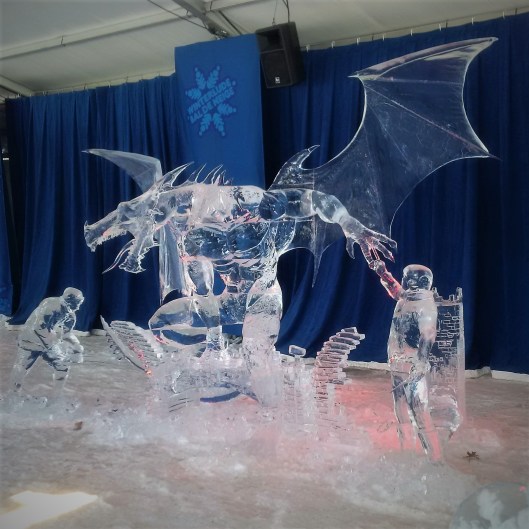
Attacking the ice dragon, Winterlude ice sculpture, Ottawa, Canada — photo by David Kitz
Many psalms spring from a place of grief, trouble and distress. This is only fitting since every life has such moments. Usually the psalmist pours out his troubles and his complaint before God, but he ends on a positive note—a note of hope. But Psalm 88 does not follow this pattern. It ends on a downer. You have taken from me friend and neighbor—darkness is my closest friend.
What are we to make of this ending? The sad reality is that not every book has a happy ending. Not every personal story has the Hollywood ending that we would like. Tragedy is real. Tragedy can strike anyone. We can live in a pretend world that says it isn’t so, but we are fooling only ourselves. This psalm adds a dark note of real-life integrity to the Book of Psalms.
But in the middle of it all—in the middle of his dark night of the soul—the psalmist takes his stand. But I cry to you for help, LORD; in the morning my prayer comes before you.
Sometimes we don’t have answers. Sometimes all we have is prayer.
Response: LORD God, when I am down, I cry to you for help. You are my hope when all hope is gone. Come to me in the dark times of my life. At such times I need you the most. Amen.
Your Turn: Are you going through a dark time? Do you find help in prayer?
21 Wednesday Feb 2018
Posted in Books by David Kitz, Lent
Tags
centurion, David Kitz, Jesus of Nazareth, Jewish prophet, Lent, Marcus, Messiah, Passover, repentance, Roman centurion, The Soldier Who Killed a King
A journey to the cross is a journey to repentance. It’s a journey to deep personal change. Will you take this journey with me?
In today’s reading, Marcus the centurion, meets with his fellow centurion, Renaldo, to discuss their response to what they see as the threat of a Jewish uprising led by a messianic prophet from Galilee.
“We have to do something. This Jewish prophet is too dangerous.”
“That’s why I came over. I have a plan. It came to me last night.”
“What about Flavio?” Renaldo resumed stroking Keeper. The dog’s silky ears twitched beneath his gentle hand.
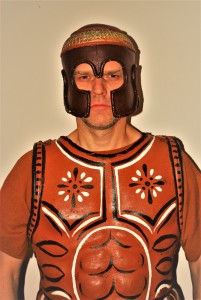
A Roman centurion — Andrew Nicholls
“Forget Flavio. He’ll be drunk for the rest of the week. Herod’s coming down about midweek. There’ll be a big wine- swilling bash for the upper crust. He’ll sober up just long enough so he can bow and scrape for Pilate at the right moment. Forget him. We have to save our own hides.”
“All right. So what’s this plan?”
“It’s not some great master scheme, but I do have a few ideas.”
“Yes, get on with it,” he said with obvious interest.
“Well, the way I see it, we have way too little information about whatever is going on here. If there’s some Passover plot being hatched, we need to be the first to know about it. Not like yesterday. I don’t like surprises. Especially Jewish Messiah surprises.”
Renaldo scowled in agreement. “So why the trunk?” he asked.
I had set it down after our greeting, and now it was Keeper, sniffing about it, that brought it to Renaldo’s attention.
“This is one way I can get some information.”
I opened the trunk and pulled out several items of clothing, among them a Jewish prayer shawl and several phylacteries. Holding one of the fringed garments to myself, I announced, “Today I am Benjamin. Benjamin from Alexandria, and I’ve come to celebrate the Passover here, in the holy city, Jerusalem.”
All this was done with a thick Aramaic accent and a mock reverence that left Renaldo slapping his thigh in laughter.
“Marcus, Marcus! Only you could pull this off!” Then he added in a more thoughtful tone, “I could look in on some of our usual sources. They’re bound to know a thing or two about this donkey man.”
“Now you’re thinking.” With a glance to the eastern sky, I added, “Look, we don’t have much time. The sun’s almost up. All my men know their assigned duties, so if you could just look in on them at the barracks, that would be great. I should be back in uniform by noon, and I could meet you there to discuss what we’ve found.”
“No problem . . . Benjamin!” he said, shaking his head and grinning, no doubt contemplating the sight of me in religious garb.
I began to place the clothing back in the trunk, and then I turned to my friend. “Oh, by the way, Renaldo, could you check in on Claudius at the Golden Gate? I expect our visiting prophet will be coming back into town by the same way today. Claudius might need a hand.”
“No problem, Marcus.” And then he added in a more serious tone, “Now, you be careful.”
“Yes, well,” I said, sighing, “I think we’ve all got to be careful.”
I swung the trunk up under my arm. With a quick wave of my free hand, I said, “I’m off for an appointment with Jesus of Nazareth.”
21 Wednesday Feb 2018
Posted in Bible, Devotionals, Psalm 88, Psalms
Tags
comfort, compassion, death, depression, despair, favor, God, Jesus Christ, joy, Ottawa, praise, the LORD, trouble, Winterlude
Reading: Psalm 88
A song. A psalm of the Sons of Korah. For the director of music.
According to mahalath leannoth. A maskil of Heman the Ezrahite.
LORD, you are the God who saves me;
day and night I cry out to you.
May my prayer come before you;
turn your ear to my cry.
I am overwhelmed with troubles
and my life draws near to death.
I am counted among those who go down to the pit;
I am like one without strength.
I am set apart with the dead, like the slain who lie in the grave,
whom you remember no more, who are cut off from your care.
You have put me in the lowest pit,
in the darkest depths.
Your wrath lies heavily on me;
you have overwhelmed me with all your waves.
You have taken from me my closest friends
and have made me repulsive to them.
I am confined and cannot escape; my eyes are dim with grief (NIV).
Reflection
There are 150 psalms in the Book of Psalms and one of the most remarkable things about them is their emotional span. They range from giddy heights of joy and praise to great depths of depression and sorrow. The full array of human emotion and experience is on display. Whatever state you find yourself in, there’s a psalm for that—a psalm for every situation and human need. If you are in desperate straits, there’s a psalm for that. If you are soaring in the presence of God, there’s a psalm for that too. They reflect our need for God and our desire to connect with Him in all of life’s experiences.

Ice sculptures at Winterlude, Ottawa, Canada — photo by David Kitz
Psalm 88 is a cry for help from the deepest pit of human need. Hear the psalmist’s cry of anguish: I am overwhelmed with troubles and my life draws near to death. I am counted among those who go down to the pit; I am like one without strength. I am confined and cannot escape; my eyes are dim with grief.
For reasons that we are not told, the psalmist feels trapped in the worst of circumstances. At times I think we all have been there—feeling alone with no one to turn to. In such times, there is no one to turn to but the LORD. In our time of despair He does not reject us or turn us away. He is a God who comforts us, even as Paul, the apostle declares, “Praise be to the God and Father of our Lord Jesus Christ, the Father of compassion and the God of all comfort, who comforts us in all our troubles, so that we can comfort those in any trouble with the comfort we ourselves receive from God” (2 Corinthians 1:3-4).
If you are in the depths of depression or despair follow the example of Heman, the psalmist. Call out to God. He is listening. He reaches to the lowest pit.
Response: LORD God, I need your comfort. Hear my prayer and answer me. In this time of sorrow show me a sign of your love and favor. Amen.
Your Turn: Are you currently facing a time of trouble or sorrow? Are others praying for you?
20 Tuesday Feb 2018
Posted in Lent
Tags
conquer, David Kitz, donkey, Galilee, Hosanna, Jesus, Jesus of Nazareth, Lord, Messiah, prophet, Rome, Son of David, temple, The Soldier Who Killed a King
I could see him clearly now. Donkey or not, he had the look of a man who knew exactly what he was doing. Those about him might not know or understand, but he knew. He had a destination in mind, a purpose. You could see it on his face.
“Hosanna to the Son of David!”
“Blessed is he who comes in the name of the Lord!”
“Hosanna in the highest heaven!”
There was something else different about him. At the time I didn’t know what it was. I couldn’t put it into words for a long time. I think I noticed it because I had watched all those other men come into Rome in their triumphal processionals. They were conquerors, but still they were hollow men, feeding off the adulation of the crowd, thirsting but never satisfied. You could see them vainly drink it in, hoping it would somehow fill the empty soul.
This donkey-riding king wasn’t drinking from the crowd. I somehow sensed he was full already, and what he had within must have come from a different source.
“Hosanna in the highest heaven!”
“Hosanna to the Son of David!”
“Blessed is he who comes in the name of the Lord!”
Just at that moment a strange feeling seemed to rise within me. Maybe it was the joy of the crowd. I had expected anger. Maybe it was the children waving palm branches or the spontaneity of the singing? I don’t know. For one moment it all seemed to come together. It seemed right somehow. Like heaven and earth had finally, for a moment, come into agreement—an agreement that had never been achieved before.
“Hosanna in the highest heaven!”
He was much closer now.
“Hosanna to the Son of David!”
He was now within the shadow of the gate.
“Blessed is he who comes in the name of the Lord!”
At that moment he looked up. For an instant our eyes met. Then I heard a voice—clearly heard a voice say, “I have a future for you.”
I was confused.
I turned to Claudius and said, “What did you mean by that?”
“What did I mean by what?” He had a blank look on his face.
“By what you said about—about the future?”
“I didn’t say anything about the future, sir. I didn’t say anything.”
I was totally baffled. Was I hearing voices? This whole thing was making no sense, no sense at all. Passover pilgrims weren’t supposed to come into the city this way. We had a revolutionary on the loose—riding a donkey. And now I was hearing things?
I rubbed the sweat from my forehead, hoping for some clarity to emerge.
I had a hundred men whose lives were in danger from this Jewish Messiah and his horde of followers. That was what mattered.
By this time the donkey man had passed under the gate and was heading in the direction of the temple in the heart of the city.
I signaled for Claudius to follow as I raced down the stairs of the gatehouse. I emerged onto the street and grabbed the first two-legged bit of Jewish scum I saw. Pressing him against the stone wall, I demanded, “Who is that man?”
I pointed at the retreating figure on the donkey.
The poor wretch was in shock and seemed quite unable to get out a word.
Claudius reached for his sword.
“Je- Jesus of Nazareth,” he stammered and then quickly added, “the prophet from Nazareth in Galilee.”
I loosened my grip. Then in a voice loud enough for all near to hear, I announced, “Well, there is one thing I do know. We’re going to have to keep an eye on that man.”
20 Tuesday Feb 2018
Posted in Bible, Devotionals, Psalm 87, Psalms
Tags
Ark of the Covenant, capital, city, city of God, community, David, galleries, Gatineau River, historic buildings, Holy Spirit, Jerusalem, Jesus, John Ceprano, museums, Ottawa, Ottawa River, Remic Rapids Park, Rideau Falls, Rideau River, Zion
Reading: Psalm 87
Of the Sons of Korah. A psalm. A song.
He has founded his city on the holy mountain.
The LORD loves the gates of Zion
more than all the other dwellings of Jacob.
Glorious things are said of you,
city of God:
“I will record Rahab and Babylon
among those who acknowledge me—
Philistia too, and Tyre, along with Cush—
and will say, ‘This one was born in Zion.’”
Indeed, of Zion it will be said,
“This one and that one were born in her,
and the Most High himself will establish her.”
The LORD will write in the register of the peoples:
“This one was born in Zion.”
As they make music they will sing,
“All my fountains are in you” (NIV).
Reflection
Do you love your hometown? I hope you do. I certainly love my hometown, or to be more accurate, my home city. I live in Ottawa, Canada’s capital city. Though I wasn’t born or raised in Ottawa, I chose to live here. There’s a lot to love about Ottawa. Like any major world capital, there are plenty of grand museums, galleries, historic buildings and monuments. But I think it’s their situation or setting that makes the city so attractive.
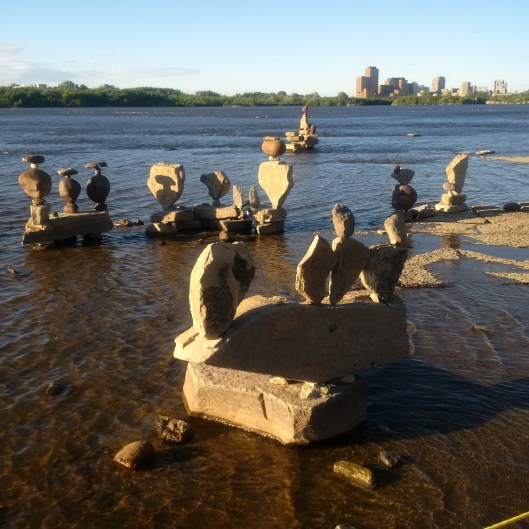
Remic Rapids Park, Ottawa, ON, balanced rock sculptures by John Ceprano — photo by David Kitz
Ottawa is situated at the juncture point of three rivers. The scenic Rideau River winds its way through the city from the south before it plunges into the Ottawa River at the Rideau Falls. On the north shore of the Ottawa River the Gatineau River makes its entry after passing through the rugged Gatineau Hills. With three scenic rivers there’s an abundance of city parks and green space.
According to the psalmist, the LORD loves his hometown too. The LORD loves the gates of Zion more than all the other dwellings of Jacob. Glorious things are said of you, city of God.
During the Old Testament era the LORD chose to dwell in Zion the citadel within Jerusalem. It was David who first brought the Ark of the Covenant to Zion after one of his successful military campaigns. (See 2 Samuel 6.) From that time forward Jerusalem has been called the city of God. It became the city of God because God dwelt there. In due course, His temple was built there.
What about your city or town? Does God dwell there? What truly makes a place remarkable or special is the One who lives there. The presence of God can turn a hut or a humble stable into the portal to heaven. If Jesus is enthroned in your heart then God is truly with you. He is in your city.
Response: LORD God, my body is a temple of the Holy Spirit. Thank you for being so personal—so intimate with me. I want to honor and serve you in my community. Be present and active here. Amen.
Your Turn: What do you like most about your community/city? Is God active in your community?
19 Monday Feb 2018
Posted in Books by David Kitz, Christ's Passion, Lent
Tags
David Kitz, Hosanna, Jerusalem, Messiah, Palm Sunday, Passion Week, Passover, pilgrims, Roman soldiers, soldier, Son of David, The Soldier Who Killed a King, triumphal entry
Four in the afternoon, Sunday, April 2, AD 30
It was never like this before. 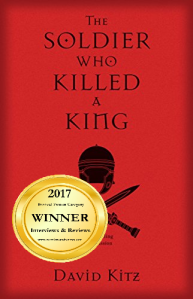
I had been posted in Jerusalem for ten years now, but in all that time, I had never seen a Passover crowd like this.
It wasn’t the numbers. I had seen that before.
The Passover pilgrims always come plodding into the city in reverent caravans. Some of them chant psalms. Others are silent, looking bone-weary as they trudge, like fretful herdsmen with children in tow. Undoubtedly, many are relieved that their holy city is finally in view.
But this year it was different. There was this man—at the center of the whole procession. There had never been a central figure before. Every movement within that huge throng seemed focused on him.
Squinting in a futile attempt to get a better view, I gave Claudius a backhanded slap to the shoulder and demanded, “What are they doing?”
“They’re climbing the trees, sir.”
“I can see that!” I snapped. “But what are they doing?”
“They seem to be tearing off the palm branches, sir.”
“What is going on here?” I said it more to myself than to any of the men standing near me. An uncomfortable feeling crept into me as the procession advanced.
“They don’t usually do this?” Claudius questioned.
“No . . . They’ve never done this before.” There was worry in my voice. Claudius had been recently assigned to this place, the festering armpit of the empire, and I was at a loss to explain what was happening before us. We were standing on the wall above the gate of Jerusalem, and less than a half mile away, we could see the jubilant pilgrims surging toward us in alarming numbers.
“They’re laying the palm branches on the road in front of that man—the man on the donkey.”
Until Claudius said it, I hadn’t noticed the donkey. Its small size and the frenzy of activity round about must have obscured this detail in the picture before me. What an odd way for this man to come. I could make no sense of it.
“They’re throwing down their cloaks before him.”
The sweat- glistened bodies of several men were clearly visible. Outer garments were being cast down before this man as a sign of homage. At the same time the rhythmic chanting of their voices became more distinct.
What were they singing? Could I pick up the words?
“Hosanna to the Son of David!”
“Blessed is he who comes in the name of the Lord!”
“Hosanna in the highest heaven!”
That’s when it hit me like a barbarian’s club. I realized what I was witnessing. It was a triumphal entry—the entry of a king.
It was the words. The words they were now boisterously shouting. He was their Messiah. The Son of David! The one they were waiting for! The one who would rid them of the Romans. He would set up his glorious Jewish kingdom, here, in Jerusalem! This is what I had been warned about since the day I first set foot on this cursed Judean soil. And we, I and my men and the garrison in the city, were all that stood in their way.
 I love the Psalms