• Home
  • About
  • DavidKitz.ca
  • Youtube Videos
  • Books by David
  • Books on Amazon.com

I love the Psalms

~ Connecting daily with God through the Psalms

I love the Psalms

Tag Archives: Bible

A Better Son than David

24 Wednesday Jul 2019

Posted by davidkitz in Devotionals, Psalm 89, Psalms

≈ 5 Comments

Tags

Bible, David, Jesus, Mary, Savior

Reading: Psalm 89
(Verses 19-29)
Once you spoke in a vision,
to your faithful people you said:
“I have bestowed strength on a warrior;
I have raised up a young man from among the people.
I have found David my servant; with my sacred oil I have anointed him.
My hand will sustain him; surely my arm will strengthen him.
The enemy will not get the better of him;
the wicked will not oppress him.
I will crush his foes before him and strike down his adversaries.
My faithful love will be with him,
and through my name his horn will be exalted.
I will set his hand over the sea, his right hand over the rivers.
He will call out to me, ‘You are my Father,
my God, the Rock my Savior.’
And I will appoint him to be my firstborn,
the most exalted of the kings of the earth.
I will maintain my love to him forever,
and my covenant with him will never fail.
I will establish his line forever,
his throne as long as the heavens endure
(NIV).

img_20190714_1702597

Green’s Creek, Ottawa, ON — photo by David Kitz

Reflection
Who is the principal figure in the Old Testament canon? Some would argue for Moses, the liberator of a nation of slaves. Others would go farther back yet to Abraham, the ancestral father of the nation of Israel. Here in Psalm 89, Ethan the Ezrahite and author of this psalm casts his vote in favor of David.

David’s name appears more frequently in the Bible than any name including the name of Jesus. Here in Psalm 89, Ethan draws a direct prophetic link to Jesus, the Son of God. He writes this about David: He will call out to me, ‘You are my Father, my God, the Rock my Savior.’ And I will appoint him to be my firstborn, the most exalted of the kings of the earth.

No other man in the Holy Scriptures can claim to be appointed as God’s firstborn. This is an honor that is reserved for David alone. But David prefigures or foreshadows Jesus, the true Son of God. Jesus was not appointed to the role of God’s son. He was conceived and born into this world as the divine Son of the Most High. Through the miracle of incarnation the son of Mary was also the Son of God and the Savior of the world. And this Mary was of royal lineage. She was a direct descendant of King David.

In Jesus Christ these words find their fulfillment: I will maintain my love to him [David] forever, and my covenant with him will never fail. I will establish his [David’s] line forever, his throne as long as the heavens endure.

 Response: LORD God, I am thankful for Jesus. I am thankful that in the dark long ago you devised a plan to send a Savior to this world. You sent a better son than David. You sent Jesus. Amen.

Your Turn: Are you thankful for God’s Son? Why?

The Word of God Revives the Soul

23 Friday Nov 2018

Posted by davidkitz in Bible, Devotionals, Psalm 19, Psalms

≈ 1 Comment

Tags

Bible, God's word, Holy Scriptures, revive, trustworthy, word of God

Reading: Psalm 19
(Verses 7-11)
The law of the LORD is perfect,
reviving the soul.
The statutes of the L
ORD are trustworthy,
making wise the simple.
The precepts of the L
ORD are right,
giving joy to the heart.
The commands of the L
ORD are radiant,
giving light to the eyes.
The fear of the L
ORD is pure,
enduring forever.
The decrees of the L
ORD are firm,
and all of them are righteous.
They are more precious than gold,
than much pure gold;
they are sweeter than honey,
than honey from the honeycomb.
By them your servant is warned;
in keeping them there is great reward
(NIV).

2017-07-03c

Ottawa River sunset — photo by David Kitz

Reflection
The voice of the speaking stars (see yesterday’s reading) is now joined by the voice of the written Holy Word. If nature, specifically the sky, is the first witness to testify to the glory of God, then the scriptures—the written word of God—constitute the second great witness to speak of God’s existence. Both these great witnesses have gathered here to testify within the context of Psalm 19.

While nature speaks to us of the existence of God the creator, it is largely silent regarding the nature or character of this all-powerful supernatural being. Is He good? Is He evil? Is He indifferent to us? Is He angry with us? What is this great, overarching, omnipresent God really like? May we approach Him?

God’s word shows us the way. Here David tells us, “The law of the LORD is perfect, reviving the soul.”

The law is perfect, flawless, inerrant and infallible. Only a perfect, flawless, inerrant and infallible God can be the source of such a document. The law of the LORD that is referred to here is in fact the Bible, the Word of God. Jack Hayford in his commentary on this verse from the Psalms states, “That the ‘law of the LORD is perfect,’ is direct reference to the absolute, complete, and entire trustworthiness of the Holy Scriptures, which constitute the Bible.”

And this perfect, true and infallible law, or Word of God, has an effect. The Word of God is active. It revives the soul. God’s word literally brings souls back to spiritual life. There is great power in the written word. The word of God is redemptive, personal and transformational.

Response: LORD God, help me draw life, wisdom and joy from your word every day. Light my way. Amen.

Your Turn: Do you read God’s word daily? How has it helped you grow in faith?

Our Tree of Life

15 Monday Oct 2018

Posted by davidkitz in Bible, Devotionals, Psalm 1, Psalms

≈ 3 Comments

Tags

Bible, David Kitz, fruit, Psalm, redemption, tree

Reading: Psalm 1

Blessed is the one
who does not walk in step with the wicked
or stand in the way that sinners take
or sit in the company of mockers,
but whose delight is in the law of the L
ORD,
and who meditates on his law day and night.
That person is like a tree planted by streams of water,
which yields its fruit in season
and whose leaf does not wither—
whatever they do prospers.
Not so the wicked!
They are like chaff that the wind blows away.
Therefore the wicked will not stand in the judgment,
nor sinners in the assembly of the righteous.
For the LORD watches over the way of the righteous,
but the way of the wicked leads to destruction
(NIV).

20180904_0712432

Weeping willow, Grey Nuns Park, Orleans, ON — photo by David Kitz

Reflection
Have you ever noticed the prominent role that trees play in the Bible? The creation account in Genesis begins with God planting two very special trees in the Garden of Eden: the Tree of Life and the Tree of the Knowledge of Good and Evil. After our first parent’s disobedience, we were banned from access the Tree of Life. But the amazing, good news of the Bible is that at the end of the book, in the last chapter of the Book of Revelation, God restores our access to the Tree of Life (Revelations 22:1-5).

In a very real sense the Bible is a story about trees.

Here in the very first Psalm, the life of the righteous is compared to a fruit-bearing tree, flourishing by streams of water. The psalmist presents a picture of tranquil beauty. Is that a picture of my life, or am I caught up in busyness? Sometimes I feel more like windblown chaff—rather worthless and lacking a sense of direction.

But that’s where the other tree at the heart of the Bible comes into play. It stands on a hill called Calvary. There my Saviour bled and died. There he showed me my true worth. There my sins were washed away, never to be remembered again. That’s where I became righteous, not by works that I had done, but by the grace and forgiveness of Christ.

What a beautiful tree! The tree on Mount Calvary isn’t beautiful because of its leaves. It’s beautiful because of its fruit—the fruit of redemption purchased by the blood of Jesus. My righteousness is solely due to him.

Response: Dear Lord Jesus, thank you for your sacrifice. Help me to always remember that you are the true source of my righteousness. At your prompting help me to rid myself of the worthless chaff in my life. Wind of God, blow on me. Water of life, refresh my soul. May I be fruitful, Lord, for you. Amen.

Your Turn: Have you knelt before the tree on Mount Calvary?

Hallelujah!

08 Monday Oct 2018

Posted by davidkitz in Bible, Devotionals, Psalm 148, Psalms

≈ 1 Comment

Tags

Bible, hallelujah, Hallelujah Chorus, praise the LORD, redemption

Reading: Psalm 148
(Verses 13-14)
Let them praise the name of the LORD,
for his name alone is exalted;
his splendor is above the earth and the heavens.
And he has raised up for his people a horn,
the praise of all his faithful servants,
of Israel, the people close to his heart.
Praise the LORD (NIV).

20180831_1354205 (2)

Rock strewn stream, Gatineau Park, Quebec — photo by David Kitz

Reflection
Broadly speaking I like modern translations of the Bible over the traditional King James Version, but… But sometimes the old King James just sounds better, or more familiar. Here at the close of Psalm 148 we have a case in point.

The New International Version ends the psalm with these words: Praise the LORD. The King James Version ends the psalm with Praise ye the LORD. But a more literal translation or transliteration of this final phrase is Hallelujah! The footnotes to the New American Standard Bible point out that Hallelu means praise, while JAH is the abbreviated Hebrew name for God, which is often translated Jehovah or more accurately Yahweh.

Whenever you see the phrase praise the LORD, you are actually looking at a translation of the Hebrew word hallelujah!

Hallelujah is entirely absent from the New International Version of the Bible. It has also been scrubbed from most of the other modern translations. To put it bluntly, I miss hallelujah. It has an uplifting ring to it. Hallelujah skips off the tongue like a shooting star. It bursts forth from a thankful heart like fireworks on a summer night. 

For the Christian believer Christmas is the great Hallelujah! God has come to the earth and been born as a baby like you and me. This is the beginning of the great redemption story.

The resurrection is the second great Hallelujah! The Son of God was vindicated. His death was not in vain. He conquered death, our greatest foe, and now Jesus reigns on high forever. That calls for a hallelujah! And for good measure, let’s add praise the LORD too!

The one who at his birth was laid in a manger is the King of kings and the Lord of lords. As Handel’s Messiah proclaims, “He shall reign forever and ever. Hallelujah!” Let the hallelujahs resound from the earth to the heavens as we join in the song of the angels—the song of the ages.

Let them praise the name of the LORD, for his name alone is exalted; his splendor is above the earth and the heavens.

Response: LORD God, I praise you for sending Jesus. I praise you for your great plan of redemption. Jesus, I thank you for carrying my sins to Calvary. I rejoice in your resurrection victory. Hallelujah! Amen.

Your Turn: Do you enjoy Handel’s Hallelujah Chorus? What is your favorite expression of praise to God?

Finally, for all my fellow Canadians, I wish you a wonderful Thanksgiving Day. We have so much to be thankful for! Hallelujah!

Are You Meditating on His Promises?

10 Tuesday Jul 2018

Posted by davidkitz in Bible, Devotionals, God's word, Psalm 119, Psalms

≈ 1 Comment

Tags

Bible, God's promises, God's word, meditation

Reading: Psalm 119
ק Qoph
(Verses 145-152)
I call with all my heart; answer me, LORD,
and I will obey your decrees.
I call out to you; save me
and I will keep your statutes.
 I rise before dawn and cry for help;
I have put my hope in your word.
My eyes stay open through the watches of the night,
that I may meditate on your promises.
 Hear my voice in accordance with your love;
preserve my life, L
ORD, according to your laws.
Those who devise wicked schemes are near,
but they are far from your law.
 Yet you are near, L
ORD,
and all your commands are true.
 Long ago I learned from your statutes
that you established them to last forever
(NIV).

2018-06-24 (2)

Wild flowers trumpet the goodness of God — photo by David Kitz

Reflection
Meditation. It seems everyone is doing it. Have you taken up meditation? Even the Bible encourages us to meditate. 

Ah, but there are some fundamental differences between transcendental meditation and the meditation that is described in the Bible. Eastern meditation, which springs from the Hindu religion, calls on the practitioner to relax and empty his or her mind.

Biblical meditation is not an emptying of the mind, or a disengagement with the thought process. Instead, it is active, concentrated thought on a topic, word or Bible verse. On an intellectual level, it has been compared to rumination—a cow chewing her cud. It involves getting the most out of what God has said—digesting His word—so it is fully incorporated into the life of the believer.

Today’s reading sheds light on the psalmist’s practice of biblical meditation: I rise before dawn and cry for help; I have put my hope in your word. My eyes stay open through the watches of the night, that I may meditate on your promises.

The psalmist is thoroughly engaged with God. He is crying out to Him. He is focussed on the word of God and His promises: I have put my hope in your word.  

In the rush of life, do we stop and meditate on God’s word? Is Bible reading just a box to check off as we speed through our day? It’s the LORD who calls us aside to spend time with Him.

Response: LORD God, with all the distractions around me, I want to get in the habit of meditating on your word. Help me to focus my attention and thoughts on your promises. You are good to me. Amen.

Your Turn: Are you easily distracted from God’s word? Do you take it with you through the day?

Male Pattern Blindness

18 Monday Jun 2018

Posted by davidkitz in Bible, Devotionals, God's word, Psalm 119, Psalms

≈ 4 Comments

Tags

apostles, Bible, blind, Holy Spirit, Lake Louise, Lord, prophet, Psalm 119, spiritual blindness

Reading: Psalm 119
ג Gimel
(Verses 17-24)
Be good to your servant while I live,
that I may obey your word.
Open my eyes that I may see
wonderful things in your law.
I am a stranger on earth;
do not hide your commands from me.
My soul is consumed with longing
for your laws at all times.
You rebuke the arrogant, who are accursed,
those who stray from your commands.
Remove from me their scorn and contempt,
for I keep your statutes.
Though rulers sit together and slander me,
your servant will meditate on your decrees.
Your statutes are my delight;
they are my counselors
(NIV).

2018-05-18 Chateau L L

Chateau Lake Louise — photo by David Kitz

Reflection
My wife knows all about my blindness. Actually, it’s a condition that afflicts many men. You see I have difficulty seeing what is right in front of me. She will tell me to get a certain item from the next room, but can I find it? Of course not. Eventually, my longsuffering wife will arrive to point out the obvious. To which I will respond with, “Now, why couldn’t I see that?”

She will then reply with, “Because you’re blind.”

I’m sure domestic scenes like this are repeated in homes all over the world. But something very similar happens when we open our Bibles. We read a passage and though we take it in with our eyes, it seems the words go nowhere. The thoughts expressed by those words do not register on our minds or in our spirits. I’m ashamed to admit there are times when I have read a chapter from the Bible and walked away completely unaware of what I have read. Nothing has registered. The psalmist’s prayer in today’s reading needs to become my own: Open my eyes that I may see wonderful things in your law.

Unless God opens our eyes when we read His word, we are engaging in an exercise in futility. The Holy Spirit inspired the apostles and prophets to write the Bible, and we urgently need the same Holy Spirit to bring those words alive for us as we read. The god of this world has blinded our eyes. Often God’s truths are veiled. We need the Holy Spirit to remove that veil. Something marvelous happens when that occurs. And we all, who with unveiled faces contemplate the Lord’s glory, are being transformed into his image with ever-increasing glory, which comes from the Lord, who is the Spirit (2 Corinthians 3: 18).  

Response: Father God, open my eyes and my heart to the truths of your glorious word. Day by day I want to grow in my knowledge and love for you. I need to be transformed by your Spirit. Remove the veil from my eyes. Amen.

Your Turn: Do you regularly read God’s word? Do you sometimes suffer from Bible blindness?

The Right Hand of God

12 Tuesday Jun 2018

Posted by davidkitz in Bible, Devotionals, God's word, Psalm 118, Psalms

≈ 5 Comments

Tags

Bible, blessing, God's blessing, Holy Spirit, honor, left-handed, right-handed, righteous

Reading: Psalm 118
(Verses 15-21)
Shouts of joy and victory
resound in the tents of the righteous:
“The L
ORD’s right hand has done mighty things!
The L
ORD’s right hand is lifted high;
the L
ORD’s right hand has done mighty things!”
I will not die but live,
and will proclaim what the L
ORD has done.
The L
ORD has chastened me severely,
but he has not given me over to death.
Open for me the gates of the righteous;
I will enter and give thanks to the L
ORD.
This is the gate of the L
ORD
through which the righteous may enter.
I will give you thanks, for you answered me;
you have become my salvation
(NIV).

2018-05-20

Flood your people with your grace mercy and peace, LORD — photo by David Kitz

Reflection
Are you left handed? Today in western cultures being left handed presents some challenges since many devices are designed with right-handed people in mind. Try finding left-handed scissors next time you’re at a store. Good luck with that! Oh, and if you find them, expect to pay three times the price of a right-handed model. Often lefties don’t have it so good.

Even today in Middle Eastern cultures being born left handed presents an enormous challenge. The right hand is used for eating food; the left hand is used for personal hygiene—bottom wiping. You dare not reverse that assigned role. Toddlers are strictly trained in this cultural practice. Usually left-handed children are forced to switch so they conform to the social norm. Making this switch plays havoc with the developing brain and often results in speech impediments such as stuttering, since this transition requires a complete rewiring of the child’s brain.

The Bible was written by Holy Spirit inspired authors, but like authors today they were not blank slates. They wrote from their cultural perspective to the people of their time. As a result, readers today can easily miss or misunderstand concepts that were readily understood in their original context.

The significance of the right hand is one of those culturally important concepts that we often pass over with little thought. The Bible is replete with references to the right hand or specifically God’s right hand. So what’s the big deal, we think to ourselves. But in Middle Eastern culture the right hand holds great significance. This is the hand of righteousness, honor and blessing. Thus, there is immense significance in this statement: “The LORD’s right hand has done mighty things! The LORD’s right hand is lifted high; the LORD’s right hand has done mighty things!”

Response: Father God, extend your right hand of blessing over me. Work on my behalf. Show me your mercy, your power and glory. Again and again I will give you thanks, for you answered me. Amen.

Your Turn: Are you like the psalmist? Has the LORD spared your life for a purpose? Has God lifted His right hand to save and bless you?

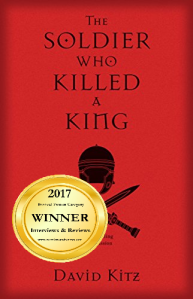
The Soldier Who Killed a King—A Review

17 Tuesday Apr 2018

Posted by davidkitz in book review, Books by David Kitz, Christ's Passion, The Soldier Who Killed a King

≈ 8 Comments

Tags

Bible, Caiaphas, David Kitz, Herod Antipas, Jesus, king, Longinus, Marcus, Palm Sunday, Pontius Pilate, redemption, resurrection, Roman, Roman centurion, The Soldier Who Killed a King

As published in Testimony Magazine, March/April Edition, 2018, reviewed by Dr. Darlene Witte-Townsend 

The Soldier Who Killed a King was voted the top book in the biblical fiction categorybiblical-fiction-award-2017_orig for 2017 by the Christian book service, Interviews and Reviews. Having recently read this book, it’s not difficult to see why. It plays like a high-stakes movie in your mind.

Canadian author, David Kitz, closely examines the events occurring between Jesus’ entry into Jerusalem on Palm Sunday and his resurrection a few days later. But we see all these events from a unique perspective—through the eyes of a Roman soldier.

This engaging, hard-hitting narrative is a distillation of Kitz’s study and prayer over a 50-year span, when as pastor, educator and Bible dramatist, he steeped himself in the wonder of this story. As a novelist, he reveals profound respect for the historical record through his characterization of Marcus Longinus, a Roman centurion who is unwillingly caught in the power struggles of the day. Furthermore, Kitz stays true to the scriptural account by integrating more than a hundred quotes from the Gospels into the story text.

Three corrupt men, Herod Antipas, “the Fox,” Pontius Pilate, “the Badger,” and Joseph Caiaphas, “the Weasel” have an insatiable lust for money and power. They each attempt to use the political tumult of the time for their own gain. In contrast to the stench of their machinations, Kitz offers a deep sense of Jesus, the donkey-riding King, as the man in whom all of heaven is invested. Jesus emerges in the Roman world offering an entirely new way for humankind to be reborn.

Above all else, this is a story of personal redemption. Marcus, the Roman Centurion is like us, caught between worlds. Who is his king? Why?

The Son of God shows unlimited compassion through healing the sick and feeding the hungry, and his purity catches the attention of the masses in a drama that still shakes the world, one aching, open, humble heart at a time. Do you need to rediscover the power of the cross? The Soldier Who Killed a King will take you there.

Gaining a Heart of Wisdom

07 Wednesday Mar 2018

Posted by davidkitz in Bible, Devotionals, Psalm 90, Psalms

≈ 5 Comments

Tags

accomplishments, achievement, ambition, Bible, God's call, humility, Moses, Orleans, Pharaoh, secret sins, the LORD, wasted life, wisdom

Reading:                                      Psalm 90

(Verses 7-12)
We are consumed by your anger
and terrified by your indignation.
You have set our iniquities before you,
our secret sins in the light of your presence.
All our days pass away under your wrath;
we finish our years with a moan.
Our days may come to seventy years,
or eighty, if our strength endures;
yet the best of them are but trouble and sorrow,
for they quickly pass, and we fly away.
If only we knew the power of your anger!
Your wrath is as great as the fear that is your due.
Teach us to number our days,
that we may gain a heart of wisdom (NIV).

Reflection
The finite nature of our lives here on planet earth should cause us to give serious thought to how we spend the days that we have been allotted. Once we reach the age of forty, roughly half of our life is over. Some claim it’s all downhill from that point forward. Life seems to speed up—to pass by quickly— as we careen toward our demise.

Violets 2017-04-28

Wood violets, Orleans, ON — photo by David Kitz

Moses concludes his prayer here in Psalm 90 with these words: Teach us to number our days, that we may gain a heart of wisdom.

No one wants to reach the end of their days and then realize that they have wasted their life. In our hearts, we all want to have a meaningful life filled with purpose. Much of that striving for success and our drive for a long list of accomplishments comes from a desire for meaning and purpose in life. Moses certainly had a string of achievements on his resume before the LORD called him home. He was after all the liberator of a nation. He was revered as a great leader and the great law giver. But was that due to Moses’ great ambition?

The Bible paints a different picture of Moses. When God called him into service, Moses resisted. The adopted son of Pharaoh was content to shepherd a few sheep on the backside of the desert. But God had other plans—bigger plans. This is what we are told about Moses. Now Moses was a very humble man, more humble than anyone else on the face of the earth (Numbers 12:3).

Perhaps true wisdom begins with humility—with knowing our place in the grand scheme of things. It starts as it did for Moses by hearing God’s call and ultimately being willing to obey, whatever that takes and wherever that takes us.

Response: LORD, teach me to number my days, so I may gain a heart of wisdom. Give me ears to hear what you are saying to me. I want to live a meaningful life filled with purpose coming from you. Amen.

Your Turn: Are you numbering your days or are they numbering you? Are you following God’s call and purpose for your life?

Under Attack

02 Friday Mar 2018

Posted by davidkitz in Bible, Devotionals, Psalm 89, Psalms

≈ 7 Comments

Tags

Babylonian invasion, Bible, Bible attacked, Creator, Darwin, defeat, foundation, foundational truth, God's word, inerrancy, Judea, King of Judah, North America, shame

Reading:                                      Psalm 89

(Verses 38-45)
But you have rejected, you have spurned,
you have been very angry with your anointed one.
You have renounced the covenant with your servant
and have defiled his crown in the dust.
You have broken through all his walls
and reduced his strongholds to ruins.
All who pass by have plundered him;
he has become the scorn of his neighbors.
You have exalted the right hand of his foes;
you have made all his enemies rejoice.
Indeed, you have turned back the edge of his sword
and have not supported him in battle.
You have put an end to his splendor
and cast his throne to the ground.
You have cut short the days of his youth;
you have covered him with a mantle of shame
(NIV).

Reflection
Though we cannot be absolutely certain, it seems likely that Psalm 89 was written during the time of the Babylonian invasion of Judea. These were days of disaster brought on by idolatry as the people turned away from God. The rebellious King of Judah suffered a catastrophic defeat as the words of this psalm state: You have put an end to his splendor and cast his throne to the ground. You have cut short the days of his youth; you have covered him with a mantle of shame.

2018-02-13 L Kranz

Photo courtesy of Liz Kranz

 In the last few decades the church in North America has also experienced a number of defeats or setbacks. Enemies of the Christian faith have risen up and become bold in their attacks. Just as ancient Jerusalem was attacked and laid low, so too Christian belief systems have been under constant assault. The walls and strongholds of our faith have been undermined.

Two unshakeable biblical truths have come under relentless attack. The first is the truth of creation. Our God is the Creator of the universe—the source point of all matter and life. Since the days of Darwin, who incidentally believed in God, atheists have mounted a ferocious attack on this foundational truth. The Christian response has often been jingoistic or at best disjointed. A more coherent and scientifically sound defense is needed.

The second truth that has been under continual attack is the veracity of the Bible. God’s holy word is mocked and routinely discredited especially at our universities. The word of God is our stronghold. Over and over again it has been proven to be accurate, reliable and true. Archeologists and scholars have marvelled at the veracity and authenticity of God’s word. But the real proof of the inerrancy of God’s word does not come from scholarly research. It comes from the transformed lives of believers.

Response: LORD God, my trust is in you and your word. Creator God, I want my faith to be as secure for me as the earth beneath my feet and the air in my lungs. You are all around me. Thank you, Lord. Amen.

Your Turn: Have attacks on your faith caused doubt? How did you overcome?

← Older posts
Newer posts →

Psalms 365: Develop a Life of Worship & Prayer

Psalms 365 Volume II

Psalms 365 vol 3
— Psalms 365 Volume III

Now available:

Psalms

Recent posts

  • The Little Children and Jesus September 25, 2026
  • The Land is Satisfied September 25, 2026
  • Divorce September 24, 2026
  • Clothed with Splendor and Majesty September 24, 2026
  • Causing to Stumble September 23, 2026
  • Robot Worshippers September 23, 2026
  • Whoever Is Not Against Us Is for Us September 22, 2026

Calendar

September 2026
M T W T F S S
 123456
78910111213
14151617181920
21222324252627
282930  
« Aug    

Blog Posts

Comments

  • davidkitz on Divorce
  • davidkitz on Divorce
  • Eileen Guyadeen on Divorce

Blog at WordPress.com.

Privacy & Cookies: This site uses cookies. By continuing to use this website, you agree to their use.
To find out more, including how to control cookies, see here: Cookie Policy
  • Subscribe Subscribed
    I love the Psalms
    Join 1,357 other subscribers

    Have a WordPress.com account? Log in now.

  • I love the Psalms
    View site in Reader
    Manage subscriptionsSign upLog in
    Report this content
    Collapse this bar
Loading Comments...