Tags
Alberta, blameless, blessed, commands, decrees, Drumheller, obey, praise, precepts, Psalm 119, Red Deer River, righteous, shame, statutes, the LORD
I will praise Him!

The Red River Valley near Drumheller, Alberta — photo by David Kitz

07 Saturday Apr 2018
Tags
Alberta, blameless, blessed, commands, decrees, Drumheller, obey, praise, precepts, Psalm 119, Red Deer River, righteous, shame, statutes, the LORD
The Red River Valley near Drumheller, Alberta — photo by David Kitz
06 Friday Apr 2018
Posted in Bible, Devotionals, Psalm 101, Psalms
Tags
anointed, blameless, David, deceit, friend of God, God's enemies, integrity, Israel, judgment, King David, lies, lower class, Regina, Saskatchewan
Reading: Psalm 101
(Verses 5-8)
Whoever slanders their neighbor in secret,
I will put to silence;
whoever has haughty eyes and a proud heart,
I will not tolerate.
My eyes will be on the faithful in the land,
that they may dwell with me;
the one whose walk is blameless
will minister to me.
No one who practices deceit
will dwell in my house;
no one who speaks falsely
will stand in my presence.
Every morning I will put to silence
all the wicked in the land;
I will cut off every evildoer
from the city of the LORD (NIV).
Reflection
One of the roles of a king in ancient Israel was to render judgment in difficult civil cases. In fact, judges ruled Israel for about 400 years before the first king was anointed; hence the judicial role was of great significance during the early years of Israel’s kingdom period.

The burning bush in a frozen landscape, Regina, Saskatchewan — photo by David Kitz
This reading from Psalm 101 should be viewed as King David’s commitment to his judicial role. He was determined to govern wisely, and for him that meant identifying and siding with those who do right. My eyes will be on the faithful in the land, that they may dwell with me; the one whose walk is blameless will minister to me.
Choosing the right kind of people to associate with is of great importance. This is not about the economic strata you occupy. Typically, rich people associate only with other rich people; similarly lower class people have friends of the same social standing. But honesty and integrity cross these artificial socioeconomic lines. There are crooks and swindlers among the rich and among the poor. In the same way there are honest people of integrity at the extremes of both wealth and poverty.
David’s objective was to raise the integrity bar. He had no patience for lies or deceit. What kind of people do you enjoy hanging around with? Do they prompt you to walk with them in a blameless way, or do they drag you down in the gutter? Do they prompt you to good deeds or tempt you into a crooked path? It has often been said that we are known by the friends we choose. Are you a friend of God? James has this admonition for us: Don’t you know that if you love the world, you are God’s enemies? And if you decide to be a friend of the world, you make yourself an enemy of God (James 4:4, CEV).
Response: Heavenly Father, I want to be your friend. I want to love you because you first loved me and showed that love through your son, Jesus. Help me to choose my friends wisely as I let your life and joy shine through me. Amen.
Your Turn: Do your friends encourage you in your faith walk? Are you letting light shine?
05 Thursday Apr 2018
Posted in Bible, Devotionals, Psalm 101, Psalms
Tags
adultery, Blame, blameless, commitment, David, goals, holiness, Jesus, justice, legalistic, love of God, loving, murder, repentance, Savior
Reading: Psalm 101
Of David. A psalm.
(Verses 1-4)
I will sing of your love and justice;
to you, LORD, I will sing praise.
I will be careful to lead a blameless life—
when will you come to me?
I will conduct the affairs of my house
with a blameless heart.
I will not look with approval
on anything that is vile.
I hate what faithless people do;
I will have no part in it.
The perverse of heart shall be far from me;
I will have nothing to do with what is evil (NIV).
Reflection
Psalm 101 is a call to action or commitment. David, the author of this psalm, commits himself to a course of action. In this short opening portion of the psalm, David makes seven ‘I will’ statements. Each commitment is life altering in some way.
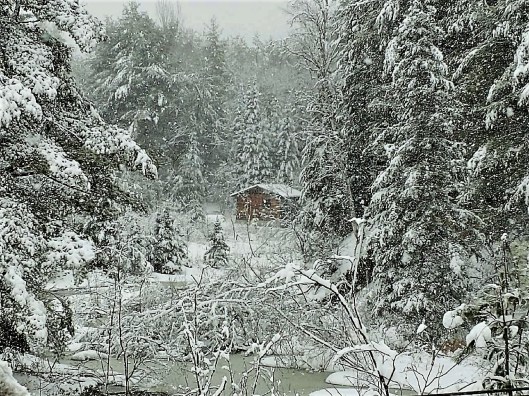
Early April snowfall — photo courtesy of Liz Kranz
The first commitment David makes is to sing of the LORD’s justice and love. He is determined to praise his God with a full, joyous awareness of the LORD’s character. This is the true starting point of any sustained relationship with God. The LORD is both loving and just. If we emphasize aspects of God’s justice too much, we risk becoming legalistic. If we focus only on the love of God, His holiness is ignored resulting in a break down in personal responsibility. Within the Godhead there exists a perfect tension between His justice and His love. As God’s servants, we do well when we recognize and maintain that tension.
Twice David uses the word blameless. I will be careful to lead a blameless life—when will you come to me? I will conduct the affairs of my house with a blameless heart. With these words, David has set for himself a high standard—an impossible standard. Did David succeed in reaching his lofty goal? The biblical record leaves no room for doubt. He failed miserably. In his affair with Bathsheba, King David was guilty of both adultery and murder.
Well, what good is there then in setting lofty goals? Why make any ‘I will’ statements, if I am doomed to fail? Why not freely look on the vile and indulge in it?
Actually, despite David’s stunning failures, there are many sound reasons for calling ourselves to a high standard. To put it bluntly, God expects it of us. He demands holiness from us—always has—always will. Will we succeed? Of course not. That’s why there’s the gift of repentance. That’s why there’s a Savior named Jesus. He’s the blameless one. I need his sinless record applied to my account.
Response: Dear God, I want my will to be conformed to your will. I want to lead a blameless life. By Jesus’ blood, grant me a blameless heart that is determined to love and serve you for all my days. Amen.
Your Turn: Should we set goals for ourselves? How do you measure the progress in your love for God?
30 Monday Oct 2017
Posted in Bible, Devotionals, Psalm 50, Psalms
Tags
blameless, forget, forgetting, forgetting God, God, Grey Nuns Park, Japan, joy, salvation, thanksgiving, wrath, wrath of God
Reading: Psalm 50
(Verses 16-23)
But to the wicked person, God says:
“What right have you to recite my laws
or take my covenant on your lips?
You hate my instruction
and cast my words behind you.
When you see a thief, you join with him;
you throw in your lot with adulterers.
You use your mouth for evil
and harness your tongue to deceit.
You sit and testify against your brother
and slander your own mother’s son.
When you did these things and I kept silent,
you thought I was exactly like you.
But I now arraign you
and set my accusations before you.
“Consider this, you who forget God,
or I will tear you to pieces, with no one to rescue you:
Those who sacrifice thank offerings honor me,
and to the blameless I will show my salvation” (NIV).
Reflection
I have a tendency to be forgetful. As I leave the house, it is not uncommon for me to forget some rather important items such as my wallet or my mobile phone. On a recent trip to Japan, my wife would often help me run through a checklist of essential items as we set out on an excursion. Wallet, rail pass, mobile phone and passport, all were needed. I dare not forget any of these.

Clothed in righteousness — Grey Nuns Park, Ottawa, ON
But there is something more important than all of these ‘essentials’. In his conclusion to Psalm 50, the psalmist Asaph reminds us not to forget God. How often have you set out on your day only to realize that you forgot God at home? Did He even make it home with you? Maybe He’s still at church? Have you had God with you lately? Have you forgotten Him completely as you went about your business?
Forgetting God is no small matter. Here is the LORD’s response to those who forget Him: “Consider this, you who forget God, or I will tear you to pieces, with no one to rescue you: Those who sacrifice thank offerings honor me, and to the blameless I will show my salvation”
We all want to see the salvation of God, but it starts with not forgetting Him. When we do, we run the risk of becoming objects of His wrath. The wrath of God is not a popular topic these days, but a lack of popularity does not negate its reality. When we choose to ignore God, there are unpleasant consequences. This applies personally and nationally. When we turn our back on the author of our salvation, terrible things happen. When we embrace Him with thanksgiving, joy will be our portion.
Response: LORD God, let me never forget your great love for me. I want to take you with me today and every day. I am thankful for the promise of your presence. Amen.
Your Turn: Do you sometimes forget God as you begin your day?
22 Sunday Oct 2017
Tags

Petrie Island Park, Ottawa, ON — photo by David Kitz
03 Monday Jul 2017
Posted in Bible, Devotionals, Psalm 19, Psalms
Tags
blameless, David, forgive, forgiveness, God, hidden faults, hidden sins, holiness, Holy Spirit, humility, meditation, pride, Redeemer, sins, the LORD, transgressions, willful sins, witness, words
Reading: Psalm 19
(Verses 12-14)
But who can discern their own errors?
Forgive my hidden faults.
Keep your servant also from willful sins;
may they not rule over me.
Then I will be blameless,
innocent of great transgression.
May these words of my mouth
and this meditation of my heart
be pleasing in your sight,
LORD, my Rock and my Redeemer (NIV).
Reflection
What is your response to God’s word and His voice as it speaks to your heart? In this final portion of Psalm 19 we see David’s response to God. God has been doing the talking thus far. The LORD has been speaking to David through the stars, through the night sky, and the blazing heat of the sun—the first witness. He has spoken to him through the Word of God—His written revelation—the second witness. Now as this Psalm draws to a close, we hear David responding back to God.

Lead me on your path, Lord — photo by David Kitz
In actuality, David is responding to the third witness. His heart is bearing witness to the reality of God. His conscience is convicting him of his sin and of the righteousness of God. We all have this third witness within us—a witness that will not be silenced, though we may try to drown out this inner voice of the Spirit. The Holy Spirit is at work in every case when we respond in a right way to God.
If along with David, we have heard the voices of the first and second witness, then there is only one appropriate response. It is the response recorded here in Holy Scriptures. If we see and grasp the awesome power and majesty of God, if through His word we have glimpsed His holiness, then we are brought low. We are humbled before him. Our greatest achievements are nothing. Our pride dissolves. Our weakness, our smallness is self-evident in the presence of the LORD of heaven and earth. We are exposed; our sin is exposed before this holy, magnificent God.
Along with David we cry out, “But who can discern their own errors? Forgive my hidden faults. Keep your servant also from willful sins; may they not rule over me.”
If we perceive God correctly, and if we assess ourselves accurately and honestly, then we quickly realize our greatest need. Our greatest need is for forgiveness. This is the solid bedrock on which any human relationship with God is built.
Here is the truth. I need forgiveness. My failings and shortcomings are many. What about you?
Response: Heavenly Father, please forgive my sins. Often I have lived according to my will, not yours. Forgive my selfish ways. May these words of my mouth and this meditation of my heart be pleasing in your sight, LORD, my Rock and my Redeemer. Amen.
Your Turn: Have you confessed your hidden sins to God? Have you acknowledged your need for a Savior from yourself?
23 Friday Jun 2017
Posted in Devotionals, Psalm 18, Psalms
Tags
angry at God, blameless, blind, Creator, hardship, humility, loss, perception, pure, pure in heart, purity, seeing God, spiritual blindness
Reading: Psalm 18
Verses 25-29
To the faithful you show yourself faithful,
to the blameless you show yourself blameless,
to the pure you show yourself pure,
but to the devious you show yourself shrewd.
You save the humble
but bring low those whose eyes are haughty.
You, LORD, keep my lamp burning;
my God turns my darkness into light.
With your help I can advance against a troop;
with my God I can scale a wall (NIV).
Reflection
How do you see God? How do you perceive Him to be? The opening lines of today’s psalm reading tell us plainly that the state of our heart determines our perception of God. God reveals Himself to us according to the condition of our soul. Therefore, David makes this observation: To the faithful you show yourself faithful, to the blameless you show yourself blameless, to the pure you show yourself pure, but to the devious you show yourself shrewd.

A celebration in the sky — photo courtesy of Donald Adam
The truth expressed in this straightforward observation has enormous implications for every human on the planet. Our relationship with God is shaped by our perception of Him, and our perception of Him is reflective of the state of our heart. For example, one person goes through a period of hardship and loss and becomes bitter and angry toward others and God. Another person goes through a similar period of hardship and loss, but emerges passionately in love with his Creator. How can this be?
The answer can be found in David’s observation: To the faithful you show yourself faithful, to the blameless you show yourself blameless, to the pure you show yourself pure, but to the devious you show yourself shrewd. The blameless assign no blame to God, but the sin-darkened soul blames Him for even the slightest adversity.
Jesus said, “Blessed are the pure in heart, for they will see God” (Matthew 5:8). Do you want to see God at work in your life? Then ask the Lord Jesus to give you a pure heart. God shows Himself—becomes visible—to those with a pure heart. The pure in heart see God in the glory of the sunset, in the face of a child, in kindness of a stranger. The sin-polluted soul can view the same scene—experience the same events—and sees God in none of it. He is blind to God.
Our eyes open the moment we humble ourselves before God. David’s words ring true today. You save the humble but bring low those whose eyes are haughty. You, LORD, keep my lamp burning; my God turns my darkness into light.
Response: Heavenly Father, give me a pure heart. I want to see you. I want to see you, Lord Jesus, alive and active all around me today. Give me eyes that see beyond the natural and into the realm of the spirit where you are at work. Amen.
Your Turn: Did you see God today? How did He show Himself to you?
17 Saturday Jun 2017
Tags
Almighty, blameless, courts of the LORD, doorkeeper, God's favor, God's house, honor, Lord God, praise, trust

Petrie Island sunset — photo by David Kitz
04 Sunday Dec 2016
Posted in Psalms, Sunday's Psalm
Bilberry Creek, Orleans, ON — photo by David Kitz
13 Thursday Oct 2016
Tags
blameless, deceit, friend of God, honesty, integrity, judges, King David
Reading: Psalm 101
(Verses 5-8)
Whoever slanders their neighbor in secret,
I will put to silence;
whoever has haughty eyes and a proud heart,
I will not tolerate.
My eyes will be on the faithful in the land,
that they may dwell with me;
the one whose walk is blameless
will minister to me.
No one who practices deceit
will dwell in my house;
no one who speaks falsely
will stand in my presence.
Every morning I will put to silence
all the wicked in the land;
I will cut off every evildoer
from the city of the LORD (NIV).
Reflection
One of the roles of a king in ancient Israel was to render judgment in difficult civil cases. In fact, judges ruled Israel for about 400 years before the first king was anointed; hence the judicial role was of great significance during the early years of Israel’s kingdom period.

Farm silo sunrise — photo by Donald Adam
This reading from Psalm 101 should be viewed as King David’s commitment to his judicial role. He was determined to govern wisely, and for him that meant identifying and siding with those who do right. My eyes will be on the faithful in the land, that they may dwell with me; the one whose walk is blameless will minister to me.
Choosing the right kind of people to associate with is of great importance. This is not about the economic strata you occupy. Typically, rich people associate only with other rich people; similarly lower class people have friends of the same social standing. But honesty and integrity cross these artificial socioeconomic lines. There are crooks and swindlers among the rich and among the poor. In the same way there are honest people of integrity at the extremes of both wealth and poverty.
David’s objective was to raise the integrity bar. He had no patience for lies or deceit. What kind of people do you enjoy hanging around with? Do they prompt you to walk with them in a blameless way, or do they drag you down in the gutter? Do they prompt you to good deeds or tempt you into a crooked path? It has often been said that we are known by the friends we choose. Are you a friend of God? James has this admonition for us: Don’t you know that if you love the world, you are God’s enemies? And if you decide to be a friend of the world, you make yourself an enemy of God (James 4:4, CEV).
Response: Heavenly Father, I want to be your friend. I want to love you because you first loved me and showed that love through your son, Jesus. Amen.
Your Turn: Do your friends encourage you in your faith?
 I love the Psalms