• Home
  • About
  • DavidKitz.ca
  • Youtube Videos
  • Books by David
  • Books on Amazon.com

I love the Psalms

~ Connecting daily with God through the Psalms

I love the Psalms

Tag Archives: children of God

The Final Cut

29 Sunday Mar 2026

Posted by davidkitz in Books by David Kitz

≈ Leave a comment

Tags

baptism of Jesus, Bartimaeus, born again, born of God, children of God, communion, God's family, insane, James, James the brother of Jesus, Jesus, Jesus' family, Joseph, Mary and Joseph, Messiah, Passover, Scripture, the cross

James: the Lynchpin of Our Faith — Chapter 7

At this point many readers may feel that this rift in Jesus’ natural family is overstated. Theologians and Bible scholars generally have not raised this matter, and it certainly is not a point of common discussion among believers, or a Sunday sermon topic within churches today. However, when one takes the time to connect the dots—make the links—the biblical record is quite clear. Jesus came from a dysfunctional family. A massive family rift existed between Jesus and his half-brothers, and James was at the crux of this division. No event brings this out more clearly than the crucifixion of Jesus.

But before we connect that final dot, let’s review the evidence of this rift as it has been presented thus far:

• Jesus was rejected by the people of his hometown, Nazareth,
and barely escaped being thrown off the cliff on which the
town was built. (Luke 4:16–30; see also Matthew 13:54–58
and Mark 6:1–6.)

• According to John, the gospel writer, Jesus’ brothers did not
believe in him or his divine mission. See John 7:1–13.

• At a point early in Jesus’ three-year ministry, his brothers and
his mother came to get Jesus because they believed he was out
of his mind. In response, Jesus identified his followers as his
true family. (Luke 4:16–30; see also Matthew 13:54–58 and
Mark 6:1–6.) Jesus taught a counter-cultural gospel of spiritual
rebirth into God’s family. (John 1:11–13 and John 3:1–21.)

• Membership in this new spiritual family required a radical
loyalty to Christ, which superseded the importance of one’s
blood relatives. (Matthew 10:34–39; see also Luke 14:26–27.)

Mackenzie King Estate, Gatineau Park — photo by David Kitz

The picture that emerges is quite clear. Following his baptism by John, Jesus left home and assumed a new identity—his true identity. He no longer identifies as the son of Joseph. He is the Son of God, even as the voice coming from heaven identified him at his baptism. (See Matthew 3:17, Mark 1:11, Luke 3:22.) His birth family, or at least the male members of it, have rejected him as insane or possibly demon possessed. They stand aloof from him, and none of them are numbered among his followers.

Mary finds herself caught in the middle, torn between her faith in and love for her firstborn, and the fierce rejection he has engendered among her other sons. She knows the secret of his divine conception and the prophetic words that were spoken over him. She witnessed the miracles and the angelic confirmation that surrounded the events of his birth. Mary believes—no, she knows—that her son Jesus is the Son of God. At her prompting, he performed his first miracle at Cana (John2:1–12). Yet here she finds herself caught in the middle of this storm of opposition—opposition within her own family. Owing to this opposition, she can only follow Jesus at a distance. She is not numbered among the women who supported and accompanied Jesus and his roving apostolic band as recorded in Luke’s Gospel:

After this, Jesus traveled about from one town and village to another, proclaiming the good news of the kingdom of God. The Twelve were with him, and also some women who had been cured of evil spirits and diseases: Mary (called Magdalene) from whom seven demons had come out; Joanna the wife of Chuza, the manager of Herod’s household; Susanna; and many others. These women were helping to support them out of their own means. (Luke 8:1–3)

Undoubtedly, Mary followed the reports of Jesus’ ministry with great interest. Repeatedly the gospel accounts record how the news of Jesus’ miraculous signs and healings spread throughout the entire region of Galilee and Judea. These reports would spur Mary to even greater faith. Surely the biblical prophecies were coming true. Her son was the long-awaited Messiah. His miraculous powers testified to his divinity. For Mary and thousands of others, hope tingled in the air. Israel’s day of deliverance was drawing nigh.

It is amid this air of expectant hope that Mary set out from Galilee to celebrate the Passover in Jerusalem. This annual pilgrimage was a well-established family tradition (Luke 2:41–42). Undoubtedly, she travelled in the company of one or more of her adult sons: James, Joseph, Simon, or Judas (Jude). No middle-aged woman at that time would undertake such a pilgrimage on her own.

Above all, Passover was and is a family celebration of the deliverance of the firstborn from the angel of death. It is a time for families to gather together. For Mary this journey would have brought back memories of that journey years earlier with her twelve-year-old firstborn, Jesus. Due to the rupture in relations recorded earlier, he was not part of the family gathering now. Jesus was with his new family, his disciples. He was going about “his Father’s business” (Luke 2:49).

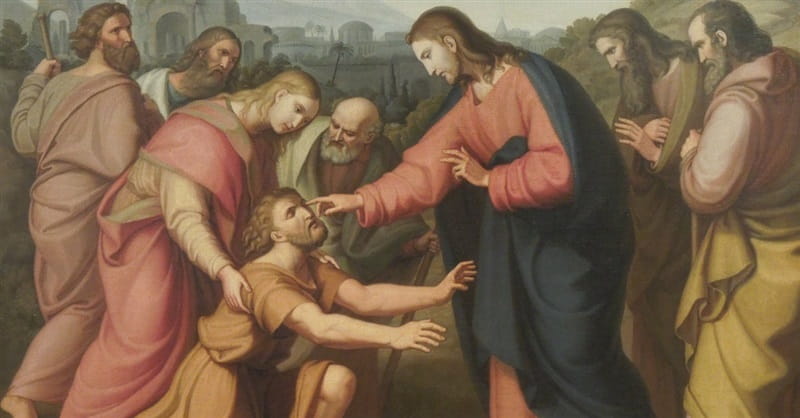
But his presence amidst the festive throng stirred their collective faith as never before. They sensed the anticipation. Surely, the long-awaited kingdom of God was at hand. On the final morning of their journey, as they left Jericho for the ascent to Jerusalem, their hopes were confirmed. To the astonishment of all, Jesus performed one of his greatest miracles. Mark’s gospel gives us the most lucid account:

As Jesus and his disciples, together with a large crowd, were leaving the city, a blind man, Bartimaeus (which means “son of Timaeus”), was sitting by the roadside begging.

When he heard that it was Jesus of Nazareth, he began to shout, “Jesus, Son of David, have mercy on me!”

Many rebuked him and told him to be quiet, but he shouted all the more, “Son of David, have mercy on me!”

Jesus stopped and said, “Call him.”

So they called to the blind man, “Cheer up! On your feet! He’s calling you.” Throwing his cloak aside, he jumped to his feet and came to Jesus.

“What do you want me to do for you?” Jesus asked
him.

The blind man said, “Rabbi, I want to see.”

“Go,” said Jesus, “your faith has healed you.” Immediately he received his sight and followed Jesus along the road. (Mark 10:46–52)

The effect that this demonstration of heaven-sent power had upon the crowd cannot be overestimated. This was divine confirmation. The Messiah had come—was walking among them now! Deliverance was at hand. Surely, Jesus was the promised son of David—the anointed one—the Christ.
Wikimediacommons

That morning Jesus did more than open the eyes of a beggar; he opened the eyes of the pilgrims to his divine call and mission. And as they continued their journey, that beggar, Bartimaeus, was walking, talking, living proof of the Messiah’s power. A blind beggar, healed and set free, embodied the Passover pilgrims’ hopes and dreams. They too could be set free from the bondage of Roman rule. Anything was possible. The kingdom of God was among them. The rightful king of the kingdom was walking the dusty road with them.

As they reached the outskirts of Jerusalem, the excitement built to a crescendo. Jesus climbed on the back of a commandeered donkey, and the crowd began to hail him as king. In doing this, he and his followers signaled that he was the coming Messiah-King, the Christ, spoken of in Old Testament prophecy ((Zechariah 9:9).

Many people spread their cloaks on the road, while others spread branches they had cut in the fields. Those who went ahead and those who followed shouted,

“Hosanna!”


“Blessed is he who comes in the name of the
Lord!”

“Blessed is the coming kingdom of our father David!”

“Hosanna in the highest heaven!” (Mark 11:8–10)
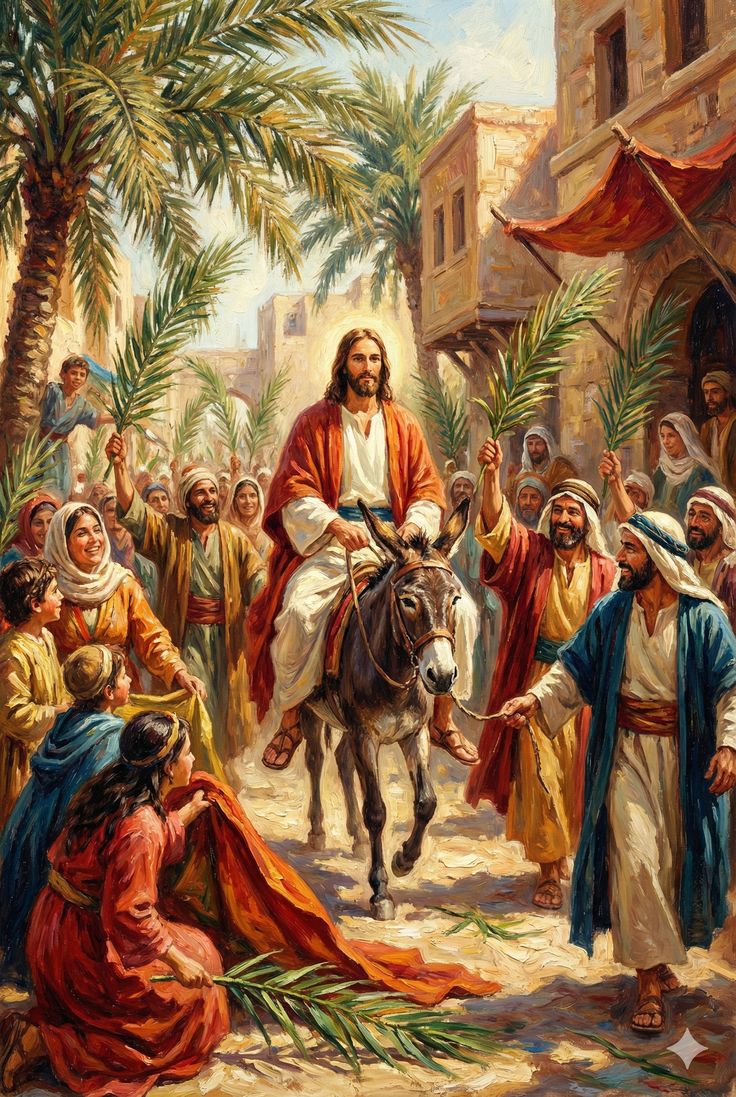
Mary’s heart must have swelled with pride as this image unfolded. Her firstborn was being hailed as king! Before her very eyes the words of the angel Gabriel—the words of the annunciation—were coming true.

He will be great and will be called the Son of the Most High. The Lord God will give him the throne of his father David, and he will reign over Jacob’s descendants forever; his kingdom will never end. (Luke 1:32–33)

Only Caiaphas, the high priest, and Pontius Pilate, the Roman governor, stood in the way. All too soon these aspirations of greatness came crashing down. The soft power of a spiritual kingdom collided with the brute force of Rome. Though this grand arrival set all of Jerusalem in a stir, Matthew 21:10–11, the powers that be were not about to surrender authority and control to a so-called prophet from Nazareth.

Upon his arrival Jesus launched a coup. But the coup was not against the Romans. Instead, it was against the temple authorities. Jesus set about cleansing the temple compound of marketers and moneychangers, and then he turned it into his center for healing and teaching. See Matthew 21:12–17. The high priestly clan would countenance none of this. The crafty Caiaphas plotted revenge. See John 11:47–53.

The week that began with a king on a donkey ended with a king on a cross.

For Mary the more ominous words of another prophet were about to come true. At the infant Jesus’ dedication in the temple, the prophet Simeon had said to Mary, “And a sword will pierce your own soul too” (Luke 2:35b). The cruelest cut was yet to come.

Sunday’s elation transitioned to midweek apprehension and finally Friday’s death and despair. An incomprehensible reversal—an unfathomable descent into hell—that’s what Mary experienced.

Her midmorning arrival at the foot of her son’s cross evokes a level of pathos that breaks the bounds of description.

Near the cross of Jesus stood his mother, his mother’s sister, Mary the wife of Clopas, and Mary Magdalene. When Jesus saw his mother there, and the disciple whom he loved standing nearby, he said to her, “Woman, here is your son,” and to the disciple, “Here is your mother.” From that time on, this disciple took her into his home. (John 19:25–27)

Jesus committed his mother into the care of John, his dearest disciple, “the disciple whom he loved.” This was the spoken will of a dying man, and according to the text above, Mary and John carried out Jesus’ will. Mary moved into John’s home.

This event raises a whole series of questions:

• Why would Jesus commit his mother into the care of his
disciple?

• Why would Mary agree to this new living arrangement?

• Where were Jesus’ brothers? Why are they not with their
mother at the foot of the cross?

• What was the motive and basis for this new living arrangement?

None of this makes sense unless there was a deep rift—an estrangement—between Jesus and his brothers. As we have already seen, such an estrangement was evident early on in Jesus’ ministry. His crucifixion brought this rift fully into the open. Here was the climax—the final cut. The family is torn asunder. As for Mary, she has irrevocably aligned herself with Jesus, her firstborn.

But where is James in all this? Where are the other half-brothers? It is unimaginable or highly unlikely that James was not present in Jerusalem for this Passover. The Passover was a family celebration, and with Joseph’s death, and Jesus’ abandonment or abdication of his family responsibilities, James was now the head of the home. Since we know Mary did not come to Jerusalem with Jesus and his apostolic band, we must conclude that she came with James. As the oldest son of Joseph, it was his responsibility to lead the family in the sacred celebration of deliverance from the bondage of Egypt through the blood of the Passover lamb.

It is reasonable to believe that while Jesus was celebrating his last Passover meal and instituting the communion sacrament with his spiritual family—his disciples in Jerusalem—James was leading the Passover celebration with Mary his mother and Jesus’ natural family members at another location in the city. The house of Joseph was divided.

James was not present at the communion table because clearly there was no spiritual union between him and Jesus. By instituting this sacrament Jesus established a link between his imminent death—as the paschal lamb offered up for the sins of the world—and the ancient Jewish Passover ritual. But there is a deeper meaning in this blood sacrifice that warrants further exploration.

Using the emblems of bread and wine, Jesus commanded his disciples to eat his body and drink his blood. Though his words should be interpreted figuratively or spiritually, (John 6:63) they nonetheless represent a drastic departure from orthodox Jewish teaching. Human sacrifice is universally condemned under the Old Covenant, and though the meat of the sacrificial animal or paschal lamb was consumed, by a direct command of God the blood must never be. “And wherever you live, you must not eat the blood of any bird or animal. Anyone who eats blood must be cut off from their people” (Leviticus 7:26–27).

The prohibition is sharp.

According to John’s Gospel, Jesus introduced this teaching about eating his body and drinking his blood in the town of Capernaum in Galilee, prior to instituting the sacrament at his last Passover in Jerusalem. Not surprisingly, his teaching was roundly rejected at that time.

Jesus said to them, “Very truly I tell you, unless you eat the flesh of the Son of Man and drink his blood, you have no life in you. Whoever eats my flesh and drinks my blood has eternal life, and I will raise them up at the last day. For my flesh is real food and my blood is real drink. Whoever eats my flesh and drinks my blood remains in me, and I in them. Just as the living Father sent me and I live because of the Father, so the one who feeds on me will live because of me. This is the bread that came down from heaven. Your ancestors ate manna and died, but whoever feeds on this bread will live forever.” He said this while teaching in the synagogue in Capernaum. (John 6:53–59)

The thought of eating human flesh and drinking human blood is disgusting, repulsive, and strictly forbidden in religious law. The response of the faithful in Capernaum should surprise no one. “On hearing it, many of his disciples said, ‘This is a hard teaching. Who can accept it?’” (John 6:60)

John goes on to report the effect that this teaching had on his followers. “From this time many of his disciples turned back and no longer followed him” (John 6:66).

The question that naturally springs to mind is: Why introduce such a disturbing teaching? Why attempt to overthrow centuries of religious law?

Clearly Jesus must have attached a great deal of significance to this doctrine. It was not peripheral; it was at the core of his teaching. Furthermore, it was at the core of his teaching because it was at the core of his being. It was about his DNA—divine eternal DNA being transferred to his followers. This is why Jesus says, “Whoever eats my flesh and drinks my blood remains in me, and I in them. Just as the living Father sent me and I live because of the Father, so the one who feeds on me will live because of me” (John 6:56–57).

Eternity was written into Christ’s DNA, and to have eternal life, his followers must have eternal DNA. Eternal DNA is found in the blood of Christ. That is why in the sacrament he offers his blood to his followers. In his blood is the life of God. In communion, on a symbolic spiritual level, we become partakers in the DNA of Christ.

To impart eternal life to his disciples, which is only available through his shed blood, Jesus overturns the centuries’ old Levitical prohibition against consuming blood:

For the life of a creature is in the blood, and I have given it to you to make atonement for yourselves on the altar; it is the blood that makes atonement for one’s life. (Leviticus 17:11)

Not only did Jesus’ followers need to partake in his divine DNA, but they also needed to be cleansed by and forgiven through the sacrifice of his body. His shed blood atones for their sins, making them acceptable to God their Father. The writer of the Book of Hebrews makes this concept clear when he states, “In fact, the law requires that nearly everything be cleansed with blood, and without the shedding of blood there is no forgiveness” (Hebrews 9:21–23).

Forgiveness and eternal life are available now through the body and blood of Christ for all who believe. But at this point in our narrative James does not believe. He stands outside the family of God as described by his half-brother, the Lamb of God. James has not experienced a spiritual rebirth. To him this talk of consuming his brother’s flesh and blood is the gibberish of a madman—or worse yet, highhanded blasphemy.

While Jesus instituted the holy sacrament, James, the firstborn son of Joseph, celebrated the Jewish Passover in the traditional way. As a dutiful mother and the family matriarch, Mary would be present with James. But her heart was with Jesus—her firstborn. After all, this memorial celebration was all about the firstborn who was protected from the Angel of Death by the blood of the Passover lamb.

Photo by Kat Smith on Pexels.com

The spiritual family and the natural family of Jesus celebrated the Passover in strikingly different ways. For the most part, this is a difference that continues to this day, as Passover and the celebration of the Eucharist mark the dividing line between the Jewish and Christian faith.

The very next morning, though James was present in the city, he refused to come with his mother to the foot of the cross. As his half-brother Jesus, the Lamb of God, hung dying, James would not climb the hill of Golgotha to bid him farewell. That is how intense the animosity he felt toward Jesus was. James shunned and despised Jesus in the moment of his greatest suffering—in the moment of his death.

Undoubtedly, before Mary arrived at the foot of the cross, there was an intense and heated conversation between her and James. This conversation is not recorded in scripture; it happened off-camera, so to speak. But it’s not difficult to imagine the issues at play.

Mary is caught in the jaws of this horrific turn of events. Mary’s soaring hopes and dreams for her messianic son have come crashing to the ground. Her faith is shattered. Heaven’s promise has turned into hell—an intensely personal hell. In her grief, her only thought is to spend a few final minutes with the child she bore, the child she nursed and loved—the son of her most cherished dreams.

James on the other hand is seized with a mixture of anguish and rage. He sees his brother’s crucifixion as a natural consequence flowing from the words and actions of a dangerously deluded mind. He had tried to put an end to this messianic delusion—to take charge of his brother early in his ministry—all to no avail (Mark 3:20–35). Now his worst nightmare has come to pass. And what had all this talk of the kingdom of God accomplished? It led directly to death on a Roman cross—an outcome that was entirely predictable. Wasn’t this the reason he tried to take charge of Jesus? But the deluded fool would have none of it. He refused to listen to his family and the voice of reason.

As seen through the eyes of James, the sins of Jesus were numerous and stunningly heinous. He abandoned his family responsibilities. He rejected the wise counsel of his family members; in fact, he rejected his entire family (Mark 3:33–35). From the earliest days of his ministry, Jesus was a deranged rebel, who opposed the highest religious authorities in the land (Mark 3:22). Furthermore, he had the audacity to take his opposition to authority to the highest level. He denounced the strict and pious Pharisees, men whose legal scruples James admired. But not content with mocking the religious establishment from the sidelines, Jesus invaded the temple courts with his deluded hordes and challenged the authority of the high priest in his own precinct. Is it any wonder that Caiaphas reacted as he did?

But here is the most grievous of all his transgressions. Jesus had delusions of grandeur—of Deity. How could James’ brother—his flesh and blood brother—be God? Deity come in the flesh? Preposterous! Such an idea was beyond scandalous. It was the height of blasphemy. And James was proven right in this assessment when the Jewish high council, the Sanhedrin, reached its verdict in Jesus’ trial (Mark 14:61b–64).

What might James have thought at this moment? Death on a cross was too kind an outcome for such a fool—such a bastard!

And now Mary, the mother of this bastard—yes, and his own mother too—wants to say farewell to her bastard. Well, let her go. She was the mother of this bastard, and for reasons that totally confounded James, she had urged Jesus on in this course of action—this blasphemous folly to the shame and disgrace of the entire family.

Let her go. Let her go crying to her humiliated, bastard son. Wasn’t she the mother of this catastrophe—this affront to the Jewish faith? She was the source and the root cause of all the dissension in the family. From the moment of Jesus’ conception to this very instant, Mary had brought disrepute and an immeasurable dishonour to the house of Joseph.

Let the b*tch go to her bastard now, he must have thought. (I derive no pleasure in using these derogatory terms. Strong, insulting language is used here to signal the complete breakdown of the family relationship.) But in all likelihood, James also let Mary know that if she went to see Jesus, she was unwelcome in his home. If she went crying to him—if she sided with him—she too was an outcast.

This is a look into the mind of James on the day Jesus died.

Photo by Pixabay on Pexels.com

Well, Mary made her decision. She walked to the foot of the cross. But she did not come forward alone. She came with other believers, her sister, “Mary the wife of Clopas, and Mary Magdalene.” See John 19:25. At last Mary has fully entered the circle of Jesus followers. She made a courageous and conscientious decision to associate herself with the family of God. She aligned herself with her firstborn.

Why did Jesus commit his mother into John’s care? Without this background, this decision makes no sense because Mary has four remaining sons—and daughters, as well. According to rabbinical law and practice, the oldest son was required to be her provider in her declining years as a widow. The decision to commit Mary to John’s care only makes sense in view of the scenario that has just been described. Mary needs a new home and a new family because she has been rejected by her remaining children, her own flesh and blood.

Mary stood before Jesus as a homeless widow without a family. She is not an orphan in the traditional sense of the word, but with the death of Jesus, she will become an orphan from her natural family. Therefore, Jesus entrusts her into John’s care.

With her arrival at the cross, Mary has taken on a new identity in the fullest sense imaginable, even as Jesus did when he was baptized. She has left the household of Joseph and joined the household of God. She will be forever known as the mother of the Son of God.

Jesus would not leave his mother in the care of an unbeliever, so he entrusted her to John, his dearest disciple.

There is a profound spiritual dynamic at work here. Jesus is signaling to all that spiritual birth takes precedence over natural birth. In his eternal kingdom, the spiritual family and spiritual DNA trump the natural family and natural DNA.

For Mary this was the final cut. She was cut off from her natural family and grafted into the family tree of God.


New from David Kitz

James—the brother of Jesus—who was this man? What evidence do we have that this “brother of our Lord” even existed?

David Kitz digs deep into archeology, family dynamics, church history, and the biblical texts. What emerges from his research is a portrait of a decisive, pivotal leader who embodied the will and character of Jesus Christ.

But how did James—James the unbeliever—transform to become a leader who changed the course of world history? In these pages you will uncover the answer and rediscover for yourself the life-changing power of the gospel.

To view further details or purchase directly from the author click here.

 

The Role of James

22 Sunday Mar 2026

Posted by davidkitz in Books by David Kitz

≈ 4 Comments

Tags

baptism of Jesus, born again, born of God, children of God, God's family, insane, James, James the brother of Jesus, Jesus, Jesus' family, Joseph, Mary and Joseph, Messiah, Nazareth, Scripture

James: the Lynchpin of Our Faith — Chapter 6

The dominant role that James played in the development of the rift between Jesus and the other members of the family should not be underestimated. With the death of Joseph, Jesus should have become the de facto head of the family. Being the firstborn son held great significance in the Jewish culture of that time, and with it came a number of responsibilities and privileges. The role of chief provider and final authority in family matters was certainly part of the package. Some of these responsibilities were cultural expectations, but others were actual requirements in the oral tradition, which later became Talmudic law.

Now here is the unenviable position that Jesus finds himself in. He is the firstborn, but he is not the son of Joseph. To use the colloquial term, he is the bastard son of another man—or so it would seem. Certainly, this is how the community would likely see him.

In a tight-knit, semi-rural community, it is reasonable to believe that from the moment of Mary’s initial pregnancy, there were whispers and hints of juicy gossip. Mary and Joseph were not living together. How did she get pregnant? Was this baby really Joseph’s son? As the child grew, in all likelihood it became evident from Jesus’ appearance that he was not Joseph’s boy. The local wags probably had great sport debating who the real father was.

Country road home — photo by David Kitz

To the natural mind, Mary’s tale of the visit from the angel Gabriel and conception by the Holy Spirit makes little logical sense. It is highly unlikely that she repeated this story to anyone except Joseph and perhaps her parents. Why say anything to anyone else? Why invite open ridicule from other family members, her friends and her neighbours? Let them think what they will. She knew the secret of Jesus conception: a secret it would remain. From Luke’s account of the lost boy Jesus in the temple courts, it is apparent that she did not even tell her son of his divine origin. It was left up to him to discover the identity of his true Father.

As for James and his younger brothers, as discussed earlier, they either discerned independently that Jesus was somehow different—not fully one of them—or they heard it from their neighbours and friends. They even may have heard it from Jesus himself. He was not shy in identifying himself as God’s son in the temple courts at age twelve. It is possible that young James and his brothers overheard Jesus’ response to his parents at that time, though they may not have originally understood the meaning and implications of his words. He may also have spoken with them about the identity of his real Father on other occasions, occasions not recorded in scripture, just as the patriarch Joseph revealed his divine destiny to his incredulous brothers (Genesis 37:5–11).

Finally, Jesus’ keen intellect, his love for the sacred scriptures and his general conduct surely set him apart from the other teens and young men in Nazareth. However, being different does not necessarily correspond with being accepted or popular among your peers. As pointed out earlier, Jesus’ ministry at the local synagogue was greeted with skepticism and open hostility by the townspeople (Mark 6:1–6, Luke 4:16–30). Additionally, his brothers did not believe in him. Though Jesus attracted many followers, many disciples—other young men like themselves—not one of his younger brothers are numbered among the apostolic band. As we have already witnessed, the relationship between them was tense and poisoned.

Without question, the death of Joseph must have raised several thorny issues. Did James recognize Jesus as the new head of the home? If Jesus was not the son of Joseph, then the privileges and responsibilities of headship should legitimately fall to James, Joseph’s firstborn—not to Jesus. For this reason, did the local religious community recognize James in the leadership role? Or did they recognize Jesus as the head of the household? Authorities in the local synagogue may well have had a say in this matter.

Photo by Vlad Cheu021ban on Pexels.com

Primogeniture also affected the family inheritance. Who was rightfully the firstborn in this case? And what role, if any, did Mary play in all this? Was she simply a bystander while the male members of the family and the synagogue rulers sorted out these matters?

Though Jesus’ half-brothers did not believe in him, without a doubt his mother did. She knew and experienced the miraculous nature of his conception and birth. She marvelled at the prophetic words spoken over Jesus at his dedication in the temple (Luke 2:22–38). We are told that “Mary treasured up all these things and pondered them in her heart” (Luke 2:19). In addition, her words of concern prompted Jesus to perform the first miracle of his public ministry, as he turned water into wine (John 2:1–11). It is abundantly clear from the gospel accounts that Mary believedin the divinity of her firstborn. Undoubtedly, after the death of her husband, she found herself caught in the middle between her two strong-willed sons, Jesus and James.

To the present-day postmodern, the issue of primogeniture may seem to be socially insignificant, but this was of great significance to the society of this period. Even if there were strong amicable relations between these two brothers, this would still be a very trying question. If there existed the slightest hint of rivalry, unresolved grievances, or a competitive spirit, these issues could quickly turn into strife and bitter malice. It is reasonable to speculate that they did.

The Bible is largely silent on these matters. We have no indication as to when or how Joseph died. We catch only a few glimpses of the dynamics among the now full-grown members of the family, but the picture that emerges is rather disturbing. During the time of Jesus’ ministry, this appears to have been a household that is dysfunctional and deeply divided.

Did Jesus even want to be recognized as the head of Joseph’s home? Perhaps it was a responsibility that fell to him, but he did not want to bear it, since, according to his genetic code, he knew it was a role that was not rightfully his. Perhaps he took on the headship role through a sense of duty, but at every turn he faced resistance and resentment from his half-brothers.

James the oldest son of Joseph would have led this resistance, and an ambitious James may have been willing and eager to usurp Jesus’ authority. After all, he saw the leadership role as lawfully his. There were ample grounds for rancorous contention in this family, and by stitching together what we can discern from the gospel accounts, division and tension were clearly present as outlined below:

• When Jesus left the family home to be baptized by John, his
departure may have served partially as an escape from a poisoned
home environment. Forty days of fasting in the desert may have
been preferable to the ongoing rancour in Nazareth.

• This much we can ascertain from the gospel accounts: by
the time of the rupture in family relations recorded in Mark 3:20–35,
James is firmly in charge of the household.

• As the eldest son of Joseph, he is chief among the brotherhood
of unbelievers that make up his family as recorded in John 7:1–13.

• In consultation with his brothers, he has determined that Jesus
“Is out of his mind” (Mark 3: 21).

• He has organized a family expedition to take charge of his
deranged half-brother.

• Despite his best efforts, he has failed to make Jesus see the
error of his ways or regain control of what he likely sees as
a dangerous and irrational member of his household (Mark 3:31-35).

The half-brothers part ways. In the synoptic gospels this is their last recorded meeting before Jesus’ death.

For Jesus this rupture in relations means liberty. He is no longer answerable to James for his life and conduct. He is accountable only to God. From the time of his baptism by John, Jesus has extricated himself from the oppressive confines of his brother’s household. He is no longer the carpenter’s son. He has discovered his true identity as the Son of God, and now at age thirty, for the first time in his life, he is able to freely walk out the full meaning of that identity.

In the same way, Jesus called on his disciples to abandon all, including family, and come and follow him in a radical new way of life. (See Luke 14:25–27.) He is the Son of God. This truth becomes the central theme—the very core—of his teaching. His followers are children of God. He teaches them to pray to their heavenly Father. The fatherhood of God is at the heart of his message to the people. In the gospels, Jesus only directly addresses God by the name of ‘father’ or even ‘abba’ (daddy) except when quoting scripture.

As cited earlier, when he is called to see his mother and brothers outside the home where he is teaching, he answered,

“Who are my mother and my brothers?”

Then he looked at those seated in a circle around him and said, “Here are my mother and my brothers! Whoever does God’s will is my brother and sister and mother.” (Mark 3:31–35)

Please note Jesus does not say, “Whoever does God’s will is my brother and sister and mother and father.”

The father figure appears to be missing in this happy family circle. Or is he? For Jesus, his father is God, and his heavenly Father oversees this—his spiritual family gathered before him. His followers are his family.

The fatherhood of God is so central to Jesus that he later instructs his disciples with these words:

But you are not to be called ‘Rabbi,’ for you have one Teacher, and you are all brothers. And do not call anyone on earth ‘father,’ for you have one Father, and he is in heaven. Nor are you to be called instructors, for you have one Instructor, the Messiah. (Matthew 23:8–10)

Indeed, according to Jesus’ radical new teaching, entrance into the kingdom of God is only possible through spiritual rebirth. Natural birth is insufficient. God must become your Father through the inner working of the Holy Spirit. His conversation with the Pharisee Nicodemus
makes this point clear:

He came to Jesus at night and said, “Rabbi, we know that you are a teacher who has come from God. For no one could perform the signs you are doing if God were not with him.”

Jesus replied, “Very truly I tell you, no one can see the kingdom of God unless they are born again.”

“How can someone be born when they are old?” Nicodemus asked. “Surely they cannot enter a second time into their mother’s womb to be born!”

Jesus answered, “Very truly I tell you, no one can enter the kingdom of God unless they are born of water and the Spirit. Flesh gives birth to flesh, but the Spirit gives birth to spirit. You should not be surprised at my saying, ‘You must be born again.’” (John 3:2–7)

Citizenship in the heavenly kingdom is only conferred on those who are born of the Spirit through faith. Jesus made his own conception by the Holy Spirit the blueprint for his followers. They too must become living repositories of divine DNA. They too, by the process of spiritual rebirth, must become children of the heavenly Father. Baptism by immersion came to symbolize this inner transformation—this spiritual rebirth.

In his introductory remarks on the ministry of Jesus, John gives us further insight into this new creation—this new birth into the family of God:

He [Jesus] came to that which was his own, but his own did not receive him. Yet to all who did receive him, to those who believed in his name, he gave the right to become children of God—children born not of natural descent, nor of human decision or a husband’s will, but born of God. (John 1:11–13)

Though Jesus was rejected by members of his own family as insane, he started a new spiritual family, a family born of God. Within that spiritual family he found a love and acceptance that superseded that of his brothers and sisters by birth. The importance of family by natural descent was replaced by the importance of spiritual rebirth. This was a radically new family—God’s family.

We can easily underestimate the dramatic shift in thinking that this required of his followers. Approaching God as a loving Father was a truly revolutionary concept. The Jewish God was austere, stern, distant and demanding; or so it was thought. But Jesus, God’s son, presented a totally different view of Him. He saw a caring Father who was as close as a whispered prayer—as near as our next breath. In the Old Testament the dominant metaphor for God is king—the ultimate ruler; in the gospels it is father—a family member.

Jesus’ Sermon on the Mount presents us with a compassionate God who truly cares about his people:

Look at the birds of the air; they do not sow or reap or store away in barns, and yet your heavenly Father feeds them. Are you not much more valuable than they? Can any one of you by worrying add a single hour to your life?

And why do you worry about clothes? See how the flowers of the field grow. They do not labor or spin. Yet I tell you that not even Solomon in all his splendor was dressed like one of these. If that is how God clothes the grass of the field, which is here today and tomorrow is thrown into the fire, will he not much more clothe you—you of little faith? So do not worry, saying, ‘What shall we eat?’ or ‘What shall we drink?’ or ‘What shall we wear?’ For the pagans run after all these things, and your heavenly Father knows that you need them. But seek first his kingdom and his righteousness, and all these things will be given to you as well. Therefore do not worry about tomorrow, for tomorrow will worry about itself. Each day has enough trouble of its own. (Matthew 6:26–34)

The contemporary teachers of the law were all about the outward observance of the rules and strict adherence to the rigours of the written code. This was a tightly controlled and religiously regimented society. In this stifling social atmosphere, the message that Jesus brought was like a breath of fresh air. God was not an uptight, omniscient slave master. He was actually a loving heavenly Father, who provided for his children’s needs.

It should come as no surprise then that people flocked to his teaching.

The implications of spiritual rebirth—this born-again experience—cannot be overstated. In a society where the family unit was all-important, this was a dramatic departure from the norm. The Jewish faith was and is rooted in the family from its very inception, beginning with the family of Abraham. Your place within the faith is based on heredity and lineage. You are a Jew because you were born a Jew—because your parents are Jewish, you can trace back your lineage to Abraham.

Furthermore, this is a closed tribal system. Entrance into the faith, with very few exceptions, is exclusively by birth. God’s chosen people are chosen by birth. According to accepted Jewish teaching of the time, God has no adopted children. You must be born into the faith. Jews saw (and continue to see) themselves as heirs to the covenant God made first with Abraham, then with Moses, and then the children of Israel. But Jesus was describing a new, more direct way of relating to God.

The only way for a male outsider to enter this closed religious system was by a dramatic, painful and even dangerous outward physical change—circumcision. A woman’s only portal into the faith was through her husband or father.

Jesus’ teaching on entrance into the kingdom of God through spiritual rebirth threw this entire religious system into disarray. It began with the repentance call of John the Baptist:

John said to the crowds coming out to be baptized by him, “You brood of vipers! Who warned you to flee from the coming wrath? Produce fruit in keeping with repentance. And do not begin to say to yourselves, ‘We have Abraham as our father.’ For I tell you that out of these stones God can raise up children for Abraham. The ax is already at the root of the trees, and every tree that does not produce good fruit will be cut down and thrown into the fire.” (Luke 3:7–9)

The Jewish leadership rejected John’s message of repentance and baptism even as they later rejected the message of rebirth as preached by Jesus. They needed no repentance; they were children of Abraham. Their lineage alone guaranteed them a place in the kingdom of God, or so they thought. Jesus did not hesitate to prick their self-righteous balloon:

To the Jews who had believed him, Jesus said, “If you hold to my teaching, you are really my disciples. Then you will know the truth, and the truth will set you free.”

They answered him, “We are Abraham’s descendants and have never been slaves of anyone. How can you say that we shall be set free?”

Jesus replied, “Very truly I tell you, everyone who sins is a slave to sin. Now a slave has no permanent place in the family, but a son belongs to it forever. So if the Son sets you free, you will be free indeed. I know that you are Abraham’s descendants. Yet you are looking for a way to kill me, because you have no room for my word. I am telling you what I have seen in the Father’s presence, and you are doing what you have heard from your father.”

“Abraham is our father,” they answered.

“If you were Abraham’s children,” said Jesus, “then you would do what Abraham did. As it is, you are looking for a way to kill me, a man who has told you the truth that I heard from God. Abraham did not do such things. You are doing the works of your own father.”

“We are not illegitimate children,” they protested. “The only Father we have is God himself.”

Jesus said to them, “If God were your Father, you would love me, for I have come here from God. I have not come on my own; God sent me. Why is my language not clear to you? Because you are unable to hear what I say. You belong to your father, the devil, and you want to carry out your father’s desires. He was a murderer from the beginning, not holding to the truth, for there is no truth in him. When he lies, he speaks his native language, for he is a liar and the father of lies. Yet because I tell the truth, you do not believe me! Can any of you prove me guilty of sin? If I am telling the truth, why don’t you believe me? Whoever belongs to God hears what God says. The reason you do not hear is that you do not belong to God.” (John 8:31–47)

Jesus looked beyond the outward and physical into the heart. (See Matthew 15:10–20). The human heart needs to be cleansed through repentance, and the human spirit, dead in sin, needs to be born again by faith through the Holy Spirit. This teaching was completely contrary to the outward religious standard of the times. For many, religion was merely an ongoing parade of hypocrisy. It was a public show one engaged in for the sake of appearance, but Jesus continually cut through the religious clutter to get to the heart. In his sermon on the mount, Jesus pointed out this hypocrisy and called for a genuine change of heart. (See Matthew 6:1–18).

Furthermore, Jesus allowed no place for middle ground. You align yourself either for or against him. In that respect he was and is a highly divisive figure. In the discourse cited above, Jesus essentially called his detractors sons of the devil. They in turn thought the same of him:

The Jews answered him, “Aren’t we right in saying that you are a Samaritan and demon-possessed?” (John 8:48)

This was an insult of the highest order, but Jesus did not back down. In fact, he upped the ante. He closed off this heated discussion in the temple courts by claiming to be God:

“Very truly I tell you,” Jesus answered, “before Abraham was born, I am!” At this, they picked up stones to stone him, but Jesus hid himself, slipping away from the temple grounds. (John 8:58–59)

He did not say, “Before Abraham was born, I was.” Jesus said, “Before Abraham was born, I am.” In so doing, he identified himself as Deity, the pre-existent one, the creator of the universe and the great “I am” of the Hebrew covenant. (See Exodus 3:14.)

To his listeners, this was blasphemy of the highest order. One should not be surprised that they tried to stone him. These are not the words of someone whom society would consider normal. They resembled the ravings of a madman.

So, then it would appear that James was right. His older brother was “out of his mind” (Mark 4:21). Here in Jesus’ own words, we have the text that proves that James was right in trying to prevent his brother from propagating this lunacy—this heresy—this fanatical teaching. Jesus claimed to be God. There can be no doubt that James believed Jesus would bring disgrace upon the whole family. This is why James distanced himself from his older brother. Undoubtedly, James also used his influence to prevent the other family members from falling under the spell of his brother, the deluded heretic.

As for Jesus, having left his natural family, he founded his own spiritual family of followers. From these he demanded absolute personal loyalty:

Do not suppose that I have come to bring peace to the earth. I did not come to bring peace, but a sword. For I have come to turn

‘a man against his father, a daughter against her mother,
a daughter-in-law against her mother-inlaw—
a man’s enemies will be the members of his own household.’

Anyone who loves their father or mother more than me is not worthy of me; anyone who loves their son or daughter more than me is not worthy of me. Whoever does not take up their cross and follow me is not worthy of me. Whoever finds their life will lose it, and whoever loses their life for my sake will find it. (Matthew 10:34–39)

Membership in Jesus’ family of born-again believers required absolute commitment—a commitment that superseded one’s commitment to flesh and blood family members. The cost of true discipleship was high, and it remains high today.

But Jesus was not asking his disciples to do anything that he did not ask of himself. His own household was divided and hostile to his mission. In a very real sense, his statement simply reflects the strife and division Jesus experienced within his family. He faced extreme opposition from his own family, and he anticipated that his disciples would face the same level of hostility as they chose to wholeheartedly follow him. Many believers throughout history and even today face severe opposition from family members as they seek to follow Jesus. Some have paid the ultimate price as martyrs at the hands of enraged family members.

Yes, Jesus came to bring a sword. He divided the Jewish nation, and he divided his family. The number of his f ollowers—his spiritual family—was growing, but so too was the opposition to his ministry.

Soon Mary would feel the soul-piercing power of the sword. This was the sword that the prophet Simeon spoke of during Jesus’ dedication as an infant in the temple many years earlier.

Then Simeon blessed them and said to Mary, his mother: “This child is destined to cause the falling and rising of many in Israel, and to be a sign that will be spoken against, so that the thoughts of many hearts will be revealed. And a sword will pierce your own soul too.” (Luke 2:34)


New from David Kitz

James—the brother of Jesus—who was this man? What evidence do we have that this “brother of our Lord” even existed?

David Kitz digs deep into archeology, family dynamics, church history, and the biblical texts. What emerges from his research is a portrait of a decisive, pivotal leader who embodied the will and character of Jesus Christ.

But how did James—James the unbeliever—transform to become a leader who changed the course of world history? In these pages you will uncover the answer and rediscover for yourself the life-changing power of the gospel.

To view further details or purchase directly from the author click here.

 

Now We Are Children of God

26 Thursday Feb 2026

Posted by davidkitz in Psalm 38, Psalms

≈ 7 Comments

Tags

children of God, Christ, faith, forgiveness, God's love, Prayer, Psalms, pure, purify, the LORD, trust in God

Today’s quote and prayer from
“Psalms 365: Develop a Life of Worship and Prayer


Today’s
Reading: Psalm 38:9-16

Listen to today’s reading by Jonathan Dent:

https://davidkitz.blog/wp-content/uploads/2026/02/ps-389-16-mix4final.mp3

LORD God,
speak to me when I am downcast.
Lift me when I am in need.
Forgive me when I fail.
You are my help and my strength.
LORD, I wait for you;
you will answer,
LORD my God.

Amen.

     — — — —

Rideau Canal, Ottawa, ON


Children of God

 See what great love
the Father has lavished on us,
that we should be called children of God!
And that is what we are!
The reason the world does not know us
is that it did not know him.
 
Dear friends,
now we are children of God,
and what we will be
has not yet been made known.
But we know that when Christ appears,
we shall be like him,
for we shall see him as he is.
 
All who have this hope in him purify themselves,
just as he is pure.

(
1 John 3:1-3 NIV)*


Whoever does not love does not know God,
because God is love (1 John 4:8 NIV)

Para la publicación de Salmos 365 de hoy en español haga clic aquí.

bgbg_v4.3_1501818
* NEW INTERNATIONAL VERSION, COPYRIGHT ©1973, 1978, 1984, 2011 BY BIBLICA

Pray for enduring peace in Israel and Gaza,
and continue to pray for peace to return to Ukraine and Russia!

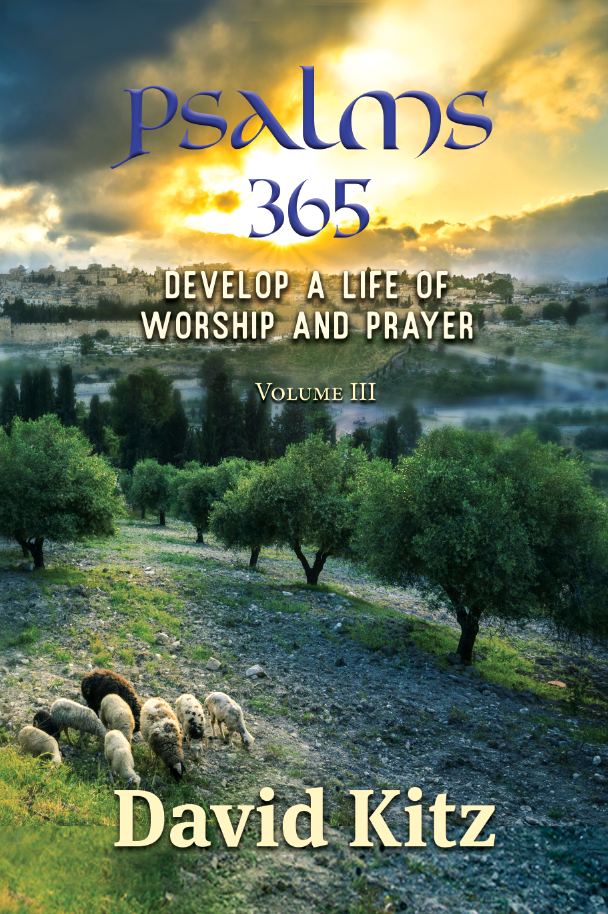
Volume I of Psalms 365: Develop a Life of Worship and Prayer won the Best Book of the Year Award from The Word Guild and Volume II has won the Best Devotional of the Year Award. For those who love God’s word, this three-book series is an ideal way to daily meet with the Lord. To purchase or for a closer look click here.

Also available from David KitzIs a return-to-Jesus revival possible in our time?
This book points the way forward.
For details click here.

Doing the Harder Thing

09 Monday Feb 2026

Posted by davidkitz in Psalm 35, Psalms

≈ Leave a comment

Tags

blessed, bridge builder, children of God, God's wrath, peacemaker, Prayer, Psalms, revenge, the LORD

Today’s quote and prayer from
“Psalms 365: Develop a Life of Worship and Prayer

 Today’s Reading: Psalm 35:22-25

Listen to today’s reading by Jonathan Dent:

https://davidkitz.blog/wp-content/uploads/2026/02/ps-3522-25-mixfinal.mp3

Blessed are the peacemakers,
for they will be called children of God
(Matthew 5:9).
LORD God,
help me to be a local peacemaker in my world today—
someone who builds bridges
between people and communities.
Amen.

     — — — —

Koranke, Japan — a place of peace — photo by David Kitz


Kindness or Revenge

Do not repay anyone evil for evil.
Be careful to do what is right
in the eyes of everyone.
 
If it is possible,
as far as it depends on you,
live at peace with everyone.

Do not take revenge, my dear friends,
but leave room for God’s wrath,
for it is written:
“It is mine to avenge;
I will repay,” says the Lord.
 
On the contrary:


“If your enemy is hungry, feed him;
    if he is thirsty, give him something to drink.
In doing this,
you will heap burning coals on his head.”

Do not be overcome by evil,
but overcome evil with good.
(Romans 12:17-21 NIV)*


Whoever does not love does not know God,
because God is love (1 John 4:8 NIV)

Para la publicación de Salmos 365 de hoy en español haga clic aquí.

bgbg_v4.3_1501818
* NEW INTERNATIONAL VERSION, COPYRIGHT ©1973, 1978, 1984, 2011 BY BIBLICA

Pray for enduring peace in Israel and Gaza,
and continue to pray for peace to return to Ukraine and Russia!

Volume I of Psalms 365: Develop a Life of Worship and Prayer won the Best Book of the Year Award from The Word Guild and Volume II has won the Best Devotional of the Year Award. For those who love God’s word, this three-book series is an ideal way to daily meet with the Lord. To purchase or for a closer look click here.

Also available from David KitzIs a return-to-Jesus revival possible in our time?
This book points the way forward.
For details click here.

Becoming a Child of God

15 Friday Aug 2025

Posted by davidkitz in Psalm 134

≈ 1 Comment

Tags

Bible, born of God, children of God, Father God, Heavenly Father, Holy Spirit, Jesus, Prayer, Psalms, redemption

Today’s quote and prayer from
“Psalms 365: Develop a Life of Worship and Prayer”
by David Kitz

Reading: Psalm 134

Father God,
I thank you for loving me
and inviting me into your family.
Lord Jesus,
thank you for purchasing my redemption.
Holy Spirit,
I thank you for the confirmation
that I am your child.
Amen.

— — — —

The true light that gives light
to everyone was coming into the world.
 
He was in the world,
and though the world was made through him,
the world did not recognize him.
He came to that which was his own,
but his own did not receive him.
 
Yet to all who did receive him,
to those who believed in his name,
he gave the right to become children of God—
 
children born not of natural descent,
nor of human decision
or a husband’s will,
but born of God.
(John 1:9-13 NIV)*

Para la publicación de Salmos 365 de hoy en español haga clic aquí.

bgbg_v4.3_1501818
* NEW INTERNATIONAL VERSION, COPYRIGHT ©1973, 1978, 1984, 2011 BY BIBLICA

Please pray for peace to return to Israel, Gaza, Iran, and Ukraine!

Volume I of Psalms 365: Develop a Life of Worship and Prayer won the Best Book of the Year Award from The Word Guild and Volume II has won the Best Devotional of the Year Award. For those who love God’s word, this three-book series is an ideal way to daily meet with the Lord. To purchase or for a closer look click here.

A gripping read from David Kitz.
Is a return-to-Jesus revival possible in our time?
This book points the way forward.

Enduring Hardship as Discipline

26 Wednesday Mar 2025

Posted by davidkitz in Psalm 94, Psalms

≈ Leave a comment

Tags

Bible, children of God, discipline, God, hardship, Jesus, Prayer, Psalms, the LORD

Today’s quote and prayer from
“Psalms 365: Develop a Life of Worship and Prayer”
by David Kitz.

 Reading: Psalm 94:8-15

LORD God,
I confess that I need your discipline.
I want to become like your Son, Jesus.
Help me to learn
from the difficult experiences of life.
I want to live my life
as your obedient child.

Amen.

— — —

“My son, do not make light of the Lord’s discipline,
    and do not lose heart when he rebukes you,
because the Lord disciplines the one he loves,
    and he chastens everyone he accepts as his son.

Endure hardship as discipline;
God is treating you as his children.
For what children are not disciplined by their father?
 
If you are not disciplined—
and everyone undergoes discipline—
then you are not legitimate,
not true sons and daughters at all.
(Hebrews 12:5-8, NIV)*

Para la publicación de Salmos 365 de hoy en español haga clic aquí.

bgbg_v4.3_1501818
* NEW INTERNATIONAL VERSION, COPYRIGHT ©1973, 1978, 1984, 2011 BY BIBLICA

Please pray for peace to return to Israel, Gaza, and Ukraine!

New from David Kitz
Winner of the 2024 Word Award of Merit in Biblical Studies
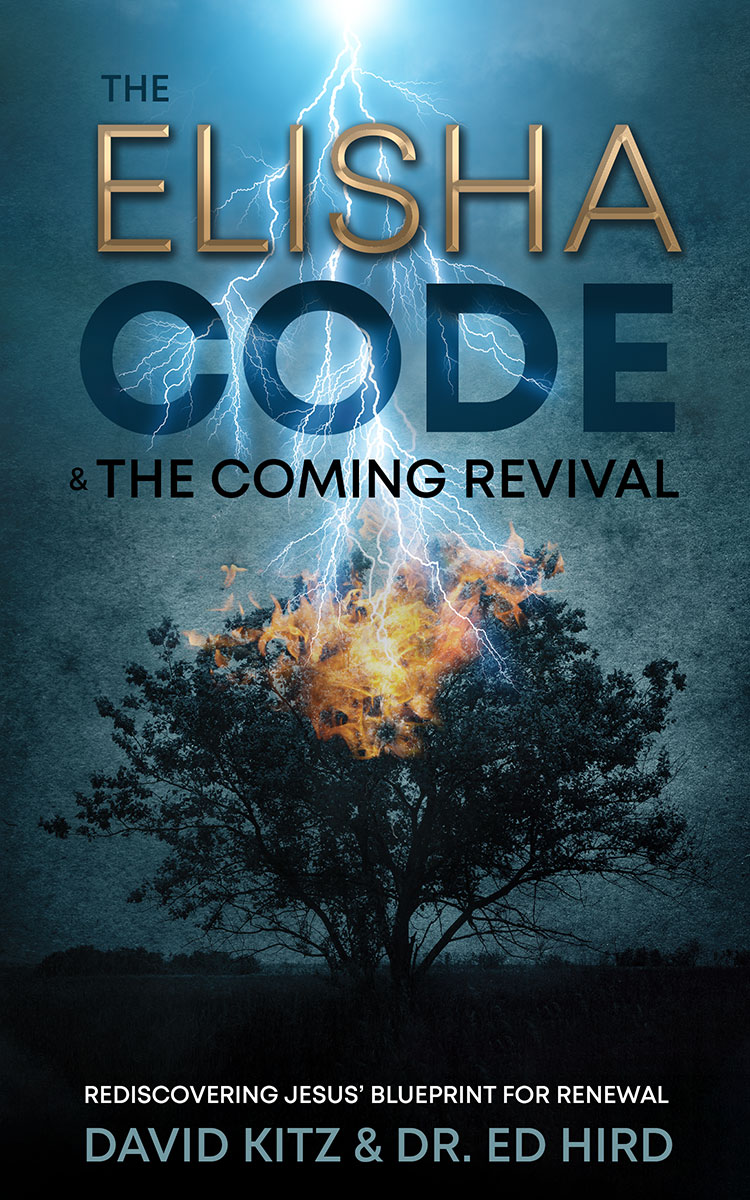
TheElishaCodeCVR5

To purchase or for a closer look click here.

Volume I of Psalms 365: Develop a Life of Worship and Prayer won the Best Book of the Year Award from The Word Guild and Volume II has won the Best Devotional of the Year Award. For those who love God’s word, this three-book series is an ideal way to daily meet with the Lord. To purchase or for a closer look click here.

This biblically accurate novel is ideal for the Lent/Easter season.
For details click here.

A Prayer for Peace

26 Tuesday Nov 2024

Posted by davidkitz in Psalm 58, Psalms

≈ 3 Comments

Tags

children of God, Gaza, Israel, Jesus, Lebanon, Palestine, peacemakers, Prayer, Prince of Peace, Psalms, Ukraine

Today’s quote and prayer from
“Psalms 365: Develop a Life of Worship and Prayer”
by David Kitz.Psalm 58 -365

Reading: Psalm 58

LORD God,
we pray for peace to return to Ukraine and Russia.
We ask for peacemakers to come to the fore
in the war raging in Israel, Gaza, Palestine, and Lebanon.
Jesus, you are the Prince of Peace. 

Come reign in our hearts 
and our troubled world.
Amen.

— — —

Blessed are the peacemakers,
    for they will be called children of God.
Blessed are those who are persecuted
because of righteousness,

    for theirs is the kingdom of heaven.
(Matthew 5:9-10)*

Para la publicación de Salmos 365 de hoy en español haga clic aquí.

bgbg_v4.3_1501818
* NEW INTERNATIONAL VERSION, COPYRIGHT ©1973, 1978, 1984, 2011 BY BIBLICA

Please pray for peace to return to Israel, Gaza, Lebanon, and Ukraine!

A gripping read from David Kitz. An ideal Christmas gift.
4485 SHARABLE-2

To purchase or for a closer look click here.

Volume I of Psalms 365: Develop a Life of Worship and Prayer won the Best Book of the Year Award from The Word Guild and Volume II has won the Best Devotional of the Year Award. For those who love God’s word, this three-book series is an ideal way to daily meet with the Lord. To purchase or for a closer look click here.
RGB300Kitz2AWARD

Embracing the God of the Bible

04 Friday Oct 2024

Posted by davidkitz in Psalm 39, Psalms

≈ Leave a comment

Tags

believe, Bible, born of God, children of God, God, Jesus, Light, Prayer, Psalms

Today’s quote and prayer from
“Psalms 365: Develop a Life of Worship and Prayer”
by David Kitz.Psalm 39_1-5 -365

Reading: Psalm 39:1-5

LORD God,
show me your ways.
Show me how much I need you day by day.
Help me to value every day
you give me on this earth.
Shine your light in me and through me
by the power of Jesus.

Amen.

— — —

The true light
that gives light to everyone
was coming into the world.

He was in the world,
and though the world was made through him,
the world did not recognize him.

He came to that which was his own,
but his own did not receive him.

Yet to all who did receive him,
to those who believed in his name,
he gave the right to become children of God—

children born not of natural descent,
nor of human decision or a husband’s will,
but born of God.
(John 1:9-13), NIV)*

Para la publicación de Salmos 365 de hoy en español haga clic aquí.

* NEW INTERNATIONAL VERSION, COPYRIGHT ©1973, 1978, 1984, 2011 BY BIBLICA

Please pray for peace to return to Israel, Gaza, and Ukraine!

Volume I of Psalms 365: Develop a Life of Worship and Prayer won the Best Book of the Year Award from The Word Guild and Volume II has won the Best Devotional of the Year Award. For those who love God’s word, this three-book series is an ideal way to daily meet with the Lord. To purchase or for a closer look click here.

New from David Kitz
Winner of the 2024 Word Award of Merit in Biblical Studies
TheElishaCodeCVR5

To purchase or for a closer look click here.

Peacemakers Will Be Called Children of God

13 Friday Sep 2024

Posted by davidkitz in Psalm 35

≈ 2 Comments

Tags

blessed, children of God, mercy, peacemakers, Prayer, Psalms, Righteousness

Today’s quote and prayer from
“Psalms 365: Develop a Life of Worship and Prayer”
by David Kitz.Psalm 35_22-25 -365

Reading: Psalm 35:22-25

“Blessed are the peacemakers,
for they will be called children of God”
 (Matthew 5:9).
LORD God,
help me to be a local peacemaker
in my world today—
someone who builds bridges
between people and communities.

Amen.

— — —

“Blessed are the poor in spirit,
for theirs is the kingdom of heaven.
Blessed are those who mourn,
for they will be comforted.
Blessed are the meek,
for they will inherit the earth.
Blessed are those who hunger
and thirst for righteousness,

for they will be filled.
Blessed are the merciful,
for they will be shown mercy.
Blessed are the pure in heart,
for they will see God.
Blessed are the peacemakers,
for they will be called children of God.
Blessed are those who are persecuted
because of righteousness,

for theirs is the kingdom of heaven.
(Matthew 5:3-10), NIV)*

Para la publicación de Salmos 365 de hoy en español haga clic aquí.

* NEW INTERNATIONAL VERSION, COPYRIGHT ©1973, 1978, 1984, 2011 BY BIBLICA

BGBG_v4.3_150[1818]

Please pray for peace to return to Israel, Gaza, and Ukraine!

Volume I of Psalms 365: Develop a Life of Worship and Prayer won the Best Book of the Year Award from The Word Guild and Volume II has won the Best Devotional of the Year Award. For those who love God’s word, this three-book series is an ideal way to daily meet with the Lord. To purchase or for a closer look click here.

RGB300Kitz2AWARD

New from David Kitz
TheElishaCodeCVR5

To purchase or for a closer look click here.

Redemption Came at a Price

29 Friday Mar 2024

Posted by davidkitz in Psalm 136

≈ 1 Comment

Tags

blood of Christ, children of God, Egypt, Israel, Jesus, Prayer, redeemed, Son of God, the LORD, victory

Today’s Good Friday Devotion from the Psalms

Reading: Psalm 136:10-16
to him who struck down the firstborn of Egypt
His love endures forever.
and brought Israel out from among them
His love endures forever.
with a mighty hand and outstretched arm;
His love endures forever.

to him who divided the Red Sea asunder
His love endures forever.
and brought Israel through the midst of it,
His love endures forever.
but swept Pharaoh and his army into the Red Sea;
His love endures forever.

 to him who led his people through the wilderness;
His love endures forever (NIV). *
Psalm 10523-38 -365

Reflection
Because of the responsive pattern employed by the psalmist, today’s reading from Psalm 136 begins as an incomplete sentence. When combined with yesterday’s reading, the full sentence reads: Give thanks to the Lord of lords, to him who struck down the firstborn of Egypt, and brought Israel out from among them with a mighty hand and outstretched arm.

Whereas yesterday’s reading from Psalm 136 celebrates the wonders of God’s creation, today’s reading celebrates the wonders of God’s redemption of Israel. The LORD delivered the captive souls of Israel from hard labor and slavery in Egypt. Though the eldest child of the Egyptians perished, the Hebrew children were spared from the Angel of Death, because the blood of the Passover lamb was applied to the doorposts of their home. See Exodus 12.

At a grim Passover celebration 2,000 years ago, Jesus suffered and died on the cross as our Passover Lamb. When we place our faith in his sacrificial blood, we too are spared from death. Jesus tasted death on our behalf, so that we can live eternally with him.  As believers we can rejoice and draw comfort from these words. “Where, O death, is your victory? Where, O death, is your sting?” The sting of death is sin, and the power of sin is the law. But thanks be to God! He gives us the victory through our Lord Jesus Christ (1 Corinthians 15:55-57).

Through the blood of Christ, the power of Satan is broken, and we are brought into the dominion of the Son of God. For he has rescued us from the dominion of darkness and brought us into the kingdom of the Son he loves, in whom we have redemption, the forgiveness of sins (Colossians 1:13-14).

Surely as redeemed children of God—children personally redeemed by the Son of God—we have this testimony: His love endures forever.

Response: Father God, I thank you for redeeming me with the sacred blood of Jesus. I have been adopted into your family. You are my heavenly Father. I can never thank you enough. Amen.

Your Turn: Are you living in a new kingdom, under a new king—King Jesus? Is your heavenly citizenship evident to others?

Para la publicación de Salmos 365 de hoy en español haga clic aquí.

* NEW INTERNATIONAL VERSION, COPYRIGHT ©1973, 1978, 1984, 2011 BY BIBLICA

BGBG_v4.3_150[1818]

Please pray for peace to return to Israel, Gaza, and Ukraine!

Volume I of Psalms 365: Develop a Life of Worship and Prayer won the Best Book of the Year Award from The Word Guild and Volume II has won the Best Devotional of the Year Award. For those who love God’s word, this three-book series is an ideal way to daily meet with the Lord. To purchase or for a closer look click here.

4485 FACEBOOK-1

Good Friday is here. Easter is approaching.
Are you ready for a journey to the cross?
For a closer look or to purchase click here.

← Older posts

Psalms 365: Develop a Life of Worship and Prayer

Psalms 365 Volume II

Psalms 365 vol 3
— Psalms 365 Volume III

Psalms

Recent posts

  • Two Fates from One Choice March 31, 2026
  • The High Priest Questions Jesus March 30, 2026
  • The Psalmist is Wrong! March 30, 2026
  • The Great King over All the Earth March 29, 2026
  • The Final Cut March 29, 2026
  • An Ever-Present Help March 28, 2026
  • My Internal Cityscape March 27, 2026

Calendar

March 2026
M T W T F S S
 1
2345678
9101112131415
16171819202122
23242526272829
3031  
« Feb    

Blog Posts

Comments

  • davidkitz on Jesus Prays for His Followers
  • Jesus Prays for His Followers – QuietMomentsWithGod on Jesus Prays for His Followers
  • davidkitz on The Role of James

Blog at WordPress.com.

Privacy & Cookies: This site uses cookies. By continuing to use this website, you agree to their use.
To find out more, including how to control cookies, see here: Cookie Policy
  • Subscribe Subscribed
    • I love the Psalms
    • Join 1,381 other subscribers
    • Already have a WordPress.com account? Log in now.
    • I love the Psalms
    • Subscribe Subscribed
    • Sign up
    • Log in
    • Report this content
    • View site in Reader
    • Manage subscriptions
    • Collapse this bar
 

Loading Comments...