
• Home
  • About
  • DavidKitz.ca
  • Youtube Videos
  • Books by David
  • Books on Amazon.com

I love the Psalms

~ Connecting daily with God through the Psalms

I love the Psalms

Tag Archives: David Kitz

Excerpt 28 for Lent from The Soldier Who Killed a King

28 Wednesday Mar 2018

Posted by davidkitz in Books by David Kitz, Christ's Passion, Good Friday, Lent, The Soldier Who Killed a King

≈ Leave a comment

Tags

blood, bloodlust, Christ, crucifixion, David Kitz, Jesus, king, Messiah, pierced, repentance, The Soldier Who Killed a King

A journey to the cross is a journey to repentance. It’s a journey to deep personal change. Will you take this journey with me?

Date: Nine thirty in the morning, Friday, April 7 30A.D.
The crucifixion of Jesus.

I tipped the bucket to one side to get enough swill to fill the dipper. I offered it to Jesus. He took a sip, worked the liquid around in his mouth, discerned the true nature of this bitter potion, and then spit it out. It left a dark stain on the dull gray rock near his feet.
“It will dull the pain,” I said emphatically.
He raised his eyes. They locked with mine. I saw in him the same look, the samebiblical-fiction-award-2017_orig determination I saw on the first day I set eyes on him, the day he rode the donkey into this city. I could still see he had a destination in mind. Some mystical purpose he somehow felt compelled to fulfill.
I dropped my gaze. He must be a fool. In his condition, in this situation, he must be a fool. A fool who unnerved me, but a fool nonetheless.
Once more I offered the drink.
With lips pressed tight, he shook his head.
He was a fool. An arrogant fool! A fool who thinks he’s tough—who can handle this—who can take it straight.
We would see who’s tough. I would show him who’s tough!
Let the big show begin.
“Now, boys!” I called out to the crew. Still wearing the purple robe, he was snatched like a young child and slammed down onto the crossbeam.
A cheer went up.
My right hand seized the hammer from Octavio. My left fumbled, then dove into, the nail pouch.
I dropped my knee onto his fingers.
Stabbed the sharpened point of the spike into the base of the palm.
Raised the hammer.
Xchuuuung!
An enormous cheer went up from the crowd.
Blood spurted across my thigh.
Xchuuuung!
Xchuuuung!
Xchuuuung!
One in.
The Christ was silent. Still . . .
Octavio urged me on. “That’s it, Marcus!”
I sprang to my feet, remembering the full rush of battle. Then scrambled to the other arm. From just off the hill, in the throng, a chant began and established itself. “More. More. More. More.”
Knee on fingers.
“More!”
Spike jabbed in.
“More!”
Hammer raised.
“More!”
Xchuuuung!
“More!”
Xchuuuung!
“More!”
Xchuuuung!
Two in. The Christ was silent.
Still . . . He was still beneath the piercing blows.
I rose, panting. Heart pounding. Bloodied hand dripping. Seeing a stainfree area farther up my hairy arm, I wiped it across my sweat- drenched brow.
Octavio saluted me with a smile and a thumbs-up signal.
The crowd roared their approval.
This time it was Octavio who yelled, “Hoist him up.”
The Christ was dragged gasping—desperately gasping—to an upright position before the death mast.
Now they could see him, and the crowd went wild with frenzied excitement. Cheering. Clapping. Hooting. Bloodlust took hold.
The props were applied to the arms of the crossbeam.
A new chant went up. 4485 SHARABLE-2
“Raise him up!”
“Raise him up!”
“Raise him up!”
Octavio signaled, and the men in back lifted the beam on which the Christ was pinned above their heads.
Then we all saw it—saw the obvious. He was still clothed. The purple robe billowed out as it was caught by a sudden cold gust of wind. The sight of it brought all my frenzied demons to the fore.
I stepped before him, looked into his agonized face, and said, “You won’t be needing this . . . king of the Jews.”
Then to the cheers of my men, I spit into his face. I added my spittle to all the rest that had dried and was clinging to his beard.
I untied the royal robe and dropped it in a heap to my right. Finally, with a wicked smile, and to cheers all around, I snatched his breechcloth from off his loins.
I tossed it to Octavio. He held it up. A trophy!
We laughed. We all laughed. I
t was a laugh not our own.
I recognized it. It was Herod’s laugh.
When he had regained some composure, the head jailer started the final count.
“Ready . . . one . . . two . . . three . . . now!”
To chants of “Raise him up, raise him up,” the Christ, the Messiah, the king, was lifted up—up before the world.
His head twisted from side to side in writhing agony. His whip-sliced back slammed against the upright as he was dragged higher.
Then with a flesh-tearing lurch, the notch in the horizontal beam found its match in the vertical. The rope was flung around, then drawn tight, securing the two cross members as one.
The silent Christ hung. He hung naked and bleeding before a jeering world.
Only the last spike remained. Awkwardly, I fumbled for it.
But a creeping unease overshadowed me. I glanced over my shoulder. Claudius stood alone, off to the side. Silent . . . He was ghastly pale and silent, transfixed by the sight before him.
I handed the last nail and the hammer back to Octavio and said, “You do it.” He snorted his surprise, but then set quickly to his task.

American readers click this link to purchase The Soldier Who Killed a King.

Canadian readers click this link to purchase The Soldier Who Killed a King directly from the author.

Excerpt 27 for Lent from The Soldier Who Killed a King

27 Tuesday Mar 2018

Posted by davidkitz in Books by David Kitz, Christ's Passion, Lent

≈ 1 Comment

Tags

blood, Caesar, Caiaphas, Christ, crucify, David Kitz, Golgotha, high priest, innocent, Jesus, king, Lent, Messiah, Pilate, repentance, trial of Jesus, verdict

A journey to the cross is a journey to repentance. It’s a journey to deep personal change. Will you take this journey with me?

Date: Eight forty in the morning, Friday, April 7 30A.D.
The trial of Jesus ends. The verdict is delivered.

Pilate was already seated, ready to pronounce judgment. A thin smile was now on his face. The cunning Badger would make the most of his final moves. When Jesus was in position, he began. Once more he motioned in the direction of the Christ, and to all assembled he announced, “Here is your king.”
“Take him away!” came the instant response. “Take him away! Crucify him!”
There was vehement insistence coming from the crowd. Some began to hurl dust in theBiblical fiction winner 2017 air. This was verging on a riot, a point that was surely obvious to the governor, yet he played them on.
“Shall I crucify your king?” Pilate called back to the throng.
“We have no king but Caesar,” the Weasel spat back.
The Badger’s eyebrows shot up.
The governor smiled and nodded. It was a smile of triumphant satisfaction. We have no king but Caesar. The Badger mulled over these words. I knew he had waited years for these words. After all he had endured in this place, wasn’t it well worth hearing this confession from the high priest’s mouth?
Ironically, the governor had Jesus to thank for the high priest’s sudden conversion and submission to imperial Rome. This declaration would never have come forth from the Weasel’s lips, except to secure the conviction of the good Galilean. Caiaphas was willing to stoop before Rome in order to spill the blood of this prophet. Here was the true measure of his hatred for the Northern Messiah.
Pilate knew all this, and he drew a good measure of perverse satisfaction from it. He understood his foe.
He called for his personal attendant to bring a basin of water. Now he would lay the blame where the bloody blame belonged. With the attendant holding the basin before him, Pilate made a great show of washing his hands before the crowd, and with insistence in his voice, he declared, “I am innocent of the blood of this man.”
Here was the feint, the great pretend.
Next came the dodge.
With water still dripping from his hands, he looked out over the crowd and declared, “You yourselves see to it.”
He spoke as though he had abdicated—bore no responsibility for the blood that now trickled down Jesus’s back. He absolved himself of that and of all that would soon flow on Golgotha.
This Badger could throw a bit of dirt.
Free WW-e FACEBOOK-2 (2)
It was fitting for Annas the aged priest to respond. It was he who answered for the people. With his finger pointed at Jesus and his gaze fixed on him, he replied, “His blood be on us.” Then he paused as though looking down through the generations of time. “And on our children,” he added with a cold, sardonic stare.
Out on the street the people answered, “Yes!” They nodded their agreement with this verdict.

American readers click this link to purchase The Soldier Who Killed a King.

Canadian readers click this link to purchase The Soldier Who Killed a King directly from the author.

Excerpt 26 for Lent from The Soldier Who Killed a King

26 Monday Mar 2018

Posted by davidkitz in Books by David Kitz, Christ's Passion, Good Friday, Lent, Psalms

≈ 3 Comments

Tags

consious, David Kitz, flailing, Jesus, The Soldier Who Killed a King, whipping post

A journey to the cross is a journey to repentance. It’s a journey to deep personal change. Will you take this journey with me?

Date: Eight fifteen in the morning, Friday, April 7 30A.D.
Jesus endures the whipping post.

His body quivered with the shock of each blow. But he was silent. Silent and gasping. “Thirteen.
“Fourteen.”
I moved to one side, trying to get a look at his face. His thorn-crowned brow was pressed to the post.
“Fifteen.
“Sixteen.”
He was mouthing a word with each blow. What was it?
“Seventeen.
“Eighteen.”
It came with a gasp. Barely audible.
“Father.
“Father.”
At twenty I called a halt. They had traversed the whole of his body, from shoulders to feet. It was a bloody path. I examined the wounds—more damage than I expected.
His breath came in huge gulps. His eyelids flickered. He remained conscious. At least he remained conscious.
Centur. Sw
I stepped over to Gaius. I cut another three studs from his whip. Then I did the same for Lucius.
“Harder! Harder!” came a shout from above and behind me. It was Cestas—Cestas going wild on the balcony of the guest chamber. He couldn’t wait for the lashing to resume. Like a giddy child, he bounced up and down and hollered for more.
I gave an upward nod to Lucius and then began calling out the stroke count again. “Twenty-one.
“Twenty-two.”
They started over at the shoulders.
“Twenty-three.
“Twenty-four.”
Once more the frenzied cheers went up.
“Twenty-five.
“Twenty-six.”
Each man aimed to outdo the other; each blow was more savage than the last.
“Twenty- seven.
“Twenty-eight.”
He did not cry out, unlike many men I have seen. He was silent beneath the cracking whip, uncommonly silent.
“Twenty-nine.
“Thirty.”
Stroke by flailing stroke they moved once more across his bloodied frame. A quivering, rutted mess. That’s what was left by the time we reached forty. I stood near him—watched his breathing. It was fast but shallow, very shallow by the time we finished.
4485 TWITTERAmerican readers click this link to purchase The Soldier Who Killed a King.

Canadian readers click this link to purchase The Soldier Who Killed a King directly from the author.

Excerpt 16 for Lent from The Soldier Who Killed a King

12 Monday Mar 2018

Posted by davidkitz in Books by David Kitz, Christ's Passion, Lent, Monday Meditation

≈ 2 Comments

Tags

Caiaphas, centurion, crucified, David Kitz, Jesus, Passion Week, Passover, Pharisees, Pilate, Roman, The Soldier Who Killed a King

A journey to the cross is a journey to repentance. It’s a journey to deep personal change. Will you take this journey with me?

In today’s reading, Marcus is in a discussion with his friend and fellow centurion, Renaldo. They are at the Roman bathhouse at the end of a long day. Date: Wednesday, April 5th, 30 A.D. 

I sat down again beside the pool and let my feet dangle in the tepid water. Renaldo put his hand on my shoulder as he eased himself down into a similar position.
“So what do you mean by that? How do you think this will end?” he asked.
“This Galilean prophet’s days may be numbered. He’s stirred up a hornet’s nest by kicking those merchants and money changers out of the temple. He’s offended and humiliated the high priest and his clan. He’s cut off a major source of their temple revenue. He called the Pharisees a brood of vipers. And if that’s not enough, he predicted that their power, their kingdom as he calls it, will be taken from them and then given to others.”
4485 TWITTER
I paused and kicked my right foot out straight, scattering a shower of drops onto the flat surface of the water. “You don’t say and do those kinds of things without creating some enemies. I’d say he’s sealed his own fate.”
With a furrowed brow, Renaldo asked, “Where’d you get this information?”
“Claudius. Claudius told me. Yesterday I had him sit in on one of the prophet’s teaching sessions. It was quite an eye- opener. Jesus doesn’t just heal the poor; he takes a skewer to the bloated rich. He’s publicly opposed the rich and powerful in this town, and his opposition has been right to their face. If nothing else, the man’s got courage.”
I drummed my fingers on the poolside tiles and then continued. “I tell you, Renaldo, they won’t stand for it. They’re probably hatching some plot to do away with him right now, as we’re sitting here talking.”
“Yeah, but he healed all those kids,” he said. “Doesn’t that show that the God of heaven is working through him?”
“The God of heaven? Do you honestly think that matters to them? This is all about money and power. That’s their real god. Jesus is a threat to their money and their positions of power. Healing a few poor kids, the offspring of the unclean—that isn’t going to mean a thing to them. You’re right. You hit the nail on the head. They’re puffed- up swine that care only about themselves. There isn’t a drop of mercy in them.” Then with scathing irony I added, “But they’re right. They’re always right. Right to the letter of the law.”
“So what do you think they’ll do?”
“I’m not sure. But I know what they won’t do. They won’t arrest him with that crowd around him. They know better than that. They’d have a bloody riot on their hands. There’s no doubt about that.”
Thought after thought came racing in as I considered the implications of my own words. “They might wait till after Passover when the crowds leave, but then Jesus would probably leave with the crowds and head right back to Galilee. Then he’d be out of their hands. No.” I hesitated and then briskly snapped my fingers. “I think they’ll try to act now, if they can. He’s humiliated them in front of the people. They won’t stand for that. Caiaphas won’t stand for it. Jesus has co- opted the high priest’s authority right within the temple courts. Blood will flow because of it. Mark my words. It will flow.”
“But what could they do to him? What crime has he committed?” Renaldo reasoned. “You know the Jews can’t condemn a man to death. They can’t have him crucified. They would have to bring him before Pilate.”
“Yes,” I said, “but accidents happen in the dark of the night. And Renaldo, I think you underestimate the old Weasel. If anyone can twist the law to his own liking, Caiaphas can. That Weasel can kill his prey in more than one way. The big question is, can he get his hands on the prophet?”
“So you really think there’ll be a confrontation?”
“Absolutely. From what I saw on Monday, the confrontation has already started. ItCentur Rep started when Jesus kicked out the merchants. Later, when I was there, the high priest’s men questioned him, but he wouldn’t back down. Then yesterday, according to Claudius, he humiliated Caiaphas and his delegation right in front of the crowd. Like I said, he called the Pharisees and the teachers of the law a pack of hypocrites and a brood of vipers. I’d call that a confrontation. And he didn’t do it out in the desert; he did it right in front of them, in front of the pilgrims, and right in their holy place. I tell you, the man’s got guts.”
“But”—I paused to emphasize my point—“I’m just waiting for the other side to strike back. And they will.”
I made a long, sweeping motion with a pointed index finger and then stabbed down spear-like into my friend’s bare ribs. “I’m sure they will.” Instinctively Renaldo recoiled, shrugged off my antics, and then said,
“But you don’t think he’s a threat to Rome?”
“Not from what I’ve seen or heard. But he is a threat to Caiaphas. Right now he’s their problem. And that’s where I want to leave him. If blood’s going to flow, I don’t want it getting on these hands.”

American readers click this link to purchase The Soldier Who Killed a King.

Canadian readers click this link to purchase The Soldier Who Killed a King directly from the author.


Excerpt 15 for Lent from The Soldier Who Killed a King

09 Friday Mar 2018

Posted by davidkitz in Books by David Kitz, Christ's Passion, Lent

≈ 1 Comment

Tags

Caiaphas, David Kitz, Jesus, Jesus of Nazareth, Kingdom of God, Lent, prophet, repentance, The Soldier Who Killed a King

A journey to the cross is a journey to repentance. It’s a journey to deep personal change. Will you take this journey with me?

In today’s reading, Marcus continues his conversation with his nephew, the young soldier Claudius. Claudius is reporting on the activities and the message of Jesus of Nazareth on Tuesday of Holy Week.

But Claudius wasn’t done.
“You know about this kingdom notion,” he said. “Jesus told another story, and it helped me catch what he was driving at. He talked about a landowner who planted a vineyard and then went away. He rented the land out to farmers, but when he sent servants to collect the rent, the farmers would beat the servants or kill them. Finally, in desperation he sent his own son to collect the rent, thinking the farmers would respect him. But the renters said, ‘Let’s kill him and the land will be ours.’ So they took the son outside the vineyard and killed him.
“Then Jesus asked the people around him what would happen to those renters when the owner came back. They answered that the landowner would kill those miserable renters and give the vineyard to someone else who would pay him on time.
“Jesus said they were right. And then he said, now catch this”—Claudius gestured with an upraised index finger—“‘The kingdom of God will be taken away from you and given to a people who will produce its fruit.’ Those were his very words.”
“So what did he mean by that?” I asked, quite mystified.
Free WWe SHARABLE-1 (2)“I wasn’t too sure myself at first. I knew he said this as a rebuke to the high priest and the religious establishment. Everyone there knew he was telling this story against them. But later I asked the man beside me what he thought Jesus meant by this parable. He said the landowner was God, the religious leaders were the renters, and the servants who came to collect the rent were the prophets of the past. We just weren’t sure who the son was. I suggested that Jesus himself might be the son. But he just looked at me like I was a complete idiot, shook his head, and said, ‘God doesn’t have a son.’ I kept my mouth shut after that.”
“Well then,” I surmised, “this prophet, this Jesus, really has set himself up in opposition to the religious authorities. If he’s publicly predicting the end of their rule, he has picked a fight with them.”
I sucked in a long, slow breath. “And, Claudius”—I nodded in his direction—“it’ll be a fight to the finish.”
I continued as my mind caught the implications of my own words. “Jesus may have the people or at least a good number of the common people on his side. But Caiaphas is nobody’s fool. He’s got money and power behind him. The son in that story, if that’s who Jesus is”—I gestured with an upraised open palm—“he might yet be taken out and killed.”

American readers click this link to purchase The Soldier Who Killed a King.

Canadian readers click this link to purchase The Soldier Who Killed a King directly from the author.

Bill Pink’s Review of The Soldier Who Killed a King

03 Saturday Mar 2018

Posted by davidkitz in book review, Books by David Kitz, Good Friday, Lent, Psalms

≈ 6 Comments

Tags

centurion, Christ, crucifixion, David Kitz, Easter, Jesus, King Herod, Marcus Longinus, Pontius Pilate, Savior, Scripture, Son of God, trial

It is hard to imagine a more ironic, more chilling dramatic exclamation than the confession of Jesus’ executioner, “Surely, He was the Son of God” (Matt. 27:54).  In The Soldier, David Kitz gives a name to the Roman executioner – Marcus Longinus. Then he gives us an hour-by-hour account of the week in Marcus’ life in the run-up to the fatal hammer blows that drove spikes into Jesus’ broken body.

4485 TWITTER

            As I began to read The Soldier, I wondered if it would be a fascinating documentary of the last week of Jesus’ ministry on Earth. Fascinating it is. The sights, sounds and smells of the Jewish Passover week come to life, from the noisy, smelly commerce in sacrificial animals to the literal river of red sacrificial blood flowing through the temple aqueducts.

Political forces delicately dance in Jerusalem. High Priest Caiaphas, Samaritan King Herod Antipas, and Roman Governor Pontius Pilate, cordial but venomous enemies, vie for control of the holy city. We see and hear the week unfold through Marcus’ eyes and ears. He fears for the very lives of his men as tumultuous crowds swell Jerusalem. Two were recently murdered by Zealot terrorists. Crowds quickly become mobs, and only the iron discipline of his small garrison insulates the city from disaster.

The Soldier soon becomes more than a documentary. Marcus becomes a man we know intimately as husband, father and brave military officer. We see his family and career jeopardized by the mental anguish of post traumatic stress disorder. Horrific visions of bloody murders populate Marcus’ dreams at night and force contemplation of suicide by day.

Jesus rides into this mix of professional anxiety and personal anguish on a donkey. From a great distance He picks Marcus out of a crowd of thousands and speaks audibly to him alone and to him specifically, saying, “I have a future for you.” During the week, Marcus is repelled by Jesus and drawn to Jesus. He fears Jesus’ power over the crowds. He is the dumbfounded eye witness to Jesus’ healing miracles. He rejoices while Jesus humiliates moneychangers and Pharisees. He hopes Jesus will be acquitted by Pilate. He feels almost personally betrayed when Jesus might have saved Himself, but deliberately does not.  Ordered to crucify Jesus, Marcus does so obediently and resolutely.

I could empathize with Marcus. Like Marcus, I was a career soldier. Like him, I had superiors I admired and those I did not. I had peers who were my friends and those I loathed.  I worried about missions I was given when they endangered subordinates I was responsible for, and, admittedly, when they jeopardized my career if they failed. Unlike Marcus, I have not literally whipped my Savior and pierced his flesh with nails. But like Marcus, my personal sins have caused Jesus to suffer pain on the cross.

The Soldier is a two-fold page turner. It is better than an exciting read. Those of usbiblical-fiction-award-2017_orig blessed with a lifetime of church have heard the story of Christ’s trial and crucifixion as often as our lives have seen Easter Sundays. We have read the Biblical account, in all four gospels, many times. Yet, as I turned the pages of The Soldier, eagerly, I also found myself compulsively turning the pages of the Bible to sort out exactly which details of that week Kitz lifts literally from Scripture and which tidbits his imagination supplies. The blend is seamless. For instance, the lame boy Christ heals in Scripture becomes Kitz’ Lucas, a three-dimensional character twice cursed by the world and twice miraculously loved by Christ. What Christian author hopes for more than for it to be said that his work sends readers scurrying into the pages of the Holy Bible?

We are all Marcus. All of us, like Marcus, have heard Jesus promise us a future. We have all been drawn to Jesus and been afraid of Jesus; we have rejoiced with Jesus, and we have all felt alone when our lives spiraled out of control in sin and remorse. Jesus has stretched out His hands to all of us, and, like Marcus, we have all driven spikes into them. When we read David Kitz’s The Soldier Who Killed a King, we too, confess, “Surely, He is the Son of God.”

American readers click this link to purchase The Soldier Who Killed a King.

Canadian readers click this link to purchase The Soldier Who Killed a King directly from the author.

Excerpt 8 for Lent from “The Soldier Who Killed a King”

28 Wednesday Feb 2018

Posted by davidkitz in Books by David Kitz, Christ's Passion, Lent

≈ 8 Comments

Tags

centurion, David Kitz, healing, Hosanna, Jesus, Marcus, miracles, repentance, The Soldier Who Killed a King

A journey to the cross is a journey to repentance. It’s a journey to deep personal change. Will you take this journey with me?

In today’s reading, Marcus the centurion, watches with intense interest as a third child is healed by the prophet from Galilee.

Seizing the moment, a young mother rushed forward, clutching a limp form in her arms. Upon seeing this mother and child, I was stabbed by pain. Remembered pain. The dark sunken eyes glazed by fever, the pallid skin, the wheezing cough and raspy breath, I remembered it all.
1_LQtjPt8ZDqx05L-IlvYlKAThe child was racked with consumption. The disease was consuming her, consuming her body, and with it a mother’s hope until none was left. The toddler didn’t stir a muscle as Jesus looked into her fevered young eyes.
Experience told me this gaunt daughter would be dead within a week. It was the mother who trembled and pleaded—pleaded for her who lacked even the strength to cry.
“Give me the child,” Jesus gently urged. The request took the mother completely by surprise. Instinctively she clutched the girl even more closely to herself.
“Give her to me.”
There was tenderness in that deep voice.
The mother was visibly caught in an inner struggle. I suppose she had held on so long and so tightly that now it was hard to give this frail object of her affection to a stranger. Their eyes met for an instant. He gave a short nod to his head as if to say, “Yes, it has to be this way.” And the struggle was over.
She eased her slumping burden into Jesus’s arms. The child’s head drooped against his chest. He wrapped a big hand around the girl’s head, brushed a wisp of hair from her eyes, rocked her side to side. Then with slow deliberation, he turned from the multitude and faced the great temple doorway.
An intense quiet engulfed the assembly. Moments passed.
“Father . . . Father . . .”
That’s all I heard him whisper. He raised his gaze to heaven and then back to the little one in his arms. With the same slow deliberation he turned back to us.
She squirmed in his arms—eyes bright and clear. Two little hands shot out, reaching for her mommy. The smile spoke ten thousand words. The child was whole. Transformed! Completely healed!
The crowd was ecstatic.
“Blessed is he that comes in the name of the Lord!”
“Hosanna! Hosanna in the highest heaven!”
Then for a second time, our eyes met. He knew me. I could see it in his eyes. I don’t mean Jesus recognized me. I mean he knew me. Knew me from front to back, from inside out, from my first day till now. It was a dreadful feeling—a naked feeling.
I turned abruptly from him. My heart hammered in my chest. I began fumbling my way through the crowd, desperate for an exit. I had to get away.
But my child . . . my daughter . . .
Why wasn’t she healed? Why wasn’t she spared?

American readers click this link to purchase The Soldier Who Killed a King.

Canadian readers click this link to purchase The Soldier Who Killed a King directly from the author.

Excerpt 4 for Lent from “The Soldier Who Killed a King”

22 Thursday Feb 2018

Posted by davidkitz in Books by David Kitz, Lent

≈ 1 Comment

Tags

Damascus, David Kitz, Jesus, Jesus of Nazareth, Kingdom of God, Matthias, miracles, prophet, Rome, The Soldier Who Killed a King

A journey to the cross is a journey to repentance. It’s a journey to deep personal change. Will you take this journey with me?

In today’s reading, Marcus the centurion, disguised in his civilian clothes, is in a discussion about Jesus with Timaeus, a linen merchant from Damascus.

“As for this Jesus of Nazareth?” He shrugged. “I know only a little more than you. My brother here in Jerusalem knew nothing about him. Had never heard the name. But I heard of him once, about a year ago, in Damascus.”
“In Damascus?”
“Yes. I’m in the linen trade.” He put his hand to an elaborately embroidered sleeveBiblical fiction winner 2017 and stroked the pattern. “We supply market stalls in Galilee. One of our sellers there told me of this prophet. He had seen him in Galilee.”
“So what did he say about him?”
“Actually, he told me quite a lot, but I don’t know how much I can believe. He said this Jesus worked miracles.”
“Miracles? What do you mean, miracles?”
“He said Jesus drove out demons, healed the sick. He told me about this one time he went out to hear this prophet, if that’s what he is. Jesus was on this hillside. Thousands had come to hear him speak. Matthias—that’s the man’s name—he said he had never heard anyone speak like him. ‘It was like heaven was talking.’ He kept saying that. ‘It was like heaven was talking.’”
Timaeus spread his arms heavenward in mock imitation. “Poor Matthias!” He shook his head.
“So was that the miracle? The way he talked?”
“No, no. It’s not that, though Matthias kept going on about ‘the kingdom of God.’ Whatever that is. I suppose he got that from this Jesus. Anyway, after they had been there all day—he said there were more than five thousand people—this prophet told them all to sit down in groups of fifty or a hundred. Then he prayed and started breaking bread. He fed that whole crowd. Every last one of them.”
“What’s so miraculous about that?”
“Matthias said he only had five loaves and two fish when he started. He was watching him, and Jesus just kept on breaking bread until the whole crowd was fed. Five thousand people.”
“Five thousand people?”
“More than five thousand people.” He shrugged incredulously. “Look, I wasn’t there. I’m just repeating this fool’s story. Matthias kept saying, ‘It was like he was giving himself to us! Like it came from inside him!’”
Now I was incredulous. I paused in my walk and asked, “What did he mean by that?”
“I swear by the altar, I have no idea.”
“So what do you make of this Matthias and his story?”
“Matthias? He’s a nutcase. And he’s from a fine family in Capernaum.” He frowned, shaking his head. “I know them well. It’s hard to believe he’d get into something like this. He’s following this prophet around the country. It’s all he talks about. He was probably up some tree yesterday breaking off palm branches.” He spat out the words in utter disgust.
“And Jesus of Nazareth?” He raised a stout index finger and waved it in my face. “There’s the real nutcase! There’s no nut like a religious nut! And this kingdom of God talk. It’ll end in disaster.”
He glanced about to see if other ears were listening.
I continued in a more hushed voice. “How do you mean? Do you think the Romans will get involved?”
“Look, I’m no prophet, but by the throne I swear.” He looked me square in the eyes. “You don’t preach about a kingdom in this place and get away with it. Rome will see to that!”
4485 TWITTER

Excerpt 3 for Lent from “The Soldier Who Killed a King”

21 Wednesday Feb 2018

Posted by davidkitz in Books by David Kitz, Lent

≈ 4 Comments

Tags

centurion, David Kitz, Jesus of Nazareth, Jewish prophet, Lent, Marcus, Messiah, Passover, repentance, Roman centurion, The Soldier Who Killed a King

A journey to the cross is a journey to repentance. It’s a journey to deep personal change. Will you take this journey with me?

In today’s reading, Marcus the centurion, meets with his fellow centurion, Renaldo, to discuss their response to what they see as the threat of a Jewish uprising led by a messianic prophet from Galilee.

      “We have to do something. This Jewish prophet is too dangerous.”
“That’s why I came over. I have a plan. It came to me last night.”
“What about Flavio?” Renaldo resumed stroking Keeper. The dog’s silky ears twitched beneath his gentle hand.

DSC_0060

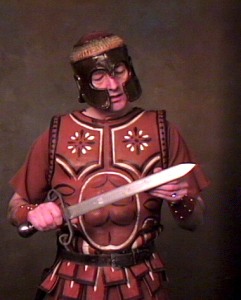
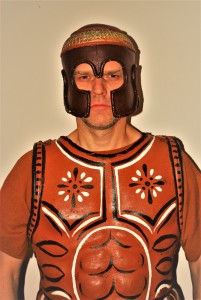
A Roman centurion — Andrew Nicholls

“Forget Flavio. He’ll be drunk for the rest of the week. Herod’s coming down about midweek. There’ll be a big wine- swilling bash for the upper crust. He’ll sober up just long enough so he can bow and scrape for Pilate at the right moment. Forget him. We have to save our own hides.”
“All right. So what’s this plan?”
“It’s not some great master scheme, but I do have a few ideas.”
“Yes, get on with it,” he said with obvious interest.
“Well, the way I see it, we have way too little information about whatever is going on here. If there’s some Passover plot being hatched, we need to be the first to know about it. Not like yesterday. I don’t like surprises. Especially Jewish Messiah surprises.”
Renaldo scowled in agreement. “So why the trunk?” he asked.
I had set it down after our greeting, and now it was Keeper, sniffing about it, that brought it to Renaldo’s attention.
“This is one way I can get some information.”
I opened the trunk and pulled out several items of clothing, among them a Jewish prayer shawl and several phylacteries. Holding one of the fringed garments to myself, I announced, “Today I am Benjamin. Benjamin from Alexandria, and I’ve come to celebrate the Passover here, in the holy city, Jerusalem.”
All this was done with a thick Aramaic accent and a mock reverence that left Renaldo slapping his thigh in laughter.
“Marcus, Marcus! Only you could pull this off!” Then he added in a more thoughtful tone, “I could look in on some of our usual sources. They’re bound to know a thing or two about this donkey man.”
“Now you’re thinking.” With a glance to the eastern sky, I added, “Look, we don’t have much time. The sun’s almost up. All my men know their assigned duties, so if you could just look in on them at the barracks, that would be great. I should be back in uniform by noon, and I could meet you there to discuss what we’ve found.”
“No problem . . . Benjamin!” he said, shaking his head and grinning, no doubt contemplating the sight of me in religious garb.
I began to place the clothing back in the trunk, and then I turned to my friend. “Oh,Soldier book by the way, Renaldo, could you check in on Claudius at the Golden Gate? I expect our visiting prophet will be coming back into town by the same way today. Claudius might need a hand.”
“No problem, Marcus.” And then he added in a more serious tone, “Now, you be careful.”
“Yes, well,” I said, sighing, “I think we’ve all got to be careful.”
I swung the trunk up under my arm. With a quick wave of my free hand, I said, “I’m off for an appointment with Jesus of Nazareth.”


Excerpt 2 for Lent from “The Soldier Who Killed a King”

20 Tuesday Feb 2018

Posted by davidkitz in Lent

≈ Leave a comment

Tags

conquer, David Kitz, donkey, Galilee, Hosanna, Jesus, Jesus of Nazareth, Lord, Messiah, prophet, Rome, Son of David, temple, The Soldier Who Killed a King

A journey to the cross is a journey to repentance. It’s a journey to deep personal change. Will you take this journey with me?

Soldier bookI could see him clearly now. Donkey or not, he had the look of a man who knew exactly what he was doing. Those about him might not know or understand, but he knew. He had a destination in mind, a purpose. You could see it on his face.
“Hosanna to the Son of David!”
“Blessed is he who comes in the name of the Lord!”
“Hosanna in the highest heaven!”
There was something else different about him. At the time I didn’t know what it was. I couldn’t put it into words for a long time. I think I noticed it because I had watched all those other men come into Rome in their triumphal processionals. They were conquerors, but still they were hollow men, feeding off the adulation of the crowd, thirsting but never satisfied. You could see them vainly drink it in, hoping it would somehow fill the empty soul.
This donkey-riding king wasn’t drinking from the crowd. I somehow sensed he was full already, and what he had within must have come from a different source.
“Hosanna in the highest heaven!”
“Hosanna to the Son of David!”
“Blessed is he who comes in the name of the Lord!”
Just at that moment a strange feeling seemed to rise within me. Maybe it was the joy of the crowd. I had expected anger. Maybe it was the children waving palm branches or the spontaneity of the singing? I don’t know. For one moment it all seemed to come together. It seemed right somehow. Like heaven and earth had finally, for a moment, come into agreement—an agreement that had never been achieved before.
“Hosanna in the highest heaven!”
He was much closer now.
“Hosanna to the Son of David!”
He was now within the shadow of the gate.
“Blessed is he who comes in the name of the Lord!”
At that moment he looked up. For an instant our eyes met. Then I heard a voice—clearly heard a voice say, “I have a future for you.”
I was confused.
I turned to Claudius and said, “What did you mean by that?”
“What did I mean by what?” He had a blank look on his face.
“By what you said about—about the future?”
“I didn’t say anything about the future, sir. I didn’t say anything.”4485 SHARABLE-1
I was totally baffled. Was I hearing voices? This whole thing was making no sense, no sense at all. Passover pilgrims weren’t supposed to come into the city this way. We had a revolutionary on the loose—riding a donkey. And now I was hearing things?
I rubbed the sweat from my forehead, hoping for some clarity to emerge.
I had a hundred men whose lives were in danger from this Jewish Messiah and his horde of followers. That was what mattered.
By this time the donkey man had passed under the gate and was heading in the direction of the temple in the heart of the city.
I signaled for Claudius to follow as I raced down the stairs of the gatehouse. I emerged onto the street and grabbed the first two-legged bit of Jewish scum I saw. Pressing him against the stone wall, I demanded, “Who is that man?”
I pointed at the retreating figure on the donkey.
The poor wretch was in shock and seemed quite unable to get out a word.
Claudius reached for his sword.
“Je- Jesus of Nazareth,” he stammered and then quickly added, “the prophet from Nazareth in Galilee.”
I loosened my grip. Then in a voice loud enough for all near to hear, I announced, “Well, there is one thing I do know. We’re going to have to keep an eye on that man.”

← Older posts
Newer posts →

Psalms 365: Develop a Life of Worship & Prayer

Psalms 365 Volume II

Psalms 365 vol 3
— Psalms 365 Volume III

Now available:

Psalms

Recent posts

  • Marriage at the Resurrection October 8, 2026
  •  A Growing List of Transgressions October 8, 2026
  • Paying the Imperial Tax to Caesar October 7, 2026
  • His Love Endures Forever October 7, 2026
  • The Authority of Jesus Questioned October 6, 2026
  • Provision in the Wilderness October 6, 2026
  • The Authority of Jesus Questioned October 5, 2026

Calendar

October 2026
M T W T F S S
 1234
567891011
12131415161718
19202122232425
262728293031  
« Sep    

Blog Posts

Comments

  • Eileen Guyadeen on Divorce
  • davidkitz on Divorce
  • davidkitz on Divorce

Blog at WordPress.com.

Privacy & Cookies: This site uses cookies. By continuing to use this website, you agree to their use.
To find out more, including how to control cookies, see here: Cookie Policy
  • Subscribe Subscribed
    I love the Psalms
    Join 1,369 other subscribers

    Have a WordPress.com account? Log in now.

  • I love the Psalms
    View site in Reader
    Manage subscriptionsSign upLog in
    Report this content
    Collapse this bar
Loading Comments...