Do not withhold your mercy from me, LORD; may your love and faithfulness always protect me. For troubles without number surround me; my sins have overtaken me, and I cannot see. They are more than the hairs of my head, and my heart fails within me. Be pleased to save me, LORD; come quickly, LORD, to help me. May all who want to take my life be put to shame and confusion; may all who desire my ruin be turned back in disgrace. May those who say to me, “Aha! Aha!” be appalled at their own shame. But may all who seek you rejoice and be glad in you; may those who long for your saving help always say, “The LORD is great!” But as for me, I am poor and needy; may the LORD think of me. You are my help and my deliverer; you are my God, do not delay. (NIV)*
I have seen a wicked and ruthless man flourishing like a luxuriant native tree, but he soon passed away and was no more; though I looked for him, he could not be found. Consider the blameless, observe the upright; a future awaits those who seek peace. But all sinners will be destroyed; there will be no future for the wicked. The salvation of the righteous comes from the LORD; he is their stronghold in time of trouble. The LORD helps them and delivers them; he delivers them from the wicked and saves them, because they take refuge in him. (NIV)*
Today’s reading is the concluding portion of Psalm 37. As noted previously, this entire psalm contrasts the life of the righteous person with the individual who pursues a life of sin and illicit gain. The righteous will receive their reward and the man who does evil will be destroyed.
We all reap what we sow. If we sow seeds of selfishness, hate and discord, we will reap a harvest of ruin. Paul, the apostle, gives us this warning, “Do not be deceived: God cannot be mocked. A man reaps what he sows. Whoever sows to please their flesh, from the flesh will reap destruction; whoever sows to please the Spirit, from the Spirit will reap eternal life” (Galatians 6:7-8).
We can readily conclude that the good man will live because of his goodness. In other words, the righteous person will be saved because of his righteous deeds. But that’s not what this psalm teaches. In fact, the idea that one is saved because of one’s righteousness runs contrary to the message of this psalm and the entire counsel of Holy Scripture. The psalmist clearly states, “The salvation of the righteous comes from the LORD.”
We are not saved by our righteousness. We are saved by the LORD. It is because of His great mercy that we are saved. This aligns with New Testament teaching as Paul declares, “For it is by grace you have been saved, through faith—and this is not from yourselves, it is the gift of God— not by works, so that no one can boast” (Ephesians 2:8-9).
Yes, we are called to live righteous lives and to do good works, but let’s not deceive ourselves into thinking that by these means we will earn our way to heaven. Jesus is the way to heaven. Our feeble efforts won’t take us very far. We need His forgiveness and the power of His redeeming blood. We are saved because we take refuge in Him.
Response LORD God, I thank you for Jesus. I am thankful I can put my complete trust in you. I am saved by your amazing grace not by my effort. Hallelujah! Lord Jesus, you are “the way, the truth and the life” (John 14:6). Amen.
Your Turn Have you relied on your righteousness rather than God’s grace? How can you develop a greater appreciation for God’s grace and acceptance?
Please pray for peace to return to Israel, Gaza, Russia and Ukraine!
Volume I of Psalms 365: Develop a Life of Worship and Prayer won the Best Book of the Year Award from The Word Guild and Volume II has won the Best Devotional of the Year Award. For those who love God’s word, this three-book series is an ideal way to daily meet with the Lord. To purchase or for a closer look click here.
Ideal for the Season of Lent
A stunning story of Holy Week through the eyes of a Roman centurion. Watch the triumphal entry of the donkey-riding king through the eyes of Marcus Longinus, the centurion charged with keeping the streets from erupting into open rebellion.
Look behind the scenes at the political plotting of King Herod, known as the scheming Fox for his ruthless shrewdness.
Get a front-row seat to the confrontation between the Jewish high priest Caiaphas and the Roman governor Pontius Pilate.
Understand as never before the horror of the decision to save a brutal terrorist in order to condemn the peaceful Jew to death.
If you’ve heard the story of Passion Week so often it’s become stale, now is the time to rediscover the terrible events leading from Jesus’s humble ride into the city to his crucifixion. The Soldier Who Killed a King will stun you afresh with how completely Christ’s resurrection changed history, one life at a time.
For the director of music. According to gittith. A psalm of David. LORD, our Lord, how majestic is your name in all the earth! You have set your glory in the heavens. Through the praise of children and infants you have established a stronghold against your enemies, to silence the foe and the avenger. When I consider your heavens, the work of your fingers, the moon and the stars, which you have set in place, what is mankind that you are mindful of them, human beings that you care for them? You have made them a little lower than the angels and crowned them with glory and honor. You made them rulers over the works of your hands; you put everything under their feet: all flocks and herds, and the animals of the wild, the birds in the sky, and the fish in the sea, all that swim the paths of the seas. LORD, our Lord, how majestic is your name in all the earth (NIV). *
Humbled before an awesome God — photo by David Kitz
Reflection
There’s something exquisitely beautiful about this psalm. Yes, in it we see the glory of the heavens, the sun, moon, and stars—the vast array of heavenly bodies. But there’s more to it than that. This psalm is more than a pretty poetic picture of the heavens.
It’s about perspective. In the grand scheme of things David grasps his true size—his insignificance. Beneath a canopy of stars, he has a transcendent moment—a God moment. He realizes the immensity of God. In the material realm you and I are just a transitory flicker across the face of time. That’s why David asks, “When I consider your heavens, the work of your fingers, the moon and the stars, which you have set in place, what is mankind that you are mindful of them, human beings that you care for them?”
In the vastness of the universe, what am I but a speck. Why would God even consider me? But He does! That’s the wonder of this psalm, and the wonder of our God. He is mindful of you and your concerns. God has crowned human beings—you and I—with glory and honor. What an awesome privilege; what an enormous responsibility! When did that happen you might ask?
Well, it happened at creation. God placed humankind as the rulers of all creation. That’s a huge responsibility, a responsibility we have often failed to fulfill. But God reaffirmed His love and commitment to us at the cross. Jesus considered you so significant he bled and died for you. Now that’s significance—eternal significance in the face of God’s own Son.
Response: Heavenly Father, Creator of the universe, thank you for considering me. Thank you for being mindful of my daily concerns. I bring them to you, my majestic, all-encompassing Lord. Amen.
Your Turn:Have you had a transcendent moment—a God moment? How did that happen? Take time to reflect on that experience.
Thank God for peace in Israel and Gaza, and continue to pray for peace to return to Ukraine and Russia!
Volume I of Psalms 365: Develop a Life of Worship and Prayer won the Best Book of the Year Award from The Word Guild and Volume II has won the Best Devotional of the Year Award. For those who love God’s word, this three-book series is an ideal way to daily meet with the Lord. To purchase or for a closer look click here.
New from David Kitz
James—the brother of Jesus—who was this man? What evidence do we have that this “brother of our Lord” even existed?
David Kitz digs deep into archeology, family dynamics, church history, and the biblical texts. What emerges from his research is a portrait of a decisive, pivotal leader who embodied the will and character of Jesus Christ.
But how did James—James the unbeliever—transform to become a leader who changed the course of world history? In these pages you will uncover the answer and rediscover for yourself the life-changing power of the gospel.
Reading:Psalm 1 Blessed is the one who does not walk in step with the wicked or stand in the way that sinners take or sit in the company of mockers, but whose delight is in the law of the LORD, and who meditates on his law day and night. That person is like a tree planted by streams of water, which yields its fruit in season and whose leaf does not wither— whatever they do prospers. Not so the wicked! They are like chaff that the wind blows away. Therefore the wicked will not stand in the judgment, nor sinners in the assembly of the righteous. For the LORD watches over the way of the righteous, but the way of the wicked leads to destruction (NIV). *
Reflection
Have you ever noticed the prominent role trees play in the Bible? The creation account in Genesis begins with God planting two very special trees in the Garden of Eden: the Tree of Life and the Tree of the Knowledge of Good and Evil. After our first parent’s disobedience, we were banned from access to the Tree of Life. But the amazing, good news of the Bible is that at the end of the book, in the last chapter of the book of Revelation, God restores our access to the Tree of Life (Revelation 22:1-5).
In a very real sense, the Bible is a story about trees.
Here in the very first Psalm, the life of the righteous is compared to a fruit-bearing tree, flourishing by streams of water. The psalmist presents a picture of tranquil beauty. Is that a picture of my life, or am I caught up in busyness? Sometimes I feel more like windblown chaff—rather worthless and lacking a sense of direction.
But that’s where the other tree at the heart of the Bible comes into play. It stands on a hill called Calvary. There my Savior bled and died. There he showed me my true worth. There my sins were washed away, never to be remembered again. That’s where I became righteous, not by works that I had done, but by the grace and forgiveness of Christ.
What a beautiful tree! The tree on Mount Calvary isn’t t beautiful because of its leaves. It’s beautiful because of its fruit—the fruit of redemption purchased by the blood of Jesus. My righteousness is solely due to him.
Response: Dear Lord Jesus, thank you for your sacrifice. Help me to always remember you are the true source of my righteousness. At your prompting help me to rid myself of the worthless chaff in my life. Wind of God, blow on me. Water of life, refresh my soul. May I be fruitful, Lord, for you. Amen.
Your Turn: Have you knelt before the tree on Mount Calvary? Today, how can you show your appreciation for the tree God planted there?
Thank God for peace in Israel and Gaza, and continue to pray for peace to return to Ukraine and Russia!
Volume I of Psalms 365: Develop a Life of Worship and Prayer won the Best Book of the Year Award from The Word Guild and Volume II has won the Best Devotional of the Year Award. For those who love God’s word, this three-book series is an ideal way to daily meet with the Lord. To purchase or for a closer look click here.
Coming soon…
James—the brother of Jesus—who was this man? What evidence do we have that this “brother of our Lord” even existed?
David Kitz digs deep into archeology, family dynamics, church history, and the biblical texts. What emerges from his research is a portrait of a decisive, pivotal leader who embodied the will and character of Jesus Christ.
But how did James—James the unbeliever—transform to become a leader who changed the course of world history? In these pages you will uncover the answer and rediscover for yourself the life-changing power of the gospel.
Reading:Psalm 147: 8-12 He covers the sky with clouds; he supplies the earth with rain and makes grass grow on the hills. He provides food for the cattle and for the young ravens when they call. His pleasure is not in the strength of the horse, nor his delight in the legs of the warrior; the LORD delights in those who fear him, who put their hope in his unfailing love. Extol the LORD, Jerusalem; praise your God, Zion (NIV). *
Reflection
I grew up on a farm on the prairies. During the hot summer it was not unusual for rain to be in short supply, but rain is essential for growing field crops of any kind.
As a child one of my favorite garden projects was growing watermelons. Two key ingredients are needed if you want to grow watermelons: lots of direct sunlight and a plentiful supply of water. I could count on the sunlight pouring down from the sky, but rain was far less dependable. There may be afternoon or evening thundershowers, but they were often of the hit and miss variety. All too often on the thundershower scoreboard, we scored a miss. In such conditions daily watering was essential.
Each of my watermelon plants could count on a daily supply of a gallon of water. Barring a major downpour, I was their supplier. I brought my plants pails of water from the well. By September all the hard work of summer began to pay off. The garden-grown watermelons were delicious and juicy beyond compare.
Today’s reading from Psalm 147 reminds us that the LORD is our supplier. He covers the sky with clouds; he supplies the earth with rain and makes grass grow on the hills (v. 8).
The LORD is the ultimate supplier of all things, rain and sunshine and life itself. All He asks is that we fear Him—honor Him with the respect He deserves. The LORD delights in those who fear him, who put their hope in his unfailing love (v. 11). What a comforting thought! The LORD delights in me. Wow!
I need a daily supplier. I need a supply of daily bread—those necessary things that sustain life. But beyond that, I also need less tangible things like love, encouragement and peace of mind. Sometimes those things fall from the sky. But there are other times when I need to go to the well—the well of my salvation. There is a supply of grace stored up there for me to access. “The LORD, the LORD himself, is my strength and my defense; he has become my salvation.” With joy you will draw water from the wells of salvation (Isaiah 12:2b-3).
Response: LORD God, I am thankful that you are my supplier. You provide for all my needs and many of my desires as well. Your grace is abundant. You are my salvation and source of joy. Amen.
Your Turn: Do you have a steady supplier? Do you have access to the well of salvation?
Please pray for peace to return to Israel, Gaza, and Ukraine!
Volume I of Psalms 365: Develop a Life of Worship and Prayer won the Best Book of the Year Award from The Word Guild and Volume II has won the Best Devotional of the Year Award. For those who love God’s word, this three-book series is an ideal way to daily meet with the Lord. To purchase or for a closer look click here.
A gripping read from David Kitz. Is a return-to-Jesus revival possible in our time?
This book points the way forward.
For details click here.
Reading:Psalm 147:1-3 Praise the LORD. How good it is to sing praises to our God, how pleasant and fitting to praise him! The LORD builds up Jerusalem; he gathers the exiles of Israel. He heals the brokenhearted and binds up their wounds (NIV). *
River of Healing — Photo courtesy of Donald Adam.
Reflection
There are a lot of brokenhearted people in this world. No, I’m not talking about sports fans who have suffered heartbreak because their team has lost. I’m talking about the more serious issues that arise—the loss of a home, a career, or a family member. I’m talking about those devastating life events from which full recovery may never be possible.
Today’s evening news carried the story of a woman who had lost her home due to severe flooding throughout our region. There she stood with her voice breaking as she described all the work she and her husband had put into their lovely home. Looking beyond her, you could see nothing but brown water lapping against the sides of her house. Everything they had worked for was ruined.
Every Friday morning for a dozen years I have been meeting with a group of men who have entered a covenant to grow stronger in their relationship with the Lord. We are accountable to one another in our commitment to grow in love and service to Jesus. But faithful commitment to the Lord provides us with no guarantee against personal heartbreak.
One of the leaders of our group lost his wife last fall due to pancreatic cancer. Now Chris must cope with the loss of his wife while also providing care and comfort for his young son and his teenage daughter. That’s heartbreaking. That’s a daunting task!
I’m not sure that I could cope with that level of loss.
In today’s reading from Psalm 147, we see a call to praise coupled with a promise that the LORD will build up, restore, and heal the heartbroken. The LORD builds up Jerusalem; he gathers the exiles of Israel. He heals the brokenhearted and binds up their wounds (v. 2-3).
I need words like that. I need healing words. The wounded need healing words. As God’s people we need to give and receive words that comfort the grieving, build up the downcast, and minister healing to the wounded. All too often our tongues do more harm than good. Too often we speak words of judgment when we should leave judgment to the LORD.
Today, remember there are a lot of brokenhearted people in this world.
Response: LORD God, heal my hurts so I can help heal the hurts of others. I pray that your people will find comfort in your word. May your words bring health and healing. You are worthy of praise. Amen.
Your Turn: How can we bind up the wounds of others? Do you have wounds that need healing?
Please pray for peace to return to Israel, Gaza, and Ukraine!
Volume I of Psalms 365: Develop a Life of Worship and Prayer won the Best Book of the Year Award from The Word Guild and Volume II has won the Best Devotional of the Year Award. For those who love God’s word, this three-book series is an ideal way to daily meet with the Lord. To purchase or for a closer look click here.
A gripping read from David Kitz. Is a return-to-Jesus revival possible in our time?
This book points the way forward.
For details click here.
Reading:Psalm 146:6-10 He is the Maker of heaven and earth, the sea, and everything in them— he remains faithful forever. He upholds the cause of the oppressed and gives food to the hungry. The LORD sets prisoners free, the LORD gives sight to the blind, the LORD lifts up those who are bowed down, the LORD loves the righteous. The LORD watches over the foreigner and sustains the fatherless and the widow, but he frustrates the ways of the wicked. The LORD reigns forever, your God, O Zion, for all generations. Praise the LORD (NIV). *
Reflection
Are you looking for the LORD’s help? Let’s be honest now. Many of us are. Well here’s a startling truth. The self-sufficient and well-to-do need not apply. We can also add the smug, the proud, and the arrogant to that list.
I thought the LORD was willing to help all who came to Him. True, but here is the sad reality; the arrogant and self-sufficient don’t come to God. They have no need for Him. They are too wrapped up in their successes and their pride to come in humility before the LORD. The LORD is the unseen author of any genuine human achievement of lasting value.
Today’s reading from Psalm 146 gives us a glimpse at those who should get their application in for the LORD’s help. Here’s the list as found in this psalm: the oppressed, the hungry, prisoners, the blind, the bowed down, foreigners, the fatherless and widows. Help is promised to all of these. To put it simply, the LORD helps the needy.
I have often heard it said that the Lord helps those who help themselves. I have even had people insist this statement is found in the Bible. It is not. This nonbiblical proverb is often used to justify human greed. In other words, I’ll grab whatever I can without any thought for those who are less fortunate. Furthermore, I’ll frame it as God blessing my greed. Ouch!
The character of God is the exact opposite. He is attracted to the needy. He helps the needy rather than running from them. Jesus continually demonstrated this quality in his earthly ministry. He showed compassion to the oppressed, the hungry, the blind, the foreigner, the widow and the fatherless. He set captives free from prisons of sin and shame. Jesus calls his followers to do the same.
Response: LORD God, I confess that often I avoid the needy rather than seeking to help them. Give me a heart of compassion—a heart like your Son, Jesus. You are my great provider. Thank you. Amen.
Your Turn: How do you respond to someone in need? Do you always help? What might help look like?
Please pray for peace to return to Israel, Gaza, and Ukraine!
Volume I of Psalms 365: Develop a Life of Worship and Prayer won the Best Book of the Year Award from The Word Guild and Volume II has won the Best Devotional of the Year Award. For those who love God’s word, this three-book series is an ideal way to daily meet with the Lord. To purchase or for a closer look click here.
A gripping read from David Kitz. Is a return-to-Jesus revival possible in our time?
This book points the way forward.
For details click here.
Reading:Psalm 145:13-16 The LORD is trustworthy in all he promises and faithful in all he does. The LORD upholds all who fall and lifts up all who are bowed down. The eyes of all look to you, and you give them their food at the proper time. You open your hand and satisfy the desires of every living thing (NIV). *
Reflection
More than thirty years ago I went through a dark time in my life. It all began rather abruptly. I got up from the dinner table and went to put my dishes on the kitchen counter. Suddenly everything went dark. According to my wife, I hit the floor with a thud. That’s where she found me unconscious. She was able to revive me and help me to the living room couch. A quick trip to the doctor followed but remaining conscious was a real struggle for me. The blackness kept closing in.
The diagnosis was a complete shutdown of my thyroid gland. Getting back to full health took quite some time. The severe depletion of the thyroid hormones in my body created several side effects. One of these side effects was clinical depression. Though I never blacked out again, I was draped in a lethargic blackness—a darkness of the soul that lasted for months. I needed an antidepressant to bring me back to balance. The medication provided the lift I needed during this dark episode of my life. Eventually, I regained full health, and I no longer needed the antidepressants.
My drug prescription provided the artificial lift that I needed during this transition back health. Today’s reading from Psalm 145 reminds us that the LORD is the true lifter. He lifts the fallen soul out of dark places. The LORD upholds all who fall and lifts up all who are bowed down (v. 14).
We all came into this world with a sinful nature. Willful disobedience comes natural to us. Prompt, willing obedience to God and his commands is not my first inclination. You see, I have fallen—fallen into a life of sin. That’s why I need a Savior. I need an inner change that is propelled by the Spirit of God. Only the LORD can lift me out my condition and restore me to spiritual health.
When God reveals Himself to us as our loving Father, and our faithful provider, by His grace we can choose to put our trust in Him. The LORD is trustworthy in all he promises and faithful in all he does (v. 15).
Do you have a lifter? Not an artificial lifter like drugs or alcohol, but a genuine lifter like the Lord Jesus Christ. Before he was lifted up on a cross, he spoke these words, “And I, when I am lifted up from the earth, will draw all people to myself” (John 12:32).
Is Jesus drawing you to himself?
Response: LORD God, thank you for lifting me out of the quagmire of sin. Jesus, you are my merciful Savior. Thank you for restoring my health and lifting me out of depression. You are faithful. Amen.
Your Turn:Has the LORD helped you through a dark period in your life? Take time now to praise him.
Please pray for peace to return to Israel, Gaza, and Ukraine!
Volume I of Psalms 365: Develop a Life of Worship and Prayer won the Best Book of the Year Award from The Word Guild and Volume II has won the Best Devotional of the Year Award. For those who love God’s word, this three-book series is an ideal way to daily meet with the Lord. To purchase or for a closer look click here.
A gripping read from David Kitz. Is a return-to-Jesus revival possible in our time?
This book points the way forward.
For details click here.
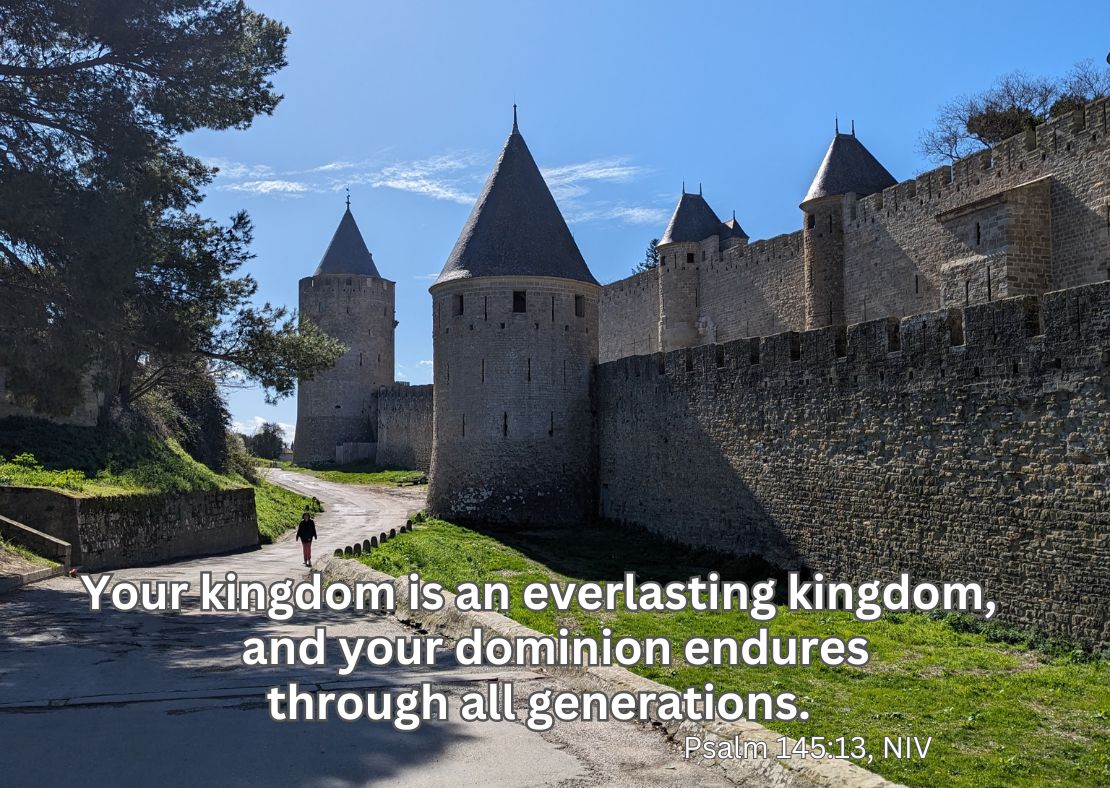
Reading:Psalm 145:8-13 The LORD is gracious and compassionate, slow to anger and rich in love. The LORD is good to all; he has compassion on all he has made. All your works praise you, LORD; your faithful people extol you. They tell of the glory of your kingdom and speak of your might, so that all people may know of your mighty acts and the glorious splendor of your kingdom. Your kingdom is an everlasting kingdom, and your dominion endures through all generations (NIV). *
Reflection
Adolf Hitler boasted that his rise to power would lead to the thousand-year reign of the Third Reich. Instead, his diabolical reign of terror came to an end after twelve years with millions dead and Europe lying in ruins. His brand of race-based nationalism ended in an unparalleled catastrophe.
Where did Hitler get his idea of a thousand-year reign? Undoubtedly, he stole the concept from the millennial rule of Christ, which is described in the revelation of Jesus Christ to John. Blessed and holy are those who share in the first resurrection. The second death has no power over them, but they will be priests of God and of Christ and will reign with him for a thousand years (Revelation 20:6).
The contrast between the reign of Christ and his kingdom, and the reign of a tyrant like Hitler is stunning. In today’s reading from Psalm 145 we catch a glimpse of the reign of God. All your works praise you, LORD; your faithful people extol you. They tell of the glory of your kingdom and speak of your might, so that all people may know of your mighty acts and the glorious splendor of your kingdom (v. 10-12).
What makes the reign of God so wonderful—so glorious? The answer lies in the character of the King. The LORD is gracious and compassionate; slow to anger and rich in love. The LORD is good to all; he has compassion on all he has made (v. 8-9).
Yes, the LORD is good to all. He is good even to the wayward and disobedient, including me. He shows compassion to those who don’t deserve it. His compassion isn’t based on race. But even more surprising, it’s not based on conduct or performance; for all have sinned and fall short of the glory of God (Romans 3:23). No, God’s compassion looks beyond that. He is the God of grace—unmerited favor.
This unmerited favor flows from a King whose blood flowed to save us—flowed to purchase our redemption. A blood-stained cross stood on a hill to declare these words to the world: The LORD is gracious and compassionate; slow to anger and rich in love (v. 8). Have you surrendered to His love?
Response: LORD God, I thank you that I am a citizen of your kingdom. Your grace and compassion have won my heart. I want to serve you. Your dominion endures through all generations (v. 13). I praise you. Amen.
Your Turn: Are you a citizen of the LORD’s kingdom—His everlasting kingdom? How does that make you feel?
Please pray for peace to return to Israel, Gaza, and Ukraine!
Volume I of Psalms 365: Develop a Life of Worship and Prayer won the Best Book of the Year Award from The Word Guild and Volume II has won the Best Devotional of the Year Award. For those who love God’s word, this three-book series is an ideal way to daily meet with the Lord. To purchase or for a closer look click here.
A gripping read from David Kitz. Is a return-to-Jesus revival possible in our time?
This book points the way forward.
For details click here.
Reading:Psalm 143:1-6 A psalm of David. LORD, hear my prayer, listen to my cry for mercy; in your faithfulness and righteousness come to my relief. Do not bring your servant into judgment, for no one living is righteous before you. The enemy pursues me, he crushes me to the ground; he makes me dwell in the darkness like those long dead. So my spirit grows faint within me; my heart within me is dismayed. I remember the days of long ago; I meditate on all your works and consider what your hands have done. I spread out my hands to you; I thirst for you like a parched land (NIV). *
Reflection On my best day, I need God’s mercy. On my worst day my need for outside help and mercy are visible to all. In truth, my need for the mercy of the LORD is never ending. All too often, we only call out to God in times of need or perceived difficulty. In reality, our need for God’s help and mercy are constant.
Here in Psalm 143, as he so often does, David calls out for God’s mercy. In many respects David’s plea for mercy is rather repetitive throughout the psalms. Why would this be? Could it be that he is in constant need of God’s sustaining support and mercy? From the following request, we can see why David repeatedly prays for God’s mercy: Do not bring your servant into judgment, for no one living is righteous before you (v. 2).
David recognized that within himself he had no righteousness. This is the starting point for a life transforming relationship with God. Contrary to a good deal of modern psychology and religious philosophy, we are not okay. We have a warped nature that is inclined to sin. It delights in rebelling against God. St. Paul describes this human condition with these words. For I know that good itself does not dwell in me, that is, in my sinful nature. For I have the desire to do what is good, but I cannot carry it out (Romans 7:18).
The prophet Isaiah described this universal human condition in this way. All of us have become like one who is unclean, and all our righteous acts are like filthy rags; we all shrivel up like a leaf, and like the wind our sins sweep us away (Isaiah 64:6).
Do I need God’s mercy? Yes, a thousand times yes!
Response: LORD God, I need your righteousness. My own righteousness is tainted with pride. I freely acknowledge my need for a Savior. You are my constant help. I thirst for you like a parched land. Amen.
Your Turn: Are you aware of your constant need for God’s mercy? Are you calling out to Him?
Please pray for peace to return to Israel, Gaza, and Ukraine!
Volume I of Psalms 365: Develop a Life of Worship and Prayer won the Best Book of the Year Award from The Word Guild and Volume II has won the Best Devotional of the Year Award. For those who love God’s word, this three-book series is an ideal way to daily meet with the Lord. To purchase or for a closer look click here.
A gripping read from David Kitz. Is a return-to-Jesus revival possible in our time? This book points the way forward. For details click here.