• Home
  • About
  • DavidKitz.ca
  • Youtube Videos
  • Books by David
  • Books on Amazon.com

I love the Psalms

~ Connecting daily with God through the Psalms

I love the Psalms

Tag Archives: Israel

Blessed Are the Peacemakers

05 Tuesday Sep 2017

Posted by davidkitz in Bible, Devotionals, Psalm 35, Psalms

≈ 4 Comments

Tags

America, attack, Christian, David, enemies, forgiveness, forgving, Gaza, Holy Land, Israel, Jesus, peace, peacemakers, Philistines, retaliation, rockets, strength, turning the other cheek, war, weakness

Reading:                                     Psalm 35

(Verses 22-25)
LORD, you have seen this; do not be silent.
Do not be far from me, Lord.
Awake, and rise to my defense!
Contend for me, my God and Lord.
Vindicate me in your righteousness, L
ORD my God;
do not let them gloat over me.
 Do not let them think, “Aha, just what we wanted!”
or say, “We have swallowed him up”
(NIV).

Reflection
There’s an old saying, “The more things change, the more they stay the same.” That certainly is true of the conflict in the Holy Land. About 3,000 years ago, in David’s time the Kingdom of Israel was in a struggle for survival. Chief among its enemies were the Philistines along the Gaza coast. On the day when I originally wrote this post, Israel’s chief enemy Hamas was firing rockets into Israel from the Gaza coast.

2017-08-13

Peaceful Petrie Island morning — photo by David Kitz

David’s words from Psalm 35 have a present day resonance. LORD, you have seen this; do not be silent. Do not be far from me, Lord. Awake, and rise to my defense! Contend for me, my God and Lord. Many in present day Israel are praying this prayer with the fervour of those who are being attacked.

But the residents of Gaza could pray this prayer with equal fervour. Their homes and businesses are also under bombardment. Where is God in all this suffering? Whose side is He on? Many in the Christian community affirm with great confidence that God is on the side of Israel. Does that make God complicit in the deaths of innocent children in Gaza?

Jesus gave this counsel to his disciples, “You have heard that it was said, ‘Eye for eye, and tooth for tooth.’ But I tell you, do not resist an evil person. If anyone slaps you on the right cheek, turn to them the other cheek also” (Matthew 5:38-39). Present day Israel (and America for that matter) has a well-established policy of hard-hitting retaliation when attacked. What are the long term consequences of this policy? Is the conflict resolved or is it inflamed?

Jesus’ admonition to turn the other cheek goes unheeded. Most feel that turning the other cheek implies weakness. In reality it requires far more strength, but in the end it yields the peaceable fruit of righteousness—not a righteousness that insists on its own way—but a righteousness that sees both sides of an issue and works hard for peace and reconciliation.

Jesus asks us to do the far harder thing. Retaliation is easy. It’s the natural response. Forgiving when we are wronged, that requires far more effort. Whose side is God on? He is on the side of peace. That’s something worth fighting for.

Response: Blessed are the peacemakers, for they will be called children of God (Matthew 5:9). LORD God, help me to be a local peacemaker in my world today—someone who builds bridges between people and communities. Amen.

Your Turn: Forgiveness and turning the other cheek works on a personal level. Can it work on an international level as well?

David the Warrior King

02 Friday Jun 2017

Posted by davidkitz in Psalm 9, Psalms

≈ 4 Comments

Tags

conquest, David, David and Goliath, Goliath, Israel, King David, Philistine, the LORD, trust in God, violence, warfare, warrior

Reading:                                           Psalm 9

For the director of music. To the tune of “The Death of the Son.” A psalm of David.

Verses 1-10
I will give thanks to you, LORD, with all my heart;
I will tell of all your wonderful deeds.
I will be glad and rejoice in you;
I will sing the praises of your name, O Most High.
My enemies turn back; they stumble and perish before you.
For you have upheld my right and my cause,
sitting enthroned as the righteous judge.
You have rebuked the nations and destroyed the wicked;
you have blotted out their name forever and ever.
Endless ruin has overtaken my enemies, you have uprooted their cities;
even the memory of them has perished.
The LORD reigns forever; he has established his throne for judgment.
He rules the world in righteousness and judges the peoples with equity.
The L
ORD is a refuge for the oppressed, a stronghold in times of trouble.
Those who know your name trust in you,
for you, L
ORD, have never forsaken those who seek you (NIV).

Reflection

Without question David was a man of war. After all, this was the man who as a strapping young teenager slew Goliath, the gigantic champion of the Philistines. Later he led King Saul’s army as they went out to do battle with the enemies of Israel. Eventually when David became King, he secured Israel’s borders and greatly expanded its territory through conquest. David knew a few things about bloodshed and war, and he had more than a few enemies.

img_20160425_150640

Wisteria, Victoria, BC — photo by David Kitz

It should not surprise us then that the language of warfare and talk of enemies and destruction should appear in the psalms that he wrote. David wrote, sang and spoke of the things he knew and experienced. He was personally involved in life and death struggles. Consequently, he was a man of violence, who lived and survived through violent times.

But he loved God. Sometimes it’s hard to reconcile the slay-my-enemies David with the LORD-is-my-shepherd David. It’s as though two contradictory Davids are living in one body. But then I look at myself—deep within myself. Am I any different? There are more than a few contradictory elements at work within me. The real warfare is within the human spirit. Will I yield to the Spirit of God, or to the foul spirit of this world, or my own selfish pride?

Like David I simply need God. I need to praise and exalt Him over all else. When I do that I gain perspective—the right perspective. With David I can say, “Those who know your name trust in you, for you, LORD, have never forsaken those who seek you.”

Response: I praise you, LORD and I seek you. Along with David I can say you have upheld me in difficult times. Be the master within me. I will be glad and rejoice in you; I will sing the praises of your name, O Most High. Amen.

Your Turn: Have you yielded to the LORD? Is He winning the warfare within?

The Healer of the Brokenhearted

05 Friday May 2017

Posted by davidkitz in Psalm 147, Psalms

≈ 7 Comments

Tags

brokenhearted, comfort, exiles, flooding, grieving, heal, healing, Israel, Jerusalem, Lord

Reading:                                         Psalm 147

(Verses 1-3)
Praise the LORD.
How good it is to sing praises to our God,
how pleasant and fitting to praise him!
The LORD builds up Jerusalem;
he gathers the exiles of Israel.
He heals the brokenhearted
and binds up their wounds (NIV).

Reflection

There are a lot of brokenhearted people in this world. No, I’m not talking about sports fans who have suffered heartbreak because their team has lost. I’m talking about the more serious issues that arise—the loss of a home, a career, or a family member. I’m talking about those devastating life events from which full recovery may never be possible.

img_20160723_183809

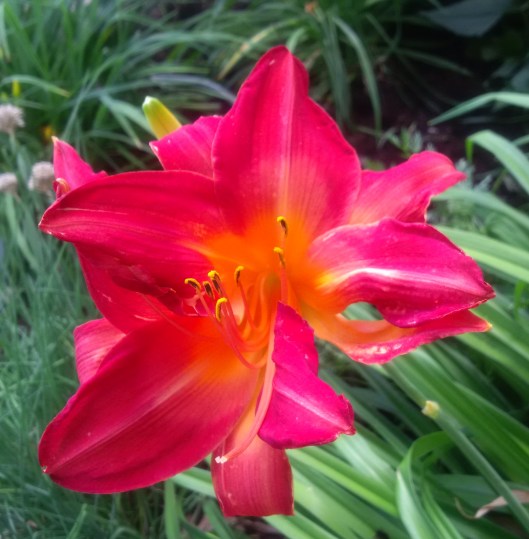
Flaming day lily — photo by David Kitz

Today’s evening news carried the story of a woman who had lost her home due to severe flooding throughout our region. There she stood with her voice breaking as she described all the work she and her husband had put into their lovely home. Looking beyond her you could see nothing but brown water lapping against the sides of her house. Everything they had worked for was ruined.

Every Friday morning for a dozen years I have been meeting with a group of men who have entered into a covenant to grow stronger in their relationship with the Lord. We are accountable to one another in our commitment to grow in love and service to Jesus. But faithful commitment to the Lord provides us with no guarantee against personal heartbreak.

One of the leaders of our group lost his wife last fall due to pancreatic cancer. Now Chris must cope with the loss of his wife while also providing care and comfort for his young son and his teenage daughter. That’s heartbreaking. That’s a daunting task!

I’m not sure that I could cope with that level of loss.

In today’s reading from Psalm 147, we see a call to praise coupled with a promise that the LORD will build up, restore, and heal the heartbroken. The LORD builds up Jerusalem; he gathers the exiles of Israel. He heals the brokenhearted and binds up their wounds.

I need words like that. I need healing words. The wounded need healing words. As God’s people we need to give and receive words that comfort the grieving, build up the downcast, and minister healing to the wounded. All too often our tongues do more harm than good. Too often we speak words of judgment, when we should leave judgment to the LORD.

Today, remember there are a lot of brokenhearted people in this world.

Response: LORD God, heal my hurts so I can help heal the hurts of others. I pray that your people will find comfort in your word. May your words bring health and healing. You are worthy of praise. Amen.

Your Turn: How can we bind up the wounds of others? Do you have wounds that need healing?

The Song of the Homesick Captive

14 Tuesday Mar 2017

Posted by davidkitz in Psalm 137, Psalms

≈ 1 Comment

Tags

Babylon, David Kitz, history, idolatry, Israel, Jewish nation, King Solomon, Moses, Old Testament, Psalms, Ten Commandments

Reading:                                         Psalm 137

(Verses 1-6)

By the rivers of Babylon we sat and wept
when we remembered Zion.
There on the poplars we hung our harps,
 for there our captors asked us for songs,
our tormentors demanded songs of joy;
they said, “Sing us one of the songs of Zion!”

How can we sing the songs of the LORD
while in a foreign land?
If I forget you, Jerusalem,
may my right hand forget its skill.
May my tongue cling to the roof of my mouth
if I do not remember you,
if I do not consider Jerusalem
my highest joy
(NIV)

Reflection

It’s difficult to pinpoint the time in history when many of the Psalms were written. Many scholars believe that the Old Testament was compiled over a period of about 900 to 1,000 years. As for the Book of Psalms, there is considerable evidence to suggest that psalms were collected from three distinct periods: the reign of King David (1 Chronicles 23:5), the rule of Hezekiah (2 Chronicles 29:30), and during the leadership of Ezra and Nehemiah (Nehemiah 12:24).[1]

img_20160928_182728_hdr

There on the poplars we hung our harps — photo by David Kitz

Psalm 137 is distinct, because we can tell from its content that this psalm was written early during the period of the Babylonian exile. Memories of Nebuchadnezzar’s destruction of Jerusalem in 586 BC were still fresh—etched with bitterness and pain in the mind of the author.

There are two great pivot points in the history of Old Testament Israel. The first is the liberation of Israel from Egypt and the conquest of the holy land. The second is the destruction of Jerusalem and the temple, and the subsequent seventy-year exile in Babylon. The mercy and power of God brought about the first pivotal event. The disobedience and idolatry of man set in motion the catastrophe of the second event.

From its inception the Jewish nation flirted with idolatry. While Moses was receiving the Ten Commandments, the people were reveling before a golden calf. King Solomon set up idols in Jerusalem so his foreign wives could worship their gods. See 1 Kings 11:1-8. This duplicity continued generation after generation until the Babylonians swept in and destroyed Jerusalem. Judgment brought change.

Response: Father God, I don’t want to learn things the hard way. I want to be quick to obey you. Help me to learn from the lessons of history. You are the one, true God. I worship you. Amen.

Your Turn: How faithful are you to the LORD? Do other interests draw you away?

[1] K.R. “Dick” Iverson, Spirit Filled Life Bible, New King James Version, Jack W. Hayford, General Editor, Thomas Nelson Publishers, Nashville, TN, 1991, p. 750.


Full Redemption

14 Tuesday Feb 2017

Posted by davidkitz in Psalm 130, Psalms

≈ 9 Comments

Tags

Israel, Jesus, Messiah, Prayer, prophetic, redeem, Redeemer, redemption, Savior, the LORD, waiting, waiting on God

Reading:                                        Psalm 130

(Verses 5-8)

I wait for the LORD, my whole being waits,
and in his word I put my hope.
 I wait for the L
ORD
more than watchmen wait for the morning,
more than watchmen wait for the morning.

Israel, put your hope in the LORD,
for with the L
ORD is unfailing love
and with him is full redemption.
He himself will redeem Israel
from all their sins
(NIV).

Reflection

Psalm 130 can be divided into three distinct sections: the confessional approach, the wait, and the LORD’s response. In yesterday’s reading, we looked at the confessional approach. The psalmist came before his God and poured out his heart. In desperation he pleaded for mercy and forgiveness. At the same time he acknowledged the extreme mercy of God. He knows full well that this God forgives the undeserving.

555

Joy comes in the morning — photo by David Kitz

Now, the psalmist waits: “I wait for the LORD, my soul waits, and in his word I put my hope. My soul waits for the LORD more than watchmen wait for the morning, more than watchmen wait for the morning.”

This is the step that is most frequently missing in our communion with God. We cannot wait; we rush on. We have things to do, people to see, a life to live. We have no time to wait for the LORD’s response. But without waiting, we cannot hear the LORD speaking to our hearts. The rush of life takes over. We do not hear our Savior speak the words of divine pardon. Prayer is reduced to one way communication. We speak into the silence, and allow no time for the God of silence to answer back.

But in his time of silence, the psalmist heard from God. In this third section of the psalm, the author is no longer addressing the LORD in prayer. Now he is addresses us. The wait is over. God has spoken, and now the psalmist rises to his feet. He has a message from the LORD for us—the Israel of God.

Israel, put your hope in the LORD, for with the LORD is unfailing love and with him is full redemption.

For Israel, there was a long wait. The promised Messiah was a long time in coming. The centuries slipped by. Generation after generation passed on, but the word of the LORD stood firm. A Redeemer was coming. With an uncanny accuracy the Old Testament prophets foretold the coming of the Christ. Many of those prophetic words are found in the Psalms. The Lord Jesus is our fount of hope—our Redeemer. He is love and the source of unfailing love. It is he who with his blood redeemed us, body, soul and spirit. In the person of Jesus, God took on human flesh. On the cross he fulfilled these words. “He himself will redeem Israel from all their sins.”

Now that’s a heaven sent valentine!

Response: Father God, I thank you for your prophetic word because it points to Jesus. Lord Jesus, thank you for laying down your life to redeem me, and all those who bow before you in repentance. Amen.

Your Turn: Are you taking time to listen for the voice of God in prayer?

The House of the LORD

01 Wednesday Feb 2017

Posted by davidkitz in Psalm 122, Psalms

≈ 5 Comments

Tags

Israel, Jerusalem, Landestreu, peace, pilgrim, pilgrimage, prosperity, Psalms of Ascent, shalom, the LORD

Reading:                                       Psalm 122

A song of ascents. Of David.

I rejoiced with those who said to me,
“Let us go to the house of the L
ORD.”
Our feet are standing in your gates, Jerusalem.

Jerusalem is built like a city
that is closely compacted together.
That is where the tribes go up—
the tribes of the L
ORD—
to praise the name of the L
ORD
according to the statute given to Israel.
 There stand the thrones for judgment,
the thrones of the house of David.

Pray for the peace of Jerusalem:
“May those who love you be secure.
May there be peace within your walls
and security within your citadels.”
For the sake of my family and friends,
I will say, “Peace be within you.”
For the sake of the house of the L
ORD our God,
I will seek your prosperity
(NIV).

Reflection

This third psalm in the Song of Ascents series is a psalm of arrival. The pilgrims have arrived at Jerusalem the destination of their pilgrimage. The following statement makes it clear that the weary travelers have arrived: Our feet are standing in your gates, Jerusalem. Jerusalem is built like a city that is closely compacted together. That is where the tribes go up—the tribes of the LORD—to praise the name of the LORD according to the statute given to Israel.

d-adam-4

Landestreu sunrise — photo courtesy of Donald Adam

It should be noted that this pilgrimage to Jerusalem was not merely an event for the occasional tourist. As the psalmist states, he came to praise the name of the LORD according to the statute given to Israel. In fact, this pilgrimage to the holy city was required according to the Law of Moses. Three times a year all your men are to appear before the Sovereign Lord, the God of Israel. I will drive out nations before you and enlarge your territory, and no one will covet your land when you go up three times each year to appear before the Lord your God (Deuteronomy 34-23-24).

Our Lord and Savior, Jesus Christ, frequently made this journey to fulfill the requirements of the Law. The first reference to this pilgrimage is found in the account of the twelve-year-old Jesus remaining in the city after his parents had left to return to Galilee (Luke 2:41-50). His last pilgrimage to celebrate the Passover ended with his crucifixion and resurrection.

With the psalmist we join in praying for the peace of Jerusalem, and peace within the church of God.

Response: Father God, we pray for your peace—the shalom of God. May your peace come to Jerusalem, and to all of Israel, and especially to all the followers of your dear son, Jesus. Amen.

Your Turn: Do you regularly pray for peace in the house of the LORD our God?

Our Idols

08 Thursday Dec 2016

Posted by davidkitz in Psalm 115, Psalms

≈ 8 Comments

Tags

God, idol worship, idolatry, idols, Israel, Mammon, money, Solomon, the LORD, worthlessness of idols

Reading:                                         Psalm 115

(Verses 1-8)

Not to us, LORD, not to us
but to your name be the glory,
because of your love and faithfulness.

Why do the nations say,
“Where is their God?”
Our God is in heaven; he does whatever pleases him.
 But their idols are silver and gold,
made by human hands.
They have mouths, but cannot speak,
eyes, but cannot see.
They have ears, but cannot hear,
noses, but cannot smell.
They have hands, but cannot feel,
feet, but cannot walk,
nor can they utter a sound with their throats.
Those who make them will be like them,
and so will all who trust in them
(NIV).

Reflection

Where are your idols? “I have none,” you say. Are you sure? Most readers of this post would deny being idol worshippers, but perhaps we have more idols than we care to admit.

img_20160425_150640

Wisteria, Victoria, BC — photo by David Kitz

Idolatry was commonly practiced during Israel’s kingdom era. In Old Testament times, the nations around God’s people all practiced various forms of idol worship. One might assume that God’s redeemed people, who were rescued from slavery, would have nothing to do with such vile practices. But you would be wrong. Time and again Israel fell into idolatry.

King Solomon, who was revered for his wisdom, is a prime example of someone who condoned idol worship. Here’s what we read about this ‘esteemed’ leader: On a hill east of Jerusalem, Solomon built a high place for Chemosh the detestable god of Moab, and for Molek the detestable god of the Ammonites. He did the same for all his foreign wives, who burned incense and offered sacrifices to their gods (1 Kings 11:7-8).

When leaders go astray, there will be many who follow. In the church today we have many leaders who have fallen captive to the god of Mammon—material goods. Jesus said, “No one can serve two masters. Either you will hate the one and love the other, or you will be devoted to the one and despise the other. You cannot serve both God and money” (Matthew 6:24).

Before we claim to be free from idols, we need to examine our hearts. Are we yielding to the Holy Spirit, or are we controlled by our desire for what this world has to offer?

Response: Father God, show me if there are idols in my life. In love, correct me when I stray. I want to serve you—put you first in my life. Lord Jesus, be my master. Amen.

Your Turn: Are there other things that can become idols in your life?

His Throne Endures Forever

07 Wednesday Sep 2016

Posted by davidkitz in Psalm 89, Psalms

≈ 2 Comments

Tags

David, God, idolatry, Israel, Judah, Psalms, royal lineage, the LORD

Reading:                                         Psalm 89

Verses 30-37

“If his sons forsake my law
and do not follow my statutes,
if they violate my decrees
and fail to keep my commands,

 I will punish their sin with the rod,
their iniquity with flogging;
but I will not take my love from him,
nor will I ever betray my faithfulness.

 I will not violate my covenant
or alter what my lips have uttered.

 Once for all, I have sworn by my holiness—
and I will not lie to David—
that his line will continue forever
and his throne endure before me like the sun;

 it will be established forever like the moon,
the faithful witness in the sky”
(NIV).

Reflection

Today’s reading from Psalm 89 continues on the theme of King David’s endless rule through his offspring. Once for all, I have sworn by my holiness—and I will not lie to David—that his line will continue forever and his throne endure before me like the sun; it will be established forever like the moon, the faithful witness in the sky.”

Tomb of David Entrance (1)

Statue of King David, Jerusalem — photo by Lois Morrow

There is however a sizeable problem with this promise to David for those who know biblical Jewish history. After the death of David’s son, the wise King Solomon, Israel was divided. The rebellious people of the northern Kingdom fell into idolatry and chose a new king, who was not a descendant of David. Despite warning after warning from prophets sent by God, Israel continued in its idolatrous ways until the nation was destroyed and swept away by Assyrian invaders in 720 BC.

On the other hand for hundreds of years, generation after generation a descendant of David sat on the throne of the southern Kingdom of Judah. For the most part these were kings who followed in the footsteps of their ancestor David. They worshipped the LORD, unlike the idolatrous northern kings of Israel who ruled from their capital Samaria. But eventually pagan practises found their way into Judea as well. In succession, several kings—descendants of David—turned to worship idols. God’s judgment fell on Judah too when the Babylonians invaded and destroyed Jerusalem in 582 BC.

So what is the point of this brief history lesson? The point is precisely this: These words from Psalm 89 are a lie and God is a liar—a sworn liar to David—unless we view Jesus as the royal heir who rules for all eternity. The Jewish kingdom came to an end. No Jewish king has ruled over a Jewish kingdom for more than 2,000 years. But Jesus, the eternal son of David reigns. Is he reigning over your life?

Response: LORD God, I submit to the reign of Jesus. You are my King—my King now and forever. Help me to govern my life according to your will and purpose. I praise you, my Savior and King. Amen.

Your Turn: Is Jesus your King? How can you show your submission to his rule today?

A Cause for Celebration

11 Thursday Aug 2016

Posted by davidkitz in Psalm 81, Psalms

≈ 1 Comment

Tags

celebration, Egypt, God, Israel, joy, music, redeem, song

Reading:                                       Psalm 81

For the director of music. According to gittith. Of Asaph.

Verses 1-9

Sing for joy to God our strength;
shout aloud to the God of Jacob!
Begin the music, strike the timbrel,
play the melodious harp and lyre.

Sound the ram’s horn at the New Moon,
and when the moon is full, on the day of our festival;
this is a decree for Israel, an ordinance of the God of Jacob.
When God went out against Egypt,
he established it as a statute for Joseph.

I heard an unknown voice say:

 “I removed the burden from their shoulders;
their hands were set free from the basket.
In your distress you called and I rescued you,
I answered you out of a thundercloud;
I tested you at the waters of Meribah.
Hear me, my people, and I will warn you—
if you would only listen to me, Israel!
You shall have no foreign god among you;
you shall not worship any god other than me
(NIV).

Reflection

Psalm 81 begins with a call for God’s people to celebrate: Sing for joy to God our strength; shout aloud to the God of Jacob! Begin the music, strike the timbrel, play the melodious harp and lyre.

IMG_1660

A celebration in the sky — photo courtesy of Donald Adam

Why should we break forth in music and song? Well, we have a good reason to celebrate. We have been set free from our burdens. Because of the victory of Christ, we have been set free from slavery to sin. The psalmist expresses this thought with these words: I heard an unknown voice say: “I removed the burden from their shoulders; their hands were set free from the basket. In your distress you called and I rescued you.”

Who is that unknown voice? That unknown voice belongs to the LORD. He is the One who set the people free from bondage in Egypt. God went out against Egypt. He opposed the most powerful nation of the world at that time and claimed a people for Himself by rescuing them from the hand of Pharaoh.

Our heavenly Father has done the same for us. At the cost of his life, Jesus redeemed us from bondage to sin and Satan and he brought us into his Kingdom. For he has rescued us from the dominion of darkness and brought us into the kingdom of the Son he loves, in whom we have redemption, the forgiveness of sins (Colossians 1:13-14). We have plenty of reasons to celebrate and break forth into music and song. Let nothing hold you back. The joy of the Lord is our strength.

Response: LORD God, I thank you for rescuing me from a life of sin and futility. I praise you for redeeming me. I rejoice in your continual goodness. Amen.

Your Turn: Do you find it difficult or easy to break into song as you think of the Lord’s love for you?

He Rejected Israel Completely

22 Friday Jul 2016

Posted by davidkitz in Psalm 78, Psalms

≈ 3 Comments

Tags

abandoned, consequences, God, Israel, nations, Psalms, sin

Reading:                                       Psalm 78

Verses 56-64

But they put God to the test
and rebelled against the Most High;
they did not keep his statutes.
Like their ancestors they were disloyal and faithless,
as unreliable as a faulty bow.
They angered him with their high places;
they aroused his jealousy with their idols.
When God heard them, he was furious;
he rejected Israel completely.
He abandoned the tabernacle of Shiloh,
the tent he had set up among humans.
He sent the ark of his might into captivity,
his splendor into the hands of the enemy.
He gave his people over to the sword;
he was furious with his inheritance.
Fire consumed their young men,
and their young women had no wedding songs;
their priests were put to the sword,
and their widows could not weep
(NIV).

Reflection

Sin has consequences. We can pretend it isn’t so, but we’re fooling ourselves. Unchecked sin on a personal level can have devastating consequences—consequences that lead to heartache and an early grave. I think we all know individuals who became trapped in sin and wandered down a self-destructive path.

DSCN2034

Grey Nuns Park, Orleans, ON — photo by David Kitz

Today’s reading from Psalm 78 reminds us that a whole nation can abandon God and become mired in the consequences of sin. The nation of Israel did just that. The psalmist tells us they were disloyal and faithless, as unreliable as a faulty bow.

When Israel abandoned God, He in turn abandoned them. We read, “He rejected Israel completely. He abandoned the tabernacle of Shiloh, the tent he had set up among humans. He sent the ark of his might into captivity, his splendor into the hands of the enemy. He gave his people over to the sword; he was furious with his inheritance.”

Has God changed? If the LORD abandoned His people in ancient times, will He treat our nation—any nation that turns away from Him differently today? There are consequences for sin and that truth applies to nations too. When collectively we abandon the ways of God and the precepts He has established from the foundations of the world, we can expect dire days ahead. That’s what happened to ancient Israel, and it can happen to us today as well.

Response: LORD God, collectively as a nation, we have wandered away from you. LORD in your mercy lead us back to the center of your holy will. Give us repentant hearts that seek your face. Amen.

Your Turn: Are you concerned about the spiritual state of your nation? What are you doing about it?

← Older posts
Newer posts →

Psalms 365: Develop a Life of Worship and Prayer

Psalms 365 Volume II

Psalms 365 vol 3
— Psalms 365 Volume III

Psalms

Recent posts

  • The Earth Is Full of His Unfailing Love January 31, 2026
  • Harassed at Every Turn January 30, 2026
  • Do you have a picture of God? January 30, 2026
  • This Is My Body January 29, 2026
  • Tasting God January 29, 2026
  • Much Superior to the Angels January 28, 2026
  • Praise Always for Answered Prayer January 28, 2026

Calendar

January 2026
M T W T F S S
 1234
567891011
12131415161718
19202122232425
262728293031  
« Dec    

Blog Posts

Comments

  • davidkitz on Much Superior to the Angels
  • Much Superior to the Angels – QuietMomentsWithGod on Much Superior to the Angels
  • davidkitz on Do you have a picture of God?

Blog at WordPress.com.

Privacy & Cookies: This site uses cookies. By continuing to use this website, you agree to their use.
To find out more, including how to control cookies, see here: Cookie Policy
  • Subscribe Subscribed
    • I love the Psalms
    • Join 1,383 other subscribers
    • Already have a WordPress.com account? Log in now.
    • I love the Psalms
    • Subscribe Subscribed
    • Sign up
    • Log in
    • Report this content
    • View site in Reader
    • Manage subscriptions
    • Collapse this bar
 

Loading Comments...