• Home
  • About
  • DavidKitz.ca
  • Youtube Videos
  • Books by David
  • Books on Amazon.com

I love the Psalms

~ Connecting daily with God through the Psalms

I love the Psalms

Tag Archives: Jesus

The Enduring Word of God

29 Wednesday Oct 2025

Posted by davidkitz in Psalm 6, Psalms

≈ 2 Comments

Tags

Bible, born again, God of mercy, Jesus, path of purity, Prayer, problems, Psalms, word of God

Today’s quote and prayer from
“Psalms 365: Develop a Life of Worship and Prayer”

Photo by David Kitz


Today’s Reading: Psalm 6

Listen to today’s reading by Jonathan Dent:

https://davidkitz.blog/wp-content/uploads/2025/10/psalm-6-remix2-final.mp3

Dear God,
I pour out my problems,
hurts and struggles before you.
Hear my prayer.
I know you are a God of mercy.
Jesus,
I open my heart
and mind to you..
Amen.

— — — —

Now that you have purified yourselves
by obeying the truth
so that you have sincere love for each other,
love one another deeply,
from the heart.
For you have been born again,
not of perishable seed,
but of imperishable,
through the living
and enduring word of God.


For,

“All people are like grass,
    and all their glory is like the flowers of the field;
the grass withers and the flowers fall,
but the word of the Lord endures forever.

And this is the word that was preached to you.
(1 Peter 1:22-25 NIV)*

Para la publicación de Salmos 365 de hoy en español haga clic aquí.

bgbg_v4.3_1501818
* NEW INTERNATIONAL VERSION, COPYRIGHT ©1973, 1978, 1984, 2011 BY BIBLICA

Thank God for peace in Israel and Gaza,
and continue to pray for peace to return to Ukraine and Russia!

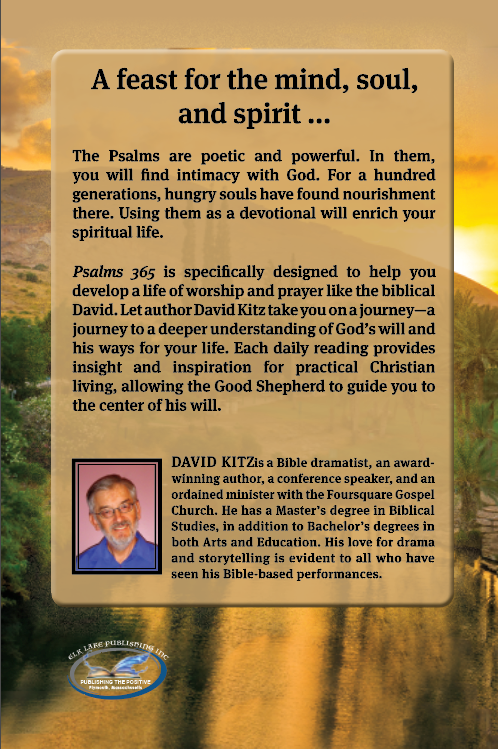
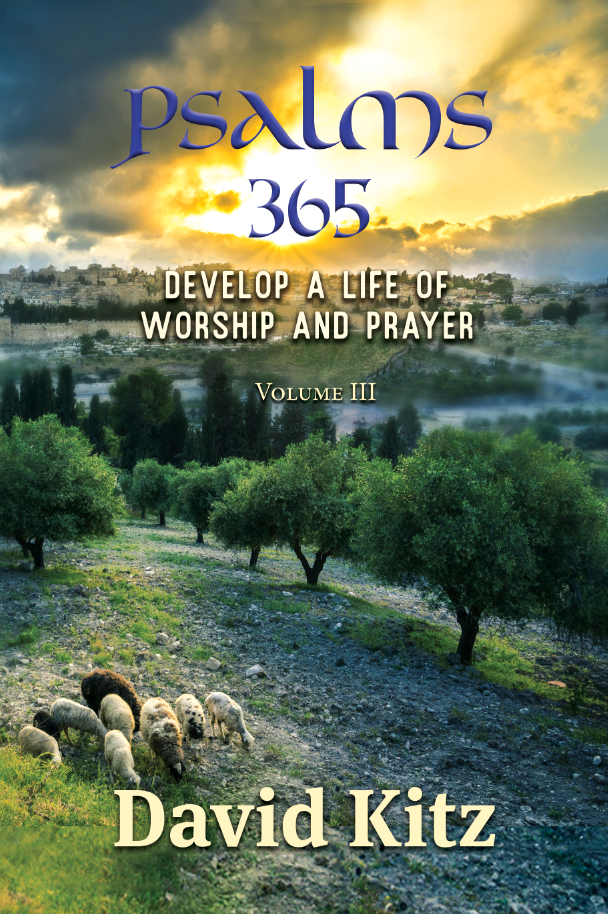
Volume I of Psalms 365: Develop a Life of Worship and Prayer won the Best Book of the Year Award from The Word Guild and Volume II has won the Best Devotional of the Year Award. For those who love God’s word, this three-book series is an ideal way to daily meet with the Lord. To purchase or for a closer look click here.

New from David Kitz

James—the brother of Jesus—who was this man? What evidence do we have that this “brother of our Lord” even existed?

David Kitz digs deep into archeology, family dynamics, church history, and the biblical texts. What emerges from his research is a portrait of a decisive, pivotal leader who embodied the will and character of Jesus Christ.

But how did James—James the unbeliever—transform to become a leader who changed the course of world history? In these pages you will uncover the answer and rediscover for yourself the life-changing power of the gospel.

Because They Know His Voice

28 Tuesday Oct 2025

Posted by davidkitz in Psalm 5, Psalms

≈ 3 Comments

Tags

Bible, dangers, enemies, God's voice, Jesus, listening to the good shepherd, Prayer, Psalms, sheep, shepherd, the LORD

Today’s quote and prayer from
“Psalms 365: Develop a Life of Worship and Prayer”


Today’s Reading: Psalm 5:8-12

Listen to today’s reading by Jonathan Dent:

https://davidkitz.blog/wp-content/uploads/2025/10/ps-58-12-remix2final.mp3

LORD God,
lead me.
I can’t see the dangers ahead.
Often, I am unaware of the enemies
that are trying to undermine my life
and my love for you.
Go before me.
Show me the way,
Lord Jesus,
because you are the way.
Amen.

— — — —

More Autumn glory — photo by David Kitz

The one who enters by the gate
is the shepherd of the sheep.

The gatekeeper opens the gate for him,
and the sheep listen to his voice. 
He calls his own sheep by name
and leads them out.

When he has brought out all his own,
he goes on ahead of them,
and his sheep follow him
because they know his voice.

But they will never follow a stranger;
in fact, they will run away from him
because they do not recognize a stranger’s voice.”

(John 10:2-5 NIV)*

Para la publicación de Salmos 365 de hoy en español haga clic aquí.

bgbg_v4.3_1501818
* NEW INTERNATIONAL VERSION, COPYRIGHT ©1973, 1978, 1984, 2011 BY BIBLICA

Thank God for peace in Israel and Gaza,
and continue to pray for peace to return to Ukraine and Russia!

Volume I of Psalms 365: Develop a Life of Worship and Prayer won the Best Book of the Year Award from The Word Guild and Volume II has won the Best Devotional of the Year Award. For those who love God’s word, this three-book series is an ideal way to daily meet with the Lord. To purchase or for a closer look click here.

New from David Kitz

James—the brother of Jesus—who was this man? What evidence do we have that this “brother of our Lord” even existed?

David Kitz digs deep into archeology, family dynamics, church history, and the biblical texts. What emerges from his research is a portrait of a decisive, pivotal leader who embodied the will and character of Jesus Christ.

But how did James—James the unbeliever—transform to become a leader who changed the course of world history? In these pages you will uncover the answer and rediscover for yourself the life-changing power of the gospel.

Philosophers Began to Debate with Him

27 Monday Oct 2025

Posted by davidkitz in Psalm 5

≈ Leave a comment

Tags

Athens, foreign gods, hearing God, Heavenly Father, Jesus, Paul, philosophers, Prayer, Psalms, resurrection

Today’s quote and prayer from
“Psalms 365: Develop a Life of Worship and Prayer”

Autumn reflections — photo by David Kitz


Today’s Reading: Psalm 5:1-7

Listen to today’s reading by Jonathan Dent:

https://davidkitz.blog/wp-content/uploads/2025/10/ps-51-7-remix1final1.mp3

Heavenly Father,
I call out to you.
I lay out my requests.
Teach me to wait expectantly for you.
Open my ears to hear your voice.
I want to be tuned into you
throughout my day.
Amen.

— — — —

Autumn Splendor – photo by David Kitz

While Paul was waiting for them in Athens,
he was greatly distressed to see
that the city was full of idols.

So he reasoned in the synagogue
with both Jews and God-fearing Greeks,
as well as in the marketplace day by day
with those who happened to be there.

A group of Epicurean and Stoic philosophers
began to debate with him.
Some of them asked,
“What is this babbler trying to say?”
Others remarked,
“He seems to be advocating foreign gods.”
They said this because
Paul was preaching the good news
about Jesus and the resurrection.

(Acts 17:16-18 NIV)*

Para la publicación de Salmos 365 de hoy en español haga clic aquí.

bgbg_v4.3_1501818
* NEW INTERNATIONAL VERSION, COPYRIGHT ©1973, 1978, 1984, 2011 BY BIBLICA

Thank God for peace in Israel and Gaza,
and continue to pray for peace to return to Ukraine and Russia!

Volume I of Psalms 365: Develop a Life of Worship and Prayer won the Best Book of the Year Award from The Word Guild and Volume II has won the Best Devotional of the Year Award. For those who love God’s word, this three-book series is an ideal way to daily meet with the Lord. To purchase or for a closer look click here.

New from David Kitz

James—the brother of Jesus—who was this man? What evidence do we have that this “brother of our Lord” even existed?

David Kitz digs deep into archeology, family dynamics, church history, and the biblical texts. What emerges from his research is a portrait of a decisive, pivotal leader who embodied the will and character of Jesus Christ.

But how did James—James the unbeliever—transform to become a leader who changed the course of world history? In these pages you will uncover the answer and rediscover for yourself the life-changing power of the gospel.

Saving the Best till Last

26 Sunday Oct 2025

Posted by davidkitz in The Elisha Code

≈ Leave a comment

Tags

Bible, blind, double anointing, Elisha, faith, God, gospel writers, Gospels, Jesus, Jewish audience, Matthew, Messiah, miracles, miraculous, New Testament, Old Testament, prophet, resurrection

Up from the grave he arose;
with a mighty triumph o’er his foes;
he arose a victor from the dark domain,
and he lives forever, with his saints to reign.
He arose! He arose! Hallelujah! Christ arose![i]

[i] Robert Lowry, Christ Arose, 1874, Public Domain

Photo by L. Kranz

Thus far in our examination of the ministry of Elisha and Jesus, we can see there are striking parallels in the miracles they worked:  

  • Their first public miracle was the transformation of water. Elisha turned a spring of foul water into good water at Jericho (2 Kings 2:19-22). Jesus turned water into wine at the wedding in Cana (John 2:1-12).
  • Elisha healed Naaman the Syrian leper (2 Kings 5:1-19). Jesus healed a leper after delivering his Sermon on the Mount (Matthew 8:1-4).
  • Elisha brought the Shunammite’s son back to life (2 Kings 4:8-37), and Jesus brought the synagogue leader’s daughter back to life (Matthew 9:18-26).
  • Elisha miraculously fed a hundred men (2 Kings 4:42-44). Jesus miraculously fed a crowd of five thousand men (Matthew 14:13-21), and then a crowd of four thousand (Matthew 15:29-39).
  • Both prophets demonstrated miracles of supernatural buoyancy. Elisha caused an iron axe-head to float (2 Kings 6:5-7), and Jesus walked on water (Matthew 14:22-33, Mark 6:45-52, John 6:15-21).
  • Both men worked miracles of provision. A widow’s jar of olive oil kept pouring and filled dozens of containers (2 Kings 4:1-7), and at Jesus’ command Peter caught a fish with a gold coin in its mouth (Matthew 17:24-27).
  • Both demonstrated power over nature. Elisha prophesied the arrival of water in the desert without wind or rain (2 Kings 3:15-18). Jesus stilled the wind and waves on the Sea of Galilee (Matthew 8:23-27).
  • Elisha opened the spiritual eyes of his servant (2 Kings 6:16-17), and Jesus opened the eyes of the blindman at the Pool of Siloam (John 9:5-7), as well as numerous others.

            When seen in tandem, this string of eight parallel miracles points to the arrival of the great Messianic prophet that Israel was longing for. Elisha’s double anointing was being doubled yet again through the ministry of Jesus. The New Testament Elisha had arrived, and his name was Jesus of Nazareth.
            Matthew deliberately framed his Gospel narrative so his Jewish readers could easily discern how Jesus duplicated and fulfilled the pattern established by the Old Testament miracle-working prophets.
            When the disciples of John the Baptist arrived to inquire if Jesus was the long-awaited Messiah, how did he respond? He listed a string of miracles:

            Jesus replied, “Go back and report to John what you hear and see: The blind receive sight, the lame walk, those who have leprosy are cleansed, the deaf hear, the dead are raised, and the good news is proclaimed to the poor. Blessed is anyone who does not stumble on account of me” (Matthew 11:4-6, NIV).

           Why did Jesus respond in this somewhat indirect enigmatic way? With his answer, he was drawing the link between his current ministry and the miracle-working prophetic ministry of the Old Testament duo of Elijah and Elisha. When John’s disciples leave, Jesus makes this abundantly clear to the crowd gathered around him by explicitly stating that John “is the Elijah who is to come” (Matthew 11:14).
            For those who have ears to hear, the implications are clear. If the new Elijah is already here in the person of John, then the miracles of Jesus herald his arrival as the new Elisha. Furthermore, Jesus’ answer implies that he is John the Baptist’s successor just as Elisha was Elijah’s successor. With John imprisoned, the double anointing now rests on Jesus, and in his conversation with John’s disciples he offers up his accomplishments as a miracle-worker as full proof of this prophetic transition.
            The hallmark of Elisha’s ministry was his double anointing (2 Kings 2:9). Elisha performed twice as many miracles as Elijah—more than thrice as many by some calculations. In his Gospel, Matthew signals that this double anointing resting on Jesus in a most unusual way. Generations of Bible scholars and apologists have puzzled over Matthew’s double vision. Repeatedly, Matthew reports on two men receiving miraculous help when the other Gospel writers report only one person receiving help.
            The first example of this is found in Matthew’s report on the restoration of two demon possessed men in the region of the Gadarenes (Matthew 8:28-34). This corresponds closely with the report of what appears to be the same event in Mark’s Gospel (Mark 5:1-20) and Luke’s Gospel (Luke 8:26-39). Mark’s account goes into considerably more detail, but Mark and Luke make no mention of a second man.
            The second occurrence is found in Matthew’s healing of two blindmen (Matthew 9:27-31). Again, for the perceptive, this double healing serves as a sign of the double anointing now resting on Jesus.
            The third example of Matthew’s double vision occurs as Jesus is leaving Jericho on his last Passover pilgrimage to Jerusalem.

           Two blind men were sitting by the roadside, and when they heard that Jesus was going by, they shouted, “Lord, Son of David, have mercy on us!” (Matthew 20:30, NIV).

          Similar accounts appear in Mark’s Gospel (Mark 10:46-52) and Luke’s Gospel (Luke 18:35-43). Again, Mark provides more detail by identifying the blindman as Bartimaeus. And yet again, Mark and Luke make no mention of a second man.
            Finally, all four Gospel writers report on the feeding of the 5,000, but only Matthew and Mark include the feeding of the 4,000. Again, Matthew reports a double miracle, while Luke and John remain silent on the second miraculous feeding.
            Bible scholars and apologists have come up with some sound reasons for these discrepancies in the four Gospels, which for the sake of brevity we will not explore here. But the following is one possible explanation:
            We tend to see what we are looking for, and undoubtedly, this principle applies to Matthew as well. When we are watching for something, we will pick out the item or event we are searching for against a busy backdrop of other sights and events. We see it because we are watching for it. The words of Jesus ring true, “Seek and you will find” (Matthew 7:7).
            A recent experience David Kitz had serves to illustrate this point. While walking along the shoreline of a marsh, he came upon a muskrat lodge protruding above the ice. He was fascinated by this discovery. After continuing further, he returned and then retraced his steps and found five more muskrat lodges. He had passed by these lodges minutes earlier but had noticed none of them. He saw them now because he was looking for them.

Petrie Island — photo by David Kitz

            So, why did Matthew see and record his list of double miracles? Could it be because he was actively watching for evidence of a double anointing resting on Jesus, whereas the other Gospel writers had their attention fixed elsewhere? Matthew was expecting to see miracles in duplicate because he was keenly aware of the Old Testament dynamic duo and their prophetic narrative. He was familiar with Elisha’s miracles, and now he was watching the same pattern of miracles repeated with a twofold impact. Yes, Elisha’s double anointing was being doubled yet again.
            Furthermore, Matthew was writing with his Jewish audience in mind—an audience that was familiar with and watching for the return of the voice and power of the Old Covenant prophets. He was writing to his people in a code they could readily decipher because they were steeped in Old Testament lore and primed to expect the arrival of their Messiah. Matthew was declaring to his countrymen that the prophetic power and anointing had returned first in the person of John the Baptist, and now through the ministry of Jesus. For this reason, his Gospel narrative directly sites more than forty Old Testament references and alludes to many others.[i]
            Like any great storyteller, Matthew saves the climax of the story until the end—just before the conclusion of his Gospel. And there is no greater climax to any story than the resurrection of Jesus. Again, in Matthew’s account, there is a discernable link to resurrection and the end-of-life experiences of both Elisha and Jesus.

The promise of resurrection — photo by David Kitz

            Elisha has his own post-death resurrection story. Like many of Elisha’s miracles, it is an event without precedent in the Old Testament. Elisha’s final miracle happened months or possibly years after his death.

             Elisha died and was buried.
             Now Moabite raiders used to enter the country every spring. Once while some Israelites were burying a man, suddenly they saw a band of raiders; so they threw the man’s body into Elisha’s tomb. When the body touched Elisha’s bones, the man came to life and stood up on his feet
(2 Kings 13:20-21, NIV).

            In his death Elisha brought forth life. How miraculous—how Christ like!
            In the same way Jesus, the New Testament Elisha, brought forth resurrection life when he died.

             And when Jesus had cried out again in a loud voice, he gave up his spirit.
            At that moment the curtain of the temple was torn in two from top to bottom. The earth shook, the rocks split and the tombs broke open. The bodies of many holy people who had died were raised to life. They came out of the tombs after Jesus’ resurrection and went into the holy city and appeared to many people. (Matthew 27:50-53, NIV)

                Again, Matthew is the only Gospel writer who reports this phenomenal event. Perhaps Matthew met with residents of Jerusalem who told him of their encounters with these resurrected holy people. Perhaps, he or some of the other apostles had such an encounter.
                Once more, we see a striking parallel between this final resurrection miracle of Jesus’ earthly ministry, and the final resurrection miracle of Elisha. Of course, Christ’s miracle in death is an amplified version of Elisha’s posthumous resurrection miracle. Elisha brought only one man back to life, while Jesus brought many holy people up from their graves. Jesus was, after all, more than a prophet. He was and is the only begotten Son of God, and this resurrection miracle acts as a token or sign pointing to the final resurrection that will come at the end of the age when Jesus returns.
                This then is the nineth and final miracle of Jesus that reflects a direct parallel miracle from the life and ministry of Elisha. It is a miracle that is found exclusively in Matthew’s Gospel. It is recorded there because Matthew was painting a portrait of Jesus for a Jewish audience. For the perceptive, it is a portrait of a prophet who came in the miracle-working power of Elisha. And like any great storyteller, Matthew saved the most power-packed event until the end.
                Will you and I be sparking a revival after our death just as Elisha did?

[i] Matthew’s use of the Old Testament — Wednesday in the Word

This is the seventh weekly excerpt from the award-winning book 
The Elisha Code & the Coming Revival 

A soul-gripping read.
Is a return-to-Jesus revival possible in our time?
This book points the way forward.
For details click here.

It Was to Save Lives

23 Thursday Oct 2025

Posted by davidkitz in Psalm 3, Psalms

≈ Leave a comment

Tags

Bible, deliverance, Egypt, famine, God, history, James, Jesus, Joseph, Prayer, Psalms, troubles

Today’s quote and prayer from
“Psalms 365: Develop a Life of Worship and Prayer”
Today’s Reading: Psalm 3

LORD God,
save me from all my troubles.
I put my confidence in you.
You reach down to me
at the low points in my life.
You have never abandoned me.
Jesus,
I give you thanks in advance
for your help.
Amen.

— — — —

Then Joseph said to his brothers,
“Come close to me.”
When they had done so, he said,
“I am your brother Joseph,
the one you sold into Egypt!

And now, do not be distressed
and do not be angry
with yourselves for selling me here,
because it was to save lives
that God sent me ahead of you.

For two years now
there has been famine in the land,
and for the next five years
there will be no plowing and reaping.

But God sent me ahead of you
to preserve for you a remnant on earth
and to save your lives by a great deliverance.

(Genesis 45:4-7 NIV)*

Para la publicación de Salmos 365 de hoy en español haga clic aquí.

bgbg_v4.3_1501818
* NEW INTERNATIONAL VERSION, COPYRIGHT ©1973, 1978, 1984, 2011 BY BIBLICA

Thank God for peace in Israel and Gaza,
and continue to pray for peace to return to Ukraine and Russia!

Volume I of Psalms 365: Develop a Life of Worship and Prayer won the Best Book of the Year Award from The Word Guild and Volume II has won the Best Devotional of the Year Award. For those who love God’s word, this three-book series is an ideal way to daily meet with the Lord. To purchase or for a closer look click here.

New from David Kitz

James—the brother of Jesus—who was this man? What evidence do we have that this “brother of our Lord” even existed?

David Kitz digs deep into archeology, family dynamics, church history, and the biblical texts. What emerges from his research is a portrait of a decisive, pivotal leader who embodied the will and character of Jesus Christ.

But how did James—James the unbeliever—transform to become a leader who changed the course of world history? In these pages you will uncover the answer and rediscover for yourself the life-changing power of the gospel.

The Son Is the Radiance of God’s Glory

22 Wednesday Oct 2025

Posted by davidkitz in Psalm 1, Psalms

≈ Leave a comment

Tags

ancestors, angels, God's son, God's glory, Hebrews, Jesus, Kiss, majesty, prophets, sins, superior, unconditional love, universe

Today’s quote and prayer from
“Psalms 365: Develop a Life of Worship and Prayer”
Today’s Reading: Psalm 2

Dear Lord Jesus,
thank you for your unconditional love.
You want only the best for me.
I yield to you.
Help me to embrace your will
and purpose for my life.
I trust in you.
I love you, Lord.
With my lips I kiss the Son.
Amen.

— — — —

Photo by Timothy Kitz

In the past
God spoke to our ancestors
through the prophets
at many times and in various ways,

but in these last days
he has spoken to us by his Son,
whom he appointed heir of all things,
and through whom also
he made the universe.

The Son is the radiance of God’s glory
and the exact representation of his being,
sustaining all things
by his powerful word.
After he had provided purification for sins,
he sat down at the right hand
of the Majesty in heaven.

So he became as much superior to the angels
as the name he has inherited
is superior to theirs.

(Hebrews 1:1-4 NIV)*

Para la publicación de Salmos 365 de hoy en español haga clic aquí.

bgbg_v4.3_1501818
* NEW INTERNATIONAL VERSION, COPYRIGHT ©1973, 1978, 1984, 2011 BY BIBLICA

Thank God for peace in Israel and Gaza,
and continue to pray for peace to return to Ukraine and Russia!

Volume I of Psalms 365: Develop a Life of Worship and Prayer won the Best Book of the Year Award from The Word Guild and Volume II has won the Best Devotional of the Year Award. For those who love God’s word, this three-book series is an ideal way to daily meet with the Lord. To purchase or for a closer look click here.

New from David Kitz

James—the brother of Jesus—who was this man? What evidence do we have that this “brother of our Lord” even existed?

David Kitz digs deep into archeology, family dynamics, church history, and the biblical texts. What emerges from his research is a portrait of a decisive, pivotal leader who embodied the will and character of Jesus Christ.

But how did James—James the unbeliever—transform to become a leader who changed the course of world history? In these pages you will uncover the answer and rediscover for yourself the life-changing power of the gospel.


For the Healing of the Nations

21 Tuesday Oct 2025

Posted by davidkitz in Psalm 1, Psalms

≈ Leave a comment

Tags

angel, Bible, fruitful, healing, Jesus, Lord God, Prayer, Psalms, Righteousness, sacrifice, the Lamb, throne of God, Tree of Life, water of life

Today’s quote and prayer from
“Psalms 365: Develop a Life of Worship and Prayer”
Today’s Reading: Psalm 1

Dear Lord Jesus,
thank you for your sacrifice.
Help me to always remember
you are the true source of my righteousness.
At your prompting,
help me to rid myself
of the worthless chaff in my life.
Wind of God,
blow on me.
Water of life,
refresh my soul.
May I be fruitful,
Lord, for you.
Amen.

— — — —

Early morning mist on the Ottawa River — photo by David Kitz

Then the angel showed me
the river of the water of life, 
as clear as crystal, 
flowing from the throne of God
and of the Lamb

down the middle of the great street of the city.
On each side of the river
stood the tree of life, 
bearing twelve crops of fruit,
yielding its fruit every month.
And the leaves of the tree
are for the healing of the nations.

No longer will there be any curse. 
The throne of God
and of the Lamb will be in the city,
and his servants will serve him.

They will see his face, 
and his name will be on their foreheads.

There will be no more night. 
They will not need the light of a lamp
or the light of the sun,
for the Lord God will give them light. 
And they will reign for ever and ever.

(Revelatian 22:1-5 NIV)*

Para la publicación de Salmos 365 de hoy en español haga clic aquí.

bgbg_v4.3_1501818
* NEW INTERNATIONAL VERSION, COPYRIGHT ©1973, 1978, 1984, 2011 BY BIBLICA

Thank God for peace in Israel and Gaza,
and continue to pray for peace to return to Ukraine and Russia!

Volume I of Psalms 365: Develop a Life of Worship and Prayer won the Best Book of the Year Award from The Word Guild and Volume II has won the Best Devotional of the Year Award. For those who love God’s word, this three-book series is an ideal way to daily meet with the Lord. To purchase or for a closer look click here.

New from David Kitz

James—the brother of Jesus—who was this man? What evidence do we have that this “brother of our Lord” even existed?

David Kitz digs deep into archeology, family dynamics, church history, and the biblical texts. What emerges from his research is a portrait of a decisive, pivotal leader who embodied the will and character of Jesus Christ.

But how did James—James the unbeliever—transform to become a leader who changed the course of world history? In these pages you will uncover the answer and rediscover for yourself the life-changing power of the gospel.


Hidden for Ages and Generations

20 Monday Oct 2025

Posted by davidkitz in Psalm 150, Psalms

≈ 2 Comments

Tags

Christ in you, Christ's suffering, Jesus, mystery, praise the LORD, Psalms, redemptive, rejoice, song, strength, the LORD

Today’s quote and prayer from
“Psalms 365: Develop a Life of Worship and Prayer”
Today’s Reading: Psalm 150

LORD God,
I praise you.
You are my strength and my song.
Help me to discover new ways to praise you
because you are good.
Let my entire life reflect
the redemptive presence
of Jesus in me.
Amen.

— — — —

Now I rejoice
in what I am suffering for you,
and I fill up in my flesh
what is still lacking
in regard to Christ’s afflictions,
for the sake of his body,
which is the church.

I have become its servant
by the commission God gave me
to present to you the word of God
in its fullness—

the mystery that has been kept hidden
for ages and generations,
but is now disclosed to the Lord’s people.

To them God has chosen to make known
among the Gentiles
the glorious riches of this mystery,
which is Christ in you,
the hope of glory.

(Colossians 1:24-27 NIV)*

Para la publicación de Salmos 365 de hoy en español haga clic aquí.

bgbg_v4.3_1501818
* NEW INTERNATIONAL VERSION, COPYRIGHT ©1973, 1978, 1984, 2011 BY BIBLICA

Thank God for a measure of peace in Israel and Gaza,
and continue to pray for peace to return to Ukraine and Russia!

Volume I of Psalms 365: Develop a Life of Worship and Prayer won the Best Book of the Year Award from The Word Guild and Volume II has won the Best Devotional of the Year Award. For those who love God’s word, this three-book series is an ideal way to daily meet with the Lord. To purchase or for a closer look click here.

Available now from the author…

A Call for Literary Prophets

19 Sunday Oct 2025

Posted by davidkitz in The Elisha Code

≈ 4 Comments

Tags

Charles Dickens, Elijah, Elisha, Harriet Beecher Stowe, Jesus, Kingdom of God, Leo Tolstoy, literary prophets, Martin Luther, Napolean, novel, prophets, Russia, Sermon on the Mount, Ukraine, war

Jesus performed many other signs in the presence of his disciples,
which are not recorded in this book.
But these are written that you may believe that Jesus is the Messiah, the Son of God, 
and that by believing you may have life in his name.
(John 20:30-31, NIV)

As stated earlier, the Old Testament prophetic duo of Elijah and Elisha can be categorized as non-literary prophets, in contrast to a host of literary prophets such as Isaiah, Ezekiel, and Micah, who provided us with the Old Testament canon.
            Like Elijah and Elisha, John the Baptist and Jesus are the premier non-literary prophets of the New Testament period. They wrote nothing for us to read. In fact, the memory of their incredible lives and deeds would undoubtedly have faded into obscurity without the work of four diligent publicists named Matthew, Mark, Luke, and John. Such is the indelible power of the written word.
            Have literary prophets arisen in our time—in the era in which we live? There are ample reasons to believe the answer is yes. But before we look for examples of current or historic literary prophets, a point of clarification is required. This search for literary prophets is not about adding to the established canon of Holy Scripture. The literary prophets we are talking about simply draw people back into relationship with God. This after all was the primary goal of godly prophetic voices down through the ages. Often that involved challenging the norms, beliefs, and systems of the time.

           In this respect perhaps the greatest prophet of the last millennium was Martin Luther [1483-1546]. He brought Europe out of the dark ages and into the glorious light of the gospel—a gospel that had been distorted almost beyond recognition by layers of institutional corruption, false doctrine, and a profound ignorance of the Holy Scriptures.
            How did Luther bring about such a radical change? The answer primarily lies in his work as a literary prophet. Scholars and historians agree that foremost among his literary works is his translation of the Bible into German, the vernacular of the people of central Europe. Of course, this inspired translators in other lands to produce Bibles in their local tongue. Suddenly, the Word of God was unleashed and active, changing hearts and lives across the continent and the work of Bible translation continues to this day.
            None of this would have taken place with such speed without the invention of Gutenberg’s printing press which for the first time made the Scriptures affordable and readily available. New technology presents new opportunities to transmit the gospel message. Are we currently using the new technologies available to us to advance the redeeming message of Christ in the world?
            In addition to translating the Bible, Luther authored a host of books, pamphlets, and tracts that expounded on biblical truth and exposed doctrinal error. Some of his views have been discredited, but many remain relevant.[i] He was a prophetic voice to his generation, and through his writing, his message still resounds five hundred years later.
            Four centuries after Luther, in eastern Europe, another literary figure arose to challenge the religious and political thinking of his time. His name was Leo Tolstoy [1828-1910].
            What might it take for peace to come today between Ukraine and Russia? What seems impossible with people is still possible with God.
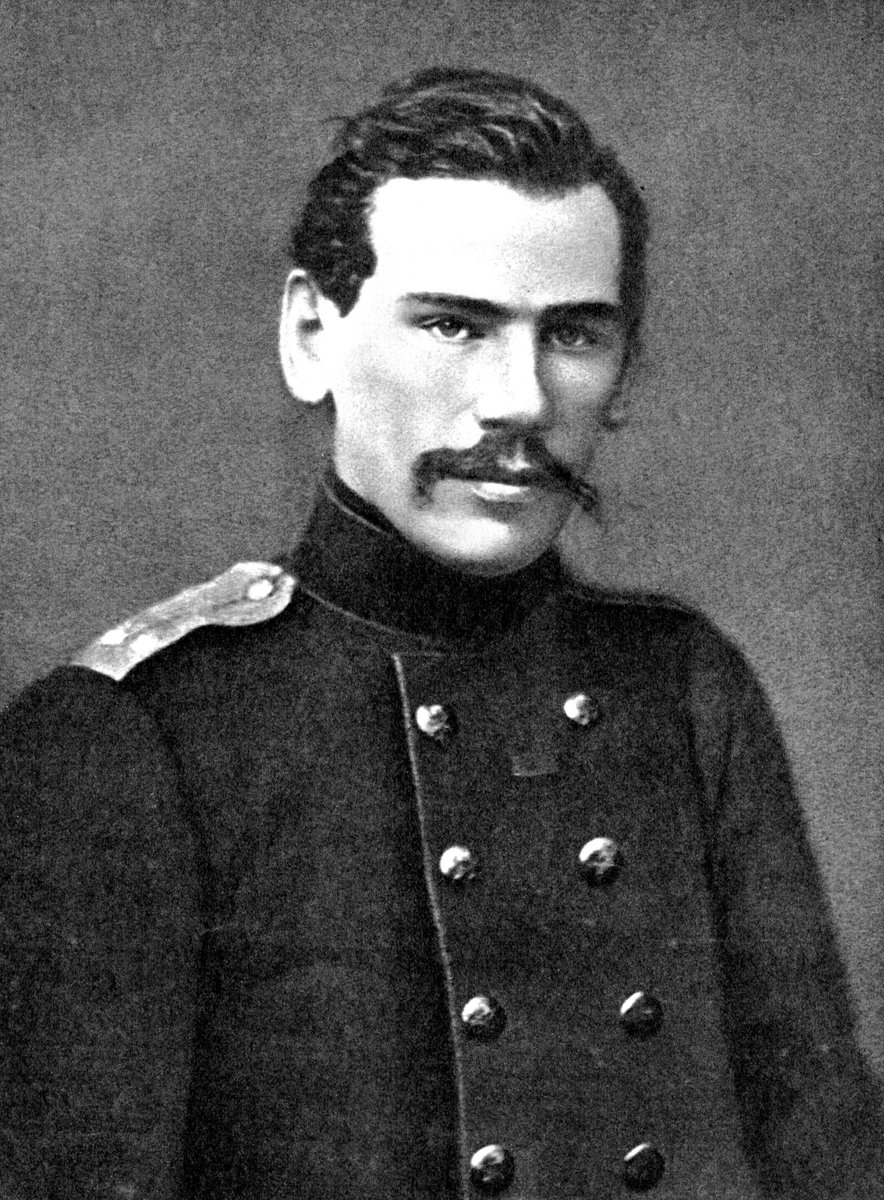
A young Leo Tolstoy

          What if Ukrainians and Russians would both rediscover the message of peace, forgiveness, and reconciliation in Tolstoy’s War & Peace? Sadly, this book is currently banned in Ukraine because of the mistaken idea that it glorifies the Russian military.
            After serving in the Crimean War as a young officer in the Russian army, Tolstoy became a committed pacifist. War & Peace never glorifies war, but rather, accurately portrays how war often embitters our souls, dehumanizes us, and robs us of the love of neighbor. Ironically, the Russian Orthodox Church excommunicated Tolstoy in 1901, partially because of his questioning their uncritical support for the Russian military.
           Many see Tolstoy as a Russian Charles Dickens. Considered by many as the world’s best novel, War & Peace overwhelms potential readers by its 1,400-page size. What surprised us as readers was how deeply Jesus’ gospel message of forgiveness was woven into this book. God is mentioned 312 times in War & Peace. Outwardly, the book is about Napoleon’s invasion of Russia, but at a deeper level, it was about human conflict and how the Kingdom of God is the only solution. 
           The Russian Prince Andrei, who represented the glorification of war in War & Peace, initially despised forgiveness as just for women and children.[i] After being mortally wounded, Andrei learns to forgive his dying enemy Anatole Kuragin, and his ex-fiancée Natasha who almost ran off with Anatole. He notably commented:

          Compassion, love of our brothers, for those who love us and for those who hate us, love of our enemies; yes, that love which God preached on earth…and I did not understand—that is what made me sorry to part with life, that is what remained for me had I lived. But now it is too late. I know it![ii]

           Andrei asks his doctor to get him a copy of the Gospels, saying that he had now a new source of happiness which had something to do with the Gospels. After discovering the law of love, Andrei met again with Natasha who was devastated with guilt and shame:

          “Forgive me!” she whispered, raising her head and glancing at him. “Forgive me!”
          “I love you,” said Prince Andrei…
          “Forgive…!”
          “Forgive what?” he asked.
          “Forgive me for what I have do-ne!” faltered Natasha in a scarcely audible, broken whisper, and began kissing his hand more rapidly, just touching it with her lips.
          “I love you more, better than before,” said Prince Andrei, lifting her face with his hand so as to look into her eyes.[iii]

            This novel could have been called Love & Forgiveness. Seventy-two times, Tolstoy talks about forgiveness in War & Peace. It was not just about the war with Napoleon, it was about the war between the sexes.

The Word of God — photo by David Kitz

            Another character in War & Peace, Pierre Bezukhov, is like a Russian Forrest Gump. He is a tragically comic figure who awkwardly stumbles into all the key times of the Napoleonic conflict, unexpectedly being a savior figure, and allowing us to observe the historic conflict in person, up close. Everything about him is unlikely, from his being an illegitimate son to becoming the wealthiest person in all of Russia. Through dreams and visions, Pierre discovered on Napoleon’s battlefield that:

            To love life is to love God. Harder and more blessed than all else is to love this life in one’s sufferings, in innocent sufferings.[i]

           Through discovering God, Pierre experienced a deep tranquility and happiness. He was no longer tormented by the meaningless of life: 

          …a simple answer was now always ready in his soul: “Because there is a God, that God without whose will not one hair falls from a man’s head.[ii]

          Meeting God gave him such a new ability to listen that people regularly told Pierre their most intimate secrets. This deep listening was what caused the embittered princess Natasha to fall in love and marry him.
           Tolstoy, a Russian aristocrat, became so enamoured with the Sermon on the Mount that he gave away all his wealth and chose to live like a peasant, tilling the land. When he decided to give up all his book income, his wife threatened to divorce him, so he compromised by only giving away the money from any of his newly written books.
            Tolstoy’s book The Kingdom of God Is Within You so impacted Mahatma Gandhi that he gave it out to his followers. Gandhi was so impressed by Tolstoy’s emphasis on the Sermon on the Mount (Matthew 5 to 7) that he read Jesus’ famous Sermon every day for the rest of his life. Tolstoy’s emphasis on non-violent resistance formed the basis of Gandhi’s campaign for Indian nationhood. Thus, through the influence of Tolstoy’s writing the entire subcontinent of India was transformed.
            Martin Luther King Jr., after reading E. Stanley Jones’ book on Gandhi, discovered the nonviolent key for his civil rights movement in America. So, the torch light of a peace-making gospel passed from a Russian author to India and onto America.
            Tolstoy’s passion for peace-making and forgiveness might even change Russian President Putin, if he would only take the time to read Tolstoy’s book.
            The late British journalist and Christian apologist Malcolm Muggeridge deeply admired the genius of Tolstoy:

         Tolstoy was one of those truly great men who come into the world at long intervals, and we need them, and we rightly continue to look to them just as the Russians do, despite all the changes that have happened.

            What if instead of resenting Russia for its tragic invasion of the Ukraine, we, like Tolstoy, began to pray passionately for its transformation? Could we have faith to believe that Russia will become a Sermon on the Mount nation, overflowing with peacemakers like Tolstoy? Let’s call out to God for such a miracle.
            On this continent in 1852, Harriet Beecher Stowe wrote a novel that transfixed America. Uncle Tom’s Cabin was the bestselling book in United States in the nineteenth century, surpassed only by the Bible.[iii] Stowe was motivated by her deep Christian faith. Her book pricked the conscience of the nation, exposed the horrors of slavery, and fomented the upheaval that led to the American Civil War which culminated in the emancipation of millions.   
            Martin Luther, Leo Tolstoy, and Harriet Beecher Stowe exemplify the incredible power of the printed page. Literary prophets are history shapers. They transformed nations and their influence remains to this day. We need more literary prophets—prophets filled with the courage of their convictions—prophets for our time.
            The written word inspires faith—life transforming faith. Perhaps John, the beloved, expressed this truth best when a the close of his Gospel he penned these immortal words: But these are written that you may believe that Jesus is the Messiah, the Son of God, and that by believing you may have life in his name (John 20:31).

[i] graf Leo Tolstoy. War and Peace (Kindle Locations 22902-22903). Kindle Edition.

[ii] graf Leo Tolstoy. War and Peace (Kindle Locations 23761-23762). Kindle Edition.

[iii] Uncle Tom’s Cabin – Wikipedia accessed March 1, 2023.

[i] graf Leo Tolstoy. War and Peace (Kindle Locations 19935-19936). Kindle Edition.

[ii] graf Leo Tolstoy. War and Peace (Kindle Locations 22902-22903). Kindle Edition.

[iii] graf Leo Tolstoy. War and Peace (Kindle Locations 19935-19936). Kindle Edition.

[i] While we honor Martin Luther as a literary prophet used in the Reformation, we acknowledge the tragic nature of the antisemitism that Luther slipped into later in his ministry.

This is the sixth weekly excerpt from the award-winning book 
The Elisha Code & the Coming Revival 

A soul-gripping read.
Is a return-to-Jesus revival possible in our time?
This book points the way forward.
For details click here.

Trusting in the LORD

18 Saturday Oct 2025

Posted by davidkitz in Psalm 112

≈ 3 Comments

Tags

brother of Jesus, gifts, James, Jesus, praise the LORD, Psalms, Righteousness, steadfast heart, the LORD, the poor, the wicked, trust in God

I will praise the LORD!
Psalm 112:6-10

Surely the righteous will never be shaken;
they will be remembered forever.
They will have no fear of bad news;
their hearts are steadfast, trusting in the LORD.
Their hearts are secure, they will have no fear;
in the end they will look in triumph on their foes.
They have freely scattered their gifts to the poor,
their righteousness endures forever;
their horn will be lifted high in honor.

The wicked will see and be vexed,
    they will gnash their teeth and waste away;
    the longings of the wicked will come to nothing. *


Para la publicación de 
Salmos 365 de hoy en español haga clic aquí.

bgbg_v4.3_1501818
* NEW INTERNATIONAL VERSION, COPYRIGHT ©1973, 1978, 1984, 2011 BY BIBLICA

Please pray for peace to return to Israel, Gaza, and Ukraine!

Volume I of Psalms 365: Develop a Life of Worship and Prayer won the Best Book of the Year Award from The Word Guild and Volume II has won the Best Devotional of the Year Award. For those who love God’s word, this three-book series is an ideal way to daily meet with the Lord. To purchase or for a closer look click here.

Coming soon…

James—the brother of Jesus—who was this man? What evidence do we have that this “brother of our Lord” even existed?

David Kitz digs deep into archeology, family dynamics, church history, and the biblical texts. What emerges from his research is a portrait of a decisive, pivotal leader who embodied the will and character of Jesus Christ.

But how did James—James the unbeliever—transform to become a leader who changed the course of world history? In these pages you will uncover the answer and rediscover for yourself the life-changing power of the gospel.

← Older posts
Newer posts →

Psalms 365: Develop a Life of Worship and Prayer

Psalms 365 Volume II

Psalms 365 vol 3
— Psalms 365 Volume III

Psalms

Recent posts

  • Betrayal & Trust April 9, 2026
  • The Third Day April 8, 2026
  • What About Spiritual Hygiene? April 8, 2026
  • Jesus Walked Along with Them April 7, 2026
  • How the mighty have fallen April 7, 2026
  • Their Words Seemed Like Nonsense April 6, 2026
  • Can you forget God? April 6, 2026

Calendar

April 2026
M T W T F S S
 12345
6789101112
13141516171819
20212223242526
27282930  
« Mar    

Blog Posts

Comments

  • Kristi on Jesus Walked Along with Them
  • davidkitz on Their Words Seemed Like Nonsense
  • Their Words Seemed Like Nonsense – QuietMomentsWithGod on Their Words Seemed Like Nonsense

Blog at WordPress.com.

Privacy & Cookies: This site uses cookies. By continuing to use this website, you agree to their use.
To find out more, including how to control cookies, see here: Cookie Policy
  • Subscribe Subscribed
    • I love the Psalms
    • Join 1,383 other subscribers
    • Already have a WordPress.com account? Log in now.
    • I love the Psalms
    • Subscribe Subscribed
    • Sign up
    • Log in
    • Report this content
    • View site in Reader
    • Manage subscriptions
    • Collapse this bar
 

Loading Comments...