• Home
  • About
  • DavidKitz.ca
  • Youtube Videos
  • Books by David
  • Books on Amazon.com

I love the Psalms

~ Connecting daily with God through the Psalms

I love the Psalms

Tag Archives: Jesus

In the Day of Your Power

07 Friday Mar 2025

Posted by davidkitz in Psalm 89, Psalms

≈ Leave a comment

Tags

Bible, David, God, Jesus, Melchizedek, Prayer, priest, Psalms, Savior, strength, the LORD

Today’s quote and prayer from
“Psalms 365: Develop a Life of Worship and Prayer”
by David Kitz.

Reading: Psalm 89:19-29

LORD God,
 I am thankful for Jesus.
I am thankful that in the dark long ago
you devised a plan to send a Savior
to this world.
You sent a better son than David.
You sent Jesus,
my Redeemer.

Amen.

— — —

A Psalm of David.

The LORD said to my Lord,
“Sit at My right hand,
Till I make Your enemies Your footstool.”
The LORD shall send the rod of Your strength out of Zion.
Rule in the midst of Your enemies!
Your people shall be volunteers
In the day of Your power;
In the beauties of holiness,
from the womb of the morning,
You have the dew of Your youth.
The LORD has sworn
And will not relent,
“You are a priest forever
According to the order of Melchizedek.”
(Psalms 110:1-4)*

Para la publicación de Salmos 365 de hoy en español haga clic aquí.

bgbg_v4.3_1501818
* NEW KING JAMES VERSION

Please pray for peace to return to Israel, Gaza, and Ukraine!

New from David Kitz
Winner of the 2024 Word Award of Merit in Biblical Studies
TheElishaCodeCVR5

To purchase or for a closer look click here.

Volume I of Psalms 365: Develop a Life of Worship and Prayer won the Best Book of the Year Award from The Word Guild and Volume II has won the Best Devotional of the Year Award. For those who love God’s word, this three-book series is an ideal way to daily meet with the Lord. To purchase or for a closer look click here.

This biblically accurate novel is ideal for the Lent/Easter season.
For details click here.

The Firstborn King

07 Friday Mar 2025

Posted by davidkitz in Psalms

≈ 3 Comments

Tags

anointing, covenant, David, faithfulness, Jesus, kingship, promise, prophecy, Savior, thanksgiving

Today’s Devotion from Psalms 365 by David Kitz

Reading: Psalm 89:19-29
Once you spoke in a vision,
to your faithful people you said:
“I have bestowed strength on a warrior;
I have raised up a young man from among the people.
I have found David my servant; with my sacred oil I have anointed him.
My hand will sustain him; surely my arm will strengthen him.
The enemy will not get the better of him;
the wicked will not oppress him.
I will crush his foes before him and strike down his adversaries.
My faithful love will be with him,
and through my name his horn will be exalted.
I will set his hand over the sea, his right hand over the rivers.
He will call out to me, ‘You are my Father,
my God, the Rock my Savior.’
And I will appoint him to be my firstborn,
the most exalted of the kings of the earth.
I will maintain my love to him forever,
and my covenant with him will never fail.
I will establish his line forever,
his throne as long as the heavens endure (NIV). *

Reflection
Who is the principal figure in the Old Testament canon? Some would argue for Moses, the liberator of a nation of slaves. Others would go farther back yet to Abraham, the ancestral father of the nation of Israel. Here in Psalm 89, Ethan the Ezrahite and author of this psalm casts his vote in favor of David.

David’s name appears more frequently in the Bible than any name including the name of Jesus. Here in Psalm 89, Ethan draws a direct prophetic link to Jesus, the Son of God. He writes this about David: He will call out to me, ‘You are my Father, my God, the Rock my Savior.’ And I will appoint him to be my firstborn, the most exalted of the kings of the earth (v. 26-27).

No other man in the Holy Scriptures can claim to be appointed as God’s firstborn. This is an honor that is reserved for David alone. But David prefigures or foreshadows Jesus, the true Son of God. Jesus was not appointed to the role of God’s son. He was conceived and born into this world as the divine Son of the Most High. Through the miracle of incarnation, the son of Mary was also the Son of God and the Savior of the world. And this Mary was of royal lineage. She was a direct descendant of King David.

In Jesus Christ these words find their fulfillment: I will maintain my love to him [David] forever, and my covenant with him will never fail. I will establish his [David’s] line forever, his throne as long as the heavens endure (v. 28-29).

Response: LORD God, I am thankful for Jesus. I am thankful that in the dark long ago you devised a plan to send a Savior to this world. You sent a better son than David. You sent Jesus. Amen.

Your Turn: Are you thankful for God’s Son? Why? How will you express your appreciation today?

Para la publicación de Salmos 365 de hoy en español haga clic aquí.

bgbg_v4.3_1501818
* NEW INTERNATIONAL VERSION, COPYRIGHT ©1973, 1978, 1984, 2011 BY BIBLICA

Please pray for peace to return to Israel, Gaza, and Ukraine!

Volume I of Psalms 365: Develop a Life of Worship and Prayer won the Best Book of the Year Award from The Word Guild and Volume II has won the Best Devotional of the Year Award. For those who love God’s word, this three-book series is an ideal way to begin the new year, and daily meet with the Lord. To purchase or for a closer look click here.

RGB72PsalmsVol2

A gripping read from David Kitz.
4485 SHARABLE-2

This biblically accurate novel is ideal for the Lent/Easter season.
For details click here.

I Kneel before the Father

05 Wednesday Mar 2025

Posted by davidkitz in Psalm 89

≈ 1 Comment

Tags

Bible, Christ, faith, God, Jesus, love of Christ, pleasing God, power, Prayer, Psalms, the LORD

Today’s quote and prayer from
“Psalms 365: Develop a Life of Worship and Prayer”
by David Kitz.

Reading: Psalm 89:5-13

LORD God,
I marvel at your wisdom and power.
But most of all I marvel at your love—
love that encompasses all—
even me.
Help me to excel at pleasing you.
Thank you, LORD! 

Amen.

— — —

For this reason I kneel before the Father, 
from whom every family
in heaven and on earth derives its name.
 
I pray that out of his glorious riches 
he may strengthen you with power 
through his Spirit in your inner being,
 so that Christ may dwell in your hearts 
through faith.
And I pray that you,
being rooted and established in love,
 
may have power,
together with all the Lord’s holy people, 
to grasp how wide and long
and high and deep is the love of Christ,

and to know this love
that surpasses knowledge—
that you may be filled 
to the measure of all the fullness of God.

(Ephesians 3:14-19)*

Para la publicación de Salmos 365 de hoy en español haga clic aquí.

bgbg_v4.3_1501818
* NEW INTERNATIONAL VERSION, COPYRIGHT ©1973, 1978, 1984, 2011 BY BIBLICA

Please pray for peace to return to Israel, Gaza, and Ukraine!

New from David Kitz
Winner of the 2024 Word Award of Merit in Biblical Studies
TheElishaCodeCVR5

To purchase or for a closer look click here.

Volume I of Psalms 365: Develop a Life of Worship and Prayer won the Best Book of the Year Award from The Word Guild and Volume II has won the Best Devotional of the Year Award. For those who love God’s word, this three-book series is an ideal way to daily meet with the Lord. To purchase or for a closer look click here.

This biblically accurate novel is ideal for the Lent/Easter season.
For details click here.

Chosen before the Creation of the World

04 Tuesday Mar 2025

Posted by davidkitz in Psalm 89

≈ Leave a comment

Tags

adoption, Bible, God, God's chosen, holy, Jesus, Prayer, predestined, Psalms, the LORD

Today’s quote and prayer from
“Psalms 365: Develop a Life of Worship and Prayer”
by David Kitz.

Reading: Psalm 89:1-4

LORD God,
I am so glad
that I’m your child forever.
You have loved me
and welcomed me into your family.
Thank you.
Thank you, Jesus.
Thank you!

Amen.

— — —

For he chose us in him
before the creation of the world 
to be holy and blameless in his sight.
In love
 he predestined us
for adoption to sonship
 through Jesus Christ,
in accordance with his pleasure and will—
 
to the praise of his glorious grace, 
which he has freely given us
in the One he loves.

(Ephesians 1:4-6)*

Para la publicación de Salmos 365 de hoy en español haga clic aquí.

bgbg_v4.3_1501818
* NEW INTERNATIONAL VERSION, COPYRIGHT ©1973, 1978, 1984, 2011 BY BIBLICA

Please pray for peace to return to Israel, Gaza, and Ukraine!

New from David Kitz
Winner of the 2024 Word Award of Merit in Biblical Studies
TheElishaCodeCVR5

To purchase or for a closer look click here.

Volume I of Psalms 365: Develop a Life of Worship and Prayer won the Best Book of the Year Award from The Word Guild and Volume II has won the Best Devotional of the Year Award. For those who love God’s word, this three-book series is an ideal way to daily meet with the Lord. To purchase or for a closer look click here.

This biblically accurate novel is ideal for the Lent/Easter season.
For details click here.

The God of Hope

03 Monday Mar 2025

Posted by davidkitz in Psalm 88

≈ 1 Comment

Tags

Bible, God, Holy Spirit, hope in God, Jesus, Prayer, Psalms, the LORD, trust in God

Today’s quote and prayer from
“Psalms 365: Develop a Life of Worship and Prayer”
by David Kitz.

Reading: Psalm 88:9-18

LORD God,
when I am down,
I cry to you for help.
You are my hope
when all hope is gone.
Come to me in the dark times of my life.
Lord Jesus,
at such times I need you the most.

Amen.

— — —

And again, Isaiah says,

“The Root of Jesse will spring up,
    one who will arise to rule over the nations;
    in him the Gentiles will hope.”

May the God of hope
fill you with all joy and peace 
as you trust in him,
so that you may overflow with hope
by the power of the Holy Spirit.

(Romans 15:12-13)*

Para la publicación de Salmos 365 de hoy en español haga clic aquí.

bgbg_v4.3_1501818
* NEW INTERNATIONAL VERSION, COPYRIGHT ©1973, 1978, 1984, 2011 BY BIBLICA

Please pray for peace to return to Israel, Gaza, and Ukraine!

New from David Kitz
Winner of the 2024 Word Award of Merit in Biblical Studies
TheElishaCodeCVR5

To purchase or for a closer look click here.

Volume I of Psalms 365: Develop a Life of Worship and Prayer won the Best Book of the Year Award from The Word Guild and Volume II has won the Best Devotional of the Year Award. For those who love God’s word, this three-book series is an ideal way to daily meet with the Lord. To purchase or for a closer look click here.

The Third Witness Prompts Response

02 Sunday Mar 2025

Posted by davidkitz in Psalms, Psalms Alive!

≈ Leave a comment

Tags

confession, Creator, David, God, God's forgiveness, Holy Spirit, Jesus, meditation, Prayer, Psalms, the LORD, transgressions, wilful sins, witness

Psalm 19:12-14
Who can discern his errors?
Forgive my hidden faults.
Keep your servant also from wilful sins;
may they not rule over me.
Then will I be blameless,
innocent of great transgression.
May the words of my mouth
and the meditation of my heart
be pleasing in your sight,
O LORD, my Rock and my Redeemer. (NIV)

What is your response to God’s word and His voice as it speaks to your heart?

That’s exactly what we find here in this final portion of Psalm 19. Here we see David’s response to God. God has been doing the talking thus far. God has been speaking to David through the stars, through the night sky, and the blazing heat of the sun—the first witness. He has spoken to him through the Word of God—His written revelation—the second witness. Now as this Psalm draws to a close, we hear David responding back to God.

In actuality, David is responding to the third witness. His heart is bearing witness to the reality of God. His conscience is convicting him of his sin and of the righteousness of God. We all have this third witness within us—a witness that will not be silenced, though we may try to drown out this inner voice of the Spirit.

This dialogue between God and man is one of the unique features of the Psalms. The Psalms are not simply the statements of a man in prayer, or even the words of a man caught up in praise and worship of his Creator. God speaks back, or as we see here in this Psalm, God initiates the conversation. We are eaves dropping on a conversation between a human being—someone just like us, caught up in the same travails and passions—and the transcendent, eternal God of the universe.

What a conversation! What communion we find here! This isn’t God pronouncing His dictates from heaven, though He has every right to do so. This is God whispering in the ear of an individual who is struggling to know and understand God’s will. And if God can speak to David in this manner, then there is hope for us. God can speak to us too. Surely this is why the Psalms have resonated with humankind throughout the ages. 

If along with David, we have heard the voices of the first and second witness, then there is only one appropriate response. It is the response recorded here in Holy Scriptures. If we see and grasp the awesome power and majesty of God, if through His word we have glimpsed His holiness, then we are brought low. We are humbled before him. Our greatest achievements are nothing. Our pride dissolves. Our weakness, our smallness is self-evident in the presence of the LORD of heaven and earth. We are exposed; our sin is exposed before this holy, magnificent God. 

Hear David’s response, “Who can discern his errors? Forgive my hidden faults.

We all stand naked of soul before our Creator. The all-seeing One knows us. He knows us intimately. There are no secrets in His all-encompassing dominion. He sees all. He knows all. We can hide nothing from Him.

But hiding is the human heart’s first response. Adam and Eve did it first. They hid from their Creator immediately after their initial sin. In fact, hiding is what our Adamic nature does best. Since our first parents fall, we have had thousands of years to perfect the art of hiding. And it truly is an art. We have all seen and heard a young child’s amateur attempts at a lie. And lies are simply a verbal attempted at hiding the truth. As we mature, we become ever more sophisticated at hiding the truth. We excuse our faults and quickly sweep them under the carpet, and for many of us the thickest and most luxurious carpets are religious carpets. They are great for hiding a multitude of sins.

One of my earliest childhood memories is an attempt to hide from my mother. I hid behind the living room drapes. They were made of thick, heavy material. I could not see her through them, so I reasoned that I must be safe. My feet were left exposed, and the form of my body was obvious as I pressed my back against the wall. It’s not hard to guess the outcome of this bit of childish foolery.

 All of us have tried to play peek-a-boo with God. Our faulty reasoning goes something like this. If I hide from Him, and I can’t see Him—if I completely ignore Him —He must not be there. I cannot see Him; He cannot see me. He will pass by without noticing me.

But a barefaced encounter with the Almighty exposes all. We have come to the Light. Nothing is hidden or can be hidden. We can’t play peek-a-boo with God.

David has been found by God. He has been found naked, just as our first parents were found naked in the Garden. Ah, but that’s not what the Adam and Eve story says. The Bible says, “they sewed fig leaves together and made coverings for themselves” (Genesis 3:7).

They were not naked. No, Eve and Adam had managed to pull a curtain over themselves as they hid in God’s living room. But their feet were exposed, even as their butts were pressed against the proverbial wall.

The truth is they were naked of soul before the all-seeing God. We are always naked of soul before Him, no matter what outer garb we put on.

Hence, David’s first response to God is so appropriate, “Who can discern his errors? Forgive my hidden faults.”

With these words, David is giving voice, to his inner voice, his conscience. The third witness is testifying to the reality of God—a God before whom, we must all give account. The God, who speaks externally through creation, and his holy written word, also speaks from within the human heart. His voice is prompting David to respond.

David is confessing that before the all-seeing One, he is naked. Not only is he fully exposed, but he is incapable of fully discerning his own sin. He cannot see himself in his entirety. Only God can see him completely.

We should note our inability to fully see ourselves is true on every level. All too often, we are blind to the consequences of our actions, blind to our character faults, blind to the annoying quirks that drive others from us. We cannot stand outside of ourselves and see ourselves fully or accurately. This is as true on the physical level as it is on the spiritual level.

Think on the following statement for a moment: You have never seen your own face. It’s true. A photograph of your face is an image of your face caught in time, but it is only an image. It is not your face. The image of your face in a mirror is just that. It is an image; it is not your face. The truth is you have never seen your own face. Only others can see your full physical form.

Only God can see you in your entirety, spirit, soul and body. He sees you from the outside and from the inside, from your beginning to your end.

 In this Psalm, David finds himself face to face with this all-seeing, all-knowing God. In humility he pleads, “Forgive my hidden faults.”

If we perceive God correctly, and if we assess ourselves accurately and honestly, then we quickly realize our greatest need. Our greatest need is for forgiveness. This is the bedrock on which any human relationship with God is built.

Next, because David longs to live in relationship with this amazing God, he cries out for holiness, “Keep your servant also from wilful sins; may they not rule over me. Then will I be blameless, innocent of great transgression (Psalm 19:13).

 We should note here that there are degrees of sin. For example, John the disciple, writes in his first letter, “There is a sin that leads to death” (1 John 5:16). John then goes on to state that, “All wrongdoing is sin, and there is a sin that does not lead to death (1 John 5:16).

But perhaps nowhere in all of the scriptures are the degrees of sin more clearly delineated than here in this passage. David begins by asking, “Who can discern his errors?”

There is no intent in errors. We all make mistakes. In this great exam called life, errors will occur. Even the most spiritually studious fall short of perfection. To sin is to miss the mark, and all, even the saintliest, will from time to time miss God’s mark of perfection.

David asks God to forgive hidden sins. We all possess an ample supply of these. Some sins are hidden from others. We may confess these sins to God, but to others they remain a secret that we take with us to our graves.

Yet other sins are hidden from us. We fail to see our own faults, which may be glaringly obvious to others. A truly good friend will not only forgive our faults, but in time he will help us to see and overcome these hidden sins.

Now as David prays, he asks, “Keep your servant also from wilful sins; may they not rule over me.”

Here we have transitioned from errors, which are unintentional sins, to the realm of wilful sins. This is a conscious decision to do wrong, to disobey God and His laws or requirements. This is a very slippery slope. Notice how wilful sin can turn into a controlling monster. We begin by wilfully choosing to disobey, but when this sin has taken root and is allowed to grow, something changes. It grows into a monstrosity. What we freely chose, now chooses us. We become its slave. It rules over us. Our will is overpowered. Any addict can testify to the ravenous power of this sin monster. Every wilful sin has an addictive power associated with it. That’s why David wants to avoid this trap. He prays, “Keep your servant also from wilful sins.”

David longs to be “blameless, innocent of great transgression.”

What is great transgression? It could be argued that it is sin that leads to death. James, the brother of our LORD writes, “We are tempted by our own desires that drag us off and trap us. And when sin is finished with us, it leaves us dead” (James 1:14-15).

But within David beats a different heart. He longs for holiness. His desire is for a blameless life—a life lived in relationship with God. It’s as though David is saying to God, “Those evening walks you took with Adam in the Garden, can we go for one of those LORD?”

Hear his prayer, “May the words of my mouth and the meditation of my heart be pleasing in your sight, O LORD, my Rock and my Redeemer.”

With these words David has identified the source of sin and the cornerstone of any hope for holiness, as we live out our lives on this earth. The source point is the human heart. If our hearts are right before God, there is hope. If our hearts are fixed on our Rock and our Redeemer, we can bring pleasure to Him.

Jesus said, “The things that come out of the mouth come from the heart, and these make a man ‘unclean’. For out of the heart come evil thoughts, murder, adultery, sexual immorality, theft, false testimony, slander. These make a man unclean” (Matthew 15:18-20).

Jesus knew the desperately wicked state of our hearts. David knew his own heart too. He knew it needed cleansing and forgiveness. That’s why he cries out for it. He knew that our mouths speak from the overflow of the heart. The meditation of the heart must be pure if the words we speak are to bring life and encouragement.

Your words are important. There is no such thing as an idle word. In a world that constantly spews forth verbal sewer filth, God is looking for those with a pure heart. Your heavenly Father does not need a stethoscope to check the condition of your heart. He only needs to listen to the words coming out of your mouth.

Notice how David wants his words and his heart to bring pleasure to God. His prayer is that they be pleasing in His sight. O, to bring pleasure to the all-seeing One! That is his prayer. He does not wish to hide; hiding is futile. No, he longs to consciously live his life in the full and constant view of the LORD.

We have all endured annoying music, droning noises or irritating voices that grate on our nerves. But the opposite is so refreshing. Soothing music, joyful noises and happy voices invigorate us. They bring gladness into our lives.

Like David, make it your goal to bring gladness to your Rock and your Redeemer. Put a smile on your Father’s face.   

Bringing Life to the Psalms

  1. Read James 2:1-12. There is no clearer biblical discourse on the power of the tongue for both good and evil. Heed the advice found there.
  2. Do you have a foul mouth? Determine to clean up your conversation. When you slip up make Psalm 19:14 your prayer.
  3. Is the third witness—the inner voice of God’s Spirit—speaking to you? Take time to respond to God. Use David’s prayer in this final portion of Psalm 19 as a pattern for your own response to the Holy Spirit’s prompting.
  4. Take time to meditate on God’s word. Select a passage and read it repeatedly. See it; smell it; taste it. Let it become part of you. In our rushed world become a cow. Lie down, relax and chew your mental cud. Meditating on God’s word is like that.
  5. Psalm 19 has a Trinitarian structure that points to the Triune God, who is the source point of all Holy Scripture. The first portion of this psalm introduces us to our heavenly Father, the LORD God of creation. The second portion extols the virtues of the Word of God. John’s Gospel introduces Jesus as the Word of God. The Word became flesh and made his dwelling among us. We have seen his glory, the glory of the one and only Son, who came from the Father, full of grace and truth (John 1:14). Finally, we witness the convicting power of the Holy Spirit as David cries out, “Forgive my hidden faults. Keep your servant also from wilful sins; may they not rule over me” (Psalm 19:12-13). The concept of the Trinity was and is foreign to the Jewish faith, yet it is written into its foundational texts. How do you account for the remarkable presence of this coded truth?
  6. Now take a minute to reread all of Psalm 19. What is God saying to you by His Spirit?

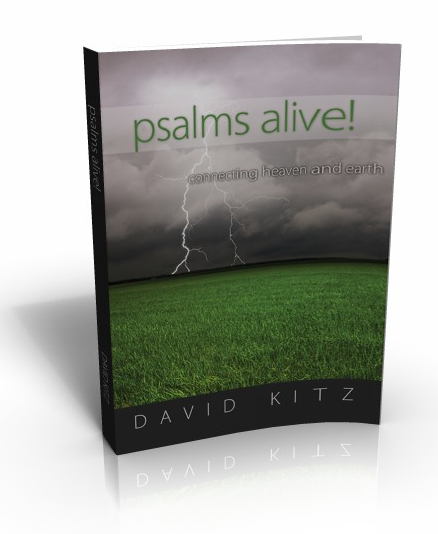
Today’s post is the third chapter from the book Psalms Alive! Connecting Heaven & Earth by David Kitz. To find out more or purchase click here.
Encourage One Another

28 Friday Feb 2025

Posted by davidkitz in Psalm 88

≈ 2 Comments

Tags

Bible, encouragement, faith, God, Jesus, Prayer, Psalms, salvation, the LORD, trust in God

Today’s quote and prayer from
“Psalms 365: Develop a Life of Worship and Prayer”
by David Kitz.

Reading: Psalm 88

LORD God,
I need your comfort.
Hear my prayer and answer me.
In my times of sorrow
show me a sign of your love and favor, Lord.
I confess
that the never ending
love of Jesus sustains me.

Amen.

— — —

But since we belong to the day,
let us be sober,
putting on faith and love as a breastplate,
and the hope of salvation as a helmet.
 
For God did not appoint us to suffer wrath
but to receive salvation
through our Lord Jesus Christ.
 
He died for us so that,
whether we are awake or asleep,
we may live together with him.
 
Therefore encourage one another
and build each other up,
just as in fact you are doing.

(1 Thessalonians 5:8-11)*

Para la publicación de Salmos 365 de hoy en español haga clic aquí.

bgbg_v4.3_1501818
* NEW INTERNATIONAL VERSION, COPYRIGHT ©1973, 1978, 1984, 2011 BY BIBLICA

Please pray for peace to return to Israel, Gaza, and Ukraine!

New from David Kitz
Winner of the 2024 Word Award of Merit in Biblical Studies
TheElishaCodeCVR5

To purchase or for a closer look click here.

Volume I of Psalms 365: Develop a Life of Worship and Prayer won the Best Book of the Year Award from The Word Guild and Volume II has won the Best Devotional of the Year Award. For those who love God’s word, this three-book series is an ideal way to daily meet with the Lord. To purchase or for a closer look click here.

Yahweh: The Lord Over All

25 Tuesday Feb 2025

Posted by davidkitz in Psalms

≈ Leave a comment

Tags

devotion, distractions, faith, focus, God, Heart, Jesus, love, nations, praise, Prayer, revelation, Savior, trust, worship

Today’s Devotion from Psalms 365 by David Kitz

Reading: Psalm 86:8-13
Among the gods there is none like you, Lord;
no deeds can compare with yours.
All the nations you have made
will come and worship before you, Lord;
they will bring glory to your name.
For you are great and do marvelous deeds;
you alone are God.
Teach me your way, LORD,
that I may rely on your faithfulness;
give me an undivided heart,
that I may fear your name.
I will praise you, Lord my God, with all my heart;
I will glorify your name forever.
For great is your love toward me;
you have delivered me from the depths,
from the realm of the dead (NIV). *

Spring melt — photo by David Kitz

Reflection
Today’s reading from Psalm 86 begins with this prophetic declaration. All the nations you have made will come and worship before you, Lord; they will bring glory to your name (v. 9).

Psalm 86 is a prayer of David, but within this prayer David makes this prophetic statement about all nations worshipping the Lord. By the Spirit of God, David saw and declared what is to come. In the pantheistic world of his time, David saw that the God he served was not a local or national god. He saw that Yahweh, the LORD was, is and will be the Lord overall. How could David know that the God of Israel would come to be worshipped in every nation on the earth?

David grasped the big picture. Or a better explanation might be that the God of the big picture grasped David and revealed this truth to him. Through David’s line would come a Savior—a Savior named Jesus—a Jewish Savior for the whole world.

Why was David able to receive such a profound revelation? We are given a clue in the words of his prayer. Teach me your way, LORD, that I may rely on your faithfulness; give me an undivided heart, that I may fear your name (v.11).

The answer may lie in David’s heart. He had an undivided heart. In other words, he was wholehearted in his love for the Lord. He had a single-minded focus on God. He says just that in the next line of his prayer. I will praise you, Lord my God, with all my heart; I will glorify your name forever (v. 12).

Are you wholehearted in your love and praise for the Lord?

Response: LORD God, unite my heart to praise your name. I don’t want to be distracted by the pursuits of this world. I set my affection on you. Thank you for loving me as your child. Amen.

Your Turn: What are some of the things that distract you from loving and fearing God? How can you develop an undivided heart?

Para la publicación de Salmos 365 de hoy en español haga clic aquí.

bgbg_v4.3_1501818
* NEW INTERNATIONAL VERSION, COPYRIGHT ©1973, 1978, 1984, 2011 BY BIBLICA

Please pray for peace to return to Israel, Gaza, and Ukraine!

Volume I of Psalms 365: Develop a Life of Worship and Prayer won the Best Book of the Year Award from The Word Guild and Volume II has won the Best Devotional of the Year Award. For those who love God’s word, this three-book series is an ideal way to begin the new year, and daily meet with the Lord. To purchase or for a closer look click here.

RGB72PsalmsVol2

A gripping read from David Kitz.
4485 SHARABLE-2

To purchase or for a closer look click here.

The True Posture of Prayer

24 Monday Feb 2025

Posted by davidkitz in Psalms

≈ Leave a comment

Tags

Beatitudes, Bible, blessings, David, devotion, eternity, faith, God, grace, humility, Jesus, mercy, Prayer, Psalms, redemption, Reflection, Scripture, Spirituality, trust, worship

Today’s Devotion from Psalms 365 by David Kitz

Reading: Psalm 86:1-7
A prayer of David.
Hear me, LORD, and answer me,
for I am poor and needy.
Guard my life, for I am faithful to you;
save your servant who trusts in you.
You are my God; have mercy on me, Lord,
for I call to you all day long.
Bring joy to your servant, Lord,
for I put my trust in you.
You, Lord, are forgiving and good,
abounding in love to all who call to you.
Hear my prayer, LORD;
listen to my cry for mercy.
When I am in distress, I call to you,
because you answer me (NIV). *

Photo by David Kitz

Reflection
What posture or position do you take when you pray? Do you kneel, stand, or lie prostrate? Do you bow your head, or raise your head and look heavenward? Do you fold your hands or raise them to God?

The Bible describes people taking various positions or postures in prayer. We cannot be certain of the physical position that David took when he prayed the words of Psalm 86. But we can be sure of this. In his heart David assumed a position of humility. His opening statement reveals a man with a humble heart. Hear me, LORD, and answer me, for I am poor and needy (v. 1).

David spent about forty years as the King of Israel. Though his early years were a struggle for survival against the murderous schemes of King Saul, David’s later years were blessed by victory and prosperity. But here in this psalm David calls himself poor and needy. He exemplifies for us the first of Jesus’ Beatitudes. “Blessed are the poor in spirit, for theirs is the kingdom of heaven” (Matthew 5:3).

In God’s eyes we are always poor and needy. Though I may have billions of dollars, what is my piddling prosperity in the sight of the owner and Creator of the universe? Can that money buy me an hour in heaven? Can it buy me immortality? Of course, it can’t. Despite his vast wealth, Apple founder Steve Jobs was unable to buy a longer life. In the end, like King David, Jobs found he was helpless, poor, and needy.

Considering this truth—in the light of eternity—let us come—poor beggars that we are to the mercy seat of God. There we can lay our burdens down. There we can humbly bring our petitions. There we can meet with Jesus. “For you know that it was not with perishable things such as silver or gold that you were redeemed from the empty way of life handed down to you from your ancestors, but with the precious blood of Christ, a lamb without blemish or defect” (1 Peter 1:18-19).

Response: LORD God, I confess I am poor and needy. My future, my whole life is in your hands. I do not own my next breath. When I am in distress, I call to you, because you answer me. Amen.

Your Turn: Pride and prayer don’t fit well together. What positions do you take when you pray?

Para la publicación de Salmos 365 de hoy en español haga clic aquí.

bgbg_v4.3_1501818
* NEW INTERNATIONAL VERSION, COPYRIGHT ©1973, 1978, 1984, 2011 BY BIBLICA

Please pray for peace to return to Israel, Gaza, and Ukraine!

Volume I of Psalms 365: Develop a Life of Worship and Prayer won the Best Book of the Year Award from The Word Guild and Volume II has won the Best Devotional of the Year Award. For those who love God’s word, this three-book series is an ideal way to begin the new year, and daily meet with the Lord. To purchase or for a closer look click here.

RGB72PsalmsVol2

A gripping read from David Kitz.
4485 SHARABLE-2

To purchase or for a closer look click here.

The Second Witness Speaks

23 Sunday Feb 2025

Posted by davidkitz in Psalms, Psalms Alive!

≈ Leave a comment

Tags

character of God, David, fear of the LORD, God, God's word, holy, Jesus, nature, nature of God, Psalms, Scripture, the LORD, trust in God, witness, word of God

Psalm 19:7:11
The law of the LORD is perfect,
reviving the soul.
The statutes of the LORD are trustworthy,
making wise the simple.
The precepts of the LORD are right,
giving joy to the heart.
The commands of the LORD are radiant,
giving light to the eyes.
The fear of the LORD is pure,
enduring forever.
The ordinances of the LORD are sure
and altogether righteous.
They are more precious than gold,
than much pure gold;
They are sweeter than honey,
than honey from the comb.
By them is your servant warned;
In keeping them there is great reward. (NIV)

             If nature is the first witness to testify to the glory of God, then the Scriptures, the written word of God, constitute the second great witness to speak of God’s existence. Both these great witnesses have gathered here to testify within the context of this Psalm. The voice of the speaking stars is now joined by the voice of the written Holy Word.

Nowhere else in Scriptures are these two witnesses so clearly juxtaposed. They have joined forces—linked arms—to deliver a message to David. And through David they deliver their message to us.

And what is that message? It is a message about the character of God. While nature speaks to us of the existence of God the Creator, it is largely silent regarding the nature or character of this all-powerful supernatural being. Is He good? Is He evil? Is He indifferent to us? Is He angry with us? What is this great, overarching, omnipresent God really like? May we approach Him?

Photo courtesy of L. Kranz

The Scriptures provide us with the answers to these questions. The apostle Peter tells us something of how the Scriptures came into being. He says that, “Men spoke from God as they were carried along by the Holy Spirit” (2 Peter 1:21).

Furthermore, Paul the apostle informed Timothy, his son in the faith that, “All scripture is God-breathed and is useful for teaching, rebuking, correcting and training in righteousness, so that the man of God may be thoroughly equipped for every good work” (2 Timothy 3:16-17).

Now listen to what this second witness, the witness of the Word, testifies to David concerning himself, and the God of the heavens?

The law of the LORD is perfect, reviving the soul.

The law is perfect, flawless, inerrant and infallible. Only a perfect, flawless, inerrant and infallible God can be the source of such a document. The law of the LORD that is referred to here is in fact the Bible, the Word of God. Jack Hayford in his commentary on this verse from the Psalms states, “That the ‘law of the LORD is perfect,’ is direct reference to the absolute, complete, and entire trustworthiness of the Holy Scriptures, which constitute the Bible.”[1]

And this perfect, true and infallible law, or Word of God, has an effect. The Word of God is active. It revives the soul. God’s word literally brings souls back to life.

If as Paul told Timothy, the scriptures are God-breathed, then it is legitimate to ask, “When did the breath of life leave them?”

The answer is, “It never has. The Bible is still alive and breathing.”

Please forgive me as I indulge in a brief fantasy. Can you visualize this scene? Some unsuspecting soul, let’s call him Bob, casually walks into a living room and plunks himself down in a big easy chair. Bob glances over at the side table and notices a Bible lying there. At first he shows no interest. But then suddenly he detects movement. Bob’s jaw drops open and his eyes become big as saucers. The Bible is moving. Its pages slowly rise and fall in a rhythmic breathing fashion. In fact Bob detects the audible sound of escaping of breath from the open pages. Our hapless friend catapults from his chair. He bolts from the room screaming, “It’s alive! It’s alive!”

If only the living nature of God’s word—the aliveness of the Bible—would become that obvious to us all!

When the apostle Paul writes of the God-breathed scriptures, he is really drawing us into the genesis imagery regarding the origin of human life.

The LORD God formed the man from the dust of the ground and breathed into his nostrils the breath of life, and the man became a living being (Genesis 2:7)

This same LORD God used the same method to bring life to his written word. The God-breathed scriptures have a life of their own. Hence the writer of the book of Hebrews declares, “The word of God is living and active. Sharper than any double-edged sword, it penetrates even to dividing soul and spirit, joints and marrow; it judges the thoughts and attitudes of the heart” (Hebrews 4:12).

Now David states in this Psalm that the law, and please remember that here the Hebraic understanding of the term law refers to the whole of God’s written word, this law brings revival to the soul. Life begets life. The living Word of God generates spiritual life. As surely as our father Adam became the father of human life, so too the written word of God has been busy fathering life since it began its God-breathed, God-initiated existence.

God’s word revives the soul. Adam’s seed can initiate biological life. But it takes the word of God to initiate spirit life inside the human soul. Since Adam’s fall we all enter this world physically alive but spiritually dead.

In Paul’s letter to the Ephesians, he wrote:

“As for you, you were dead in your transgressions and sins, in which you used to   live when you followed the ways of this world and of the ruler of the kingdom of   the air, the spirit who is now at work in those who are disobedient” (Ephesians 2:1-2).

It is God’s holy written word that revives that part of us that died when our first parents disobeyed. Spiritual death occurred the moment Adam and Eve disobeyed. Their obedience to Satan’s temptation empowered this ruler of the kingdom of the air. His rulership in the world had its genesis with this first sin. The prince of death established his reign.

Now here in this Psalm, by God-breathed revelation, this witness speaks of the reviving work of God’s word. When God’s word is brought into contact with the human soul, spirit life springs forth. Our souls are reconnected with our Creator. The harmony between God and man that was lost in the Garden is suddenly restored.

I am a gardener, and every spring I take dry, dead-looking seeds out of a package and drop them into the soil of my garden. And every spring a certain kind of magic takes place. Those dead-looking seeds come to life, and a barren patch of ground becomes an oasis of life and abundance.

Now that’s a picture of God’s written word coming to life in the warm soil of the human heart; a spiritually dead clod of earth suddenly comes alive with the vibrant, pulsating fullness of spirit life—life that comes directly from the Father of lights. There’s no experience like it. This is rebirth. This is revival. God’s word is the true source of this life that has been reborn. The living word has been busy begetting new life.

Now let’s return to the premise we began with at the start of this chapter. That premise is that the written word of God reveals the character of God. Thus far, the second witness has testified to the truth of God’s word. We have learned that God’s word is perfect, hence God is perfect. But that perfect word or law does not leave us dead, it brings revival.

Next the great witness which is God’s word declares, “The statutes of the LORD are trustworthy, making wise the simple.” Only a trustworthy God would give us trustworthy statutes. So, God is trustworthy.

Furthermore, through his statutes God imparts wisdom to us. James, the brother of our LORD, invites us to ask for God’s wisdom: If any of you need wisdom, you should ask God, and it will be given to you. God is generous and won’t correct you for asking (James 1:5 CEV).

Again, the second witness speaks, “The precepts of the LORD are right, giving joy to the heart.” Only a righteous God would give us right precepts, so we must logically conclude that God is righteous, or right in all he does. Furthermore, when the right precepts of this righteous God are applied to the human heart, in the context of human relationships and experiences, joy is the result.

In fact, the apostle Paul asserts that, “the kingdom of God is not a matter of eating and drinking, but of righteousness, peace and joy in the Holy Spirit (Romans 14:17).

Real joy—soul-filling and overflowing joy—is rooted in being in right standing with others and with God.

Again, the witness of God’s word testifies, “The commands of the LORD are radiant, giving light to the eyes.”

If the LORD’s commands are radiant, then God the source of these commands must be full of light. Here is another characteristic of God that we can add to our growing list. God is light. There is nothing dark or shadowy about him.

Even as Jesus stooped to impart the gift of sight to a man born blind, he declared, “I am the light of the world” (John 9:5).

Are you looking for direction or guidance in this sin-clouded world? Come to Christ the incarnate word. Observe God’s commands and look to God’s word. The Psalmist proclaims, “Your word is a lamp to my feet and a light for my path” (Psalm 119:105).

Now our second great witness within this Psalm asserts, “The fear of the LORD is pure, enduring forever.”    

Throughout the Bible we are repeatedly admonished to fear the LORD. The fear of the LORD is the beginning of wisdom (Proverbs 9:10). Yet we live in a world that ignores the LORD, and even among church attending believers the fear of the LORD is a teaching that has fallen much out of fashion. Simultaneously, in far too many of these same churches, sin runs rampant, unchecked and unbridled. Because there is no fear of the LORD, our sanctuaries become polluted.

The fear of the LORD produces purity. James reminds us that “God is our judge, and he can save or destroy us” (James 4:12 CEV). If we truly know God as our judge, a holy respect and reverent fear will inform all our thoughts, words and actions. The fear of the LORD acts as a filter screening out the impurities that world drops into our lives.

From this statement we can conclude that the eternal God is holy and pure. Because he has designed us to have fellowship with him, he desires these same qualities in us.

Finally concerning God’s word, our witness states, “The ordinances of the LORD are sure and altogether righteous.”

If God’s ordinances are sure and certain, then God must be dependable. We can rely on him. God’s laws are unchanging. God is not evolving; hence his laws are not evolving. Perfection cannot be improved upon.

The writer of Hebrews tells us, “Jesus Christ is the same, yesterday, today and forever” (Hebrews 13:8).

Jesus Christ is as merciful today as he was two thousand years ago. He remains approachable. He is still a healer, a miracle worker, a friend of sinners.

There are no mood swings with God. He is not fickle. He does not change with the times. The changing god, the evolving god, who suddenly gets with it, is no god at all since he is a god fashioned at our own impulse, made to suit and bless our ever-changing whims.

The true God is a rock—the rock of truth upon which we can build our lives.

The second witness has spoken. His testimony is a litany of praise for God’s word. Within in that litany of praise we discover the character of God. Here is a God who is perfect, trustworthy, righteous, and full of light, pure, eternal and unchanging. But what should excite us most is that this totally wondrous God wants to commune with us, longs to revive us, desires his very best for us. His laws and by extension all his written word is precious beyond compare. Here is the food of heaven for the hungry soul. Jesus said, “It is written: ‘Man shall not live on bread alone, but on every word that comes from the mouth of God'” (Matthew 4:4).

[1] From the Spirit Filled Bible, Thomas Nelson Publishers, page 768.

Bringing Life to the Psalms

  1. Do you allow time for the witness of God’s word to personally speak into your life? Establish a daily Bible reading routine. You feed your body daily. Feed your spirit too, with a daily dose of Bible reading.
  2. Too busy to read God’s word? Buy or download a set of Bible tapes or CDs and listen to the Word during your daily commute.
  3. Post key Bible passages about your home or on your personal computer. Discover ways to embed God’s word into your mind. His word is life changing as we feed upon it.
  4. Can you recall a time when God’s Word leapt off the page as you read it? What was that like? What did He say?

Today’s post is the second chapter from the book Psalms Alive! Connecting Heaven & Earth by David Kitz. To view or purchase click here.

← Older posts
Newer posts →

Psalms 365: Develop a Life of Worship and Prayer

Psalms 365 Volume II

Psalms 365 vol 3
— Psalms 365 Volume III

Psalms

Recent posts

  • My Time is in Your Hands January 14, 2026
  • Take Heart! January 13, 2026
  • From the Bottom of the Dry Well January 13, 2026
  • They Do Not Know What They Are Doing January 12, 2026
  • Don’t Step into the Hate Trap January 12, 2026
  • A Fortress of Salvation January 11, 2026
  • Finishing Well and Growing in Fruitfulness  January 11, 2026

Calendar

January 2026
M T W T F S S
 1234
567891011
12131415161718
19202122232425
262728293031  
« Dec    

Blog Posts

Comments

  • davidkitz on I Call to You for Help
  • I Call to You for Help – QuietMomentsWithGod on I Call to You for Help
  • davidkitz on Finishing Well and Growing in Fruitfulness 

Blog at WordPress.com.

Privacy & Cookies: This site uses cookies. By continuing to use this website, you agree to their use.
To find out more, including how to control cookies, see here: Cookie Policy
  • Subscribe Subscribed
    • I love the Psalms
    • Join 1,379 other subscribers
    • Already have a WordPress.com account? Log in now.
    • I love the Psalms
    • Subscribe Subscribed
    • Sign up
    • Log in
    • Report this content
    • View site in Reader
    • Manage subscriptions
    • Collapse this bar
 

Loading Comments...