I will praise Him!

Where evening fades — photo courtesy of Eric Wright
11 Saturday Nov 2017

Where evening fades — photo courtesy of Eric Wright
15 Sunday Oct 2017
Tags
Aaron, forgiving, holy, holy mountain, Israel, LORD our God, Moses, mountain, pillar of cloud, Samuel

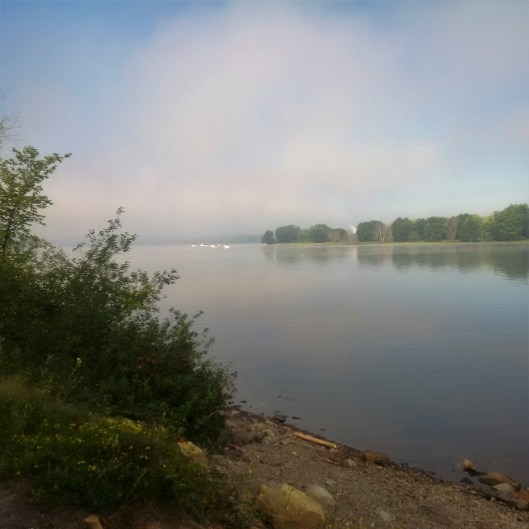
Foggy morning sunrise on Petrie Island — photo by David Kitz
25 Monday Sep 2017
Posted in Bible, Devotionals, Psalm 38, Psalms
Tags
Blame, confess, David, God, grace, Moses, Ottawa ON, Ottawa River, repent, repentance, Savior, sin, the LORD
Reading: Psalm 38
(Verses 17-22)
For I am about to fall,
and my pain is ever with me.
I confess my iniquity;
I am troubled by my sin.
Many have become my enemies without cause;
those who hate me without reason are numerous.
Those who repay my good with evil
lodge accusations against me,
though I seek only to do what is good.
LORD, do not forsake me;
do not be far from me, my God.
Come quickly to help me,
my Lord and my Savior (NIV).
Reflection
Today’s reading is the concluding portion of Psalm 38. As noted previously, this entire psalm is a lament over sin, and the trouble and affliction it has brought into David’s life. Rather than blaming others or blaming God, David takes responsibility for his self-inflicted difficulties. In anguish of spirit he cries out, “I confess my iniquity; I am troubled by my sin.”

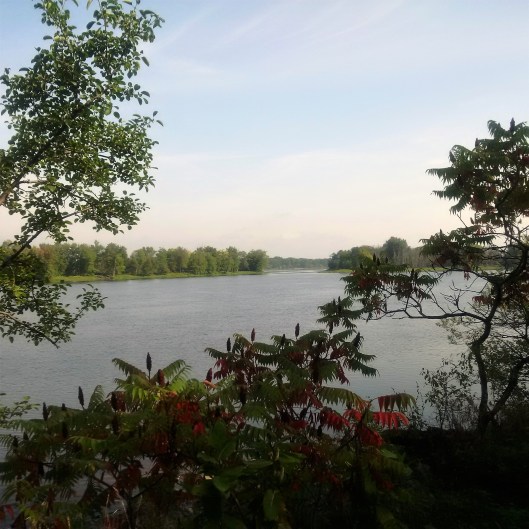
The Ottawa River, Ottawa, ON — photo by David Kitz
Are you troubled by your sin, or do you revel in it? Have the consequences of sin started to bite. The writer of the Book of Hebrews tells us that Moses “chose to be mistreated along with the people of God rather than to enjoy the fleeting pleasures of sin” (Hebrews 11:25). There are pleasures in sin for a season, but the long term consequences are pain and death. It would appear from a full reading of this psalm that David is suffering some of the consequences of his misguided sin.
But David has the correct response. He confesses his sin and throws himself upon the mercies of God. Hear his humble plea, “LORD, do not forsake me; do not be far from me, my God. Come quickly to help me, my Lord and my Savior.”
God’s ears are always open to that kind of prayer. We may believe that we have fallen too far –that our sin is too great –that we have sunk too low. But God hears our cry and His grace is sufficient. His mercy knows no bounds. The blood of Christ flows to the lowest valley. He can cleanse the vilest heart, if we call out to Him.
Repentance is a wonderful gift, perhaps the greatest gift of all. At various times in his life David fell into the grip of sin. But David knew how to repent and as a result he found favor in the eyes of God. Discover the gift of repentance today. It’s more than feeling sorry for yourself. It’s a 180-degree turn from pursuing sin to pursuing God.
Response: LORD God, grant me the gift of repentance. I am thankful that Jesus died on the cross to wash me clean. Hallelujah! I want to pursue you, Lord. You are my help and my righteousness. My salvation comes from you. Amen.
Your Turn: Are you troubled by sin? Have you found a remedy?
14 Tuesday Mar 2017
Tags
Babylon, David Kitz, history, idolatry, Israel, Jewish nation, King Solomon, Moses, Old Testament, Psalms, Ten Commandments
Reading: Psalm 137
(Verses 1-6)
By the rivers of Babylon we sat and wept
when we remembered Zion.
There on the poplars we hung our harps,
for there our captors asked us for songs,
our tormentors demanded songs of joy;
they said, “Sing us one of the songs of Zion!”
How can we sing the songs of the LORD
while in a foreign land?
If I forget you, Jerusalem,
may my right hand forget its skill.
May my tongue cling to the roof of my mouth
if I do not remember you,
if I do not consider Jerusalem
my highest joy (NIV)
Reflection
It’s difficult to pinpoint the time in history when many of the Psalms were written. Many scholars believe that the Old Testament was compiled over a period of about 900 to 1,000 years. As for the Book of Psalms, there is considerable evidence to suggest that psalms were collected from three distinct periods: the reign of King David (1 Chronicles 23:5), the rule of Hezekiah (2 Chronicles 29:30), and during the leadership of Ezra and Nehemiah (Nehemiah 12:24).[1]

There on the poplars we hung our harps — photo by David Kitz
Psalm 137 is distinct, because we can tell from its content that this psalm was written early during the period of the Babylonian exile. Memories of Nebuchadnezzar’s destruction of Jerusalem in 586 BC were still fresh—etched with bitterness and pain in the mind of the author.
There are two great pivot points in the history of Old Testament Israel. The first is the liberation of Israel from Egypt and the conquest of the holy land. The second is the destruction of Jerusalem and the temple, and the subsequent seventy-year exile in Babylon. The mercy and power of God brought about the first pivotal event. The disobedience and idolatry of man set in motion the catastrophe of the second event.
From its inception the Jewish nation flirted with idolatry. While Moses was receiving the Ten Commandments, the people were reveling before a golden calf. King Solomon set up idols in Jerusalem so his foreign wives could worship their gods. See 1 Kings 11:1-8. This duplicity continued generation after generation until the Babylonians swept in and destroyed Jerusalem. Judgment brought change.
Response: Father God, I don’t want to learn things the hard way. I want to be quick to obey you. Help me to learn from the lessons of history. You are the one, true God. I worship you. Amen.
Your Turn: How faithful are you to the LORD? Do other interests draw you away?
[1] K.R. “Dick” Iverson, Spirit Filled Life Bible, New King James Version, Jack W. Hayford, General Editor, Thomas Nelson Publishers, Nashville, TN, 1991, p. 750.
07 Tuesday Mar 2017
Tags
baptism, bondage, Egypt, grace, liberation, Moses, peer pressure, Pharaoh, salvation, Satan, sinful habits, slavery, taskmasters
Reading: Psalm 135
(Verses 8-14)
He struck down the firstborn of Egypt,
the firstborn of people and animals.
He sent his signs and wonders into your midst, Egypt,
against Pharaoh and all his servants.
He struck down many nations
and killed mighty kings—
Sihon king of the Amorites,
Og king of Bashan,
and all the kings of Canaan—
and he gave their land as an inheritance,
an inheritance to his people Israel.
Your name, LORD, endures forever,
your renown, LORD, through all generations.
For the LORD will vindicate his people
and have compassion on his servants (NIV).
Reflection
Psalm 135 began with a call for the LORD’s people to praise Him. For the LORD has chosen Jacob to be his own, Israel to be his treasured possession.

They were all baptized into Moses in the cloud and in the sea (1 Corinthians 10:2). Photo by David Kitz
In today’s reading, the psalmist recounts how Israel came to be God’s treasured possession. It happened as the result of a great cosmic struggle. The descendants of the patriarch Israel (who was also called Jacob) were enslaved in Egypt. There they toiled under cruel taskmasters until by the hand of Moses the LORD sent his signs and wonders into their midst. After ten terrible plagues, Pharaoh finally relented and set God’s people free. Nevertheless, Pharaoh changed his mind and sent his army to pursue Israel. Again at the Red Sea, the LORD intervened. He parted the sea, for His chosen people, but brought it crashing down upon Egypt’s army.
Make no mistake; you too are part of a great cosmic struggle. You were born into a world that is under the control of Satan. Jesus called our adversary the ruler, or prince of this world (John 16:11). We were born under Satan’s authority and within his domain just as the Hebrew children were born into a state slavery in the land of Egypt. As we grow up, Satan has his taskmasters, who set us to work doing his bidding. It begins as we bow to peer pressure, but soon those things we choose begin to assert control. We can soon find ourselves in a downward spiral, imprisoned by sinful habits.
Only Jesus can liberate us from this bondage. At the cross he paid the full price for our redemption. Crossing the Red Sea foreshadows the New Testament sacrament of baptism. It signals our break with the old life—the old bondage. See 1 Corinthians 10:1-4. We have a new master now. His name is Jesus. He is the great liberator. He liberates us from the bondage of sin, and the taunts of the Accuser, who insists that we will never be good enough. But Jesus is our sufficiency. By his grace we are saved.
Response: Father God, I thank you for liberation. Through Jesus you freed me from the bondage of sin. I am eternally grateful. Fill me with the joy of your salvation. You saved me. Hallelujah! Amen.
Your Turn: Have you been liberated from the bondage of sin?
07 Friday Oct 2016
Tags
Aaron, discipline, forgiveness, forgiving, God, holy, Moses, Samuel, the LORD
Reading: Psalm 99
Verses 6-9
Moses and Aaron were among his priests,
Samuel was among those who called on his name;
they called on the LORD
and he answered them.
He spoke to them from the pillar of cloud;
they kept his statutes and the decrees he gave them.
LORD our God,
you answered them;
you were to Israel a forgiving God,
though you punished their misdeeds.
Exalt the LORD our God
and worship at his holy mountain,
for the LORD our God is holy (NIV).
Reflection
David’s name appears in the text of several of the psalms, but this is the only psalm that lists other heroes of the faith. Moses, Aaron and Samuel, three heavy hitters of the Old Testament, are honored here. They are honored because they called on the LORD and he answered them.

Petrie Island marsh — photo by David Kitz
I could quibble with the choice of these three. Moses struck the rock in anger when he was told to speak to it and thereby bring forth water for the people. As a consequence, he was not allowed to enter the Promised Land. Aaron gave into the people’s will and fashioned an idol—the golden calf. Samuel appointed Saul as the first king of Israel—a man who became a disappointing, disastrous leader who descended into witchcraft.
But… But then can I claim to be error free in the way I have lived my life? Like Moses I have lost my patience in more than one situation. If God treated me like Moses, there would be little hope of me reaching the Promised Land. Like Aaron I have a tendency to be led astray by the crowd, and like the prophet Samuel, at times I have backed people who stumbled badly and betrayed the Lord.
I have not lived a flawless life. That’s why I take comfort in these words: LORD our God, you answered them; you were to Israel a forgiving God, though you punished their misdeeds.
I need a forgiving God. I need a God who forgives my transgressions—those times when I think I know better, but of course I’m wrong. And if I am truly honest, I also admit that I need a God who punishes my misdeeds. If there are no consequences for my wrong doing, my transgressions will escalate. I need the discipline of the LORD, or I will go astray by following my own selfish desires. Just like the ancient people of Israel I need to live under the wise and loving rule of a holy God. How about you? Do you need a forgiving God?
Response: LORD God, you are holy. I want to live in a way that honors you. You know my failings and shortcomings. Forgive me as I call on you. I am needy. Amen.
Your Turn: If there were no consequences for sin would that change your life and conduct?
13 Tuesday Sep 2016
Tags
brevity of life, God, humility, meaning of life, Moses, purpose, wisdom
Reading: Psalm 90
Verses 7-12
We are consumed by your anger
and terrified by your indignation.
You have set our iniquities before you,
our secret sins in the light of your presence.
All our days pass away under your wrath;
we finish our years with a moan.
Our days may come to seventy years,
or eighty, if our strength endures;
yet the best of them are but trouble and sorrow,
for they quickly pass, and we fly away.
If only we knew the power of your anger!
Your wrath is as great as the fear that is your due.
Teach us to number our days, that we may gain a heart of wisdom (NIV).
Reflection
The finite nature of our lives here on planet earth should cause us to give serious thought to how we spend the days that we have been allotted. Once we reach the age of forty, roughly half of our life is over. Some claim it’s all downhill from that point forward. Life seems to speed up—to pass by quickly— as we careen toward our demise.

Riverside getaway — photo by David Kitz
Moses concludes his prayer here in Psalm 90 with these words: Teach us to number our days, that we may gain a heart of wisdom.
No one wants to reach the end of their days and then realize that they have wasted their life. In our hearts, we all want to have a meaningful life filled with purpose. Much of that striving for success and our drive for a long list of accomplishments comes from a desire for meaning and purpose in life. Moses certainly had a string of achievements on his resume before the LORD called him home. He was after all the liberator of a nation. He was revered as a great leader and the great law giver. But was that due to Moses’ great ambition?
The Bible paints a different picture of Moses. When God called him into service, Moses resisted. The adopted son of Pharaoh was content to shepherd a few sheep on the backside of the desert. But God had other plans—bigger plans. This is what we are told about Moses. Now Moses was a very humble man, more humble than anyone else on the face of the earth (Numbers 12:3).
Perhaps true wisdom begins with humility—with knowing our place in the grand scheme of things. It starts as it did for Moses by hearing God’s call and ultimately being willing to obey, whatever that takes and wherever that takes us.
Response: LORD, teach me to number my days, so I may gain a heart of wisdom. Give me ears to hear what you are saying to me. I want to live a meaningful life filled with purpose coming from you. Amen.
Your Turn: Are you numbering your days or are they numbering you? Are you following God’s call?
12 Monday Sep 2016
Tags
Ecclesiastes, eternal, Glenn Fobert, God, life, Moses, Psalms, temporal, the meaning of life
Reading: Psalm 90
A prayer of Moses the man of God.
Verses 1-6
Lord, you have been our dwelling place
throughout all generations.
Before the mountains were born
or you brought forth the whole world,
from everlasting to everlasting you are God.
You turn people back to dust,
saying, “Return to dust, you mortals.”
A thousand years in your sight
are like a day that has just gone by,
or like a watch in the night.
Yet you sweep people away in the sleep of death—
they are like the new grass of the morning:
In the morning it springs up new,
but by evening it is dry and withered (NIV).
Reflection
In case you have not noticed, your life on this earth is temporal. It won’t last forever. In fact, there is very little on this earth that fits into the “lasts forever category.” My car fits well into this rusty, temporal category. My physical body will suffer a similar fate. My morning aches and pains remind me of this outcome. In this psalm Moses states the obvious when he makes this declaration: You turn people back to dust, saying, “Return to dust, you mortals.”

Morning mist on the Ottawa River — photo by David Kitz
James, the brother of our Lord, makes a similar observation: You should know better than to say, “Today or tomorrow we will go to the city. We will do business there for a year and make a lot of money!” What do you know about tomorrow? How can you be so sure about your life? It is nothing more than mist that appears for only a little while before it disappears (James 4:13-14).
Only God stands apart, above and beyond this temporal world. He is the ageless One, untouched by time. This assertion holds true. A thousand years in your sight are like a day that has just gone by, or like a watch in the night.
The entire book of Ecclesiastes addresses the topic of the temporal nature of human life. Glenn Fobert has written an excellent book that explains the true meaning of that puzzling book: Everything Is Mist: Ecclesiastes on Life in a Puzzling and Troubled Temporary World
Life is not meaningless or vanity. According to Fobert, scholars have mistranslated the Hebrew word for mist in Ecclesiastes. Life is like a morning fog that lifts and it is gone. Where has it gone? It goes to the eternal One, the Creator of all life. How then should we live? Ecclesiastes gives us the answer. Simply live in full reverence and praise to your Maker.
Response: LORD God, I thank you for being the author of this wonderful thing called life. Today I want to live in humble thanksgiving and praise to you. Let my work, words and conduct honor you. Amen.
Your Turn: Is the Lord your dwelling place? Are you at home with Him?

14 Thursday Jul 2016
Posted in Psalms, Thursday's Thought

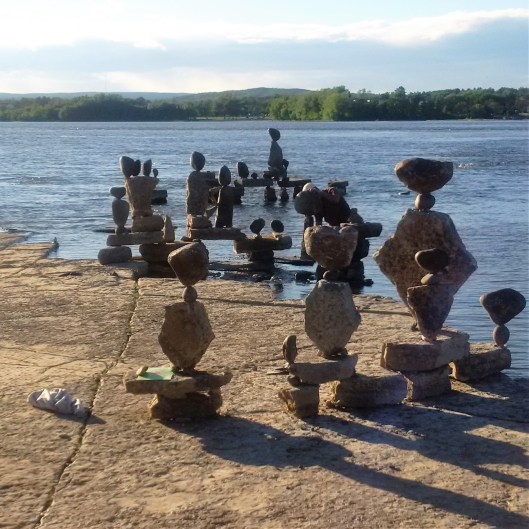
Remic Rapids Park, Ottawa, ON, balanced rock sculptures by John Ceprano — photo by David Kitz
Reflection
This week’s I Love the Psalms theme is rock.
There’s an old saying about how it’s hard to get blood from a stone. But according to today’s verse from the Psalms, God is very good at getting water from a rock.
This quote from the Psalms refers to the time when the people of Israel were without water in the Sinai Desert. The LORD gave Moses these instructions, “I will be there with you. Strike the rock with the stick, and water will pour out for the people to drink.” Moses did this while the leaders watched (Exodus 17:6).
St. Paul tells us the true significance of the rock that was struck in the wilderness. All of them also ate the same spiritual food and drank the same spiritual drink, which flowed from the spiritual rock that followed them. That rock was Christ (1 Corinthians 10:3-4).
Jesus is the rock that was struck on our behalf and from him gushes living water that will bring eternal life. He said, “If you are thirsty, come to me and drink! Have faith in me, and you will have life-giving water flowing from deep inside you, just as the Scriptures say” (John 7:37-38).
Response: LORD God, I thank you for Jesus, the eternal living rock. Through his shed blood I have everlasting life. Jesus, you are my water of life. Amen.
Your Turn: Is Jesus the rock of your salvation?