• Home
  • About
  • DavidKitz.ca
  • Youtube Videos
  • Books by David
  • Books on Amazon.com

I love the Psalms

~ Connecting daily with God through the Psalms

I love the Psalms

Tag Archives: Saskatchewan

A Four-Legged Champ

05 Sunday Mar 2023

Posted by davidkitz in Books by David Kitz

≈ 6 Comments

Tags

cougar, cows, David Kitz, dog, farm, Saskatchewan

A true story by David Kitz *


“Do you think this one will make it?”

“No.” My sister Edith shook her head in glum resignation.

As we gazed down at this shivering, whimpering, pup, the prospects for his survival beyond a year were anything but promising. You see, in the space of five years we had gone through a string of canine disasters.

Five years earlier, our dog Collie—yes, he was a collie—had passed on after a long life of service on the farm. All future dogs were inevitably compared with Collie. For the Kitz family, he represented the gold standard in dogs.

The next dog was Pubby, a fiercely loyal black spaniel that met his grim fate when he was hit by a car.

Next on the list, Topsy, an excellent cow-herder, was in a terrible accident with a snowplow.

A young lab, Sandy, though lovable, turned out to be completely useless as a farm dog—dumb as a stump.

Our last dog, Buddy, proved to be even worse than Sandy. He chased chickens, and when he caught them, he killed them. Naturally, my mother would have none of this. Buddy’s term as a farm dog was abruptly cut short.

Now, all six Kitz children were staring at a scrawny brown pup of uncertain pedigree. After these five disasters, we were almost afraid to become attached—hesitant to open ourselves to love yet another dog and face more disappointment.

But a whimpering pup has a way of tugging at your heart strings. He spent much of his first week curled up on an old towel in a cardboard box in the basement. One by one, each of the six Kitz children ventured downstairs to comfort this timid, whining, puppy.

My memory is that during this time, I adopted him and he became my dog. Dale, my younger brother, disputes this. In retrospect, I guess that, despite our initial misgivings, we all claimed him as our own. Or he claimed us.

We named him Champ. I believe I was the one to come up with that name, but this too is open to dispute. It was a rather bold name
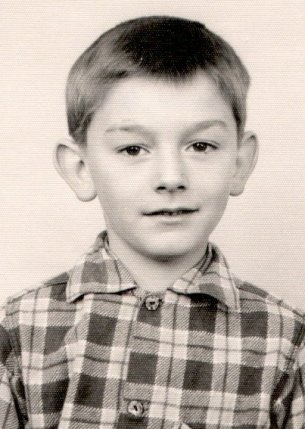
School Boy

David Kitz at about the time Champ arrived.

for a dog that didn’t look much like a champion. Even when he reached adult size, he was still scrawny, fine-boned, and barely knee-high. Did he weigh twenty-five pounds? Possibly not.

His hair and ears were a silky brown, lovely for stroking, but the rest of his short body fur had an odd grizzled appearance, a mix of various shades of brown, black and white.

What breed was he? I have no idea. I have never since seen a dog like him. Some odd mix, I guess. The Champ breed.

On the Kitz farm, every animal needed to prove its worth and that included dogs.

Farms in Saskatchewan are big, and at 1,120 acres, our farm was no exception. In addition to fields of wheat, barley, and oats, my dad had eighty head of cattle. We had a dairy herd and a beef herd on separate pastures about a mile apart. The dairy cows would be brought to the barn for milking twice daily.

Nothing is more frustrating than having to tramp across 160 acres after an ornery cow. Believe me, I know, having done it more than a few times. A good cattle dog will do this chore for you and save you much time and trouble.

Champ took to cow herding like a duck to water. He loved instilling the fear of God into thousand-pound steers. He would get behind them and then bark and nip at their hocks (ankles) to get them to move. Doing this just right requires a good deal of precision and agility. Precision, because ideally the dog bite should be hard enough to cause pain, but insufficient to pierce the skin. Agility, because the startled bovine kicks back reflexively and the dog needs to move fast and in the right direction. I’ve seen a kick from a cow send a slow-moving dog flying through the air.

Champ seemed to instinctively know what to do. With lightning speed, he applied just enough jaw pressure to get the desired result, and then he got out of the way. In a matter of seconds, he could turn a cantankerous ton of live beef into a spectacle of meek compliance. He demanded respect, and knew exactly how to get it.

Cows aren’t dumb creatures. Usually, it took only one encounter with Champ to establish who was boss. After that, the mere sight of the dog brought obedient submission.

With Champ as helper, rounding up the herd and moving it to a new location became much easier. A single command from one of the Kitz children— “Sic’um!”—and Champ did all the work.

Champ seemed to have an innate intelligence—much more than the average dog. But he had two other strong character traits as well.

First, he was incredibly eager to please his human masters. In fact, nothing delighted him more. If we were happy with him, his tail wagged with such enthusiasm that his entire hindquarters joined in the rhythm. A simple pat on the head after a job well done was enough to send him into spasms of pure joy.

Second, he hated being reprimanded. When a voice was raised in correction, he was totally crushed. His head would drop. He would tuck his tail tightly between his legs and slink away with the most mournful look on his honest face. With quick, baleful glances, his eyes would plead, “I didn’t mean to! I’m sorry! So sorry!” With his intelligence, his eagerness to please, and his strong desire to avoid a mistake, learning and obedience training was a cinch.

Furthermore, Champ was a dog with a conscience. If he transgressed some established rule, like coming onto the porch without permission, he would skitter away in a state of cowering humility. Not once did he find himself on the receiving end of any form of corporal punishment from me. It wasn’t needed. He learned to watch your eyes and the expression on your face. If you were happy, he was beyond happy. In my later life as a teacher, when a student was caught red-handed in some infraction, I would long to see half the contrition shown by my dog Champ.

At command, Champ showed his aggressive side when herding cattle, but in truth he was a soft-hearted mush pot. Nothing brought out this characteristic more fully than the birth of a farm animal. When my dad rose in the early morning to check on the cattle, he’d know immediately if a calf had been born during the night. As Dad stepped out the door of the house, Champ would greet him in a state of total ecstasy. He’d hustle dad over to the barn where he would stand over the newborn with a doggish grin as if to say, “Look, what happened here! Isn’t it wonderful?”

Champ took it upon himself to be the guardian of any newborn animals. The cows, for the most part, understood his intentions and put up with his hovering enthusiasm. But Champ was equally enthused about newborn piglets, kittens, or chicks, and his guardian instinct would immediately kick in.
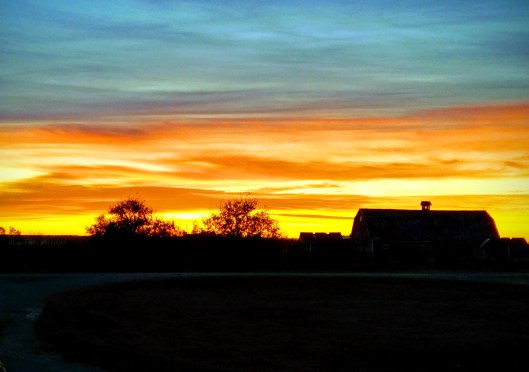
img_20191008_0741537-effects

The Kitz barn at sunrise, MacNutt, SK — photo by David Kitz

However, despite valiant efforts on his part, Champ’s intentions were sometimes misunderstood. This led to a farmyard standoff I’ll never forget. One afternoon, our bantam hen sauntered over to the house to display her clutch of freshly hatched chicks. When he saw this brood of fluffballs, Champ went into paroxysms of ecstasy. He ran in circles, wagging his tail, and barked his joyous greeting for all to hear.

The poor hen had no idea what to make of this crazy dog. Sensing a threat, she hastily gathered her chicks under her wings.

Champ reacted in shock. Clearly, this hen had swallowed these chicks whole. This could only mean one thing. He had to rescue them. He lowered his head and barked angrily at the hen.

This only confirmed the hen’s worst fears and she went into a full defensive posture. No chick would escape from beneath her wings while this vicious beast was about.

Meanwhile, the humans on the scene were doubled over in laughter.

Eventually, someone restrained Champ and the hen allowed the chicks to resume their roaming.

In due time, the dog and hen arrived at peace terms. There was plenty of skepticism on both sides, but from that day on, an uneasy truce prevailed.

Little did I suspect that one day I would be in need of Champ’s watchful protection.

During our summer vacations, my younger brother Dale and I loved to tramp about the wooded pasture land that surrounded our farm home. The summer I was eleven, we found a secluded spot in the far corner of the pasture, where we chopped down a few saplings and set up a makeshift tent. Champ always tagged along on these excursions.

One day, while Dale and I were relaxing by our tent, Champ began barking frantically. He ran in tight circles around us. Every hair on his back stood erect. To us, he seemed totally panicked.

We looked about to see what had set the dog into such an astonishing frenzy, but could see nothing. But his urgent alarm grew even more intense. The dog was completely beside himself with fear, running in circles around us. Each frantic bark seemed to urge us to get out of there.

I picked up the axe, and together the three of us ran for our lives. What we were running from Dale and I could only guess. Was it some large wild animal? A malicious human intruder? I had never seen my dog react this way to anything or anyone before.

We reported this event to our parents, who listened with interest, but could offer no further insight except to say that we were wise to heed Champ’s warning and leave.

We were spooked by this, and for two weeks we didn’t return to our favorite spot.

Finally, we took courage, and on a sunny summer afternoon, we set out for our secluded campsite once again. Of course Champ tagged along with us.

All went well until we were near our destination. As we emerged into an open grassy area, Champ suddenly went ballistic. But this time we clearly saw the cause of his alarm.

A short distance ahead of us, a huge tawny cat—a cougar—reared up and bounded off into the woods with Champ in hot pursuit! Dale and I froze in our tracks, shaken to the core.

Wisely, Champ’s pursuit was brief. He returned after the cougar dashed into the woods. But now we knew what was out there. On the earlier occasion, only our faithful dog stood between us and that powerful predator. Without Champ’s fierce protection, two prairie boys may well have become a meal for a hungry cougar.

A week later, after the morning milking, Champ and I were leading the cows back to the pasture when I spotted the waist-high cougar standing on the driveway leading to the machine shed. Completely fearless, Champ was off like a shot! Again, the cougar fled—and this time it didn’t return.

For me, these three cougar encounters became the stuff of legend. You see, up to this point, no one in recent years had ever reported seeing a cougar in Saskatchewan. During my childhood, cougars were commonly called mountain lions, because their range had been reduced to the Rocky Mountains. When I spoke of this experience to friends at school, they scoffed at me in disbelief.

Even my parents were doubtful. They never saw the big cat, although my dad saw Champ’s reaction to the second sighting from a distance.

After a while, I learned to keep my mouth shut about this matter. But I knew what I had witnessed.

Twenty years later, a cougar was hit and killed on a roadway about thirty miles from our farm. After that news report, I spoke openly about my childhood experience with the cougar. The evidence of the big cat’s presence was now irrefutable.

Unfortunately, in recent years, cougar attacks on humans have become increasingly common. Each time I hear of such reports, I think of Champ.

I owe fifty plus years of my life to that skinny, whimpering pup in a cardboard box.

As for me, I grew up and moved to Edmonton for university. I married and settled there.

My younger brother took over the farm. Every time I returned home, my dear four-legged friend would greet me. He’d rest his head on my knee and I would stroke his silky head.

Of course, each year he was getting older. On one of those summer trips it was clear his health was failing. He knew it. We all knew it. It was so hard to leave that last time.

Jesus said, “No one has greater love than this—that one lays down his life for his friends” (John 15:13 NET).

The first one to demonstrate that kind of friendship—that kind of love for me was a champion—a fearless, four-legged Champ.

* An earlier version of this story was published in Hot Apple Cider with Cinnamon.

Why I Support Ukraine

10 Saturday Sep 2022

Posted by davidkitz in Psalms, Uncategorized

≈ 7 Comments

Tags

Canada, Russia, Saskatchewan, settlers, Ukraine

Readers who routinely follow my blog posts will find the following line at the end of every post:

Please pray for the people of Ukraine!

After the Russia launched its full-scale attack on Ukraine on February 24, 2022, it was common to see  shows of support for Ukraine from many bloggers. But as the war raged on, the slogans of support  gradually diminished or disappeared entirely. Why have I persisted in daily calling for prayer for Ukraine?

The simple answer is because the war has not stopped. The Russians have not withdrawn from Ukrainian territory. On the contrary, they continue to shell cities and towns destroying homes, schools, and hospitals, and committing unimaginable atrocities in the communities they have occupied. So, the need for prayer support continues.

Furthermore, Ukraine has a democratically elected government, whereas Russia is ruled by an autocrat who has murdered journalists and political opponents who have exposed his grasping brutality. Vladimir Putin has not been content to confine his cunning violence to his own country. His hitmen have murdered his opponents living in foreign countries like Britain.

Ukraine is not the first country to be attacked by the Russian bear. First Chechnya came under attack. That was followed by a war with Georgia. Then Russia became an active combatant in the Syrian Civil War. Whole cities were leveled by Russian artillery. The same general who commanded the Syrian campaign is now in charge of the invasion of Ukraine. Yes, once again whole cities like Mariupol have been bombed into oblivion.

Immigration Ship Augusta Victoria

The trans-Atlantic steamer “Augusta Victoria”

Finally, for me this war has a personal connection. My grandfather, Jacob Kitz, came from what is now western Ukraine. At that time western Ukraine was part of the Austro-Hungarian Empire. In 1889, with his parents and younger sister, five-year-old Jacob boarded the steamship Augusta Victoria in Odesa, Ukraine. On November 9th of that year, the family disembarked in New York. They were homesteaders seeking a better life in North America. Their quest for fertile farmland took them first to Minneapolis, then north to Winnipeg, Canada and finally in the fall of 1890 to the little prairie settlement of Langenburg in the present-day province of Saskatchewan. They were among the very first pioneers to settle the land.

Thousands of German, Polish and Ukrainian speaking settlers from western Ukraine followed in their footsteps. They established prosperous farm communities across western Canada. In many respects the land, climate, and crops of the Canadian prairies are almost identical to what they left behind in Ukraine.

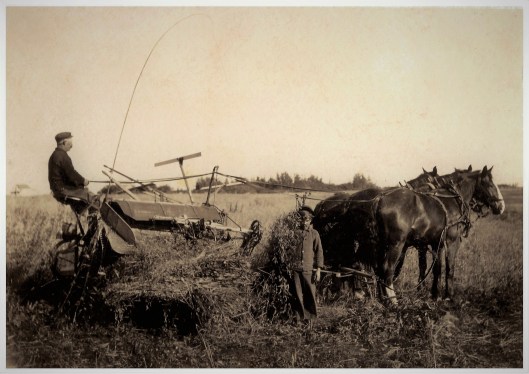
Adam Hautz 2 001

My great-grandfather with his son in Saskatchewan.

Above all these settlers found peace and security in Canada whereas those who remained in Europe were forced to endure the full-on horrors of two world wars, and Stalin’s premeditated starvation during the communist collectivization of 1930s. Now once again, an aggressive dictator has shattered the peace with this unprovoked war.

That is why I support Ukraine. That is why I continue to end my daily posts with these words:

Please pray for the people of Ukraine!

Two Boxcars and Two Cents

17 Sunday Jul 2022

Posted by davidkitz in family

≈ 19 Comments

Tags

depression, drought, family, farm, Saskatchewan

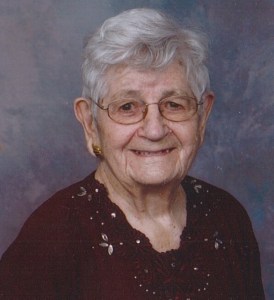
My Mother was welcomed into her heavenly home on July 9, 2022. Here is an account of the hardships of her childhood that she wrote about a decade ago. We have much to be thankful for.

My father Gotlieb Ziebart was born in Russia in 1886. He came to Canada in 1912, just before the First World War. He came to Wolseley, Saskatchewan. He helped build the number one highway. Later he took up a homestead, section 35, township 16, range 24, West 3 degrees, new, Maple Creek – Piepot on the prairies of southwestern Saskatchewan.

Wanda

Wanda Kitz (nee Ziebart) 1922-2022

He married my mother, Emily Wuschke in 1917. She was from Bateman, Saskatchewan. Her parents came over to Canada from Poland in 1911 when my mother was ten years old. There were nine children. The youngest was born in Canada, and she was only nine months old when her father passed away. The oldest boy in the family was sixteen. When his father died, he stayed at home to farm and the other kids went working. The boys were hired to tend cattle for neighbors and the girls babysat. They stayed wherever they worked. Their pay was a place to sleep, their daily food, and maybe a secondhand pair of shoes or a coat. They got home once in two or three months. Things were tough.

My parents lived on the homestead for about five years. I was the third child born there. Their farm was seconded by ranchers, and they wanted dad’s land, so he sold it and moved to Bateman and then to Mankota.

My father was a good farmer and by 1928 we had a car, a tractor, and a threshing machine and two lines of horses. He also had cattle and five kids. But he lived on rented land.

So he bought a farm at Mossbank. Mother had three brothers living there. His hopes were high for a great future for his family. He put all his money down for a down payment on the farm. Then the depression came. Markets crashed, not just the stock market, but the market for grain and everything the farm produced.

Drought came.

He lost everything.

The drought lasted for eight years. Things were rough. The government gave us relief – two dollars per person per month. By that time there were six children, but dad wouldn’t take anything for the baby.

He said, “I have milk. I will feed him.”

So we got twelve dollars a month. That was during the winter. When the grass got green, the government relief was cut off. My father was a proud man, and he didn’t take anything from anyone, least of all the government.

As the drought worsened, the people that had a little money just packed up and left for the Peace River country in northern Alberta, or they moved to B.C. There were beautiful homes and farmyards left vacant. They were simply abandoned. The land didn’t get seeded. The wind and the grasshoppers took care of it.

By 1937 things were so bad, the government offered to help the farmers to move out. Dad was one of them. They could move you, or watch you starve. There was no feed for the cattle. The government wanted you to sell them. I remember having to go and pump water every two hours until the well was dry. Then we would wait two hours and go pump again.

Dad and three of his friends went land hunting. Dad came back and said he had bought a farm. The other men said they were going to buy later, but they never did.

We were moving – moving from the treeless prairie to the bush country.

The prairie was all we knew.

Mother and us kids were not happy about the move. At Mossbank, mother had brothers and sisters and a mother. We kids had all our cousins and friends. But we moved to Aaron, Saskatchewan – post office White Beach. Dad had sold horses and cattle and made a down payment of $150.00 on a farm on the west end of Thunder Hill. It was more than four hundred miles to the northeast, very near the Manitoba border. For us it was like moving to another world.

How did we get there?

The government gave us two boxcars on a freight train. They said they would pay the passenger tickets to get the family there, and it would take two days for the freight train to arrive. The freight cars came, but nothing to move the family. No money. No money from the government, and dad didn’t have any.

You are on your own. You do what you must.

We had two days to load. In one freight car, dad put the cattle at one end, and the farm implements at the other end. Everything was taken apart. The seed drill, the binder, the hay rake, the wagon, and the horse drawn sleigh, everything was packed into the rail car. On the other end of the car were the nine horses, pigs in a crate, chickens, a dog and a cat, and then more farm implements piled up on one side. On the other railcar he put a wagon box. On the far end of the box was the furniture stacked from bottom to top. The dining room buffet was at the bottom, the dresser on top, and then the sewing machine on top of that. I can still see it all stacked and crammed in.

Mother and five kids lived in the wagon box. Dad and my oldest brother could stay with the cattle in the other car. They were legal. But the rest of us, the family, we were stowaways.

Right on the top of all the implements dad put the harrows, and we unrolled a mattress over them. We could lie up there, but couldn’t sit. It was too cramped. I spent most of my time up there.

The train stopped in every town, and every time it stopped or started it gave this awful jar. Our heads would hit the steel bars on the roof of the car. It was terrible. Terrible!

It was so hot! No air!

We were shut up with the animals. The stench!

Dad was told it would take us two days. We left Mossbank on the thirteenth of August in the afternoon at about three o’clock. We were prairie refugees. Dust bowl refugees. We traveled from Mossbank to Avonlea, and they left us sitting there until the next day, about thirty-five miles from Mossbank.

The next day we went from Avonlea to Moose Jaw and then on to Regina.

The third day we went to Saskatoon and sat there in the stifling prairie heat.

On the fourth day we started east and made it to Humboldt. We stayed there overnight.

On the fifth day we got to Aaron at about suppertime. We had traveled five days. The cattle and horses had little or no water or feed. The cattle were let out of the cars once, into the stockyards, but not the horses.

We had very little food and water. We almost died in the heat. It was August 13th to the 18th, 1937.

Hot. Dry. Dusty. Unrelenting heat.

Mother had prepared some food for on the way, enough for two days. She had roasted two chickens. When the railway station agent in Mossbank couldn’t sell us tickets, he was mad. Dad had no money. The agent wanted to squeal on him, so dad gave him the two roasted chickens and then dad told him to keep his mouth shut. But we starved.

I will never forget all this as long as I live.

That first evening in Aaron, mother and my sister and I stayed with the people from whom dad had bought the land. They gave us supper and a bed for the night. Dad and the boys stayed with the boxcars. They looked after the cattle and started unloading and setting the wagons together.

The next morning, I and two of my brothers were put in charge of the cattle. We were to take them to our farm ten miles away. We were strangers in a strange land. The cattle had never seen trees before. All this bush was foreign to them. They went through everything, fences and all. They wanted to go home, and so did we – back to where we came from.

By noon we were about halfway. There was an open field where the hay had been cut, so we let the cows graze and rest there. We went to a farmhouse and asked for water. Then we went back to the cattle and waited for dad to come with the wagons.

The people in the farmhouse were good to us. When afternoon began turning to evening, they came and asked us to come and have supper with them. We waited until midnight before dad finally came. Then we took the cattle the rest of the way. They followed the wagon in the dark, and this time they had sense enough to stay on the road.

When we got to our home, there were renters living on the land. It was August and they had to take off the crop. They were Ukrainian and couldn’t speak any English, but they had two boys, eight and ten years old. They could speak English because they learned it at school, so that is how we communicated with them. They gave mother and my sister and me a spot on the floor to sleep. Dad and the boys found some hay to sleep on. The next day they gave us a granary to use as a house until they moved out.

I was fourteen years old when we moved north to Aaron. Come September, my sister and one brother and I went to White Beech School. I was in grade eight. We got to know some very nice people. After all these years I still keep in touch with my old school pal Eva. She lives in Benito.

When we got there in mid-August, we had to make hay and feed for the winter. The people around us were very kind. They helped us out by giving us patches of hay land that they hadn’t cut. They gave us potatoes and vegetables too. We had never seen tomatoes in a garden before, or carrots or dry beans. In the south there was no such thing. There was no rain, only grasshoppers and dust storms. Here in the north everything was green – grass so tall you couldn’t walk through it. And it rained!

But winter came.

The government was supposed to send us relief for a year from Mossbank, but it didn’t come until Christmas. Dad had no money. The storekeeper at White Beech gave us credit so we could get coal oil and matches and a few groceries, or we would have starved in the dark.

For Christmas we kids wrote a letter to our friends and cousins in Mossbank. We were so homesick for them and our old home! We gave the letter to dad. But he couldn’t mail it. He didn’t have the two cents for postage stamps. He carried that letter in his pocket. He didn’t have the heart to tell us. Eventually in spring we found the crumpled envelope in dad’s jacket pocket.

That spring dad planted wheat on Thunder Hill. It came up and grew like nothing we had ever seen. We had high hopes. But everything rusted out. A rust fungus killed the wheat as it headed out. Most of the wheat was burned in the field. There was nothing in it. That first year in the north was harder to take than all the years of drought on the prairie. There the land had taught us to expect nothing. And we got nothing. But here the land, the sky and the falling rain promised to give us the moon. But come September, it too gave us nothing – a harvest of hardship.

After I passed my grade eight, I went out working for $5.00 a month. I finally worked my way to Roblin, Manitoba, and then to MacNutt, Saskatchewan where I met Ewald Kitz. We were married in 1943. A year later my parents moved to Dropmore, Manitoba where they farmed until they retired to Roblin. Mother passed away in 1970, and dad in 1977 at the age of ninety-one.

As long as I live, I will never forget that train trip from Mossbank to Aaron. Even now if I happen to be at a railway crossing when the train goes by, it still sends hot and cold shivers down my spine. Unbelievable!

I still can’t throw anything away. I always think of the hard times I went through growing up. I guess that’s why I make World Relief quilts. I know what it’s like to be without, what it’s like to be forced to pack up and leave home.

On Tour with “The Soldier Who Killed a King”

01 Tuesday May 2018

Posted by davidkitz in Books by David Kitz, Christ's Passion, Easter Sunday, Good Friday, Palm Sunday

≈ 8 Comments

Tags

Alberta, bookstore, Calgary, centurion, Easter, Kregel, Moose Jaw, Ottawa, Regina, resurrection, Saskatchewan, Saskatoon, the cross, The Soldier Who Killed a King

How do you celebrate a book that was conceived in drama? With a book and drama a tour of course.

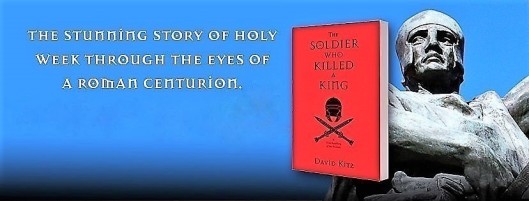
My biblical novel about Christ’s Passion began as a four-act, one-man play over twentybiblical-fiction-award-2017_orig years ago. So when Kregel Publishing released The Soldier Who Killed a King, it logically followed that the original drama should be an integral part of promoting this book across the continent.

With Easter approaching I arranged a Canadian prairie tour that featured eight scheduled events in four prairie cities: Moose Jaw, Regina, and Saskatoon in Saskatchewan, and Calgary in Alberta.

Things didn’t get off to a good start.

My flight from Ottawa via Toronto to Regina was uneventful. I arrived on Thursday, March 22nd. My first event was my “Centurion’s Report” drama on Friday evening in Moose Jaw. Moose Jaw is an easy one hour drive from Regina on a four lane divided highway. What could possibly go wrong?

Well, Friday dawned with a howling prairie wind. Soon the wind was accompanied by swirling snow. By mid afternoon blizzard conditions resulted in semi trailer trucks being blown off the highway between Regina and Moose Jaw. Dozens of vehicles were stuck. For safety reasons we decided to cancel the Friday evening event. We make our plans, but sometimes weather overrules.

Book store events did not disappoint.

Saturday dawned clear and cold. At noon I started a four hour book signing event at the Chapters bookstore in Regina. What I like most about these events is the conversations you have with prospective buyers. It’s always fascinating to find the common ground that can lead to a book purchase.

IMG_20180324_131758 (4)

Signing at Chapters bookstore in Regina

The following week I had two more book signing events at Indigo stores in Saskatoon and Calgary. It’s especially gratifying to meet readers who have already read your book and are there to meet you in person and buy more of your books.

There’s never a dull moment during a dramatization of “The Centurion’s Report.”

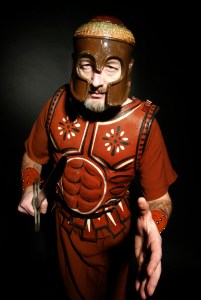
On Palm Sunday morning I was at “The Bridge” church in Regina portraying the centurion’s response to Christ’s triumphal entry into Jerusalem. The tension builds as Marcus Longinus  seizes a member of the audience at the close of Act 1, flips a merchant’s table in Act 2, and nails Christ to a wooden cross in Act 3. The resurrection of Jesus in Act 4 results in a personal encounter with our Lord. The action is riveting, and so it should be. This was after all a week of intense, history-changing drama.

Free WW-e FACEBOOK-2 (2)

It’s always great when you can fit in a bit of family time into a busy schedule.

Monday and Tuesday were spent visiting with my 95-year-old mom in rural Saskatchewan. Despite the advancing years, she is in good health, active and sound of mind. It was also a real treat to spend time with two of my sisters and my brother, as well as a few nieces. A stunning, frosty sunrise greeted us as we set out on our trip from Regina to Churchbridge, SK.

IMG_20180326_073412[3121]

Frosty sunrise east of Regina, SK — photo by David Kitz

Wednesday morning March 28th was the start of the second leg of my tour. This meant picking up a rental car at the Regina airport for the three hour drive to Saskatoon. The remainder of the day was spent meeting with the pastor of Courts of Praise Church as we planned for “The Centurion’s Report” presentation on Good Friday.

For the next three nights I had the good fortune of staying with my nephew Ross and his family. There home is a 20  minute drive west of the city. The Indigo bookstore event on Thursday went very well. But the highlight of the Saskatoon portion of the tour was the Good Friday morning service at Courts of Praise.

OTT0304-KITZ1

Photo credit Jean Levac, Ottawa Citizen

The Good Friday service brought together four churches for a presentation of “The Centurion’s Report.” One of the unique features of this presentation was the incorporation of communion between Act 3 and Act 4. It was a very meaningful addition to the drama surrounding Christ’s crucifixion.

Supper with another nephew rounded out the events of a perfect day—a beautiful Good Friday.

Saturday dawned cold and bright. Yes, very cold -25C with a windchill of -35C, but with a bright sunshining the eight hour drive to Calgary was pleasure. I love the wide open prairies and being able to see twenty miles to the horizon and beyond.

2018-03-31

Big sky country in the Red Deer River Valley, Alberta — photo by David Kitz

In many respects Easter Sunday in Calgary was the highlight of the tour.

Cornerstone Church in Calgary was the biggest audience for “The Centurion’s Report” on this tour It also resulted in the most book sales after the morning service. The same was true of my book signing event at the Indigo store in the afternoon.

But the biggest thrill of the day came when I was introduced to my two stagehands before the Easter morning service. The tallest young man introduced himself as Timothy. I replied, “Wow, that’s my oldest son’s name!” I then turned to the second young man and asked, “And what’s your name?”

He answered, “Joshua.”

I burst out laughing. My second son is named Joshua. My sons, Tim and Josh, have often helped me as stagehands back in Ottawa. I thought the Lord has a great sense of humor. He brought memories of family back on this special resurrection morning. Later that afternoon I sold a copy of The Soldier Who Killed the King to the Burgess family. Burgess is my wife’s maiden name. So in two divine coincidences I was directly reminded of each of my family members on an Easter Sunday 2,000 miles from home.

The drive back to Regina was a visual feast for this prairie boy’s eyes.

2018-04-02b

Along a prairie trail, north of Maple Creek, Saskatchewan — photo by David Kitz

I set out for Regina before sunrise on Easter Monday morning. It was still clear and cold, but the nine hour leisurely drive was a treat for the eyes. Cowboy country beckoned, and I couldn’t help but stop for a few photos of the stunning vistas.

It was great to be back in Regina with the Robinson family in whose home I stayed for a large portion of this tour. On Tuesday evening they hosted a “book and drama” party for a few of their friends. Many of these friends had been part of a book study of The Soldier Who Killed a King, which Dr. Robinson led. For them it was a meet-the-author evening, but for me it was a meet the readers event.

Early Wednesday morning my flight left Regina airport. I returned to Ottawa tired, but happy. In total I logged about 5,000 km (3,000 miles) in the air, and 2,200 km (1,350 miles) in ground travel.

What will stay with me are memories of warm smiles and lives touched by the message of the cross.

4485 FACEBOOK-1


Time Capsule Testimony

10 Tuesday Apr 2018

Posted by davidkitz in Bible, Devotionals, Psalm 102, Psalms

≈ 1 Comment

Tags

bondage, Cypress Hills, death penalty, generations, Holy Spirit, hula-hoop, Jesus, praise, prisoners, Saskatchewan, sin, testify, testimony, the LORD, time capsule, unborn, Zion

Reading:                                    Psalm 102                                                                  

 (Verses 18-22)
Let this be written for a future generation,
that a people not yet created may praise the L
ORD:
“The L
ORD looked down from his sanctuary on high,
from heaven he viewed the earth,
to hear the groans of the prisoners
and release those condemned to death.”
So the name of the L
ORD will be declared in Zion
and his praise in Jerusalem
when the peoples and the kingdoms
assemble to worship the L
ORD (NIV).

Reflection
Time capsules are a fascinating idea. They can tell us a great deal about what people at a certain point in history considered important or indicative of that particular time. What was significant in the lives of people 100 years ago? A time capsule gives us a glimpse into that long ago period. For instance, a time capsule from 1959 might contain a hula-hoop, but the significance of that craze might well be lost on the current generation of young people.

IMG_20180402_105449 (2)

Fenced ranch land north of the Cypress Hills in Saskatchewan — photo by David Kitz

In some respects, this reading from Psalm 102 acts as a time capsule. It is a written testimony of what the LORD has done. “The LORD looked down from his sanctuary on high, from heaven he viewed the earth, to hear the groans of the prisoners and release those condemned to death.” 

Generation after generation of Bible readers has read this written testimony. They know that the LORD hears the groans of prisoners and sets them free. But this testimony doesn’t end there. It doesn’t end there because the LORD has not stopped listening and acting. He continues to do these things today.

I can personally testify to being set free from the bondage of sin. I know that due to my sinful nature I was condemned to die. But Jesus suffered the punishment I deserve on my behalf. When I called out to God, He heard my cry and set me free from the death penalty I was living under. My body may perish, but through the blood shed by Jesus and the work of the Holy Spirit, I have eternal life. That’s my testimony. That’s the time capsule message I want to send to the next generation and beyond.

By the way, my testimony is not unique. Millions of people around the world can testify to the life changing power of the LORD. They all have time capsule testimonies that they want to send to a generation as yet unborn.

What about you? Do you have a testimony to God’s redeeming forgiveness and power? It might be worth your time to write it down. We overcome the attacks of the enemy by the words of our testimony. You have a story to tell. It’s a time capsule with contents far more valuable than a hula-hoop. 

Response: Heavenly Father, I thank you for your intervention in my life. You have given me a story to tell—a testimony to your amazing grace. Help me to carry that testimony to a future generation—a generation that is not yet born. Amen.

Your Turn: Have you testified to the saving power of Jesus? How has the Lord changed your life?

The Path of Purity

08 Sunday Apr 2018

Posted by davidkitz in Bible, Psalm 119, Psalms

≈ 2 Comments

Tags

commands, decrees, Maple Creek, praise, praising God, precepts, pure, purity, rejoice, riches, Saskatchewan, sin, statutes, word of God

I will praise Him!

IMG_20180402_105427 (2)

Where the deer and the antelope play, near Maple Creek, Saskatchewan — photo by David Kitz

ב Beth

How can a young person stay on the path of purity?
    By living according to your word.
I seek you with all my heart;
    do not let me stray from your commands.
I have hidden your word in my heart
    that I might not sin against you.
Praise be to you, LORD;
    teach me your decrees.
With my lips I recount
    all the laws that come from your mouth.
I rejoice in following your statutes
    as one rejoices in great riches.
I meditate on your precepts
    and consider your ways.
I delight in your decrees;
    I will not neglect your word.

(Psalm 119:9-16, NIV)

What are your eyes on?

06 Friday Apr 2018

Posted by davidkitz in Bible, Devotionals, Psalm 101, Psalms

≈ 5 Comments

Tags

anointed, blameless, David, deceit, friend of God, God's enemies, integrity, Israel, judgment, King David, lies, lower class, Regina, Saskatchewan

Reading:                                     Psalm 101

(Verses 5-8)
Whoever slanders their neighbor in secret,
I will put to silence;
whoever has haughty eyes and a proud heart,
I will not tolerate.
My eyes will be on the faithful in the land,
that they may dwell with me;
the one whose walk is blameless
will minister to me.
No one who practices deceit
will dwell in my house;
no one who speaks falsely
will stand in my presence.
Every morning I will put to silence
all the wicked in the land;
I will cut off every evildoer
from the city of the L
ORD (NIV).

Reflection
One of the roles of a king in ancient Israel was to render judgment in difficult civil cases. In fact, judges ruled Israel for about 400 years before the first king was anointed; hence the judicial role was of great significance during the early years of Israel’s kingdom period.

2018-03-28

The burning bush in a frozen landscape, Regina, Saskatchewan — photo by David Kitz

This reading from Psalm 101 should be viewed as King David’s commitment to his judicial role. He was determined to govern wisely, and for him that meant identifying and siding with those who do right. My eyes will be on the faithful in the land, that they may dwell with me; the one whose walk is blameless will minister to me. 

Choosing the right kind of people to associate with is of great importance. This is not about the economic strata you occupy. Typically, rich people associate only with other rich people; similarly lower class people have friends of the same social standing. But honesty and integrity cross these artificial socioeconomic lines. There are crooks and swindlers among the rich and among the poor. In the same way there are honest people of integrity at the extremes of both wealth and poverty.

David’s objective was to raise the integrity bar. He had no patience for lies or deceit. What kind of people do you enjoy hanging around with? Do they prompt you to walk with them in a blameless way, or do they drag you down in the gutter? Do they prompt you to good deeds or tempt you into a crooked path? It has often been said that we are known by the friends we choose. Are you a friend of God? James has this admonition for us: Don’t you know that if you love the world, you are God’s enemies? And if you decide to be a friend of the world, you make yourself an enemy of God (James 4:4, CEV). 

Response: Heavenly Father, I want to be your friend. I want to love you because you first loved me and showed that love through your son, Jesus. Help me to choose my friends wisely as I let your life and joy shine through me. Amen.

Your Turn: Do your friends encourage you in your faith walk? Are you letting light shine?

Early Thanksgiving?

04 Wednesday Apr 2018

Posted by davidkitz in Bible, Devotionals, Psalm 100, Psalms

≈ 1 Comment

Tags

feast, gladness, gratitude, joy, prairie, praise, prayers, psalm of praise, Regina, Saskatchewan, sheep, thanks, thanksgiving, the LORD

Reading:                                   Psalm 100                                                                

A psalm. For giving grateful praise.
Shout for joy to the LORD, all the earth.
Worship the LORD with gladness;
come before him with joyful songs.
Know that the L
ORD is God.
It is he who made us, and we are his;
we are his people, the sheep of his pasture.
Enter his gates with thanksgiving
and his courts with praise;
give thanks to him and praise his name.
For the L
ORD is good and his love endures forever;
his faithfulness continues through all generations
(NIV).

Reflection
When you grow up on a prairie farm, as I did, you appreciate the traditional aspects of Thanksgiving all the more. You are reminded each day that the food on your table does not simply come from a store. You are actively engaged in producing the nourishment that sustains your own life. Though today may be a long way from Thanksgiving, I know I need daily reminders to be thankful. How about you?

2018-03-25hdr

Early morning sunrise, Regina, Saskatchewan — photo by David Kitz

As a youngster I sat down to many a Thanksgiving feast, and almost all the food found on that groaning table was home-grown. I watched those vegetables growing in our garden in the hot summer sun. I even pulled the weeds from around those peas. And those mashed potatoes, I helped my mother hill those tubers in the spring and then dug them up after the frost hit in the fall.

My brother loved growing pumpkins, and mom would turn his favorite into the best pumpkin pie east of the Rockies. And how can you eat pumpkin pie without a mound of whipped cream on top? Well let me tell you, it tastes even better, when just that morning you milked the cows that produced that sweet rich cream. Oh, and that huge turkey—we’ll miss that pompous strutting gobbler out by the hen-house. But I’m sure we’ll get over it, somehow. For now, let’s just dig in.

Let’s all dig in, and give thanks to the God, who made all this possible. This sumptuous feast has been brought to you by Him. Now that’s Thanksgiving!

The great God in heaven has been kind to us. He has answered our prayers. He brought the warmth of spring and the rain of heaven. He caused his face to shine upon us. The rich earth responded to his touch. It brought forth its bounty, and now around this table we have gathered together as a family to celebrate God’s great goodness to us.

As the psalmist declares, “It is he who made us, and we are his; we are his people, the sheep of his pasture.” So today with joy-filled hearts we enter his gates with thanksgiving and his courts with praise. We give thanks to him and praise his name. 

Response: Heavenly Father, thank you for all your kindness. You have been so good to us! Help us to maintain an attitude of gratitude all year long and not only on Thanksgiving Day, but every day. Amen.

Your Turn: What blessings from God’s hand are you most grateful for? Say a prayer of thanks right now.

Great Is His Love Toward Us

18 Sunday Mar 2018

Posted by davidkitz in Bible, Psalm 117, Psalms

≈ 4 Comments

Tags

faithfulness, love, love of God, nations, praise, Saskatchewan, the LORD

I will praise Him!

IMG_1736 D Adam

Saskatchewan sunrise — photo by Donald Adam

Praise the LORD, all you nations;
    extol him, all you peoples.
For great is his love toward us,
    and the faithfulness of the LORD endures forever.

Praise the LORD.

(Psalm 117:1-2, NIV)

Overflowing Abundance

01 Friday Dec 2017

Posted by davidkitz in Bible, Devotionals, Psalm 65, Psalms

≈ 1 Comment

Tags

abundance, Adam and Eve, bounty, cornucopia, crops, fertile soil, garden, grain, Saskatchewan, the LORD, vocation, work

Reading:                                      Psalm 65

(Verses 9-13)
You care for the land and water it;
you enrich it abundantly.
The streams of God are filled with water
to provide the people with grain,
for so you have ordained it.
You drench its furrows and level its ridges;
you soften it with showers and bless its crops.
You crown the year with your bounty,
and your carts overflow with abundance.
The grasslands of the wilderness overflow;
the hills are clothed with gladness.
The meadows are covered with flocks
and the valleys are mantled with grain;
they shout for joy and sing
(NIV).

Reflection
I can’t read this psalm without picturing an overflowing cornucopia. This is the psalmist’s horn of plenty. Speaking of the LORD, David declares, “You crown the year with your bounty, and your carts overflow with abundance.”

2017-06-28 purple stars

Purple stars bring backyard joy — photo by David Kitz

My farm boy’s heart delights in this psalm. I delight in the land and the soil. Being on the land and cultivating the rich earth nurtures my soul. I am invigorated by it. The soil where I grew up in Saskatchewan was black and fertile. It’s the best kind of soil for crops. In the summer the fields were mantled with grain—a vast sea of wheat billowing in the breeze.

But I’m not alone in my love for the earth. David assures us that God has that same affection for the soil. You care for the land and water it; you enrich it abundantly. You drench its furrows and level its ridges; you soften it with showers and bless its crops.

Now in practical terms my love for the soil is confined to a small backyard suburban garden. I tend my vegetable garden with care and God above does His part. He softens the earth with showers and blesses its crops. This morning, my wife and I rooted out a grape vine in preparation for spring planting. It was a pleasure to work with her and my heavenly partner, the LORD God Almighty.

Before the snow flies in the fall we will pull out the last of the carrots and parsnips. To everything there is a season, a time for every purpose under heaven (Ecclesiastes 3:1 NKJV).

In our toil we are not alone. There is something sacred about work. God ordained it. He planted a Garden for Adam and Eve to tend. Whether we are rooting out weeds, extracting teeth or rooting out unproductive habits, God is present in our work. Welcome Him as your partner.

Response: LORD God, I am thankful for my calling and the work you have set before me. You are my partner in it and my provider. I give myself to you to your service today. Amen.

Your Turn: Do you see yourself as God’s partner in your vocation?

← Older posts

Psalms 365: Develop a Life of Worship and Prayer

Psalms 365 Volume II

Psalms 365 vol 3
— Psalms 365 Volume III

Psalms

Recent posts

  • May the LORD Grant All Your Requests December 20, 2025
  • A Horn of Salvation December 19, 2025
  • Ready for the King of Glory December 19, 2025
  • My Spirit Rejoices in God My Savior December 18, 2025
  • Joining the Generation That Seeks God December 18, 2025
  • Why Am I So Favored December 17, 2025
  • How Can You Find the Good Life? December 17, 2025

Calendar

December 2025
M T W T F S S
1234567
891011121314
15161718192021
22232425262728
293031  
« Nov    

Blog Posts

Comments

  • davidkitz on Joining the Generation That Seeks God
  • cjsmissionaryminister on God Sent His Son
  • cjsmissionaryminister on The God of the Broken

Blog at WordPress.com.

Privacy & Cookies: This site uses cookies. By continuing to use this website, you agree to their use.
To find out more, including how to control cookies, see here: Cookie Policy
  • Subscribe Subscribed
    • I love the Psalms
    • Join 1,377 other subscribers
    • Already have a WordPress.com account? Log in now.
    • I love the Psalms
    • Subscribe Subscribed
    • Sign up
    • Log in
    • Report this content
    • View site in Reader
    • Manage subscriptions
    • Collapse this bar
 

Loading Comments...