• Home
  • About
  • DavidKitz.ca
  • Youtube Videos
  • Books by David
  • Books on Amazon.com

I love the Psalms

~ Connecting daily with God through the Psalms

I love the Psalms

Tag Archives: temple

Abandoning the LORD

22 Wednesday Aug 2018

Posted by davidkitz in Bible, Devotionals, Psalm 138, Psalms

≈ 2 Comments

Tags

abandoned, home, temple, the LORD, vindication

Reading: Psalm 138
(Verses 6-8)
Though the LORD is exalted, he looks kindly on the lowly;
though lofty, he sees them from afar.
 Though I walk in the midst of trouble,
you preserve my life.
You stretch out your hand against the anger of my foes;
with your right hand you save me.
The L
ORD will vindicate me;
your love, L
ORD, endures forever—
do not abandon the works of your hands
(NIV).

IMG_20180815_1156008

The abandoned McNeill Estate in the Spirit Rock Conservation Area, Wiarton, Ontario — photo by David Kitz

Reflection
There is something tragic about an abandoned house. An empty house has a missing soul. It was built to have souls—people—in it, so an absence of life invokes feelings of sadness in me. At one point hopes and dreams were alive in that house. It was a place of comfort and love—a refuge from nature’s elements. Perhaps it echoed with the voices of children at play, but now it sits empty and forlorn.

I find it surprising how quickly a home or community deteriorates after it’s abandoned. Have you viewed videos or the haunting images of the abandoned communities around the Chernobyl and Fukushima nuclear plants? In a few short years everything constructed by humans has become completely overgrown, and it begins to decay and breakdown.

Turning to today’s reading, we see that David ends this psalm with both a confession of faith and a prayer: The LORD will vindicate me; your love, LORD, endures forever—do not abandon the works of your hands. 

David lives in confidence that the LORD is with him and will vindicate him—will side with him in the battles of life. But he adds this petition—do not abandon the works of your hands.  

What happens when God abandons us? I dread the thought. When the LORD no longer lives among us, our lives—our spiritual lives—begin to deteriorate like an abandoned house in a nuclear exclusion zone. Around Fukushima wild boars have taken over. With no one to oppose them, they have ravaged the countryside and have moved into the abandoned towns.

Will the LORD abandon us? There is little chance of that happening. The far greater concern is that we abandon the LORD. I have witnessed firsthand the devastation that occurs when that happens. When people who respond to the gospel turn their backs on their Savior, over time the outcome resembles the ravages of nature on an abandoned home.

We need to recall these words: Though the LORD is exalted, he looks kindly on the lowly; though lofty, he sees them from afar. Though I walk in the midst of trouble, you preserve my life.

Response: LORD God, I want you to be fully at home in my heart and my mind. Show me your kindness. My body is a temple for your Holy Spirit. Live in me and through me, Lord Jesus. Amen.

Your Turn: How do you feel about abandoned houses? Is your inner man (woman) occupied by God?

In the Morning, LORD

11 Saturday Aug 2018

Posted by davidkitz in Bible, God's word, Psalm 5, Psalms

≈ Leave a comment

Tags

expectant prayer, Lord, morning, temple

I will praise Him!

IMG_20180802_1003080 (2)

Wild morning glory — photo by David Kitz

In the morning, LORD, you hear my voice;
    in the morning I lay my requests before you
    and wait expectantly.
For you are not a God who is pleased with wickedness;
    with you, evil people are not welcome.
The arrogant cannot stand
    in your presence.
You hate all who do wrong;
you destroy those who tell lies.
The bloodthirsty and deceitful
    you, LORD, detest.
But I, by your great love,
    can come into your house;
in reverence I bow down
    toward your holy temple.

(Psalm 5:3-7, NIV)

Discovering Your Identity in Worship

08 Wednesday Aug 2018

Posted by davidkitz in Bible, Devotionals, God's word, Psalm 134, Psalms

≈ Leave a comment

Tags

child of God, Creator, identity, Jerusalem, Jesus, Songs of Ascent, temple

Reading: Psalm 134
A song of ascents.
Praise the LORD, all you servants of the LORD
who minister by night in the house of the L
ORD.
Lift up your hands in the sanctuary
and praise the L
ORD.
May the LORD bless you from Zion,
he who is the Maker of heaven and earth
(NIV).

IMG_20180629_1750359[3581]

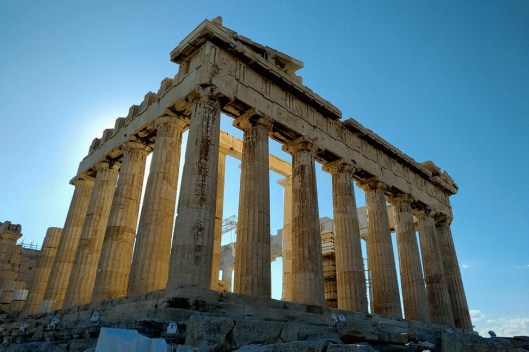
Columns at the gateway to the Acropolis in Athens, Greece — photo by David Kitz

Reflection
This is the fifteenth and final psalm in the Songs of Ascent series. In reality, this psalm is the pilgrims’ farewell offering of worship to the LORD.  After a week or more in Jerusalem, the time has arrived for the pilgrims to return to their homes. But on the evening before they set out on the return journey, they make one last visit to Mount Zion and the great Temple of the LORD. There they lift their hands in praise to the God of Israel. Early next morning, they will begin the arduous journey back home. But for now, it’s time to bless the LORD and offer thanks.

It is likely that the twelve-year-old Jesus sang this psalm with his parents on the final evening of their Passover pilgrimage to Jerusalem. On the following day the family departed for Nazareth where Joseph would resume his trade as a carpenter. When they left the next morning, they assumed Jesus was traveling with them in the large company of other pilgrims from their hometown. See Luke 2:41-52.

Typically, we read this account of the lost twelve-year-old Jesus from the viewpoint of a parent. We identify with the stress of losing a child in a big city. We would title this story, “Mary and Joseph find lost Jesus.” But the story reads quite differently, when we view it from the perspective of a child trying to discover who he really is. Viewed from Jesus’ perspective the title of the story might well be, “Lost Boy finds Himself” or “Lost Boy Discovers His Divinity.”

How did Jesus discover he was the son of God? Some believers might well reason that the answer is obvious. Jesus is God; therefore, he is omniscient. The all-knowing Jesus would surely know that he was God’s son. But many theologians would beg to differ. They view the humanity of Christ as all pervasive. Jesus was 100% human and as such he needed to learn and discover his identity even as any child does.

If through the incarnation Jesus fully took on humanity, then the boy Jesus needed to discover his divine identity. It may have been written into every fibre of his being, but he still needed to discover it, just as any young musical prodigy needs to explore and discover his or her gift. All divine gifts must be discovered and developed to reach their maximum potential.

How do we discover our true identity? From the account in Luke, it would appear that the boy Jesus discovered his true identity in the House of God. Perhaps it began as he lifted his hands in worship. We cannot fully discover who we are until we discover who God is. We must know our Creator to know ourselves. Self-understanding begins with knowing whose we are. You and I belong to the Father.

Response: Father God, I thank you for loving me and inviting me into your family. Lord Jesus, thank you for purchasing my redemption. Holy Spirit, I thank you for the confirmation that I am your child. Amen.

Your Turn: Do you know who you are? How is God the Father shaping your identity?

Building a House of Lasting Worth

25 Wednesday Jul 2018

Posted by davidkitz in Bible, Devotionals, God's word, Psalm 127, Psalms

≈ Leave a comment

Tags

builder, children, gold, heritage, Solomon, Songs of Ascent, temple

Reading: Psalm 127
A song of ascents. Of Solomon.
Unless the LORD builds the house,
the builders labor in vain.
Unless the L
ORD watches over the city,
the guards stand watch in vain.
In vain you rise early
and stay up late,
toiling for food to eat—
for he grants sleep to those he loves.
Children are a heritage from the LORD,
offspring a reward from him.
Like arrows in the hands of a warrior
are children born in one’s youth.
Blessed is the man
whose quiver is full of them.
They will not be put to shame
when they contend with their opponents in court
(NIV).

IMG_20180629_1825564-ANIMATION (2)

The Parthenon, Athens, Greece — photo by David Kitz

Reflection
There are fifteen Songs of Ascent. Four of them are attributed to David, but only this one is attributed to David’s son, Solomon. It is very fitting that King Solomon should be credited with penning this psalm. The psalm begins with this sentence: Unless the LORD builds the house, the builders labor in vain. 

Solomon was the greatest builder of the Old Testament era. He built the magnificent temple of the LORD in Jerusalem. On this project, he spared no expense. Solomon covered the inside of the temple with pure gold, and he extended gold chains across the front of the inner sanctuary, which was overlaid with gold (1 Kings 6:21).

In addition to the temple, Solomon built an enormous palace for himself, as well as stables for his horses and chariots. (See 1 Kings 10:26). Solomon was an expert at construction and on vanity (see the Book of Ecclesiastes) yet he states, “Unless the LORD builds the house, the builders labor in vain. Unless the LORD watches over the city, the guards stand watch in vain.”

So then, where is lasting value? There is lasting value in our children. The grand construction project of lasting worth is the life of a child—the soul of a child. Are we pouring a foundation that is built on the solid rock of Christ’s teaching? Are we overlaying the inside of that temple with pure gold? Are we instilling values of honesty, charity and self-worth? The real treasure is in the heart of a child—a child that will carry those values to the next generation.

Solomon reminds us: Children are a heritage from the LORD, offspring a reward from him. They are the arrows that are targeted at the third generation. Now there is a construction project worthy of a king.

Response: Father God, I want to see the true worth of my children. Help me to pass on values and lessons of faith to them. I thank you for them. They are a gift from you of immeasurable worth. Amen.

Your Turn: Are you overlaying the sanctuary of your child’s heart with pure gold?

Excerpt 17 for Lent from The Soldier Who Killed a King

13 Tuesday Mar 2018

Posted by davidkitz in Books by David Kitz, Christ's Passion, Lent, The Soldier Who Killed a King

≈ 1 Comment

Tags

Barabbas, Caesar, Caiaphas, centurion, Golgotha, Jerusalem, Jesus, Kidron Valley, Messiah, prophet, repentance, Romans, Rome, sinners, tax collector, temple

A journey to the cross is a journey to repentance. It’s a journey to deep personal change. Will you take this journey with me?

In today’s reading, Marcus, the centurion, meets with Jonas the tax collector. They discuss the news of the week, namely the huge stir that Jesus has caused in Jerusalem since his triumphal entry into the city. Date: Early morning April 6th, 30 A.D.

As I descended the stairs of the gate, I caught sight of Jonas and his son, unoccupied at the customs booth. With a quick wave of my hand, I signaled my intention to speak with him, and after taking the salute of the sentinels at the gate, I headed straight to the booth. “Good morning, you old goat!” I called out as I approached.
“Well, if it isn’t the top dog himself,” he shot back.
“It’s always good to see a man standing around doing nothing. It sets me at ease,” I said. “Ease?” His eyebrows shot up. “Oh yeah.” He nodded emphatically. “It’s been a week of ease all right. I’ve had my feet up all week.”
Of course, just the opposite was true, and it was true for both of us.
Free WW-e FACEBOOK-2 (2)
“Do you think we could have a short word?” With a jerk of my head, I motioned in the direction of the road leading down the Kidron Valley.
“Sure,” he answered, and then with a glance and a nod to his son, he transferred responsibility to him. A light mist still hung over the lowest reaches of the valley, but the early-morning sun was promising to burn it off. The swallows nesting along the crevices in the city wall were engaged in a full-throated competition with the songbirds in the trees along the brook. Traffic to and from the city was just beginning to stir.
When we had gone a few paces beyond the gate, I spoke. “I just wanted to say thanks for the help with the Barabbas case.”
“Oh, don’t mention it.” There was relief in his voice. “I thought you were going to warn me about some new plot.”
“No, there’s no new plot.” I hesitated. “Let me rephrase that. There’s no new plot that I know about. You never can be sure what’s being hatched in this crazy city.”
“Yeah, you’re right about that. I guess we learned that with Barabbas.” Jonas nervously bit on the corner whiskers of his mustache, and then continued. “Now, that Galilean prophet? I’ve been losing sleep over him all week.”
“Harmless as a dove,” I said. “Harmless as a dove.”
“How do you know?”
“I checked him out myself on Monday, right back there in the temple courts.” I made a quick double-pump motion with my upraised thumb aimed over my shoulder. “Then on Tuesday I had Claudius in there with the prophet.”
“You Romans have more nerve than brains.” He kicked a loose pebble off the pathway, looked up at me with a quizzical grin, and then with an incredulous shake of his head, he repeated, “More nerve than brains, that’s all I can say.”
“If we didn’t have nerve, we wouldn’t be running this place. Or any other place for that matter.”
He shrugged, furrowed his brow, and then cocked his head to one side. It was his way of reluctantly conceding my point.
“So he’s harmless?”
“Harmless to us.” With my index finger, I pointed first at myself, then at Jonas, and then back again. “Caiaphas, on the other hand”—I paused for effect—“now there’s a man who I’m sure hasn’t slept well all week.”
“So you think the old rusty gate has lost some sleep? Over what?”
“Money. Money and prestige. It can’t look too good having some roving up-country rabbi come in and take over your temple at the religious high point of the year.”
“I suppose not,” Jonas said. But then he added, “You know this prophet, Jesus of Nazareth, he’s been here before. He kicked out the money changers a few years back. Caused quite a stir then. But nothing like this. He’s got the temple guards running scared. That’s what my uncle told me.”
James Tht“Your uncle’s right. I saw that firsthand on Monday. So what else do you know about this Galilean?”
“My wife tells me he’s a friend of tax collectors and sinners. She told me one of his disciples was a tax collector before he met the prophet.”
“Ah, tax collectors and sinners?” I responded with a wink and a nod. “Maybe there is hope for the two of us yet.”
Jonas smiled back at me. “So, Marcus, where is this all headed? Some people think he’s the Messiah. You know that, don’t you?”
“Yes, we’re well aware of that. But he doesn’t oppose paying taxes to Caesar.” I gave my tax collector a supportive thumbs-up signal. “And he hasn’t spoken a word against Rome since he’s been here.”
“That’s not a surprise. He knows better. You and your boys would have him nailed up on Golgotha the moment he did.”
“You’re right about that,” I agreed. “But I honestly don’t think he’s got a quarrel with us. He’s going after the parading hypocrites in long, flowing robes, those killjoy Pharisees and teachers of the law. You know the ones—the religious police who run this place.”

American readers click this link to purchase The Soldier Who Killed a King.

Canadian readers click this link to purchase The Soldier Who Killed a King directly from the author.


Excerpt 9 for Lent from “The Soldier Who Killed a King”

01 Thursday Mar 2018

Posted by davidkitz in Books by David Kitz, Christ's Passion, Lent

≈ 3 Comments

Tags

Antonia Fortress, Caiaphas, centurion, Jesus of Nazareth, Jews, prophet, revolutionary, Rome, temple, The Soldier Who Killed a King

A journey to the cross is a journey to repentance. It’s a journey to deep personal change. Will you take this journey with me?

In today’s reading, Marcus is in a discussion with his friend and fellow centurion Renaldo. He gives an eyewitness account of what he saw Jesus doing in the temple courts.

“I know it’s hard to believe, but I saw it with my own eyes. His leg grew a full hand span. It happened right in front of me!”
For emphasis I gestured at an imaginary spot a few feet ahead.
“Are you sure it was Lucas?”
“Who else could it be? What other kid hobbles along on a crutch and has a bum leg aFree WWe SHARABLE-1 (2) hand span shorter than the other?”
“Lucas?” Renaldo snorted as he shook his head. He was incredulous.
“It was the same boy I’ve seen begging at the Fish Gate for the last six months.”
“The one with the copper begging bowl?”
“The one with the copper begging bowl,” I affirmed with a nod and then added, “Don’t believe me? Check it out yourself. The last time I saw him, he was dancing around on both feet. He’ll be back at your gate soon enough. But I don’t think he’ll be carrying his begging bowl or his crutch.”
Renaldo looked thoughtful as his eyes scanned the streets of the city below. We were standing atop one of the four turrets of the Antonia Fortress, the hub for military command here in the city. We had finished a light noon meal and then, for sake of privacy, had climbed the stairs to the top of the northeast tower.
“Look, Renaldo, like I said, I wouldn’t have believed any of this if I hadn’t seen it myself.” “So let me get this straight. This Jesus of Nazareth does miracles, and you saw him do them?”
“That’s right.”
“He kicked the money changers and merchants out of the temple courts?”
“He went at ’em like a wild man.”
“He defied the delegation from the high priest?” Renaldo questioned.
“Sent them scurrying for the exits like bugs under a rock.”
Picture Cent-helmet“What do you make of this prophet, Marcus? This Messiah?”
Now it was my turn to be pensive. I was so awestruck by what I had witnessed that I was having a hard time sorting through all my thoughts and impressions. The words came to me slowly. “He’s not at all like what I expected. He’s not at all like a revolutionary.”
“So he’s not a revolutionary. Then we’ve got nothing to worry about,” Renaldo said.
“I didn’t say that.” I paused but then added, “He’s not like your common revolutionary.” I put emphasis on the word “common.”
“So, he is a revolutionary.”
“His revolution, if that’s what he’s leading, doesn’t seem to be against us, against Rome—at least not at this point.” The vagueness of my answer left me feeling awkward.
“Then who is he fighting?”
“He’s not exactly endeared himself to the religious establishment. Caiaphas is probably having a holy altar- kicking tantrum right now. Those merchants pay good money to set up shop in there”—I gestured with a sweep of my hand in the direction of the temple compound—“and they’re going to be after him to get that Northern hick- town Messiah out of there. Now!” In imitation of their tactics, I made a downward stab with my index finger. “And I mean now.”
“So we let the high priest and his clan handle it. They’ve got the authority and the manpower.”
“Not at the moment. Jesus and his followers outnumber those temple guards maybe a hundred to one. I tell you he has the people—the crowd—in his hands. They don’t dare move against him.”
“Marcus, it’s still up to Caiaphas. It’s his problem. Let the Jews sort it out.”
“I suppose you’re right. He still scares me,” I confessed. “Scares me like no man ever has.”
“Why?” Renaldo queried.
“He’s got power like no man I’ve ever seen.” I shuddered inside at the thought of the unearthly nature of that power.
“This prophet really has you rattled, doesn’t he?” Renaldo said. “You’re still worried, aren’t you?”
“Yeah, I’m still worried.” Then to justify my concern, I added, “This talk about a kingdom bothers me. Besides, you didn’t see what I saw today. It makes all the difference.”

American readers click this link to purchase The Soldier Who Killed a King.

Canadian readers click this link to purchase The Soldier Who Killed a King directly from the author.

Excerpt 2 for Lent from “The Soldier Who Killed a King”

20 Tuesday Feb 2018

Posted by davidkitz in Lent

≈ Leave a comment

Tags

conquer, David Kitz, donkey, Galilee, Hosanna, Jesus, Jesus of Nazareth, Lord, Messiah, prophet, Rome, Son of David, temple, The Soldier Who Killed a King

A journey to the cross is a journey to repentance. It’s a journey to deep personal change. Will you take this journey with me?

Soldier bookI could see him clearly now. Donkey or not, he had the look of a man who knew exactly what he was doing. Those about him might not know or understand, but he knew. He had a destination in mind, a purpose. You could see it on his face.
“Hosanna to the Son of David!”
“Blessed is he who comes in the name of the Lord!”
“Hosanna in the highest heaven!”
There was something else different about him. At the time I didn’t know what it was. I couldn’t put it into words for a long time. I think I noticed it because I had watched all those other men come into Rome in their triumphal processionals. They were conquerors, but still they were hollow men, feeding off the adulation of the crowd, thirsting but never satisfied. You could see them vainly drink it in, hoping it would somehow fill the empty soul.
This donkey-riding king wasn’t drinking from the crowd. I somehow sensed he was full already, and what he had within must have come from a different source.
“Hosanna in the highest heaven!”
“Hosanna to the Son of David!”
“Blessed is he who comes in the name of the Lord!”
Just at that moment a strange feeling seemed to rise within me. Maybe it was the joy of the crowd. I had expected anger. Maybe it was the children waving palm branches or the spontaneity of the singing? I don’t know. For one moment it all seemed to come together. It seemed right somehow. Like heaven and earth had finally, for a moment, come into agreement—an agreement that had never been achieved before.
“Hosanna in the highest heaven!”
He was much closer now.
“Hosanna to the Son of David!”
He was now within the shadow of the gate.
“Blessed is he who comes in the name of the Lord!”
At that moment he looked up. For an instant our eyes met. Then I heard a voice—clearly heard a voice say, “I have a future for you.”
I was confused.
I turned to Claudius and said, “What did you mean by that?”
“What did I mean by what?” He had a blank look on his face.
“By what you said about—about the future?”
“I didn’t say anything about the future, sir. I didn’t say anything.”4485 SHARABLE-1
I was totally baffled. Was I hearing voices? This whole thing was making no sense, no sense at all. Passover pilgrims weren’t supposed to come into the city this way. We had a revolutionary on the loose—riding a donkey. And now I was hearing things?
I rubbed the sweat from my forehead, hoping for some clarity to emerge.
I had a hundred men whose lives were in danger from this Jewish Messiah and his horde of followers. That was what mattered.
By this time the donkey man had passed under the gate and was heading in the direction of the temple in the heart of the city.
I signaled for Claudius to follow as I raced down the stairs of the gatehouse. I emerged onto the street and grabbed the first two-legged bit of Jewish scum I saw. Pressing him against the stone wall, I demanded, “Who is that man?”
I pointed at the retreating figure on the donkey.
The poor wretch was in shock and seemed quite unable to get out a word.
Claudius reached for his sword.
“Je- Jesus of Nazareth,” he stammered and then quickly added, “the prophet from Nazareth in Galilee.”
I loosened my grip. Then in a voice loud enough for all near to hear, I announced, “Well, there is one thing I do know. We’re going to have to keep an eye on that man.”

God’s Domain

09 Friday Feb 2018

Posted by davidkitz in Bible, Devotionals, Psalm 84, Psalms

≈ 4 Comments

Tags

Almighty, altar of God, church, dwelling, dwelling place for God, King Solomon, Lord Almighty, nature, Old Testament, psalmist, sparrow, temple

Reading:                                       Psalm 84

For the director of music. According to gittith. Of the Sons of Korah. A psalm.
(Verses 1-7)
How lovely is your dwelling place, LORD Almighty!
My soul yearns, even faints,
for the courts of the L
ORD;
my heart and my flesh cry out for the living God.
Even the sparrow has found a home,
and the swallow a nest for herself,
where she may have her young—
a place near your altar,
L
ORD Almighty, my King and my God.
Blessed are those who dwell in your house;
they are ever praising you.
Blessed are those whose strength is in you,
whose hearts are set on pilgrimage.
As they pass through the Valley of Baka,
they make it a place of springs;
the autumn rains also cover it with pools.
They go from strength to strength,
till each appears before God in Zion
(NIV).

Reflection
Where does God live? If you were going to pay God a visit where would you go? Some of us would head off to a church. The psalmist speaks of travelling to the temple in Jerusalem. Psalm 84 was often used by pilgrims as they made the long journey to the holy city to be near to God in His temple.

Eric E.Wright 12

Awakening the Dawn — photo courtesy of Eric Wright

When I read the phrase, “How lovely is your dwelling place, O LORD Almighty!” my mind instantly flashes to pictures of nature. I see God there, in the dazzling sunset, in the mountain grandeur, in the forest depths, in expansive prairie vistas, in the wind whipped ocean breakers, and by the sunlit babbling stream. God is there. This is His dwelling place. It is just as David declared, “The earth is the LORD‘s, and everything in it, the world, and all who live in it” (Psalm 24:1).

Nature is God’s domain. He formed it, planned it, spoke it into existence. It is his dwelling place. Our attempts to create a dwelling place for him are feeble at best. After overseeing the construction of one of the seven wonders of the ancient world, King Solomon, that master temple builder of the Old Testament declared, “There is not enough room in heaven for you, LORD God. How can you possibly live on earth in this temple I have built?” (1 Kings 8:27).

But here in Psalm 84 the psalmist marvels that nature has invaded the temple. Swallows have built their nest in the temple, close by the altar of God. He exclaims, “Blessed are those who dwell in your house; they are ever praising you.” Indeed, there is no better place to be than near to the heart of God. 

Response: LORD God, I want to be near to you today. I want to dwell where you are. Please come and stay with me. Be as close to me as my next breath. Amen.

Your Turn: Where are you closest to God? Do you long to be near Him?

The God of the City

20 Friday Oct 2017

Posted by davidkitz in Bible, Devotionals, Psalm 48, Psalms

≈ Leave a comment

Tags

Ark of the Covenant, cities, city, God's Spirit, Jerusalem, Lord Almighty, MacNutt, Mount Zion, New Covenant, praise, Saskatchewan, temple, the LORD

Reading:                                       Psalm 48

A song. A psalm of the Sons of Korah.
(Verses 1-8)
Great is the LORD, and most worthy of praise,
in the city of our God, his holy mountain.
Beautiful in its loftiness, the joy of the whole earth,
like the heights of Zaphon is Mount Zion,
the city of the Great King.
God is in her citadels;
he has shown himself to be her fortress.
When the kings joined forces,
when they advanced together,
they saw her and were astounded;
they fled in terror.
Trembling seized them there,
pain like that of a woman in labor.
You destroyed them like ships of Tarshish
shattered by an east wind.
As we have heard, so we have seen
in the city of the L
ORD Almighty,
in the city of our God:
God makes her secure forever
(NIV).

Reflection
I grew up on a farm in wide open rural Saskatchewan, Canada. It was a cross-country mile to the nearest neighbour, but if you stood at the right spot in our farmyard, you could see our neighbour’s house. I loved growing up on the farm and I still love visiting. Who wouldn’t? I was living in God’s country surrounded by the wild beauty of nature in all its varied, changing forms.

img_20161108_172452_hdr

Autumn sunset near MacNutt, Saskatchewan — photo by David Kitz

 But I have spent the last forty years living in the city—actually three rather large cities with populations of more than a million. Is the God of the open country the God of the city too? The psalmist seemed to think so. He begins Psalm 48 with this declaration: Great is the LORD, and most worthy of praise, in the city of our God, his holy mountain.

Of course the sons of Korah were referring to biblical Jerusalem, more specifically Mount Zion, the fortified citadel within the walls of ancient Israel’s capital. God was within her. During the reign of David the Ark of the Covenant—the seat of the LORD’s rule—was housed in the sacred tabernacle on Mount Zion. This was where God dwelt.

Where does God dwell today? As partakers of the new covenant, through the blood of Christ we are the temples of God. Paul, the apostle, asks, “Don’t you know that you yourselves are God’s temple and that God’s Spirit dwells in your midst?” (1 Corinthians 3:16). God dwells in the city too—your city. Whether it’s Calgary, Ottawa, New York or Tokyo, God is within her because His redeemed people live there.

Response: LORD, I thank you because you live within us! Help me to let my light shine in my city. Amen.

Your Turn: How would you characterize your city? How is God revealing His presence there?

Peace in the Midst of the Storm

01 Tuesday Aug 2017

Posted by davidkitz in Bible, Devotionals, Psalm 29, Psalms

≈ 7 Comments

Tags

cedars, cedars of Lebanon, Creator, glory, God's glory, God's voice, Jesus, Lebanon, lightning, peace, Sea of Galilee, storm, storms of life, tempest, temple, the LORD, thunderstorms

Reading: Psalm 29
A psalm of David.
Ascribe to the LORD, you heavenly beings,
ascribe to the L
ORD glory and strength.
Ascribe to the LORD the glory due his name;
worship the L
ORD in the splendor of his holiness.
The voice of the LORD is over the waters; the God of glory thunders,
the L
ORD thunders over the mighty waters.
The voice of the LORD is powerful; the voice of the LORD is majestic.
The voice of the L
ORD breaks the cedars;
the L
ORD breaks in pieces the cedars of Lebanon.
He makes Lebanon leap like a calf, Sirion like a young wild ox.
The voice of the LORD strikes with flashes of lightning.
The voice of the L
ORD shakes the desert;
the L
ORD shakes the Desert of Kadesh.
The voice of the L
ORD twists the oaks and strips the forests bare.
And in his temple all cry, “Glory!”
The LORD sits enthroned over the flood; the LORD is enthroned as King forever.
The L
ORD gives strength to his people; the LORD blesses his people with peace (NIV).

Reflection
In Psalm 29 we see and hear the LORD, the God of the storm. There is an evocative poetic style to this psalm that helps the reader to picture the fury of the approaching tempest. But we not only see the flashes of lightning and the power of the wind, we also hear the booming thunder as it shakes the desert. The voice of the LORD twists the oaks and strips the forests bare. And in his temple all cry, “Glory!”

Eric E.Wright 13

Lake Ontario surf on a stormy day – photo by Eric E. Wright

Nine times the psalmist repeats the phrase the voice of the LORD. In this psalm, the voice of the LORD is a very active force. The voice of the LORD thunders, breaks, strikes, shakes, twists and strips. The voice of the LORD is powerful; the voice of the LORD is majestic. 

The voice of the LORD spoke the world into existence, set the planets in their orbits, and scattered the starry hosts across the heavens. A thunderstorm sweeping down from Lebanon is as nothing to Him.

But the LORD of the storm is also the LORD of peace. One day on the Sea of Galilee Jesus our Lord brought peace to the storm. A furious squall came up, and the waves broke over the boat, so that it was nearly swamped. Jesus was in the stern, sleeping on a cushion. The disciples woke him and said to him, “Teacher, don’t you care if we drown?”

He got up, rebuked the wind and said to the waves, “Quiet! Be still!” Then the wind died down and it was completely calm (Mark 4:37-39).

Response: You are the LORD of the storm and the LORD of peace. When storms arise in my life help me to trust you completely. Lord Jesus, grant me peace in the midst of the storm. Amen.

Your Turn: Jesus says to us, “Why are you so afraid? Do you still have no faith?” (Mark 4:40). Are you hearing him?

← Older posts
Newer posts →

Psalms 365: Develop a Life of Worship & Prayer

Psalms 365 Volume II

Psalms 365 vol 3
— Psalms 365 Volume III

Now available:

Psalms

Recent posts

  • A Devotional Journey through the Epistle of James September 13, 2026
  • A Fresh Perspective That Sent Me Back to the Gospels September 12, 2026
  • Giving Grateful Praise September 12, 2026
  • The Yeast of the Pharisees and Herod September 11, 2026
  • Honesty and Integrity September 11, 2026
  • Jesus Feeds the Four Thousand September 10, 2026
  • Sing of Love & Justice September 10, 2026

Calendar

September 2026
M T W T F S S
 123456
78910111213
14151617181920
21222324252627
282930  
« Aug    

Blog Posts

Comments

  • davidkitz on A Throne of Cherubim
  • davidkitz on They Called on the LORD
  • atimetoshare.me on They Called on the LORD

Blog at WordPress.com.

Privacy & Cookies: This site uses cookies. By continuing to use this website, you agree to their use.
To find out more, including how to control cookies, see here: Cookie Policy
  • Subscribe Subscribed
    • I love the Psalms
    • Join 1,353 other subscribers
    • Already have a WordPress.com account? Log in now.
    • I love the Psalms
    • Subscribe Subscribed
    • Sign up
    • Log in
    • Report this content
    • View site in Reader
    • Manage subscriptions
    • Collapse this bar
Loading Comments...