• Home
  • About
  • DavidKitz.ca
  • Youtube Videos
  • Books by David
  • Books on Amazon.com

I love the Psalms

~ Connecting daily with God through the Psalms

I love the Psalms

Tag Archives: word of God

The Power of the Word Revives the Soul

03 Wednesday Dec 2025

Posted by Tim K in Psalm 19, Psalms

≈ 1 Comment

Tags

Bible, inerrant, law of the LORD, Scripture, the LORD, word of God

Today’s Devotion from Psalms 365 by David Kitz

Reading: Psalm 19:7-11

Listen to today’s reading by Jonathan Dent:

https://davidkitz.blog/wp-content/uploads/2025/12/psalm-197-11-mix6-final.mp3

The law of the LORD is perfect,
reviving the soul.
The statutes of the L
ORD are trustworthy,
making wise the simple.
The precepts of the L
ORD are right,
giving joy to the heart.
The commands of the L
ORD are radiant,
giving light to the eyes.
The fear of the L
ORD is pure,
enduring forever.
The decrees of the L
ORD are firm,
and all of them are righteous.
They are more precious than gold,
than much pure gold;
they are sweeter than honey,
than honey from the honeycomb.
By them your servant is warned;
in keeping them there is great reward
(NIV).*

The Word of God — photo by David Kitz

Reflection
The voice of the speaking stars (see yesterday’s reading) is now joined by the voice of the written Holy Word. If nature, specifically the sky, is the first witness to testify to the glory of God, then the Scriptures—the written Word of God—constitute the second great witness to speak of God’s existence. Both these great witnesses have gathered here to testify within the context of Psalm 19.

While nature speaks to us of the existence of God the creator, it is largely silent regarding the nature or character of this all-powerful supernatural being. Is He good? Is He evil? Is He indifferent to us? Is He angry with us? What is this great, overarching, omnipresent God really like? May we approach Him?

God’s word shows us the way. Here David tells us, “The law of the LORD is perfect, reviving the soul” (v. 7).

The law is perfect, flawless, inerrant, and infallible. Only a perfect, flawless, inerrant, and infallible God can be the source of such a document. The law of the LORD referred to here is in fact the Bible, the Word of God. Jack Hayford in his commentary on this verse from the Psalms states, “That the ‘law of the LORD is perfect,’ is direct reference to the absolute, complete, and entire trustworthiness of the Holy Scriptures, which constitute the Bible.”

And this perfect, true, and infallible law, or Word of God, has an effect. The Word of God is active. It revives the soul. God’s word literally brings souls back to spiritual life. There is great power in the written word. The Word of God is redemptive, personal, and transformational.

Response: LORD God, help me draw life, wisdom, and joy from your word every day. Help me see your Word lighting my way. Amen.

Your Turn: Do you read God’s word daily? How has it helped you grow in faith?


Para la publicación de Salmos 365 de hoy en español haga clic aquí.

bgbg_v4.3_1501818
* NEW INTERNATIONAL VERSION, COPYRIGHT ©1973, 1978, 1984, 2011 BY BIBLICA

Please pray for peace to return to Israel, Gaza, Russia and Ukraine!

Volume I of Psalms 365: Develop a Life of Worship and Prayer won the Best Book of the Year Award from The Word Guild and Volume II has won the Best Devotional of the Year Award. For those who love God’s word, this three-book series is an ideal way to daily meet with the Lord. To purchase or for a closer look click here.

Volume I of Psalms 365: Develop a Life of Worship and Prayer won the Best Book of the Year Award from The Word Guild and Volume II has won the Best Devotional of the Year Award. For those who love God’s word, this three-book series is an ideal way to daily meet with the Lord. To purchase or for a closer look click here.


New from David Kitz

James—the brother of Jesus—who was this man? What evidence do we have that this “brother of our Lord” even existed?

David Kitz digs deep into archeology, family dynamics, church history, and the biblical texts. What emerges from his research is a portrait of a decisive, pivotal leader who embodied the will and character of Jesus Christ.

But how did James—James the unbeliever—transform to become a leader who changed the course of world history? In these pages you will uncover the answer and rediscover for yourself the life-changing power of the gospel.

To view further details or purchase directly from the author click here.

The Enduring Word of God

29 Wednesday Oct 2025

Posted by davidkitz in Psalm 6, Psalms

≈ 2 Comments

Tags

Bible, born again, God of mercy, Jesus, path of purity, Prayer, problems, Psalms, word of God

Today’s quote and prayer from
“Psalms 365: Develop a Life of Worship and Prayer”

Photo by David Kitz


Today’s Reading: Psalm 6

Listen to today’s reading by Jonathan Dent:

https://davidkitz.blog/wp-content/uploads/2025/10/psalm-6-final-2-mix.mp3

Dear God,
I pour out my problems,
hurts and struggles before you.
Hear my prayer.
I know you are a God of mercy.
Jesus,
I open my heart
and mind to you..
Amen.

— — — —

Now that you have purified yourselves
by obeying the truth
so that you have sincere love for each other,
love one another deeply,
from the heart.
For you have been born again,
not of perishable seed,
but of imperishable,
through the living
and enduring word of God.


For,

“All people are like grass,
    and all their glory is like the flowers of the field;
the grass withers and the flowers fall,
but the word of the Lord endures forever.

And this is the word that was preached to you.
(1 Peter 1:22-25 NIV)*

Para la publicación de Salmos 365 de hoy en español haga clic aquí.

bgbg_v4.3_1501818
* NEW INTERNATIONAL VERSION, COPYRIGHT ©1973, 1978, 1984, 2011 BY BIBLICA

Thank God for peace in Israel and Gaza,
and continue to pray for peace to return to Ukraine and Russia!

Volume I of Psalms 365: Develop a Life of Worship and Prayer won the Best Book of the Year Award from The Word Guild and Volume II has won the Best Devotional of the Year Award. For those who love God’s word, this three-book series is an ideal way to daily meet with the Lord. To purchase or for a closer look click here.

New from David Kitz

James—the brother of Jesus—who was this man? What evidence do we have that this “brother of our Lord” even existed?

David Kitz digs deep into archeology, family dynamics, church history, and the biblical texts. What emerges from his research is a portrait of a decisive, pivotal leader who embodied the will and character of Jesus Christ.

But how did James—James the unbeliever—transform to become a leader who changed the course of world history? In these pages you will uncover the answer and rediscover for yourself the life-changing power of the gospel.

Jesus as the Ultimate Revelation of God

10 Friday Oct 2025

Posted by davidkitz in Psalm 147, Psalms

≈ Leave a comment

Tags

Bible, devotion, faith, guidance, Holy Spirit, Jesus, presence, revelation, Scripture, spirit, truth, word of God

Today’s Devotion from Psalms 365 by David Kitz

Reading: Psalm 147:19-20
He has revealed his word to Jacob,
his laws and decrees to Israel.
He has done this for no other nation;
they do not know his laws.
Praise the LORD (NIV). *

Reflection
Have you ever asked yourself this question: Where is God?

It’s a valid question. But when we ask that question, it may indicate a lack of faith or at least a level of doubt. When disaster strikes it’s not unusual to wonder, where is God in all this?

There are several theologically correct answers to that question. One could reply that God is in heaven, where He always has been. Or we could say God is everywhere because the Bible teaches that the LORD is omnipresent. See Psalm 139:7-10. Still others may say that the Lord is in their heart. St. Paul reminds us of this truth with this admonition: Do you not know that your bodies are temples of the Holy Spirit, who is in you, whom you have received from God? You are not your own; you were bought at a price. Therefore honor God with your bodies (1 Corinthians 6:19-20).

The simple truth is God needs to reveal Himself to us. The most obvious way that God does this is through His written word. Today’s reading from Psalm 147 speaks of the importance of that revelation. He has revealed his word to Jacob, his laws and decrees to Israel. He has done this for no other nation; they do not know his laws (v. 19-20).

But the written word of God can be nothing but dead words on a page to us unless those words are activated—made alive by the Spirit of God. We need the intervention of God—a revelation from God. When that happens, the written words dance off the page and into our hearts. The writer of Hebrews expresses it this way. For the word of God is alive and active. Sharper than any double-edged sword, it penetrates even to dividing soul and spirit, joints and marrow; it judges the thoughts and attitudes of the heart (Hebrews 4:12).

Just as God revealed His word to Jacob, we need God to speak to us today. He does that through His written word, but He also does that through the direct prompting of the Holy Spirit. God still speaks to people today. Are your ears open to hear His voice?

The greatest revelation of God came through the person of Jesus Christ. He is the word incarnate—the logos of God who came to dwell among us. At Christmas we celebrate the miracle of Jesus’ birth—God revealed in human flesh.

Where is God? He is in the person of Jesus. Jesus, come and dwell in my heart.

Response: LORD God, I need a greater revelation of you. When you show yourself to me, I am changed. Come, Lord Jesus. Invigorate my life. Help me to know you better. Speak deeply to my heart. Amen.

Your Turn: How does God speak to your heart? Does He reveal Himself to you in a variety of ways?

Para la publicación de Salmos 365 de hoy en español haga clic aquí.

bgbg_v4.3_1501818
* NEW INTERNATIONAL VERSION, COPYRIGHT ©1973, 1978, 1984, 2011 BY BIBLICA

Please pray for peace to return to Israel, Gaza, and Ukraine!

Volume I of Psalms 365: Develop a Life of Worship and Prayer won the Best Book of the Year Award from The Word Guild and Volume II has won the Best Devotional of the Year Award. For those who love God’s word, this three-book series is an ideal way to daily meet with the Lord. To purchase or for a closer look click here.

A gripping read from David Kitz.
Is a return-to-Jesus revival possible in our time?
This book points the way forward.
For details click here.

God’s Word Is Alive and Active

09 Thursday Oct 2025

Posted by davidkitz in Psalm 147

≈ 4 Comments

Tags

attitudes, Bible, creation, give account, God's word, Jesus, joy, peace, Prayer, Psalms, Righteousness, Scripture, thoughts, word of God

Today’s quote and prayer from
“Psalms 365: Develop a Life of Worship and Prayer”

Today’s Reading: Psalm 147: 13-18

LORD God,
I treasure your commands
and your words.
I want your word to be active within me,
cutting off those sins and habits
that are unproductive,
and then bringing forth new life
and the fruits of righteousness,
peace, and joy.
Thank you, Jesus,
for your eternal word.
Amen.

— — — —

For the word of God is alive and active.
Sharper than any double-edged sword,
it penetrates even to dividing soul and spirit,
joints and marrow;
it judges the thoughts
and attitudes of the heart.
 

Nothing in all creation is hidden
from God’s sight.
Everything is uncovered and laid bare
before the eyes of him
to whom we must give account.

(Hebrews 4:14-15 NIV)*

Para la publicación de Salmos 365 de hoy en español haga clic aquí.

bgbg_v4.3_1501818
* NEW INTERNATIONAL VERSION, COPYRIGHT ©1973, 1978, 1984, 2011 BY BIBLICA

Please pray for peace to return to Israel, Gaza, Sudan, and Ukraine!

Volume I of Psalms 365: Develop a Life of Worship and Prayer won the Best Book of the Year Award from The Word Guild and Volume II has won the Best Devotional of the Year Award. For those who love God’s word, this three-book series is an ideal way to daily meet with the Lord. To purchase or for a closer look click here.

A gripping read from David Kitz.
Is a return-to-Jesus revival possible in our time?
This book points the way forward.

The Power of God’s Word

09 Thursday Oct 2025

Posted by davidkitz in Psalm 147, Psalms

≈ Leave a comment

Tags

Bible, blessing, conviction, devotion, faith, God's word, Growth, healing, life, obedience, peace, prosperity, Psalms, Reflection, Scripture, security, strength, word, word of God

Today’s Devotion from Psalms 365 by David Kitz

Reading: Psalm 147: 13-18
He strengthens the bars of your gates
and blesses your people within you.
He grants peace to your borders
and satisfies you with the finest of wheat.
He sends his command to the earth;
his word runs swiftly.
He spreads the snow like wool
and scatters the frost like ashes.
He hurls down his hail like pebbles.
Who can withstand his icy blast?
He sends his word and melts them;
he stirs up his breezes, and the waters flow (NIV). *

Photo by Maria Orlova on Pexels.com

Reflection
What does a swiftly running word look like? Does it have legs on the bottom of each letter so it can run along, somewhat like a scurrying centipede? Or maybe when words run, they flow like a babbling stream rushing around and over rocks? How do you visualize running words?

Here in Psalm 147, the psalmist uses this metaphor to describe God’s word in action. He [the LORD] sends his command to the earth; his word runs swiftly (v. 15).

We can be sure of one thing. When the word of the LORD is sent forth, it accomplishes its purpose. The prophet Isaiah wrote of that unchanging truth. As the rain and the snow come down from heaven, and do not return to it without watering the earth and making it bud and flourish, so that it yields seed for the sower and bread for the eater, so is my word that goes out from my mouth: It will not return to me empty, but will accomplish what I desire and achieve the purpose for which I sent it (Isaiah 55:10-11).

God’s word brings blessing. That’s the picture that the psalmist paints. Isaiah uses different brush strokes, but in essence he paints a similar picture. The outpouring of the word of God onto His people brings a bountiful blessing. He strengthens the bars of your gates and blesses your people within you. He grants peace to your borders and satisfies you with the finest of wheat (v. 13-14).

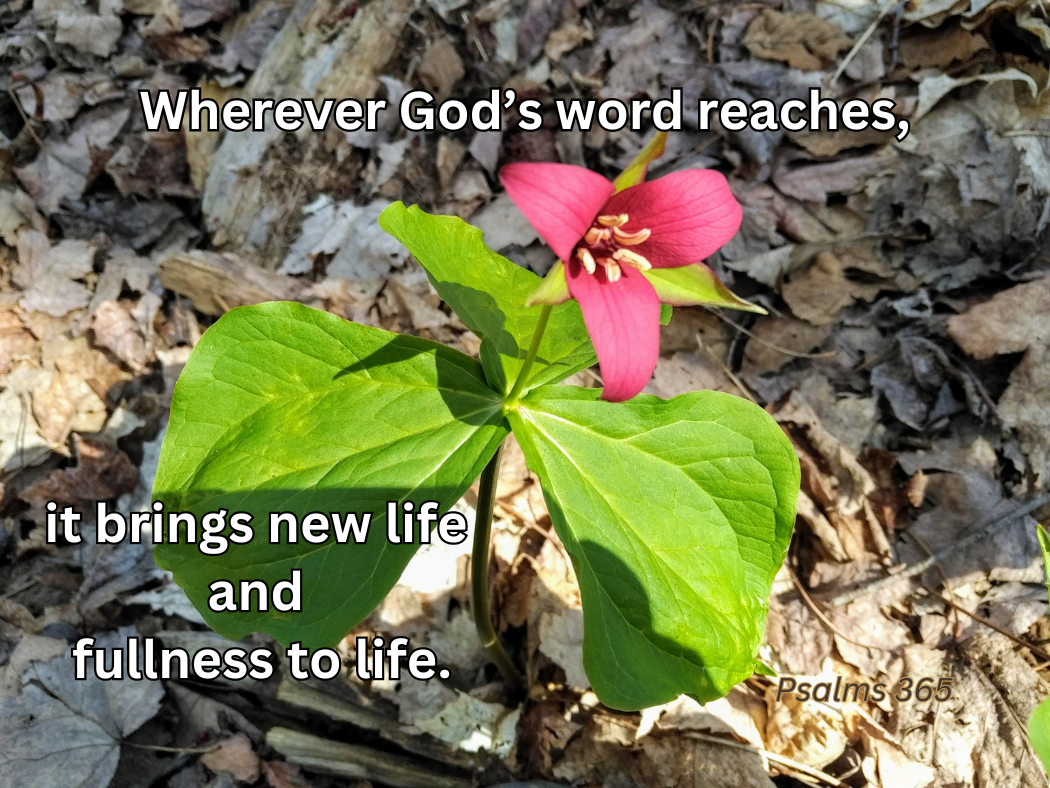
Wherever God’s word reaches, it brings new life and fullness to life. Yes, it often brings conviction of sins, but those are the dead limbs that need to be cut off so new growth can flourish. God’s word reorients my life from a path that leads to death to the way everlasting.

The inner peace and security that I need are found in the presence of the LORD. I need a constant flow of God’s word into my heart and my mind. True prosperity, healing and strength are found in the swiftly running words of God. I want to be immersed in those running words.

Response: LORD God, I treasure your commands and your words. I want your word to be active within me, cutting off those sins and habits that are unproductive, and then bringing forth new life and the fruits of righteousness, peace, and joy. Thank you, Jesus. Amen.

Your Turn: Do you allow God’s word to run and play in your mind? Has a Bible verse changed your life?

Para la publicación de Salmos 365 de hoy en español haga clic aquí.

bgbg_v4.3_1501818
* NEW INTERNATIONAL VERSION, COPYRIGHT ©1973, 1978, 1984, 2011 BY BIBLICA

Please pray for peace to return to Israel, Gaza, and Ukraine!

Volume I of Psalms 365: Develop a Life of Worship and Prayer won the Best Book of the Year Award from The Word Guild and Volume II has won the Best Devotional of the Year Award. For those who love God’s word, this three-book series is an ideal way to daily meet with the Lord. To purchase or for a closer look click here.

A gripping read from David Kitz.
Is a return-to-Jesus revival possible in our time?
This book points the way forward.
For details click here.

Filled with Laughter

24 Sunday Aug 2025

Posted by davidkitz in Psalm 126, Psalms

≈ Leave a comment

Tags

churches, faith, fortunes, harvest, Holy Spirit, Jesus, Jesus People, joy, lost generation, Prayer, Psalms, restoration, revival, the LORD, word of God, Zion

Psalm 126

A Song of Ascents

When the LORD brought back the captives to Zion,
we were like men who dreamed.
Our mouths were filled with laughter,
our tongues with songs of joy.
Then it was said among the nations,
“The LORD has done great things for them.”
The LORD has done great things for us,
and we are filled with joy.

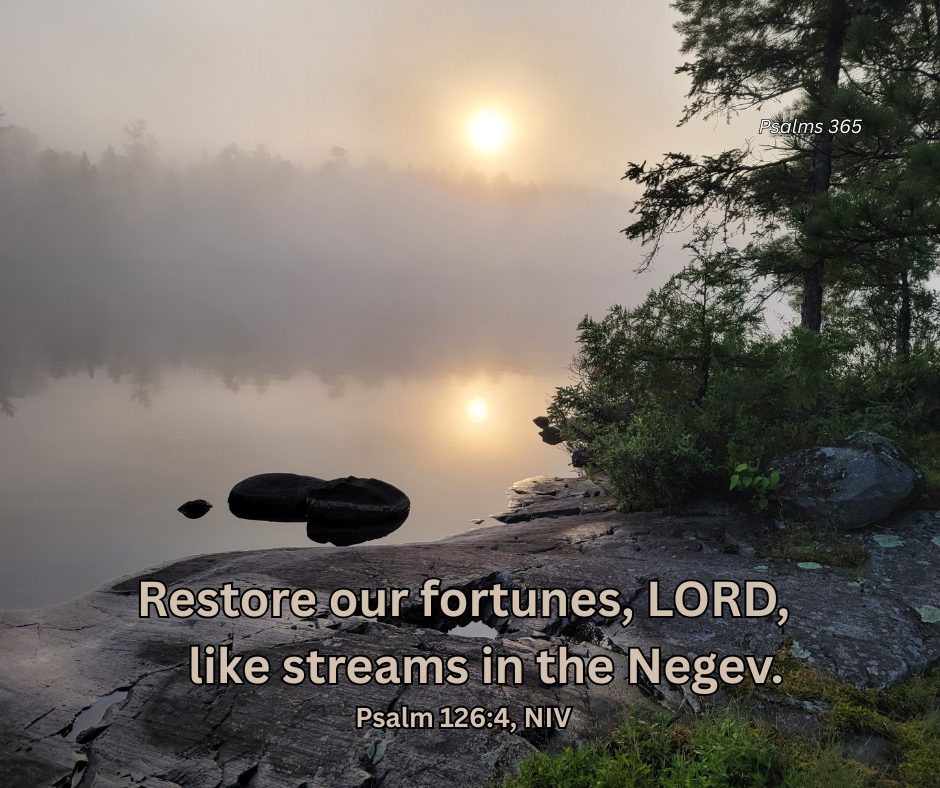
Restore our fortunes, O LORD,
like streams in the Negev.
Those who sow in tears will reap with songs of joy.
He who goes out weeping,
carrying seed to sow,
will return with songs of joy,
carrying sheaves with him.

I cannot read this psalm—Psalm 126—without immediately identifying with it. I have lived this psalm; I have experienced the reality of it.

Now that’s a rather bold statement; some might call it an ignorant or arrogant statement. The historical context of this psalm is readily identifiable. The psalmist is commenting on the joyous return of the exiles following the seventy-year Babylonian captivity—an event that occurred in the sixth century before the birth of Christ. How could anyone alive today claim that they have lived or experienced this particular Psalm? None of us were present during these dramatic events in Jewish history.

But again, I repeat: I have lived this psalm; I have experienced the reality of it.

The whole premise of this book is built on the notion that the psalms can come alive within us. The writer of the Book of Hebrews reminds us that “the word of God is living and active (Hebrews 4:12).

Photo by L. Kranz

What is there then, to prevent this living word from coming alive within us? Why can we not experience this active word of God transforming and transporting us to the throne of grace? Only two things hinder us from living in the power and wonder of the word of God, and they are sin and unbelief. And sin and unbelief are only too eager to form within us, a constricting bond that smothers the Spirit empowered Word.

But when the power of sin is broken, and unbelief is purged from the doubting soul—oh what liberty awaits! The word of God comes alive within us. The LORD is then free to do great and glorious things in us, and through us.

That was my experience as a young man in the early 1970’s. The LORD was bringing back the captives to Zion, “and we were like men who dreamed. Our mouths were filled with laughter, our tongues with songs of joy.”

I was caught up in the vortex of the Jesus People movement of that time, and amazing things were happening. Young men and women were coming to faith in Christ at a phenomenal rate. At every church meeting newcomers were finding the forgiveness they needed. The prodigals were coming home in droves. Every gathering closed with a baptismal service as new believers affirmed their faith in the crucified and risen Christ. There was a heady infectious joy in the church that could not be contained.   

At that time, “Our mouths were filled with laughter, our tongues with songs of joy.”

The spontaneity of the worship experience during those days was truly astonishing. New songs were born—born by the Spirit—right within the corporate worship time. Many of them came directly from the scriptures. The psalms became the source book for our worship. The captives—captives of sin and Satan—had been set free, and now there was a new song in our hearts, and on our lips—a song of praise to our God. We could not keep this to ourselves. Who could possibly contain the overflowing goodness and mercy of God?

This ingathering of souls was God’s doing. A lost generation was arrested by the Almighty. He was turning us around, and we were discovering Jesus. And this move of the Holy Spirit did not begin in the church. No, it began in the flop houses and hippy communes. It started on the street—in the world—the sin-saturated world. It did not start with saintly scholars and philosophers, but rather with the young and restless, the hitchhikers and misfits. God was calling them to Himself, and He was miraculously transforming lives as only can God do.

Because this new thing that God was doing started in the world, many Christians were suspicious of it. Could this really be God? Many churches stood aloof. But those who welcomed these misfits found themselves overwhelmed and transformed by what God was doing. He had initiated this, and He stood at the center of it.

Soon the Jesus’ movement was affecting the entire youth culture. Amazing Grace became the number one hit on top forty radio. A half dozen hit songs spoke of the man from Galilee. Time magazine ran a cover story on how the youth across the continent were discovering Jesus. Suddenly, it was cool to love Jesus and to follow him.

And I was a frontline witness to all this. I was seeing lives changed all around me. Close friends, who were far from God, suddenly were having life altering encounters with Jesus. We were like men who dreamed. And in that dream Jesus had come to live among us. His long flowing hair had become our own. He was with us again, just like he was with that band of fishermen on the Sea of Galilee, and the nets were full of fish—boat swamping full of fish.

“Our mouths were filled with laughter, our tongues with songs of joy. Then it was said among the nations, ‘The LORD has done great things for them.'”

The world knows when God is doing something remarkable, and the psalmist records the ancient world heard that the captive Jewish nation had been released. The exiles were free to return to their homeland, and return they did. In the early 1970’s the modern world heard that Jesus was bringing young people to himself. They too were free—set free from a load of guilt and sin, set free from addictions and hang ups—free to love and serve God with hearts washed pure by the blood of the Lamb.

“The LORD has done great things for us, and we are filled with joy!”

That was my experience—an experience that was shared by thousands of others across this continent during this remarkable time. It was the LORD’s doing. He did great things for us—things I will never forget.

But …

But there is a pause in this psalm. This is a psalm written in two distinct sections, or stanzas. In most translations, this break between stanzas is indicated by a blank line. The psalmist abruptly transitions from joyous triumph to sober petition, from exuberance to sobbing desperation. We are left wondering what happened in between. What happened in that blank line? Why this sharp transition? In bleak desolation the psalmist pleads, “Restore our fortunes, O LORD, like streams in the Negev.”

Atacama Desert, Chile — Photo credit http://www.explora.com

Streams in the Negev are intermittent. A raging torrent one day becomes a mere trickle on the next day, and then nothing on the third day. The boisterous river of joy turns into a blank line on the desert floor. Nothing—just nothing.

The Negev is the parched desert region to the south of the land of Judah. Cloud bursts there can produce these streams in the barren desert, and with the sudden arrival of this moisture, long dormant seeds spring to life. Suddenly new life abounds. But without further moisture, the scorching sun takes its toll. The harsh environment reasserts its dominance. Land that was briefly lush and verdant reverts to desert dust.

Is it any wonder then that the psalmist cries out, “Restore our fortunes, O LORD, like streams in the Negev.” The psalmist longs for the flow of new life to continue.

And right along with the psalmist I cry, “Send your river flowing through here once again. Send a cloud burst of your mercy down on this nation again. Invade this culture again. Turn our young people to Jesus, yet again. Touch this new generation. Let them find themselves walking with you, the living Christ. You did it once, Lord, and I saw it. I experienced it. Now do it again! Do it again, not for me, but for those who don’t know you. Do great things for them. Set them free from the sin and the lies that ensnare them. Touch all of us, once again!”

“Restore our fortunes, O LORD, like streams in the Negev.”

In those days, at the height of what God was doing, I saw a dozen young men line up in the freezing cold. They arrived early. They were waiting for the pastor to arrive on a Saturday night to unlock the church so they could come in and give their hearts to Jesus. I saw hundreds of young people being baptized at that same church—more than three hundred in a year—one for every day of the year. The God of the harvest was adding to the church “daily those who were being saved” (Acts 2:47).

This was not about the Holy Spirit tickling the churches’ funny bone. It was about sinners finding God. Time after time I saw the lost crowding the altar at the close of the service. They wanted Jesus, nothing more, nothing less, just Jesus.

Now, only the faithful come to the altar, if anyone comes at all.

 “Restore our fortunes, O LORD.”

 I echo the psalmist’s prayer, “Restore our fortunes, O LORD.”

Fortunately, we are provided with the promise of God’s word in tandem with the psalmist’s petition, “Those who sow in tears will reap with songs of joy.”

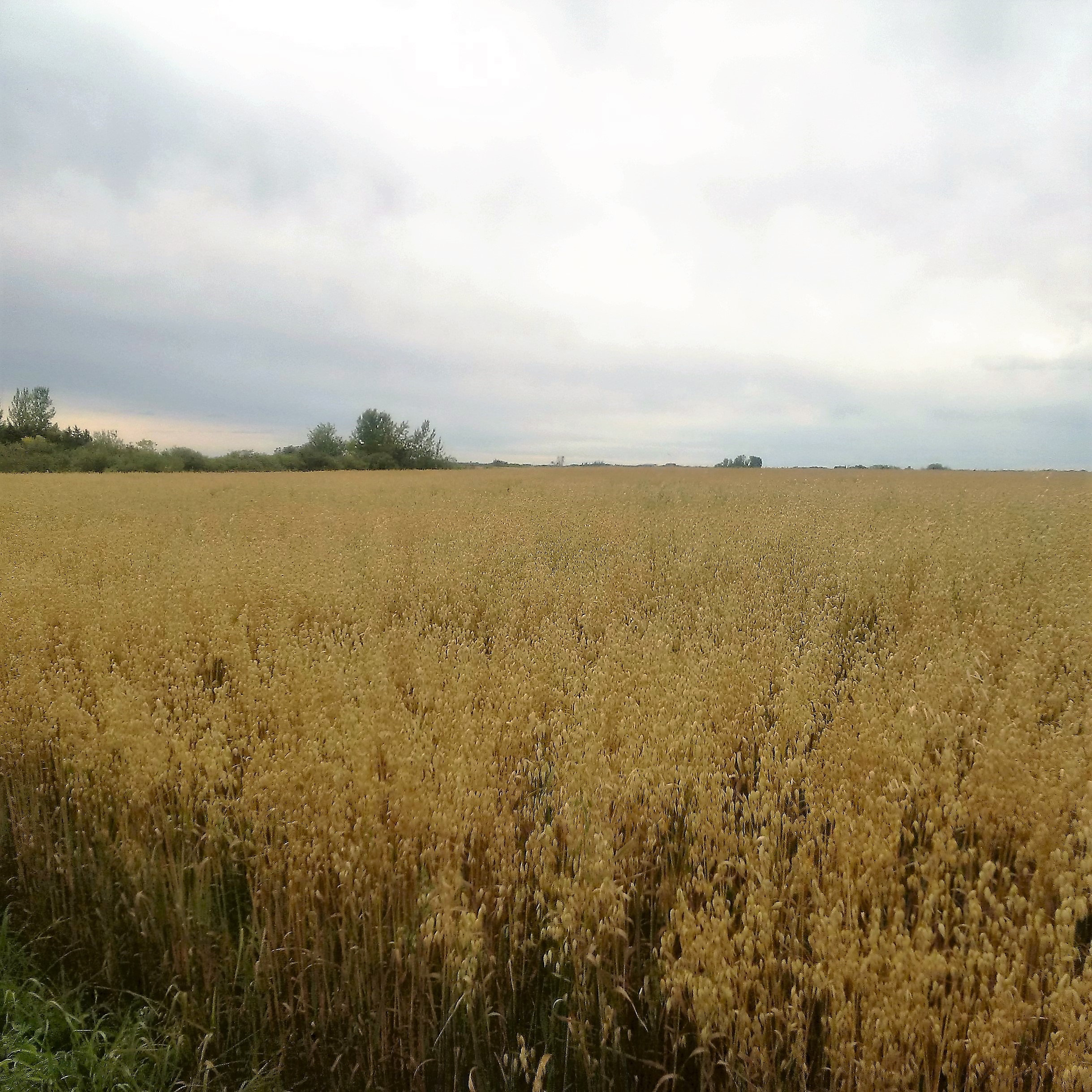
A field of harvest ready oats near MacNutt, SK — photo by David Kitz

If you live in a dry land, water it with your tears. If the wind of God’s Spirit is a distant memory, remember seasons change. The seed of God’s word is still viable. It is always power packed and ready to spring to life. Just add water.

“He who goes out weeping, carrying seed to sow, will return with songs of joy, carrying sheaves with him.”

God’s promise stands sure and certain, but for us, two questions remain. Are you going out weeping? And are you carrying seed to sow?

Perhaps the church in Canada has never experienced a harsher spiritual climate than that which exists today. We live in a society that by and large has turned its back on God. The gospel message is often treated with contempt or outright ridicule. The church exists in a spiritual desert. Figuratively, Canada is the Negev. Conditions in in the United States are only marginally better.

In such a harsh climate the natural inclination is to cocoon ourselves away. The world out there is inhospitable. It’s best to stay inside, to huddle amongst ourselves. Isn’t it better to cloister ourselves away, than to expose ourselves to the harsh elements and the criticism of others? Let’s circle the wagons and entertain ourselves. This has become the unspoken modus operandi for many churches.

Into our cloistered existence the psalmist speaks. He instructs us to step out of our sheltered place. He tells us to go out weeping. What a bizarre command! Weeping is for private places. Why would we want to go out into the world weeping? Yet, this is what we are encouraged to do. Could it be that we are to get out of our churches and cry? Cry over what?

How about crying over a lost generation? How about crying over the homeless, the addicted and the needy? How about crying over the devastating effects of sin, and the degradation of our youth?

One day in the late 1950’s, David Wilkerson opened a copy of Life magazine where he saw photos of young gang members in New York City. Looking into their eyes, he broke down and wept. This young pastor left the shelter of his country church to bring the gospel to the toughest gangs in New York City. He went “out weeping, carrying seed to sow” and yes, David Wilkerson returned “with songs of joy, carrying sheaves with him.” He proved that the message of the cross is more powerful than the switchblade.

God has given us His seed—the word of God—for a reason. We are to scatter it out in the world. There can be no harvest unless someone goes out and plants the seed.

Are you carrying seed to sow? Don’t just carry it into the world. Scatter it. There is no joy quite like the harvester’s joy. The harvester has worked with God, and the LORD’s joy becomes his own.

“He who goes out weeping, carrying seed to sow, will return with songs of joy, carrying sheaves with him.”

Bringing Life to the Psalms

  1. Have you experienced the joy of harvest, where new souls have been added to the Kingdom of God? What was that experience like? What role did you play? Read 1 Corinthians 3:5-9 for Paul’s perspective on planting and harvesting.
  2. What is the difference between ingathering and revival? There appears to be a place for both in the economy of God’s Kingdom. Take note of the revival that took place under the leadership of Josiah, King of Judah, as recorded in 2 Chronicles 34-35. The discovery of the Book of the Law of the LORD was a key element in this revival. In a similar way, I would contend that the release of the Good News, New Testament by the Bible Society contributed significantly to the Jesus People movement of the early 1970’s. How important is it for you to have an understandable translation of the scriptures?
  3. Are we living in a harsh spiritual climate? Is the gospel message impacting the culture in which we live, or is the culture of the world impacting the church?
  4. What are you personally doing to sow the seed of God’s word? What are some innovative ways to get the seed out into the field? What can churches do to facilitate going out with the seed of God’s word? Have you circled the wagons? Are you merely entertaining yourselves? What is the role of tears in the harvest that God wills to bring on the earth?
  5. Reread Psalm 126. What is God saying to you by His Spirit?

Today’s post is Chapter 25 from the book Psalms Alive! Connecting Heaven & Earth by David Kitz. To find out more or purchase click here.


I Will Not Neglect Your Word

03 Sunday Aug 2025

Posted by davidkitz in Psalm 119, Psalms, Psalms Alive!

≈ 2 Comments

Tags

Bible, faith in God, God's word, Jesus, meditating on God's word, meditation, memorization, praise, Psalm 119, Righteousness, the LORD, word of God

Psalm 119:12-16

Praise be to you, O LORD;
Teach me your decrees.
With my lips I recount
all the laws that come from your mouth.
I rejoice in following your statutes
as one rejoices in great riches.
I meditate on your precepts
and consider your ways.
I delight in your decrees;
I will not neglect your word.

Psalm 119 is the longest psalm in the Bible. It is also an acrostic poem, which in this case means each stanza of this poetic psalm begins with a different letter of the Hebrew alphabet. The section above for instance, begins with the letter Beth, which roughly corresponds to our letter B. Also, within each alphabetic stanza are eight verses, which all begin with the same Hebrew letter. In this way the psalm’s composer works his way through the entire twenty-two letters of the Hebrew alphabet. This psalm is in fact a remarkable literary composition, which was originally structured to be memorized, like the alphabet. Unfortunately, for the English reader, much of the elaborate, intricate beauty of this psalm is lost the moment it is translated from its original tongue.

The theme of this psalm is consistent throughout. It is a poetic testimony in praise of God’s holy, unchanging word. Here we find the alpha and omega of the psalms—a literary tribute to the A to Z wonder of God’s word. Every letter trumpets the salutary goodness of God’s written word. Charles Spurgeon, the nineteenth century theologian, has called Psalm 119, “A pearl island, or better still, a garden of sweet flowers.”[1]

Here in Psalm 119, we find these immortal words of comfort and encouragement, “Your word is a lamp to my feet and a light for my path” (Psalm 119:105).

Throughout the ages the saints of God have found that light for the journey comes streaming through the written pages of the word of God. Where can we turn in times of despair? How can we scale mountains of fear? How can we cross an ocean of worry? In this sin-darkened world, the word of God stands secure. It sends out a beam of radiant truth to light the traveller’s path. Is it any wonder then that the psalmist declares, “I have put my hope in your word” (Psalm 119:147b).

The light of your presence, LORD — photo by David Kitz

While Psalm 119 shouts out the eternal praises of God’s word, it does so, from a kneeling position. There is an unmistakable posture to this psalm. It rings most true, when it is spoken by a worshipper on his knees. This is a psalm filled with humble supplication. It is humble supplication that kneels and bows low before the Holy One of Israel.

There is an earnest pleading in this psalm that springs from the realization that apart from God and His Holy Word, personal holiness and salvation are impossible. Hence, we have the opening question that frames this stanza, “How can a young man keep his way pure?” 

But in His mercy the LORD has provided a response: “Praise be to you, O LORD; teach me your decrees.”

Unless God teaches me His decrees, I stumble through life lost, without direction, meaning or purpose. In reality, the eat, drink and be merry philosophy that governs the actions of so many in this world, simply springs naturally from their lost state. Hedonism is after all a rather logical response, if life has no meaning or purpose, or if our souls have no eternal destiny.

But to the soul that has heard God’s whisper in the wind or caught a glimpse of His unfading glory in the setting sun, hedonism has lost much of its allure. The soul that takes the long view—that sees beyond the grave—lives life in a different light. We are called to live on a higher plain—a plain that is sustained and nourished by God’s life-giving, life-invigorating Word.

So, in humility with the psalmist, we cry out to the LORD, “Teach me your decrees.”

Now, aware of our fallen position—from a position of need—we cry out to the LORD, “Teach me your decrees.”

The arrogant and self-satisfied are unfamiliar with this prayer. It has no resonance within them. This is the prayer of the hungry and the thirsty. It is Jesus, the word incarnate, who takes it upon himself to personally answer this prayer. Through the beatitudes he answers the cry of our heart, “Blessed are those who hunger and thirst for righteousness, for they will be filled” (Matthew 5:6).

There is a righteousness that does not spring from our performance or our merit. It does not come from observing the law. It comes directly from the crucified and risen Christ, the one who knew no sin. This righteousness—the righteousness of Christ—is credited to our account by faith.  So then as the apostle Paul asserts, “we have believed in Jesus Christ, that we might be justified by faith in Christ and not by the works of the law; for by the works of the law no flesh shall be justified” (Galatians 2:16 NKJV).

Did the writer of Psalm 119 understand the true source of holiness, or was he simply trying to achieve holiness through his own human effort? Is the psalmist’s focus on the law of the LORD and His commands and decrees, just a misdirected reflection of legalistic Old Testament thinking? For today’s believers, who look back in history from this side of the cross, this is a valid question.

On this point, the psalmist’s prayer in later in Psalm 119 is truly insightful. Notice both his choice of words and his posture in supplication, “May your unfailing love come to me, O LORD, your salvation according to your promise; then I will answer the one who taunts me, for I trust in your word” (Psalm 119:41).

Clearly the psalmist saw his need for salvation—salvation that comes freely from a God of grace and unfailing love. Secondly, in the same way as New Testament believers find salvation, the psalmist puts his trust in the word of God and the LORD’s sure promises—promises that include the coming of a Saviour-Redeemer. Satan’s taunts are no match for the believer who has put his faith in the LORD and His word.

Bridge across the Assiniboine River — photo courtesy of Donald Adam

Biblical revelation is progressive through time. The full revelation of God’s way of redemption was not revealed to the Old Testament prophets. They saw in part and prophesied in part concerning the coming of our Lord and Saviour, Jesus Christ. But the partial nature of their revelation does not invalidate their testimony or the authority of their words. Even as the above passage reveals, they saw the way of salvation with an uncanny accuracy—an accuracy that was Holy Spirit breathed.

In fact, the apostle Peter validates the ministry of the Old Testament writers by declaring of these men that they “spoke from God as they were carried along by the Holy Spirit” (2 Peter 1:21).

Again, Peter confirms the authority of the Old Testament scriptures by quoting the words of Isaiah, “All men are like grass and their glory is like the flowers of the field; the grass withers and the flowers fall, but the word of the Lord stands forever” (1 Peter 1:24- 25).

If the word of the LORD stands forever, why do so many Christians discount the Old Testament scriptures? They maybe scriptures, but we discount them. They have been dumped into the half-off bin at the back of our scriptural storehouse. They’re in the front of the Bible, but for many of us, they are in that unused, unread portion. Mentally, we have moved them to the back forty. They have become the back forty-four—out of sight and out of mind. 

But the words of Psalm 119 break into our mind. Here we have some radical thinking—a radical all out devotion to God’s word.

“With my lips I recount all the laws that come from your mouth. I rejoice in following your statutes as one rejoices in great riches.”

In my mind, recounting something with my lips sounds a lot like a rehearsal. Have you rehearsed God’s laws? Doing a rehearsal with my lips sounds a lot like recitation. Have you recited God’s laws? And how can anyone recite something without memorizing it? Have you committed portions of God’s word to memory?

Photo by Thirdman on Pexels.com

Memorization is a skill that has fallen by the wayside. At one time it was routinely taught and practised at our schools. Alas, in many classes, at many schools, those days are long gone. For many years the church was the last bastion of memorization. But in many churches, here too, this skill has fallen by the wayside. As a result, God’s word has fallen by the wayside. 

In recent years the birds of the air have had plenty to devour, because God’s people have forgotten how to hide the word of the LORD in their hearts. But Satan’s emissaries have been busy doing double duty. Not only have they been snatching away the word of God, they also have been filling the empty spots in our minds. They have been planting illicit images where God’s word should be growing.

Is it any wonder then that the church is anaemic? The Spirit-infused bread of life has not been digested and incorporated into the church, the earthbound corpus Christi.  

Memorization is hard work; it takes discipline. A disciple embraces discipline. Are you a disciple in the body of Christ? Then you will discover there is a joy that comes through incorporating God’s word more fully into your mind and into your life.   

The psalmist found a wellspring of joy in the word of God. Hear his words, “I rejoice in following your statutes as one rejoices in great riches.”

Light shines on the righteous and joy on the upright in heart — photo by David Kitz

Memorization very naturally leads to incorporation. The word becomes part of us, just as the food we eat. God’s word is lived out—expressed daily through our lives. We follow the written word—the statutes—and in so doing we are following Christ. After all, it was Jesus who told his disciples, “If you love me, you will obey what I command” (John 14:15).

When we obey, the word becomes fully alive in us. As it was at Christ’s conception, once again, the word becomes incarnate. But this time, God’s word is alive in us—alive in our earthen vessels.

Are you rich with this world’s wealth? Or are you rich in God’s word? Are you finding joy in following Jesus’ commands? If you are discovering that joy, a wonderful promise awaits you. Jesus said, “If anyone loves me, he will obey my teaching. My Father will love him, and we will come to him and make our home with him” (John 14:23).

The empty spot in the garden of our heart will be filled. Jesus will live there through the power of His Word. Your heart will become His dwelling place.

Meditating on God’s word makes room for Jesus in our mind. The psalmist did not only know the secret of a clean mind, he also knew how to keep his mind occupied, healthy and active. Hear him again, “I meditate on your precepts and consider your ways.”

Unlike mind emptying transcendental meditation, biblical meditation fills the mind with God’s holy word. Our mind becomes a garden of life—a garden of sweet flowers—bringing glory to God our Creator.

Autumn sunflowers, Churchbridge, SK — photo by David Kitz

By meditating on God’s word and His ways, we put into practice the apostle Paul’s, advice to us, “Whatever is true, whatever is noble, whatever is right, whatever is pure, whatever is lovely, whatever is admirable—if anything is excellent or praiseworthy—think about such things” (Philippians 4:8).

As we meditate on these things and put them into practice, the God of all peace will be with us. He resides in His Word. His presence in us will manifest itself through an ever-increasing measure of spiritual power, when we open our hearts and our minds to meditate on His word. Then we will find joy coming to us through God’s word. The psalmist’s confession will become our own. “I delight in your decrees.”

“I will not neglect your word.”

For me, these words have become a daily challenge, and a personal commitment. I will not neglect God’s word. When I am walking in His garden, Jesus finds me there.

[1] The Treasury of David, Psalms 111-150 (Classic Reflections on the Wisdom of the Psalms, Volume 3) by Charles H. Spurgeon, Henderson Publishing, 2005.

Bringing Life to the Psalms

  1. Memorization and meditation are sisters. Both practices bury God’s word more deeply in our minds. The buried seed of God’s word germinates, grows and bears fruit. Why not commit yourself to memorize God’s word? Psalm 119 Beth is a wonderful place to begin this life changing practice.
  2. When the word of God takes root in our hearts, we become living epistles—letters from God to a lost generation. You are the only Bible many in this world will ever read. Take a moment to read 2 Corinthians 3:1-3. What do those around you see when they read your life?
  3. Is the Old Testament in your scriptural deep-discount bin? What relevance does it have for your life today? Have there been instances when an Old Testament passage or story significantly impacted your life? What steps can be taken to honor the whole of God’s word more fully in our churches today?
  4. Take time to read all of Psalm 119. Highlight those verses that particularly speak to your heart. Review these same passages later in the day or the week. Take time to think on these things. By doing so, you are meditating on God’s word.

Today’s post is Chapter 23 from the book Psalms Alive! Connecting Heaven & Earth by David Kitz. To find out more or purchase click here.


His Kingdom Rules over All

26 Saturday Jul 2025

Posted by davidkitz in Psalm 103

≈ 3 Comments

Tags

angels, dominion, God's word, heaven, kingdom, praise the LORD, word of God

I will praise the LORD!

You have set your glory in the heavens — photo by David Kitz

Psalm 103:19-22

The LORD has established his throne in heaven,
    and his kingdom rules over all.
Praise the LORD, you his angels,
    you mighty ones who do his bidding,
    who obey his word.
Praise the LORD, all his heavenly hosts,
    you his servants who do his will.
Praise the LORD, all his works
    everywhere in his dominion.
Praise the LORD, my soul. *

Para la publicación de Salmos 365 de hoy en español haga clic aquí.

bgbg_v4.3_1501818
* NEW INTERNATIONAL VERSION, COPYRIGHT ©1973, 1978, 1984, 2011 BY BIBLICA

Please pray for peace to return to Israel, Gaza, and Ukraine!

Volume I of Psalms 365: Develop a Life of Worship and Prayer won the Best Book of the Year Award from The Word Guild and Volume II has won the Best Devotional of the Year Award. For those who love God’s word, this three-book series is an ideal way to daily meet with the Lord. To purchase or for a closer look click here.

A gripping read from David Kitz.
Is a return-to-Jesus revival possible in our time?
This book points the way forward.
For details click here.

Test Me in This

16 Wednesday Jul 2025

Posted by davidkitz in Psalm 119, Psalms

≈ Leave a comment

Tags

Bible, Lord Almighty, Prayer, promises of God, Psalms, testing God, tithes, word of God

Today’s quote and prayer from
“Psalms 365: Develop a Life of Worship and Prayer”
by David Kitz.

Road tested — photo by David Kitz

Reading: Psalm 119:137-144

LORD God,
your word and your promises
stand true for all eternity.
Help me to believe and live each day
through the wise application of your word.
Give me understanding
that I may live 
(Psalm 119:144).
Amen.

— — — —

“Will a mere mortal rob God? Yet you rob me.

“But you ask, ‘How are we robbing you?’

“In tithes and offerings.
You are under a curse—
your whole nation—
because you are robbing me.

Bring the whole tithe into the storehouse,
that there may be food in my house.
Test me in this,”
says the LORD Almighty,
“and see if I will not throw open
the floodgates of heaven
and pour out so much blessing
that there will not be room enough to store it.

I will prevent pests from devouring your crops,
and the vines in your fields
will not drop their fruit before it is ripe,”
says the LORD Almighty.

“Then all the nations will call you blessed,
for yours will be a delightful land,”
says the LORD Almighty.

(Malachi 3:8-12 NIV)*

Para la publicación de Salmos 365 de hoy en español haga clic aquí.

bgbg_v4.3_1501818
* NEW INTERNATIONAL VERSION, COPYRIGHT ©1973, 1978, 1984, 2011 BY BIBLICA

Please pray for peace to return to Israel, Gaza, Iran, and Ukraine!

Volume I of Psalms 365: Develop a Life of Worship and Prayer won the Best Book of the Year Award from The Word Guild and Volume II has won the Best Devotional of the Year Award. For those who love God’s word, this three-book series is an ideal way to daily meet with the Lord. To purchase or for a closer look click here.

A gripping read from David Kitz.
Is a return-to-Jesus revival possible in our time?
This book points the way forward.

Unshaken Trust

11 Friday Jul 2025

Posted by davidkitz in Psalm 119, Psalms

≈ Leave a comment

Tags

devotion, discernment, double-minded, faith, holiness, integrity, mind of Christ, obedience, Righteousness, Scripture, stability, steadfastness, truth, wisdom, word of God

Today’s Devotion from Psalms 365 by David Kitz

Reading: Psalm 119:113-120
ס Samekh
I hate double-minded people,
but I love your law.
You are my refuge and my shield;
I have put my hope in your word.
Away from me, you evildoers,
that I may keep the commands of my God!
Sustain me, my God, according to your promise, and I will live;
do not let my hopes be dashed.
Uphold me, and I will be delivered;
I will always have regard for your decrees.
You reject all who stray from your decrees,
for their delusions come to nothing.
All the wicked of the earth you discard like dross;
therefore I love your statutes.
My flesh trembles in fear of you;
I stand in awe of your laws (NIV). *

Reflection
Our reading today from Psalm 119 begins with a rather harsh statement: I hate double-minded people, but I love your law (v. 113).

You never know where you stand with a double-minded person. His opinions and his views on various topics shift, depending on who he is with or what is currently in vogue. Everything is relative, so what is wrong today might be right tomorrow depending on the circumstances of course. This fluid, shifting perspective, accurately reflects the moral tenor of our times. There is no certainty. There are no absolutes.

Psalm 119 is a direct contradiction of this world view. The author rejoices in the word of God. He exalts the LORD’s commands. My flesh trembles in fear of you; I stand in awe of your laws (v. 120).

But where does that leave me? I live in a world that is trying to bend me—to distort me—so I fit into its mold. It takes real determination to resist. If I compromise my faith, I quickly become a double-minded person, unfit for the Lord’s service. I need the mind of Christ.

James has this advice for us: If any of you lacks wisdom, let him ask of God, who gives to all liberally and without reproach, and it will be given to him. But let him ask in faith, with no doubting, for he who doubts is like a wave of the sea driven and tossed by the wind. For let not that man suppose that he will receive anything from the Lord; he is a double-minded man, unstable in all his ways (James 1:5-8).

Response: Father God, I need your wisdom to live right in this world. I want to escape the corruption that is in the world by drawing close to you and obeying your holy and unchanging word. I call on you for help. Amen.

Your Turn: Do you suffer from double-mindedness? Where is your anchor?

Para la publicación de Salmos 365 de hoy en español haga clic aquí.

bgbg_v4.3_1501818
* NEW INTERNATIONAL VERSION, COPYRIGHT ©1973, 1978, 1984, 2011 BY BIBLICA

Please pray for peace to return to Israel, Gaza, and Ukraine!

Volume I of Psalms 365: Develop a Life of Worship and Prayer won the Best Book of the Year Award from The Word Guild and Volume II has won the Best Devotional of the Year Award. For those who love God’s word, this three-book series is an ideal way to daily meet with the Lord. To purchase or for a closer look click here.

A gripping read from David Kitz.
Is a return-to-Jesus revival possible in our time?
This book points the way forward.
For details click here.

← Older posts

Psalms 365: Develop a Life of Worship and Prayer

Psalms 365 Volume II

Psalms 365 vol 3
— Psalms 365 Volume III

Psalms

Recent posts

  • Ready for the King of Glory December 19, 2025
  • My Spirit Rejoices in God My Savior December 18, 2025
  • Joining the Generation That Seeks God December 18, 2025
  • Why Am I So Favored December 17, 2025
  • How Can You Find the Good Life? December 17, 2025
  • The Power of the Most High December 16, 2025
  •  The Earth Turns to the LORD December 16, 2025

Calendar

December 2025
M T W T F S S
1234567
891011121314
15161718192021
22232425262728
293031  
« Nov    

Blog Posts

Comments

  • davidkitz on Joining the Generation That Seeks God
  • cjsmissionaryminister on God Sent His Son
  • cjsmissionaryminister on The God of the Broken

Blog at WordPress.com.

Privacy & Cookies: This site uses cookies. By continuing to use this website, you agree to their use.
To find out more, including how to control cookies, see here: Cookie Policy
  • Subscribe Subscribed
    • I love the Psalms
    • Join 1,378 other subscribers
    • Already have a WordPress.com account? Log in now.
    • I love the Psalms
    • Subscribe Subscribed
    • Sign up
    • Log in
    • Report this content
    • View site in Reader
    • Manage subscriptions
    • Collapse this bar
 

Loading Comments...