• Home
  • About
  • DavidKitz.ca
  • Youtube Videos
  • Books by David
  • Books on Amazon.com

I love the Psalms

~ Connecting daily with God through the Psalms

I love the Psalms

Author Archives: davidkitz

Who am I? The Defining Question

01 Sunday Mar 2026

Posted by davidkitz in Books by David Kitz

≈ 2 Comments

Tags

deity of Jesus, God, James, James the brother of Jesus, Jerusalem, Jesus, lukewarm, Mary and Joseph, Passover, Son of God, temple

James: the Lynchpin of Our Faith — Chapter 3

John in the opening chapter to his gospel account makes this observation about Jesus: “He was in the world, and though the world was made through him, the world did not recognize him. He came to that which was his own, but his own did not receive him” (John 1:10–11).

Most commentators on this passage conclude that John, who wrote this gospel in the latter part of the first century, was referring to the rejection of Jesus by the majority of the Jewish nation. To paraphrase: Jesus came to his own people, but they did not recognize him as their Messiah or receive him as such.

Undoubtedly, this is a correct interpretation of this passage. However, I would argue that typically we view and interpret this passage much too broadly. On the macro level this standard view is correct; Jesus was rejected by the Jewish nation. But it is within the microcosm of the family that the truth of this passage truly hits home. Jesus was not only rejected by his nation; he was rejected by his own family. A careful reading of the gospels makes this painful point clear.

The hometown rejection, which we read of in the previous chapter, foreshadows a much more extensive rejection of Jesus that rippled through his family, through the religious establishment and the whole of Jewish society. It culminated in his condemnation by the Sanhedrin and crucifixion at the hands of the Romans. Despite his wise teachings, which were coupled with signs and wonders, most of his contemporaries did not recognize the divinity of Christ. In their eyes, he was just a man—a man dangerously masquerading as so much more. The Gospel accounts make it blatantly clear that this was also the view that James and his brothers held.

But before we delve deeper into Jesus’ rejection by his family, we need to examine the topic of self-recognition. In the quote above, John stated, “He [Jesus] was in the world, and though the world was made through him, the world did not recognize him” (John 1:10).

John sees the problem of Jesus rejection as stemming from a failure of the people to recognize who he was. John clearly saw Jesus as the Creator of the universe; he recognized Jesus as Deity, but by and large Jewish society did not. He was Deity disguised in humanity and for many the disguise was too effective, too confounding. To this day it remains a stumbling block, particularly for those trained in the Jewish faith. God taking on human form is a foreign concept, and it is incomprehensible.

Now imagine for a moment how baffling—how incomprehensible—this concept would be for a twelve-year-old Jewish boy. But somehow at the age of twelve, Jesus grasped it. He recognized his own Deity. He saw himself as the Son of God. How exactly did this come about?

Childhood is all about self-discovery and learning our place in the world. Quite naturally self-discovery begins at home within the context of the family. We learn who we are from our parents and siblings. They define our genetic and cultural heredity. Genetically we are like them, and we become even more like them through our exposure to their loving nurture, interaction and instruction. Our family defines us, particularly at a young age. But for reasons we do not fully understand, Jesus saw himself as radically different. He saw that he did not fit or rightfully belong in his father’s household—in Joseph’s household. Already at age twelve, he recognized that he was not Joseph’s son.

How did this come about? How did Jesus come to see himself as different? Furthermore, it is one thing to conclude that this man you have grown up with is not your true father, but it is a huge leap for a twelve-year-old to conclude that he is some kind of divinely conceived genetic mutant, an offspring of God—a God/Boy. Yet that is how Jesus came to see himself.

The only gospel account of Jesus’ childhood presents a fascinating snapshot of Jesus’ self-perception. In the following account, Jesus reveals how he sees himself; he grasps his true identity:

Every year Jesus’ parents went to Jerusalem for the Festival of the Passover. When he was twelve years old, they went up to the festival, according to the custom. After the festival was over, while his parents were returning home, the boy Jesus stayed behind in Jerusalem, but they were unaware of it. Thinking he was in their company, they traveled on for a day. Then they began looking for him among their relatives and friends. When they did not find him, they went back to Jerusalem to look for him. After three days they found him in the temple courts, sitting among the teachers, listening to them and asking them questions. Everyone who heard him was amazed at his understanding and his answers. When his parents saw him, they were astonished.

His mother said to him, “Son, why have you treated us like this? Your father and I have been anxiously searching for you.”

“Why were you searching for me?” he asked. “Didn’t you know I had to be in my Father’s house?” But they did not understand what he was saying to them.

Then he went down to Nazareth with them and was obedient to them. But his mother treasured all these things in her heart. And Jesus grew in wisdom and stature, and in favor with God and man. (Luke 2:41–52)

The Boy Jesus in the Temple Courts

Jesus response to Mary’s question speaks volumes about Jesus’ self-perception. “Why were you searching for me? Didn’t you know I had to be in my Father’s house?”

It’s almost as though he is saying to his mother, “I know who I am. I’ve figured it out. Did you forget whose son I really am? God is my Father. All I wanted to do is spend some time with Him.”

“But they did not understand what he was saying to them” (Luke 2:50).

If Mary and Joseph did not understand what Jesus was saying to them, it would seem to indicate that they did not tell him of his divine origin. There was no private conversation where Joseph took Jesus aside and said, “Look son, you’re really not my son. Oh, and by the way, this is how you came about…”

Apparently, Mary did not have this conversation with Jesus either. Think about it. It would be a very difficult conversation to initiate. Explaining the virgin birth would surely stretch the bounds of common logic and would profoundly conflict with the norms of the Jewish faith. Why would the one true God impregnate a Jewish girl by the Spirit? Consider it for a moment. It’s preposterous and intrinsically it runs counter to all we know of Jewish religious dogma.

How do you tell your firstborn that he is the Son of God? Apparently, you don’t. If he truly is the Son of God, you let him figure it out. From this account, it would seem this is the course of inaction that Mary and Joseph took. They let Jesus figure it out. And he did.

That’s what’s truly remarkable about this account. The twelve-year-old figured it out. He discovered his true identity.

The question remains: How did Jesus do it? How did he come to realize his divinity?

Typically, we read this account of the lost twelve-year-old Jesus from the viewpoint of a parent. We identify with the stress of losing a child in a big city. We would title this story, “Mary and Joseph find lost Jesus.” But the story reads quite differently when we view it from the perspective of a child trying to discover who he really is. Viewed from Jesus’ perspective the title of the story might well be, “Lost Boy finds Himself ” or “Lost Boy Discovers His Divinity.”

How did Jesus discover he was God’s son? Some believers might well reason that the answer is obvious. Jesus is God; therefore, he is omniscient. The all-knowing Jesus would surely know that he was God’s son. But many theologians would beg to differ. They view the humanity of Christ as all-pervasive. Jesus was 100% human, and as such he needed to learn and discover his identity, even as any child does. The apostle Paul’s writing lends credence to this perspective. Here is his advice to the believers at Philippi:

In your relationships with one another, have the same mindset as Christ Jesus: Who, being in very nature God, did not consider equality with God something to be used to his own advantage; rather, he made himself nothing by taking the very nature of a servant, being made in human likeness. And being found in appearance as a man, he humbled himself by becoming obedient to death—even death on a cross!

Therefore God exalted him to the highest place and gave him the name that is above every name, that at the name of Jesus every knee should bow, in heaven and on earth and under the earth, and every tongue acknowledge that Jesus Christ is Lord, to the glory of God the Father. (Philippians 2:5–11)

The passage above contrasts the humility and exaltation of Christ. In taking on humanity, Christ emptied himself of Deity. He fully became one of us. He was faced with the same frailties and limitations. In other words, in his humanity, he did not know everything. His feet got tired after a long day, and, yes, they probably stank too. He was fully human. He grew hungry and thirsty, and he was tempted in every way just as we are.

The writer of the Book of Hebrews, when speaking of Jesus tells us that he was

fully human in every way, in order that he [Jesus] might become a merciful and faithful high priest in service to God, and that he might make atonement for the sins of the people. Because he himself suffered when he was tempted, he is able to help those who are being tempted. (Hebrews 2:17–18)

If this is true, then the boy Jesus needed to discover his divine identity. It may have been written into every fibre of his being, but he still needed to discover it, just as any young musical prodigy needs to explore and discover his or her gift. All divine gifts must be discovered and developed to reach their maximum potential.

Luke concludes his boyhood account about Jesus with these words: “Jesus grew in wisdom and stature, and in favor with God and man” (Luke 2:41–52). Evidently, there was a process of learning and growth in Jesus’ development, even as there is in any boy transitioning to manhood. But there was something different about this child. His interests were different from his peers. We are told that he was found in the temple courts, “sitting among the teachers, listening to them and asking them questions. Everyone who heard him was amazed at his understanding and his answers” (Luke 2:46b–47). Clearly, he possessed wisdom and insight beyond his years. His divine DNA was showing. It was written into the very character of his soul, and he was learning to read what was written there.

He was the Son of God.

That is what the boy Jesus saw writ large upon his life. That is what he heard his Father saying to him. If Joseph did not tell the boy Jesus about his divine origin, his heavenly Father certainly did. He was whispering in his ear, “You are my son!”

The teachers were amazed because they were catching glimpses of Deity.

Why did this realization of who he was occur to Jesus at this time?

Developmental psychologists tell us there is something quite significant about the mind of a twelve-year-old. For most children it’s the year of the great leap forward. Mentally there is this massive shift that takes place in brain function. The brain moves from concrete to abstract thought. Ideas take on far greater significance. The mind is less dependent on physical objects as props to thought. Ideas and concepts can be grasped and manipulated in ways that were impossible a few months earlier. In this context, the concept and understanding of self takes on a new significance.

In his twelfth year, for the first time Jesus fully understood who he was.

Jesus was different from his brothers. That was probably the first clue in discovering his true identity. We don’t know what Jesus looked like. First century people didn’t have cameras, and Da Vinci and the European master artists did not have time machines, so we really have no clear idea about Jesus’ appearance.

We do not know what divine DNA looks like when it takes on human form. Did Jesus simply look like a male version of Mary? Or were there other marked differences in appearance coming from the heavenly Father?

We can safely assume that Jesus didn’t look like Joseph, and if he didn’t resemble Joseph, he probably appeared to be different from his half-brothers, James, Joseph, Simon, and Jude. A father’s facial and physical traits are usually very evident in his sons.

A perceptive child would notice the differences. And Jesus was a perceptive child. By age twelve he would recognize that he was the different one, the odd one in the family. Knowing whose child you are cuts to the very core of your identity. Discovering you are not who you think you are is jarring to say the least. Imagine waking up to this totally altered reality. You are not your father’s son. You belong to someone else. You are someone else.

That is the reality that the twelve-year-old Jesus was coming to grips with. His decision to not return to Nazareth with his parents needs to be viewed in this context. Was this a deliberate decision? If Jesus knew he was not Joseph’s son, why return with this man who was not his father? But if he wasn’t Joseph’s son, whose child was he? Did Jesus stay in Jerusalem in an attempt to discover the answer to that question? The twelve- year-old Jesus was coming face to face with an intense identity crisis.

There is a huge level of pathos and emotional freight in this story. Joseph and Mary are frantically worried and searching for their lost son. But on the other side of the equation, we see a lost son—with his whole sense of self in question. Was he searching for and discovering a new identity? But there is a huge leap from recognizing you are different—not fully one of the family—to identifying yourself as the Son of God.

But Jesus made that leap. The New King James Version translates Jesus’ response to Mary’s question in the temple this way. “Why did you seek Me? Did you not know that I must be about My Father’s business?” (Luke 2:49).

Implicit in that response is Jesus’ recognition that he was not the carpenter’s son, but instead God’s son—God’s son ready and willing to take on God’s work.

The easier conclusion a perceptive twelve-year-old might reach is that he was the product of Mary’s union with another man—maybe the result of a teenage fling or indiscretion, or perhaps Mary was raped by a Roman soldier. That would account for Jesus’ apparent differences from the other members in the family. It might also be the reason why these differences were not discussed. His conception was an embarrassing episode prior to marriage. For reasons of family pride, some things were better left unsaid.

But Jesus did not reach this more mundane conclusion. According to the scenario presented here, everything within him told him he was the Son of God. His internal script contained a different code, and there in the temple he had deciphered it. He was God’s son come in the flesh. The lost boy had found Himself. He had found His true identity, not as Joseph’s son, but as God’s Son. (4

Time would tell if this was just the deluded thoughts of a preteen dreamer, or if there was the ring of truth to his self-identification with Deity.

J. W. Shepard in his classic The Christ of the Gospels gives us his take on this account from Luke:

Theologians have speculated as to when Jesus first became conscious of the fact that He was God’s son in a peculiar sense and of his Messianic mission. We turn to these words as the sole clear self-revelation of Jesus in his boyhood years. In them we find his feeling of a distinct disappointment, that his parents did not understand Him better. He reveals in them the consciousness of a unique relationship to His Father. He expressed in them a clear sense of His primary obligations to God, which for the time had so engrossed His attention, that He almost lost sight of time and his human filial relationships. (5

At this point readers may well be questioning how this connects with James. This is supposed to be a book about James after all. But James may well have been present—standing next to Mary and Joseph when Jesus said “Why did you seek Me? Did you not know that I must be about My Father’s business?” (Luke 2:49 NKJV)

There are some sound reasons for believing that this was the case—that young James was present when Jesus identified himself as God’s son. In the previous chapter we clearly established that there were other children born to Mary and Joseph. Luke tells us that… “Every year Jesus’ parents went to Jerusalem for the Festival of the Passover. When he was twelve years old, they went up to the festival, according to the custom” (Luke 2:41–42).

It is logical to assume that this was a pilgrimage that the whole family undertook. Being observant Jews, there are no obvious grounds to assume otherwise. If this is the case, there may well have been as many as five or six children in this family entourage. In this context losing track of one child makes far more sense, given the large size of this family. The oldest boy, Jesus, was more independent, so “Thinking he was in their company, they traveled on for a day. Then they began looking for him among their relatives and friends” (Luke 2:44).

When Joseph and Mary returned to Jerusalem to search for Jesus, James and his brothers and sisters may have come with them. Having just lost one child, Mary and Joseph would want their remaining children close beside them, or safe in the care of the extended family. Hence, it is possible that James was present with his parents when they came upon Jesus in the temple courts.

Via-Dolorosa in Jerusalem — photo courtesy of Lois Morrow

Finally, we need to consider how this story came to be in Luke’s Gospel. In the introduction to his gospel, the good doctor Luke gives us some insight into the sources he drew upon when he wrote his account of Jesus life.

Many have undertaken to draw up an account of the things that have been fulfilled among us, just as they were handed down to us by those who from the first were eyewitnesses and servants of the word. With this in mind, since I myself have carefully investigated everything from the beginning, I too decided to write an orderly account for you, most excellent Theophilus, so that you may know the certainty of the things you have been taught. (Luke 1:1–4)

Luke asserts that he did some careful investigation, and from the above statement it is reasonable to assume that he interviewed eyewitnesses before he sat down to write this portion of his Gospel account. Who were these eyewitnesses?

Luke tells us more about the birth of Jesus and John the Baptistthan any other Gospel writer. He alone describes the stable birth in Bethlehem, the angelic visitation and the adoration of the shepherds. He alone speaks of the encounter with Simeon and the prophetess Anna in the temple courts, where Mary and Joseph hear prophetic words spoken over the baby Jesus. None of the other three Gospel writers make mention of the boyhood of Jesus. Only Luke recounts the twelve-year-old Jesus’ instructional escapade with the teachers of the law in the temple courts.

There is a richness of detail in these stories which strongly suggests that Luke got these accounts from someone who was present when they happened, someone who had an intimate knowledge of the holy family and their history. Two possible sources spring immediately to mind: Mary and James.

Since Joseph died at a relatively young age, Mary would appear to be the obvious choice. But if Luke had an opportunity to speak with her, she would be well-advanced in years. When was Luke’s Gospel written? Could Luke have interviewed Mary or James—or perhaps both—before he penned his Gospel?

Biblical scholars vary widely in their dating of Luke’s Gospel. In his introduction to the Book of Luke, Dr. J. Lyle Story, Associate Professor of Biblical Studies at Regent University, makes the following statement:

Since Luke was in Caesarea during Paul’s two-year incarceration there (Acts 27:1), he would have had ample opportunity during that time to conduct the investigation he mentions in Luke 1:1–4. If this is the case, then Luke’s Gospel may be dated around A.D. 59–60, but as late as A.D. 75. (6

It is by no means unreasonable to picture a seventy-five-year-old Mary in the company of her greying son, James, sitting down over a meal with the good doctor Luke to discuss the events of Jesus’ birth and childhood. It is in fact a thoroughly plausible explanation as to how Luke was able to provide us with such a vivid account of these gospel events. Luke interviewed, probed and questioned the eyewitnesses that were available to him. And who would be better to question about Christ’s birth than Mary, the mother of Jesus?

In summing up Jesus’ birth and the visitation of the shepherds, Luke wrote, “But Mary treasured up all these things and pondered them in her heart” (Luke 2:19). Since these are inner thoughts, how would Luke know that this was so, unless Mary told him?

Some would argue these passages simply came through the divine inspiration that was at work when Luke penned these words—an inspiration that infuses all the holy scriptures. But Luke clearly states that his sources were eyewitnesses. The use of eyewitness accounts does not nullify the concept of divine inspiration. On the contrary, one could argue that it reinforces it.

An early dating of Luke’s Gospel makes a meeting between Mary, James and Luke not only possible, but highly likely. Given James’ preeminent position in the early church,7 it stands to reason that he would be aware of Luke’s intention to write an authoritative gospel account of Jesus life. Luke may in fact, have asked for permission from James and sought his blessing to do so.

We also know that Luke accompanied Paul on his journey to Jerusalem, where together they met with James and the leaders of the church (Acts 21:15–40). Luke would have had an opportunity to discuss and research these matters at that time.

It would also logically follow that both James and Mary would want the events of Jesus annunciation, divine conception, birth and childhood recorded for posterity. Since Mary was already well-advanced in years, this would lend an element of urgency to this project. Full collaboration with Luke is the likely outcome.

Evangelho — Lc 1, 26-38 AI Modified

Historical records indicate that James died a martyr’s death in 64 AD. If Luke’s gospel was completed after 64 AD, then James was not the source of the material found in chapters one and two of Luke’s gospel. But with each succeeding year, the likelihood of Mary being the eyewitness source also diminishes. This makes an early dating of Luke’s gospel eminently plausible.

So, in conclusion, let’s return to that moment the boy Jesus said, “Did you not know that I must be about My Father’s business?” (Luke 2:49 NKJV)

Where was James when Jesus made this declaration? He was likely standing alongside his mother, Mary, and his father, Joseph, as those words were spoken.

Years later, James may also have played a significant role in ensuringthat those words were recorded for all generations.

4) A more commonly accepted scenario for Jesus’ self-identification is presented in the next chapter.

5) J. W. Shepard, The Christ of the Gospels (Eerdmans, 1938), p. 54.

6) J. Lyle Story, “Introduction: The Gospel of Luke,” Spirit Filled Life Bible, New King James Version, General Editor Jack W. Hayford (Thomas Nelson, 1991), p. 1503.

7) For a more thorough discussion of James’ leadership role in the early church, see Chapter 12 of this book.


New from David Kitz

James—the brother of Jesus—who was this man? What evidence do we have that this “brother of our Lord” even existed?

David Kitz digs deep into archeology, family dynamics, church history, and the biblical texts. What emerges from his research is a portrait of a decisive, pivotal leader who embodied the will and character of Jesus Christ.

But how did James—James the unbeliever—transform to become a leader who changed the course of world history? In these pages you will uncover the answer and rediscover for yourself the life-changing power of the gospel.

To view further details or purchase directly from the author click here.



Teach Me Your Paths

28 Saturday Feb 2026

Posted by davidkitz in Psalm 25, Psalm 33, Psalm 34, Psalm 35, Psalm 37, Psalms

≈ 7 Comments

Tags

guidance for life, love of God, mercy of God, praise the LORD, Prayer, Psalms, put to shame, Savior, shame, sins of my youth, trust in the LORD, youth

I will praise the LORD!


Reading: Psalm 25:1-7

Listen to today’s reading by Jonathan Dent:

https://davidkitz.blog/wp-content/uploads/2025/12/psalm-251-7-mix5final.mp3

Of David.

In you, LORD my God,
    I put my trust.
I trust in you;
    do not let me be put to shame,
    nor let my enemies triumph over me.
No one who hopes in you
    will ever be put to shame,
but shame will come on those
    who are treacherous without cause.
Show me your ways, LORD,
    teach me your paths.
Guide me in your truth and teach me,
    for you are God my Savior,
    and my hope is in you all day long.
Remember, LORD, your great mercy and love,
    for they are from of old.
Do not remember the sins of my youth
    and my rebellious ways;
according to your love remember me,
    for you, LORD, are good. (NIV)*

Para la publicación de Salmos 365 de hoy en español haga clic aquí.

bgbg_v4.3_1501818
* NEW INTERNATIONAL VERSION, COPYRIGHT ©1973, 1978, 1984, 2011 BY BIBLICA

Please pray for peace to return to Israel, Gaza, and Ukraine!

Volume I of Psalms 365: Develop a Life of Worship and Prayer won the Best Book of the Year Award from The Word Guild and Volume II has won the Best Devotional of the Year Award. For those who love God’s word, this three-book series is an ideal way to daily meet with the Lord. To purchase or for a closer look click here.

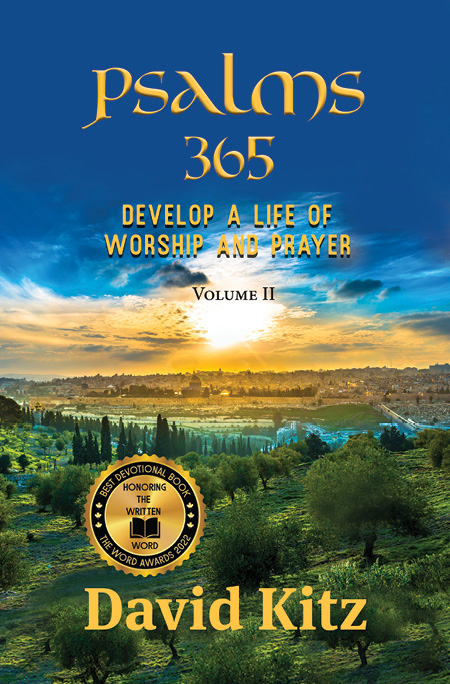
The photo of Jerusalem on the cover of Psalm 365, Volume II

Available now…

James—the brother of Jesus—who was this man? What evidence do we have that this “brother of our Lord” even existed?

David Kitz digs deep into archeology, family dynamics, church history, and the biblical texts. What emerges from his research is a portrait of a decisive, pivotal leader who embodied the will and character of Jesus Christ.

But how did James—James the unbeliever—transform to become a leader who changed the course of world history? In these pages you will uncover the answer and rediscover for yourself the life-changing power of the gospel.

To view further details or purchase directly from the author click here.

Prince and Savior

27 Friday Feb 2026

Posted by davidkitz in Psalms, Psalm 38

≈ Leave a comment

Tags

forgiveness, Jesus, Prayer, Psalms, purify, Righteousness, salvation, Savior, the cross, the LORD, trust in God

Today’s quote and prayer from
“Psalms 365: Develop a Life of Worship and Prayer


Today’s
Reading: Psalm 38:17-22 

Listen to today’s reading by Jonathan Dent:

https://davidkitz.blog/wp-content/uploads/2026/02/ps-3817-22-mix1final.mp3

LORD God,
grant me the gift of repentance.
I am thankful Jesus died on the cross
to wash me clean.
Hallelujah!
I want to pursue you, Lord.
You are my help and my righteousness.
My salvation comes from you.
Amen.

     — — — —

Prince and Savior

The God of our ancestors raised Jesus from the dead—
whom you killed by hanging him on a cross.
 
God exalted him to his own right hand
as Prince and Savior
that he might bring Israel to repentance
and forgive their sins.
 
We are witnesses of these things,
and so is the Holy Spirit,
whom God has given to those who obey him.”

(
Acts 5:30-32 NIV)*


Whoever does not love does not know God,
because God is love (1 John 4:8 NIV)

Para la publicación de Salmos 365 de hoy en español haga clic aquí.

bgbg_v4.3_1501818
* NEW INTERNATIONAL VERSION, COPYRIGHT ©1973, 1978, 1984, 2011 BY BIBLICA

Pray for enduring peace in Israel and Gaza,
and continue to pray for peace to return to Ukraine and Russia!

Volume I of Psalms 365: Develop a Life of Worship and Prayer won the Best Book of the Year Award from The Word Guild and Volume II has won the Best Devotional of the Year Award. For those who love God’s word, this three-book series is an ideal way to daily meet with the Lord. To purchase or for a closer look click here.

Ideal for the Season of Lent


Watch the triumphal entry of the donkey-riding king through the eyes of Marcus Longinus, the centurion charged with keeping the streets from erupting into open rebellion.

Look behind the scenes at the political plotting of King Herod, known as the scheming Fox for his ruthless shrewdness.

Get a front-row seat to the confrontation between the Jewish high priest Caiaphas and the Roman governor Pontius Pilate.

Understand as never before the horror of the decision to save a brutal terrorist in order to condemn the peaceful Jew to death.

If you’ve heard the story of Passion Week so often it’s become stale, now is the time to rediscover the terrible events leading from Jesus’s humble ride into the city to his crucifixion. The Soldier Who Killed a King will stun you afresh with how completely Christ’s resurrection changed history, one life at a time.

To view further details or purchase click here.

Now We Are Children of God

26 Thursday Feb 2026

Posted by davidkitz in Psalm 38, Psalms

≈ 7 Comments

Tags

children of God, Christ, faith, forgiveness, God's love, Prayer, Psalms, pure, purify, the LORD, trust in God

Today’s quote and prayer from
“Psalms 365: Develop a Life of Worship and Prayer


Today’s
Reading: Psalm 38:9-16

Listen to today’s reading by Jonathan Dent:

https://davidkitz.blog/wp-content/uploads/2026/02/ps-389-16-mix4final.mp3

LORD God,
speak to me when I am downcast.
Lift me when I am in need.
Forgive me when I fail.
You are my help and my strength.
LORD, I wait for you;
you will answer,
LORD my God.

Amen.

     — — — —

Rideau Canal, Ottawa, ON


Children of God

 See what great love
the Father has lavished on us,
that we should be called children of God!
And that is what we are!
The reason the world does not know us
is that it did not know him.
 
Dear friends,
now we are children of God,
and what we will be
has not yet been made known.
But we know that when Christ appears,
we shall be like him,
for we shall see him as he is.
 
All who have this hope in him purify themselves,
just as he is pure.

(
1 John 3:1-3 NIV)*


Whoever does not love does not know God,
because God is love (1 John 4:8 NIV)

Para la publicación de Salmos 365 de hoy en español haga clic aquí.

bgbg_v4.3_1501818
* NEW INTERNATIONAL VERSION, COPYRIGHT ©1973, 1978, 1984, 2011 BY BIBLICA

Pray for enduring peace in Israel and Gaza,
and continue to pray for peace to return to Ukraine and Russia!

Volume I of Psalms 365: Develop a Life of Worship and Prayer won the Best Book of the Year Award from The Word Guild and Volume II has won the Best Devotional of the Year Award. For those who love God’s word, this three-book series is an ideal way to daily meet with the Lord. To purchase or for a closer look click here.

Also available from David KitzIs a return-to-Jesus revival possible in our time?
This book points the way forward.
For details click here.

Three That Testify

25 Wednesday Feb 2026

Posted by davidkitz in Psalm 38, Psalms

≈ Leave a comment

Tags

amazing grace, blood of Christ, Christ, faith, forgiveness, Jesus, Prayer, Psalms, salvation, testimony, the LORD, trust in God

Today’s quote and prayer from
“Psalms 365: Develop a Life of Worship and Prayer


Today’s
Reading: Psalm 38:1-8

Listen to today’s reading by Jonathan Dent:

https://davidkitz.blog/wp-content/uploads/2026/02/ps-381-8-mixfinal.mp3

LORD God,
I thank you for Jesus.
I am thankful I can put my complete trust in you.
You forgive me
and cleanse me from all my sins.
I am saved by your amazing grace
not by my effort.
Amen.

     — — — —

Three That Testify

This is the one who came by water and blood—
Jesus Christ.
He did not come by water only,
but by water and blood.
And it is the Spirit who testifies,
because the Spirit is the truth.
 
For there are three that testify:
 
the Spirit, the water and the blood;
and the three are in agreement.
 
We accept human testimony,
but God’s testimony is greater
because it is the testimony of God,
which he has given about his Son.

(
1 John 5:6-9 NIV)*


Whoever does not love does not know God,
because God is love (1 John 4:8 NIV)

Para la publicación de Salmos 365 de hoy en español haga clic aquí.

bgbg_v4.3_1501818
* NEW INTERNATIONAL VERSION, COPYRIGHT ©1973, 1978, 1984, 2011 BY BIBLICA

Pray for enduring peace in Israel and Gaza,
and continue to pray for peace to return to Ukraine and Russia!

Volume I of Psalms 365: Develop a Life of Worship and Prayer won the Best Book of the Year Award from The Word Guild and Volume II has won the Best Devotional of the Year Award. For those who love God’s word, this three-book series is an ideal way to daily meet with the Lord. To purchase or for a closer look click here.

Also available from David KitzIs a return-to-Jesus revival possible in our time?
This book points the way forward.
For details click here.

The Gift of God

24 Tuesday Feb 2026

Posted by davidkitz in Psalm 37, Psalms

≈ 1 Comment

Tags

amazing grace, Christ, faith, gift of God, grace of God, Jesus, peace, Prayer, Psalms, salvation, the LORD, trust in God

Today’s quote and prayer from
“Psalms 365: Develop a Life of Worship and Prayer


Today’s
Reading: Psalm 37:35-40

Listen to today’s reading by Jonathan Dent:

https://davidkitz.blog/wp-content/uploads/2026/02/ps-3735-40-mix1final.mp3

LORD God,
I thank you for Jesus.
I am thankful I can put my complete trust in you.
I am saved by your amazing grace
not by my effort.
Hallelujah!
Lord Jesus,
you are
“the way, the truth and the life” (John 14:6).
Amen.

     — — — —

The Gift of God

And God raised us up with Christ
and seated us with him
in the heavenly realms in Christ Jesus,

in order that in the coming ages
he might show the incomparable riches of his grace,
expressed in his kindness to us in Christ Jesus.

For it is by grace you have been saved,
through faith—
and this is not from yourselves,
it is the gift of God—

not by works, so that no one can boast.
(Ephesians 2:6-9 NIV)*


Whoever does not love does not know God,
because God is love (1 John 4:8 NIV)

Para la publicación de Salmos 365 de hoy en español haga clic aquí.

bgbg_v4.3_1501818
* NEW INTERNATIONAL VERSION, COPYRIGHT ©1973, 1978, 1984, 2011 BY BIBLICA

Pray for enduring peace in Israel and Gaza,
and continue to pray for peace to return to Ukraine and Russia!

Volume I of Psalms 365: Develop a Life of Worship and Prayer won the Best Book of the Year Award from The Word Guild and Volume II has won the Best Devotional of the Year Award. For those who love God’s word, this three-book series is an ideal way to daily meet with the Lord. To purchase or for a closer look click here.

Also available from David KitzIs a return-to-Jesus revival possible in our time?
This book points the way forward.
For details click here.

Overflowing Hope

23 Monday Feb 2026

Posted by davidkitz in Psalm 37, Psalms

≈ 2 Comments

Tags

hope in God, Jesus, nations, peace, Prayer, Psalms, the LORD, trust in God

Today’s quote and prayer from
“Psalms 365: Develop a Life of Worship and Prayer


Today’s
Reading: Psalm 37:30-34

Listen to today’s reading by Jonathan Dent:

https://davidkitz.blog/wp-content/uploads/2026/02/ps-3730-4-mix1final.mp3

LORD God,
we live in a very troubled world.
When evil rises,
we put our trust in you.
Help me to walk in the way of love.
Surround me with your peace.
Keep those who serve their country safe.
I pray in Jesus’ name.
Amen.

     — — — —


Overflowing Hope

And again, Isaiah says,

“The Root of Jesse will spring up,
    one who will arise to rule over the nations;
    in him the Gentiles will hope.”

May the God of hope
fill you with all joy and peace
as you trust in him,
so that you may overflow with hope
by the power of the Holy Spirit.
(Romans 15:12-13 NIV)*


Whoever does not love does not know God,
because God is love (1 John 4:8 NIV)

Para la publicación de Salmos 365 de hoy en español haga clic aquí.

bgbg_v4.3_1501818
* NEW INTERNATIONAL VERSION, COPYRIGHT ©1973, 1978, 1984, 2011 BY BIBLICA

Pray for enduring peace in Israel and Gaza,
and continue to pray for peace to return to Ukraine and Russia!

Volume I of Psalms 365: Develop a Life of Worship and Prayer won the Best Book of the Year Award from The Word Guild and Volume II has won the Best Devotional of the Year Award. For those who love God’s word, this three-book series is an ideal way to daily meet with the Lord. To purchase or for a closer look click here.

Also available from David KitzIs a return-to-Jesus revival possible in our time?
This book points the way forward.
For details click here.

The LORD Loves the Just

22 Sunday Feb 2026

Posted by davidkitz in Psalm 33, Psalm 34, Psalm 35, Psalm 37, Psalms

≈ 2 Comments

Tags

blessing, children, delight in the LORD, desires of the heart, generous, praise the LORD, Prayer, Psalms, trust in the LORD

I will praise the LORD!


Reading: Psalm 37:23-29

Listen to today’s reading by Jonathan Dent:

https://davidkitz.blog/wp-content/uploads/2026/02/ps-3723-8-mix1final.mp3

The LORD makes firm the steps
of the one who delights in him;
though he may stumble, he will not fall,
for the L
ORD upholds him with his hand.
I was young and now I am old,
yet I have never seen the righteous forsaken
or their children begging bread.
They are always generous and lend freely;
their children will be a blessing.
Turn from evil and do good;
then you will dwell in the land forever.
For the L
ORD loves the just
and will not forsake his faithful ones.
Wrongdoers will be completely destroyed;
the offspring of the wicked will perish.
The righteous will inherit the land
and dwell in it forever.
(NIV)*

Para la publicación de Salmos 365 de hoy en español haga clic aquí.

bgbg_v4.3_1501818
* NEW INTERNATIONAL VERSION, COPYRIGHT ©1973, 1978, 1984, 2011 BY BIBLICA

Please pray for peace to return to Israel, Gaza, and Ukraine!

Volume I of Psalms 365: Develop a Life of Worship and Prayer won the Best Book of the Year Award from The Word Guild and Volume II has won the Best Devotional of the Year Award. For those who love God’s word, this three-book series is an ideal way to daily meet with the Lord. To purchase or for a closer look click here.

The photo of Jerusalem on the cover of Psalm 365, Volume II

Available now…

James—the brother of Jesus—who was this man? What evidence do we have that this “brother of our Lord” even existed?

David Kitz digs deep into archeology, family dynamics, church history, and the biblical texts. What emerges from his research is a portrait of a decisive, pivotal leader who embodied the will and character of Jesus Christ.

But how did James—James the unbeliever—transform to become a leader who changed the course of world history? In these pages you will uncover the answer and rediscover for yourself the life-changing power of the gospel.

To view further details or purchase directly from the author click here.

A Not So Immaculate Conception

22 Sunday Feb 2026

Posted by davidkitz in Books by David Kitz

≈ 4 Comments

Tags

angel of the Lord, conception, faith, gospel, holy family, Jacob, James, James the brother of Jesus, Jesus, Mary, Mary and Joseph, Nazareth, virgin birth

James: the Lynchpin of Our Faith — Chapter 2

James was conceived in the ordinary way—the way that is common to all humanity. There was no virgin birth for him, no choir of angels trumpeted his arrival, and no star appeared to signal his nativity. He was from what we can surmise, just an ordinary child, born into a very extraordinary family.

Mary Consoles Eve by Sr. Grace Remington

It should be noted that there are three men in the New Testament who bear the name James. Since they have the same name, the identity of these three men is often confused. The most prominent James during Jesus’ earthly ministry was James, the son of Zebedee. He was numbered among the twelve apostles. He was the older brother of the apostleJohn—the John who penned the Gospel that bears his name. Peter and the two sons of Zebedee were part of Jesus’ inner circle. During his ministry, Jesus often called Peter, James, and John apart from the other apostles to privately accompany him.2 But there was a second James within the apostolic circle. This was James, son of Alphaeus. He is sometimes called James the Less. Though he is numbered among the twelve disciples, he did not play a significant role in the New Testament narrative.

In contrast to these two men, James, the brother of Jesus, was never part of the apostolic team. The apostle James, the son of Zebedee was martyred early in the development of the church in Jerusalem (Acts 12:1–2), and we hear nothing further of James, son of Alphaeus, beyond a mention in the gospel accounts. Our purpose here is solely to focus on James, the brother of Jesus.

But was this James really born into this holy family? Roman Catholics revere Mary as a perpetual virgin; hence, they view any teaching that Mary had other children by Joseph as utter heresy. However, other children is precisely what we find when we examine the New Testament scriptures. In fact, we have already touched on a Bible verse that disproves the premise upon which this Catholic doctrine is based. Mary was not a perpetual virgin, not according to the Gospel of Matthew.

When Joseph woke up, he did what the angel of the Lord had commanded him and took Mary home as his wife. But he did not consummate their marriage until she gave birth to a son. And he gave him the name Jesus. (Matthew 1:24–25)

For our purpose, the key words in this passage are did not consummate. In other words, Joseph had no sexual union with Mary until after Jesus was born. It is interesting to look at how other Bible scholars have translated the original Greek of this passage. Here are some examples:

Then Joseph being raised from sleep did as the angel of the Lord had bidden him, and took unto him his wife: And knew her not till she had brought forth her firstborn son: and he called his name Jesus. (King James Version)

So when Joseph woke up, he married Mary, as the angel of the Lord had told him to. But he had no sexual relations with her before she gave birth to her son. And Joseph named him Jesus. (GNT)

And Joseph awoke from his sleep and did as the angel of the Lord commanded him, and took Mary as his wife, but kept her a virgin until she gave birth to a Son; and he called His name Jesus. (NASB)

When Joseph woke up he did what the angel had told him. He married Mary, but had no intercourse with her until she had given birth to a son. Then he gave him the name Jesus. (PHILLIPS)

All five of the translations cited above, while using different words, convey the same meaning. Mary remained a virgin until after the birth of the Christ child. Then after giving birth in due course, Joseph and Mary began normal sexual relations. This is what would be expected of any young married couple.

The King James Version (KJV) gives us the most literal translation of this passage. Matthew uses the Greek verb ginosko, which is translated into English as know, knew or to know. In this case, the verb is a negated progressive past tense, so in the KJV it is translated as knew her not. In the footnote to this passage the New American Standard Version more accurately renders the Greek used here as was not knowing her.

Matthew is using the verb know to convey the idea of carnal knowledge or sexual experience. By using the Greek form of this verb, he is harkening back to the first recorded instance of sexual relations in the Bible. “And Adam knew Eve his wife; and she conceived, and bare Cain, and said, “I have gotten a man from the LORD” (Genesis 4:1, KJV, emphasis added). Matthew’s Jewish readers would immediately understand the biblical reference to this form of knowledge.

Art by Hult –www.biblicalarchaeology.org

The chief point we need to recognize here is that Joseph’s state of not knowing her came to an end. Mary was a virgin until some point after Jesus was born. In Matthew 1:25, the preposition rendered until (NIV) or till (KJV) is of crucial importance. It signals an action or a state of being coming to an end at a fixed point in the future. The Greek word translated as until is heos and it is more literally translated as up to or unto. In other words, Joseph’s state of not knowing his wife Mary lasted up to the birth of Jesus. Thereafter, the marriage was consummated, as the NIV translation states.

Luke gives us further evidence that this marriage was consummated; he even provides a strong clue to the timing. After referring to Jesus’ circumcision on the eighth day following his birth (Luke 2:21), the gospel writer goes on to report on Mary’s purification rites.

When the time came for the purification rites required by the Law of Moses, Joseph and Mary took him [Jesus] to Jerusalem to present him to the Lord (as it is written in the Law of the Lord, “Every firstborn male is to be consecrated to the Lord”), and to offer a sacrifice in keeping with what is said in the Law of the Lord: “a pair of doves or two young pigeons.” (Luke 2:22–24)

Leon Morris, in his commentary on the Gospel of Luke, rightly points out that there are two religious rites recorded in this passage.

Two quite separate ceremonies are involved here, the presentation of the child and the purification of the mother. The Levitical law provided that after the birth of a son a woman would be unclean for seven days leading up to the circumcision and for a further thirty-three she should keep away from all holy things (for a daughter the time was doubled; Leviticus12:1–5).3

After the completion of this purification rite, it was deemed fitting and proper for a Jewish married couple to resume their sexual relationship. Because prior to Jesus’ birth there had been no sexual relations between Mary and Joseph, one can logically conclude that their marriage was consummated shortly after this temple ceremony, most likely on the same day.

While the doctrine of the virgin birth rests on a solid scriptural foundation, there are no scriptural grounds from which one can argue that Mary remained a perpetual virgin. Joseph was instructed by the angel to take Mary home as his wife (Matthew 1:20). No special instructions on abstinence were given. One can then logically assume that normal marital relations ensued. In fact, in Matthew 1:25 we are explicitly told that Joseph knew his wife (consummated the marriage) after the birth of Jesus. Furthermore, Luke provides us with a definitive time frame as to when sexual relations began. Being observant Jews in every way, the Holy Family followed the rites proscribed by the Law. This includes the full rites of marriage.

Photo by Jonathan Borba on Pexels.com

It should then come as no surprise when we read that other children were born to this family. All four gospels refer to Jesus’ brothers; two of the gospels list them by name.

Isn’t this the carpenter’s son? Isn’t his mother’s name Mary, and aren’t his brothers James, Joseph, Simon and Judas? (Matthew 13:55)

“Isn’t this the carpenter? Isn’t this Mary’s son and the brother of James, Joseph, Judas and Simon? Aren’t his sisters here with us?” And they took offense at him. (Mark 6:3)

In the context of the two passages above, Mary is clearly identified as the mother of Jesus and his brothers: James, Joseph, Simon, and Judas. The Judas recorded here should not be confused with Judas Iscariot, the disciple who betrayed Jesus. This Judas—the brother of James and half-brother of Jesus—is widely recognized as the New Testament author of the Book of Jude. Jude is a Greek language variant of Judas. In fact, this brother Judas identifies himself in the opening line of his New Testament epistle with these words: “Jude, a servant of Jesus Christ and a brother of James…” (Jude 1a).

The Mark 6:3 passage is significant because it establishes that there were also daughters born through the union of Mary and Joseph, as well as four sons. The fifth son is Jesus, the firstborn, who, according to scripture and long-established church doctrine, was conceived by the Holy Spirit.

Typically, children are listed according to their birth order. This appears to be precisely what is happening in the above passages. The sons are listed from oldest to youngest, though in Mark’s account Simon and Judas are reversed.

Since this was a patriarchal society, it should come as no great surprise that the daughters’ names are not mentioned. They may have been born after the boys listed here or perhaps interspersed among the boys in birth order. Matthew makes no reference to the sisters, while Mark mentions them but does not provide us with any names.

This passage from Mark is significant for another reason. The townspeople ask, “Isn’t this Mary’s son and the brother of James…?”

In a patriarchal society—one that does not bother to list sisters’ names—why not frame the question this way: “Isn’t this Joseph’s son?” By referring to Mary rather than Joseph, are the townspeople tacitly recognizing that Joseph was not the father of Jesus? This is a culturally unusual way of framing the question of lineage. It is presumed that Joseph died years earlier and that may explain why there is no reference made to him, but nonetheless it is peculiar that his name is not mentioned.

The list of brothers provides another clue about James. James is the anglicized version of the name Jacob, or in Hebrew Ya’aqov. Jacob, the Old Testament patriarch, was the second-born twin son of Isaac and Rebekah. Jacob’s older brother Esau was born with Jacob grasping onto his heel (Genesis 25:21–26).

Ya’aqov or James was a particularly fitting name for a second son in a Jewish family. But the name also suggests a certain character. The original Jacob was continually grasping for more. He was not content with his second-place status in relation to his brother. He provoked Esau into selling his birthright (Genesis 25:27-34) and later he conspired with his mother to cheat Esau out of his father’s blessing (Genesis 27).

If in character and conduct James/Ya’aqov resembled his Old Testament counterpart, then in his formative years Jesus would experience very difficult and challenging times with his brother. As we will see, during Jesus’ ministry James played the role of Jacob, a supplanter or deceptive usurper to great effect.

The list of brothers from Matthew and Mark’s Gospels form part of a description of the same incident—Jesus’ return to his hometown of Nazareth at the height of his public ministry. A closer look at Mark’s account provides us with a fascinating glimpse into this messianic family and the interplay of hometown perceptions and dynamics.

Jesus left there and went to his hometown, accompanied by his disciples. When the Sabbath came, he began to teach in the synagogue, and many who heard him were amazed.

“Where did this man get these things?” they asked. “What’s this wisdom that has been given him? What are these remarkable miracles he is performing? Isn’t this the carpenter? Isn’t this Mary’s son and the brother of James, Joseph, Judas and Simon? Aren’t his sistershere with us?” And they took offense at him.

Jesus said to them, “A prophet is not without honor except in his own town, among his relatives and in his own home.” He could not do any miracles there, except lay his hands on a few sick people and heal them. He was amazed at their lack of faith. (Mark 6:1–6a)

There is a kind of small-town-plausibility to this story that is quite disarming. Local boy leaves home; makes the Big Time, surrounded by adoring crowds and an entourage of followers. Our heroic figure returns home, but rather than adulation, he is greeted by small-minded jealousy and skepticism. This is a situation that in various forms has played itself out a thousand times, in a thousand small towns throughout the ages and in every society. Reading between the lines you can perhaps hear the crowd’s unspoken thoughts. “He’s nothing special. I remember him as a runny-nosed little kid. We know his family. There’s nothing wonderful about them. Who does he think he is?”

Photo by Pixabay on Pexels.com

This outcome was to be expected. They had no faith in him. He was too familiar, too ordinary in their eyes. They were amazed at his wisdom and the reports of miracles, but in their eyes he had committed the sin of overreaching. He had gone well beyond the expected small-town norms. Over achievers must be put in their place, so “they took offence at him” (Matthew 13:57a; Mark 6:3b).

There’s a confounding mix of the ordinary meeting the highly extraordinary in this account—an encounter of the common man with the ultimate superhuman. And Jesus was both: common and supernatural. He was the carpenter turned Savior of the world. This hometown reaction is what you might expect when God takes on flesh and becomes one of us. No one knew quite how to handle Him. He does not fit the norm. He is incongruent in so many ways, far outside the norm of human experience. The easiest response is to reject Him.

What can we conclude about James, the subject of this book, from these observations? What we have portrayed here is a rather ordinary first-century Jewish family. James, the second son of Joseph the carpenter (Matthew 13:55), was conceived and came into the world through Mary in the same way as any other child on the planet. He had one older brother named Jesus and three younger brothers, in addition to at least two sisters. It seems clear that Joseph had passed away at some point before the hometown visit recorded in Mark 6:1–6 and Matthew 13: 53–58. Before taking up his public ministry, Jesus had worked in the family business as a carpenter. It seems highly likely that with Jesus’ departure, James would have continued in the family trade. It is equally clear that the townspeople of Nazareth largely rejected Jesus’ ministry. They had no faith in him and “took offence at him” (Matthew 13:57a;
Mark 6:3b).

So how did James respond to his brother’s rise to fame? As we will see, James, like those around him, showed himself to be a true hometown boy, a son of Nazareth. He too shared in their skepticism.

2) Matthew 17:1, Mark 5:37, Mark 9:2, Mark 14:33, Luke 8:51, Luke 9:28.
3 Leon Morris, Luke—Tyndale New Testament Commentaries (Eerdmans, 1984), pp. 86–87.


New from David Kitz

James—the brother of Jesus—who was this man? What evidence do we have that this “brother of our Lord” even existed?

David Kitz digs deep into archeology, family dynamics, church history, and the biblical texts. What emerges from his research is a portrait of a decisive, pivotal leader who embodied the will and character of Jesus Christ.

But how did James—James the unbeliever—transform to become a leader who changed the course of world history? In these pages you will uncover the answer and rediscover for yourself the life-changing power of the gospel.

To view further details or purchase directly from the author click here.
Silence

21 Saturday Feb 2026

Posted by davidkitz in book review

≈ Leave a comment

Tags

persecution, church, silence, Japan, priest, history, historic novel, Christian faith, believers, missionary, Japanese, Catholic, Portuguese, Shusaku Endo

A Review of Silence by Shusaku Endo

For me Shusaku Endo’s book Silence was a difficult read. It was difficult because I knew the outcome of the story. I had watched the Scorsese movie shortly after it was released in 2016. Furthermore, in the mid 1980ies I served as a Christian missionary in Japan. So, I am familiar with Japanese landscapes, beliefs, and culture. For reasons of faith and culture this is a heartbreaking story.

What Endo does very well is slowly build tension as the story advances. For most of the book we are living a hidden and confined life—confined and hidden in the mind of the Catholic priest Rodrigues. The constant fear of discovery and torture by the Buddhist Japanese authorities is palpable.

When Rodrigues is finally captured the fear of inevitable torture continually builds as he witnesses other believers and priests succumb to torture, apostasy, and death. The anticipation of torture in many respects is worse than the torture itself. This acute psychological torment builds till it reaches a dramatic climax.

Throughout this novel silence is the underlying theme. After initially enjoying great success the original Portuguese missionaries to Japan hit a vicious wall of state led persecution, violence, and death. The once vibrant Japanese church is destroyed. What follows is silence. Two young Portuguese missionaries are sent to investigate and see if any believers remain. This book is a fictionalized account of the experience of these two early seventeenth century priests whose names are recorded in the annals of Japanese and Portuguese history.

For the priest, Rodrigues, the most troubling silence is the silence of God amid carnage and suffering. But this is where the book departs from the movie script. In the novel, God breaks the silence. Rodrigues finally hears God’s voice.

In this respect I found the novel more gratifying than the movie. Nevertheless, the end of the book is grim and disturbing. If there is hope in this book it can be found in this implicit truth:

Despite the pervasive evil and cruelty of man, the God of mercy still speaks.

I come from a protestant/Pentecostal tradition, consequently I find aspects of the Catholic version of the Christian faith disturbing, or unbiblical. Nevertheless, the courage and zeal of the believers in Christ as portrayed in this book is astonishing. For this reason, I recommend it. But be warned. This is not a lighthearted read. It’s a brutal and historically accurate portrayal of systematic state-led religious repression.

← Older posts
Newer posts →

Psalms 365: Develop a Life of Worship and Prayer

Psalms 365 Volume II

Psalms 365 vol 3
— Psalms 365 Volume III

Psalms

Recent posts

  • Absalom to Judas, Betrayal to Triumph March 10, 2026
  • He Had Compassion on Them March 9, 2026
  • Compassion and Empathy March 9, 2026
  • More Precious Than Gold March 8, 2026
  • The Family Rift March 8, 2026
  • Their Voice Goes Out into All the Earth March 7, 2026
  • By the Gift of God’s Grace March 6, 2026

Calendar

March 2026
M T W T F S S
 1
2345678
9101112131415
16171819202122
23242526272829
3031  
« Feb    

Blog Posts

Enter your email address to follow this blog and receive notifications of new posts by email.

Comments

  • Eileen Guyadeen on He Had Compassion on Them
  • cjsmissionaryminister on More Precious Than Gold
  • davidkitz on Not My Will

Blog at WordPress.com.

Privacy & Cookies: This site uses cookies. By continuing to use this website, you agree to their use.
To find out more, including how to control cookies, see here: Cookie Policy
  • Subscribe Subscribed
    • I love the Psalms
    • Join 1,384 other subscribers
    • Already have a WordPress.com account? Log in now.
    • I love the Psalms
    • Subscribe Subscribed
    • Sign up
    • Log in
    • Report this content
    • View site in Reader
    • Manage subscriptions
    • Collapse this bar
 

Loading Comments...