• Home
  • About
  • DavidKitz.ca
  • Youtube Videos
  • Books by David
  • Books on Amazon.com

I love the Psalms

~ Connecting daily with God through the Psalms

I love the Psalms

Author Archives: davidkitz

Reading 24 for Lent from “The Soldier Who Killed a King”

29 Friday Mar 2019

Posted by davidkitz in Lent, The Soldier Who Killed a King

≈ 1 Comment

Tags

Caiaphas, Herod, Jesus, Lent, Messiah, Pilate, repentance

A journey to the cross is a journey to repentance. It’s a journey to deep personal change. Will you take this journey with me?

Date: Seven in the morning, Friday, April 7, 30A.D.
Jesus trial before Pontius Pilate continues.

In due course we all resumed our previous positions. At this point I fully expected Pilate to pronounce the prisoner guilty of high treason. After all, this Messiah had freely confessed to being a king. But I can only guess that Jesus’s words did have an impact on the governor. Upon taking his seat, Pilate announced, “I find no basis for a charge against him.”
A murmur arose from beyond the pikemen.
Caiaphas was livid. He let fly with a torrent of accusations, the last of these being that Jesus had threatened to destroy the temple and then rebuild it in three days.
Showing extraordinary patience, Pilate let the high priest rage. When Caiaphas’s fury was spent, Pilate turned to Jesus and asked, “Don’t you hear the testimony they are bringing against you?”
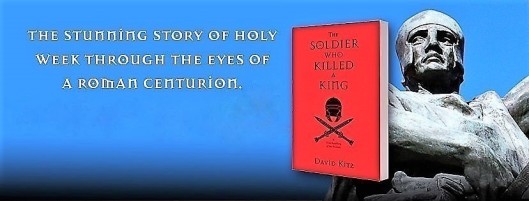
Free WW-e FACEBOOK-2 (2)
But Jesus answered him not a word. His silence itself became a challenge. Pilate had cleared him. Why should he answer to these further allegations?
Though stunned by this silence, Pilate repeated his position. “I find no basis for a charge against him.”
Once again discontent began to rumble through the crowd on the street.
At this point I expected the trial to end and the prisoner to be released. Let the crowds rage. Rome had spoken.
But Annas stepped smartly into the breach. “He stirs up the people all over Judea by his teaching. He started in Galilee and has come all the way here.”
“Is he a Galilean?” Pilate asked. “Under Herod’s jurisdiction?”
“Yes,” the flustered Caiaphas confessed, not knowing where this questioning might lead. “Then to Herod he should go,” was Pilate’s prompt response. “Why drag me into this?” He sneered at the high priest.
The governor seemed weary of the whole affair, and for the third time that morning, he found a way to dodge and retreat.
This trial was over.
The dark-eyed Badger rose from his judgment seat. He walked over to Jesus, the accused, and with a rather cunning smile and a nod, he said, “Off to Herod you will go, man of truth.”

To download a free study guide for this high-impact, bible-based novel visit: https://www.davidkitz.ca/centurion.php/free study guide PDF

For book purchases of The Soldier Who Killed a King try Amazon or https://www.christianbook.com

Trust and Betrayal

29 Friday Mar 2019

Posted by davidkitz in Devotionals, Psalm 52, Psalms

≈ 1 Comment

Tags

betrayal, David, priest, Saul, trust in God, unfailing love

Reading: Psalm 52
For the director of music. A maskil of David.
When Doeg the Edomite had gone to Saul and told him:
“David has gone to the house of Ahimelek.”
Why do you boast of evil, you mighty hero?
Why do you boast all day long,
you who are a disgrace in the eyes of God?
You who practice deceit, your tongue plots destruction;
it is like a sharpened razor.
You love evil rather than good,
falsehood rather than speaking the truth.
You love every harmful word, you deceitful tongue!
Surely God will bring you down to everlasting ruin:
He will snatch you up and pluck you from your tent;
he will uproot you from the land of the living.
The righteous will see and fear; they will laugh at you, saying,
“Here now is the man who did not make God his stronghold
but trusted in his great wealth and grew strong by destroying others!”
But I am like an olive tree flourishing in the house of God;
I trust in God’s unfailing love for ever and ever.
For what you have done I will always praise you
in the presence of your faithful people.
And I will hope in your name, for your name is good
(NIV).

2018-05-11 L Kranz

Photo courtesy of Liz Kranz

Reflection
Like several of David’s psalms, Psalm 52 comes with a backstory. It’s a story of stunning betrayal. Though he was loyal, David was forced to flee from jealous King Saul. On one occasion, he sought refuge at the tabernacle of the LORD and with Ahimelech the priest. Doeg the Edomite, Saul’s chief shepherd, was present at the tabernacle that day. Acting in good faith, Ahimelech helped David by providing food and a weapon—the sword of Goliath. This innocent act of kindness led directly to Ahimelech’s death. Doeg reported this incident to Saul, who ordered the priests be put to death. Doeg personally killed eighty-five of them. (For a full account of this treachery see 1 Samuel 21-22.)

We live in a fallen world—a world where stunning betrayal is often rewarded. In the political realm or the world of high finance, almost daily we hear accounts of how men and women have cut down those they once considered family and friends. All too often this accusation rings true: You who practice deceit, your tongue plots destruction; it is like a sharpened razor.

David discovered that he could trust very few men. He placed his trust in God. When the world turns on you, as it did on David, we can turn to God. Here is the testimony of a wise man: I trust in God’s unfailing love for ever and ever. For what you have done I will always praise you in the presence of your faithful people. And I will hope in your name, for your name is good.

Response: LORD God, help me to always put my trust in your unfailing love. You are my help and refuge in the storms of life. Bring me through by your grace. Amen.

Your Turn: Has someone you trusted let you down? Has that experience damaged or renewed your trust in God?

Reading 23 for Lent from “The Soldier Who Killed a King”

28 Thursday Mar 2019

Posted by davidkitz in Lent, The Soldier Who Killed a King

≈ 1 Comment

Tags

Jesus, king of the Jews, kingdom, Lent, Pilate, repentance

A journey to the cross is a journey to repentance. It’s a journey to deep personal change. Will you take this journey with me?

Date: Six fifty in the morning, Friday, April 7 A.D.
Jesus trial before Pontius Pilate continues.

When we entered the judgment hall, the dark-eyed Badger was seething. He knew Caiaphas was using him. He had said so to the assessor. He let fly a string of profanity. “He has me trapped!” he snarled. “Trapped like a rat in a stone water jar.” And with that he tossed the list of charges onto his desk.
James ThtThen he turned to Jesus in the center of the room. He looked him over, walked fully around him. Pilate sighed and nervously ran his fingers through his thinning hair. He made a smacking sound with his lips and asked, “Are you the king of the Jews?”
“You have said so,” came his equivocal answer.
This answer left the governor rocking on his heels. He brought a finger to his lips in pensive thought.
Jesus was not making an acquittal any easier.
But after a moment Jesus continued. “Is that your own idea, or did others talk to you about me?”
“Am I a Jew?”
 Pilate shot back with an ample measure of haughty contempt. “Your own people and chief priests handed you over to me.” He continued the questioning. “What is it you have done?”
“My kingdom is not of this world,” Jesus said, and to drive home this point, he added, “If it were, my servants would fight to prevent my arrest by the Jewish leaders. But now my kingdom is from another place.”
Certain words that Claudius had spoken came echoing back into my mind. He had been convinced that this kingdom Jesus spoke of was somehow different from kingdoms as we know them. Now I heard it from this would-be Messiah’s mouth. He was no armed insurrectionist, and he had offered the actions of his followers as proof.
But Pilate seized on that word—kingdom. “You are a king, then!” Pilate deduced.
With calm, clear deliberation the prophet spoke. “You say that I am a king. In fact, the reason I was born and came into the world is to testify to the truth. Everyone on the side of truth listens to me.”
It almost seemed from this response that Jesus was operating from, and speaking on,Biblical fiction winner 2017 some higher plane—a dimension I had witnessed him operate from during the healings at the temple. He was inviting Pilate to join him in discovering this higher ground of truth.
Pilate would not be moved. They were speaking past each other.
“What is truth?” Pilate shrugged. The question was rhetorical. He had no intention of being dragged into a philosophical discussion with this prophet of the Jewish masses. Once again, the Badger retreated.
Grabbing the list of charges from off his desk, he motioned for us to follow him back outside.

To download a free study guide for this high-impact, bible-based novel visit: https://www.davidkitz.ca/centurion.php/free study guide PDF

For book purchases of The Soldier Who Killed a King try Amazon or https://www.christianbook.com

A Heart Made Pure

28 Thursday Mar 2019

Posted by davidkitz in Devotionals, Psalm 51, Psalms

≈ 4 Comments

Tags

David, Psalm 51, pure, pure heart, purity, salvation, spiritual health

Reading: Psalm 51
(Verses 10-19)
Create in me a pure heart, O God,
and renew a steadfast spirit within me.
Do not cast me from your presence
or take your Holy Spirit from me.
Restore to me the joy of your salvation
and grant me a willing spirit, to sustain me.
Then I will teach transgressors your ways,
so that sinners will turn back to you.
Deliver me from the guilt of bloodshed, O God,
you who are God my Savior,
and my tongue will sing of your righteousness.
Open my lips, Lord, and my mouth will declare your praise.
You do not delight in sacrifice, or I would bring it;
you do not take pleasure in burnt offerings.
My sacrifice, O God, is a broken spirit;
a broken and contrite heart you, God, will not despise.
May it please you to prosper Zion,
to build up the walls of Jerusalem.
Then you will delight in the sacrifices of the righteous,
in burnt offerings offered whole;
then bulls will be offered on your altar
(NIV).

Balmaha, Scotland

Balmaha, Scotland — photo courtesy of Jan Jablonski

Reflection
I just had my morning shower. Nothing special about that—daily showers are the social norm. But they haven’t always been the norm. Step back a century and the weekly bath was the norm. Step back a thousand years and a bath was an annual event. With this lack of personal hygiene is it any wonder that epidemics ran rampant through the medieval population, and diseases like smallpox and the bubonic plague killed millions in Europe?

As a society we have embraced the concept and practice of personal hygiene. But what about spiritual hygiene? Have we embraced that as well? I fear the opposite is true. Are we routinely plunging into the deep end of a cesspool of sin? Do we mistakenly believe there are no consequences? A filthy spirit can be as deadly as bubonic plague. A host of mental, emotional and social problems are a direct result of poor spiritual hygiene. Cleanse your heart and mind and you will walk in spiritual health.

From his own cesspool of sin David cried out: Create in me a pure heart, O God, and renew a steadfast spirit within me. Do not cast me from your presence or take your Holy Spirit from me. Restore to me the joy of your salvation and grant me a willing spirit, to sustain me.

I don’t know about you, but daily I need to bathe in Christ’s love and forgiveness. He cleans me up.

Response: LORD God, thank you for the forgiveness you purchased for me through the shed blood of Jesus your son. I acknowledge my need for your cleansing power. Amen.

Your Turn: How is your spiritual hygiene today? How do you keep your spirit clean?

Reading 22 for Lent from “The Soldier Who Killed a King”

27 Wednesday Mar 2019

Posted by davidkitz in Lent, The Soldier Who Killed a King

≈ 1 Comment

Tags

Caesar, Caiaphas, Jesus, Lent, Pilate, repentance

A journey to the cross is a journey to repentance. It’s a journey to deep personal change. Will you take this journey with me?

Date: Six thirty in the morning, Friday, April 7 A.D.
Jesus trial before Pontius Pilate begins.

The governor peered over the heads of the men directly in front of him. He scanned the assemblage on the street, took in the significance of it all, and then cleared his throat. “Where is the man?”
Jonathon turned quickly. On reaching the first step, he beckoned beyond our pikemen to three of his own temple guards, who then advanced with their prisoner—Jesus of Nazareth.
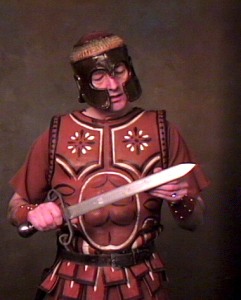
Picture Cent-helmetHe was a mess, almost unrecognizable. His hair was matted. He had been spat upon. The spittle was drying in his beard. There were red welts on his face and neck, a blood- oozing gash above his left eye, a discernible limp to his gait.
It was apparent that during the night they’d had their way with him.
He was escorted to a position directly before me. Intuitively I knew he was my man now, my charge.
A twitch of Pilate’s eyebrow hinted his surprise at the condition of the man.
“Loose him,” he directed with a slight wave of his hand.
Two temple guards hastened to unfasten the leather strap binding Jesus’s arms to his torso. The third man freed the prisoner’s hands. With a second wave of his hand, Pilate dismissed the temple guards, who repositioned themselves on the first step and stood facing the proceedings.
Pilate took a seat on the throne of judgment, which had been brought out for him by two attendants. Raising the scroll in his left hand, he asked, “What charges are you bringing against this man?”
It was clear from this gesture that he was referring to the charges written on the scroll he now clutched in his hand. Undoubtedly he had read these charges himself, and in all likelihood had discussed them
with the assessor standing to his right. But he wanted the high priest to articulate them. “If he were not a criminal, we would not have handed him over to you,” Caiaphas said with a huff.
A rather cheeky response, I thought.
“Take him yourselves and judge him by your own law,” Pilate answered.
Here Annas interjected, “But we have no right to execute anyone.”
A devious response if there ever was one. The temple, in fact, routinely acted as bothbiblical-fiction-award-2017_orig judge and executioner in religious matters and had been granted full authority to do so. Death by stoning was commonplace. I had witnessed Annas himself cast the first stone at some hapless adulteress within the first week of my arrival here ten years ago. No, the temple had the right to execute, and these crafty fellows could surely find grounds to execute this man. They just didn’t want the blood on their hands. They did not want to be blamed for the death of this rabbi. For many he had become the hope of the nation. No, they wanted us to do the job, to act as their executioners. They wanted him judged and executed under Roman law. What Caiaphas said next made this abundantly clear.
“We have found this man”—he aimed a bony finger at Jesus—“subverting our nation. He opposes payment of taxes to Caesar and claims to be Messiah, a king.”
Now here was a capital offense—a capital offense under Roman law.
The Weasel had backed the Badger into a corner, and he was relishing the moment. These charges would need further examination. But Pilate would not proceed in full view of a gloating high priest, urged on by his consorts and a handpicked audience. He retreated.
He abruptly arose from his throne, fixed his eyes on me, and said, “Bring the man.” He motioned with a jerk of his head toward the great doors behind us and then marched off into his residence.
I stepped down to escort Jesus, but he was already in motion. It became clear that the steps were painful for him. I put my hand to his elbow.

To download a free study guide for this high-impact, bible-based novel visit: https://www.davidkitz.ca/centurion.php/free study guide PDF

For book purchases of The Soldier Who Killed a King try Amazon or https://www.christianbook.com

A Repentant Heart

27 Wednesday Mar 2019

Posted by davidkitz in Devotionals, Psalm 51, Psalms

≈ Leave a comment

Tags

lament, Psalm 51, repent, repentance, sin, transgressions

Reading: Psalm 51
For the director of music. A psalm of David.
When the prophet Nathan came to him after
David had committed adultery with Bathsheba.
(Verses 1-9)
Have mercy on me, O God, according to your unfailing love;
according to your great compassion blot out my transgressions.
Wash away all my iniquity and cleanse me from my sin.
For I know my transgressions,
and my sin is always before me.
Against you, you only, have I sinned
and done what is evil in your sight;
so you are right in your verdict and justified when you judge.
Surely I was sinful at birth,
sinful from the time my mother conceived me.
Yet you desired faithfulness even in the womb;
you taught me wisdom in that secret place.
Cleanse me with hyssop, and I will be clean;
wash me, and I will be whiter than snow.
Let me hear joy and gladness;
let the bones you have crushed rejoice.
Hide your face from my sins and blot out all my iniquity
(NIV).

54278470_10102411589572771_1144080387442475008_o

Balmaha, Scotland — photo courtesy of Jan Jablonski

Reflection
Psalm 51 is the great repentance psalm. Nothing matches the deep contrition expressed here by David. There can be little doubt that David was truly remorseful for what he had done. He says it with words, but according to the Scriptures, his actions which followed also revealed a repentant heart. There is no blame shifting here; David takes full responsibility for his actions. Hear his humble plea: For I know my transgressions and my sin is always before me. Against you, you only, have I sinned and done what is evil in your sight; so you are right in your verdict and justified when you judge.

When Saul and Jonathan were slain in battle by the Philistines, David composed this lament. “Your glory, O Israel, lies slain upon your high places! How the mighty have fallen!” (2 Samuel 1:19 NRSV). David might well have sung this lament for himself. Here he was the vaunted King of Israel, the LORD’s anointed, and he had a fellow soldier murdered to cover up the adulterous affair he was having with this loyal soldier’s wife. This was the conduct of David—the man of God! Yes. “How the mighty have fallen!” 

The amazing part of this story is not David’s sin or the depths of his depravity. The amazing part is that he repented—earnestly repented. In our day leader after leader has been caught red-handed in unscrupulous practices. But do they repent? Do they come clean and change their ways? Not likely. Most often they continue in denial. Those with absolute power continue to govern ruthlessly. Nathan, the prophet, was fortunate that King David heard the voice of God speaking through a human vessel. David was quick to humble himself and repent. How do you respond when confronted with your sin?

Response: LORD God, I want to be like David—quick to acknowledge my sin and repent. Grant me a soft heart—a sensitive heart—a repentant heart in Jesus’ name. Amen.

Your Turn: How can we maintain a repentant heart before God? What hinders repentance?

Reading 21 for Lent from “The Soldier Who Killed a King”

26 Tuesday Mar 2019

Posted by davidkitz in Lent, The Soldier Who Killed a King

≈ 1 Comment

Tags

Jesus of Nazareth, Lent, Messiah, Pontius Pilate, repentance

A journey to the cross is a journey to repentance. It’s a journey to deep personal change. Will you take this journey with me?

Date: Five forty-five in the morning, Friday, April 7 A.D.
In today’s reading, a messenger from Pontius Pilate arrives at the home of Marcus Longinus, the Roman centurion, with the news that Jesus has been arrested.

“Sir, I have just come from the governor. You are to report to the Praetorium immediately. Jesus of Nazareth has been arrested. The high priest has brought him before the governor for judgment.”
“Is that so?” I said in a state of consternation. “Who sent you?”
“The governor himself. He said you were familiar with the Galilean.”
I blew a short puff of air through my nostrils. All of Jerusalem was somewhat familiar with the Galilean.
“So he wants me there immediately?”
“Immediately, sir.” He shifted from one foot to the other and then, as if to justify thisCentur. Sw response, he added, “The high priest and a big delegation, maybe three hundred men, maybe more, arrived at the palace door at first light. They had the prisoner—Jesus—with them.”
“Tell the governor I’m on my way.”
With a quick nod of my head, I dismissed the messenger. Instantly he turned and began his run back to the governor’s residence. I took one step back inside the gate and began barking orders.
“You, you, and you!” I stabbed my index finger in the direction of the most dressed and prepared-looking soldiers. “Strap on your swords and follow me. Now!”
Then, addressing the other soldiers, I announced, “The rest of you, meet me at the Praetorium as soon as you are ready.”
“Claudius”—I nodded in his direction—“you are in charge. I’ll give everyone their assignment for the day when they get there.”
I stepped back through the gate and began covering the ground with long, quick strides. My three recruits had to run to catch up. With each stride a new thought came jogging into my head. Stupid Arius! Why didn’t he tell me the messenger was from Pilate? I would have moved a good deal faster.
Obviously my concerns about the prophet had moved up the chain of command. Flavio must have informed Pilate about my worries and the actions I had taken, hence this unusual move—a direct summons by the governor. I harbored the hope that he would consult directly with me on the matter. Three hundred men! Three hundred men at first light? The Weasel must have had a busy night. It takes a good deal of effort to set your troops in array. Caiaphas must have been hatching this plot for a good long while. 4485 TWITTER
But the Weasel caught his prey! What a sweet bit of treachery that must have been. I wondered how he pulled that off. Now the high priest would move in for the kill. We would see if he could slaughter his own Passover lamb. The people! If the pilgrims, especially the Galilean pilgrims, knew their Messiah had been seized, there could be a mass revolt. That must be why the Weasel had done his dirty work in the dark of the night. And furthermore, he had played out this drama at the zenith of the festival, while minds and hearts were on faith, home, and family. Here was a cunning scheme worthy of the Fox, played out by the Weasel.
Undoubtedly most of the population would still be unaware of these developments, even as I had been caught off guard. Off guard but not surprised. I could smell this coming.
My conversation with Renaldo at the bathhouse came echoing back. It gave me an eerie feeling knowing I had spoken like some prophetic oracle. It made me wonder from where that insight had really come.
“By Jupiter! I forgot the spikes.” I wheeled around while reaching out my hand to halt the soldier at my side. Addressing him directly, I said, “I forgot them—the spikes. They’re in a pouch hanging on a peg in my bedchamber. My wife, she’ll know where they are. Ask her to get the pouch for you. Then bring it to me at the Praetorium. Oh, and tell the other men to hurry. This is urgent.” I fixed my eyes on him to stress the importance of this last statement and then added, “Now run.”

To download a free study guide for this high-impact, bible-based novel visit: https://www.davidkitz.ca/centurion.php/free study guide PDF

For book purchases of The Soldier Who Killed a King try Amazon or https://www.christianbook.com

Are You Forgetting God?

26 Tuesday Mar 2019

Posted by davidkitz in Devotionals, Psalm 50, Psalms

≈ 3 Comments

Tags

covenant, God, Psalm 50, salvation, wrath of God

Reading: Psalm 50
(Verses 16-23)
But to the wicked person, God says:
“What right have you to recite my laws
or take my covenant on your lips?
You hate my instruction
and cast my words behind you.
When you see a thief, you join with him;
you throw in your lot with adulterers.
You use your mouth for evil
and harness your tongue to deceit.
You sit and testify against your brother
and slander your own mother’s son.
When you did these things and I kept silent,
you thought I was exactly like you.
But I now arraign you
and set my accusations before you.
“Consider this, you who forget God,
or I will tear you to pieces, with no one to rescue you:
Those who sacrifice thank offerings honor me,
and to the blameless I will show my salvation”
(NIV).

53906712_10102411590979951_1966131312511156224_o

Balmaha, Scotland, — photo courtesy of Jan Jablonski

Reflection
I have a tendency to be forgetful. As I leave the house, it is not uncommon for me to forget some rather important items such as my wallet or my mobile phone. On our recent trip to Japan, my wife would often help me run through a checklist of essential items as we set out on an excursion. Wallet, rail pass, mobile phone and passport, all were needed. I dare not forget any of these.

But there is something more important than all of these ‘essentials’. In his conclusion to Psalm 50, the psalmist Asaph reminds us not to forget God. How often have you set out on your day only to realize that you forgot God at home? Did He even make it home with you? Maybe He’s still at church? Have you had God with you lately? Have you forgotten Him completely as you went about your business?

Forgetting God is no small matter. Here is the LORD’s response to those who forget Him: “Consider this, you who forget God, or I will tear you to pieces, with no one to rescue you: Those who sacrifice thank offerings honor me, and to the blameless I will show my salvation”

We all want to see the salvation of God, but it starts with not forgetting Him. When we do, we run the risk of becoming objects of His wrath. The wrath of God is not a popular topic these days, but a lack of popularity does not negate its reality. When we choose to ignore God, there are unpleasant consequences. This applies personally and nationally. When we turn our back on the author of our salvation, terrible things happen. When we embrace Him with thanksgiving, joy will be our portion.

Response: LORD God, let me never forget your great love for me. I want to take you with me today and every day. I am thankful for the promise of your presence. Amen.

Your Turn: Do you sometimes forget God as you begin your day?

Reading 20 for Lent from “The Soldier Who Killed a King”

25 Monday Mar 2019

Posted by davidkitz in Lent, Psalms, The Soldier Who Killed a King

≈ Leave a comment

Tags

Caiaphas, Herod Antipas, Lent, Pilate, repentance

A journey to the cross is a journey to repentance. It’s a journey to deep personal change. Will you take this journey with me?

Date: Mid afternoon on Thursday, April 6th, 30 A.D.
In today’s reading, Governor Pontius Pilate gives a brief speech formally welcoming Herod the tetrarch to Jerusalem.

At last the two mounted commanders arrived before Pilate’s chariot. They were motioned to take their position on either side. After a brief confusion of feet, the royal litter managed to turn sideways so the royal couple could face the governor as he stood upon his imperial chariot. The trumpeters sounded the fanfare. When the last note had echoed off the marble wall, Pilate unrolled the parchment handed to him by an attendant. He cleared his throat and began his oration.
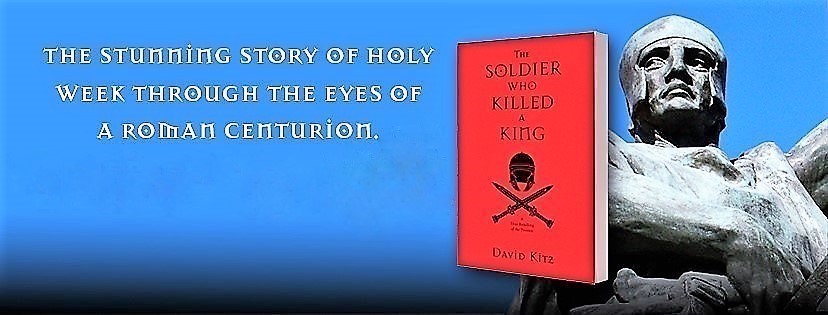
Free WW-e FACEBOOK-2 (2)
“It was under the rule of the great and wise Emperor Caesar Augustus that this magnificent temple behind us began to take shape. He recognized the desire of the Jewish people for a central place to worship. It was Herod the great Idumean king who oversaw the construction of this masterpiece of the empire, and today it stands as a symbol of Roman respect for the unity and diversity of all the peoples of the empire. It is only fitting today that I, as the emperor’s representative, welcome the son of this master builder, Herod Antipas, the tetrarch of Galilee and Perea.”
With a wave of his hand, Pilate signaled the sounding of a second trumpet fanfare. As the first note was sounded, he stepped off the chariot and then graciously lent a hand to his wife. Thus accompanied by his mate, he swaggered over to the royal litter to personally greet Herod and Herodias, who both stood to meet them.
Greetings were exchanged, none of which I could discern from a distance. After a brief discussion Claudia joined Herodias in the royal litter. Herod barked out some orders. The litter bearers stood to their feet and headed off in the direction of the governor’s residence. Apparently the ladies would have their own time together.
At a leisurely pace Pilate escorted Herod over to where the priestly delegation waited.Soldier book
It was an unusual sight, these three hostile, inflated men exchanging greetings and meaningless pleasantries. Herod Antipas, Pontius Pilate, and Joseph Caiaphas; the Fox, the Badger, and the Weasel. All three were kings in their own right, within their own jurisdiction. All three craved more power, absolute power, while fiercely holding one another in check.
Pilate turned to me and gave a quick, tight nod. I signaled up to Claudius, and the great Golden Gate, the Messiah Gate, was hoisted, granting entrance to the three competing kings.
Only the fourth king, the people’s king—the donkey king—only he was absent.

To download a free study guide for this high-impact, bible-based novel visit: https://www.davidkitz.ca/centurion.php/free study guide PDF

For book purchases of The Soldier Who Killed a King try Amazon or https://www.christianbook.com

Judgment Day is Coming

25 Monday Mar 2019

Posted by davidkitz in Devotionals, Psalm 50, Psalms

≈ 3 Comments

Tags

crucifixion, God's judgment, judgment, justice, summons, the LORD

Reading: Psalm 50
A psalm of Asaph.
(Verses 1-6)
The Mighty One, God, the LORD,
speaks and summons the earth
from the rising of the sun to where it sets.
From Zion, perfect in beauty,
God shines forth.
Our God comes and will not be silent;
a fire devours before him,
and around him a tempest rages.
He summons the heavens above,
and the earth, that he may judge his people:
“Gather to me this consecrated people,
who made a covenant with me by sacrifice.”
And the heavens proclaim his righteousness,
for he is a God of justice
(NIV).

53556600_10102411588724471_8891070223889727488_o (1)

Balmaha, Scotland — photo courtesy of Jan Jablonski

Reflection
Psalm 50 begins by reminding us that Judgment Day is coming. A great summoning will take place. We will all gather before the throne of God. Rich and poor, the powerful and the weak, the living and the dead—all will gather before the LORD. None are excused. The Mighty One, God, the LORD, speaks and summons the earth from the rising of the sun to where it sets. 

On the day before his crucifixion Jesus elaborated at some length on this great summoning. For some it will be a day of joy and gladness; for others it will be a day of dread and sorrow. “When the Son of Man comes in his glory, and all the angels with him, he will sit on his glorious throne. All the nations will be gathered before him, and he will separate the people one from another as a shepherd separates the sheep from the goats. He will put the sheep on his right and the goats on his left” (Matthew 25:31-33).

What kind of day will it be for you?

It will certainly be a day of justice. The world is crying out for justice. All too often in this world—in this life—there is no such thing. The innocent suffer, while the perpetrators get off free. They gloat in their pride, while swaddled in luxury. On that great day—that Judgment Day—the tables will be turned. The great Judge of all the earth will see to that. And so He should. Since the fall of man, the world is crying out for justice.

It is well worth noting that in his account of Judgment Day, Jesus decides if we will enter into bliss or torment based on how we treat others. He states, “The King will reply, ‘Truly I tell you, whatever you did for one of the least of these brothers and sisters of mine, you did for me’ (Matthew 25:40).

Response: LORD God, help me to live my life in joyous preparation for that great summoning when wrong will be made right. Help me to be merciful so that I will receive your mercy in Jesus’ name. Amen.

Your Turn: How can we prepare our hearts and live our lives aright in the knowledge that Judgment Day is coming?

← Older posts
Newer posts →

Psalms 365: Develop a Life of Worship & Prayer

Psalms 365 Volume II

Psalms 365 vol 3
— Psalms 365 Volume III

Now available:

Psalms

Recent posts

  • Writing for a Future Generation September 16, 2026
  • Peter Declares That Jesus Is the Messiah September 15, 2026
  • The LORD’s Appointment September 15, 2026
  • Jesus Heals a Blind Man at Bethsaida September 14, 2026
  • God’s Firestarters: Healing Pioneers September 14, 2026
  • Jesus Remains September 14, 2026
  • A Devotional Journey through the Epistle of James September 13, 2026

Calendar

September 2026
M T W T F S S
 123456
78910111213
14151617181920
21222324252627
282930  
« Aug    

Blog Posts

Enter your email address to follow this blog and receive notifications of new posts by email.

Comments

  • davidkitz on A Throne of Cherubim
  • davidkitz on They Called on the LORD
  • atimetoshare.me on They Called on the LORD

Blog at WordPress.com.

Privacy & Cookies: This site uses cookies. By continuing to use this website, you agree to their use.
To find out more, including how to control cookies, see here: Cookie Policy
  • Subscribe Subscribed
    • I love the Psalms
    • Join 1,353 other subscribers
    • Already have a WordPress.com account? Log in now.
    • I love the Psalms
    • Subscribe Subscribed
    • Sign up
    • Log in
    • Report this content
    • View site in Reader
    • Manage subscriptions
    • Collapse this bar
Loading Comments...