• Home
  • About
  • DavidKitz.ca
  • Youtube Videos
  • Books by David
  • Books on Amazon.com

I love the Psalms

~ Connecting daily with God through the Psalms

I love the Psalms

Tag Archives: crucifixion

Excerpt 28 for Lent from The Soldier Who Killed a King

28 Wednesday Mar 2018

Posted by davidkitz in Books by David Kitz, Christ's Passion, Good Friday, Lent, The Soldier Who Killed a King

≈ Leave a comment

Tags

blood, bloodlust, Christ, crucifixion, David Kitz, Jesus, king, Messiah, pierced, repentance, The Soldier Who Killed a King

A journey to the cross is a journey to repentance. It’s a journey to deep personal change. Will you take this journey with me?

Date: Nine thirty in the morning, Friday, April 7 30A.D.
The crucifixion of Jesus.

I tipped the bucket to one side to get enough swill to fill the dipper. I offered it to Jesus. He took a sip, worked the liquid around in his mouth, discerned the true nature of this bitter potion, and then spit it out. It left a dark stain on the dull gray rock near his feet.
“It will dull the pain,” I said emphatically.
He raised his eyes. They locked with mine. I saw in him the same look, the samebiblical-fiction-award-2017_orig determination I saw on the first day I set eyes on him, the day he rode the donkey into this city. I could still see he had a destination in mind. Some mystical purpose he somehow felt compelled to fulfill.
I dropped my gaze. He must be a fool. In his condition, in this situation, he must be a fool. A fool who unnerved me, but a fool nonetheless.
Once more I offered the drink.
With lips pressed tight, he shook his head.
He was a fool. An arrogant fool! A fool who thinks he’s tough—who can handle this—who can take it straight.
We would see who’s tough. I would show him who’s tough!
Let the big show begin.
“Now, boys!” I called out to the crew. Still wearing the purple robe, he was snatched like a young child and slammed down onto the crossbeam.
A cheer went up.
My right hand seized the hammer from Octavio. My left fumbled, then dove into, the nail pouch.
I dropped my knee onto his fingers.
Stabbed the sharpened point of the spike into the base of the palm.
Raised the hammer.
Xchuuuung!
An enormous cheer went up from the crowd.
Blood spurted across my thigh.
Xchuuuung!
Xchuuuung!
Xchuuuung!
One in.
The Christ was silent. Still . . .
Octavio urged me on. “That’s it, Marcus!”
I sprang to my feet, remembering the full rush of battle. Then scrambled to the other arm. From just off the hill, in the throng, a chant began and established itself. “More. More. More. More.”
Knee on fingers.
“More!”
Spike jabbed in.
“More!”
Hammer raised.
“More!”
Xchuuuung!
“More!”
Xchuuuung!
“More!”
Xchuuuung!
Two in. The Christ was silent.
Still . . . He was still beneath the piercing blows.
I rose, panting. Heart pounding. Bloodied hand dripping. Seeing a stainfree area farther up my hairy arm, I wiped it across my sweat- drenched brow.
Octavio saluted me with a smile and a thumbs-up signal.
The crowd roared their approval.
This time it was Octavio who yelled, “Hoist him up.”
The Christ was dragged gasping—desperately gasping—to an upright position before the death mast.
Now they could see him, and the crowd went wild with frenzied excitement. Cheering. Clapping. Hooting. Bloodlust took hold.
The props were applied to the arms of the crossbeam.
A new chant went up. 4485 SHARABLE-2
“Raise him up!”
“Raise him up!”
“Raise him up!”
Octavio signaled, and the men in back lifted the beam on which the Christ was pinned above their heads.
Then we all saw it—saw the obvious. He was still clothed. The purple robe billowed out as it was caught by a sudden cold gust of wind. The sight of it brought all my frenzied demons to the fore.
I stepped before him, looked into his agonized face, and said, “You won’t be needing this . . . king of the Jews.”
Then to the cheers of my men, I spit into his face. I added my spittle to all the rest that had dried and was clinging to his beard.
I untied the royal robe and dropped it in a heap to my right. Finally, with a wicked smile, and to cheers all around, I snatched his breechcloth from off his loins.
I tossed it to Octavio. He held it up. A trophy!
We laughed. We all laughed. I
t was a laugh not our own.
I recognized it. It was Herod’s laugh.
When he had regained some composure, the head jailer started the final count.
“Ready . . . one . . . two . . . three . . . now!”
To chants of “Raise him up, raise him up,” the Christ, the Messiah, the king, was lifted up—up before the world.
His head twisted from side to side in writhing agony. His whip-sliced back slammed against the upright as he was dragged higher.
Then with a flesh-tearing lurch, the notch in the horizontal beam found its match in the vertical. The rope was flung around, then drawn tight, securing the two cross members as one.
The silent Christ hung. He hung naked and bleeding before a jeering world.
Only the last spike remained. Awkwardly, I fumbled for it.
But a creeping unease overshadowed me. I glanced over my shoulder. Claudius stood alone, off to the side. Silent . . . He was ghastly pale and silent, transfixed by the sight before him.
I handed the last nail and the hammer back to Octavio and said, “You do it.” He snorted his surprise, but then set quickly to his task.

American readers click this link to purchase The Soldier Who Killed a King.

Canadian readers click this link to purchase The Soldier Who Killed a King directly from the author.
Bill Pink’s Review of The Soldier Who Killed a King

03 Saturday Mar 2018

Posted by davidkitz in book review, Books by David Kitz, Good Friday, Lent, Psalms

≈ 6 Comments

Tags

centurion, Christ, crucifixion, David Kitz, Easter, Jesus, King Herod, Marcus Longinus, Pontius Pilate, Savior, Scripture, Son of God, trial

It is hard to imagine a more ironic, more chilling dramatic exclamation than the confession of Jesus’ executioner, “Surely, He was the Son of God” (Matt. 27:54).  In The Soldier, David Kitz gives a name to the Roman executioner – Marcus Longinus. Then he gives us an hour-by-hour account of the week in Marcus’ life in the run-up to the fatal hammer blows that drove spikes into Jesus’ broken body.

4485 TWITTER

            As I began to read The Soldier, I wondered if it would be a fascinating documentary of the last week of Jesus’ ministry on Earth. Fascinating it is. The sights, sounds and smells of the Jewish Passover week come to life, from the noisy, smelly commerce in sacrificial animals to the literal river of red sacrificial blood flowing through the temple aqueducts.

Political forces delicately dance in Jerusalem. High Priest Caiaphas, Samaritan King Herod Antipas, and Roman Governor Pontius Pilate, cordial but venomous enemies, vie for control of the holy city. We see and hear the week unfold through Marcus’ eyes and ears. He fears for the very lives of his men as tumultuous crowds swell Jerusalem. Two were recently murdered by Zealot terrorists. Crowds quickly become mobs, and only the iron discipline of his small garrison insulates the city from disaster.

The Soldier soon becomes more than a documentary. Marcus becomes a man we know intimately as husband, father and brave military officer. We see his family and career jeopardized by the mental anguish of post traumatic stress disorder. Horrific visions of bloody murders populate Marcus’ dreams at night and force contemplation of suicide by day.

Jesus rides into this mix of professional anxiety and personal anguish on a donkey. From a great distance He picks Marcus out of a crowd of thousands and speaks audibly to him alone and to him specifically, saying, “I have a future for you.” During the week, Marcus is repelled by Jesus and drawn to Jesus. He fears Jesus’ power over the crowds. He is the dumbfounded eye witness to Jesus’ healing miracles. He rejoices while Jesus humiliates moneychangers and Pharisees. He hopes Jesus will be acquitted by Pilate. He feels almost personally betrayed when Jesus might have saved Himself, but deliberately does not.  Ordered to crucify Jesus, Marcus does so obediently and resolutely.

I could empathize with Marcus. Like Marcus, I was a career soldier. Like him, I had superiors I admired and those I did not. I had peers who were my friends and those I loathed.  I worried about missions I was given when they endangered subordinates I was responsible for, and, admittedly, when they jeopardized my career if they failed. Unlike Marcus, I have not literally whipped my Savior and pierced his flesh with nails. But like Marcus, my personal sins have caused Jesus to suffer pain on the cross.

The Soldier is a two-fold page turner. It is better than an exciting read. Those of usbiblical-fiction-award-2017_orig blessed with a lifetime of church have heard the story of Christ’s trial and crucifixion as often as our lives have seen Easter Sundays. We have read the Biblical account, in all four gospels, many times. Yet, as I turned the pages of The Soldier, eagerly, I also found myself compulsively turning the pages of the Bible to sort out exactly which details of that week Kitz lifts literally from Scripture and which tidbits his imagination supplies. The blend is seamless. For instance, the lame boy Christ heals in Scripture becomes Kitz’ Lucas, a three-dimensional character twice cursed by the world and twice miraculously loved by Christ. What Christian author hopes for more than for it to be said that his work sends readers scurrying into the pages of the Holy Bible?

We are all Marcus. All of us, like Marcus, have heard Jesus promise us a future. We have all been drawn to Jesus and been afraid of Jesus; we have rejoiced with Jesus, and we have all felt alone when our lives spiraled out of control in sin and remorse. Jesus has stretched out His hands to all of us, and, like Marcus, we have all driven spikes into them. When we read David Kitz’s The Soldier Who Killed a King, we too, confess, “Surely, He is the Son of God.”

American readers click this link to purchase The Soldier Who Killed a King.

Canadian readers click this link to purchase The Soldier Who Killed a King directly from the author.

From a Facebook Post

07 Wednesday Feb 2018

Posted by davidkitz in book review, Books by David Kitz, Psalms

≈ Leave a comment

Tags

book review, centurion, conflict, crucifixion, David Kitz, drama, Facebook, guilt, Jesus, Kitz, peace, review, surprise, the Passion, The Soldier Who Killed a King

Pleasant surprises are just that—pleasant. This morning I woke up to a pleasant surprise on my Facebook page. That surprise came courtesy of Greg Thurston. He posted the following review of my book:

Last night I finished reading The Soldier Who Killed a King, by David Kitz: I was Soldier bookspeechless, but I must speak.

What a compelling story of the Passion, told by the Centurion who drove the nails into Jesus’ hands. To say it was gripping, riveting, real, and fresh is completely inadequate. Kitz manages to skillfully draw you through a familiar story with uncommon drama, unexpected turns, and brings tears along the way.

This singular story is simultaneously the story of us all: seeking to deal with our guilt, our inner conflicts, and to find the elusive peace we know must be out there.

I highly recommend this book. You may think you know the story, but you don’t know it at all. Read it and see what it does to you.

Good News to Start 2018

03 Wednesday Jan 2018

Posted by davidkitz in book review, Books by David Kitz, Psalms

≈ 20 Comments

Tags

award, crucified, crucifixion, Easter, forgiven, Interviews and Reviews, Lent, Longinus, New Years Day, Passion Week, redeemed, the cross, The Soldier Who Killed a King

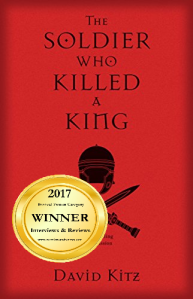
It’s always encouraging to get good news as you start the new year. That was my experience on New Years Day this year as I got word that my novel The Soldier Who Killed a King was voted the top book in the biblical fiction category for 2017, by the Christian book service, Interviews and Reviews.

biblical-fiction-award-2017_origYes, I was pleased! Winning this award bodes well for book sales as we approach the Lent and Easter season which will commence in mid February.

The book details the events of Passion Week as seen through the eyes of the Roman centurion, Marcus Longinus. He is the centurion who at the foot of the cross made this startling confession about Jesus, “Surely he was the Son of God!” (See Matthew 27:54, NIV.)

What led this hardened soldier to reach such a conclusion?

I think we often underestimate the power of the cross and the heart-gripping story that unfolded there. Paul, the apostle, did not make that mistake. Paul writes: Jews demand signs and Greeks look for wisdom, but we preach Christ crucified: a stumbling block to Jews and foolishness to Gentiles, but to those whom God has called, both Jews and Greeks, Christ the power of God and the wisdom of God (1 Corinthians 1:22-24). Biblical fiction winner 2017

The real good news for 2018 isn’t that my book won an award. The true good news is that Jesus suffered and died a wretched death on a wooden cross, so that I can be redeemed and forgiven.

He did the same for you. Do you believe that?

Have you been to the foot of the cross lately? I dare you to go there. Go there and be changed—truly changed.  That’s the real power of the cross. And that my friend is absolutely the best news of 2018!

This year I pray that you will fully experience the transformational power of the cross.


Drinking Acid

19 Tuesday Dec 2017

Posted by davidkitz in Bible, Devotionals, Psalms

≈ 1 Comment

Tags

acid, betrayal, crucifixion, David's psalms, disgrace, Jesus, Judas, judgment, Peter, prophetic, scorned, shamed, thirst, vinegar

Reading:                                      Psalm 69

(Verses 19-28)
You know how I am scorned, disgraced and shamed;
all my enemies are before you.
Scorn has broken my heart and has left me helpless;
I looked for sympathy, but there was none,
for comforters, but I found none.
They put gall in my food
and gave me vinegar for my thirst.
May the table set before them become a snare;
may it become retribution and a trap.
May their eyes be darkened so they cannot see,
and their backs be bent forever.
Pour out your wrath on them;
let your fierce anger overtake them.
May their place be deserted;
let there be no one to dwell in their tents.
For they persecute those you wound
and talk about the pain of those you hurt.
Charge them with crime upon crime;
do not let them share in your salvation.
May they be blotted out of the book of life
and not be listed with the righteous
(NIV).

Reflection
Vinegar is not the first thing I would reach for, if I wanted to quench my thirst. Vinegar sets my teeth on edge. It curdles milk. It crinkles the stomach. Why? Because it’s acid, a naturally occurring acid.

2017-12-17

Cold December sunshine — photo by David Kitz

You don’t give your friend acid to drink. But at his crucifixion that’s what the soldiers gave Jesus to quench his thirst. The soldiers also came up and mocked him. They offered him wine vinegar (Luke 23:36).

Like many of David’s psalms, there is a prophetic element in them and in this portion of Psalm 69; we see that prophetic element vividly portrayed. Jesus experienced the rejection described here. His friends deserted him. There were none to comfort him. He was scorned, disgraced and shamed. As he hung dying, he was given vinegar for his thirst.

The retribution that this psalm calls for fell on Judas. In Acts 1:20, Peter references this psalm as he speaks of the judgment that fell on Judas for his betrayal of Jesus. Yet in his moment of weakness even Peter denied knowing the Lord.

When our time of testing comes will we stand true to the Lord?

Response: Lord Jesus, you suffered rejection on my behalf. Help me be faithful to you when the world mocks you. Help me stand true. Give me courage through the power of your Holy Spirit. Amen.

Your Turn: Have you always stood true, aligning yourself with Jesus?

Absolutely Stunning!

27 Wednesday Sep 2017

Posted by davidkitz in book review, Books by David Kitz, Psalms

≈ 2 Comments

Tags

author, book, Christ, crucified, crucifixion, David Kitz, movie, Roman centurion, The Soldier Who Killed a King

An Amazon Book Review by CafinatedReads2009

When it comes to fiction books that are centered around Biblical times, it takes a really good author to hook me into the story line. Don’t get me wrong, I love reading my Bible, however, not every author can create a story that brings the Biblical portion off the book pages and to the reader like a movie screen. David Kitz, however, truly hooked me with this book, and took me on a first-class whirlwind ride through history.

I absolutely felt every emotion of this book, watching, most often on the edge of my seat, Soldier bookas Christ was crucified. This book really brings to life the Biblical and the historical detail. As I watched the Roman centurion who was tasked with awful task, I found myself with tears in my eyes, both for him, and for Christ. It was a heart-wrenching, gut twisting, thought provoking story of sacrifice and pain.

This book……anything less than a 5 star review would be a disgrace. The style of which David Kitz wrote this novel is stunning and captivating.

This book is definitely not for everyone though. If you are a reader of Biblical fiction, if you want to see what happened during that eventful week in time, then this book is for you. You will not be disappointed and you will want more! I know I am already ready for another beautifully written novel of Biblical times by this superbly talented author! Grab The Soldier Who Killed a King and be prepared for a jaw dropping experience of watching the crucifixion come into play.

A Book Review by Glynis Belec

21 Thursday Sep 2017

Posted by davidkitz in book review, Books by David Kitz

≈ 2 Comments

Tags

centurion, crucifixion, David Kitz, Donkey King, Passover, resurrection, soldier, Son of God, The Soldier Who Killed a King

The Soldier Who Killed a King is not a light read that fills me with superficiality andSoldier book indifference about something that happened in history. Instead I am transported to a place filled with conflict, violence, emotional turmoil, restlessness and intrigue via the powerful character of Marcus Longinus, the Centurion in charge of keeping law and order during a tumultuous time.

David Kitz has created a character in Marcus Longinus that helps me consider the internal battle the Centurion faces and what stirs in his heart to make the declaration that the Donkey King really is the Son of God.

The minor characters are relate-able in emotion, too, and I especially appreciate the insight Kitz gives about the tenderness of Marcus Longinus as is presented beautifully in his interaction with family. The Soldier Who Killed a King kept me riveted and even though I tried to put the book down (one has to sleep) I found myself having to turn just one more page.

Confrontation after confrontation; from the Passover crowd to the nail-scarred hands of the Man who was to change the course of history—I was fascinated, compelled to read it and moved sometimes, to tears. This is a book that doesn’t hold back, yet it is not gory nor does it contain gratuitous violence.

Even though this is a work of fiction, it contains accuracy as outlined in the Gospels. I appreciate the timeline and the steady pace of The Soldier Who Killed a King. I would recommend this book highly for it approaches the week of Christ’s suffering and resurrection from a unique and genuine viewpoint and offers a fresh look at forgiveness and Divine love unleashed.

4485 TWITTER

REVIEW OF: The Soldier Who Killed a King

31 Thursday Aug 2017

Posted by davidkitz in Books by David Kitz, Psalms

≈ 6 Comments

Tags

author, Barabbas, Bible, Canadian Bible Society, centurion, Christian, crucifixion, David Kitz, Easter, gospel, historic novel, historical research, Jesus, Passion Week, plot, Roman centurion, terrorist, The Soldier Who Killed a King

REVIEW OF: The Soldier Who Killed a King
SUB-TITLE: A True Retelling of the Passion
PUBLISHER: Kregel Publishing, 2017, 285 pages Soldier book
CLASSIFICATION: Historical Christian fiction
ISBN: 978-0-8254-4485-2
AUTHOR: David Kitz

BY: Wilf Wight, Director, (retired)
Eastern Ontario District
Canadian Bible Society

Maybe it is because I am left-handed, or maybe it demonstrates impatience, but when I first pick up any book, I invariably flip to the concluding pages. Call me a cheater if you will, but I am looking for a conclusion worthy of the time required to read the book! When I turned to the back of The Soldier Who Killed a King, the concluding pages of this story accomplished what every well-written book should do. The author reached back into the plot for a brief review and then projected the reader toward the future. In this case, the plot obviously had elements of violence and suffering which were being transformed through forgiveness and healing. And the future held promise of hope and excitement.

My attention next is concentrated on the first couple of chapters. Has the author grasped my attention in the opening paragraphs? Was sufficient detail given to introduce the plot, while only hinting at more intrigue to follow? Were the characters being carefully introduced in a way that begged my investigation? Yes, the author passed the basic tests. He had been successful in reaching out to me and I wanted to read this book!

Our western world has had major exposure to the Christian Gospel and most readers know at least something of what has come to be known as Holy Week, the week between Palm Sunday and Easter. However, the Bible makes only passing reference to two of the main characters in the story, the Centurion (military officer) who carried out the crucifixion and Barabbas (the convicted murderer) released by the authorities. The author seizes upon this opportunity to give them personalities, develop their thoughts and articulate their opinions. This proved to be a clever and effective tool to experience the unfolding of the drama in a fresh perspective.

For readers who have the mistaken idea that the biblical account is far removed from reality, here is fiction that will help them discover truth. As the author effectively paints the picture of the process of first century justice, political influence and compromise become realities. We cringe as the sentence is carried out by the most cruel and violent method. This is the most gripping account of the crucifixion that I have ever read! One could almost hear the hammer fall, feel the pain, sense the dishonor and share the guilt of that scene. After reading the description of the crucifixion of the first two victims, I hesitated, in fact halted.  I was not sure if I wanted to tackle the third one—that of the Christ. And yet, despite the graphic description of this horrible experience, the author accomplished his goal without resorting to gross descriptions of the mangled human body.

We are confronted with the enigma of the Christ. He is the one who has demonstrated miraculous power to heal the lame and restore sight to the blind. He is the one who gently took children on his knee to teach them. Yet he set aside the exercise of his powers to submit to the terror of the Cross. The terrorist, Barabbas, was released—set free from prison and back into society—as the peoples’ alternative choice. And the sentence was carried out under Pilate’s  orders by the Soldier. Through the eyes of these two characters we see another perspective, which does not usually come to the mind of the worshiper during Passion Week.

One device the author uses effectively is the introduction of each chapter with a day and time orientation. In this way the unfolding of the drama is situated on the calendar. Those who know the biblical account realize that Friday is coming but that is not the end of the story because Easter Sunday will be the revelation of the resurrected Christ.

As we approach the chapter dealing with Easter Sunday, the reader is rewarded with the hope and excitement of an amazing new day. The darkness of the crucifixion is not forgotten but rather dims in the light of the resurrection. The despair of death is replaced by the hope of new life. The willing submission of Jesus, the Donkey King, to the soldiers is now recast as the power of the One who can forgive and restore.

The concluding pages of the story bring us to a climax, so well-crafted and tensioned that I dare not give it away.

The epilogue provides further details of the main characters of the plot, gleaned from historical research. The endnotes reference biblical and other texts, which document the main course of events. The author has done his homework. His account of these events is well researched and credible.

4485 TWITTER


The Soldier Who Killed a King

19 Saturday Aug 2017

Posted by davidkitz in Books by David Kitz, Psalms

≈ 5 Comments

Tags

5 star review, biblical, Biblical fiction, Christ, crucifixion, David Kitz, emotion, Roman centurion, soldier, The Soldier Who Killed a King

The ebook version of my Passion of Christ novel is available for just $0.99 for the next 24 hours on Amazon.

Here is a look at the most recent Amazon review:

4485-e BLOG 160x375When it comes to fiction books that are centered around Biblical times, it takes a really good author to hook me into the story line. Don’t get me wrong, I love reading my Bible, however, not every author can create a story that brings the Biblical portion off the book pages and to the reader like a movie screen. David Kitz, however, truly hooked me with this book, and took me on a first-class whirlwind ride through history. 

I absolutely felt every emotion of this book, watching, most often on the edge of my seat, as Christ was crucified. This book really brings to life the Biblical and the historical detail. As I watched the Roman Centurion who was tasked with awful task, I found myself with tears in my eyes, both for him, and for Christ. It was a heart-wrenching, gut twisting, thought provoking story of sacrifice and pain. 

This book……anything less than a 5 star review would be a disgrace. The style of which David Kitz wrote this novel is stunning and captivating. This book is definitely not for everyone though. If you are a reader of Biblical fiction, if you want to see what happened during that eventful week in time, then this book is for you. You will not be disappointed and you will want more! I know I am already ready for another beautifully written novel of Biblical times by this superbly talented author! Grab this book and be prepared for a jaw dropping experience of watching the crucifixion come into play. 

CafinatedReads2009


The Ends of the Earth Will Turn to the LORD

13 Thursday Jul 2017

Posted by davidkitz in Bible, Devotionals, Psalm 22, Psalms

≈ 4 Comments

Tags

baptizing, Christ, crucifixion, faith, generations, good news, gosp, great commission, Holy Spirit, Jesus, Lord Jesus Christ, nations, prophetic, repentance, Savior, the LORD, worship

Reading:                                      Psalm 22

(Verses 27-31)

All the ends of the earth
will remember and turn to the L
ORD,
and all the families of the nations
will bow down before him,
for dominion belongs to the L
ORD
and he rules over the nations.
All the rich of the earth will feast and worship;
all who go down to the dust will kneel before him—
those who cannot keep themselves alive.
Posterity will serve him;
future generations will be told about the L
ORD.
They will proclaim his righteousness,
declaring to a people yet unborn:
He has done it!
(NIV)

Reflection

This final portion of Psalm 22 signals the ultimate triumph of the Lord Jesus Christ. In the first half of this psalm Christ’s humiliation, suffering and death by crucifixion are vividly portrayed. With stunning accuracy and detail, David depicts these events from Christ’s perspective. Only God-breathed prophetic insight could reveal such truth through a human vessel. For prophecy never had its origin in the human will, but prophets, though human, spoke from God as they were carried along by the Holy Spirit (2 Peter 1:21).

2017-07-01

Dominion belongs to the LORD — photo by David Kitz

With today’s reading we discover the worldwide impact of Christ’s redemptive death and resurrection. All the ends of the earth will remember and turn to the LORD, and all the families of the nations will bow down before him, for dominion belongs to the LORD and he rules over the nations.

Christ’s gospel—the good news of the Kingdom—has been voiced abroad. Death, hell and the grave have been conquered. Jesus Christ is Lord over all! Keep in mind that this turning to the LORD by all the families of the nations was an alien concept to the people of Israel during David’s time. Yet again, David spoke prophetically of the time when the gospel message would burst forth from its Jewish cocoon and be declared and received by ready hearts all over the world. Our Savior’s commission will be fulfilled. “Therefore go and make disciples of all nations, baptizing them in the name of the Father and of the Son and of the Holy Spirit, and teaching them to obey everything I have commanded you. And surely I am with you always, to the very end of the age” (Matthew 28:19-20).

We have the promise of the worldwide spread of the gospel from generation to generation. Posterity will serve him; future generations will be told about the LORD. They will proclaim his righteousness, declaring to a people yet unborn: He has done it!

Response: Father, thank you for the good news of the gospel. Jesus is alive and reigns forever. Help me to do my part in bringing the message of your love and redemption to the world. I want to see people from all nations turning to you in repentance and faith. Amen.

Your Turn: How can we spread the good news? What are you doing to tell His story?

← Older posts
Newer posts →

Psalms 365: Develop a Life of Worship and Prayer

Psalms 365 Volume II

Psalms 365 vol 3
— Psalms 365 Volume III

Psalms

Recent posts

  • Hope for the Downcast March 12, 2026
  • Jesus Washes His Disciples Feet March 11, 2026
  • Thirst for the LORD March 11, 2026
  • Jesus Predicts His Betrayal March 10, 2026
  • Absalom to Judas, Betrayal to Triumph March 10, 2026
  • He Had Compassion on Them March 9, 2026
  • Compassion and Empathy March 9, 2026

Calendar

March 2026
M T W T F S S
 1
2345678
9101112131415
16171819202122
23242526272829
3031  
« Feb    

Blog Posts

Comments

  • atimetoshare.me on Hope for the Downcast
  • davidkitz on He Had Compassion on Them
  • He Had Compassion on Them – QuietMomentsWithGod on He Had Compassion on Them

Blog at WordPress.com.

Privacy & Cookies: This site uses cookies. By continuing to use this website, you agree to their use.
To find out more, including how to control cookies, see here: Cookie Policy
  • Subscribe Subscribed
    • I love the Psalms
    • Join 1,384 other subscribers
    • Already have a WordPress.com account? Log in now.
    • I love the Psalms
    • Subscribe Subscribed
    • Sign up
    • Log in
    • Report this content
    • View site in Reader
    • Manage subscriptions
    • Collapse this bar
 

Loading Comments...