
• Home
  • About
  • DavidKitz.ca
  • Youtube Videos
  • Books by David
  • Books on Amazon.com

I love the Psalms

~ Connecting daily with God through the Psalms

I love the Psalms

Tag Archives: Golgotha

Excerpt 29 for Lent from The Soldier Who Killed a King

29 Thursday Mar 2018

Posted by davidkitz in Books by David Kitz, Christ's Passion, Good Friday, Lent, The Soldier Who Killed a King

≈ 1 Comment

Tags

Christ, crucifixion, disciple, Golgotha, Jesus

A journey to the cross is a journey to repentance. It’s a journey to deep personal change. Will you take this journey with me?

Date: About noon, Friday, April 7 30A.D.
The crucifixion of Jesus.

Now there was movement on the Mother’s Hill. A middle-aged couple came down. Their heads were hanging. They clung to each other, supported each other, every step an anguish. They made their way before the encircling pikemen.
I knew who they were—knew why they had come. Here were the broken parents, broken beyond this world’s repair. I met them at the base of the hill, told them they had some time.
They advanced up the Skull. She fell, fell whimpering before her son. Thaddaeus. Boisterous soldiers fell silent and then walked off, right off the hill. The family was alone with their grief.

4485 TWITTER
Having witnessed this grim but welcoming reception, another party stepped off the Mother’s Hill and advanced to Golgotha. This was a group of five. The women clung to one another in couples. They were shepherded by a tall young man. His fresh face and scant beard bore witness to his youth. I recognized him. He had been with Jesus, had stood closest to him.
He introduced himself. He said his name was John. I received his party—ushered them by the outer ring of soldiers.
They were bowed by the sight. They clung to one another afresh, repulsed by the horror of what met their eyes.
After a few moments the young man came before two of the huddled older women. He stooped to speak with one of the women—the Christ’s mother, I assumed. Then with his arm about her shoulder, John advanced up the rock mound.
Jesus saw them.
He struggled.
“Woman . . . behold your son!”
There was a double- edged meaning here, almost too painful for words. At first I thought he was simply referring to himself—to his own wretched state. And perhaps on one level he was.
His body sagged. But then he thrust himself up and forward for another breath, and with his next words his meaning became clear. To the young man, to his disciple, he said, “Behold your mother!”
He had committed his mother into this disciple’s care. She fell to her knees. She trembled, unable to speak. Only wretched sobbing was heard from within the circle of the hill.
In due time I led both families off. They left willingly. This was too much to bear, too much to watch.
From his cross Animal watched the Mother’s Hill. But no one came. That’s when he broke—broke like a clay pot dropped onto the hard rock of the Skull.
He sobbed. He moaned.
His tears flowed like rivers into his dark, young beard.
But no mother came. No one came at all. Free WW-e FACEBOOK-2 (2)
The wind picked up. The sky grew dark. Then it grew darker yet. The horses began to neigh and paw the ground. In the distance a dog barked. It was a bark that changed to a howl but ended in a whimper. I looked about. I could see it on every face. It was fear. Raw fear. This was not the dark of cloud or storm. This was the sun covering, hiding its face from what it saw upon the earth.
A total darkness descended, as black as any night.
There was a discord here—a discord utter and complete. If heaven and earth had come into some perfect union—some perfect harmony—on the day Jesus arrived in this city, it was in blaring dissonance now. Blaring dissonance echoed off the empty chambers of my soul.
It was a deafening darkness.
The mocking crowds fell silent. The highway traffic stopped. All was still.
Silent.
Only the three men were heard. Heard in the darkness. Three men working to maintain this perverted thing called life.
Working.
Pushing up.
Up to catch a breath.

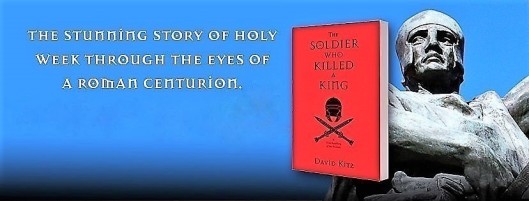
American readers click this link to purchase The Soldier Who Killed a King.

Canadian readers click this link to purchase The Soldier Who Killed a King directly from the author.


Excerpt 27 for Lent from The Soldier Who Killed a King

27 Tuesday Mar 2018

Posted by davidkitz in Books by David Kitz, Christ's Passion, Lent

≈ 1 Comment

Tags

blood, Caesar, Caiaphas, Christ, crucify, David Kitz, Golgotha, high priest, innocent, Jesus, king, Lent, Messiah, Pilate, repentance, trial of Jesus, verdict

A journey to the cross is a journey to repentance. It’s a journey to deep personal change. Will you take this journey with me?

Date: Eight forty in the morning, Friday, April 7 30A.D.
The trial of Jesus ends. The verdict is delivered.

Pilate was already seated, ready to pronounce judgment. A thin smile was now on his face. The cunning Badger would make the most of his final moves. When Jesus was in position, he began. Once more he motioned in the direction of the Christ, and to all assembled he announced, “Here is your king.”
“Take him away!” came the instant response. “Take him away! Crucify him!”
There was vehement insistence coming from the crowd. Some began to hurl dust in theBiblical fiction winner 2017 air. This was verging on a riot, a point that was surely obvious to the governor, yet he played them on.
“Shall I crucify your king?” Pilate called back to the throng.
“We have no king but Caesar,” the Weasel spat back.
The Badger’s eyebrows shot up.
The governor smiled and nodded. It was a smile of triumphant satisfaction. We have no king but Caesar. The Badger mulled over these words. I knew he had waited years for these words. After all he had endured in this place, wasn’t it well worth hearing this confession from the high priest’s mouth?
Ironically, the governor had Jesus to thank for the high priest’s sudden conversion and submission to imperial Rome. This declaration would never have come forth from the Weasel’s lips, except to secure the conviction of the good Galilean. Caiaphas was willing to stoop before Rome in order to spill the blood of this prophet. Here was the true measure of his hatred for the Northern Messiah.
Pilate knew all this, and he drew a good measure of perverse satisfaction from it. He understood his foe.
He called for his personal attendant to bring a basin of water. Now he would lay the blame where the bloody blame belonged. With the attendant holding the basin before him, Pilate made a great show of washing his hands before the crowd, and with insistence in his voice, he declared, “I am innocent of the blood of this man.”
Here was the feint, the great pretend.
Next came the dodge.
With water still dripping from his hands, he looked out over the crowd and declared, “You yourselves see to it.”
He spoke as though he had abdicated—bore no responsibility for the blood that now trickled down Jesus’s back. He absolved himself of that and of all that would soon flow on Golgotha.
This Badger could throw a bit of dirt.
Free WW-e FACEBOOK-2 (2)
It was fitting for Annas the aged priest to respond. It was he who answered for the people. With his finger pointed at Jesus and his gaze fixed on him, he replied, “His blood be on us.” Then he paused as though looking down through the generations of time. “And on our children,” he added with a cold, sardonic stare.
Out on the street the people answered, “Yes!” They nodded their agreement with this verdict.

American readers click this link to purchase The Soldier Who Killed a King.

Canadian readers click this link to purchase The Soldier Who Killed a King directly from the author.

Excerpt 17 for Lent from The Soldier Who Killed a King

13 Tuesday Mar 2018

Posted by davidkitz in Books by David Kitz, Christ's Passion, Lent, The Soldier Who Killed a King

≈ 1 Comment

Tags

Barabbas, Caesar, Caiaphas, centurion, Golgotha, Jerusalem, Jesus, Kidron Valley, Messiah, prophet, repentance, Romans, Rome, sinners, tax collector, temple

A journey to the cross is a journey to repentance. It’s a journey to deep personal change. Will you take this journey with me?

In today’s reading, Marcus, the centurion, meets with Jonas the tax collector. They discuss the news of the week, namely the huge stir that Jesus has caused in Jerusalem since his triumphal entry into the city. Date: Early morning April 6th, 30 A.D.

As I descended the stairs of the gate, I caught sight of Jonas and his son, unoccupied at the customs booth. With a quick wave of my hand, I signaled my intention to speak with him, and after taking the salute of the sentinels at the gate, I headed straight to the booth. “Good morning, you old goat!” I called out as I approached.
“Well, if it isn’t the top dog himself,” he shot back.
“It’s always good to see a man standing around doing nothing. It sets me at ease,” I said. “Ease?” His eyebrows shot up. “Oh yeah.” He nodded emphatically. “It’s been a week of ease all right. I’ve had my feet up all week.”
Of course, just the opposite was true, and it was true for both of us.
Free WW-e FACEBOOK-2 (2)
“Do you think we could have a short word?” With a jerk of my head, I motioned in the direction of the road leading down the Kidron Valley.
“Sure,” he answered, and then with a glance and a nod to his son, he transferred responsibility to him. A light mist still hung over the lowest reaches of the valley, but the early-morning sun was promising to burn it off. The swallows nesting along the crevices in the city wall were engaged in a full-throated competition with the songbirds in the trees along the brook. Traffic to and from the city was just beginning to stir.
When we had gone a few paces beyond the gate, I spoke. “I just wanted to say thanks for the help with the Barabbas case.”
“Oh, don’t mention it.” There was relief in his voice. “I thought you were going to warn me about some new plot.”
“No, there’s no new plot.” I hesitated. “Let me rephrase that. There’s no new plot that I know about. You never can be sure what’s being hatched in this crazy city.”
“Yeah, you’re right about that. I guess we learned that with Barabbas.” Jonas nervously bit on the corner whiskers of his mustache, and then continued. “Now, that Galilean prophet? I’ve been losing sleep over him all week.”
“Harmless as a dove,” I said. “Harmless as a dove.”
“How do you know?”
“I checked him out myself on Monday, right back there in the temple courts.” I made a quick double-pump motion with my upraised thumb aimed over my shoulder. “Then on Tuesday I had Claudius in there with the prophet.”
“You Romans have more nerve than brains.” He kicked a loose pebble off the pathway, looked up at me with a quizzical grin, and then with an incredulous shake of his head, he repeated, “More nerve than brains, that’s all I can say.”
“If we didn’t have nerve, we wouldn’t be running this place. Or any other place for that matter.”
He shrugged, furrowed his brow, and then cocked his head to one side. It was his way of reluctantly conceding my point.
“So he’s harmless?”
“Harmless to us.” With my index finger, I pointed first at myself, then at Jonas, and then back again. “Caiaphas, on the other hand”—I paused for effect—“now there’s a man who I’m sure hasn’t slept well all week.”
“So you think the old rusty gate has lost some sleep? Over what?”
“Money. Money and prestige. It can’t look too good having some roving up-country rabbi come in and take over your temple at the religious high point of the year.”
“I suppose not,” Jonas said. But then he added, “You know this prophet, Jesus of Nazareth, he’s been here before. He kicked out the money changers a few years back. Caused quite a stir then. But nothing like this. He’s got the temple guards running scared. That’s what my uncle told me.”
James Tht“Your uncle’s right. I saw that firsthand on Monday. So what else do you know about this Galilean?”
“My wife tells me he’s a friend of tax collectors and sinners. She told me one of his disciples was a tax collector before he met the prophet.”
“Ah, tax collectors and sinners?” I responded with a wink and a nod. “Maybe there is hope for the two of us yet.”
Jonas smiled back at me. “So, Marcus, where is this all headed? Some people think he’s the Messiah. You know that, don’t you?”
“Yes, we’re well aware of that. But he doesn’t oppose paying taxes to Caesar.” I gave my tax collector a supportive thumbs-up signal. “And he hasn’t spoken a word against Rome since he’s been here.”
“That’s not a surprise. He knows better. You and your boys would have him nailed up on Golgotha the moment he did.”
“You’re right about that,” I agreed. “But I honestly don’t think he’s got a quarrel with us. He’s going after the parading hypocrites in long, flowing robes, those killjoy Pharisees and teachers of the law. You know the ones—the religious police who run this place.”

American readers click this link to purchase The Soldier Who Killed a King.

Canadian readers click this link to purchase The Soldier Who Killed a King directly from the author.


Ears That Are Open

29 Friday Sep 2017

Posted by davidkitz in Bible, Devotionals, Psalm 40, Psalms

≈ 3 Comments

Tags

disciple, disciples, ears open, ears to hear, God's call, Golgotha, gospel, hearing God, Jesus, Prayer, redemption, sugar-coated gospel, the cross

Reading:                                      Psalm 40

 (Verses 6-10)
Sacrifice and offering you did not desire—
but my ears you have opened—
burnt offerings and sin offerings you did not require.
Then I said, “Here I am, I have come—
it is written about me in the scroll.
I desire to do your will, my God;
your law is within my heart.”
I proclaim your saving acts in the great assembly;
I do not seal my lips, L
ORD, as you know.
I do not hide your righteousness in my heart;
I speak of your faithfulness and your saving help.
I do not conceal your love and your faithfulness
from the great assembly
(NIV).

Reflection
The first half of today’s psalm reading is quoted directly in Hebrews 10:5-7. The writer of the Book of Hebrews saw Jesus as the prophetic fulfillment of this passage. Jesus became the necessary sacrifice for the sins of the world. When God came to earth in bodily form as the babe of Bethlehem, He came clothed in humanity. Jesus came with his ears wide open to the voice of his heavenly Father. He came to do His Father’s will. For Jesus the Father’s will meant going to the whipping post and climbing the hill of Golgotha to die in agony on the cross. That was the sacrifice the Father desired.

2017-09-02f

Marsh-side flower stalks — photo by David Kitz

Has God opened your ears to His voice? Have you loved God until it hurt? It hurt Jesus to do His Father’s will. If we are Jesus’ disciples, should we expect better treatment than our Master? Often what we hear preached is a sugar-coated gospel that asks little of us. Jesus asked his disciples for their lives. He said, “Anyone who loves their father or mother more than me is not worthy of me; anyone who loves their son or daughter more than me is not worthy of me. Whoever does not take up their cross and follow me is not worthy of me. Whoever finds their life will lose it, and whoever loses their life for my sake will find it” (Matthew 10:37-39).

Have you lost your life for the sake of Jesus? Now, that’s a high calling with a steep price attached.

Are your ears open to God’s calling? There are times when I don’t want to hear God’s voice. That’s why I don’t seek Him in prayer. He may tell me something I don’t want to hear. All too often, I am His reluctant servant. I would rather do my will than His will. He must change my desires. My desires must become His desires. Only then can I serve with joy. Jesus’ desire was always to do his Father’s will. From an early age he was about his Father’s business, fulfilling His Father’s plan for His life.

Whose plan are you following?

Response: LORD God, help me to truly hear and obey your voice. I want to be your disciple, Lord Jesus. Thank you for your great sacrifice by which you purchased my redemption. Amen.

Your Turn: Have you heard God’s voice and walked away? He doesn’t give up easily. He remains faithful. He renews His call.

Hands and Feet Pierced for Me

11 Tuesday Jul 2017

Posted by davidkitz in Bible, Devotionals, Psalm 22, Psalms

≈ 4 Comments

Tags

David, Golgotha, Gospels, Jesus, Jesus' death, Lamb of God, Landestreu, messianic Psalms, pardon, pierce, psalm of David, redemption, Roman soldiers, suffering of Christ, thanks, the cross, victory

Reading:                                      Psalm 22

(Verses 16-21)

Dogs surround me,
a pack of villains encircles me;
they pierce my hands and my feet.
All my bones are on display;
people stare and gloat over me.
They divide my clothes among them
and cast lots for my garment.
But you, LORD, do not be far from me.
You are my strength; come quickly to help me.
Deliver me from the sword,
my precious life from the power of the dogs.
Rescue me from the mouth of the lions;
save me from the horns of the wild oxen
(NIV).

Reflection
The title notes to Psalm 22 state, “A psalm of David.” But while this is David’s psalm, it’s entirely about Jesus—about our Savior’s personal thoughts and experience—about his suffering and death. Nowhere is this expressed more clearly than in the opening lines posted above: Dogs surround me, a pack of villains encircles me; they pierce my hands and my feet.

d-adam-4

Landestreu sunrise — photo courtesy of Donald Adam

On the rock hill called Golgotha, surrounded by his taunting enemies, Jesus is stripped naked. His hands and feet are pierced as he is nailed to the cross and lifted up for the whole world to see. The helpless Christ silently laments, “All my bones are on display; people stare and gloat over me.”

All four Gospels record what happens next. The soldiers divide up Jesus clothes and gamble for his seamless garment. “Let’s not tear it,” they said to one another. “Let’s decide by lot who will get it.” This happened that the scripture might be fulfilled that said, “They divided my clothes among them and cast lots for my garment.” So this is what the soldiers did (John 19:24).

Thoughtless Roman soldiers fulfilled what David penned nine centuries earlier. But was Jesus truly helpless? If he was helpless, he was helpless by design. If he was forsaken by his Father, he was forsaken by choice—his choice. This was a course of action that Jesus willingly chose. He lay down his life. The Lamb of God suffered and died that our sins might be atoned, that we may receive a full pardon. Redemption has come; the price has been paid in full—paid in blood.

The turning point in this psalm is found in the last stanza above. With unvoiced words Jesus cries out to be rescued and delivered from death. Three days later his prayer was answered through his bodily resurrection. Ultimately, Jesus triumphed over death, hell and the grave. By faith his suffering brings our redemption and victory.

Response: Lord Jesus, my thanks flows to you. You were forsaken that I might have eternal life. Thank you for thinking of me rather than of yourself. You deserve all praise. Amen.

Your Turn: What is the right response to the love Jesus showed?

Newer posts →

Psalms 365: Develop a Life of Worship and Prayer

Psalms 365 Volume II

Psalms 365 vol 3
— Psalms 365 Volume III

Psalms

Recent posts

  • I Call to You for Help January 10, 2026
  • Above All Gods January 9, 2026
  • The Need for a Place of Refuge January 9, 2026
  • David Dances before the LORD January 8, 2026
  • The God of Turn-Arounds January 8, 2026
  • The LORD Who Heals You January 7, 2026
  • Why Praise God? January 7, 2026

Calendar

January 2026
M T W T F S S
 1234
567891011
12131415161718
19202122232425
262728293031  
« Dec    

Blog Posts

Comments

  • davidkitz on The Ultimate Come from Behind Victory  
  • cjsmissionaryminister on Preparing a Landing Strip for the Holy Spirit
  • cjsmissionaryminister on The Ultimate Come from Behind Victory  

Blog at WordPress.com.

Privacy & Cookies: This site uses cookies. By continuing to use this website, you agree to their use.
To find out more, including how to control cookies, see here: Cookie Policy
  • Subscribe Subscribed
    • I love the Psalms
    • Join 1,381 other subscribers
    • Already have a WordPress.com account? Log in now.
    • I love the Psalms
    • Subscribe Subscribed
    • Sign up
    • Log in
    • Report this content
    • View site in Reader
    • Manage subscriptions
    • Collapse this bar
 

Loading Comments...