• Home
  • About
  • DavidKitz.ca
  • Youtube Videos
  • Books by David
  • Books on Amazon.com

I love the Psalms

~ Connecting daily with God through the Psalms

I love the Psalms

Tag Archives: Jerusalem

Who am I? The Defining Question

01 Sunday Mar 2026

Posted by davidkitz in Books by David Kitz

≈ 2 Comments

Tags

deity of Jesus, God, James, James the brother of Jesus, Jerusalem, Jesus, lukewarm, Mary and Joseph, Passover, Son of God, temple

James: the Lynchpin of Our Faith — Chapter 3

John in the opening chapter to his gospel account makes this observation about Jesus: “He was in the world, and though the world was made through him, the world did not recognize him. He came to that which was his own, but his own did not receive him” (John 1:10–11).

Most commentators on this passage conclude that John, who wrote this gospel in the latter part of the first century, was referring to the rejection of Jesus by the majority of the Jewish nation. To paraphrase: Jesus came to his own people, but they did not recognize him as their Messiah or receive him as such.

Undoubtedly, this is a correct interpretation of this passage. However, I would argue that typically we view and interpret this passage much too broadly. On the macro level this standard view is correct; Jesus was rejected by the Jewish nation. But it is within the microcosm of the family that the truth of this passage truly hits home. Jesus was not only rejected by his nation; he was rejected by his own family. A careful reading of the gospels makes this painful point clear.

The hometown rejection, which we read of in the previous chapter, foreshadows a much more extensive rejection of Jesus that rippled through his family, through the religious establishment and the whole of Jewish society. It culminated in his condemnation by the Sanhedrin and crucifixion at the hands of the Romans. Despite his wise teachings, which were coupled with signs and wonders, most of his contemporaries did not recognize the divinity of Christ. In their eyes, he was just a man—a man dangerously masquerading as so much more. The Gospel accounts make it blatantly clear that this was also the view that James and his brothers held.

But before we delve deeper into Jesus’ rejection by his family, we need to examine the topic of self-recognition. In the quote above, John stated, “He [Jesus] was in the world, and though the world was made through him, the world did not recognize him” (John 1:10).

John sees the problem of Jesus rejection as stemming from a failure of the people to recognize who he was. John clearly saw Jesus as the Creator of the universe; he recognized Jesus as Deity, but by and large Jewish society did not. He was Deity disguised in humanity and for many the disguise was too effective, too confounding. To this day it remains a stumbling block, particularly for those trained in the Jewish faith. God taking on human form is a foreign concept, and it is incomprehensible.

Now imagine for a moment how baffling—how incomprehensible—this concept would be for a twelve-year-old Jewish boy. But somehow at the age of twelve, Jesus grasped it. He recognized his own Deity. He saw himself as the Son of God. How exactly did this come about?

Childhood is all about self-discovery and learning our place in the world. Quite naturally self-discovery begins at home within the context of the family. We learn who we are from our parents and siblings. They define our genetic and cultural heredity. Genetically we are like them, and we become even more like them through our exposure to their loving nurture, interaction and instruction. Our family defines us, particularly at a young age. But for reasons we do not fully understand, Jesus saw himself as radically different. He saw that he did not fit or rightfully belong in his father’s household—in Joseph’s household. Already at age twelve, he recognized that he was not Joseph’s son.

How did this come about? How did Jesus come to see himself as different? Furthermore, it is one thing to conclude that this man you have grown up with is not your true father, but it is a huge leap for a twelve-year-old to conclude that he is some kind of divinely conceived genetic mutant, an offspring of God—a God/Boy. Yet that is how Jesus came to see himself.

The only gospel account of Jesus’ childhood presents a fascinating snapshot of Jesus’ self-perception. In the following account, Jesus reveals how he sees himself; he grasps his true identity:

Every year Jesus’ parents went to Jerusalem for the Festival of the Passover. When he was twelve years old, they went up to the festival, according to the custom. After the festival was over, while his parents were returning home, the boy Jesus stayed behind in Jerusalem, but they were unaware of it. Thinking he was in their company, they traveled on for a day. Then they began looking for him among their relatives and friends. When they did not find him, they went back to Jerusalem to look for him. After three days they found him in the temple courts, sitting among the teachers, listening to them and asking them questions. Everyone who heard him was amazed at his understanding and his answers. When his parents saw him, they were astonished.

His mother said to him, “Son, why have you treated us like this? Your father and I have been anxiously searching for you.”

“Why were you searching for me?” he asked. “Didn’t you know I had to be in my Father’s house?” But they did not understand what he was saying to them.

Then he went down to Nazareth with them and was obedient to them. But his mother treasured all these things in her heart. And Jesus grew in wisdom and stature, and in favor with God and man. (Luke 2:41–52)
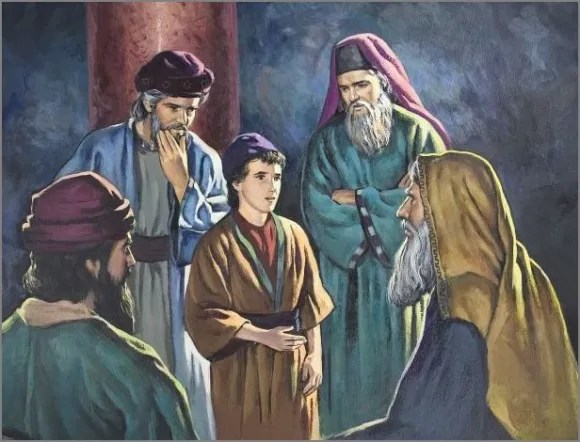
The Boy Jesus in the Temple Courts

Jesus response to Mary’s question speaks volumes about Jesus’ self-perception. “Why were you searching for me? Didn’t you know I had to be in my Father’s house?”

It’s almost as though he is saying to his mother, “I know who I am. I’ve figured it out. Did you forget whose son I really am? God is my Father. All I wanted to do is spend some time with Him.”

“But they did not understand what he was saying to them” (Luke 2:50).

If Mary and Joseph did not understand what Jesus was saying to them, it would seem to indicate that they did not tell him of his divine origin. There was no private conversation where Joseph took Jesus aside and said, “Look son, you’re really not my son. Oh, and by the way, this is how you came about…”

Apparently, Mary did not have this conversation with Jesus either. Think about it. It would be a very difficult conversation to initiate. Explaining the virgin birth would surely stretch the bounds of common logic and would profoundly conflict with the norms of the Jewish faith. Why would the one true God impregnate a Jewish girl by the Spirit? Consider it for a moment. It’s preposterous and intrinsically it runs counter to all we know of Jewish religious dogma.

How do you tell your firstborn that he is the Son of God? Apparently, you don’t. If he truly is the Son of God, you let him figure it out. From this account, it would seem this is the course of inaction that Mary and Joseph took. They let Jesus figure it out. And he did.

That’s what’s truly remarkable about this account. The twelve-year-old figured it out. He discovered his true identity.

The question remains: How did Jesus do it? How did he come to realize his divinity?

Typically, we read this account of the lost twelve-year-old Jesus from the viewpoint of a parent. We identify with the stress of losing a child in a big city. We would title this story, “Mary and Joseph find lost Jesus.” But the story reads quite differently when we view it from the perspective of a child trying to discover who he really is. Viewed from Jesus’ perspective the title of the story might well be, “Lost Boy finds Himself ” or “Lost Boy Discovers His Divinity.”

How did Jesus discover he was God’s son? Some believers might well reason that the answer is obvious. Jesus is God; therefore, he is omniscient. The all-knowing Jesus would surely know that he was God’s son. But many theologians would beg to differ. They view the humanity of Christ as all-pervasive. Jesus was 100% human, and as such he needed to learn and discover his identity, even as any child does. The apostle Paul’s writing lends credence to this perspective. Here is his advice to the believers at Philippi:

In your relationships with one another, have the same mindset as Christ Jesus: Who, being in very nature God, did not consider equality with God something to be used to his own advantage; rather, he made himself nothing by taking the very nature of a servant, being made in human likeness. And being found in appearance as a man, he humbled himself by becoming obedient to death—even death on a cross!

Therefore God exalted him to the highest place and gave him the name that is above every name, that at the name of Jesus every knee should bow, in heaven and on earth and under the earth, and every tongue acknowledge that Jesus Christ is Lord, to the glory of God the Father. (Philippians 2:5–11)

The passage above contrasts the humility and exaltation of Christ. In taking on humanity, Christ emptied himself of Deity. He fully became one of us. He was faced with the same frailties and limitations. In other words, in his humanity, he did not know everything. His feet got tired after a long day, and, yes, they probably stank too. He was fully human. He grew hungry and thirsty, and he was tempted in every way just as we are.

The writer of the Book of Hebrews, when speaking of Jesus tells us that he was

fully human in every way, in order that he [Jesus] might become a merciful and faithful high priest in service to God, and that he might make atonement for the sins of the people. Because he himself suffered when he was tempted, he is able to help those who are being tempted. (Hebrews 2:17–18)

If this is true, then the boy Jesus needed to discover his divine identity. It may have been written into every fibre of his being, but he still needed to discover it, just as any young musical prodigy needs to explore and discover his or her gift. All divine gifts must be discovered and developed to reach their maximum potential.

Luke concludes his boyhood account about Jesus with these words: “Jesus grew in wisdom and stature, and in favor with God and man” (Luke 2:41–52). Evidently, there was a process of learning and growth in Jesus’ development, even as there is in any boy transitioning to manhood. But there was something different about this child. His interests were different from his peers. We are told that he was found in the temple courts, “sitting among the teachers, listening to them and asking them questions. Everyone who heard him was amazed at his understanding and his answers” (Luke 2:46b–47). Clearly, he possessed wisdom and insight beyond his years. His divine DNA was showing. It was written into the very character of his soul, and he was learning to read what was written there.

He was the Son of God.

That is what the boy Jesus saw writ large upon his life. That is what he heard his Father saying to him. If Joseph did not tell the boy Jesus about his divine origin, his heavenly Father certainly did. He was whispering in his ear, “You are my son!”

The teachers were amazed because they were catching glimpses of Deity.

Why did this realization of who he was occur to Jesus at this time?

Developmental psychologists tell us there is something quite significant about the mind of a twelve-year-old. For most children it’s the year of the great leap forward. Mentally there is this massive shift that takes place in brain function. The brain moves from concrete to abstract thought. Ideas take on far greater significance. The mind is less dependent on physical objects as props to thought. Ideas and concepts can be grasped and manipulated in ways that were impossible a few months earlier. In this context, the concept and understanding of self takes on a new significance.

In his twelfth year, for the first time Jesus fully understood who he was.

Jesus was different from his brothers. That was probably the first clue in discovering his true identity. We don’t know what Jesus looked like. First century people didn’t have cameras, and Da Vinci and the European master artists did not have time machines, so we really have no clear idea about Jesus’ appearance.

We do not know what divine DNA looks like when it takes on human form. Did Jesus simply look like a male version of Mary? Or were there other marked differences in appearance coming from the heavenly Father?

We can safely assume that Jesus didn’t look like Joseph, and if he didn’t resemble Joseph, he probably appeared to be different from his half-brothers, James, Joseph, Simon, and Jude. A father’s facial and physical traits are usually very evident in his sons.

A perceptive child would notice the differences. And Jesus was a perceptive child. By age twelve he would recognize that he was the different one, the odd one in the family. Knowing whose child you are cuts to the very core of your identity. Discovering you are not who you think you are is jarring to say the least. Imagine waking up to this totally altered reality. You are not your father’s son. You belong to someone else. You are someone else.

That is the reality that the twelve-year-old Jesus was coming to grips with. His decision to not return to Nazareth with his parents needs to be viewed in this context. Was this a deliberate decision? If Jesus knew he was not Joseph’s son, why return with this man who was not his father? But if he wasn’t Joseph’s son, whose child was he? Did Jesus stay in Jerusalem in an attempt to discover the answer to that question? The twelve- year-old Jesus was coming face to face with an intense identity crisis.

There is a huge level of pathos and emotional freight in this story. Joseph and Mary are frantically worried and searching for their lost son. But on the other side of the equation, we see a lost son—with his whole sense of self in question. Was he searching for and discovering a new identity? But there is a huge leap from recognizing you are different—not fully one of the family—to identifying yourself as the Son of God.

But Jesus made that leap. The New King James Version translates Jesus’ response to Mary’s question in the temple this way. “Why did you seek Me? Did you not know that I must be about My Father’s business?” (Luke 2:49).

Implicit in that response is Jesus’ recognition that he was not the carpenter’s son, but instead God’s son—God’s son ready and willing to take on God’s work.

The easier conclusion a perceptive twelve-year-old might reach is that he was the product of Mary’s union with another man—maybe the result of a teenage fling or indiscretion, or perhaps Mary was raped by a Roman soldier. That would account for Jesus’ apparent differences from the other members in the family. It might also be the reason why these differences were not discussed. His conception was an embarrassing episode prior to marriage. For reasons of family pride, some things were better left unsaid.

But Jesus did not reach this more mundane conclusion. According to the scenario presented here, everything within him told him he was the Son of God. His internal script contained a different code, and there in the temple he had deciphered it. He was God’s son come in the flesh. The lost boy had found Himself. He had found His true identity, not as Joseph’s son, but as God’s Son. (4

Time would tell if this was just the deluded thoughts of a preteen dreamer, or if there was the ring of truth to his self-identification with Deity.

J. W. Shepard in his classic The Christ of the Gospels gives us his take on this account from Luke:

Theologians have speculated as to when Jesus first became conscious of the fact that He was God’s son in a peculiar sense and of his Messianic mission. We turn to these words as the sole clear self-revelation of Jesus in his boyhood years. In them we find his feeling of a distinct disappointment, that his parents did not understand Him better. He reveals in them the consciousness of a unique relationship to His Father. He expressed in them a clear sense of His primary obligations to God, which for the time had so engrossed His attention, that He almost lost sight of time and his human filial relationships. (5

At this point readers may well be questioning how this connects with James. This is supposed to be a book about James after all. But James may well have been present—standing next to Mary and Joseph when Jesus said “Why did you seek Me? Did you not know that I must be about My Father’s business?” (Luke 2:49 NKJV)

There are some sound reasons for believing that this was the case—that young James was present when Jesus identified himself as God’s son. In the previous chapter we clearly established that there were other children born to Mary and Joseph. Luke tells us that… “Every year Jesus’ parents went to Jerusalem for the Festival of the Passover. When he was twelve years old, they went up to the festival, according to the custom” (Luke 2:41–42).

It is logical to assume that this was a pilgrimage that the whole family undertook. Being observant Jews, there are no obvious grounds to assume otherwise. If this is the case, there may well have been as many as five or six children in this family entourage. In this context losing track of one child makes far more sense, given the large size of this family. The oldest boy, Jesus, was more independent, so “Thinking he was in their company, they traveled on for a day. Then they began looking for him among their relatives and friends” (Luke 2:44).

When Joseph and Mary returned to Jerusalem to search for Jesus, James and his brothers and sisters may have come with them. Having just lost one child, Mary and Joseph would want their remaining children close beside them, or safe in the care of the extended family. Hence, it is possible that James was present with his parents when they came upon Jesus in the temple courts.

Via-Dolorosa in Jerusalem — photo courtesy of Lois Morrow

Finally, we need to consider how this story came to be in Luke’s Gospel. In the introduction to his gospel, the good doctor Luke gives us some insight into the sources he drew upon when he wrote his account of Jesus life.

Many have undertaken to draw up an account of the things that have been fulfilled among us, just as they were handed down to us by those who from the first were eyewitnesses and servants of the word. With this in mind, since I myself have carefully investigated everything from the beginning, I too decided to write an orderly account for you, most excellent Theophilus, so that you may know the certainty of the things you have been taught. (Luke 1:1–4)

Luke asserts that he did some careful investigation, and from the above statement it is reasonable to assume that he interviewed eyewitnesses before he sat down to write this portion of his Gospel account. Who were these eyewitnesses?

Luke tells us more about the birth of Jesus and John the Baptistthan any other Gospel writer. He alone describes the stable birth in Bethlehem, the angelic visitation and the adoration of the shepherds. He alone speaks of the encounter with Simeon and the prophetess Anna in the temple courts, where Mary and Joseph hear prophetic words spoken over the baby Jesus. None of the other three Gospel writers make mention of the boyhood of Jesus. Only Luke recounts the twelve-year-old Jesus’ instructional escapade with the teachers of the law in the temple courts.

There is a richness of detail in these stories which strongly suggests that Luke got these accounts from someone who was present when they happened, someone who had an intimate knowledge of the holy family and their history. Two possible sources spring immediately to mind: Mary and James.

Since Joseph died at a relatively young age, Mary would appear to be the obvious choice. But if Luke had an opportunity to speak with her, she would be well-advanced in years. When was Luke’s Gospel written? Could Luke have interviewed Mary or James—or perhaps both—before he penned his Gospel?

Biblical scholars vary widely in their dating of Luke’s Gospel. In his introduction to the Book of Luke, Dr. J. Lyle Story, Associate Professor of Biblical Studies at Regent University, makes the following statement:

Since Luke was in Caesarea during Paul’s two-year incarceration there (Acts 27:1), he would have had ample opportunity during that time to conduct the investigation he mentions in Luke 1:1–4. If this is the case, then Luke’s Gospel may be dated around A.D. 59–60, but as late as A.D. 75. (6

It is by no means unreasonable to picture a seventy-five-year-old Mary in the company of her greying son, James, sitting down over a meal with the good doctor Luke to discuss the events of Jesus’ birth and childhood. It is in fact a thoroughly plausible explanation as to how Luke was able to provide us with such a vivid account of these gospel events. Luke interviewed, probed and questioned the eyewitnesses that were available to him. And who would be better to question about Christ’s birth than Mary, the mother of Jesus?

In summing up Jesus’ birth and the visitation of the shepherds, Luke wrote, “But Mary treasured up all these things and pondered them in her heart” (Luke 2:19). Since these are inner thoughts, how would Luke know that this was so, unless Mary told him?

Some would argue these passages simply came through the divine inspiration that was at work when Luke penned these words—an inspiration that infuses all the holy scriptures. But Luke clearly states that his sources were eyewitnesses. The use of eyewitness accounts does not nullify the concept of divine inspiration. On the contrary, one could argue that it reinforces it.

An early dating of Luke’s Gospel makes a meeting between Mary, James and Luke not only possible, but highly likely. Given James’ preeminent position in the early church,7 it stands to reason that he would be aware of Luke’s intention to write an authoritative gospel account of Jesus life. Luke may in fact, have asked for permission from James and sought his blessing to do so.

We also know that Luke accompanied Paul on his journey to Jerusalem, where together they met with James and the leaders of the church (Acts 21:15–40). Luke would have had an opportunity to discuss and research these matters at that time.

It would also logically follow that both James and Mary would want the events of Jesus annunciation, divine conception, birth and childhood recorded for posterity. Since Mary was already well-advanced in years, this would lend an element of urgency to this project. Full collaboration with Luke is the likely outcome.

Evangelho — Lc 1, 26-38 AI Modified

Historical records indicate that James died a martyr’s death in 64 AD. If Luke’s gospel was completed after 64 AD, then James was not the source of the material found in chapters one and two of Luke’s gospel. But with each succeeding year, the likelihood of Mary being the eyewitness source also diminishes. This makes an early dating of Luke’s gospel eminently plausible.

So, in conclusion, let’s return to that moment the boy Jesus said, “Did you not know that I must be about My Father’s business?” (Luke 2:49 NKJV)

Where was James when Jesus made this declaration? He was likely standing alongside his mother, Mary, and his father, Joseph, as those words were spoken.

Years later, James may also have played a significant role in ensuringthat those words were recorded for all generations.

4) A more commonly accepted scenario for Jesus’ self-identification is presented in the next chapter.

5) J. W. Shepard, The Christ of the Gospels (Eerdmans, 1938), p. 54.

6) J. Lyle Story, “Introduction: The Gospel of Luke,” Spirit Filled Life Bible, New King James Version, General Editor Jack W. Hayford (Thomas Nelson, 1991), p. 1503.

7) For a more thorough discussion of James’ leadership role in the early church, see Chapter 12 of this book.


New from David Kitz

James—the brother of Jesus—who was this man? What evidence do we have that this “brother of our Lord” even existed?

David Kitz digs deep into archeology, family dynamics, church history, and the biblical texts. What emerges from his research is a portrait of a decisive, pivotal leader who embodied the will and character of Jesus Christ.

But how did James—James the unbeliever—transform to become a leader who changed the course of world history? In these pages you will uncover the answer and rediscover for yourself the life-changing power of the gospel.

To view further details or purchase directly from the author click here.



I Saw the New Jerusalem

02 Friday Jan 2026

Posted by davidkitz in Psalm 28, Psalms

≈ Leave a comment

Tags

bride of Christ, end of suffering, God's mercy, heaven, Jerusalem, Jesus, new Jerusalem, Prayer, Psalms, sacrifice, salvation, the LORD

Today’s quote and prayer from
“Psalms 365: Develop a Life of Worship and Prayer

 Today’s Reading: Psalm 28:1-5

Listen to today’s reading by Jonathan Dent:

https://davidkitz.blog/wp-content/uploads/2026/01/ps-281-5-mixfinal2.mp3


LORD God,
have mercy on me.
Do not drag me away with the wicked,
with those who do evil.

I put my trust in the redeeming sacrifice
of your Son, Jesus.
Jesus,
you are just,
and you are my help and salvation.
Amen.

— — — —

Photo by Asad Photo Maldives on Pexels.com


The New Jerusalem

I saw the Holy City,
the new Jerusalem,
coming down out of heaven from God,
prepared as a bride
beautifully dressed for her husband.
 
And I heard a loud voice from the throne saying,
“Look!
God’s dwelling place is now among the people,
and he will dwell with them.
They will be his people,
and God himself will be with them
and be their God.
 
‘He will wipe every tear from their eyes.
There will be no more death’
or mourning or crying or pain,
for the old order of things has passed away.”

(Revelation 21:2-4 NIV)*

May God bless you in 2026!

Para la publicación de Salmos 365 de hoy en español haga clic aquí.

bgbg_v4.3_1501818
* NEW INTERNATIONAL VERSION, COPYRIGHT ©1973, 1978, 1984, 2011 BY BIBLICA

Pray for enduring peace in Israel and Gaza,
and continue to pray for peace to return to Ukraine and Russia!

Volume I of Psalms 365: Develop a Life of Worship and Prayer won the Best Book of the Year Award from The Word Guild and Volume II has won the Best Devotional of the Year Award. For those who love God’s word, this three-book series is an ideal way to daily meet with the Lord. To purchase or for a closer look click here.

Also available from David KitzIs a return-to-Jesus revival possible in our time?
This book points the way forward.
For details click here.

My Eyes Have Seen Your Salvation

28 Sunday Dec 2025

Posted by davidkitz in Psalm 25, Psalms

≈ Leave a comment

Tags

Gentiles, Holy Spirit, Israel, Jerusalem, Jesus, Mary, Messiah, praise the LORD, Prayer, Psalms, Simeon, temple, the LORD

I will praise the LORD!

Photo by Laura Garcia on Pexels.com


Reading: Psalm 25:1-7

https://davidkitz.blog/wp-content/uploads/2025/12/psalm-251-7-mix5final.mp3


Jesus Presented in the Temple

Now there was a man in Jerusalem called Simeon,
who was righteous and devout.
He was waiting for the consolation of Israel,
and the Holy Spirit was on him.

It had been revealed to him by the Holy Spirit
that he would not die
before he had seen the Lord’s Messiah.

Moved by the Spirit,
he went into the temple courts.
When the parents brought in the child Jesus
to do for him what the custom of the Law required,

Simeon took him in his arms
and praised God, saying:

   “Sovereign Lord, as you have promised,
you may now dismiss your servant in peace.
For my eyes have seen your salvation,
which you have prepared in the sight of all nations:
a light for revelation to the Gentiles,
and the glory of your people Israel.”

The child’s father and mother marveled
at what was said about him.
 
Then Simeon blessed them
and said to Mary, his mother:
“This child is destined to cause the falling
and rising of many in Israel,
and to be a sign that will be spoken against,

so that the thoughts of many hearts
will be revealed.
And a sword will pierce your own soul too.”
*
(Luke 2:25-35, NIV)

Para la publicación de Salmos 365 de hoy en español haga clic aquí.

bgbg_v4.3_1501818
* NEW INTERNATIONAL VERSION, COPYRIGHT ©1973, 1978, 1984, 2011 BY BIBLICA

Please pray for peace to return to Israel, Gaza, and Ukraine!

Volume I of Psalms 365: Develop a Life of Worship and Prayer won the Best Book of the Year Award from The Word Guild and Volume II has won the Best Devotional of the Year Award. For those who love God’s word, this three-book series is an ideal way to daily meet with the Lord. To purchase or for a closer look click here.

Available now…

James—the brother of Jesus—who was this man? What evidence do we have that this “brother of our Lord” even existed?

David Kitz digs deep into archeology, family dynamics, church history, and the biblical texts. What emerges from his research is a portrait of a decisive, pivotal leader who embodied the will and character of Jesus Christ.

But how did James—James the unbeliever—transform to become a leader who changed the course of world history? In these pages you will uncover the answer and rediscover for yourself the life-changing power of the gospel.

To view further details or purchase directly from the author click here.

The One They Have Pierced

01 Monday Dec 2025

Posted by davidkitz in Psalms

≈ Leave a comment

Tags

David, firstborn, Heavenly Father, Jerusalem, Jesus, pierced, Prayer, Psalms

Today’s quote and prayer from
“Psalms 365: Develop a Life of Worship and Prayer


Today’s
Reading: Psalm 18:46-50

Listen to today’s reading by Jonathan Dent:

https://davidkitz.blog/wp-content/uploads/2025/11/psalm-18-6-46-50-final-mix.mp3


Heavenly Father,
thank you for sending Jesus.
Thank you for his life,
his death, and his resurrection.
I love you, Lord Jesus.
You are the living Rock
on which I can build my life.
Through you,
I am more than a conqueror.
Holy Spirit help me live this day
in praise of my Savior.
Amen.

— — — —

Perce Rock at sunset — photo by David Kitz

“And I will pour out on the house of David
and the inhabitants of Jerusalem
a spirit of grace and supplication.
They will look on me,
the one they have pierced,
and they will mourn for him
as one mourns for an only child,
and grieve bitterly for him
as one grieves for a firstborn son.
(Zechariah 12:10 NIV)*

Para la publicación de Salmos 365 de hoy en español haga clic aquí.

bgbg_v4.3_1501818
* NEW INTERNATIONAL VERSION, COPYRIGHT ©1973, 1978, 1984, 2011 BY BIBLICA

Pray for enduring peace in Israel and Gaza,
and continue to pray for peace to return to Ukraine and Russia!

Volume I of Psalms 365: Develop a Life of Worship and Prayer won the Best Book of the Year Award from The Word Guild and Volume II has won the Best Devotional of the Year Award. For those who love God’s word, this three-book series is an ideal way to daily meet with the Lord. To purchase or for a closer look click here.

New from David Kitz

James—the brother of Jesus—who was this man? What evidence do we have that this “brother of our Lord” even existed?

David Kitz digs deep into archeology, family dynamics, church history, and the biblical texts. What emerges from his research is a portrait of a decisive, pivotal leader who embodied the will and character of Jesus Christ.

But how did James—James the unbeliever—transform to become a leader who changed the course of world history? In these pages you will uncover the answer and rediscover for yourself the life-changing power of the gospel.

To view further details or purchase this or other books directly from the author click here.

A Thank Offering to You

09 Sunday Nov 2025

Posted by davidkitz in Psalm 116

≈ 2 Comments

Tags

Jerusalem, praise the LORD, Prayer, Psalms, sacrifice, servant, servant of the LORD, the LORD, vows

I will praise the LORD!


Psalm 116:15-19

Precious in the sight of the LORD
    is the death of his faithful servants.
Truly I am your servant, LORD;
    I serve you just as my mother did;
    you have freed me from my chains.
I will sacrifice a thank offering to you
and call on the name of the LORD.
I will fulfill my vows to the LORD
in the presence of all his people,
in the courts of the house of the LORD—
in your midst, Jerusalem.
Praise the LORD. *


Para la publicación de 
Salmos 365 de hoy en español haga clic aquí.

bgbg_v4.3_1501818
* NEW INTERNATIONAL VERSION, COPYRIGHT ©1973, 1978, 1984, 2011 BY BIBLICA

Please pray for peace to return to Israel, Gaza, and Ukraine!

Volume I of Psalms 365: Develop a Life of Worship and Prayer won the Best Book of the Year Award from The Word Guild and Volume II has won the Best Devotional of the Year Award. For those who love God’s word, this three-book series is an ideal way to daily meet with the Lord. To purchase or for a closer look click here.

Coming soon…

James—the brother of Jesus—who was this man? What evidence do we have that this “brother of our Lord” even existed?

David Kitz digs deep into archeology, family dynamics, church history, and the biblical texts. What emerges from his research is a portrait of a decisive, pivotal leader who embodied the will and character of Jesus Christ.

But how did James—James the unbeliever—transform to become a leader who changed the course of world history? In these pages you will uncover the answer and rediscover for yourself the life-changing power of the gospel.

To view further details or purchase directly from the author click here.

Abandoned and Desolate

29 Friday Aug 2025

Posted by davidkitz in Psalm 138

≈ Leave a comment

Tags

abandoning God, Bible, blessed, children, desolation, God's kindness, Jerusalem, Jesus, Prayer, prophets, Psalms, temple of the Holy Spirit, the LORD

Today’s quote and prayer from
“Psalms 365: Develop a Life of Worship and Prayer”

Today’s Reading: Psalm 138:6-8

LORD God,
I want you to be fully at home
in my heart and my mind.
Show me your kindness.
My body is a temple
for your Holy Spirit.
Live in me and through me,
Lord Jesus.
Amen.

— — — —
 
“Jerusalem, Jerusalem,
you who kill the prophets
and stone those sent to you,
how often
I have longed to gather your children together,
as a hen gathers her chicks under her wings,
and you were not willing.

Look,
your house is left to you desolate.
I tell you,
you will not see me again until you say,
‘Blessed is he
who comes in the name of the Lord.’”

(Luke 13:34-35 NIV)*

Para la publicación de Salmos 365 de hoy en español haga clic aquí.

bgbg_v4.3_1501818
* NEW INTERNATIONAL VERSION, COPYRIGHT ©1973, 1978, 1984, 2011 BY BIBLICA

Please pray for peace to return to Israel, Gaza, Iran, and Ukraine!

Volume I of Psalms 365: Develop a Life of Worship and Prayer won the Best Book of the Year Award from The Word Guild and Volume II has won the Best Devotional of the Year Award. For those who love God’s word, this three-book series is an ideal way to daily meet with the Lord. To purchase or for a closer look click here.

A gripping read from David Kitz.
Is a return-to-Jesus revival possible in our time?
This book points the way forward.

A Lament for Jerusalem

26 Tuesday Aug 2025

Posted by davidkitz in Psalm 137

≈ Leave a comment

Tags

Babylon, Babylonian exile, Bible, destruction of Jerusalem, devotion, God, idolatry, Jerusalem, judgment, mercy of God, Psalms, repentance, Ten Commandments, Zion

Reading: Psalm 137:1-6

By the rivers of Babylon we sat and wept
when we remembered Zion.
There on the poplars we hung our harps,
 for there our captors asked us for songs,
our tormentors demanded songs of joy;
they said, “Sing us one of the songs of Zion!”
How can we sing the songs of the LORD
while in a foreign land?
If I forget you, Jerusalem,
may my right hand forget its skill.
May my tongue cling to the roof of my mouth
if I do not remember you,
if I do not consider Jerusalem my highest joy
(NIV) *

Reflection
It’s difficult to pinpoint the time in history when many of the Psalms were written. Many scholars believe that the Old Testament was compiled over a period of about 900 to 1,000 years. As for the Book of Psalms, there is considerable evidence to suggest that psalms were collected from three distinct periods: the reign of King David (1 Chronicles 23:5), the rule of Hezekiah (2 Chronicles 29:30), and during the leadership of Ezra and Nehemiah (Nehemiah 12:24).[1]

Psalm 137 is distinct, because we can tell from its content that this psalm was written early during the period of the Babylonian exile. Memories of Nebuchadnezzar’s destruction of Jerusalem in 586 BC were still fresh—etched with bitterness and pain in the mind of the author.

There are two great pivot points in the history of Old Testament Israel. The first is the liberation of Israel from Egypt and the subsequent conquest of the holy land. The second is the destruction of Jerusalem and the temple, which was followed by the seventy-year exile in Babylon. The mercy and power of God brought about the first pivotal event. The disobedience and idolatry of man set in motion the catastrophe of the second event.

From its inception the Jewish nation flirted with idolatry. While Moses was receiving the Ten Commandments, the people were reveling before a golden calf. King Solomon set up idols in Jerusalem so his foreign wives could worship their gods. See 1 Kings 11:1-8. This duplicity continued generation after generation until the Babylonians swept in and destroyed Jerusalem. Harsh judgment brought change. Will harsh judgment bring change in us, or will the mercy of God bring us to repentance?

Response: Father God, I don’t want to learn things the hard way. I want to be quick to obey you. Help me to learn from the lessons of history. You are the one, true God. I worship you. Amen.

Your Turn: How faithful are you to the LORD? Do other interests draw you away?

[1] K.R. “Dick” Iverson, Spirit Filled Life Bible, New King James Version, Jack W. Hayford, General Editor, Thomas Nelson Publishers, Nashville, TN, 1991, p. 750.

Para la publicación de Salmos 365 de hoy en español haga clic aquí.

bgbg_v4.3_1501818
* NEW INTERNATIONAL VERSION, COPYRIGHT ©1973, 1978, 1984, 2011 BY BIBLICA


Please pray for peace to return to Israel, Gaza, and Ukraine!

Volume I of Psalms 365: Develop a Life of Worship and Prayer won the Best Book of the Year Award from The Word Guild and Volume II has won the Best Devotional of the Year Award. For those who love God’s word, this three-book series is an ideal way to daily meet with the Lord. To purchase or for a closer look click here.

A gripping read from David Kitz.
Is a return-to-Jesus revival possible in our time?
This book points the way forward.
For details click here.

I Lift Up My Eyes

10 Sunday Aug 2025

Posted by davidkitz in Psalm 121, Psalms

≈ Leave a comment

Tags

armor of God, Christ, Jerusalem, Jesus, lighthouse, Mount Calvary, pilgrimage, Prayer, Psalm 121, Psalms, the cross, the LORD, Zion

Psalm 121

A Song of Ascents

I lift up my eyes to the hills—
Where does my help come from?
My help comes from the LORD,
the Maker of heaven and earth.
He will not let your foot slip—
He who watches over you will not slumber;
Indeed, he who watches over Israel
will neither slumber nor sleep.
The LORD watches over you—
The LORD is your shade at your right hand;
The sun will not harm you by day,
nor the moon by night.
The LORD will keep you from all harm—
He will watch over your life;
The LORD will watch over your coming and going
both now and forever more.

Psalm 121 is a Song of Ascents, and as such it was a psalm, which was intended for use by pilgrims as they journeyed to Jerusalem. This particular psalm was most often sung or chanted as the pilgrims set out from Jericho. As they lifted up their eyes, the sharply rising hill country of Judah stretched off into the distance. Hill after hill rose up before them.

This final portion of the pilgrimage was truly an ascent. From the Dead Sea plain the road to Jerusalem climbs nearly five thousand feet. This is truly an ascent—an ascent from the Dead Sea, the lowest point on earth’s surface, to the heights of Mount Zion.

For the bone-weary pilgrims, who had already walked more than one hundred kilometres (60 miles) from Galilee, the sight of those distant hills must have brought a measure of aching discouragement. Here was a looming challenge. Could they make this final ascent? The opening question of this psalm was not a matter of poetic whimsy. It was spoken in earnest.

Photo by Marek Piwnicki on Pexels.com

“I lift up my eyes to the hills—where does my help come from?”

The weary pilgrim may well be asking, “Having come this far, can I complete this journey? Do I have enough energy—enough stamina to climb those hills? Will I be able to reach Zion? I am exhausted now—before I even start the ascent. I can’t do this on my own.”

“Where does my help come from?”

The psalmist’s answer resounds off those ancient hills. Even today, it echoes down through the ages and reverberates through the chambers of the heart. 

“My help comes from the LORD, the Maker of heaven and earth.”

I cannot make it on my own. Realistically, I am incapable of this final climb. Zion is unreachable in my own strength. But all things are possible with God. He is the Maker of heaven and earth. Surely the Maker of the earth can help me move across this tiny portion of the planet that He has formed. He is my help. My help comes from the LORD!

This bold profession from the psalmist reflects reality for all who have answered our Saviour’s call to walk in faith. We start from the lowest point. Jesus does not call us from the heights. He calls us from the Dead Sea—a place of both physical and spiritual death. Paul, the apostle, makes this perfectly clear.

As for you, you were dead in your transgressions and sins, in which you used to live when you followed the ways of this world and the ruler of the kingdom of the air, the spirit that is now at work in those who are disobedient. All of us also lived among them at one time, gratifying the cravings of our sinful nature and following its desires and thoughts (Ephesians 2:1-2).   

It is from this low point that we lift up our eyes. If we look at ourselves—at our sin steeped past—there is no hope. It is just as St. Paul says, we are dead in our transgressions and sins. If we lift up our eyes to the road ahead—to the upward-sloping road of righteousness—we will become discouraged. All we see are hills—obstacles as far as the eye can see. Holiness is not an innate human response. The way is hard; the climb is steep, even impossible. There is no hope there. No, we must lift our eyes higher yet. We must look past the hills, and to the LORD, the Maker of heaven and earth. 

“Where does my help come from? My help comes from the LORD, the Maker of heaven and earth.”

How high are you lifting your eyes? If we look to the LORD, there is hope. Through Him, the way becomes possible. In Him there is grace for the journey. Through his love and mercy, we are no longer spiritually dead. We have a new life—a new life in Christ. The road ahead has in fact been prepared for us. It is as Paul asserts, “But because of his great love for us, God, who is rich in mercy, made us alive with Christ even when we were dead in transgressions—it is by grace you have been saved” (Ephesians 2:4-5).

Having been born again through faith, it is Christ who now walks with us on this earthly pilgrimage. We can leave behind the Dead Sea region with all its life draining futility. We can leave behind the fetid sea of sin. But we are not travelling alone now. Our forerunner, our brother, the King, is walking with us.

He is walking beside me. When I lift up my eyes, He comes into view.

As I walk on, His words are my constant comfort and encouragement. Jesus speaks to the pilgrim, “I am the light of the world. Whoever follows me will never walk in darkness, but will have the light of life” (John 8:12).

Here in this psalm, we have our LORD’s sure promise.

“He will not let your foot slip—he who watches over you will not slumber; indeed, he who watches over Israel will neither slumber nor sleep.”

For the weary Jewish pilgrim, a foot slip was no small mishap. If a foot slipped and an ankle twisted, the journey was over. There was no point in proceeding. Why add more agonizing miles to the journey? Why inconvenience others with your injury? The pilgrim would find a safe place to rest and recover, perhaps at an inn, while the others in his party would proceed to Zion.

A pilgrimage to the house of God — MacNutt, Saskatchewan — photo by David Kitz

The Christian pilgrim’s constant prayer should be, “Do not let my foot slip. Let my step be firm; let my path be straight.”

This is why our Lord taught us to pray, “Lead us not into temptation, but deliver us from the evil one” (Matthew 6:13).

The LORD is always alert to that prayer. It’s His prayer and it’s His desire to answer it. We can rest assured that He will watch over us. We can rest—yes—truly rest. We can put our minds at ease, because He will not. He will not rest. He will not slumber or sleep. Like a mother keeps vigil over a desperately sick child, so the LORD will watch over every move we make—every time we stir—so constant is His care.

Those, who are saved by grace, can find rest in His grace. He will not let your foot slip. His goal is your goal. He longs to welcome you to Zion, to the House of God, to your eternal home.

So it then follows that “the LORD watches over you—the LORD is your shade at your right hand; the sun will not harm you by day, nor the moon by night.”

Interestingly, Jesus told one of his best-known parables about this particular journey—the journey from Jerusalem down to Jericho. In truth, it’s the pilgrim’s journey of Psalm 121 done in reverse. We know it as the parable of the Good Samaritan. From this parable we discover that the descent from Jerusalem to Jericho was not only steep and treacherous. It was also fraught with danger. The steep hills, rills and canyons were ideal hideouts for highway robbers. They could pounce on the unsuspecting traveller from behind any one of ten thousand rocks. One never knew what danger might lurk around the next sharp curve in the road. Ambushes on this route were common. It was wise to travel in a group. The lone traveller was an easy target for marauding thieves.

When we decide to follow Christ, we instantly become a target for Satan’s attack. He and his demonic minions lie in wait for the unsuspecting faith pilgrim. The lone-believer can quickly become the wounded-and-dying-believer. The struggling-believer may soon become the fallen-believer—fallen and half dead.

We are our brother’s keeper. There is safety in numbers. We are to journey together. So with this in mind,

Let us hold unswervingly to the hope we profess, for he who promised is faithful. And let us consider how we may spur one another on toward love and good deeds. Let us not give up meeting together, as some are in the habit of doing, but let us encourage one another and all the more as you see the Day approaching (Hebrews 10:23-25).

In addition, we need the LORD’s protective shield round about us. We need His promise. “The LORD is your shade at your right hand; the sun will not harm you by day, nor the moon by night.”

Roman armor — photo by David Kitz

Pray for the LORD’s round the clock protection. Put on the full armor of God. The LORD’s pilgrim is also the LORD’s warrior against spiritual forces of darkness. The apostle Paul reminds us,

Take up the shield of faith, with which you can extinguish all the flaming arrows   of the evil one. Take the helmet of salvation and the sword of the Spirit, which is the word of God. And pray in the Spirit on all occasions with all kinds of prayers and requests. With all this in mind, be alert and always keep praying for all the saints (Ephesians 6:16-18). 

As you do all these things on your upward journey “the LORD will keep you from all harm—He will watch over your life; the LORD will watch over your coming and going both now and forever more.”

It’s amazing how much distance you can cover on foot, when your pace is steady, and when you make a straight path, or a direct line to your objective. I was reminded of this truth just this afternoon. Once again, I am back in Chicago for some drama events. Once again, I went for a walk along scenic Lincoln Park on the shore of Lake Michigan. But unlike my leisurely stroll of last summer, today from the outset, I set a pace—a brisk pace—and I had an objective in mind.

My objective was a lighthouse at the end of a concrete peer that juts out into the aquamarine waters of the lake. Having set my sights on this lighthouse, I made a beeline for it. For me, taking the most direct route, sometimes meant stepping off the well-worn path and heading off across country.  

Following Christ is like that. If we have him in our sights, the well-worn path that others follow may not be for us. Those other paths bring us to other destinations. They may even bring us close to the Lighthouse, but not to the Lighthouse.

When you lift up your eyes, lift them to the one you are following. Lift them to Jesus. Then let your feet follow the most direct path to him, regardless of how others are walking. If your pace is steady and unwavering, and if your course is straight, the miles will fly by.

Cape Breton, N.S. lighthouse — Photo by David Kitz

The distance flew by for me. I reached my objective, the lighthouse, so quickly that I set another objective. This was another lighthouse still farther up the shore. I maintained my pace and again I took the most direct route. Again, I was surprised by the speed at which I covered the distance. When I reached this second objective, a whole new vista opened up. New opportunities presented themselves.

If you fix your eyes on Christ, he will bring you to the summit of the next hill. A new adventure—a new vista awaits.

When I look back over the years of my faith pilgrimage, I can see that my progress has not always been steady or direct. There have been distractions. My pace has been erratic. Other paths—well-worn paths—have intersected with the direct path to Christ. At times I have drifted down those intersecting paths.

But then, I lift up my eyes. I lift my eyes to the hill—the hill of my salvation. There is a cross on that hill. Though Jesus’ hands are pinned, he beckons me closer. I fix my eyes on him. He draws me up—up the round stone hill of Calvary.

Let us throw off everything that hinders and the sin that so easily entangles, and let us run with perseverance the race marked out for us. Let us fix our eyes on Jesus, the author and perfecter of our faith, who for the joy set before him endured the cross, scorning its shame, and sat down at the right hand of the throne of God (Hebrews 12:1-2).

“Jesus, draw me to the summit. I fix my eyes on you.”

A new vista awaits.

Bringing Life to the Psalms

  1. In our urban environment, we live in an artificial world—a world planned for the automobile. It seems many of us have forgotten why the LORD gave us legs, yet we talk about our walk of faith. This week plan a walk. Be sure to take Jesus with you. Ask him to speak to you on the way. Remember the resurrected Christ joined his disciples as they walked to Emmaus.
  2. Have you ever been distracted from the path? Was it immediately obvious that you had left the path God had called you to walk? What brought you back? Did a particular event trigger your return?
  3. In a world of flashing distractions, how do we keep our eyes fixed on Jesus? In your walk of faith, when your pace is steady and progress is readily apparent, what sort of things are you doing?
  4. Are you your brother’s or sister’s keeper? Have you helped someone recently in their faith walk? Have you needed help? Open, honest communication is essential. Satan attacks and silences believers, but our Father invites us to speak to Him and to each other.
  5. Reread Psalm 121. What is God saying to you by His Spirit?

Today’s post is Chapter 24 from the book Psalms Alive! Connecting Heaven & Earth by David Kitz. To find out more or purchase click here.


Great Persecution Broke Out

05 Tuesday Aug 2025

Posted by davidkitz in Psalm 129

≈ Leave a comment

Tags

Bible, church, faith, Jerusalem, persecution, Prayer, prison, Psalms

Today’s quote and prayer from
“Psalms 365: Develop a Life of Worship and Prayer”
by David Kitz.


Reading: Psalm 129

Father God,
I pray for those who are facing severe persecution,
whatever their faith may be.
But I pray especially for my brothers
and sisters in Christ.
Have mercy on them for Jesus’ sake.
Amen.

— — — —

On that day a great persecution broke out
against the church in Jerusalem,
and all except the apostles were scattered
throughout Judea and Samaria.
 
Godly men buried Stephen
and mourned deeply for him.
 
But Saul began to destroy the church.
Going from house to house,
he dragged off both men and women
and put them in prison.

(Acts 8:1-3
NIV)*

Para la publicación de Salmos 365 de hoy en español haga clic aquí.

bgbg_v4.3_1501818
* NEW INTERNATIONAL VERSION, COPYRIGHT ©1973, 1978, 1984, 2011 BY BIBLICA

Please pray for peace to return to Israel, Gaza, Iran, and Ukraine!

Volume I of Psalms 365: Develop a Life of Worship and Prayer won the Best Book of the Year Award from The Word Guild and Volume II has won the Best Devotional of the Year Award. For those who love God’s word, this three-book series is an ideal way to daily meet with the Lord. To purchase or for a closer look click here.

A gripping read from David Kitz.
Is a return-to-Jesus revival possible in our time?
This book points the way forward.

Like a Mountain

30 Wednesday Jul 2025

Posted by davidkitz in Psalm 125

≈ Leave a comment

Tags

Bible, devotion, God's presence, Jerusalem, mountains, permanence, Psalms, reassurance, steadfast, surrounded, the LORD, trust in God

Today’s Devotion from Psalms 365 by David Kitz

Reading: Psalm 125

A song of ascents.
Those who trust in the LORD are like Mount Zion,
    which cannot be shaken but endures forever.
As the mountains surround Jerusalem,
    so the L
ORD surrounds his people
    both now and forevermore.
The scepter of the wicked will not remain
    over the land allotted to the righteous,
for then the righteous might use
    their hands to do evil.
LORD, do good to those who are good,
    to those who are upright in heart.
But those who turn to crooked ways
    the L
ORD will banish with the evildoers.
Peace be on Israel (NIV). *

The “Three Sisters” mountain peaks in the Canadian Rockies — photo by David Kitz

Reflection
If someone compared you to a mountain, would you take it as a compliment, or would you be offended? Your answer to that question may depend on your gender. I suspect very few women would like to be compared to a mountain. Though I am a male, becoming a mountain of a man has never been one of my ambitions. Nevertheless, Psalm 125 begins by comparing those who trust in the LORD to Mount Zion. Those who trust in the LORD are like Mount Zion, which cannot be shaken but endures forever (v. 1).

This is the sixth psalm in the Songs of Ascent series, and clearly the psalmist is inspired by his surroundings. He beholds the beauty of Jerusalem, its citadels, and the mountains around it. There is something reassuring about a mountain. Mountains have stood the test of time. They have endured when human endeavors have come and gone. In a world of transition, the mountains remain; they stand firm.

Are you like a mountain—solid and immovable? You ask—how can I be? Without the LORD, this is utterly impossible. But the psalmist provides us with this assurance: As the mountains surround Jerusalem, so the LORD surrounds his people both now and forevermore (v. 2).

We only have permanence because of the LORD. He has you surrounded. Are you going through hell and high water? God has you surrounded. Are you facing opposition? He has you surrounded. Is there trouble on every side? He has you surrounded. As the mountains surround Jerusalem, so the LORD surrounds his people both now and forevermore.

Again, this psalm reassures us that the LORD is on our side. He is working on our behalf. The scepter of the wicked will not remain over the land allotted to the righteous, for then the righteous might use their hands to do evil (v. 3).

Response: Father God, I trust in you. I trust that you are working on my behalf. Help me to become steadfast, immovable, always abounding in the work of the Lord (1 Corinthians 15:58, NKJV). Amen.

Your Turn: Do you have enduring faith? How can you become steadfast?

Para la publicación de Salmos 365 de hoy en español haga clic aquí.

bgbg_v4.3_1501818
* NEW INTERNATIONAL VERSION, COPYRIGHT ©1973, 1978, 1984, 2011 BY BIBLICA

Please pray for peace to return to Israel, Gaza, and Ukraine!

Volume I of Psalms 365: Develop a Life of Worship and Prayer won the Best Book of the Year Award from The Word Guild and Volume II has won the Best Devotional of the Year Award. For those who love God’s word, this three-book series is an ideal way to daily meet with the Lord. To purchase or for a closer look click here.

A gripping read from David Kitz.
Is a return-to-Jesus revival possible in our time?
This book points the way forward.
For details click here.


← Older posts

Psalms 365: Develop a Life of Worship and Prayer

Psalms 365 Volume II

Psalms 365 vol 3
— Psalms 365 Volume III

Psalms

Recent posts

  • Longing for God March 14, 2026
  • A New Command March 13, 2026
  • Altered by the Altar March 13, 2026
  • Judas Took the Bread March 12, 2026
  • Hope for the Downcast March 12, 2026
  • Jesus Washes His Disciples Feet March 11, 2026
  • Thirst for the LORD March 11, 2026

Calendar

March 2026
M T W T F S S
 1
2345678
9101112131415
16171819202122
23242526272829
3031  
« Feb    

Blog Posts

Comments

  • cjsmissionaryminister on Jesus Washes His Disciples Feet
  • davidkitz on Hope for the Downcast
  • atimetoshare.me on Hope for the Downcast

Blog at WordPress.com.

Privacy & Cookies: This site uses cookies. By continuing to use this website, you agree to their use.
To find out more, including how to control cookies, see here: Cookie Policy
  • Subscribe Subscribed
    • I love the Psalms
    • Join 1,384 other subscribers
    • Already have a WordPress.com account? Log in now.
    • I love the Psalms
    • Subscribe Subscribed
    • Sign up
    • Log in
    • Report this content
    • View site in Reader
    • Manage subscriptions
    • Collapse this bar
 

Loading Comments...