
• Home
  • About
  • DavidKitz.ca
  • Youtube Videos
  • Books by David
  • Books on Amazon.com

I love the Psalms

~ Connecting daily with God through the Psalms

I love the Psalms

Tag Archives: Jesus of Nazareth

Reading 9 for Lent from “The Soldier Who Killed a King”

14 Thursday Mar 2019

Posted by davidkitz in Lent, The Soldier Who Killed a King

≈ Leave a comment

Tags

Caiaphas, Jesus of Nazareth, Lent, miracles, repentance

A journey to the cross is a journey to repentance. It’s a journey to deep personal change. Will you take this journey with me?

In today’s reading, Marcus is in a discussion with his friend and fellow centurion Renaldo. He gives an eyewitness account of what he saw Jesus doing in the temple courts.

“I know it’s hard to believe, but I saw it with my own eyes. His leg grew a full hand span. It happened right in front of me!”
For emphasis I gestured at an imaginary spot a few feet ahead.
“Are you sure it was Lucas?”
“Who else could it be? What other kid hobbles along on a crutch and has a bum leg aFree WWe SHARABLE-1 (2) hand span shorter than the other?”
“Lucas?” Renaldo snorted as he shook his head. He was incredulous.
“It was the same boy I’ve seen begging at the Fish Gate for the last six months.”
“The one with the copper begging bowl?”
“The one with the copper begging bowl,” I affirmed with a nod and then added, “Don’t believe me? Check it out yourself. The last time I saw him, he was dancing around on both feet. He’ll be back at your gate soon enough. But I don’t think he’ll be carrying his begging bowl or his crutch.”
Renaldo looked thoughtful as his eyes scanned the streets of the city below. We were standing atop one of the four turrets of the Antonia Fortress, the hub for military command here in the city. We had finished a light noon meal and then, for sake of privacy, had climbed the stairs to the top of the northeast tower.
“Look, Renaldo, like I said, I wouldn’t have believed any of this if I hadn’t seen it myself.” “So let me get this straight. This Jesus of Nazareth does miracles, and you saw him do them?”
“That’s right.”
“He kicked the money changers and merchants out of the temple courts?”
“He went at ’em like a wild man.”
“He defied the delegation from the high priest?” Renaldo questioned.
“Sent them scurrying for the exits like bugs under a rock.”
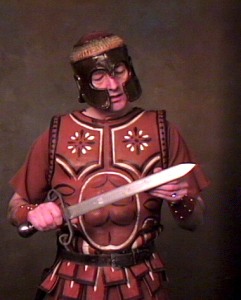
Picture Cent-helmet“What do you make of this prophet, Marcus? This Messiah?”
Now it was my turn to be pensive. I was so awestruck by what I had witnessed that I was having a hard time sorting through all my thoughts and impressions. The words came to me slowly. “He’s not at all like what I expected. He’s not at all like a revolutionary.”
“So he’s not a revolutionary. Then we’ve got nothing to worry about,” Renaldo said.
“I didn’t say that.” I paused but then added, “He’s not like your common revolutionary.” I put emphasis on the word “common.”
“So, he is a revolutionary.”
“His revolution, if that’s what he’s leading, doesn’t seem to be against us, against Rome—at least not at this point.” The vagueness of my answer left me feeling awkward.
“Then who is he fighting?”
“He’s not exactly endeared himself to the religious establishment. Caiaphas is probably having a holy altar- kicking tantrum right now. Those merchants pay good money to set up shop in there”—I gestured with a sweep of my hand in the direction of the temple compound—“and they’re going to be after him to get that Northern hick- town Messiah out of there. Now!” In imitation of their tactics, I made a downward stab with my index finger. “And I mean now.”
“So we let the high priest and his clan handle it. They’ve got the authority and the manpower.”
“Not at the moment. Jesus and his followers outnumber those temple guards maybe a hundred to one. I tell you he has the people—the crowd—in his hands. They don’t dare move against him.”
“Marcus, it’s still up to Caiaphas. It’s his problem. Let the Jews sort it out.”
“I suppose you’re right. He still scares me,” I confessed. “Scares me like no man ever has.”
“Why?” Renaldo queried.
“He’s got power like no man I’ve ever seen.” I shuddered inside at the thought of the unearthly nature of that power.
“This prophet really has you rattled, doesn’t he?” Renaldo said. “You’re still worried, aren’t you?”
“Yeah, I’m still worried.” Then to justify my concern, I added, “This talk about a kingdom bothers me. Besides, you didn’t see what I saw today. It makes all the difference.”

To download a free study guide for this high-impact, bible-based novel visit: https://www.davidkitz.ca/centurion.php/free study guide PDF

For book purchases of The Soldier Who Killed a King try Amazon or https://www.christianbook.com

Reading 4 for Lent from “The Soldier Who Killed a King”

09 Saturday Mar 2019

Posted by davidkitz in Books by David Kitz, Lent

≈ 1 Comment

Tags

Galilee, Jesus of Nazareth, Lent, miracles, repentance, Romans

A journey to the cross is a journey to repentance. It’s a journey to deep personal change. Will you take this journey with me?

In today’s reading, Marcus the centurion, disguised in his civilian clothes, is in a discussion about Jesus with Timaeus, a linen merchant from Damascus.

“As for this Jesus of Nazareth?” He shrugged. “I know only a little more than you. My brother here in Jerusalem knew nothing about him. Had never heard the name. But I heard of him once, about a year ago, in Damascus.”
“In Damascus?”
“Yes. I’m in the linen trade.” He put his hand to an elaborately embroidered sleeveBiblical fiction winner 2017 and stroked the pattern. “We supply market stalls in Galilee. One of our sellers there told me of this prophet. He had seen him in Galilee.”

“So what did he say about him?”
“Actually, he told me quite a lot, but I don’t know how much I can believe. He said this Jesus worked miracles.”
“Miracles? What do you mean, miracles?”
“He said Jesus drove out demons, healed the sick. He told me about this one time he went out to hear this prophet, if that’s what he is. Jesus was on this hillside. Thousands had come to hear him speak. Matthias—that’s the man’s name—he said he had never heard anyone speak like him. ‘It was like heaven was talking.’ He kept saying that. ‘It was like heaven was talking.’”
Timaeus spread his arms heavenward in mock imitation. “Poor Matthias!” He shook his head.
“So was that the miracle? The way he talked?”
“No, no. It’s not that, though Matthias kept going on about ‘the kingdom of God.’ Whatever that is. I suppose he got that from this Jesus. Anyway, after they had been there all day—he said there were more than five thousand people—this prophet told them all to sit down in groups of fifty or a hundred. Then he prayed and started breaking bread. He fed that whole crowd. Every last one of them.”
“What’s so miraculous about that?”
“Matthias said he only had five loaves and two fish when he started. He was watching him, and Jesus just kept on breaking bread until the whole crowd was fed. Five thousand people.”
“Five thousand people?”
“More than five thousand people.” He shrugged incredulously. “Look, I wasn’t there. I’m just repeating this fool’s story. Matthias kept saying, ‘It was like he was giving himself to us! Like it came from inside him!’”
Now I was incredulous. I paused in my walk and asked, “What did he mean by that?”
“I swear by the altar, I have no idea.”
“So what do you make of this Matthias and his story?”
“Matthias? He’s a nutcase. And he’s from a fine family in Capernaum.” He frowned, shaking his head. “I know them well. It’s hard to believe he’d get into something like this. He’s following this prophet around the country. It’s all he talks about. He was probably up some tree yesterday breaking off palm branches.” He spat out the words in utter disgust.
“And Jesus of Nazareth?” He raised a stout index finger and waved it in my face. “There’s the real nutcase! There’s no nut like a religious nut! And this kingdom of God talk. It’ll end in disaster.”
He glanced about to see if other ears were listening.
I continued in a more hushed voice. “How do you mean? Do you think the Romans will get involved?”
“Look, I’m no prophet, but by the throne I swear.” He looked me square in the eyes. “You don’t preach about a kingdom in this place and get away with it. Rome will see to that!”
4485 TWITTER

To download a free study guide for this high-impact, bible-based novel visit: https://www.davidkitz.ca/centurion.php/free study guide PDF

For book purchases of The Soldier Who Killed a King try Amazon or https://www.christianbook.com

Excerpt 25 for Lent from The Soldier Who Killed a King

23 Friday Mar 2018

Posted by davidkitz in Books by David Kitz, Christ's Passion, Good Friday, Lent

≈ 5 Comments

Tags

Galilee, Herod, Jesus, Jesus of Nazareth, king, King Herod, Lent, majesty, Messiah, prophet, repentance, wine

A journey to the cross is a journey to repentance. It’s a journey to deep personal change. Will you take this journey with me?

Date: Seven fifteen in the morning, Friday, April 7 30A.D.
Jesus is questioned by Herod Antipas.

“Jesus of Nazareth,” the Fox pompously intoned. “The prophet of Galilee. I’ve longed to see you, my most noteworthy subject.”
With that Herod arose, and holding his robe shut, he approached the Messiah. He inspected the taller man, walked fully around him. Noticing the welts and the dried spittle, he looked my way and asked, “Is this your work, centurion?”
“No, Your Majesty.” My eyes darted to Jonathon and back to Herod again.
“Ah, the high priest’s work!” the Fox remarked grandly as he turned to Jonathon. “I didn’t think you temple boys were capable.”
This bit of sarcasm drew an acknowledging nod and a slight smile from the chief temple guard. Here was a backhanded compliment from the pretentious Fox.
“Your Majesty, I have here a letter from His Excellency the governor and certain chargesJames Wri brought by—”
The king halted me with an uplifted hand and a shake of his head.
“That can wait, centurion.” He paused, and then with a certain dramatic flourish, he began. “We have here a man of rare talent. He makes the lame to walk, the blind to see, has cured the leper. I have heard reports that he has raised the dead.” And then spotting a gold chalice on the inlaid table, he seized it by the stem and with relish declared, “He has even turned water into wine.”
He lifted the chalice before the Messiah and grandly asked, “Isn’t that so, Jesus?”
The Messiah did not answer him a word.
If Herod was perturbed by this silence, he didn’t show it. “Servant girl!” he hollered. “Servant girl!”
An attractive young woman entered from the door on the left, and with short, quick steps, she made her way before the tetrarch. She bowed low.
“Fill this chalice with water and bring it back.”
He stared after her as she left.
I noticed Herodias following his hungry gaze.
“Soon we will see if this prophet can perform the works of which we heard.” He nodded his head with an eager enthusiasm. Then addressing Jesus, he asked, “Tell us of your magic arts.”
The Messiah fixed his eyes straight ahead. He looked beyond the Fox and did not answer him a word. His silence was challenging enough.
4485 TWITTER

American readers click this link to purchase The Soldier Who Killed a King.

Canadian readers click this link to purchase The Soldier Who Killed a King directly from the author.


Excerpt 22 for Lent from The Soldier Who Killed a King

20 Tuesday Mar 2018

Posted by davidkitz in Books by David Kitz, Christ's Passion, Good Friday, Lent

≈ 1 Comment

Tags

Annas, Caiaphas, high priest, Jesus of Nazareth, judge, Pontius Pilate, The Soldier Who Killed a King, trial, trial of Jesus

A journey to the cross is a journey to repentance. It’s a journey to deep personal change. Will you take this journey with me?

Date: Six thirty in the morning, Friday, April 7 A.D.
Jesus trial before Pontius Pilate begins.

The governor peered over the heads of the men directly in front of him. He scanned the assemblage on the street, took in the significance of it all, and then cleared his throat. “Where is the man?”
Jonathon turned quickly. On reaching the first step, he beckoned beyond our pikemen to three of his own temple guards, who then advanced with their prisoner—Jesus of Nazareth.
Picture Cent-helmetHe was a mess, almost unrecognizable. His hair was matted. He had been spat upon. The spittle was drying in his beard. There were red welts on his face and neck, a blood- oozing gash above his left eye, a discernable limp to his gait.
It was apparent that during the night they’d had their way with him.
He was escorted to a position directly before me. Intuitively I knew he was my man now, my charge.
A twitch of Pilate’s eyebrow hinted his surprise at the condition of the man.
“Loose him,” he directed with a slight wave of his hand.
Two temple guards hastened to unfasten the leather strap binding Jesus’s arms to his torso. The third man freed the prisoner’s hands. With a second wave of his hand, Pilate dismissed the temple guards, who repositioned themselves on the first step and stood facing the proceedings.
Pilate took a seat on the throne of judgment, which had been brought out for him by two attendants. Raising the scroll in his left hand, he asked, “What charges are you bringing against this man?”
It was clear from this gesture that he was referring to the charges written on the scroll he now clutched in his hand. Undoubtedly he had read these charges himself, and in all likelihood had discussed them
with the assessor standing to his right. But he wanted the high priest to articulate them. “If he were not a criminal, we would not have handed him over to you,” Caiaphas said with a huff.
A rather cheeky response, I thought.
“Take him yourselves and judge him by your own law,” Pilate answered.
Here Annas interjected, “But we have no right to execute anyone.”
A devious response if there ever was one. The temple, in fact, routinely acted as bothbiblical-fiction-award-2017_orig judge and executioner in religious matters and had been granted full authority to do so. Death by stoning was commonplace. I had witnessed Annas himself cast the first stone at some hapless adulteress within the first week of my arrival here ten years ago. No, the temple had the right to execute, and these crafty fellows could surely find grounds to execute this man. They just didn’t want the blood on their hands. They did not want to be blamed for the death of this rabbi. For many he had become the hope of the nation. No, they wanted us to do the job, to act as their executioners. They wanted him judged and executed under Roman law. What Caiaphas said next made this abundantly clear.
“We have found this man”—he aimed a bony finger at Jesus—“subverting our nation. He opposes payment of taxes to Caesar and claims to be Messiah, a king.”
Now here was a capital offense—a capital offense under Roman law.
The Weasel had backed the Badger into a corner, and he was relishing the moment. These charges would need further examination. But Pilate would not proceed in full view of a gloating high priest, urged on by his consorts and a handpicked audience. He retreated.
He abruptly arose from his throne, fixed his eyes on me, and said, “Bring the man.” He motioned with a jerk of his head toward the great doors behind us and then marched off into his residence.
I stepped down to escort Jesus, but he was already in motion. It became clear that the steps were painful for him. I put my hand to his elbow.

American readers click this link to purchase The Soldier Who Killed a King.

Canadian readers click this link to purchase The Soldier Who Killed a King directly from the author.

Excerpt 21 for Lent from The Soldier Who Killed a King

19 Monday Mar 2018

Posted by davidkitz in Books by David Kitz, Christ's Passion, Good Friday, Lent

≈ 1 Comment

Tags

arrested, Caiaphas, centurion, high priest, Jerusalem, Jesus of Nazareth, Lent, Longinus, Marcus, Pontius Pilate, repentance, The Soldier Who Killed a King

A journey to the cross is a journey to repentance. It’s a journey to deep personal change. Will you take this journey with me?

Date: Five forty-five in the morning, Friday, April 7 A.D.
In today’s reading, a messenger from Pontius Pilate arrives at the home of Marcus Longinus, the Roman centurion, with the news that Jesus has been arrested.

“Sir, I have just come from the governor. You are to report to the Praetorium immediately. Jesus of Nazareth has been arrested. The high priest has brought him before the governor for judgment.”
“Is that so?” I said in a state of consternation. “Who sent you?”
“The governor himself. He said you were familiar with the Galilean.”
I blew a short puff of air through my nostrils. All of Jerusalem was somewhat familiar with the Galilean.
“So he wants me there immediately?”
“Immediately, sir.” He shifted from one foot to the other and then, as if to justify thisCentur. Sw response, he added, “The high priest and a big delegation, maybe three hundred men, maybe more, arrived at the palace door at first light. They had the prisoner—Jesus—with them.”

“Tell the governor I’m on my way.”
With a quick nod of my head, I dismissed the messenger. Instantly he turned and began his run back to the governor’s residence. I took one step back inside the gate and began barking orders.
“You, you, and you!” I stabbed my index finger in the direction of the most dressed and prepared-looking soldiers. “Strap on your swords and follow me. Now!”
Then, addressing the other soldiers, I announced, “The rest of you, meet me at the Praetorium as soon as you are ready.”
“Claudius”—I nodded in his direction—“you are in charge. I’ll give everyone their assignment for the day when they get there.”
I stepped back through the gate and began covering the ground with long, quick strides. My three recruits had to run to catch up. With each stride a new thought came jogging into my head. Stupid Arius! Why didn’t he tell me the messenger was from Pilate? I would have moved a good deal faster.
Obviously my concerns about the prophet had moved up the chain of command. Flavio must have informed Pilate about my worries and the actions I had taken, hence this unusual move—a direct summons by the governor. I harbored the hope that he would consult directly with me on the matter. Three hundred men! Three hundred men at first light? The Weasel must have had a busy night. It takes a good deal of effort to set your troops in array. Caiaphas must have been hatching this plot for a good long while. 4485 TWITTER
But the Weasel caught his prey! What a sweet bit of treachery that must have been. I wondered how he pulled that off. Now the high priest would move in for the kill. We would see if he could slaughter his own Passover lamb. The people! If the pilgrims, especially the Galilean pilgrims, knew their Messiah had been seized, there could be a mass revolt. That must be why the Weasel had done his dirty work in the dark of the night. And furthermore, he had played out this drama at the zenith of the festival, while minds and hearts were on faith, home, and family. Here was a cunning scheme worthy of the Fox, played out by the Weasel.
Undoubtedly most of the population would still be unaware of these developments, even as I had been caught off guard. Off guard but not surprised. I could smell this coming.
My conversation with Renaldo at the bathhouse came echoing back. It gave me an eerie feeling knowing I had spoken like some prophetic oracle. It made me wonder from where that insight had really come.
“By Jupiter! I forgot the spikes.” I wheeled around while reaching out my hand to halt the soldier at my side. Addressing him directly, I said, “I forgot them—the spikes. They’re in a pouch hanging on a peg in my bedchamber. My wife, she’ll know where they are. Ask her to get the pouch for you. Then bring it to me at the Praetorium. Oh, and tell the other men to hurry. This is urgent.” I fixed my eyes on him to stress the importance of this last statement and then added, “Now run.”

American readers click this link to purchase The Soldier Who Killed a King.

Canadian readers click this link to purchase The Soldier Who Killed a King directly from the author.

Excerpt 15 for Lent from The Soldier Who Killed a King

09 Friday Mar 2018

Posted by davidkitz in Books by David Kitz, Christ's Passion, Lent

≈ 1 Comment

Tags

Caiaphas, David Kitz, Jesus, Jesus of Nazareth, Kingdom of God, Lent, prophet, repentance, The Soldier Who Killed a King

A journey to the cross is a journey to repentance. It’s a journey to deep personal change. Will you take this journey with me?

In today’s reading, Marcus continues his conversation with his nephew, the young soldier Claudius. Claudius is reporting on the activities and the message of Jesus of Nazareth on Tuesday of Holy Week.

But Claudius wasn’t done.
“You know about this kingdom notion,” he said. “Jesus told another story, and it helped me catch what he was driving at. He talked about a landowner who planted a vineyard and then went away. He rented the land out to farmers, but when he sent servants to collect the rent, the farmers would beat the servants or kill them. Finally, in desperation he sent his own son to collect the rent, thinking the farmers would respect him. But the renters said, ‘Let’s kill him and the land will be ours.’ So they took the son outside the vineyard and killed him.
“Then Jesus asked the people around him what would happen to those renters when the owner came back. They answered that the landowner would kill those miserable renters and give the vineyard to someone else who would pay him on time.
“Jesus said they were right. And then he said, now catch this”—Claudius gestured with an upraised index finger—“‘The kingdom of God will be taken away from you and given to a people who will produce its fruit.’ Those were his very words.”
“So what did he mean by that?” I asked, quite mystified.
Free WWe SHARABLE-1 (2)“I wasn’t too sure myself at first. I knew he said this as a rebuke to the high priest and the religious establishment. Everyone there knew he was telling this story against them. But later I asked the man beside me what he thought Jesus meant by this parable. He said the landowner was God, the religious leaders were the renters, and the servants who came to collect the rent were the prophets of the past. We just weren’t sure who the son was. I suggested that Jesus himself might be the son. But he just looked at me like I was a complete idiot, shook his head, and said, ‘God doesn’t have a son.’ I kept my mouth shut after that.”


“Well then,” I surmised, “this prophet, this Jesus, really has set himself up in opposition to the religious authorities. If he’s publicly predicting the end of their rule, he has picked a fight with them.”
I sucked in a long, slow breath. “And, Claudius”—I nodded in his direction—“it’ll be a fight to the finish.”
I continued as my mind caught the implications of my own words. “Jesus may have the people or at least a good number of the common people on his side. But Caiaphas is nobody’s fool. He’s got money and power behind him. The son in that story, if that’s who Jesus is”—I gestured with an upraised open palm—“he might yet be taken out and killed.”

American readers click this link to purchase The Soldier Who Killed a King.

Canadian readers click this link to purchase The Soldier Who Killed a King directly from the author.

Excerpt 14 for Lent from The Soldier Who Killed a King

08 Thursday Mar 2018

Posted by davidkitz in Books by David Kitz, Christ's Passion, Lent, Psalms

≈ 1 Comment

Tags

baptize, Caesar, Holy Week, hypocrites, Jesus, Jesus of Nazareth, John the Baptist, Jordan River, Lent, repent, Rome

A journey to the cross is a journey to repentance. It’s a journey to deep personal change. Will you take this journey with me?

In today’s reading, Marcus is in conversation with his nephew, the young soldier Claudius. Claudius is reporting on the activities and the message of Jesus of Nazareth on Tuesday of Holy Week.

Claudius went on. “One thing I do know for sure: those fancy-robed religious leaders don’t like him much. Jesus had taught for a while this morning, when all of a sudden the high priest, along with maybe ten other officials, came marching in. They demanded to know by what authority he was doing these things.

DSC_0060

A Roman centurion

He didn’t answer them, but instead he asked them a question. He asked them, ‘By what authority did John baptize?’ They talked it over and then said, ‘We don’t know.’ So he said he wouldn’t answer their question either. They just turned around and left in a holy huff. You could really tell the crowd around Jesus just loved the way he handled these high and mighty holy types.” Claudius abruptly turned to me and asked, “Who was this John anyway?”
“A few years back he caused quite a stir. Thousands of people went out to the Jordan River to hear him. He insisted that people repent, turn from their sins, and then he would baptize them in the river. Even some of my own men went out to hear him. In the end, Herod the tetrarch had him beheaded.”
After reflecting a moment on the day’s events, I caustically commented, “That bloody old Fox hasn’t changed much.”
“Anyway,” Claudius continued, “from then on Jesus would teach for a while, and then some new high-powered delegation would arrive to question him. They weren’t sincere in their questions. It was like they were trying to trap him into saying something they could later use against him. That’s all I think they were after. But in the end Jesus always turned the tables on them. He exposed their real motives. He saw right through them.”
I felt a certain remembered discomfort when Claudius said those words. After all, Jesus’s eyes had shone a light on the darkness of my own soul. I don’t know why I felt so naked, so transparent before this man.
“But, Claudius, what makes you so sure he’s not here to kick out the Romans?”
“It was the way he answered one of those fancy-robed delegations. They asked him if it was lawful to pay taxes to Caesar. He called them hypocrites right to their faces. He accused them of trying to trap him. Then he asked for a coin. He demanded to know biblical-fiction-award-2017_origwhose portrait and inscription were on it. When they answered, ‘Caesar’s,’ he jumped on them—like a cat onto a nest of mice. ‘So give back to Caesar what is Caesar’s, and to God what is God’s,’ he told them. Even at a distance, I could see their mouths drop and their ears catch fire. They left like cowering dogs with their tails between their legs.”
Claudius became even more animated as he said, “The crowd—the crowd loved it. You could really tell the people loved seeing those phony religious officials get a taste of a little humility. I’m sure they haven’t tasted it for a good long while.”
Then to conclude, he said, “That’s why I don’t think he’s a threat to us. He’s not opposed to paying taxes. Nothing he said all day makes me think he’s got a quarrel with Rome. But he’s sure got the religious leaders worried and bothered. Later in the day he went after them full force. Called them hypocrites, blind guides, a brood of vipers!”
“Ooo! I’m sure they were pleased,” I said sarcastically.
This assessment confirmed what Renaldo and I had been thinking. I had heard the same thing reflected back to me by Flavio. This latest evidence on taxes lent considerable weight to the conclusion Claudius had drawn. But I still felt uneasy. Jesus simply struck me as such a huge, larger-than-life figure—the kind of person you don’t dismiss lightly, no matter what others say. I somehow felt that all we had done thus far was scratch the surface. I’m not sure I really understood him at all. How could I begin to fathom what he was trying to accomplish?

American readers click this link to purchase The Soldier Who Killed a King.

Canadian readers click this link to purchase The Soldier Who Killed a King directly from the author.

Excerpt 12 for Lent from “The Soldier Who Killed a King”

06 Tuesday Mar 2018

Posted by davidkitz in Books by David Kitz, Christ's Passion, Lent, Psalms

≈ 1 Comment

Tags

centurion, healed, Herod, Jesus of Nazareth, Lent, Marcus, Pilate, repentance, The Soldier Who Killed a King

A journey to the cross is a journey to repentance. It’s a journey to deep personal change. Will you take this journey with me?

In today’s reading, Marcus meets with his fellow centurion and friend, Renaldo. Renaldo has just seen the young boy Lucas who was healed in the temple courts on the previous day by Jesus of Nazareth.

“Marcus! Marcus!”
I spun around to see Renaldo emerging from the gateway stairway.
“Hey, Marcus! You were right. That boy really was healed.”
He voiced the words with such bald enthusiasm that I was completely disarmed.
“I just saw him. He was here—here at the gate.” He gestured down the gateway parapet4485 SHARABLE-2 to a point below us. “I saw him. I examined his leg. It’s completely healed. Just like the other one. It’s incredible!” he enthused. “He can jump! And run!”
“I told you. I told you, Renaldo,” I said while shaking my head.
“Yeah, but you don’t expect it,” he said as he justified his unbelief. “I mean, this kid’s been like this from birth. You see him the same way, day after day. And then one day . . . Boom! He’s completely different.”
“I told you. You didn’t believe me?” I uttered the words with a certain smug satisfaction.
“Well, you don’t expect it,” he repeated. “I mean, it’s one thing to hear it, but it’s quite something else to see it for yourself.”
“That’s exactly what I was trying to tell you. I said you’ve got to see this for yourself to understand.”
I sighed. Now I was beginning to realize why I wasn’t getting through.
“So it was Lucas,” I stated.
“It was Lucas!” Renaldo confirmed, shaking his head in a state of incredulous wonderment.
I changed the topic.
“Look, Renaldo, I would like to talk with you more about this, but we’ve both got some work to do. Word has just come in to Flavio. Herod has accepted Pilate’s invitation. He’ll be going directly to the Praetorium. Arriving at four. The Fish Gate route needs to be cleared. You know those temple traders have set up shop in there, and you’ve got to get them out. And the sooner, the better. Flavio says that’s your sector, so you’re on.” Renaldo took all this in stride. “Sure, Marcus. I’ll get right on it.”
I turned from him, but he called after me.
“Marcus. We need to talk more about this Jesus—this Jesus of Nazareth.”

American readers click this link to purchase The Soldier Who Killed a King.

Canadian readers click this link to purchase The Soldier Who Killed a King directly from the author.

Excerpt 11 for Lent from The Soldier Who Killed a King

05 Monday Mar 2018

Posted by davidkitz in Books by David Kitz, Christ's Passion, Lent, Psalms

≈ 1 Comment

Tags

governor, Jesus of Nazareth, king, King Herod, kingdom, Kingdom of God, Marcus, Messiah, pilgrims, prophet, Roman, The Soldier Who Killed a King, weapons

A journey to the cross is a journey to repentance. It’s a journey to deep personal change. Will you take this journey with me?

In today’s reading, Marcus the centurion meets with Flavio, the Roman tribune, who is his commanding officer. He lays out his concerns about a Galilean prophet that he sees as a dangerous threat—Jesus of Nazareth.

“Sometimes I think you worry too much, Marcus.”
“I worry because it’s my job to worry,” I shot back. “Barabbas is in prison because I worry.”
Flavio appeared to consider my reply as he swallowed another stringy morsel. “So what do you know about this prophet?”
“A lot of people think he’s the Messiah.”
“May all the gods help us! Another Roman-killing messiah!” Flavio jeered.
“This one just might be the real thing,” I said.
Centur. Sw“Ha!” he scoffed. “Bring him on!” He reached for his flagon. Finding it empty, he bellowed, “Where’s my wine?”
“Bloody incompetent servants,” he muttered. Then turning to me, he asked, “Does he have weapons?”
“No, not that I’ve seen.”
“Has he threatened us?”
“Not exactly.”
“Assaulted the tax collectors?”
“No.”
“Then leave the Jewish dog alone.”
The servant arrived with a bowl of hot, sticky cheese and placed it before me, along with two small barley loaves.
“Wine! Where’s the ruddy wine?” Flavio demanded of his harried attendant.
“He is preaching about a kingdom—the kingdom of God,” I countered.
“So let him preach.”
“Who do you think will be the king of this kingdom?” I reasoned. When Flavio remained silent, I answered my own question. “I’m sure it will be none other than Jesus of Nazareth. I don’t think there’s room for two kings in this town, and a Roman governor too.”
“I see your point,” Flavio said. He wiped a greasy hand across his mouth and thenbiblical-fiction-award-2017_orig rubbed the three days of stubble on his chin. “So he talks about a kingdom?”
“The coming kingdom,” I clarified. “It’s the whole point—the core of his message. So I’m told.”
The servant arrived with the wine. Flavio helped himself. Drank two- thirds of it in a massive gulp, then poured himself some more.
“And he has followers?” Flavio continued.
“Most of the Galilean pilgrims are firmly in his camp.”
“Galilee?” Flavio questioned. “He’s Herod’s man.” He paused to rub the tip of his nose. “I wonder what the Fox thinks of this Messiah.”

American readers click this link to purchase The Soldier Who Killed a King.

Canadian readers click this link to purchase The Soldier Who Killed a King directly from the author.

The Anointed One

05 Monday Mar 2018

Posted by davidkitz in Bible, Devotionals, Psalm 89, Psalms

≈ 3 Comments

Tags

anointed, Babylonians, Christ, crucified, David, Greek, Hebrew, Israel, Jesus, Jesus Christ, Jesus of Nazareth, king, Messiah, New Testament, Old Testament, psalmist, resurrection, the LORD

Reading:                                      Psalm 89

(Verses 46-52)
How long, LORD? Will you hide yourself forever?
How long will your wrath burn like fire?
Remember how fleeting is my life.
For what futility you have created all humanity!
Who can live and not see death,
or who can escape the power of the grave?
Lord, where is your former great love,
which in your faithfulness you swore to David?
Remember, Lord, how your servant has been mocked,
how I bear in my heart the taunts of all the nations,
the taunts with which your enemies, L
ORD, have mocked,
with which they have mocked every step of your anointed one.
Praise be to the LORD forever!
Amen and Amen
(NIV).

Reflection
Many people believe that Christ is Jesus’ last name. That is not the case. The Bible does not tell us Jesus’ family name. Often he is identified by the town that he is from—Jesus of Nazareth. So what then is the significance of the word Christ or Khristos in the Greek? Christ is a title. One might even call it a job description. It means the anointed one, the one who is designated by God to rule and reign over his people. The Greek word Khristos or Christ corresponds to the Hebrew word Mashiach or Messiah. The anointed one or Christ was and is the son of David who rules over the house of Jacob and the Israel of God. Just as David was anointed to be king of Israel, Jesus is anointed to be our king.

2018-02-05b

End of winter glory — photo by David Kitz

When we read Psalm 89 with the understanding that the anointed one is also the Christ, the psalm takes on a whole new layer of meaning. Yes, during the fall of Jerusalem to the Babylonians, the anointed one was mocked. But this is also true of Jesus, the anointed Son of David, who was led off to be crucified outside the city gate. These words were fulfilled in Christ: Remember, Lord, how your servant has been mocked, how I bear in my heart the taunts of all the nations, the taunts with which your enemies, LORD, have mocked, with which they have mocked every step of your anointed one.

But there is a significant difference between the Old Testament, anointed one, and our New Testament Christ. The psalmist asks this question: Who can live and not see death, or who can escape the power of the grave?

The implicit answer is that no one can escape death and the grave. But… but there is One—One, who tasted death on our behalf—One, who escaped the power of the grave. His name is Jesus. He is the Christ, the anointed One, and our Messiah. He is the One who by virtue of the resurrection is King now and forevermore.

Response: LORD God, I thank you for Jesus, the Christ, the anointed One. Thank you for your death, burial and resurrection. I join with the psalmist in saying, “Praise be to the LORD forever! Amen and Amen.”

Your Turn: In what way is Christ a job description? What job has he done and is he doing for you?

← Older posts
Newer posts →

Psalms 365: Develop a Life of Worship and Prayer

Psalms 365 Volume II

Psalms 365 vol 3
— Psalms 365 Volume III

Psalms

Recent posts

  • May the LORD Grant All Your Requests December 20, 2025
  • A Horn of Salvation December 19, 2025
  • Ready for the King of Glory December 19, 2025
  • My Spirit Rejoices in God My Savior December 18, 2025
  • Joining the Generation That Seeks God December 18, 2025
  • Why Am I So Favored December 17, 2025
  • How Can You Find the Good Life? December 17, 2025

Calendar

December 2025
M T W T F S S
1234567
891011121314
15161718192021
22232425262728
293031  
« Nov    

Blog Posts

Comments

  • davidkitz on Joining the Generation That Seeks God
  • cjsmissionaryminister on God Sent His Son
  • cjsmissionaryminister on The God of the Broken

Blog at WordPress.com.

Privacy & Cookies: This site uses cookies. By continuing to use this website, you agree to their use.
To find out more, including how to control cookies, see here: Cookie Policy
  • Subscribe Subscribed
    • I love the Psalms
    • Join 1,377 other subscribers
    • Already have a WordPress.com account? Log in now.
    • I love the Psalms
    • Subscribe Subscribed
    • Sign up
    • Log in
    • Report this content
    • View site in Reader
    • Manage subscriptions
    • Collapse this bar
 

Loading Comments...