Tags
I will praise Him!

Shine down on your people, LORD — photo by David Kitz
02 Sunday Sep 2018
Posted in Bible, God's word, Psalm 10, Psalms
Tags

Shine down on your people, LORD — photo by David Kitz
23 Wednesday May 2018
Posted in Bible, Devotionals, Psalm 110, Psalms
Tags
Adonai, Jesus, king, Lake Louise, Melchizedek, Messiah, messianic, priest, prophet
Reading: Psalm 110
Of David. A psalm.
The LORD says to my Lord:
“Sit at my right hand until I make your enemies a footstool for your feet.”
The LORD will extend your mighty scepter from Zion, saying,
“Rule in the midst of your enemies!”
Your troops will be willing on your day of battle.
Arrayed in holy splendor,
your young men will come to you
like dew from the morning’s womb.
The LORD has sworn and will not change his mind:
“You are a priest forever, in the order of Melchizedek.”
The Lord is at your right hand;
he will crush kings on the day of his wrath.
He will judge the nations, heaping up the dead
and crushing the rulers of the whole earth.
He will drink from a brook along the way,
and so he will lift his head high (NIV).
Reflection
Psalm 110 is perhaps the most messianic psalm in the entire psalter. Jesus made a direct reference to the opening line of this psalm in a discussion he had with the Pharisees in the temple courts during the week of his crucifixion. See Matthew 22:41-46 and Luke 20:41-44.

Lake Louise, Alberta — photo by David Kitz
Jesus asks, “What do you think about the Messiah? Whose son is he?” In response the Pharisees answer, “The son of David.”
But Jesus refutes their answer by quoting from Psalm 110. His answer does not carry the same punch in the English language quote we see in Matthew, because we fail to see the distinction between the first ‘LORD’ and the second ‘Lord’. We see these words as synonymous, but in the original Hebrew they most certainly are not. The first LORD is Yahweh (Jehovah), but the second Lord is Adonai, the Messiah.
Speaking prophetically by the Spirit, David was referring to his Adonai—his Messiah. By quoting this scripture Jesus was affirming his designation by God as the Messiah that the Jewish nation had longed to see. The long wait was over. Jesus the Messiah was standing directly in front of Pharisees who were blind to his presence and his deity.
This Lord or Adonai is also the divinely designated priest who will present his own body as a sacrifice on the cross. The LORD has sworn and will not change his mind: “You are a priest forever, in the order of Melchizedek.” The writer of the Book of Hebrews has a great deal to say about the priesthood of Melchizedek. He systematically reasons that Jesus is our heaven-sent prophet, priest and king. See Hebrews chapters 6-8.
Response: Father God, thank you for sending Jesus into the world to be my personal Messiah. Jesus, you suffered and died for me. Now extend your reign as conquering king over me and through me. Amen.
Your Turn: Have you bowed your knee before the Messiah King?
17 Tuesday Apr 2018
Tags
Bible, Caiaphas, David Kitz, Herod Antipas, Jesus, king, Longinus, Marcus, Palm Sunday, Pontius Pilate, redemption, resurrection, Roman, Roman centurion, The Soldier Who Killed a King
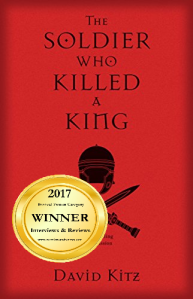
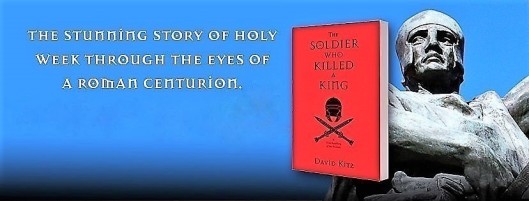
The Soldier Who Killed a King was voted the top book in the biblical fiction category
for 2017 by the Christian book service, Interviews and Reviews. Having recently read this book, it’s not difficult to see why. It plays like a high-stakes movie in your mind.
Canadian author, David Kitz, closely examines the events occurring between Jesus’ entry into Jerusalem on Palm Sunday and his resurrection a few days later. But we see all these events from a unique perspective—through the eyes of a Roman soldier.
This engaging, hard-hitting narrative is a distillation of Kitz’s study and prayer over a 50-year span, when as pastor, educator and Bible dramatist, he steeped himself in the wonder of this story. As a novelist, he reveals profound respect for the historical record through his characterization of Marcus Longinus, a Roman centurion who is unwillingly caught in the power struggles of the day. Furthermore, Kitz stays true to the scriptural account by integrating more than a hundred quotes from the Gospels into the story text.
Three corrupt men, Herod Antipas, “the Fox,” Pontius Pilate, “the Badger,” and Joseph Caiaphas, “the Weasel” have an insatiable lust for money and power. They each attempt to use the political tumult of the time for their own gain. In contrast to the stench of their machinations, Kitz offers a deep sense of Jesus, the donkey-riding King, as the man in whom all of heaven is invested. Jesus emerges in the Roman world offering an entirely new way for humankind to be reborn.
Above all else, this is a story of personal redemption. Marcus, the Roman Centurion is like us, caught between worlds. Who is his king? Why?
The Son of God shows unlimited compassion through healing the sick and feeding the hungry, and his purity catches the attention of the masses in a drama that still shakes the world, one aching, open, humble heart at a time. Do you need to rediscover the power of the cross? The Soldier Who Killed a King will take you there.
02 Monday Apr 2018
Posted in Bible, Devotionals, Monday Meditation, Psalm 99, Psalms
Tags
cherubim, exalted, holiness, holy, Holy Spirit, justice, king, praise, pure, pure heart, righteous, the LORD, worship, Zion
Reading: Psalm 99
(Verses 1-5)
The LORD reigns,
let the nations tremble;
he sits enthroned between the cherubim,
let the earth shake.
Great is the LORD in Zion;
he is exalted over all the nations.
Let them praise your great and awesome name—
he is holy.
The King is mighty, he loves justice—
you have established equity;
in Jacob you have done
what is just and right.
Exalt the LORD our God
and worship at his footstool;
he is holy (NIV).
Reflection
What does it mean to be holy? There are several shades of meaning for the word holy. It can mean being consecrated or dedicated for a special purpose. It also means righteous. But the definition that fits best in the light of Psalm 99 reads like this: awe-inspiring—having a character that evokes reverence (Encarta Dictionary).

Photo courtesy of Liz Kranz.
The psalmist is effusive with his praise for the LORD, but three times in this short psalm, he centers back to this phrase: he is holy. Yes, the LORD reigns, He is righteous and exalted, but what has really caught the psalmist’s attention is the LORD’s holiness. That’s what sets Him apart and elevates Him above the stratosphere.
Has the LORD’s holiness caught your attention? Have you been filled with awe by the holiness of God? I fear that far too often we have diminished God. We have tried to make Him like us—powerful but a bit quirky—maybe short-tempered or set in His ways. What nonsense! Our God is holy. We need to wake up to that fact. It must be central to our understanding of God.
In the Beatitudes from his Sermon on the Mount Jesus said, “Blessed are the pure in heart, for they will see God” (Matthew 5:8). To clarify, I might add that the pure in heart will see the true God, not a distorted caricature. Our sinful nature has a way of distorting our view of the LORD. That’s why personal purity and holiness are so essential. The apostle Peter provides this admonition: As obedient children, do not conform to the evil desires you had when you lived in ignorance. But just as he who called you is holy, so be holy in all you do; for it is written: “Be holy, because I am holy” (1 Peter 1:14-16).
Response: LORD God, I want to see you at work in my life. Help me with the help of your Holy Spirit to clean up those areas that distort my view of you. You are holy. I worship you in the beauty of your holiness. Amen.
Your Turn: Are there times when you have seen God as short-tempered or set in His ways? Have you avoided God’s call to holiness?
28 Wednesday Mar 2018
Tags
blood, bloodlust, Christ, crucifixion, David Kitz, Jesus, king, Messiah, pierced, repentance, The Soldier Who Killed a King
Date: Nine thirty in the morning, Friday, April 7 30A.D.
The crucifixion of Jesus.
I tipped the bucket to one side to get enough swill to fill the dipper. I offered it to Jesus. He took a sip, worked the liquid around in his mouth, discerned the true nature of this bitter potion, and then spit it out. It left a dark stain on the dull gray rock near his feet.
“It will dull the pain,” I said emphatically.
He raised his eyes. They locked with mine. I saw in him the same look, the same
determination I saw on the first day I set eyes on him, the day he rode the donkey into this city. I could still see he had a destination in mind. Some mystical purpose he somehow felt compelled to fulfill.
I dropped my gaze. He must be a fool. In his condition, in this situation, he must be a fool. A fool who unnerved me, but a fool nonetheless.
Once more I offered the drink.
With lips pressed tight, he shook his head.
He was a fool. An arrogant fool! A fool who thinks he’s tough—who can handle this—who can take it straight.
We would see who’s tough. I would show him who’s tough!
Let the big show begin.
“Now, boys!” I called out to the crew. Still wearing the purple robe, he was snatched like a young child and slammed down onto the crossbeam.
A cheer went up.
My right hand seized the hammer from Octavio. My left fumbled, then dove into, the nail pouch.
I dropped my knee onto his fingers.
Stabbed the sharpened point of the spike into the base of the palm.
Raised the hammer.
Xchuuuung!
An enormous cheer went up from the crowd.
Blood spurted across my thigh.
Xchuuuung!
Xchuuuung!
Xchuuuung!
One in.
The Christ was silent. Still . . .
Octavio urged me on. “That’s it, Marcus!”
I sprang to my feet, remembering the full rush of battle. Then scrambled to the other arm. From just off the hill, in the throng, a chant began and established itself. “More. More. More. More.”
Knee on fingers.
“More!”
Spike jabbed in.
“More!”
Hammer raised.
“More!”
Xchuuuung!
“More!”
Xchuuuung!
“More!”
Xchuuuung!
Two in. The Christ was silent.
Still . . . He was still beneath the piercing blows.
I rose, panting. Heart pounding. Bloodied hand dripping. Seeing a stainfree area farther up my hairy arm, I wiped it across my sweat- drenched brow.
Octavio saluted me with a smile and a thumbs-up signal.
The crowd roared their approval.
This time it was Octavio who yelled, “Hoist him up.”
The Christ was dragged gasping—desperately gasping—to an upright position before the death mast.
Now they could see him, and the crowd went wild with frenzied excitement. Cheering. Clapping. Hooting. Bloodlust took hold.
The props were applied to the arms of the crossbeam.
A new chant went up. 
“Raise him up!”
“Raise him up!”
“Raise him up!”
Octavio signaled, and the men in back lifted the beam on which the Christ was pinned above their heads.
Then we all saw it—saw the obvious. He was still clothed. The purple robe billowed out as it was caught by a sudden cold gust of wind. The sight of it brought all my frenzied demons to the fore.
I stepped before him, looked into his agonized face, and said, “You won’t be needing this . . . king of the Jews.”
Then to the cheers of my men, I spit into his face. I added my spittle to all the rest that had dried and was clinging to his beard.
I untied the royal robe and dropped it in a heap to my right. Finally, with a wicked smile, and to cheers all around, I snatched his breechcloth from off his loins.
I tossed it to Octavio. He held it up. A trophy!
We laughed. We all laughed. I
t was a laugh not our own.
I recognized it. It was Herod’s laugh.
When he had regained some composure, the head jailer started the final count.
“Ready . . . one . . . two . . . three . . . now!”
To chants of “Raise him up, raise him up,” the Christ, the Messiah, the king, was lifted up—up before the world.
His head twisted from side to side in writhing agony. His whip-sliced back slammed against the upright as he was dragged higher.
Then with a flesh-tearing lurch, the notch in the horizontal beam found its match in the vertical. The rope was flung around, then drawn tight, securing the two cross members as one.
The silent Christ hung. He hung naked and bleeding before a jeering world.
Only the last spike remained. Awkwardly, I fumbled for it.
But a creeping unease overshadowed me. I glanced over my shoulder. Claudius stood alone, off to the side. Silent . . . He was ghastly pale and silent, transfixed by the sight before him.
I handed the last nail and the hammer back to Octavio and said, “You do it.” He snorted his surprise, but then set quickly to his task.
American readers click this link to purchase The Soldier Who Killed a King.
Canadian readers click this link to purchase The Soldier Who Killed a King directly from the author.
27 Tuesday Mar 2018
Posted in Books by David Kitz, Christ's Passion, Lent
Tags
blood, Caesar, Caiaphas, Christ, crucify, David Kitz, Golgotha, high priest, innocent, Jesus, king, Lent, Messiah, Pilate, repentance, trial of Jesus, verdict
Date: Eight forty in the morning, Friday, April 7 30A.D.
The trial of Jesus ends. The verdict is delivered.
Pilate was already seated, ready to pronounce judgment. A thin smile was now on his face. The cunning Badger would make the most of his final moves. When Jesus was in position, he began. Once more he motioned in the direction of the Christ, and to all assembled he announced, “Here is your king.”
“Take him away!” came the instant response. “Take him away! Crucify him!”
There was vehement insistence coming from the crowd. Some began to hurl dust in the
air. This was verging on a riot, a point that was surely obvious to the governor, yet he played them on.
“Shall I crucify your king?” Pilate called back to the throng.
“We have no king but Caesar,” the Weasel spat back.
The Badger’s eyebrows shot up.
The governor smiled and nodded. It was a smile of triumphant satisfaction. We have no king but Caesar. The Badger mulled over these words. I knew he had waited years for these words. After all he had endured in this place, wasn’t it well worth hearing this confession from the high priest’s mouth?
Ironically, the governor had Jesus to thank for the high priest’s sudden conversion and submission to imperial Rome. This declaration would never have come forth from the Weasel’s lips, except to secure the conviction of the good Galilean. Caiaphas was willing to stoop before Rome in order to spill the blood of this prophet. Here was the true measure of his hatred for the Northern Messiah.
Pilate knew all this, and he drew a good measure of perverse satisfaction from it. He understood his foe.
He called for his personal attendant to bring a basin of water. Now he would lay the blame where the bloody blame belonged. With the attendant holding the basin before him, Pilate made a great show of washing his hands before the crowd, and with insistence in his voice, he declared, “I am innocent of the blood of this man.”
Here was the feint, the great pretend.
Next came the dodge.
With water still dripping from his hands, he looked out over the crowd and declared, “You yourselves see to it.”
He spoke as though he had abdicated—bore no responsibility for the blood that now trickled down Jesus’s back. He absolved himself of that and of all that would soon flow on Golgotha.
This Badger could throw a bit of dirt.
It was fitting for Annas the aged priest to respond. It was he who answered for the people. With his finger pointed at Jesus and his gaze fixed on him, he replied, “His blood be on us.” Then he paused as though looking down through the generations of time. “And on our children,” he added with a cold, sardonic stare.
Out on the street the people answered, “Yes!” They nodded their agreement with this verdict.
American readers click this link to purchase The Soldier Who Killed a King.
Canadian readers click this link to purchase The Soldier Who Killed a King directly from the author.
23 Friday Mar 2018
Posted in Books by David Kitz, Christ's Passion, Good Friday, Lent
Tags
Galilee, Herod, Jesus, Jesus of Nazareth, king, King Herod, Lent, majesty, Messiah, prophet, repentance, wine
Date: Seven fifteen in the morning, Friday, April 7 30A.D.
Jesus is questioned by Herod Antipas.
“Jesus of Nazareth,” the Fox pompously intoned. “The prophet of Galilee. I’ve longed to see you, my most noteworthy subject.”
With that Herod arose, and holding his robe shut, he approached the Messiah. He inspected the taller man, walked fully around him. Noticing the welts and the dried spittle, he looked my way and asked, “Is this your work, centurion?”
“No, Your Majesty.” My eyes darted to Jonathon and back to Herod again.
“Ah, the high priest’s work!” the Fox remarked grandly as he turned to Jonathon. “I didn’t think you temple boys were capable.”
This bit of sarcasm drew an acknowledging nod and a slight smile from the chief temple guard. Here was a backhanded compliment from the pretentious Fox.
“Your Majesty, I have here a letter from His Excellency the governor and certain charges
brought by—”
The king halted me with an uplifted hand and a shake of his head.
“That can wait, centurion.” He paused, and then with a certain dramatic flourish, he began. “We have here a man of rare talent. He makes the lame to walk, the blind to see, has cured the leper. I have heard reports that he has raised the dead.” And then spotting a gold chalice on the inlaid table, he seized it by the stem and with relish declared, “He has even turned water into wine.”
He lifted the chalice before the Messiah and grandly asked, “Isn’t that so, Jesus?”
The Messiah did not answer him a word.
If Herod was perturbed by this silence, he didn’t show it. “Servant girl!” he hollered. “Servant girl!”
An attractive young woman entered from the door on the left, and with short, quick steps, she made her way before the tetrarch. She bowed low.
“Fill this chalice with water and bring it back.”
He stared after her as she left.
I noticed Herodias following his hungry gaze.
“Soon we will see if this prophet can perform the works of which we heard.” He nodded his head with an eager enthusiasm. Then addressing Jesus, he asked, “Tell us of your magic arts.”
The Messiah fixed his eyes straight ahead. He looked beyond the Fox and did not answer him a word. His silence was challenging enough.

American readers click this link to purchase The Soldier Who Killed a King.
Canadian readers click this link to purchase The Soldier Who Killed a King directly from the author.
21 Wednesday Mar 2018
Posted in Books by David Kitz, Christ's Passion, Good Friday, Lent
Tags
governor, Jesus, Jewish, king, kingdom, Messiah, Pontius Pilate, prophet, repentance, truth
Date: Six fifty in the morning, Friday, April 7 A.D.
Jesus trial before Pontius Pilate continues.
When we entered the judgment hall, the dark-eyed Badger was seething. He knew Caiaphas was using him. He had said so to the assessor. He let fly a string of profanity. “He has me trapped!” he snarled. “Trapped like a rat in a stone water jar.” And with that he tossed the list of charges onto his desk.
Then he turned to Jesus in the center of the room. He looked him over, walked fully around him. Pilate sighed and nervously ran his fingers through his thinning hair. He made a smacking sound with his lips and asked, “Are you the king of the Jews?”
“You have said so,” came his equivocal answer.
This answer left the governor rocking on his heels. He brought a finger to his lips in pensive thought.
Jesus was not making an acquittal any easier.
But after a moment Jesus continued. “Is that your own idea, or did others talk to you about me?”
“Am I a Jew?” Pilate shot back with an ample measure of haughty contempt. “Your own people and chief priests handed you over to me.” He continued the questioning. “What is it you have done?”
“My kingdom is not of this world,” Jesus said, and to drive home this point, he added, “If it were, my servants would fight to prevent my arrest by the Jewish leaders. But now my kingdom is from another place.”
Certain words that Claudius had spoken came echoing back into my mind. He had been convinced that this kingdom Jesus spoke of was somehow different from kingdoms as we know them. Now I heard it from this would-be Messiah’s mouth. He was no armed insurrectionist, and he had offered the actions of his followers as proof.
But Pilate seized on that word—kingdom. “You are a king, then!” Pilate deduced.
With calm, clear deliberation the prophet spoke. “You say that I am a king. In fact, the reason I was born and came into the world is to testify to the truth. Everyone on the side of truth listens to me.”
It almost seemed from this response that Jesus was operating from, and speaking on,
some higher plane—a dimension I had witnessed him operate from during the healings at the temple. He was inviting Pilate to join him in discovering this higher ground of truth.
Pilate would not be moved. They were speaking past each other.
“What is truth?” Pilate shrugged. The question was rhetorical. He had no intention of being dragged into a philosophical discussion with this prophet of the Jewish masses. Once again, the Badger retreated.
Grabbing the list of charges from off his desk, he motioned for us to follow him back outside.
American readers click this link to purchase The Soldier Who Killed a King.
Canadian readers click this link to purchase The Soldier Who Killed a King directly from the author.
21 Wednesday Mar 2018
Posted in Bible, Devotionals, Psalm 95, Psalms
Tags
Durham ON, God, God's hands, hands, king, Maker, mountain, pancreatic cancer, psalmist, reassurance, the LORD, the sea, world, worship
Reading: Psalm 95
(Verses 1-7)
Come, let us sing for joy to the LORD;
let us shout aloud to the Rock of our salvation.
Let us come before him with thanksgiving
and extol him with music and song.
For the LORD is the great God,
the great King above all gods.
In his hand are the depths of the earth,
and the mountain peaks belong to him.
The sea is his, for he made it,
and his hands formed the dry land.
Come, let us bow down in worship,
let us kneel before the LORD our Maker;
for he is our God
and we are the people of his pasture,
the flock under his care (NIV).
Reflection
I can’t read this opening portion of Psalm 95 without the folk spiritual “He’s Got the Whole World in His Hands” springing to mind. The psalmist makes this declaration: In his hand are the depths of the earth, and the mountain peaks belong to him. The sea is his, for he made it, and his hands formed the dry land. In other words, He’s got the whole world in His hands.

Evening fishing near Durham, ON — photo by David Kitz
There is something deeply reassuring about that thought. The great loving God, the Creator of the universe, has the whole world in His hands. But more specifically, our heavenly Father has you and me in His hands. If we grasp this biblical truth, it has broad personal implications.
Early this morning I met with a weekly gathering of men to pray and study God’s word. One of the co-leaders of the group is going through a great personal tragedy. His young, vibrant wife is dying of pancreatic cancer. Unless the Lord miraculously intervenes, his school-age son and daughter will soon be without a mother. At the close of our meeting we placed our hands on this husband and father and prayed. The LORD has the whole world in his hands including this young family.
Do we understand the LORD’s purposes in all this? No. We would be fools to think we do. We can content ourselves in knowing that these great matters—these matters of life and death are in God’s hands. They are loving hands—hands that in the person of Jesus were scarred and pierced by nails. I’ll be content to be held in those hands.
Knowing this, let’s heed the psalmist’s call. Come, let us bow down in worship, let us kneel before the LORD our Maker; for he is our God and we are the people of his pasture, the flock under his care.
Response: LORD God, you know all things. We were created for your purpose. Help us to live our lives in service to you. We are the flock under your care. Please extend your hand of mercy and blessing to those we know who are suffering or grieving. Amen.
Your Turn: Does knowing your life is in God’s hands bring you reassurance?
20 Tuesday Mar 2018
Posted in Bible, Devotionals, Psalm 94, Psalms
Tags
anxiety, cares, corruption, election, joy, king, misery, nation, political, problems, Righteousness, Suffering, the LORD, trouble, truth, unfailing love, wisdom
Reading: Psalm 94
(Verses 16-23)
Who will rise up for me against the wicked?
Who will take a stand for me against evildoers?
Unless the LORD had given me help,
I would soon have dwelt in the silence of death.
When I said, “My foot is slipping,”
your unfailing love, LORD, supported me.
When anxiety was great within me,
your consolation brought me joy.
Can a corrupt throne be allied with you—
a throne that brings on misery by its decrees?
The wicked band together against the righteous
and condemn the innocent to death.
But the LORD has become my fortress,
and my God the rock in whom I take refuge.
He will repay them for their sins
and destroy them for their wickedness;
the LORD our God will destroy them (NIV).
Reflection
Here is a question that is well worth asking at election time, or really at any time during the life of a nation: Can a corrupt throne be allied with you—a throne that brings on misery by its decrees?

Late winter snowfall — photo by David Kitz
Whatever your political persuasion, this is a question that has relevance. Corruption isn’t a problem that is unique to just one party. It transcends the political spectrum. Corruption and poorly designed laws or decrees can bring misery to millions. According to the psalmist, it has happened in the past and as long as we live in a fallen world, it will continue into the future.
If we fix our eyes on the problems of this world, we can soon find ourselves in despair. Like the psalmist, in times of worry, we need to turn to the LORD. When I said, “My foot is slipping,” your unfailing love, LORD, supported me. When anxiety was great within me, your consolation brought me joy.
That’s the good news of the gospel. In times of anxiety we have someone to turn to. His name is Jesus. He was familiar with suffering and adversity. In Psalm 55 we read, “Cast your cares on the LORD and he will sustain you; he will never let the righteous be shaken” (Psalm 55:22). The apostle Peter reiterates the same thought: Cast all your anxiety on him [God] because he cares for you (1 Peter 5:7).
In times of trouble the unfailing love of the LORD will sustain you. In times of loss His consolation will bring you joy. That’s the promise of Psalm 94. It’s a promise that’s worth clinging to in good times and bad, and yes, even in election years.
Response: LORD God, I am so glad that first and foremost I live under your Kingdom rule. You are my King. I find unfailing love and consolation in knowing you. Guide the leaders of our land into paths of righteousness, wisdom and truth. Amen.
Your Turn: Are you facing adversity now? How can I pray for you?