• Home
  • About
  • DavidKitz.ca
  • Youtube Videos
  • Books by David
  • Books on Amazon.com

I love the Psalms

~ Connecting daily with God through the Psalms

I love the Psalms

Monthly Archives: March 2019

Reading 16 for Lent from The Soldier Who Killed a King

21 Thursday Mar 2019

Posted by davidkitz in Lent, The Soldier Who Killed a King

≈ Leave a comment

Tags

Caiaphas, centurion, Jesus, Lent, prophet, repentance, Rome

A journey to the cross is a journey to repentance. It’s a journey to deep personal change. Will you take this journey with me?

In today’s reading, Marcus is in a discussion with his friend and fellow centurion, Renaldo. They are at the Roman bathhouse at the end of a long day. Date: Wednesday, April 5th, 30 A.D. 

I sat down again beside the pool and let my feet dangle in the tepid water. Renaldo put his hand on my shoulder as he eased himself down into a similar position.
“So what do you mean by that? How do you think this will end?” he asked.
“This Galilean prophet’s days may be numbered. He’s stirred up a hornet’s nest by kicking those merchants and money changers out of the temple. He’s offended and humiliated the high priest and his clan. He’s cut off a major source of their temple revenue. He called the Pharisees a brood of vipers. And if that’s not enough, he predicted that their power, their kingdom as he calls it, will be taken from them and then given to others.”
4485 TWITTER
I paused and kicked my right foot out straight, scattering a shower of drops onto the flat surface of the water. “You don’t say and do those kinds of things without creating some enemies. I’d say he’s sealed his own fate.”
With a furrowed brow, Renaldo asked, “Where’d you get this information?”
“Claudius. Claudius told me. Yesterday I had him sit in on one of the prophet’s teaching sessions. It was quite an eye- opener. Jesus doesn’t just heal the poor; he takes a skewer to the bloated rich. He’s publicly opposed the rich and powerful in this town, and his opposition has been right to their face. If nothing else, the man’s got courage.”
I drummed my fingers on the poolside tiles and then continued. “I tell you, Renaldo, they won’t stand for it. They’re probably hatching some plot to do away with him right now, as we’re sitting here talking.”
“Yeah, but he healed all those kids,” he said. “Doesn’t that show that the God of heaven is working through him?”
“The God of heaven? Do you honestly think that matters to them? This is all about money and power. That’s their real god. Jesus is a threat to their money and their positions of power. Healing a few poor kids, the offspring of the unclean—that isn’t going to mean a thing to them. You’re right. You hit the nail on the head. They’re puffed- up swine that care only about themselves. There isn’t a drop of mercy in them.” Then with scathing irony I added, “But they’re right. They’re always right. Right to the letter of the law.”
“So what do you think they’ll do?”
“I’m not sure. But I know what they won’t do. They won’t arrest him with that crowd around him. They know better than that. They’d have a bloody riot on their hands. There’s no doubt about that.”
Thought after thought came racing in as I considered the implications of my own words. “They might wait till after Passover when the crowds leave, but then Jesus would probably leave with the crowds and head right back to Galilee. Then he’d be out of their hands. No.” I hesitated and then briskly snapped my fingers. “I think they’ll try to act now, if they can. He’s humiliated them in front of the people. They won’t stand for that. Caiaphas won’t stand for it. Jesus has co-opted the high priest’s authority right within the temple courts. Blood will flow because of it. Mark my words. It will flow.”
“But what could they do to him? What crime has he committed?” Renaldo reasoned. “You know the Jews can’t condemn a man to death. They can’t have him crucified. They would have to bring him before Pilate.”
“Yes,” I said, “but accidents happen in the dark of the night. And Renaldo, I think you underestimate the old Weasel. If anyone can twist the law to his own liking, Caiaphas can. That Weasel can kill his prey in more than one way. The big question is, can he get his hands on the prophet?”
“So you really think there’ll be a confrontation?”
“Absolutely. From what I saw on Monday, the confrontation has already started. ItCentur Rep started when Jesus kicked out the merchants. Later, when I was there, the high priest’s men questioned him, but he wouldn’t back down. Then yesterday, according to Claudius, he humiliated Caiaphas and his delegation right in front of the crowd. Like I said, he called the Pharisees and the teachers of the law a pack of hypocrites and a brood of vipers. I’d call that a confrontation. And he didn’t do it out in the desert; he did it right in front of them, in front of the pilgrims, and right in their holy place. I tell you, the man’s got guts.”
“But”—I paused to emphasize my point—“I’m just waiting for the other side to strike back. And they will.”
I made a long, sweeping motion with a pointed index finger and then stabbed down spear-like into my friend’s bare ribs. “I’m sure they will.” Instinctively Renaldo recoiled, shrugged off my antics, and then said,
“But you don’t think he’s a threat to Rome?”
“Not from what I’ve seen or heard. But he is a threat to Caiaphas. Right now he’s their problem. And that’s where I want to leave him. If blood’s going to flow, I don’t want it getting on these hands.”

To download a free study guide for this high-impact, bible-based novel visit: https://www.davidkitz.ca/centurion.php/free study guide PDF

For book purchases of The Soldier Who Killed a King try Amazon or https://www.christianbook.com

The Psalmist’s Mistake

21 Thursday Mar 2019

Posted by davidkitz in Psalm 49, Psalms

≈ 3 Comments

Tags

death, faith, Jesus Christ, ransom, redeem, Redeemer

Reading: Psalm 49
For the director of music. Of the Sons of Korah. A psalm.
(Verses 1-12)
Hear this, all you peoples;
listen, all who live in this world,
both low and high, rich and poor alike:
My mouth will speak words of wisdom;
the meditation of my heart will give you understanding.
I will turn my ear to a proverb;
with the harp I will expound my riddle:
Why should I fear when evil days come,
when wicked deceivers surround me—
those who trust in their wealth and boast of their great riches?
No one can redeem the life of another
or give to God a ransom for them—
the ransom for a life is costly, no payment is ever enough—
so that they should live on forever and not see decay.
For all can see that the wise die,
that the foolish and the senseless also perish,
leaving their wealth to others.
Their tombs will remain their houses forever,
their dwellings for endless generations,
though they had named lands after themselves.
People, despite their wealth, do not endure;
they are like the beasts that perish
(NIV).

20161214_143224_HDR (2)

Killaloe Creek — photo courtesy of Liz Kranz

Reflection
This opening portion of Psalm 49 reminds me of that old maxim: There are only two certainties in this life: death and taxes. The same fate awaits us all; no one is spared. The Grim Reaper cuts down all without exception. The psalmist asserts the obvious: For all can see that the wise die, that the foolish and the senseless also perish, leaving their wealth to others.

But the psalmist is not entirely correct. He makes a sweeping statement that fails to account for a most unusual exception. The psalmist states: No one can redeem the life of another or give to God a ransom for them—the ransom for a life is costly, no payment is ever enough—so that they should live on forever and not see decay.

Jesus Christ is that unusual exception. He proves the psalmist wrong. Jesus paid my ransom. He redeemed my life. He went to the cross on my behalf and there he poured out his life blood so that I can live forever. Then to prove that Jesus’ sacrifice was accepted, God the Father raised Him from the dead. Death no longer has dominion over Him. Better still, those who put their trust in Jesus Christ will be raised to life on the last day. Praise be to God, who breaks the bonds of death.

Response: LORD, I thank you for the victory of Jesus! By faith I will live and reign through Him. Lord Jesus, you are my redeemer. I rejoice in your great love. Eternity is mine. I am forever grateful. Amen.

Your Turn: Jesus faced death and overcame. Will you be an overcomer too through Him?

Reading 15 for Lent from The Soldier Who Killed a King

20 Wednesday Mar 2019

Posted by davidkitz in Lent, The Soldier Who Killed a King

≈ Leave a comment

Tags

Jesus, Kingdom of God, Lent, prophet, repentance, The Soldier Who Killed a King

A journey to the cross is a journey to repentance. It’s a journey to deep personal change. Will you take this journey with me?

In today’s reading, Marcus continues his conversation with his nephew, the young soldier Claudius. Claudius is reporting on the activities and the message of Jesus of Nazareth on Tuesday of Holy Week.

But Claudius wasn’t done.
“You know about this kingdom notion,” he said. “Jesus told another story, and it helped me catch what he was driving at. He talked about a landowner who planted a vineyard and then went away. He rented the land out to farmers, but when he sent servants to collect the rent, the farmers would beat the servants or kill them. Finally, in desperation he sent his own son to collect the rent, thinking the farmers would respect him. But the renters said, ‘Let’s kill him and the land will be ours.’ So they took the son outside the vineyard and killed him.
“Then Jesus asked the people around him what would happen to those renters when the owner came back. They answered that the landowner would kill those miserable renters and give the vineyard to someone else who would pay him on time.
“Jesus said they were right. And then he said, now catch this”—Claudius gestured with an upraised index finger—“‘The kingdom of God will be taken away from you and given to a people who will produce its fruit.’ Those were his very words.”
“So what did he mean by that?” I asked, quite mystified.
Free WWe SHARABLE-1 (2)“I wasn’t too sure myself at first. I knew he said this as a rebuke to the high priest and the religious establishment. Everyone there knew he was telling this story against them. But later I asked the man beside me what he thought Jesus meant by this parable. He said the landowner was God, the religious leaders were the renters, and the servants who came to collect the rent were the prophets of the past. We just weren’t sure who the son was. I suggested that Jesus himself might be the son. But he just looked at me like I was a complete idiot, shook his head, and said, ‘God doesn’t have a son.’ I kept my mouth shut after that.”
“Well then,” I surmised, “this prophet, this Jesus, really has set himself up in opposition to the religious authorities. If he’s publicly predicting the end of their rule, he has picked a fight with them.”
I sucked in a long, slow breath. “And, Claudius”—I nodded in his direction—“it’ll be a fight to the finish.”
I continued as my mind caught the implications of my own words. “Jesus may have the people or at least a good number of the common people on his side. But Caiaphas is nobody’s fool. He’s got money and power behind him. The son in that story, if that’s who Jesus is”—I gestured with an upraised open palm—“he might yet be taken out and killed.”

To download a free study guide for this high-impact, bible-based novel visit: https://www.davidkitz.ca/centurion.php/free study guide PDF

For book purchases of The Soldier Who Killed a King try Amazon or https://www.christianbook.com
Your City Skyline

20 Wednesday Mar 2019

Posted by davidkitz in Psalm 48, Psalms

≈ 5 Comments

Tags

cityscapes, God's presence, Psalm 48, temple, Zion

Reading: Psalm 48
(Verses 9-14)
Within your temple, O God,
we meditate on your unfailing love.
Like your name, O God,
your praise reaches to the ends of the earth;
your right hand is filled with righteousness.
Mount Zion rejoices,
the villages of Judah are glad
because of your judgments.
Walk about Zion, go around her,
count her towers,
consider well her ramparts,
view her citadels,
that you may tell of them
to the next generation.
For this God is our God for ever and ever;
he will be our guide even to the end (NIV).

manhatten-skyline-2014-11-10

The Manhattan skyline New York — photo by David Kitz

Reflection
Have you watched a television newscast recently? Invariably at some point during that telecast you will see a cityscape—a grand view of the city skyline in all its glory. If experts from Montreal, Vancouver or Chicago are being interviewed, they will appear against the backdrop of a large photo of their city. Routinely, sports telecasts feature brief live shots of the arena and the host city’s downtown.   

Why do broadcasters go to the trouble of filming these cityscapes and providing these skyline backdrops? A good part of the answer is identification. We identify a city by its skyline and by its landmark buildings and towers. Washington, D.C. is intimately linked to pictures of the Capitol, Paris with the Eiffel Tower and Toronto with the CN Tower. When the twin towers of the World Trade Center were destroyed, New York mourned not only the loss of lives, but also the loss of an element of its identity—the twin icons of its identity.

Psalm 48 is the Bible’s version of a cityscape telecast. Read the psalmist’s call: Walk about Zion, go around her, count her towers, consider well her ramparts, view her citadels that you may tell of them to the next generation.

What is the psalmist asking us to do? He is asking us to identify with the city of God. What makes Zion unique in the earth is the presence of God within her. The psalmist clearly stated, “God is in her citadels.” Is God within you? Is He reigning in your heart and mind? Is He the master of your affections? Have you had landmark experiences with God that changed the course of your life? Have you climbed towers of prayer? Have you stood guard on the ramparts of your mind? Then with conviction you can say with the psalmist, “For this God is our God forever and ever; he will be our guide even to the end.”

Response: LORD God, reign in me. Establish your capital in my heart. Govern my ways, now and forever more. I commit my thoughts and intellect to your service. Stir my heart and my affections. Amen.

Your Turn: Has Jesus come to rule your heart? Is the Lord enthroned there?

Reading 14 for Lent from The Soldier Who Killed a King

19 Tuesday Mar 2019

Posted by davidkitz in Lent, The Soldier Who Killed a King

≈ 1 Comment

Tags

Caesar, Herod, Jesus of Nazareth, Lent, repentance, Roman centurion

A journey to the cross is a journey to repentance. It’s a journey to deep personal change. Will you take this journey with me?

In today’s reading, Marcus is in conversation with his nephew, the young soldier Claudius. Claudius is reporting on the activities and the message of Jesus of Nazareth on Tuesday of Holy Week.

Claudius went on. “One thing I do know for sure: those fancy-robed religious leaders don’t like him much. Jesus had taught for a while this morning, when all of a sudden the high priest, along with maybe ten other officials, came marching in. They demanded to

DSC_0060

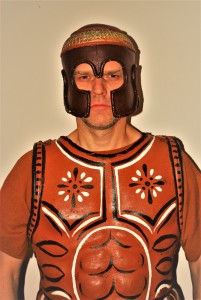
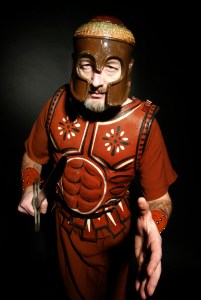
A Roman centurion

know by what authority he was doing these things. He didn’t answer them, but instead he asked them a question. He asked them, ‘By what authority did John baptize?’ They talked it over and then said, ‘We don’t know.’ So he said he wouldn’t answer their question either. They just turned around and left in a holy huff. You could really tell the crowd around Jesus just loved the way he handled these high and mighty holy types.” Claudius abruptly turned to me and asked, “Who was this John anyway?”
“A few years back he caused quite a stir. Thousands of people went out to the Jordan River to hear him. He insisted that people repent, turn from their sins, and then he would baptize them in the river. Even some of my own men went out to hear him. In the end, Herod the tetrarch had him beheaded.”
After reflecting a moment on the day’s events, I caustically commented, “That bloody old Fox hasn’t changed much.”
“Anyway,” Claudius continued, “from then on Jesus would teach for a while, and then some new high-powered delegation would arrive to question him. They weren’t sincere in their questions. It was like they were trying to trap him into saying something they could later use against him. That’s all I think they were after. But in the end Jesus always turned the tables on them. He exposed their real motives. He saw right through them.”
I felt a certain remembered discomfort when Claudius said those words. After all, Jesus’s eyes had shone a light on the darkness of my own soul. I don’t know why I felt so naked, so transparent before this man.
“But, Claudius, what makes you so sure he’s not here to kick out the Romans?”
“It was the way he answered one of those fancy-robed delegations. They asked him if it was lawful to pay taxes to Caesar. He called them hypocrites right to their faces. He accused them of trying to trap him. Then he asked for a coin. He demanded to know biblical-fiction-award-2017_origwhose portrait and inscription were on it. When they answered, ‘Caesar’s,’ he jumped on them—like a cat onto a nest of mice. ‘So give back to Caesar what is Caesar’s, and to God what is God’s,’ he told them. Even at a distance, I could see their mouths drop and their ears catch fire. They left like cowering dogs with their tails between their legs.”
Claudius became even more animated as he said, “The crowd—the crowd loved it. You could really tell the people loved seeing those phony religious officials get a taste of a little humility. I’m sure they haven’t tasted it for a good long while.”
Then to conclude, he said, “That’s why I don’t think he’s a threat to us. He’s not opposed to paying taxes. Nothing he said all day makes me think he’s got a quarrel with Rome. But he’s sure got the religious leaders worried and bothered. Later in the day he went after them full force. Called them hypocrites, blind guides, a brood of vipers!”
“Ooo! I’m sure they were pleased,” I said sarcastically.
This assessment confirmed what Renaldo and I had been thinking. I had heard the same thing reflected back to me by Flavio. This latest evidence on taxes lent considerable weight to the conclusion Claudius had drawn. But I still felt uneasy. Jesus simply struck me as such a huge, larger-than-life figure—the kind of person you don’t dismiss lightly, no matter what others say. I somehow felt that all we had done thus far was scratch the surface. I’m not sure I really understood him at all. How could I begin to fathom what he was trying to accomplish?

To download a free study guide for this high-impact, bible-based novel visit: https://www.davidkitz.ca/centurion.php/free study guide PDF

For book purchases of The Soldier Who Killed a King try Amazon or https://www.christianbook.com

God in the City

19 Tuesday Mar 2019

Posted by davidkitz in Psalm 48, Psalms

≈ 5 Comments

Tags

Ark of the Covenant, David, Jerusalem, Mount Zion, Psalm 48, temple

Reading: Psalm 48
A song. A psalm of the Sons of Korah.
(Verses 1-8)
Great is the LORD, and most worthy of praise,
in the city of our God, his holy mountain.
Beautiful in its loftiness, the joy of the whole earth,
like the heights of Zaphon is Mount Zion,
the city of the Great King.
God is in her citadels;
he has shown himself to be her fortress.
When the kings joined forces,
when they advanced together,
they saw her and were astounded;
they fled in terror.
Trembling seized them there,
pain like that of a woman in labor.
You destroyed them like ships of Tarshish
shattered by an east wind.
As we have heard, so we have seen
in the city of the L
ORD Almighty,
in the city of our God:
God makes her secure forever
(NIV).

2019-01-04-Ottawa DT

Looking south from the War Memorial in Downtown Ottawa — photo by David Kitz

Reflection
I grew up on a farm in wide open rural Saskatchewan, Canada. It was a cross-country mile to the nearest neighbour, but if you stood at the right spot in our farmyard, you could see our neighbour’s house. I loved growing up on the farm and I still love visiting. Who wouldn’t? I was living in God’s country surrounded by the wild beauty of nature in all its varied, changing forms.

But I have spent the last forty years living in the city—actually three rather large cities with populations of more than a million. Is the God of the open country the God of the city too? The psalmist seemed to think so. He begins Psalm 48 with this declaration: Great is the LORD, and most worthy of praise, in the city of our God, his holy mountain.

Of course the sons of Korah were referring to biblical Jerusalem, more specifically Mount Zion, the fortified citadel within the walls of ancient Israel’s capital. God was within her. During the reign of David the Ark of the Covenant—the seat of the LORD’s rule—was housed in the sacred tabernacle on Mount Zion. This was where God dwelt.

Where does God dwell today? As partakers of the new covenant, through the blood of Christ we are the temples of God. Paul, the apostle, asks, “Don’t you know that you yourselves are God’s temple and that God’s Spirit dwells in your midst?” (1 Corinthians 3:16). God dwells in the city too—your city. Whether it’s Calgary, Ottawa, New York, Helsinki or Tokyo, God is within her because His redeemed people live there.

Response: LORD, I thank you because you live within us! Help me to let my light shine in my city. Amen.

Your Turn: How would you characterize your city? How is God revealing His presence there?

Reading 13 for Lent from The Soldier Who Killed a King

18 Monday Mar 2019

Posted by davidkitz in Lent, The Soldier Who Killed a King

≈ 1 Comment

Tags

Herod, Jerusalem, Lent, Pontius Pilate, repentance

A journey to the cross is a journey to repentance. It’s a journey to deep personal change. Will you take this journey with me?

In today’s reading, Marcus is among the detail of soldiers assigned to welcome Herod the Tetrarch to Jerusalem. As the royal procession is about to enter the city a disturbing incident takes place that reveals the character of the man that Jesus called a fox.

Suddenly, just ahead, among the bowing throng, a small copper bowl flashed in the sun. I sucked in a shallow breath and hoped it had gone unnoticed.
Herod’s hand shot out from the left side of the litter, just a few feet above and ahead of my horse’s ears.
“There! There!” he yelled. “Stop the litter!”
Flavio bellowed, “Halt!”
“Bring the boy over.” Herod gestured to the bodyguard next to me.
The guard beckoned with his hand, and the once crippled Lucas stepped forward. He wore a shy smile, but there was an eager glint in his eye.
“Is that a beggar’s bowl in your hand?” the king inquired.
“Yes, sir.”
“I didn’t come to feed beggars,” Herod said coldly. “Now, teach this boy not to beg from a king.” Herod again gestured to the guard.
With one hand the guard grabbed the boy’s free hand. With the other hand he raised his gleaming sword above his head.

OTT0304-KITZ1

Photo credit Jean Levac, Ottawa Citizen

With sudden terror in his eyes, Lucas instinctively yanked back.
The blade flashed down.
The boy fell back into the crowd as the guard triumphantly raised the severed, dripping hand above his head.
“Well done, Cestas!” Herod cheered. “Well done!”
I saw Lucas flee, white- faced and stumbling, clutching tight the bleeding stump.
“There are no beggars in Galilee,” the Fox announced to the crowd. “And if I ruled here, there would be none in Jerusalem.”
The onlookers were stunned—riveted to the spot. Herod paused, and after a brief search he pulled out the flimsy purple robe from among the cushions behind him. He made a great show of folding it carefully several times.
“Bring me your trophy.”
Biblical fiction winner 2017Cestas came forward and placed the small, severed hand in the folds of the purple robe, bowing graciously to his monarch.

“Ah, tribute for the governor.” Herod laughed coarsely. “Let’s be off!”
The remainder of the processional was uneventful. Following the trumpeters’ fanfare, Pontius Pilate and his wife, Claudia Procula, received the tetrarch graciously, with considerable pomp. The Roman governor politely inquired about the journey and made flattering comments about Herodias and her attire.

To download a free study guide for this high-impact, bible-based novel visit: https://www.davidkitz.ca/centurion.php/free study guide PDF

For book purchases of The Soldier Who Killed a King try Amazon or https://www.christianbook.com

A Psalm of Resurrection

18 Monday Mar 2019

Posted by davidkitz in Psalm 47, Psalms

≈ 2 Comments

Tags

ascended, Psalm 47, resurrection, the risen Christ, victory

Reading: Psalm 47
For the director of music. Of the Sons of Korah. A psalm.
Clap your hands, all you nations;
shout to God with cries of joy.
For the LORD Most High is awesome,
the great King over all the earth.
He subdued nations under us,
peoples under our feet.
He chose our inheritance for us,
the pride of Jacob, whom he loved.
God has ascended amid shouts of joy,
the L
ORD amid the sounding of trumpets.
Sing praises to God, sing praises;
sing praises to our King, sing praises.
For God is the King of all the earth;
sing to him a psalm of praise.
God reigns over the nations;
God is seated on his holy throne.
The nobles of the nations assemble
as the people of the God of Abraham,
for the kings of the earth belong to God;
he is greatly exalted (NIV).

20161205_150201_HDR (1)

Bonnechere River — photo courtesy of Liz Kranz

Reflection
I appreciate God’s timing; it brings a smile to my face. Yesterday’s psalm reading seemed particularly appropriate as we reflected on the events of Good Friday. Today’s psalm posting is fitting as we rejoice in the triumph of the resurrection. I can’t help but think of the risen Christ as I read these words: God has ascended amid shouts of joy, the LORD amid the sounding of trumpets.

Psalm 47 calls forth a spontaneous joy. It is a song of celebration to the LORD for the victories of the LORD. He has conquered! What has He conquered? The LORD has conquered the nations. Sing praises to God, sing praises; sing praises to our King, sing praises. For God is the King of all the earth; sing to him a psalm of praise. God reigns over the nations; God is seated on his holy throne.

In its original context, Psalm 47 celebrated the victory of Israel over the surrounding nations. But that is a feeble victory compared to Christ the King’s triumph over death, hell and the power of the grave. Hallelujah! The King is alive. He arose from the dead. The power of sin and Satan are defeated, and because He lives and reigns we too will live and reign with Him through eternity. For if, while we were God’s enemies, we were reconciled to him through the death of his Son, how much more, having been reconciled, shall we be saved through his life! (Romans 5:10).

In the resurrection of Jesus we have the ultimate cause for celebration. Shout to God with cries of joy!

Response: LORD God, I thank you for the victory of Jesus! He is my forerunner. I will live and reign through Him. Amen.

Your Turn: The resurrection means the dead in Christ will be raised. Who will you want to greet first?

Reading 12 for Lent from The Soldier Who Killed a King

17 Sunday Mar 2019

Posted by davidkitz in Lent, The Soldier Who Killed a King

≈ 2 Comments

Tags

healing, Herod, Jesus of Nazareth, Lent, repentance

A journey to the cross is a journey to repentance. It’s a journey to deep personal change. Will you take this journey with me?

In today’s reading, Marcus meets with his fellow centurion and friend, Renaldo. Renaldo has just seen the young boy Lucas who was healed in the temple courts on the previous day by Jesus of Nazareth.

“Marcus! Marcus!”
I spun around to see Renaldo emerging from the gateway stairway.
“Hey, Marcus! You were right. That boy really was healed.”
He voiced the words with such bald enthusiasm that I was completely disarmed.
“I just saw him. He was here—here at the gate.” He gestured down the gateway parapet4485 SHARABLE-2 to a point below us. “I saw him. I examined his leg. It’s completely healed. Just like the other one. It’s incredible!” he enthused. “He can jump! And run!”
“I told you. I told you, Renaldo,” I said while shaking my head.
“Yeah, but you don’t expect it,” he said as he justified his unbelief. “I mean, this kid’s been like this from birth. You see him the same way, day after day. And then one day . . . Boom! He’s completely different.”
“I told you. You didn’t believe me?” I uttered the words with a certain smug satisfaction.
“Well, you don’t expect it,” he repeated. “I mean, it’s one thing to hear it, but it’s quite something else to see it for yourself.”
“That’s exactly what I was trying to tell you. I said you’ve got to see this for yourself to understand.”
I sighed. Now I was beginning to realize why I wasn’t getting through.
“So it was Lucas,” I stated.
“It was Lucas!” Renaldo confirmed, shaking his head in a state of incredulous wonderment.
I changed the topic.
“Look, Renaldo, I would like to talk with you more about this, but we’ve both got some work to do. Word has just come in to Flavio. Herod has accepted Pilate’s invitation. He’ll be going directly to the Praetorium. Arriving at four. The Fish Gate route needs to be cleared. You know those temple traders have set up shop in there, and you’ve got to get them out. And the sooner, the better. Flavio says that’s your sector, so you’re on.” Renaldo took all this in stride. “Sure, Marcus. I’ll get right on it.”
I turned from him, but he called after me.
“Marcus. We need to talk more about this Jesus—this Jesus of Nazareth.”

To download a free study guide for this high-impact, bible-based novel visit: https://www.davidkitz.ca/centurion.php/free study guide PDF

For book purchases of The Soldier Who Killed a King try Amazon or https://www.christianbook.com

The Open Hand of God

17 Sunday Mar 2019

Posted by davidkitz in Bible, Psalm 145, Psalms

≈ Leave a comment

Tags

praise, promises, satisfy, the LORD, trust in God, trustworthy

I will praise Him!

IMG_20180730_1031333

Bumble bee visits rose blossom — photo by David Kitz

The LORD is trustworthy in all he promises
    and faithful in all he does.
The LORD upholds all who fall
    and lifts up all who are bowed down.
The eyes of all look to you,
    and you give them their food at the proper time.
You open your hand
    and satisfy the desires of every living thing.

(Psalm 145:13b-16, NIV)


← Older posts
Newer posts →

Psalms 365: Develop a Life of Worship and Prayer

Psalms 365 Volume II

Psalms 365 vol 3
— Psalms 365 Volume III

Psalms

Recent posts

  • Don’t Step into the Hate Trap January 12, 2026
  • A Fortress of Salvation January 11, 2026
  • Finishing Well and Growing in Fruitfulness  January 11, 2026
  • I Call to You for Help January 10, 2026
  • Above All Gods January 9, 2026
  • The Need for a Place of Refuge January 9, 2026
  • David Dances before the LORD January 8, 2026

Calendar

March 2019
M T W T F S S
 123
45678910
11121314151617
18192021222324
25262728293031
« Feb   Apr »

Blog Posts

Enter your email address to follow this blog and receive notifications of new posts by email.

Comments

  • davidkitz on Above All Gods
  • davidkitz on Above All Gods
  • davidkitz on David Dances before the LORD

Blog at WordPress.com.

Privacy & Cookies: This site uses cookies. By continuing to use this website, you agree to their use.
To find out more, including how to control cookies, see here: Cookie Policy
  • Subscribe Subscribed
    • I love the Psalms
    • Join 1,381 other subscribers
    • Already have a WordPress.com account? Log in now.
    • I love the Psalms
    • Subscribe Subscribed
    • Sign up
    • Log in
    • Report this content
    • View site in Reader
    • Manage subscriptions
    • Collapse this bar
 

Loading Comments...