• Home
  • About
  • DavidKitz.ca
  • Youtube Videos
  • Books by David
  • Books on Amazon.com

I love the Psalms

~ Connecting daily with God through the Psalms

I love the Psalms

Category Archives: Books by David Kitz

Excerpt 12 for Lent from “The Soldier Who Killed a King”

06 Tuesday Mar 2018

Posted by davidkitz in Books by David Kitz, Christ's Passion, Lent, Psalms

≈ 1 Comment

Tags

centurion, healed, Herod, Jesus of Nazareth, Lent, Marcus, Pilate, repentance, The Soldier Who Killed a King

A journey to the cross is a journey to repentance. It’s a journey to deep personal change. Will you take this journey with me?

In today’s reading, Marcus meets with his fellow centurion and friend, Renaldo. Renaldo has just seen the young boy Lucas who was healed in the temple courts on the previous day by Jesus of Nazareth.

“Marcus! Marcus!”
I spun around to see Renaldo emerging from the gateway stairway.
“Hey, Marcus! You were right. That boy really was healed.”
He voiced the words with such bald enthusiasm that I was completely disarmed.
“I just saw him. He was here—here at the gate.” He gestured down the gateway parapet4485 SHARABLE-2 to a point below us. “I saw him. I examined his leg. It’s completely healed. Just like the other one. It’s incredible!” he enthused. “He can jump! And run!”
“I told you. I told you, Renaldo,” I said while shaking my head.
“Yeah, but you don’t expect it,” he said as he justified his unbelief. “I mean, this kid’s been like this from birth. You see him the same way, day after day. And then one day . . . Boom! He’s completely different.”
“I told you. You didn’t believe me?” I uttered the words with a certain smug satisfaction.
“Well, you don’t expect it,” he repeated. “I mean, it’s one thing to hear it, but it’s quite something else to see it for yourself.”
“That’s exactly what I was trying to tell you. I said you’ve got to see this for yourself to understand.”
I sighed. Now I was beginning to realize why I wasn’t getting through.
“So it was Lucas,” I stated.
“It was Lucas!” Renaldo confirmed, shaking his head in a state of incredulous wonderment.
I changed the topic.
“Look, Renaldo, I would like to talk with you more about this, but we’ve both got some work to do. Word has just come in to Flavio. Herod has accepted Pilate’s invitation. He’ll be going directly to the Praetorium. Arriving at four. The Fish Gate route needs to be cleared. You know those temple traders have set up shop in there, and you’ve got to get them out. And the sooner, the better. Flavio says that’s your sector, so you’re on.” Renaldo took all this in stride. “Sure, Marcus. I’ll get right on it.”
I turned from him, but he called after me.
“Marcus. We need to talk more about this Jesus—this Jesus of Nazareth.”

American readers click this link to purchase The Soldier Who Killed a King.

Canadian readers click this link to purchase The Soldier Who Killed a King directly from the author.
Excerpt 11 for Lent from The Soldier Who Killed a King

05 Monday Mar 2018

Posted by davidkitz in Books by David Kitz, Christ's Passion, Lent, Psalms

≈ 1 Comment

Tags

governor, Jesus of Nazareth, king, King Herod, kingdom, Kingdom of God, Marcus, Messiah, pilgrims, prophet, Roman, The Soldier Who Killed a King, weapons

A journey to the cross is a journey to repentance. It’s a journey to deep personal change. Will you take this journey with me?

In today’s reading, Marcus the centurion meets with Flavio, the Roman tribune, who is his commanding officer. He lays out his concerns about a Galilean prophet that he sees as a dangerous threat—Jesus of Nazareth.

“Sometimes I think you worry too much, Marcus.”
“I worry because it’s my job to worry,” I shot back. “Barabbas is in prison because I worry.”
Flavio appeared to consider my reply as he swallowed another stringy morsel. “So what do you know about this prophet?”
“A lot of people think he’s the Messiah.”
“May all the gods help us! Another Roman-killing messiah!” Flavio jeered.
“This one just might be the real thing,” I said.
Centur. Sw“Ha!” he scoffed. “Bring him on!” He reached for his flagon. Finding it empty, he bellowed, “Where’s my wine?”
“Bloody incompetent servants,” he muttered. Then turning to me, he asked, “Does he have weapons?”
“No, not that I’ve seen.”
“Has he threatened us?”
“Not exactly.”
“Assaulted the tax collectors?”
“No.”
“Then leave the Jewish dog alone.”
The servant arrived with a bowl of hot, sticky cheese and placed it before me, along with two small barley loaves.
“Wine! Where’s the ruddy wine?” Flavio demanded of his harried attendant.
“He is preaching about a kingdom—the kingdom of God,” I countered.
“So let him preach.”
“Who do you think will be the king of this kingdom?” I reasoned. When Flavio remained silent, I answered my own question. “I’m sure it will be none other than Jesus of Nazareth. I don’t think there’s room for two kings in this town, and a Roman governor too.”
“I see your point,” Flavio said. He wiped a greasy hand across his mouth and thenbiblical-fiction-award-2017_orig rubbed the three days of stubble on his chin. “So he talks about a kingdom?”
“The coming kingdom,” I clarified. “It’s the whole point—the core of his message. So I’m told.”
The servant arrived with the wine. Flavio helped himself. Drank two- thirds of it in a massive gulp, then poured himself some more.
“And he has followers?” Flavio continued.
“Most of the Galilean pilgrims are firmly in his camp.”
“Galilee?” Flavio questioned. “He’s Herod’s man.” He paused to rub the tip of his nose. “I wonder what the Fox thinks of this Messiah.”

American readers click this link to purchase The Soldier Who Killed a King.

Canadian readers click this link to purchase The Soldier Who Killed a King directly from the author.
Bill Pink’s Review of The Soldier Who Killed a King

03 Saturday Mar 2018

Posted by davidkitz in book review, Books by David Kitz, Good Friday, Lent, Psalms

≈ 6 Comments

Tags

centurion, Christ, crucifixion, David Kitz, Easter, Jesus, King Herod, Marcus Longinus, Pontius Pilate, Savior, Scripture, Son of God, trial

It is hard to imagine a more ironic, more chilling dramatic exclamation than the confession of Jesus’ executioner, “Surely, He was the Son of God” (Matt. 27:54).  In The Soldier, David Kitz gives a name to the Roman executioner – Marcus Longinus. Then he gives us an hour-by-hour account of the week in Marcus’ life in the run-up to the fatal hammer blows that drove spikes into Jesus’ broken body.

4485 TWITTER

            As I began to read The Soldier, I wondered if it would be a fascinating documentary of the last week of Jesus’ ministry on Earth. Fascinating it is. The sights, sounds and smells of the Jewish Passover week come to life, from the noisy, smelly commerce in sacrificial animals to the literal river of red sacrificial blood flowing through the temple aqueducts.

Political forces delicately dance in Jerusalem. High Priest Caiaphas, Samaritan King Herod Antipas, and Roman Governor Pontius Pilate, cordial but venomous enemies, vie for control of the holy city. We see and hear the week unfold through Marcus’ eyes and ears. He fears for the very lives of his men as tumultuous crowds swell Jerusalem. Two were recently murdered by Zealot terrorists. Crowds quickly become mobs, and only the iron discipline of his small garrison insulates the city from disaster.

The Soldier soon becomes more than a documentary. Marcus becomes a man we know intimately as husband, father and brave military officer. We see his family and career jeopardized by the mental anguish of post traumatic stress disorder. Horrific visions of bloody murders populate Marcus’ dreams at night and force contemplation of suicide by day.

Jesus rides into this mix of professional anxiety and personal anguish on a donkey. From a great distance He picks Marcus out of a crowd of thousands and speaks audibly to him alone and to him specifically, saying, “I have a future for you.” During the week, Marcus is repelled by Jesus and drawn to Jesus. He fears Jesus’ power over the crowds. He is the dumbfounded eye witness to Jesus’ healing miracles. He rejoices while Jesus humiliates moneychangers and Pharisees. He hopes Jesus will be acquitted by Pilate. He feels almost personally betrayed when Jesus might have saved Himself, but deliberately does not.  Ordered to crucify Jesus, Marcus does so obediently and resolutely.

I could empathize with Marcus. Like Marcus, I was a career soldier. Like him, I had superiors I admired and those I did not. I had peers who were my friends and those I loathed.  I worried about missions I was given when they endangered subordinates I was responsible for, and, admittedly, when they jeopardized my career if they failed. Unlike Marcus, I have not literally whipped my Savior and pierced his flesh with nails. But like Marcus, my personal sins have caused Jesus to suffer pain on the cross.

The Soldier is a two-fold page turner. It is better than an exciting read. Those of usbiblical-fiction-award-2017_orig blessed with a lifetime of church have heard the story of Christ’s trial and crucifixion as often as our lives have seen Easter Sundays. We have read the Biblical account, in all four gospels, many times. Yet, as I turned the pages of The Soldier, eagerly, I also found myself compulsively turning the pages of the Bible to sort out exactly which details of that week Kitz lifts literally from Scripture and which tidbits his imagination supplies. The blend is seamless. For instance, the lame boy Christ heals in Scripture becomes Kitz’ Lucas, a three-dimensional character twice cursed by the world and twice miraculously loved by Christ. What Christian author hopes for more than for it to be said that his work sends readers scurrying into the pages of the Holy Bible?

We are all Marcus. All of us, like Marcus, have heard Jesus promise us a future. We have all been drawn to Jesus and been afraid of Jesus; we have rejoiced with Jesus, and we have all felt alone when our lives spiraled out of control in sin and remorse. Jesus has stretched out His hands to all of us, and, like Marcus, we have all driven spikes into them. When we read David Kitz’s The Soldier Who Killed a King, we too, confess, “Surely, He is the Son of God.”

American readers click this link to purchase The Soldier Who Killed a King.

Canadian readers click this link to purchase The Soldier Who Killed a King directly from the author.

Excerpt 10 for Lent from The Soldier Who Killed a King

02 Friday Mar 2018

Posted by davidkitz in Books by David Kitz, Christ's Passion, Lent

≈ 1 Comment

Tags

Barabbas, Jesus of Nazareth, repentance, terrorist, The Soldier Who Killed a King

A journey to the cross is a journey to repentance. It’s a journey to deep personal change. Will you take this journey with me?

In today’s reading, Marcus recruits his nephew, the young soldier Claudius, to spy on the activities of a man he sees as a dangerous threat—Jesus of Nazareth.

“Look, Claudius. We need to keep an eye on this man. I mean what I’m saying. All our lives could be in jeopardy.
“You’re a natural choice,” I reasoned. “Like I said, you’re a new face around here. You speak Aramaic very well—better than I do. And you’ve got a brain in your head. Right now, you’re the best man I have for the job.”
I could see he was thinking.
“Couldn’t we just get some paid informants or something?”

DSC_0060

“Ha! In a case like this, paid informants will tell you whatever you want to hear and collect afterward. How do you think I managed to nail Barabbas? It wasn’t with paid informants!” I scoffed at the idea. “No, he’ll feel the spikes on Friday because I went out and got the facts on him—myself.”
Determined to press home my point, I continued, “Look, there are times in this business when you’ve got to put your own life on the line. You got to dirty your own fingers. When good men like Hermes and Andreas go down, you don’t sit and polish your brass. You get out there and sniff out the stinking truth for yourself. You owe it to your men.”
I drew a deep breath and plunged on. “As for Barabbas, he’s a tin-pot hooligan. A brainless bloody terrorist!” I spat the words out. “Now Jesus . . . Jesus, on the other hand, there’s a different dog on the prowl. He’s got followers. He’s got a crowd around him. He’s got heaven on his side. You don’t let Jewish messiahs strut around under your nose and just ignore them.”

American readers click this link to purchase The Soldier Who Killed a King.

Canadian readers click this link to purchase The Soldier Who Killed a King directly from the author.

Excerpt 9 for Lent from “The Soldier Who Killed a King”

01 Thursday Mar 2018

Posted by davidkitz in Books by David Kitz, Christ's Passion, Lent

≈ 3 Comments

Tags

Antonia Fortress, Caiaphas, centurion, Jesus of Nazareth, Jews, prophet, revolutionary, Rome, temple, The Soldier Who Killed a King

A journey to the cross is a journey to repentance. It’s a journey to deep personal change. Will you take this journey with me?

In today’s reading, Marcus is in a discussion with his friend and fellow centurion Renaldo. He gives an eyewitness account of what he saw Jesus doing in the temple courts.

“I know it’s hard to believe, but I saw it with my own eyes. His leg grew a full hand span. It happened right in front of me!”
For emphasis I gestured at an imaginary spot a few feet ahead.
“Are you sure it was Lucas?”
“Who else could it be? What other kid hobbles along on a crutch and has a bum leg aFree WWe SHARABLE-1 (2) hand span shorter than the other?”
“Lucas?” Renaldo snorted as he shook his head. He was incredulous.
“It was the same boy I’ve seen begging at the Fish Gate for the last six months.”
“The one with the copper begging bowl?”
“The one with the copper begging bowl,” I affirmed with a nod and then added, “Don’t believe me? Check it out yourself. The last time I saw him, he was dancing around on both feet. He’ll be back at your gate soon enough. But I don’t think he’ll be carrying his begging bowl or his crutch.”
Renaldo looked thoughtful as his eyes scanned the streets of the city below. We were standing atop one of the four turrets of the Antonia Fortress, the hub for military command here in the city. We had finished a light noon meal and then, for sake of privacy, had climbed the stairs to the top of the northeast tower.
“Look, Renaldo, like I said, I wouldn’t have believed any of this if I hadn’t seen it myself.” “So let me get this straight. This Jesus of Nazareth does miracles, and you saw him do them?”
“That’s right.”
“He kicked the money changers and merchants out of the temple courts?”
“He went at ’em like a wild man.”
“He defied the delegation from the high priest?” Renaldo questioned.
“Sent them scurrying for the exits like bugs under a rock.”
Picture Cent-helmet“What do you make of this prophet, Marcus? This Messiah?”
Now it was my turn to be pensive. I was so awestruck by what I had witnessed that I was having a hard time sorting through all my thoughts and impressions. The words came to me slowly. “He’s not at all like what I expected. He’s not at all like a revolutionary.”
“So he’s not a revolutionary. Then we’ve got nothing to worry about,” Renaldo said.
“I didn’t say that.” I paused but then added, “He’s not like your common revolutionary.” I put emphasis on the word “common.”
“So, he is a revolutionary.”
“His revolution, if that’s what he’s leading, doesn’t seem to be against us, against Rome—at least not at this point.” The vagueness of my answer left me feeling awkward.
“Then who is he fighting?”
“He’s not exactly endeared himself to the religious establishment. Caiaphas is probably having a holy altar- kicking tantrum right now. Those merchants pay good money to set up shop in there”—I gestured with a sweep of my hand in the direction of the temple compound—“and they’re going to be after him to get that Northern hick- town Messiah out of there. Now!” In imitation of their tactics, I made a downward stab with my index finger. “And I mean now.”
“So we let the high priest and his clan handle it. They’ve got the authority and the manpower.”
“Not at the moment. Jesus and his followers outnumber those temple guards maybe a hundred to one. I tell you he has the people—the crowd—in his hands. They don’t dare move against him.”
“Marcus, it’s still up to Caiaphas. It’s his problem. Let the Jews sort it out.”
“I suppose you’re right. He still scares me,” I confessed. “Scares me like no man ever has.”
“Why?” Renaldo queried.
“He’s got power like no man I’ve ever seen.” I shuddered inside at the thought of the unearthly nature of that power.
“This prophet really has you rattled, doesn’t he?” Renaldo said. “You’re still worried, aren’t you?”
“Yeah, I’m still worried.” Then to justify my concern, I added, “This talk about a kingdom bothers me. Besides, you didn’t see what I saw today. It makes all the difference.”

American readers click this link to purchase The Soldier Who Killed a King.

Canadian readers click this link to purchase The Soldier Who Killed a King directly from the author.

Excerpt 8 for Lent from “The Soldier Who Killed a King”

28 Wednesday Feb 2018

Posted by davidkitz in Books by David Kitz, Christ's Passion, Lent

≈ 8 Comments

Tags

centurion, David Kitz, healing, Hosanna, Jesus, Marcus, miracles, repentance, The Soldier Who Killed a King

A journey to the cross is a journey to repentance. It’s a journey to deep personal change. Will you take this journey with me?

In today’s reading, Marcus the centurion, watches with intense interest as a third child is healed by the prophet from Galilee.

Seizing the moment, a young mother rushed forward, clutching a limp form in her arms. Upon seeing this mother and child, I was stabbed by pain. Remembered pain. The dark sunken eyes glazed by fever, the pallid skin, the wheezing cough and raspy breath, I remembered it all.
1_LQtjPt8ZDqx05L-IlvYlKAThe child was racked with consumption. The disease was consuming her, consuming her body, and with it a mother’s hope until none was left. The toddler didn’t stir a muscle as Jesus looked into her fevered young eyes.
Experience told me this gaunt daughter would be dead within a week. It was the mother who trembled and pleaded—pleaded for her who lacked even the strength to cry.
“Give me the child,” Jesus gently urged. The request took the mother completely by surprise. Instinctively she clutched the girl even more closely to herself.
“Give her to me.”
There was tenderness in that deep voice.
The mother was visibly caught in an inner struggle. I suppose she had held on so long and so tightly that now it was hard to give this frail object of her affection to a stranger. Their eyes met for an instant. He gave a short nod to his head as if to say, “Yes, it has to be this way.” And the struggle was over.
She eased her slumping burden into Jesus’s arms. The child’s head drooped against his chest. He wrapped a big hand around the girl’s head, brushed a wisp of hair from her eyes, rocked her side to side. Then with slow deliberation, he turned from the multitude and faced the great temple doorway.
An intense quiet engulfed the assembly. Moments passed.
“Father . . . Father . . .”
That’s all I heard him whisper. He raised his gaze to heaven and then back to the little one in his arms. With the same slow deliberation he turned back to us.
She squirmed in his arms—eyes bright and clear. Two little hands shot out, reaching for her mommy. The smile spoke ten thousand words. The child was whole. Transformed! Completely healed!
The crowd was ecstatic.
“Blessed is he that comes in the name of the Lord!”
“Hosanna! Hosanna in the highest heaven!”
Then for a second time, our eyes met. He knew me. I could see it in his eyes. I don’t mean Jesus recognized me. I mean he knew me. Knew me from front to back, from inside out, from my first day till now. It was a dreadful feeling—a naked feeling.
I turned abruptly from him. My heart hammered in my chest. I began fumbling my way through the crowd, desperate for an exit. I had to get away.
But my child . . . my daughter . . .
Why wasn’t she healed? Why wasn’t she spared?

American readers click this link to purchase The Soldier Who Killed a King.

Canadian readers click this link to purchase The Soldier Who Killed a King directly from the author.

Excerpt 5 for Lent from “The Soldier Who Killed a King”

23 Friday Feb 2018

Posted by davidkitz in Books by David Kitz, Lent

≈ Leave a comment

Tags

Alexandria, blind, demons, Galilee, Jericho, Jerusalem, Jesus, Kidron Valley, Longinus, repentance, Son of David

A journey to the cross is a journey to repentance. It’s a journey to deep personal change. Will you take this journey with me?

In today’s reading, Marcus Longinus the centurion, disguised in his civilian clothes, is waiting by the city gate for the arrival of Jesus. It is the morning of the second day of Passover Week.

Then someone ahead of me pointed and yelled, “That’s him! He’s coming!”
Necks craned. I raised my hand to shade my eyes. Just over the brow of the hill, a figure in white rabbinical robes was beginning his descent into the Kidron Valley. It soon became apparent he was not alone. A clutch of young bearded men surrounded him, and trailing behind was an assortment of wives, children, and barking dogs of both types, canine and human. The whole entourage may have numbered a hundred twenty. There was no donkey today and, to my relief, no thronging thousands. I’m sure there was a collective sigh of relief above the gate as well.
The near-giddy anticipation of these spectators was something I had not expected. I wasFree WWe SHARABLE-1 (2) surprised to find myself caught up in it. The front edges of the crowd by the wall surged forward to line the roadside. Meanwhile, others continued to pour through the gate.
The man to my left stepped forward, planting his foot on my toes. I grunted in pain and instinctively pushed my thumb and knuckles into his ribs. This brought the desired relief, and the man turned to face me. It was the man with the boy on his shoulders.
“My toes!” I gestured.
“Sorry, my friend.”
I felt slightly embarrassed by the gruffness of my response. “You’re waiting to see Jesus,” I offered, stating the obvious.
“Yeah. The kids are crazy about him.” He nodded in the direction of the brood to my right. “It’s all they talked about since we came yesterday.”
I could tell from his accent that he was from Galilee, so I continued. “Do you know much about him? See, I’m a Passover pilgrim from Alexandria in Egypt. All I know is what I saw yesterday.”
“That was incredible!” he enthused. “Did you see him come in on the donkey? That’s fulfillment of a prophecy.”
Then he took on a more distant, thoughtful look, and he began to quote. “Rejoice greatly, Daughter Zion! Shout, Daughter Jerusalem!” And now his eyes brightened. “See, your king comes to you, righteous and victorious.” He slowed for emphasis, and with his free hand stabbed the air. “Lowly and riding on a donkey, on a colt, the foal of a donkey.”
It always amazed me how these people memorized their Scriptures. “So, do you think he’s”—I hesitated—“the Christ?”
“Shh!” He gestured with a finger to his lips and a glance to the wall. “Or the stones will hear.”
He continued. “There is no one like him. He drives out demons. He heals the sick. Even the dead have been raised. And yesterday”—his voice raced with excitement— “yesterday I saw this with my own eyes. He healed a man born blind.”
Seeing my interest, he pressed on.
“In the morning, we were leaving Jericho, the whole throng from Galilee, and by the side of the road was this blind beggar. He was yelling, ‘Jesus, Son of David, have mercy on me!’ Jesus stopped and touched the man’s eyes.”
He made as though he would touch my eyes.
“And he was healed!” His own bright eyes beamed at me as he smiled broadly. The boy on his shoulders also joined in his father’s enthusiasm as for the first time he smiled down at me.
We began to reposition ourselves, for the object of our conversation was now drawing near.
He nudged my shoulder. “And when he speaks, it’s like God is talking to me. None of the rabbis speak like him. It’s like he has seen heaven and heard the voice of the Holy One.” A girl in her teens near the front edge of the crowd shouted, “Hosanna to the Son of David!”
Soon others joined in. The masses surged around him, and together we squeezed through the Messiah Gate and pressed on toward the temple.

Excerpt 4 for Lent from “The Soldier Who Killed a King”

22 Thursday Feb 2018

Posted by davidkitz in Books by David Kitz, Lent

≈ 1 Comment

Tags

Damascus, David Kitz, Jesus, Jesus of Nazareth, Kingdom of God, Matthias, miracles, prophet, Rome, The Soldier Who Killed a King

A journey to the cross is a journey to repentance. It’s a journey to deep personal change. Will you take this journey with me?

In today’s reading, Marcus the centurion, disguised in his civilian clothes, is in a discussion about Jesus with Timaeus, a linen merchant from Damascus.

“As for this Jesus of Nazareth?” He shrugged. “I know only a little more than you. My brother here in Jerusalem knew nothing about him. Had never heard the name. But I heard of him once, about a year ago, in Damascus.”
“In Damascus?”
“Yes. I’m in the linen trade.” He put his hand to an elaborately embroidered sleeveBiblical fiction winner 2017 and stroked the pattern. “We supply market stalls in Galilee. One of our sellers there told me of this prophet. He had seen him in Galilee.”
“So what did he say about him?”
“Actually, he told me quite a lot, but I don’t know how much I can believe. He said this Jesus worked miracles.”
“Miracles? What do you mean, miracles?”
“He said Jesus drove out demons, healed the sick. He told me about this one time he went out to hear this prophet, if that’s what he is. Jesus was on this hillside. Thousands had come to hear him speak. Matthias—that’s the man’s name—he said he had never heard anyone speak like him. ‘It was like heaven was talking.’ He kept saying that. ‘It was like heaven was talking.’”
Timaeus spread his arms heavenward in mock imitation. “Poor Matthias!” He shook his head.
“So was that the miracle? The way he talked?”
“No, no. It’s not that, though Matthias kept going on about ‘the kingdom of God.’ Whatever that is. I suppose he got that from this Jesus. Anyway, after they had been there all day—he said there were more than five thousand people—this prophet told them all to sit down in groups of fifty or a hundred. Then he prayed and started breaking bread. He fed that whole crowd. Every last one of them.”
“What’s so miraculous about that?”
“Matthias said he only had five loaves and two fish when he started. He was watching him, and Jesus just kept on breaking bread until the whole crowd was fed. Five thousand people.”
“Five thousand people?”
“More than five thousand people.” He shrugged incredulously. “Look, I wasn’t there. I’m just repeating this fool’s story. Matthias kept saying, ‘It was like he was giving himself to us! Like it came from inside him!’”
Now I was incredulous. I paused in my walk and asked, “What did he mean by that?”
“I swear by the altar, I have no idea.”
“So what do you make of this Matthias and his story?”
“Matthias? He’s a nutcase. And he’s from a fine family in Capernaum.” He frowned, shaking his head. “I know them well. It’s hard to believe he’d get into something like this. He’s following this prophet around the country. It’s all he talks about. He was probably up some tree yesterday breaking off palm branches.” He spat out the words in utter disgust.
“And Jesus of Nazareth?” He raised a stout index finger and waved it in my face. “There’s the real nutcase! There’s no nut like a religious nut! And this kingdom of God talk. It’ll end in disaster.”
He glanced about to see if other ears were listening.
I continued in a more hushed voice. “How do you mean? Do you think the Romans will get involved?”
“Look, I’m no prophet, but by the throne I swear.” He looked me square in the eyes. “You don’t preach about a kingdom in this place and get away with it. Rome will see to that!”
4485 TWITTER

Excerpt 3 for Lent from “The Soldier Who Killed a King”

21 Wednesday Feb 2018

Posted by davidkitz in Books by David Kitz, Lent

≈ 4 Comments

Tags

centurion, David Kitz, Jesus of Nazareth, Jewish prophet, Lent, Marcus, Messiah, Passover, repentance, Roman centurion, The Soldier Who Killed a King

A journey to the cross is a journey to repentance. It’s a journey to deep personal change. Will you take this journey with me?

In today’s reading, Marcus the centurion, meets with his fellow centurion, Renaldo, to discuss their response to what they see as the threat of a Jewish uprising led by a messianic prophet from Galilee.

      “We have to do something. This Jewish prophet is too dangerous.”
“That’s why I came over. I have a plan. It came to me last night.”
“What about Flavio?” Renaldo resumed stroking Keeper. The dog’s silky ears twitched beneath his gentle hand.

DSC_0060

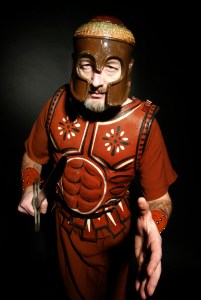
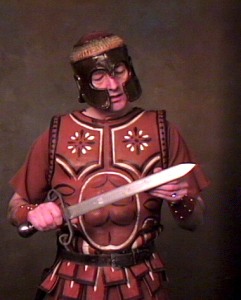
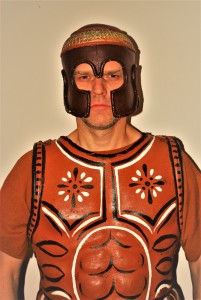
A Roman centurion — Andrew Nicholls

“Forget Flavio. He’ll be drunk for the rest of the week. Herod’s coming down about midweek. There’ll be a big wine- swilling bash for the upper crust. He’ll sober up just long enough so he can bow and scrape for Pilate at the right moment. Forget him. We have to save our own hides.”
“All right. So what’s this plan?”
“It’s not some great master scheme, but I do have a few ideas.”
“Yes, get on with it,” he said with obvious interest.
“Well, the way I see it, we have way too little information about whatever is going on here. If there’s some Passover plot being hatched, we need to be the first to know about it. Not like yesterday. I don’t like surprises. Especially Jewish Messiah surprises.”
Renaldo scowled in agreement. “So why the trunk?” he asked.
I had set it down after our greeting, and now it was Keeper, sniffing about it, that brought it to Renaldo’s attention.
“This is one way I can get some information.”
I opened the trunk and pulled out several items of clothing, among them a Jewish prayer shawl and several phylacteries. Holding one of the fringed garments to myself, I announced, “Today I am Benjamin. Benjamin from Alexandria, and I’ve come to celebrate the Passover here, in the holy city, Jerusalem.”
All this was done with a thick Aramaic accent and a mock reverence that left Renaldo slapping his thigh in laughter.
“Marcus, Marcus! Only you could pull this off!” Then he added in a more thoughtful tone, “I could look in on some of our usual sources. They’re bound to know a thing or two about this donkey man.”
“Now you’re thinking.” With a glance to the eastern sky, I added, “Look, we don’t have much time. The sun’s almost up. All my men know their assigned duties, so if you could just look in on them at the barracks, that would be great. I should be back in uniform by noon, and I could meet you there to discuss what we’ve found.”
“No problem . . . Benjamin!” he said, shaking his head and grinning, no doubt contemplating the sight of me in religious garb.
I began to place the clothing back in the trunk, and then I turned to my friend. “Oh,Soldier book by the way, Renaldo, could you check in on Claudius at the Golden Gate? I expect our visiting prophet will be coming back into town by the same way today. Claudius might need a hand.”
“No problem, Marcus.” And then he added in a more serious tone, “Now, you be careful.”
“Yes, well,” I said, sighing, “I think we’ve all got to be careful.”
I swung the trunk up under my arm. With a quick wave of my free hand, I said, “I’m off for an appointment with Jesus of Nazareth.”


Excerpts for Lent from “The Soldier Who Killed a King”

19 Monday Feb 2018

Posted by davidkitz in Books by David Kitz, Christ's Passion, Lent

≈ Leave a comment

Tags

David Kitz, Hosanna, Jerusalem, Messiah, Palm Sunday, Passion Week, Passover, pilgrims, Roman soldiers, soldier, Son of David, The Soldier Who Killed a King, triumphal entry

A journey to the cross is a journey to repentance. It’s a journey to deep personal change. Will you take this journey with me?

Four in the afternoon, Sunday, April 2, AD 30
It was never like this before. biblical-fiction-award-2017_orig
I had been posted in Jerusalem for ten years now, but in all that time, I had never seen a Passover crowd like this.
It wasn’t the numbers. I had seen that before.
The Passover pilgrims always come plodding into the city in reverent caravans. Some of them chant psalms. Others are silent, looking bone-weary as they trudge, like fretful herdsmen with children in tow. Undoubtedly, many are relieved that their holy city is finally in view.
But this year it was different. There was this man—at the center of the whole procession. There had never been a central figure before. Every movement within that huge throng seemed focused on him.
Squinting in a futile attempt to get a better view, I gave Claudius a backhanded slap to the shoulder and demanded, “What are they doing?”
“They’re climbing the trees, sir.”
“I can see that!” I snapped. “But what are they doing?”
“They seem to be tearing off the palm branches, sir.”
“What is going on here?” I said it more to myself than to any of the men standing near me. An uncomfortable feeling crept into me as the procession advanced.
“They don’t usually do this?” Claudius questioned.
“No . . . They’ve never done this before.” There was worry in my voice. Claudius had been recently assigned to this place, the festering armpit of the empire, and I was at a loss to explain what was happening before us. We were standing on the wall above the gate of Jerusalem, and less than a half mile away, we could see the jubilant pilgrims surging toward us in alarming numbers.
“They’re laying the palm branches on the road in front of that man—the man on the donkey.”
Until Claudius said it, I hadn’t noticed the donkey. Its small size and the frenzy of activity round about must have obscured this detail in the picture before me. What an odd way for this man to come. I could make no sense of it.
“They’re throwing down their cloaks before him.”
The sweat- glistened bodies of several men were clearly visible. Outer garments were being cast down before this man as a sign of homage. At the same time the rhythmic chanting of their voices became more distinct.
What were they singing? Could I pick up the words?
     “Hosanna to the Son of David!”
     “Blessed is he who comes in the name of the Lord!”
     “Hosanna in the highest heaven!”
That’s when it hit me like a barbarian’s club. I realized what I was witnessing. It was a triumphal entry—the entry of a king.
It was the words. The words they were now boisterously shouting. He was their Messiah. The Son of David! The one they were waiting for! The one who would rid them of the Romans. He would set up his glorious Jewish kingdom, here, in Jerusalem! This is what I had been warned about since the day I first set foot on this cursed Judean soil. And we, I and my men and the garrison in the city, were all that stood in their way.

← Older posts
Newer posts →

Psalms 365: Develop a Life of Worship and Prayer

Psalms 365 Volume II

Psalms 365 vol 3
— Psalms 365 Volume III

Psalms

Recent posts

  • What’s Your Intention? February 23, 2026
  • The LORD Loves the Just February 22, 2026
  • A Not So Immaculate Conception February 22, 2026
  • Silence February 21, 2026
  • Commit Your Way to the LORD February 21, 2026
  • Generosity Is Never out of Season February 20, 2026
  • Your Heart’s Delight February 20, 2026

Calendar

February 2026
M T W T F S S
 1
2345678
9101112131415
16171819202122
232425262728  
« Jan    

Blog Posts

Enter your email address to follow this blog and receive notifications of new posts by email.

Comments

  • davidkitz on A Not So Immaculate Conception
  • davidkitz on Commit Your Way to the LORD
  • Commit Your Way to the LORD – QuietMomentsWithGod on Commit Your Way to the LORD

Blog at WordPress.com.

Privacy & Cookies: This site uses cookies. By continuing to use this website, you agree to their use.
To find out more, including how to control cookies, see here: Cookie Policy
  • Subscribe Subscribed
    • I love the Psalms
    • Join 1,385 other subscribers
    • Already have a WordPress.com account? Log in now.
    • I love the Psalms
    • Subscribe Subscribed
    • Sign up
    • Log in
    • Report this content
    • View site in Reader
    • Manage subscriptions
    • Collapse this bar
 

Loading Comments...