Reading 35 for Lent from “The Soldier Who Killed a King”

Tags

, , , , ,

A journey to the cross is a journey to repentance. It’s a journey to deep personal change. Will you take this journey with me?

Date: Eight in the morning, Saturday, April 8, 30 A.D.
Marcus Longinus, the Roman centurion, on his way to set a guard at the tomb, considers the possibility of Jesus rising from the dead.

On the surface I protested being drawn into this, the high priest’s plan of preemptive precaution, but within me, I was filled with dark apprehension. These measures had merit. This guarding of the tomb might well be warranted.
I did not fear his disciples. There had been no sign of them, no sign of armed uprising. No, it was the prophet himself that I feared.
This notion of him rising from the dead did not strike me as all that far fetched. On the surface the Christ’s prediction seemed impossible— utterly impossible—totally preposterous. But then in life he had been a total master of the impossible. The example of the blind Bartimaeus sprang to mind. This Messiah had tossed off miracles like he was tossing off the covers from his bed. Could he now toss off the shroud of death?
There was something far larger at work here. This was more than the raving of a lunatic. Why else would the sun refuse to shine as he hung dying? Why else would the earth shudder with his last breath? No, he was the Son of God. My very own words came back to haunt me. Anything was possible; nothing could be ruled out!
I remembered the worried look I saw on Pilate’s face just this morning, when Annas had raised this matter. Without saying a word I knew we both were of the same mind on this. He too thought a resurrection could occur. Why else his prompt response?

This was more than the raving of a lunatic. Why else would the sun refuse to shine as he hung dying? Why else would the earth shudder with his last breath? No, he was the Son of God.


Oh yes, and then there was the rubbing of the hands. Guilt stains are not so easily removed. I should know. After all these years the blond-haired girl still visits me quite regularly on those soul- tormenting nights.
Only the high priest’s men seemed sure of themselves, cocky in their victory, but not cocky enough to throw all caution to the wind. Why else post a guard? But winds can change, and all this might yet blow up in their faces.
Free WW-e FACEBOOK-2 (2)

To download a free study guide for this high-impact, bible-based novel visit: https://www.davidkitz.ca/centurion.php/free study guide PDF

For book purchases of The Soldier Who Killed a King try Amazon or christianbook.com.

Awakened to Praise!

Tags

, , , , , ,

Reading: Psalm 57
(Verses 6-11)
They spread a net for my feet—
I was bowed down in distress.
They dug a pit in my path—
but they have fallen into it themselves.
My heart, O God, is steadfast,
my heart is steadfast;
I will sing and make music.
Awake, my soul!
Awake, harp and lyre!
I will awaken the dawn.
I will praise you, Lord, among the nations;
I will sing of you among the peoples.
For great is your love, reaching to the heavens;
your faithfulness reaches to the skies.
Be exalted, O God, above the heavens;
let your glory be over all the earth
(NIV).

img_20180928_1514405-effects

Petrie Island late summer sun — photo by David Kitz

Reflection
As with many of David’s psalms, Psalm 57 turns on a dime. By that I mean the psalmist begins in a state of worry and trouble. In his distress David cries out to God and the Lord answers him. Suddenly, desperate pleas are replaced by wholehearted praise. The psalm ends with rejoicing over the goodness of God. David invites us to join in his rejoicing. I will sing and make music. Awake, my soul! Awake, harp and lyre! I will awaken the dawn. I will praise you, Lord, among the nations; I will sing of you among the peoples.

There is tremendous power in music. When I am discouraged—trapped in the Christian pilgrim’s Slough of Despond—a song of praise can lift me out like nothing else. Perhaps you have had a similar experience. When I am drowning in a sea of regrets, music brings buoyancy. Worship helps me set my eyes on Jesus, the author and perfecter of my faith. See Hebrews 12:2. Faith gives us eyes to see beyond our current set of circumstances.

Most often we want to see God’s deliverance before we praise Him. In the introduction to Psalm 57 we read that David hid in a cave from King Saul. David called out for God to deliver him and He did. Therefore, David bursts out with music and song. Can you picture him strumming on his harp and singing with a smile you can see for a mile?

But there are times when I believe God wants us to sing His praise before deliverance comes—before the healing appears. He is our good and faithful God whether we have faith to move mountains or are troubled by doubt. Whether we live or die, He is faithful and worthy of our praise. In all the circumstances of life our help comes from Him.    

Response: LORD God, even in the midst of trouble fill my heart with praise for you. You are good and faithful. You are my help—my steadfast help—through Jesus Christ your Son. Amen.

Your Turn: Can you recall a time when you praised God before He brought the answer to your prayer?

Reading 34 for Lent from “The Soldier Who Killed a King”

Tags

, , , ,

A journey to the cross is a journey to repentance. It’s a journey to deep personal change. Will you take this journey with me?

Date: Eight in the morning, Saturday, April 8, 30AD
Marcus Longinus, the Roman centurion, meets with Renaldo, a fellow centurion, to discuss the setting of a guard at Jesus’ tomb.

“I may have some work for you men,” I called out to these soldiers. “So don’t leave just yet.”
Upon hearing my voice Renaldo emerged from a side room where he and his wife had been tending to Lucas. “What is it, Marcus?” he asked.
“Oh, I need some men to guard the prophet’s tomb.” It was impossible to hide my frustration.
“Why?” Renaldo reacted with a shake of his head. He found this quite perplexing.
“Well,” I responded, “it seems that the high priest and his crew are worried that either Jesus will arise from the dead or his disciples will come and steal his body.”
“That’s bizarre.” Renaldo shook his head again. “Just bizarre. Where did they get that notion?”
“From Jesus. From the prophet himself. Apparently he predicted it.”
He bowed his head slightly, and then brought his hand to his forehead in what appeared to be a desperate attempt to mentally digest it all.
“Look, Renaldo. I don’t have time to try and explain this.” My exasperation was clearly showing. “And I don’t really know if I even can. Right now I need sixteen men to take to the tomb for the first shift. I need them there within the hour. I thought if we combined your men here with my men next door, we could make up this first contingent.”
“First contingent?”
“First contingent—first shift. They want it guarded day and night for the next three days.”
He shook his head again. “Fine.” He threw up his hands in exasperation. “We’ll prance around and do the Weasel’s bidding.” He was clearly angry. “Did Pilate approve this?”

DSC_0060

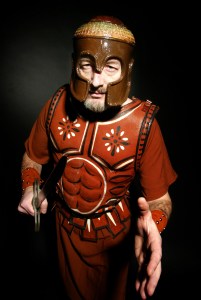
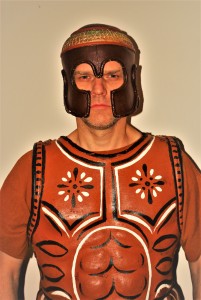
Roman centurion — Andrew Nicholls

“Yes sir.” I bowed low in a show of mock subservience. “He’s back lickin’ the holy man’s stinkin’ feet—once again! He started yesterday during the Messiah’s trial,” I said bitterly, “and now, who knows when he’ll stop.”
“I can only shake my head,” Renaldo answered as he did just that. Then after a pause, with grim resignation in his voice, he said, “Let’s get on with it. I suppose we have to do it.”
He turned and bellowed at the twelve waiting men, “All of you head over next door.”

To download a free study guide for this high-impact, bible-based novel visit: https://www.davidkitz.ca/centurion.php/free study guide PDF

For book purchases of The Soldier Who Killed a King try Amazon or christianbook.com.
Under the Wings of the Almighty

Tags

, , , , ,

Reading: Psalm 57
For the director of music. To the tune of “Do Not Destroy.”
Of David. A miktam. When he had fled from Saul into the cave.
(Verses 1-5)
Have mercy on me, my God, have mercy on me,
for in you I take refuge.
I will take refuge in the shadow of your wings
until the disaster has passed.
I cry out to God Most High,
to God, who vindicates me.
He sends from heaven and saves me,
rebuking those who hotly pursue me—
God sends forth his love and his faithfulness.
I am in the midst of lions;
I am forced to dwell among ravenous beasts—
men whose teeth are spears and arrows,
whose tongues are sharp swords.
Be exalted, O God, above the heavens;
let your glory be over all the earth
(NIV).

img_20181220_1051543

The ceiling of the Parliament of Canada Library — photo by David Kitz

Reflection
Have you ever had one of those mornings where you just want to pull the covers over your head and hide away from the world? David was having one of those days when he composed Psalm 57. But in David’s case, he wasn’t just trying to avoid a snarly boss. His boss, King Saul, was hunting David down to kill him. Needless to say, there must have been some fervor in David’s plea for help. “Have mercy on me, my God, have mercy on me, for in you I take refuge. I will take refuge in the shadow of your wings until the disaster has passed.”

The phrase ‘take refuge in the shadow of your wings’ reminds me of a story etched on my mind from my childhood. My dog, Champ, absolutely loved any newborn creature on the farm. He instantly became the newborn’s defender. Generally, this worked out very well and we appreciated his hovering affection. All was fine until one day our pet bantam hen brought her newly hatched chicks to our backyard.

Champ was thrilled at the sight of these tiny fluff balls. He greeted them with a bark and vigorously wagged his tail to welcome these new arrivals. Mother hen misunderstood his intentions. She hastily gathered her chicks under her wings to defend them from this wild beast. Champ was outraged. Surely this hen had swallowed up these defenceless chicks. He began to bark at her fiercely, trying to get her off her brood. The hen simply tightened her wings down on the chicks. Laughing at the sight of this, we called off our well-intentioned but misguided dog.

Our heavenly Father is our wise and well-intentioned protector. Do we refuse His help? We are eternally safe in the shelter of His wings. Let Him draw you close today. 

Response: LORD God, you are my defender. Help me daily to appreciate your love and protection. When the cruelty of this world assaults me, I find shelter under your wings. Amen.

Your Turn: Do we sometimes push away from our secure place near the heart of God?

Reading 33 for Lent from “The Soldier Who Killed a King”

Tags

, , , , ,

A journey to the cross is a journey to repentance. It’s a journey to deep personal change. Will you take this journey with me?

Date: Eight in the morning, Saturday, April 8, 30 A.D.
Marcus Longinus, the Roman centurion, endures a sleepless night as he reflects on his role in Christ’s crucifixion.

It was a horrible night. Horrible!biblical-fiction-award-2017_orig
I could not sleep. The events of the day kept flooding over my mind—a constant bloody torrent. During the daylight hours you can steel yourself against another man’s suffering. But at night your hard shell dissolves from around you, and you are left in just your own skin again. Then their suffering soaks into your flesh, and it becomes your own.
There seemed to be no end to it—no end to this torment. I willed myself to sleep. But I could not find that door of escape. It eluded me.
Instead I was pursued relentlessly by the dreadful events of the day. The hammer blows kept ringing in my head. And now their pain was mine.
All night my mind was on Golgotha.
Why me? Why Jesus? Why by some cruel twist of heaven’s fate did I find myself with him upon the hill of execution?
When I closed my eyes, his face appeared before me. His gentle eyes stared down on me, boring a hole into my very soul. Blood oozed down from the stabbing crown of thorns. It pooled and dried along his eyebrows. And his pain? His pain was my own.
Once in the night Zelda put her arm around me and drew close.
I pulled away. I could not be comforted. I could not be loved, and neither could I give love. She could not reach me. I was well beyond all this.
Why did I spit in Jesus’s face? Why did all hell erupt from within me? I hated being forced into this role, the role of the killer, the executioner. Just as in Germania, I was compelled—forced by circumstances into a role that I despised. But when my moment came, with my men gathered around, I played it to the hilt. The brute lurking at the bottom of the chasm within me took full control. Today on Golgotha the horror and rage of Germania had found a fresh vent.
But this was no barbarian village. This was no blond-haired girl; this was the Son of God. The Son of God . . .
The words of my confession reverberated through my throbbing mind, over and over, until I thought my head would split.
4485 FACEBOOK-1

To download a free study guide for this high-impact, bible-based novel visit: https://www.davidkitz.ca/centurion.php/free study guide PDF

For book purchases of The Soldier Who Killed a King try Amazon or christianbook.com.

Praise for God’s Word

Tags

, , , , ,

Reading: Psalm 56
(Verses 8-13)
Record my misery;
list my tears on your scroll—
are they not in your record?
Then my enemies will turn back
when I call for help.
By this I will know that God is for me.
In God, whose word I praise,
in the L
ORD, whose word I praise—
in God I trust and am not afraid.
What can man do to me?
I am under vows to you, my God;
I will present my thank offerings to you.
For you have delivered me from death
and my feet from stumbling,
that I may walk before God
in the light of life
(NIV).

20180810_1947152

Lead me in your path, Lord — photo by David Kitz

Reflection
Psalm 56 is a relatively short psalm. Yet in this short psalm, David repeats the phrase ‘whose word I praise’ three times. In today’s reading he states, “In God, whose word I praise, in the LORD, whose word I praise—in God I trust and am not afraid.”

For me this phrase raises a question. Whose word do I praise? Do I praise God’s word? Do I appreciate and value the written word of God? Have I made it my refuge as it was for David? Is it my sustenance? Do I feed on it daily? While fasting in the wilderness Jesus answered the tempter, “It is written, ‘One does not live by bread alone, but by every word that comes from the mouth of God’” (Matthew 4:4). 

Do you trust the living, active word of God to help you today and every day? Trust really is crucial. If I don’t trust that God’s word will help, encourage, correct and sustain me, I won’t bother reading it or meditating on it. I’ll trust in my own abilities or seek direction from other sources.

Trust is crucial in election campaigns. During such campaigns politicians from a variety of parties make their pitch to the electorate. Again the fundamental question for each voter is whose word, do you trust? Politicians often promise more than they can deliver. Often I have been let down by a politician who promised to do things differently, but once in office failed to deliver, or became caught up in scandal after scandal. I presume the same disappointment holds true for many voters.

We need to remember that salvation won’t ever be achieved at the ballot box. It was achieved at the cross—only at the cross. The remedy for my sin is found there. The living word of God reminds us of that trustworthy, unchanging truth.

Response: LORD God, I put my trust in your word. I praise your life-giving word for it is good and completely trustworthy. Your word is a lamp for my feet, a light on my path (Psalm 119:105). Amen.

Your Turn: Do you make it your habit to read and meditate on the word of God?

In God I Trust and am not Afraid

Tags

, , , , , ,

Reading: Psalm 56
For the director of music. To the tune of “A Dove on Distant Oaks.”
Of David.
A miktam. When the Philistines had seized him in Gath.
(Verses 1-7)
Be merciful to me, my God,
for my enemies are in hot pursuit;
all day long they press their attack.
My adversaries pursue me all day long;
in their pride many are attacking me.
When I am afraid, I put my trust in you.
In God, whose word I praise—
in God I trust and am not afraid.
What can mere mortals do to me?
All day long they twist my words;
all their schemes are for my ruin.
They conspire, they lurk,
they watch my steps, hoping to take my life.
Because of their wickedness do not let them escape;
in your anger, God, bring the nations down
(NIV).

M Taylor Plum blossoms

Plum blossoms, Nagoya, Japan — photo courtesy of Matthew Taylor

Reflection
In times of trouble David knew where to turn. With his enemies, the Philistines, surrounding him, he turned to God. Hear his bold confession, “When I am afraid, I put my trust in you. In God, whose word I praise—in God I trust and am not afraid. What can mere mortals do to me?”

 David, the obvious answer is, “Mere mortals can torture and kill you.”

Despite this David remained confident. The Philistines could destroy his body but they could not harm his eternal spirit which was at peace—protected by God. Do you and I have the same confidence? That confidence can be ours if we put our trust in God.

Jesus warned his disciples, “Do not be afraid of those who kill the body but cannot kill the soul. Rather, be afraid of the One who can destroy both soul and body in hell” (Matthew 10:28). The One we are to fear is God alone. Jesus perfectly demonstrated his trust in God the Father when he went to the cross on our behalf. There he was tortured and killed, but three days later he was vindicated by the Father, who raised him from the dead. Our redemption and salvation come from Jesus.

When we face mortal danger or a deadly prognosis may these words be on our lips and in our heart: When I am afraid, I put my trust in you. In God, whose word I praise—in God I trust and am not afraid. What can mere mortals do to me?

Response: LORD God, right now I put my faith and trust in you. By the blood of Jesus you forgive all my sins and have paid the price for my redemption. When I am afraid, I turn to you. I put my trust in you alone. Amen.

Your Turn: Who do you trust and turn to when bad news comes? Friends and family can provide support, but is your Father—your heavenly Father with you? Are you leaning into Him?

Reading 32 for Easter from “The Soldier Who Killed a King”

Tags

, , , , ,

A journey to the cross is a journey to repentance. It’s a journey to deep personal change. Will you take this journey with me?

Date: Nine in the morning, Sunday, April 9, 30 A.D.
Marcus Longinus, the Roman centurion, investigates his soldiers’ report that Jesus had risen from the dead.

It was as they said. The stone was rolled away. But it was not merely rolled to the side as I had expected. It had been pushed right up and out of its stone track, and it had toppled over a good distance from the tomb entrance.
I edged my way toward it. About two paces from the end of the stone track, there was gouge in the shallow soil, where the round cover stone had landed and then rolled. This was a real headshaker. How had this happened? It must have been rolled back with such force that when it reached the end of the track, it bounced up and out. No wonder the men were scared! This was awesome. Forty men could not do this!
Suddenly I felt very small, small and afraid.

OTT0304-KITZ1

Photo credit Jean Levac, Ottawa Citizen

And this was the very stone we had sealed just a day earlier. A close examination showed that in a few spots there were still fragments of broken plaster on it. I exhaled a huge puff of air. This discovery in itself was beyond all expectation. The force of the quake could not have done this. A quake of such magnitude would have collapsed the tomb itself, and not a building in the city would be standing. No, a direct force had hurled this boulder away from the tomb’s entrance.
An almighty warrior from heaven’s realm?
I rejoined my two men. Suddenly they gained a new level of respect in my eyes. Their fears had become my own. I found I was rolling my head from side to side just as I had seen Claudius do.

“You saw this happen?” I gestured to the fallen round rock and then put a finger to my lips. I was astounded.
“Actually,” Philip admitted, “I didn’t see him roll the stone. We all fell like dead men when the earthquake hit. But after, when I opened my eyes, the angel was sitting on it, and . . . and Jesus was walking out of the tomb.” He fell to his knees and began to beat the ground as he said this last part. He was gripped afresh by the memory.
“Where were you when this happened?” He raised his head and pointed to a spot a few paces away. “Right there.”
“And you?” I looked at Claudius. He pointed to another spot. “Just over here,” he said. “That’s my cloak. I left it when I ran.”
There was, in fact, a good bit of flotsam scattered about: a few cloaks, a water jug, Philip’s precious dice, even a helmet. Here were all the signs of panicked flight. They had left all and fled for their lives.
For me only one question remained. Was the open tomb truly empty?
“Get to your feet, Philip,” I said. “You two stay here and watch while I go take a look inside.”
I took three deep breaths and set out on my little journey. It was only about twenty paces4485 SHARABLE-2 to the tomb entrance. A distance made much longer by my fear. But the whole scene was bathed in the warmth of morning sunlight. I started slowly. About halfway to the entrance, a songbird broke forth in glorious melody. The sun’s rays streamed into the rock tomb, lighting my way.
It was empty! The stone slab lay empty. Actually, it was not entirely so. The death shroud had been rolled up, and the face covering was neatly folded and lay off to one side. It appeared as though the awakened corpse took a moment to make his bed after getting up.
The Galilean prophet, the true king, had arisen and gone forth!

To download a free study guide for this high-impact, bible-based novel visit: https://www.davidkitz.ca/centurion.php/free study guide PDF

For book purchases of The Soldier Who Killed a King try Amazon or https://www.christianbook.com

Reading 32 for Lent from “The Soldier Who Killed a King”

Tags

, , , ,

A journey to the cross is a journey to repentance. It’s a journey to deep personal change. Will you take this journey with me?

Date: Seven in the morning, Saturday, April 8, 30 A.D.
Annas meets with Pontius Pilate and asks that Jesus’ tomb be guarded.

Pilate was seated even as I saw him yesterday. He wore a rather haggard look, as though he had slept on the bloodstained rocks of Golgotha. He motioned for the temple delegation to step forward. I waited at the back of the room in a repetition of the governor’s late- day interview with Joseph of Arimathea.
Annas bowed and began. “Sir, we remember that while he was still alive that deceiver said, ‘After three days I will rise again.’”
A strange tingle ran through me as he said this. Pilate rubbed his hands.
Annas continued. “So give the order for the tomb to be made secure until the third day. Otherwise, his disciples may come and steal the body and tell the people that he has been raised from the dead.” Then he concluded by lifting a bony finger and saying, “This last deception will be worse than the first.”
On hearing this, Pilate sighed deeply, then beckoned me forward. There was worry in his eyes. “The centurion here, Marcus Longinus, is fully acquainted with the case of the Galilean prophet. He oversaw his crucifixion.” Then he addressed me directly. “Is that not so?”
I nodded. “Yes, sir. It is as you say.”
With that he raised his hands and motioned both parties together. Then, speaking directly to all of us, he said, “Take a guard. Go, make the tomb as secure as you know how.” Rubbing his guilt- stained hands once more, the Badger got up and skulked off. Free WW-e FACEBOOK-2 (2)Annas was jubilant. With eagerness in his voice, he turned to address me. “How soon can you have your troops at the tomb?”
“We should be there in about an hour.”
“Excellent! These two gentlemen will meet you there. They will ensure that all is in order. Understood?”
“Yes. Understood,” I said. Then I addressed the Pharisees. “Do you know which tomb? Do you know where it is?”
Annas answered for them. “Ah, they know it well.” He gave a contemptuous snort. “The traitor’s tomb, Joseph of Arimathea!”
“I will bring my men and meet you there then.” I gave a slight bow with my head. The chamberlain saw us to the door, and then I was off, back to my home.
I shook my head several times in disbelief as I trudged back. Every time I tried to extricate myself from this Messiah pit, this kingdom of God affair, this abysmal hole, I would find myself sucked in even deeper. And now it had happened again. Was there no escape?
Would I ever be allowed to speak my mind before Pilate?

To download a free study guide for this high-impact, bible-based novel visit: https://www.davidkitz.ca/centurion.php/free study guide PDF

For book purchases of The Soldier Who Killed a King try Amazon or https://www.christianbook.com