• Home
  • About
  • DavidKitz.ca
  • Youtube Videos
  • Books by David
  • Books on Amazon.com

I love the Psalms

~ Connecting daily with God through the Psalms

I love the Psalms

Tag Archives: Messiah

Excerpt 17 for Lent from The Soldier Who Killed a King

13 Tuesday Mar 2018

Posted by davidkitz in Books by David Kitz, Christ's Passion, Lent, The Soldier Who Killed a King

≈ 1 Comment

Tags

Barabbas, Caesar, Caiaphas, centurion, Golgotha, Jerusalem, Jesus, Kidron Valley, Messiah, prophet, repentance, Romans, Rome, sinners, tax collector, temple

A journey to the cross is a journey to repentance. It’s a journey to deep personal change. Will you take this journey with me?

In today’s reading, Marcus, the centurion, meets with Jonas the tax collector. They discuss the news of the week, namely the huge stir that Jesus has caused in Jerusalem since his triumphal entry into the city. Date: Early morning April 6th, 30 A.D.

As I descended the stairs of the gate, I caught sight of Jonas and his son, unoccupied at the customs booth. With a quick wave of my hand, I signaled my intention to speak with him, and after taking the salute of the sentinels at the gate, I headed straight to the booth. “Good morning, you old goat!” I called out as I approached.
“Well, if it isn’t the top dog himself,” he shot back.
“It’s always good to see a man standing around doing nothing. It sets me at ease,” I said. “Ease?” His eyebrows shot up. “Oh yeah.” He nodded emphatically. “It’s been a week of ease all right. I’ve had my feet up all week.”
Of course, just the opposite was true, and it was true for both of us.
Free WW-e FACEBOOK-2 (2)
“Do you think we could have a short word?” With a jerk of my head, I motioned in the direction of the road leading down the Kidron Valley.
“Sure,” he answered, and then with a glance and a nod to his son, he transferred responsibility to him. A light mist still hung over the lowest reaches of the valley, but the early-morning sun was promising to burn it off. The swallows nesting along the crevices in the city wall were engaged in a full-throated competition with the songbirds in the trees along the brook. Traffic to and from the city was just beginning to stir.
When we had gone a few paces beyond the gate, I spoke. “I just wanted to say thanks for the help with the Barabbas case.”
“Oh, don’t mention it.” There was relief in his voice. “I thought you were going to warn me about some new plot.”
“No, there’s no new plot.” I hesitated. “Let me rephrase that. There’s no new plot that I know about. You never can be sure what’s being hatched in this crazy city.”
“Yeah, you’re right about that. I guess we learned that with Barabbas.” Jonas nervously bit on the corner whiskers of his mustache, and then continued. “Now, that Galilean prophet? I’ve been losing sleep over him all week.”
“Harmless as a dove,” I said. “Harmless as a dove.”
“How do you know?”
“I checked him out myself on Monday, right back there in the temple courts.” I made a quick double-pump motion with my upraised thumb aimed over my shoulder. “Then on Tuesday I had Claudius in there with the prophet.”
“You Romans have more nerve than brains.” He kicked a loose pebble off the pathway, looked up at me with a quizzical grin, and then with an incredulous shake of his head, he repeated, “More nerve than brains, that’s all I can say.”
“If we didn’t have nerve, we wouldn’t be running this place. Or any other place for that matter.”
He shrugged, furrowed his brow, and then cocked his head to one side. It was his way of reluctantly conceding my point.
“So he’s harmless?”
“Harmless to us.” With my index finger, I pointed first at myself, then at Jonas, and then back again. “Caiaphas, on the other hand”—I paused for effect—“now there’s a man who I’m sure hasn’t slept well all week.”
“So you think the old rusty gate has lost some sleep? Over what?”
“Money. Money and prestige. It can’t look too good having some roving up-country rabbi come in and take over your temple at the religious high point of the year.”
“I suppose not,” Jonas said. But then he added, “You know this prophet, Jesus of Nazareth, he’s been here before. He kicked out the money changers a few years back. Caused quite a stir then. But nothing like this. He’s got the temple guards running scared. That’s what my uncle told me.”
James Tht“Your uncle’s right. I saw that firsthand on Monday. So what else do you know about this Galilean?”
“My wife tells me he’s a friend of tax collectors and sinners. She told me one of his disciples was a tax collector before he met the prophet.”
“Ah, tax collectors and sinners?” I responded with a wink and a nod. “Maybe there is hope for the two of us yet.”
Jonas smiled back at me. “So, Marcus, where is this all headed? Some people think he’s the Messiah. You know that, don’t you?”
“Yes, we’re well aware of that. But he doesn’t oppose paying taxes to Caesar.” I gave my tax collector a supportive thumbs-up signal. “And he hasn’t spoken a word against Rome since he’s been here.”
“That’s not a surprise. He knows better. You and your boys would have him nailed up on Golgotha the moment he did.”
“You’re right about that,” I agreed. “But I honestly don’t think he’s got a quarrel with us. He’s going after the parading hypocrites in long, flowing robes, those killjoy Pharisees and teachers of the law. You know the ones—the religious police who run this place.”

American readers click this link to purchase The Soldier Who Killed a King.

Canadian readers click this link to purchase The Soldier Who Killed a King directly from the author.


Excerpt 11 for Lent from The Soldier Who Killed a King

05 Monday Mar 2018

Posted by davidkitz in Books by David Kitz, Christ's Passion, Lent, Psalms

≈ 1 Comment

Tags

governor, Jesus of Nazareth, king, King Herod, kingdom, Kingdom of God, Marcus, Messiah, pilgrims, prophet, Roman, The Soldier Who Killed a King, weapons

A journey to the cross is a journey to repentance. It’s a journey to deep personal change. Will you take this journey with me?

In today’s reading, Marcus the centurion meets with Flavio, the Roman tribune, who is his commanding officer. He lays out his concerns about a Galilean prophet that he sees as a dangerous threat—Jesus of Nazareth.

“Sometimes I think you worry too much, Marcus.”
“I worry because it’s my job to worry,” I shot back. “Barabbas is in prison because I worry.”
Flavio appeared to consider my reply as he swallowed another stringy morsel. “So what do you know about this prophet?”
“A lot of people think he’s the Messiah.”
“May all the gods help us! Another Roman-killing messiah!” Flavio jeered.
“This one just might be the real thing,” I said.
Centur. Sw“Ha!” he scoffed. “Bring him on!” He reached for his flagon. Finding it empty, he bellowed, “Where’s my wine?”
“Bloody incompetent servants,” he muttered. Then turning to me, he asked, “Does he have weapons?”
“No, not that I’ve seen.”
“Has he threatened us?”
“Not exactly.”
“Assaulted the tax collectors?”
“No.”
“Then leave the Jewish dog alone.”
The servant arrived with a bowl of hot, sticky cheese and placed it before me, along with two small barley loaves.
“Wine! Where’s the ruddy wine?” Flavio demanded of his harried attendant.
“He is preaching about a kingdom—the kingdom of God,” I countered.
“So let him preach.”
“Who do you think will be the king of this kingdom?” I reasoned. When Flavio remained silent, I answered my own question. “I’m sure it will be none other than Jesus of Nazareth. I don’t think there’s room for two kings in this town, and a Roman governor too.”
“I see your point,” Flavio said. He wiped a greasy hand across his mouth and thenbiblical-fiction-award-2017_orig rubbed the three days of stubble on his chin. “So he talks about a kingdom?”
“The coming kingdom,” I clarified. “It’s the whole point—the core of his message. So I’m told.”
The servant arrived with the wine. Flavio helped himself. Drank two- thirds of it in a massive gulp, then poured himself some more.
“And he has followers?” Flavio continued.
“Most of the Galilean pilgrims are firmly in his camp.”
“Galilee?” Flavio questioned. “He’s Herod’s man.” He paused to rub the tip of his nose. “I wonder what the Fox thinks of this Messiah.”

American readers click this link to purchase The Soldier Who Killed a King.

Canadian readers click this link to purchase The Soldier Who Killed a King directly from the author.

The Anointed One

05 Monday Mar 2018

Posted by davidkitz in Bible, Devotionals, Psalm 89, Psalms

≈ 3 Comments

Tags

anointed, Babylonians, Christ, crucified, David, Greek, Hebrew, Israel, Jesus, Jesus Christ, Jesus of Nazareth, king, Messiah, New Testament, Old Testament, psalmist, resurrection, the LORD

Reading:                                      Psalm 89

(Verses 46-52)
How long, LORD? Will you hide yourself forever?
How long will your wrath burn like fire?
Remember how fleeting is my life.
For what futility you have created all humanity!
Who can live and not see death,
or who can escape the power of the grave?
Lord, where is your former great love,
which in your faithfulness you swore to David?
Remember, Lord, how your servant has been mocked,
how I bear in my heart the taunts of all the nations,
the taunts with which your enemies, L
ORD, have mocked,
with which they have mocked every step of your anointed one.
Praise be to the LORD forever!
Amen and Amen
(NIV).

Reflection
Many people believe that Christ is Jesus’ last name. That is not the case. The Bible does not tell us Jesus’ family name. Often he is identified by the town that he is from—Jesus of Nazareth. So what then is the significance of the word Christ or Khristos in the Greek? Christ is a title. One might even call it a job description. It means the anointed one, the one who is designated by God to rule and reign over his people. The Greek word Khristos or Christ corresponds to the Hebrew word Mashiach or Messiah. The anointed one or Christ was and is the son of David who rules over the house of Jacob and the Israel of God. Just as David was anointed to be king of Israel, Jesus is anointed to be our king.

2018-02-05b

End of winter glory — photo by David Kitz

When we read Psalm 89 with the understanding that the anointed one is also the Christ, the psalm takes on a whole new layer of meaning. Yes, during the fall of Jerusalem to the Babylonians, the anointed one was mocked. But this is also true of Jesus, the anointed Son of David, who was led off to be crucified outside the city gate. These words were fulfilled in Christ: Remember, Lord, how your servant has been mocked, how I bear in my heart the taunts of all the nations, the taunts with which your enemies, LORD, have mocked, with which they have mocked every step of your anointed one.

But there is a significant difference between the Old Testament, anointed one, and our New Testament Christ. The psalmist asks this question: Who can live and not see death, or who can escape the power of the grave?

The implicit answer is that no one can escape death and the grave. But… but there is One—One, who tasted death on our behalf—One, who escaped the power of the grave. His name is Jesus. He is the Christ, the anointed One, and our Messiah. He is the One who by virtue of the resurrection is King now and forevermore.

Response: LORD God, I thank you for Jesus, the Christ, the anointed One. Thank you for your death, burial and resurrection. I join with the psalmist in saying, “Praise be to the LORD forever! Amen and Amen.”

Your Turn: In what way is Christ a job description? What job has he done and is he doing for you?

Excerpt 3 for Lent from “The Soldier Who Killed a King”

21 Wednesday Feb 2018

Posted by davidkitz in Books by David Kitz, Lent

≈ 4 Comments

Tags

centurion, David Kitz, Jesus of Nazareth, Jewish prophet, Lent, Marcus, Messiah, Passover, repentance, Roman centurion, The Soldier Who Killed a King

A journey to the cross is a journey to repentance. It’s a journey to deep personal change. Will you take this journey with me?

In today’s reading, Marcus the centurion, meets with his fellow centurion, Renaldo, to discuss their response to what they see as the threat of a Jewish uprising led by a messianic prophet from Galilee.

      “We have to do something. This Jewish prophet is too dangerous.”
“That’s why I came over. I have a plan. It came to me last night.”
“What about Flavio?” Renaldo resumed stroking Keeper. The dog’s silky ears twitched beneath his gentle hand.

DSC_0060

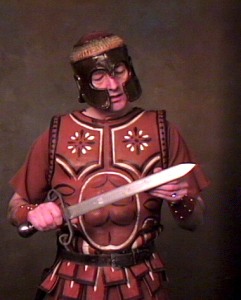
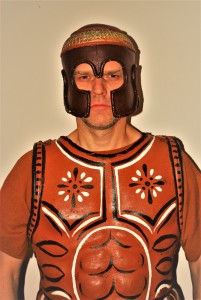
A Roman centurion — Andrew Nicholls

“Forget Flavio. He’ll be drunk for the rest of the week. Herod’s coming down about midweek. There’ll be a big wine- swilling bash for the upper crust. He’ll sober up just long enough so he can bow and scrape for Pilate at the right moment. Forget him. We have to save our own hides.”
“All right. So what’s this plan?”
“It’s not some great master scheme, but I do have a few ideas.”
“Yes, get on with it,” he said with obvious interest.
“Well, the way I see it, we have way too little information about whatever is going on here. If there’s some Passover plot being hatched, we need to be the first to know about it. Not like yesterday. I don’t like surprises. Especially Jewish Messiah surprises.”
Renaldo scowled in agreement. “So why the trunk?” he asked.
I had set it down after our greeting, and now it was Keeper, sniffing about it, that brought it to Renaldo’s attention.
“This is one way I can get some information.”
I opened the trunk and pulled out several items of clothing, among them a Jewish prayer shawl and several phylacteries. Holding one of the fringed garments to myself, I announced, “Today I am Benjamin. Benjamin from Alexandria, and I’ve come to celebrate the Passover here, in the holy city, Jerusalem.”
All this was done with a thick Aramaic accent and a mock reverence that left Renaldo slapping his thigh in laughter.
“Marcus, Marcus! Only you could pull this off!” Then he added in a more thoughtful tone, “I could look in on some of our usual sources. They’re bound to know a thing or two about this donkey man.”
“Now you’re thinking.” With a glance to the eastern sky, I added, “Look, we don’t have much time. The sun’s almost up. All my men know their assigned duties, so if you could just look in on them at the barracks, that would be great. I should be back in uniform by noon, and I could meet you there to discuss what we’ve found.”
“No problem . . . Benjamin!” he said, shaking his head and grinning, no doubt contemplating the sight of me in religious garb.
I began to place the clothing back in the trunk, and then I turned to my friend. “Oh,Soldier book by the way, Renaldo, could you check in on Claudius at the Golden Gate? I expect our visiting prophet will be coming back into town by the same way today. Claudius might need a hand.”
“No problem, Marcus.” And then he added in a more serious tone, “Now, you be careful.”
“Yes, well,” I said, sighing, “I think we’ve all got to be careful.”
I swung the trunk up under my arm. With a quick wave of my free hand, I said, “I’m off for an appointment with Jesus of Nazareth.”


Excerpt 2 for Lent from “The Soldier Who Killed a King”

20 Tuesday Feb 2018

Posted by davidkitz in Lent

≈ Leave a comment

Tags

conquer, David Kitz, donkey, Galilee, Hosanna, Jesus, Jesus of Nazareth, Lord, Messiah, prophet, Rome, Son of David, temple, The Soldier Who Killed a King

A journey to the cross is a journey to repentance. It’s a journey to deep personal change. Will you take this journey with me?

Soldier bookI could see him clearly now. Donkey or not, he had the look of a man who knew exactly what he was doing. Those about him might not know or understand, but he knew. He had a destination in mind, a purpose. You could see it on his face.
“Hosanna to the Son of David!”
“Blessed is he who comes in the name of the Lord!”
“Hosanna in the highest heaven!”
There was something else different about him. At the time I didn’t know what it was. I couldn’t put it into words for a long time. I think I noticed it because I had watched all those other men come into Rome in their triumphal processionals. They were conquerors, but still they were hollow men, feeding off the adulation of the crowd, thirsting but never satisfied. You could see them vainly drink it in, hoping it would somehow fill the empty soul.
This donkey-riding king wasn’t drinking from the crowd. I somehow sensed he was full already, and what he had within must have come from a different source.
“Hosanna in the highest heaven!”
“Hosanna to the Son of David!”
“Blessed is he who comes in the name of the Lord!”
Just at that moment a strange feeling seemed to rise within me. Maybe it was the joy of the crowd. I had expected anger. Maybe it was the children waving palm branches or the spontaneity of the singing? I don’t know. For one moment it all seemed to come together. It seemed right somehow. Like heaven and earth had finally, for a moment, come into agreement—an agreement that had never been achieved before.
“Hosanna in the highest heaven!”
He was much closer now.
“Hosanna to the Son of David!”
He was now within the shadow of the gate.
“Blessed is he who comes in the name of the Lord!”
At that moment he looked up. For an instant our eyes met. Then I heard a voice—clearly heard a voice say, “I have a future for you.”
I was confused.
I turned to Claudius and said, “What did you mean by that?”
“What did I mean by what?” He had a blank look on his face.
“By what you said about—about the future?”
“I didn’t say anything about the future, sir. I didn’t say anything.”4485 SHARABLE-1
I was totally baffled. Was I hearing voices? This whole thing was making no sense, no sense at all. Passover pilgrims weren’t supposed to come into the city this way. We had a revolutionary on the loose—riding a donkey. And now I was hearing things?
I rubbed the sweat from my forehead, hoping for some clarity to emerge.
I had a hundred men whose lives were in danger from this Jewish Messiah and his horde of followers. That was what mattered.
By this time the donkey man had passed under the gate and was heading in the direction of the temple in the heart of the city.
I signaled for Claudius to follow as I raced down the stairs of the gatehouse. I emerged onto the street and grabbed the first two-legged bit of Jewish scum I saw. Pressing him against the stone wall, I demanded, “Who is that man?”
I pointed at the retreating figure on the donkey.
The poor wretch was in shock and seemed quite unable to get out a word.
Claudius reached for his sword.
“Je- Jesus of Nazareth,” he stammered and then quickly added, “the prophet from Nazareth in Galilee.”
I loosened my grip. Then in a voice loud enough for all near to hear, I announced, “Well, there is one thing I do know. We’re going to have to keep an eye on that man.”

Excerpts for Lent from “The Soldier Who Killed a King”

19 Monday Feb 2018

Posted by davidkitz in Books by David Kitz, Christ's Passion, Lent

≈ Leave a comment

Tags

David Kitz, Hosanna, Jerusalem, Messiah, Palm Sunday, Passion Week, Passover, pilgrims, Roman soldiers, soldier, Son of David, The Soldier Who Killed a King, triumphal entry

A journey to the cross is a journey to repentance. It’s a journey to deep personal change. Will you take this journey with me?

Four in the afternoon, Sunday, April 2, AD 30
It was never like this before. biblical-fiction-award-2017_orig
I had been posted in Jerusalem for ten years now, but in all that time, I had never seen a Passover crowd like this.
It wasn’t the numbers. I had seen that before.
The Passover pilgrims always come plodding into the city in reverent caravans. Some of them chant psalms. Others are silent, looking bone-weary as they trudge, like fretful herdsmen with children in tow. Undoubtedly, many are relieved that their holy city is finally in view.
But this year it was different. There was this man—at the center of the whole procession. There had never been a central figure before. Every movement within that huge throng seemed focused on him.
Squinting in a futile attempt to get a better view, I gave Claudius a backhanded slap to the shoulder and demanded, “What are they doing?”
“They’re climbing the trees, sir.”
“I can see that!” I snapped. “But what are they doing?”
“They seem to be tearing off the palm branches, sir.”
“What is going on here?” I said it more to myself than to any of the men standing near me. An uncomfortable feeling crept into me as the procession advanced.
“They don’t usually do this?” Claudius questioned.
“No . . . They’ve never done this before.” There was worry in my voice. Claudius had been recently assigned to this place, the festering armpit of the empire, and I was at a loss to explain what was happening before us. We were standing on the wall above the gate of Jerusalem, and less than a half mile away, we could see the jubilant pilgrims surging toward us in alarming numbers.
“They’re laying the palm branches on the road in front of that man—the man on the donkey.”
Until Claudius said it, I hadn’t noticed the donkey. Its small size and the frenzy of activity round about must have obscured this detail in the picture before me. What an odd way for this man to come. I could make no sense of it.
“They’re throwing down their cloaks before him.”
The sweat- glistened bodies of several men were clearly visible. Outer garments were being cast down before this man as a sign of homage. At the same time the rhythmic chanting of their voices became more distinct.
What were they singing? Could I pick up the words?
     “Hosanna to the Son of David!”
     “Blessed is he who comes in the name of the Lord!”
     “Hosanna in the highest heaven!”
That’s when it hit me like a barbarian’s club. I realized what I was witnessing. It was a triumphal entry—the entry of a king.
It was the words. The words they were now boisterously shouting. He was their Messiah. The Son of David! The one they were waiting for! The one who would rid them of the Romans. He would set up his glorious Jewish kingdom, here, in Jerusalem! This is what I had been warned about since the day I first set foot on this cursed Judean soil. And we, I and my men and the garrison in the city, were all that stood in their way.

He Shall Have Dominion

28 Thursday Dec 2017

Posted by davidkitz in Bible, Devotionals, Psalm 72, Psalms

≈ 1 Comment

Tags

Canada's Parliament, dominion, Fathers of Confederation, forced labor, high taxation, King James Version, Messiah, messianic, National Gallery of Canada, parliament, revolt, sea to sea, Solomon

Reading:                                       Psalm 72

Of Solomon
(Verses 1-11)
Endow the king with your justice, O God,
the royal son with your righteousness.
May he judge your people in righteousness,
your afflicted ones with justice.
May the mountains bring prosperity to the people,
the hills the fruit of righteousness.
May he defend the afflicted among the people
and save the children of the needy;
may he crush the oppressor.
May he endure as long as the sun,
as long as the moon, through all generations.
May he be like rain falling on a mown field,
like showers watering the earth.
In his days may the righteous flourish
and prosperity abound till the moon is no more.
May he rule from sea to sea
and from the River to the ends of the earth.
May the desert tribes bow before him and his enemies lick the dust.
May the kings of Tarshish and of distant shores bring tribute to him.
May the kings of Sheba and Seba present him gifts.
May all kings bow down to him and all nations serve him
(NIV).

Reflection
There is a verse from Psalm 72 carved in stone into Canada’s Parliament building. From the King James Version it reads, “He shall have dominion also from sea to sea, and from the river unto the ends of the earth” (Psalm 72:8).

img_20161228_164216

Canada’s Parliament Buildings as seen from the National Gallery — photo by David Kitz

There are several ways of interpreting this verse. First, it should be noted that Psalm 72 is a prayer of Solomon. During his reign, Solomon brought the nation of Israel to the pinnacle of greatness, prosperity and dominance over its surrounding neighbors. But Solomon also sowed the seeds that brought about the nation’s decline after his death. His marriage to hundreds of foreign wives led directly to idolatry and a forsaking of the ways of the LORD. Personal wealth and aggrandizement were achieved by means of forced labor and high taxation. Revolt was festering beneath a surface of calm.

Another interpretation of this psalm takes a more messianic approach. The Messiah will reign. He will have dominion from sea to sea. Many believe this is how the Fathers of Confederation viewed this passage. They longed for the reign of Christ on the earth. Even so we pray, thy Kingdom come, thy will be done on earth as it is in heaven. That should be the prayer of every Christian believer in whatever country we live.

Response: LORD Jesus, have dominion over me. I willingly submit to your rule. You are my King and my God. I willingly bow my knees before you. Reign over me, and in me to the end of time. Amen.

Your Turn: Are you by nature rebellious or do you find it easy to submit to God’s rule?

Praising God for Answered Prayer

24 Thursday Aug 2017

Posted by davidkitz in Bible, Devotionals, Psalm 34, Psalms

≈ 3 Comments

Tags

actor, answered prayer, author, David, Gath, glory, God, Jesus Christ, justice, King Achish, King David, king of Gath, King Saul, leader, madmen, Messiah, musician, Philistine, poet, praise, prophet, Psalms, skills, talents, warrior, wisdom

Reading:                                     Psalm 34

Of David.
When he pretended to be insane before Abimelek, who drove him away, and he left.(Verses 1-7)
I will extol the LORD at all times;
his praise will always be on my lips.
I will glory in the L
ORD; let the afflicted hear and rejoice.
Glorify the L
ORD with me; let us exalt his name together.
I sought the LORD, and he answered me;
he delivered me from all my fears.
Those who look to him are radiant;
their faces are never covered with shame.
This poor man called, and the L
ORD heard him;
he saved him out of all his troubles.
The angel of the L
ORD encamps around those who fear him,
and he delivers them
(NIV).

Reflection
David was a man of many talents. He was a gifted musician and a poet—the author of many of the psalms. He was a battle-hardened warrior and a leader of men. After many years of struggle he became the king of all Israel, and in that role he governed an unruly people with wisdom, justice and demonstrable success. David was also a prophet. Many of his psalms are infused with prophetic significance as they point to the coming Messiah—Jesus Christ.

David Warrior

Photo Credit: http://www.joydigitalsa.com

In addition to this long list of David’s skills and accomplishments, we should also add actor. In an early episode in David’s flight from King Saul, he escaped to the Philistine city of Gath. But he was recognized by some of the people who said, “Isn’t this David, the king of the land? Isn’t he the one they sing about in their dances: “‘Saul has slain his thousands, and David his tens of thousands’?” (1 Samuel 21:11). 

To escape certain death, David pretended to be stark raving mad. He must have been a convincing actor because the king of Gath released him saying, “Look at the man! He is insane! Why bring him to me? Am I so short of madmen that you have to bring this fellow here to carry on like this in front of me? Must this man come into my house?” (1 Samuel 21:14-15).

In response to his release from King Achish, David composed Psalm 34—one of the most joyous of all the psalms. Nothing inspires praise like answered prayer when your life is on the line. David did not take the credit for his skill as an actor. Neither did he take credit for conceiving the idea for this clever deception. He gave all the glory to God and he invites us to join in his celebration of praise. Glorify the LORD with me; let us exalt his name together. I sought the LORD, and he answered me; he delivered me from all my fears.

Along with David we have good reason to rejoice; we have a God who saves us. This poor man called, and the LORD heard him; he saved him out of all his troubles.

Response: Those who look to him are radiant. LORD, we look to you. Today let me shine for you. Amen.

Your Turn: What talents can you thank God for? How has he answered your prayers?

THE SOLDIER WHO KILLED A KING

06 Thursday Jul 2017

Posted by davidkitz in Books by David Kitz, Psalms

≈ Leave a comment

Tags

Caiaphas, centurion, David Kitz, Herod Antipas, Jesus, Longinus, Messiah, miracles, Palm Sunday, Pilate, soldier, Son of God

The most cinematic account of the Passion of Christ that I have ever read.

by Alex Szollo

Entire libraries can be filled with accounts of the life and times of Jesus Christ, worshipped by billions of people all over the world as the Son of God, the Messiah, the Savior of the world, and all this has, of course, developed over the course of time. I’ve always been fascinated with the world into which Jesus was born, lived, died and was raised to life again. I’ve seen countless movies based on His life, and I’ve read a wealth of fiction books, from all sorts of perspectives.

Soldier bookI think it’s safe to say that after years of reading about Christ, I found the most gripping, dramatic account of His passion that I’ve ever read. It arrived in the form of a novel called THE SOLDIER WHO KILLED A KING, written by David Kitz, whom I wholeheartedly thank for the signed copy of the novel. I also hereby declare that the views you are about to read are entirely my own. This is what this book fully deserves, ’cause, to say it briefly, it’s awesome!

The novel is written from the point of view of Marcus Longinus, a Roman soldier who observes the effect that Jesus has on the people of Jerusalem on Palm Sunday, which is the event that starts the story. Over the course of a week, this man’s entire life is turned upside down and built anew as he seeks to find out the truth about who the mysterious, wonder-working “donkey king” is, and what He means for Rome, Israel, and the entire world.

He witnesses the triumphant entry into Jerusalem, the cleansing of the temple, and thinks Jesus to be a ragtag revolutionary. Then, he sees Him pray and bring miracles to those who need them, and begins to wonder whether there’s more than meets the eye to this man, as he witnesses Jesus becoming caught in the power struggles between Caiaphas, Pilate and Herod Antipas(or the Weasel, the Badger and the Fox – all very fitting nicknames).

Here is where the book becomes brutal, and I’m not just talking about what Jesus goes through. There’s a very powerful and dramatic scene where the blood-crazed Herod abuses his power in a shocking manner. Read the book to find out how, and how Christ plays a role in the aftermath of that scene. As for the Passion itself, it is depicted in all its cruelty, but there’s a great deal of reverence coming across.

4485 FACEBOOK-1

Readers will be transported to those times, they will be terrified and inspired at the same time, reliving the most impactful sacrifice of all time. Mr. Kitz’s background as a spoken-word drama performer comes across powerfully in this gripping narrative, which does not feel cheesy or preachy for a second. It’s the story of a man whose faith develops gradually, the fictional but Truth-filled story of the difference one Man and one week made in the history of the world.

I’m blessed to have this book on my shelf, and give it ten out of five stars! Blessings upon blessings, Mr. Kitz! You’ve written one for the ages!

THE SOLDIER WHO KILLED A KING is now available for pre-order from Kregel Publishing: http://www.kregel.com/fiction/the-soldier-who-killed-a-king/


Kissing the Son

23 Tuesday May 2017

Posted by davidkitz in Psalm 2, Psalms

≈ Leave a comment

Tags

Christ, financial affairs, Jerusalem, king, Kiss, kissing, Messiah, messianic, monarch, prophetic, submission, submit, the LORD, Zion

Reading:                                              Psalm 2

Why do the nations conspire and the peoples plot in vain?
The kings of the earth rise up and the rulers band together
against the L
ORD and against his anointed, saying,
“Let us break their chains and throw off their shackles.”

The One enthroned in heaven laughs; the Lord scoffs at them.
He rebukes them in his anger and terrifies them in his wrath, saying,
“I have installed my king on Zion, my holy mountain.”

I will proclaim the LORD’s decree:
He said to me, “You are my son; today I have become your father.
Ask me, and I will make the nations your inheritance,
the ends of the earth your possession.
You will break them with a rod of;
you will dash them to pieces like pottery.”

Therefore, you kings, be wise; be warned, you rulers of the earth.
Serve the L
ORD with fear and celebrate his rule with trembling.
Kiss his son, or he will be angry and your way will lead to your destruction,
for his wrath can flare up in a moment.
                               Blessed are all who take refuge in him (NIV).                            

Reflection

Kisses are so close-up and personal, so intimate. I don’t know about you, but I don’t kiss everyone I meet. Kisses are reserved for those special people in my life—people I know and trust—people I love.

597

Butchart Gardens, Victoria, BC — photo by David Kitz

Here in Psalm 2, kings and rulers are commanded to kiss the Son of God. What an odd command? What is the significance of this? The kiss in this case signals full submission to the supreme potentate. Kings and rulers are to submit to the overarching rule of Christ over themselves, their affairs and their entire domain.

Psalm 2 is the first of several messianic psalms scattered throughout the Book of Psalms. There is nothing subtle about the messianic message found here. The LORD has installed His anointed as king in Zion and furthermore this anointed one is identified as the Son of God. The term the LORD’s “anointed” is frequently translated as Messiah or Christ.

In the Book of Acts, we see the apostles viewed this psalm as the prophetic fulfillment of Christ’s mission during his last days in Jerusalem. The anointed Son of God was rejected by Herod and Pilate, the rulers of that time. They refused to kiss the Son. See Acts 4:23-31.

But what about me? Have I kissed the Son? Have I submitted to his will for my life? In my own small way, I too am a monarch, a ruler of my own domain. Today, will I allow him to rule over me, my conduct, my activities and my financial affairs?

Response: Dear Lord Jesus, thank you for your unconditional love. You want only the best for me. I yield to you. Help me to embrace your will and purpose for my life. I trust in you. I love you, Lord. With my lips I kiss the Son. Amen.

Your Turn: Have you kissed the Son? How can you show your love and loyalty to Jesus today?

← Older posts
Newer posts →

Psalms 365: Develop a Life of Worship & Prayer

Psalms 365 Volume II

Psalms 365 vol 3
— Psalms 365 Volume III

Now available:

Psalms

Recent posts

  • God on Your Side May 15, 2026
  • Woe on Unrepentant Towns May 14, 2026
  • A Hymn of Triumph May 14, 2026
  • The Workers Are Few May 13, 2026
  • Blessing so we might bless May 13, 2026
  • Jesus Raises a Dead Girl and Heals a Sick Woman May 12, 2026
  • Praying from the Heart May 12, 2026

Calendar

May 2026
M T W T F S S
 123
45678910
11121314151617
18192021222324
25262728293031
« Apr    

Blog Posts

Comments

  • davidkitz on A Hymn of Triumph
  • pastorpete51 on A Hymn of Triumph
  • davidkitz on Praying from the Heart

Blog at WordPress.com.

Privacy & Cookies: This site uses cookies. By continuing to use this website, you agree to their use.
To find out more, including how to control cookies, see here: Cookie Policy
  • Subscribe Subscribed
    • I love the Psalms
    • Join 1,349 other subscribers
    • Already have a WordPress.com account? Log in now.
    • I love the Psalms
    • Subscribe Subscribed
    • Sign up
    • Log in
    • Report this content
    • View site in Reader
    • Manage subscriptions
    • Collapse this bar

Loading Comments...