
• Home
  • About
  • DavidKitz.ca
  • Youtube Videos
  • Books by David
  • Books on Amazon.com

I love the Psalms

~ Connecting daily with God through the Psalms

I love the Psalms

Tag Archives: repentance

Excerpt 28 for Lent from The Soldier Who Killed a King

28 Wednesday Mar 2018

Posted by davidkitz in Books by David Kitz, Christ's Passion, Good Friday, Lent, The Soldier Who Killed a King

≈ Leave a comment

Tags

blood, bloodlust, Christ, crucifixion, David Kitz, Jesus, king, Messiah, pierced, repentance, The Soldier Who Killed a King

A journey to the cross is a journey to repentance. It’s a journey to deep personal change. Will you take this journey with me?

Date: Nine thirty in the morning, Friday, April 7 30A.D.
The crucifixion of Jesus.

I tipped the bucket to one side to get enough swill to fill the dipper. I offered it to Jesus. He took a sip, worked the liquid around in his mouth, discerned the true nature of this bitter potion, and then spit it out. It left a dark stain on the dull gray rock near his feet.
“It will dull the pain,” I said emphatically.
He raised his eyes. They locked with mine. I saw in him the same look, the samebiblical-fiction-award-2017_orig determination I saw on the first day I set eyes on him, the day he rode the donkey into this city. I could still see he had a destination in mind. Some mystical purpose he somehow felt compelled to fulfill.
I dropped my gaze. He must be a fool. In his condition, in this situation, he must be a fool. A fool who unnerved me, but a fool nonetheless.
Once more I offered the drink.
With lips pressed tight, he shook his head.
He was a fool. An arrogant fool! A fool who thinks he’s tough—who can handle this—who can take it straight.
We would see who’s tough. I would show him who’s tough!
Let the big show begin.
“Now, boys!” I called out to the crew. Still wearing the purple robe, he was snatched like a young child and slammed down onto the crossbeam.
A cheer went up.
My right hand seized the hammer from Octavio. My left fumbled, then dove into, the nail pouch.
I dropped my knee onto his fingers.
Stabbed the sharpened point of the spike into the base of the palm.
Raised the hammer.
Xchuuuung!
An enormous cheer went up from the crowd.
Blood spurted across my thigh.
Xchuuuung!
Xchuuuung!
Xchuuuung!
One in.
The Christ was silent. Still . . .
Octavio urged me on. “That’s it, Marcus!”
I sprang to my feet, remembering the full rush of battle. Then scrambled to the other arm. From just off the hill, in the throng, a chant began and established itself. “More. More. More. More.”
Knee on fingers.
“More!”
Spike jabbed in.
“More!”
Hammer raised.
“More!”
Xchuuuung!
“More!”
Xchuuuung!
“More!”
Xchuuuung!
Two in. The Christ was silent.
Still . . . He was still beneath the piercing blows.
I rose, panting. Heart pounding. Bloodied hand dripping. Seeing a stainfree area farther up my hairy arm, I wiped it across my sweat- drenched brow.
Octavio saluted me with a smile and a thumbs-up signal.
The crowd roared their approval.
This time it was Octavio who yelled, “Hoist him up.”
The Christ was dragged gasping—desperately gasping—to an upright position before the death mast.
Now they could see him, and the crowd went wild with frenzied excitement. Cheering. Clapping. Hooting. Bloodlust took hold.
The props were applied to the arms of the crossbeam.
A new chant went up. 4485 SHARABLE-2
“Raise him up!”
“Raise him up!”
“Raise him up!”
Octavio signaled, and the men in back lifted the beam on which the Christ was pinned above their heads.
Then we all saw it—saw the obvious. He was still clothed. The purple robe billowed out as it was caught by a sudden cold gust of wind. The sight of it brought all my frenzied demons to the fore.
I stepped before him, looked into his agonized face, and said, “You won’t be needing this . . . king of the Jews.”
Then to the cheers of my men, I spit into his face. I added my spittle to all the rest that had dried and was clinging to his beard.
I untied the royal robe and dropped it in a heap to my right. Finally, with a wicked smile, and to cheers all around, I snatched his breechcloth from off his loins.
I tossed it to Octavio. He held it up. A trophy!
We laughed. We all laughed. I
t was a laugh not our own.
I recognized it. It was Herod’s laugh.
When he had regained some composure, the head jailer started the final count.
“Ready . . . one . . . two . . . three . . . now!”
To chants of “Raise him up, raise him up,” the Christ, the Messiah, the king, was lifted up—up before the world.
His head twisted from side to side in writhing agony. His whip-sliced back slammed against the upright as he was dragged higher.
Then with a flesh-tearing lurch, the notch in the horizontal beam found its match in the vertical. The rope was flung around, then drawn tight, securing the two cross members as one.
The silent Christ hung. He hung naked and bleeding before a jeering world.
Only the last spike remained. Awkwardly, I fumbled for it.
But a creeping unease overshadowed me. I glanced over my shoulder. Claudius stood alone, off to the side. Silent . . . He was ghastly pale and silent, transfixed by the sight before him.
I handed the last nail and the hammer back to Octavio and said, “You do it.” He snorted his surprise, but then set quickly to his task.

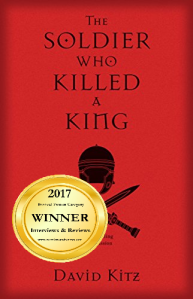
American readers click this link to purchase The Soldier Who Killed a King.

Canadian readers click this link to purchase The Soldier Who Killed a King directly from the author.

Excerpt 27 for Lent from The Soldier Who Killed a King

27 Tuesday Mar 2018

Posted by davidkitz in Books by David Kitz, Christ's Passion, Lent

≈ 1 Comment

Tags

blood, Caesar, Caiaphas, Christ, crucify, David Kitz, Golgotha, high priest, innocent, Jesus, king, Lent, Messiah, Pilate, repentance, trial of Jesus, verdict

A journey to the cross is a journey to repentance. It’s a journey to deep personal change. Will you take this journey with me?

Date: Eight forty in the morning, Friday, April 7 30A.D.
The trial of Jesus ends. The verdict is delivered.

Pilate was already seated, ready to pronounce judgment. A thin smile was now on his face. The cunning Badger would make the most of his final moves. When Jesus was in position, he began. Once more he motioned in the direction of the Christ, and to all assembled he announced, “Here is your king.”
“Take him away!” came the instant response. “Take him away! Crucify him!”
There was vehement insistence coming from the crowd. Some began to hurl dust in theBiblical fiction winner 2017 air. This was verging on a riot, a point that was surely obvious to the governor, yet he played them on.
“Shall I crucify your king?” Pilate called back to the throng.
“We have no king but Caesar,” the Weasel spat back.
The Badger’s eyebrows shot up.
The governor smiled and nodded. It was a smile of triumphant satisfaction. We have no king but Caesar. The Badger mulled over these words. I knew he had waited years for these words. After all he had endured in this place, wasn’t it well worth hearing this confession from the high priest’s mouth?
Ironically, the governor had Jesus to thank for the high priest’s sudden conversion and submission to imperial Rome. This declaration would never have come forth from the Weasel’s lips, except to secure the conviction of the good Galilean. Caiaphas was willing to stoop before Rome in order to spill the blood of this prophet. Here was the true measure of his hatred for the Northern Messiah.
Pilate knew all this, and he drew a good measure of perverse satisfaction from it. He understood his foe.
He called for his personal attendant to bring a basin of water. Now he would lay the blame where the bloody blame belonged. With the attendant holding the basin before him, Pilate made a great show of washing his hands before the crowd, and with insistence in his voice, he declared, “I am innocent of the blood of this man.”
Here was the feint, the great pretend.
Next came the dodge.
With water still dripping from his hands, he looked out over the crowd and declared, “You yourselves see to it.”
He spoke as though he had abdicated—bore no responsibility for the blood that now trickled down Jesus’s back. He absolved himself of that and of all that would soon flow on Golgotha.
This Badger could throw a bit of dirt.
Free WW-e FACEBOOK-2 (2)
It was fitting for Annas the aged priest to respond. It was he who answered for the people. With his finger pointed at Jesus and his gaze fixed on him, he replied, “His blood be on us.” Then he paused as though looking down through the generations of time. “And on our children,” he added with a cold, sardonic stare.
Out on the street the people answered, “Yes!” They nodded their agreement with this verdict.

American readers click this link to purchase The Soldier Who Killed a King.

Canadian readers click this link to purchase The Soldier Who Killed a King directly from the author.

Excerpt 25 for Lent from The Soldier Who Killed a King

23 Friday Mar 2018

Posted by davidkitz in Books by David Kitz, Christ's Passion, Good Friday, Lent

≈ 5 Comments

Tags

Galilee, Herod, Jesus, Jesus of Nazareth, king, King Herod, Lent, majesty, Messiah, prophet, repentance, wine

A journey to the cross is a journey to repentance. It’s a journey to deep personal change. Will you take this journey with me?

Date: Seven fifteen in the morning, Friday, April 7 30A.D.
Jesus is questioned by Herod Antipas.

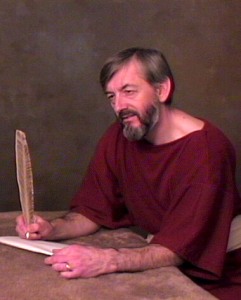
“Jesus of Nazareth,” the Fox pompously intoned. “The prophet of Galilee. I’ve longed to see you, my most noteworthy subject.”
With that Herod arose, and holding his robe shut, he approached the Messiah. He inspected the taller man, walked fully around him. Noticing the welts and the dried spittle, he looked my way and asked, “Is this your work, centurion?”
“No, Your Majesty.” My eyes darted to Jonathon and back to Herod again.
“Ah, the high priest’s work!” the Fox remarked grandly as he turned to Jonathon. “I didn’t think you temple boys were capable.”
This bit of sarcasm drew an acknowledging nod and a slight smile from the chief temple guard. Here was a backhanded compliment from the pretentious Fox.
“Your Majesty, I have here a letter from His Excellency the governor and certain chargesJames Wri brought by—”
The king halted me with an uplifted hand and a shake of his head.
“That can wait, centurion.” He paused, and then with a certain dramatic flourish, he began. “We have here a man of rare talent. He makes the lame to walk, the blind to see, has cured the leper. I have heard reports that he has raised the dead.” And then spotting a gold chalice on the inlaid table, he seized it by the stem and with relish declared, “He has even turned water into wine.”
He lifted the chalice before the Messiah and grandly asked, “Isn’t that so, Jesus?”
The Messiah did not answer him a word.
If Herod was perturbed by this silence, he didn’t show it. “Servant girl!” he hollered. “Servant girl!”
An attractive young woman entered from the door on the left, and with short, quick steps, she made her way before the tetrarch. She bowed low.
“Fill this chalice with water and bring it back.”
He stared after her as she left.
I noticed Herodias following his hungry gaze.
“Soon we will see if this prophet can perform the works of which we heard.” He nodded his head with an eager enthusiasm. Then addressing Jesus, he asked, “Tell us of your magic arts.”
The Messiah fixed his eyes straight ahead. He looked beyond the Fox and did not answer him a word. His silence was challenging enough.
4485 TWITTER

American readers click this link to purchase The Soldier Who Killed a King.

Canadian readers click this link to purchase The Soldier Who Killed a King directly from the author.


Excerpt 23 for Lent from The Soldier Who Killed a King

21 Wednesday Mar 2018

Posted by davidkitz in Books by David Kitz, Christ's Passion, Good Friday, Lent

≈ 1 Comment

Tags

governor, Jesus, Jewish, king, kingdom, Messiah, Pontius Pilate, prophet, repentance, truth

A journey to the cross is a journey to repentance. It’s a journey to deep personal change. Will you take this journey with me?

Date: Six fifty in the morning, Friday, April 7 A.D.
Jesus trial before Pontius Pilate continues.

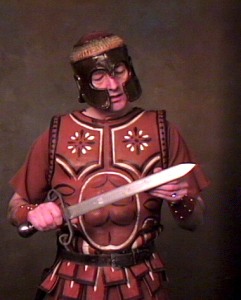
When we entered the judgment hall, the dark-eyed Badger was seething. He knew Caiaphas was using him. He had said so to the assessor. He let fly a string of profanity. “He has me trapped!” he snarled. “Trapped like a rat in a stone water jar.” And with that he tossed the list of charges onto his desk.
James ThtThen he turned to Jesus in the center of the room. He looked him over, walked fully around him. Pilate sighed and nervously ran his fingers through his thinning hair. He made a smacking sound with his lips and asked, “Are you the king of the Jews?”
“You have said so,” came his equivocal answer.
This answer left the governor rocking on his heels. He brought a finger to his lips in pensive thought.
Jesus was not making an acquittal any easier.
But after a moment Jesus continued. “Is that your own idea, or did others talk to you about me?”
“Am I a Jew?”
Pilate shot back with an ample measure of haughty contempt. “Your own people and chief priests handed you over to me.” He continued the questioning. “What is it you have done?”
“My kingdom is not of this world,” Jesus said, and to drive home this point, he added, “If it were, my servants would fight to prevent my arrest by the Jewish leaders. But now my kingdom is from another place.”
Certain words that Claudius had spoken came echoing back into my mind. He had been convinced that this kingdom Jesus spoke of was somehow different from kingdoms as we know them. Now I heard it from this would-be Messiah’s mouth. He was no armed insurrectionist, and he had offered the actions of his followers as proof.
But Pilate seized on that word—kingdom. “You are a king, then!” Pilate deduced.
With calm, clear deliberation the prophet spoke. “You say that I am a king. In fact, the reason I was born and came into the world is to testify to the truth. Everyone on the side of truth listens to me.”
It almost seemed from this response that Jesus was operating from, and speaking on,Biblical fiction winner 2017 some higher plane—a dimension I had witnessed him operate from during the healings at the temple. He was inviting Pilate to join him in discovering this higher ground of truth.
Pilate would not be moved. They were speaking past each other.
“What is truth?” Pilate shrugged. The question was rhetorical. He had no intention of being dragged into a philosophical discussion with this prophet of the Jewish masses. Once again, the Badger retreated.
Grabbing the list of charges from off his desk, he motioned for us to follow him back outside.

American readers click this link to purchase The Soldier Who Killed a King.

Canadian readers click this link to purchase The Soldier Who Killed a King directly from the author.


Excerpt 21 for Lent from The Soldier Who Killed a King

19 Monday Mar 2018

Posted by davidkitz in Books by David Kitz, Christ's Passion, Good Friday, Lent

≈ 1 Comment

Tags

arrested, Caiaphas, centurion, high priest, Jerusalem, Jesus of Nazareth, Lent, Longinus, Marcus, Pontius Pilate, repentance, The Soldier Who Killed a King

A journey to the cross is a journey to repentance. It’s a journey to deep personal change. Will you take this journey with me?

Date: Five forty-five in the morning, Friday, April 7 A.D.
In today’s reading, a messenger from Pontius Pilate arrives at the home of Marcus Longinus, the Roman centurion, with the news that Jesus has been arrested.

“Sir, I have just come from the governor. You are to report to the Praetorium immediately. Jesus of Nazareth has been arrested. The high priest has brought him before the governor for judgment.”
“Is that so?” I said in a state of consternation. “Who sent you?”
“The governor himself. He said you were familiar with the Galilean.”
I blew a short puff of air through my nostrils. All of Jerusalem was somewhat familiar with the Galilean.
“So he wants me there immediately?”
“Immediately, sir.” He shifted from one foot to the other and then, as if to justify thisCentur. Sw response, he added, “The high priest and a big delegation, maybe three hundred men, maybe more, arrived at the palace door at first light. They had the prisoner—Jesus—with them.”

“Tell the governor I’m on my way.”
With a quick nod of my head, I dismissed the messenger. Instantly he turned and began his run back to the governor’s residence. I took one step back inside the gate and began barking orders.
“You, you, and you!” I stabbed my index finger in the direction of the most dressed and prepared-looking soldiers. “Strap on your swords and follow me. Now!”
Then, addressing the other soldiers, I announced, “The rest of you, meet me at the Praetorium as soon as you are ready.”
“Claudius”—I nodded in his direction—“you are in charge. I’ll give everyone their assignment for the day when they get there.”
I stepped back through the gate and began covering the ground with long, quick strides. My three recruits had to run to catch up. With each stride a new thought came jogging into my head. Stupid Arius! Why didn’t he tell me the messenger was from Pilate? I would have moved a good deal faster.
Obviously my concerns about the prophet had moved up the chain of command. Flavio must have informed Pilate about my worries and the actions I had taken, hence this unusual move—a direct summons by the governor. I harbored the hope that he would consult directly with me on the matter. Three hundred men! Three hundred men at first light? The Weasel must have had a busy night. It takes a good deal of effort to set your troops in array. Caiaphas must have been hatching this plot for a good long while. 4485 TWITTER
But the Weasel caught his prey! What a sweet bit of treachery that must have been. I wondered how he pulled that off. Now the high priest would move in for the kill. We would see if he could slaughter his own Passover lamb. The people! If the pilgrims, especially the Galilean pilgrims, knew their Messiah had been seized, there could be a mass revolt. That must be why the Weasel had done his dirty work in the dark of the night. And furthermore, he had played out this drama at the zenith of the festival, while minds and hearts were on faith, home, and family. Here was a cunning scheme worthy of the Fox, played out by the Weasel.
Undoubtedly most of the population would still be unaware of these developments, even as I had been caught off guard. Off guard but not surprised. I could smell this coming.
My conversation with Renaldo at the bathhouse came echoing back. It gave me an eerie feeling knowing I had spoken like some prophetic oracle. It made me wonder from where that insight had really come.
“By Jupiter! I forgot the spikes.” I wheeled around while reaching out my hand to halt the soldier at my side. Addressing him directly, I said, “I forgot them—the spikes. They’re in a pouch hanging on a peg in my bedchamber. My wife, she’ll know where they are. Ask her to get the pouch for you. Then bring it to me at the Praetorium. Oh, and tell the other men to hurry. This is urgent.” I fixed my eyes on him to stress the importance of this last statement and then added, “Now run.”

American readers click this link to purchase The Soldier Who Killed a King.

Canadian readers click this link to purchase The Soldier Who Killed a King directly from the author.

Excerpt 20 for Lent from The Soldier Who Killed a King

16 Friday Mar 2018

Posted by davidkitz in Books by David Kitz, Christ's Passion, Friday's Focus, Lent, The Soldier Who Killed a King

≈ 1 Comment

Tags

Caesar Augustus, Caiaphas, Galilee, Herod Antipas, Herod the Great, Herodias, kings, Messiah, Pontius Pilate, power, repentance

A journey to the cross is a journey to repentance. It’s a journey to deep personal change. Will you take this journey with me?

Date: Mid afternoon on Thursday, April 6th, 30 A.D.
In today’s reading, Governor Pontius Pilate gives a brief speech formally welcoming Herod the tetrarch to Jerusalem.

At last the two mounted commanders arrived before Pilate’s chariot. They were motioned to take their position on either side. After a brief confusion of feet, the royal litter managed to turn sideways so the royal couple could face the governor as he stood upon his imperial chariot. The trumpeters sounded the fanfare. When the last note had echoed off the marble wall, Pilate unrolled the parchment handed to him by an attendant. He cleared his throat and began his oration.
Free WW-e FACEBOOK-2 (2)
“It was under the rule of the great and wise Emperor Caesar Augustus that this magnificent temple behind us began to take shape. He recognized the desire of the Jewish people for a central place to worship. It was Herod the great Idumean king who oversaw the construction of this masterpiece of the empire, and today it stands as a symbol of Roman respect for the unity and diversity of all the peoples of the empire. It is only fitting today that I, as the emperor’s representative, welcome the son of this master builder, Herod Antipas, the tetrarch of Galilee and Perea.”
With a wave of his hand, Pilate signaled the sounding of a second trumpet fanfare. As the first note was sounded, he stepped off the chariot and then graciously lent a hand to his wife. Thus accompanied by his mate, he swaggered over to the royal litter to personally greet Herod and Herodias, who both stood to meet them.
Greetings were exchanged, none of which I could discern from a distance. After a brief discussion Claudia joined Herodias in the royal litter. Herod barked out some orders. The litter bearers stood to their feet and headed off in the direction of the governor’s residence. Apparently the ladies would have their own time together.
At a leisurely pace Pilate escorted Herod over to where the priestly delegation waited.Soldier book
It was an unusual sight, these three hostile, inflated men exchanging greetings and meaningless pleasantries. Herod Antipas, Pontius Pilate, and Joseph Caiaphas; the Fox, the Badger, and the Weasel. All three were kings in their own right, within their own jurisdiction. All three craved more power, absolute power, while fiercely holding one another in check.
Pilate turned to me and gave a quick, tight nod. I signaled up to Claudius, and the great Golden Gate, the Messiah Gate, was hoisted, granting entrance to the three competing kings.
Only the fourth king, the people’s king—the donkey king—only he was absent.

American readers click this link to purchase The Soldier Who Killed a King.

Canadian readers click this link to purchase The Soldier Who Killed a King directly from the author.


Excerpt 19 for Lent from The Soldier Who Killed a King

15 Thursday Mar 2018

Posted by davidkitz in Books by David Kitz, Christ's Passion, Lent, The Soldier Who Killed a King

≈ 1 Comment

Tags

Caiaphas, centurion, Claudia Procula, governor, Herod, Herod the tetrarch, high priest, King Herod, Pontius Pilate, repentance, Savior

A journey to the cross is a journey to repentance. It’s a journey to deep personal change. Will you take this journey with me?

In today’s reading, the rivalry and tension between the Governor Pontius Pilate, and Joseph Caiaphas, the high priest are on full display. The two leaders are waiting for the official arrival of Herod the tetrarch. Date: Mid afternoon on Thursday, April 6th, 30 A.D.

When all were in position, I called for the lowering of the heavy, grated iron gate. From now on, the Passover celebrants would be forced to use an alternate entrance or exit.
In short order the toga-clad governor, Pontius Pilate, arrived on his gold-ornamented chariot. The gate was raised. By the governor’s side stood Claudia Procula lavishly dressed in full-length scarlet. Her bejeweled opulence contrasted sharply with the poverty common to most women of this province. The chariot took a position allowing the ruling couple to look out to the Mount of Olives, in readiness for the approaching king.
The only missing player was Caiaphas. In due time his delegation arrived, and the enormous gate was hauled up once more on creaking chains, only to be lowered again when the priestly party had exited.
4485 TWITTER
Pilate had been gazing down the road stretched out before him when Caiaphas arrived, and it was only the coarse rattle coming from the gate chains behind him that alerted him to the approach of the high priest and his delegation. He turned, stepped down from the chariot, and briskly strode over to the dumbfounded cleric. The expression on Caiaphas’s face said it all. He clearly did not expect to see Pilate here. He had intended this to be a discreet, private tour and consultation.
“You’re expecting someone?” Pilate brusquely inquired.
An uncomfortable pause followed. Caiaphas cast a hasty glance at those accompanying him, adjusted the folds in his robe, cleared his rusty throat, and replied, “Yes, King Herod requested a tour of the great temple.”
“Did he now?” There was a coldness in Pilate’s voice that betrayed the utter contempt he felt toward this Jewish leader. “Ahh!” He gestured grandly. “There is no king in these parts. I know of no king.” Then spotting me on horseback nearby, the governor turned and in mock sincerity called out, “Centurion. Is there a king around here?”
“We have no king here but Caesar,” I answered, joining in the sport.
“The centurion says there is no king but Caesar. Do you have some other king I’m unaware of? Perhaps I should meet this king.”
By now the high priest was well beyond flustered. He had stepped into a trap. Surrounded by Roman troops and cut off from the safety of the temple’s hallowed sanctum, he was now being hectored by his chief political rival. It seemed more than he could endure. He began to tremble uncontrollably, whether from fear or anger I could not tell.
“Your Excellency”—he swallowed hard—“I was referring to the . . . te-tetrarch of Galilee.” 
“The te-tetrarch?” Pilate mimicked not only the high priest’s tremulous stammer, but also the rusty-gate scratch of his voice. “Is that so? Well, the tetrarch is no king. And he certainly isn’t your king.” Then with slow, icy deliberation, Pilate said, “There is no king here but Caesar. Did you hear that?”
This was no rhetorical question. “Yes, Your Excellency. I heard.”Biblical fiction winner 2017
“Do you, any of you”—he scanned the delegation—“have any other king?”
The cowering dogs dutifully answered, “No, we have no other king.”
Caiaphas, however, was silent. A fact well noted by the governor.
Then Pilate took a step closer to the trembling priest, pointed a bony finger in his face, and hissed, “Now don’t forget that, you old goat, or your blood will be running down the Kidron! Did you hear that?”
“I . . . I am your servant, Your Excellency,” Caiaphas rasped.
“Ha!” Pilate laughed an icy laugh in a show of disdain for that remark. Then he turned on his heels and marched back to his chariot, where once more he joined his wife.
For a full minute there was stunned silence from the religious delegation, and then suddenly they all began to speak at once in a huddle of hushed tones like schoolboys after a tongue-lashing from the headmaster.
But there was murder in the high priest’s eye. Nothing childish there. From my vantage point I could see that. He didn’t have the means, but he most certainly had the intent.
I am sure that if the gate had been open, the delegation would have returned to the safety of the sanctuary to plot their revenge, but that option was not open to them. They were trapped in this pocket, surrounded by hated foreign troops, subject to the whim and ridicule of their enemy, awaiting the arrival of their pretentious savior king.
Long, awkward moments passed. But they were saved from this interminable purgatory by Herod’s arrival.

American readers click this link to purchase The Soldier Who Killed a King.

Canadian readers click this link to purchase The Soldier Who Killed a King directly from the author.

Excerpt 18 for Lent from The Soldier Who Killed a King

14 Wednesday Mar 2018

Posted by davidkitz in Books by David Kitz, Christ's Passion, Lent, Mid-Week Medtiation

≈ Leave a comment

Tags

blind, demon, God, Jesus, Jewish, king, Kingdom of God, Messiah, miraculous, Pool of Siloam, power, repentance

A journey to the cross is a journey to repentance. It’s a journey to deep personal change. Will you take this journey with me?

In today’s reading, Marcus, the centurion, rides back into Jerusalem on horseback. As he rides his mind turns over his thoughts about Jesus of Nazareth. Date: Near noon on Thursday, April 6th, 30 A.D.

We continued on to the fortress, but my mind was on the Northern Messiah. His penetrating eyes haunted my thoughts. There was a power there that I had no ability to fathom. I was reminded of Ruth’s words. Ruth was one of our household servants, a Jewish girl. When at the supper table I had told Zelda about Jesus and his miraculous powers, Ruth’s eyes brightened. I asked her if she knew anything about this man.
biblical-fiction-award-2017_orig“Oh, yes,” she’d said. “Almost a year ago he healed a blind beggar from the Lower City. Jesus made some mud, put it on the beggar’s eyes, and sent him to wash in the Pool of Siloam. When he washed, he could see. It was a miracle. I’ve seen this man myself. I know it’s true,” she earnestly avowed.
When I’d asked her about this power Jesus had and where it came from, she bowed her head and answered, “From God.”
But she seemed somehow uncomfortable with her answer. She added, “It must be from God. He does good things. But our leaders aren’t sure. They think it may be demon power. But demons don’t heal the sick.”
Maybe the religious leaders were right. Maybe it was demonic power that made the blind see. It seemed preposterous. But why had I heard this voice? Why did this man trouble me so? Thinking of him seemed to stir up nothing but torment within me, and I didn’t even know why. I felt strangely attracted to him, yet at the same time repelled.
Then there was this talk about the kingdom of God. Maybe Timaeus was right about this prophet. The words of the wealthy merchant came back to me: “You don’t talk about a kingdom in this place and get away with it. Rome will see to that!”
Maybe we would see to it. Maybe we should see to it soon. But Jesus’s enemies were the same pompous, self-serving leaders I despised. He had aligned himself with the common man, with the poor, the oppressed, the sick and suffering. And he didn’t just champion their cause for personal benefit like some crass politician lobbying for the emperor’s favor. No, he healed them. He fed them. He walked with them, ate with them. He was one of them. He was their king, whether he wore a crown or not. I saw that clearly when he entered on the donkey. He was the donkey king. A horse would have put him above the crowd. A horse would have meant elevating himself like all the other egotistical men who led in this upside-down world.
In his case others would have to do the elevating.
The meaning of his entry on Sunday came clear to me now. It was a perspective gained from my comfortable perch on the back of my own noble steed.
By the time I reached the fortress for the second time in the week, I resolved to shut this Messiah out of my mind. He didn’t fit any of my categories for human behavior or religious thought. He was beyond understanding, an unwelcome intruder into my city and my thought life.

American readers click this link to purchase The Soldier Who Killed a King.

Canadian readers click this link to purchase The Soldier Who Killed a King directly from the author.


Excerpt 17 for Lent from The Soldier Who Killed a King

13 Tuesday Mar 2018

Posted by davidkitz in Books by David Kitz, Christ's Passion, Lent, The Soldier Who Killed a King

≈ 1 Comment

Tags

Barabbas, Caesar, Caiaphas, centurion, Golgotha, Jerusalem, Jesus, Kidron Valley, Messiah, prophet, repentance, Romans, Rome, sinners, tax collector, temple

A journey to the cross is a journey to repentance. It’s a journey to deep personal change. Will you take this journey with me?

In today’s reading, Marcus, the centurion, meets with Jonas the tax collector. They discuss the news of the week, namely the huge stir that Jesus has caused in Jerusalem since his triumphal entry into the city. Date: Early morning April 6th, 30 A.D.

As I descended the stairs of the gate, I caught sight of Jonas and his son, unoccupied at the customs booth. With a quick wave of my hand, I signaled my intention to speak with him, and after taking the salute of the sentinels at the gate, I headed straight to the booth. “Good morning, you old goat!” I called out as I approached.
“Well, if it isn’t the top dog himself,” he shot back.
“It’s always good to see a man standing around doing nothing. It sets me at ease,” I said. “Ease?” His eyebrows shot up. “Oh yeah.” He nodded emphatically. “It’s been a week of ease all right. I’ve had my feet up all week.”
Of course, just the opposite was true, and it was true for both of us.
Free WW-e FACEBOOK-2 (2)
“Do you think we could have a short word?” With a jerk of my head, I motioned in the direction of the road leading down the Kidron Valley.
“Sure,” he answered, and then with a glance and a nod to his son, he transferred responsibility to him. A light mist still hung over the lowest reaches of the valley, but the early-morning sun was promising to burn it off. The swallows nesting along the crevices in the city wall were engaged in a full-throated competition with the songbirds in the trees along the brook. Traffic to and from the city was just beginning to stir.
When we had gone a few paces beyond the gate, I spoke. “I just wanted to say thanks for the help with the Barabbas case.”
“Oh, don’t mention it.” There was relief in his voice. “I thought you were going to warn me about some new plot.”
“No, there’s no new plot.” I hesitated. “Let me rephrase that. There’s no new plot that I know about. You never can be sure what’s being hatched in this crazy city.”
“Yeah, you’re right about that. I guess we learned that with Barabbas.” Jonas nervously bit on the corner whiskers of his mustache, and then continued. “Now, that Galilean prophet? I’ve been losing sleep over him all week.”
“Harmless as a dove,” I said. “Harmless as a dove.”
“How do you know?”
“I checked him out myself on Monday, right back there in the temple courts.” I made a quick double-pump motion with my upraised thumb aimed over my shoulder. “Then on Tuesday I had Claudius in there with the prophet.”
“You Romans have more nerve than brains.” He kicked a loose pebble off the pathway, looked up at me with a quizzical grin, and then with an incredulous shake of his head, he repeated, “More nerve than brains, that’s all I can say.”
“If we didn’t have nerve, we wouldn’t be running this place. Or any other place for that matter.”
He shrugged, furrowed his brow, and then cocked his head to one side. It was his way of reluctantly conceding my point.
“So he’s harmless?”
“Harmless to us.” With my index finger, I pointed first at myself, then at Jonas, and then back again. “Caiaphas, on the other hand”—I paused for effect—“now there’s a man who I’m sure hasn’t slept well all week.”
“So you think the old rusty gate has lost some sleep? Over what?”
“Money. Money and prestige. It can’t look too good having some roving up-country rabbi come in and take over your temple at the religious high point of the year.”
“I suppose not,” Jonas said. But then he added, “You know this prophet, Jesus of Nazareth, he’s been here before. He kicked out the money changers a few years back. Caused quite a stir then. But nothing like this. He’s got the temple guards running scared. That’s what my uncle told me.”
James Tht“Your uncle’s right. I saw that firsthand on Monday. So what else do you know about this Galilean?”
“My wife tells me he’s a friend of tax collectors and sinners. She told me one of his disciples was a tax collector before he met the prophet.”
“Ah, tax collectors and sinners?” I responded with a wink and a nod. “Maybe there is hope for the two of us yet.”
Jonas smiled back at me. “So, Marcus, where is this all headed? Some people think he’s the Messiah. You know that, don’t you?”
“Yes, we’re well aware of that. But he doesn’t oppose paying taxes to Caesar.” I gave my tax collector a supportive thumbs-up signal. “And he hasn’t spoken a word against Rome since he’s been here.”
“That’s not a surprise. He knows better. You and your boys would have him nailed up on Golgotha the moment he did.”
“You’re right about that,” I agreed. “But I honestly don’t think he’s got a quarrel with us. He’s going after the parading hypocrites in long, flowing robes, those killjoy Pharisees and teachers of the law. You know the ones—the religious police who run this place.”

American readers click this link to purchase The Soldier Who Killed a King.

Canadian readers click this link to purchase The Soldier Who Killed a King directly from the author.


Excerpt 15 for Lent from The Soldier Who Killed a King

09 Friday Mar 2018

Posted by davidkitz in Books by David Kitz, Christ's Passion, Lent

≈ 1 Comment

Tags

Caiaphas, David Kitz, Jesus, Jesus of Nazareth, Kingdom of God, Lent, prophet, repentance, The Soldier Who Killed a King

A journey to the cross is a journey to repentance. It’s a journey to deep personal change. Will you take this journey with me?

In today’s reading, Marcus continues his conversation with his nephew, the young soldier Claudius. Claudius is reporting on the activities and the message of Jesus of Nazareth on Tuesday of Holy Week.

But Claudius wasn’t done.
“You know about this kingdom notion,” he said. “Jesus told another story, and it helped me catch what he was driving at. He talked about a landowner who planted a vineyard and then went away. He rented the land out to farmers, but when he sent servants to collect the rent, the farmers would beat the servants or kill them. Finally, in desperation he sent his own son to collect the rent, thinking the farmers would respect him. But the renters said, ‘Let’s kill him and the land will be ours.’ So they took the son outside the vineyard and killed him.
“Then Jesus asked the people around him what would happen to those renters when the owner came back. They answered that the landowner would kill those miserable renters and give the vineyard to someone else who would pay him on time.
“Jesus said they were right. And then he said, now catch this”—Claudius gestured with an upraised index finger—“‘The kingdom of God will be taken away from you and given to a people who will produce its fruit.’ Those were his very words.”
“So what did he mean by that?” I asked, quite mystified.
Free WWe SHARABLE-1 (2)“I wasn’t too sure myself at first. I knew he said this as a rebuke to the high priest and the religious establishment. Everyone there knew he was telling this story against them. But later I asked the man beside me what he thought Jesus meant by this parable. He said the landowner was God, the religious leaders were the renters, and the servants who came to collect the rent were the prophets of the past. We just weren’t sure who the son was. I suggested that Jesus himself might be the son. But he just looked at me like I was a complete idiot, shook his head, and said, ‘God doesn’t have a son.’ I kept my mouth shut after that.”
“Well then,” I surmised, “this prophet, this Jesus, really has set himself up in opposition to the religious authorities. If he’s publicly predicting the end of their rule, he has picked a fight with them.”
I sucked in a long, slow breath. “And, Claudius”—I nodded in his direction—“it’ll be a fight to the finish.”
I continued as my mind caught the implications of my own words. “Jesus may have the people or at least a good number of the common people on his side. But Caiaphas is nobody’s fool. He’s got money and power behind him. The son in that story, if that’s who Jesus is”—I gestured with an upraised open palm—“he might yet be taken out and killed.”

American readers click this link to purchase The Soldier Who Killed a King.

Canadian readers click this link to purchase The Soldier Who Killed a King directly from the author.

← Older posts
Newer posts →

Psalms 365: Develop a Life of Worship and Prayer

Psalms 365 Volume II

Psalms 365 vol 3
— Psalms 365 Volume III

Psalms

Recent posts

  • What brings success? March 16, 2026
  • A Prayer to the God of My Life March 15, 2026
  • A House Divided March 15, 2026
  • Longing for God March 14, 2026
  • A New Command March 13, 2026
  • Altered by the Altar March 13, 2026
  • Judas Took the Bread March 12, 2026

Calendar

March 2026
M T W T F S S
 1
2345678
9101112131415
16171819202122
23242526272829
3031  
« Feb    

Blog Posts

Comments

  • davidkitz on A House Divided
  • davidkitz on A House Divided
  • atimetoshare.me on A House Divided

Blog at WordPress.com.

Privacy & Cookies: This site uses cookies. By continuing to use this website, you agree to their use.
To find out more, including how to control cookies, see here: Cookie Policy
  • Subscribe Subscribed
    • I love the Psalms
    • Join 1,382 other subscribers
    • Already have a WordPress.com account? Log in now.
    • I love the Psalms
    • Subscribe Subscribed
    • Sign up
    • Log in
    • Report this content
    • View site in Reader
    • Manage subscriptions
    • Collapse this bar
 

Loading Comments...