• Home
  • About
  • DavidKitz.ca
  • Youtube Videos
  • Books by David
  • Books on Amazon.com

I love the Psalms

~ Connecting daily with God through the Psalms

I love the Psalms

Tag Archives: Savior

Send Your Spirit, LORD

23 Monday Apr 2018

Posted by davidkitz in Bible, Devotionals, Psalm 104, Psalms

≈ 2 Comments

Tags

Christ, church, faith, funeral, Jesus, Landestreu, meditation, praise the LORD, resurrection, Savior, sinners, spirit, the grave, the LORD

Reading:                                     Psalm 104              

 (Verses 27-35)
All creatures look to you
    to give them their food at the proper time.
When you give it to them, they gather it up;
when you open your hand, they are satisfied with good things.
When you hide your face, they are terrified;
when you take away their breath, they die and return to the dust.
When you send your Spirit, they are created,
    and you renew the face of the ground.
May the glory of the LORD endure forever;
    may the LORD rejoice in his works—
he who looks at the earth, and it trembles,
    who touches the mountains, and they smoke.
I will sing to the LORD all my life;
    I will sing praise to my God as long as I live.
May my meditation be pleasing to him,
    as I rejoice in the LORD.
But may sinners vanish from the earth
    and the wicked be no more.
Praise the LORD, my soul. Praise the LORD (NIV).

Reflection
Recently, my wife and I attended the funeral of my brother-in-law, Victor. He was a man of deep faith, who was always active in the church. At no point was he ashamed to call himself a follower of his Lord and Savior, Jesus Christ. Victor loved his Savior and I am sure his spirit rejoiced to see Jesus face to face.

d-adam-4

Landestreu graveside sunrise — photo courtesy of Donald Adam

There is a line from today’s reading from Psalm 104 which is particularly relevant as we think about life and death: when you take away their breath, they die and return to the dust. When you send your Spirit, they are created, and you renew the face of the ground.

In context of this psalm, the author was speaking of all creatures, in other words the animal kingdom, but these words apply to all that breathe the breath of life, including humans. For Victor, who struggled for every breath during the last years of his life, the words of this psalm had true meaning. But the second part of this psalm reading is also pertinent in the context of a funeral: When you send your Spirit, they are created.

I believe in the resurrection of the dead. The grave is not the final end for those who have placed their faith in Christ. A great re-creation will happen. The grave could not hold Jesus, and a day is coming when it will not hold Victor, or any who have died in the faith. For the Lord himself will come down from heaven, with a loud command, with the voice of the archangel and with the trumpet call of God, and the dead in Christ will rise first (1 Thessalonians 4:16).  

Response: Father God, send your reviving Spirit. Come, Lord Jesus. I long for your return. Amen.

Your Turn: Do you believe in the resurrection of the dead? Who do you long to greet on the other side?

Do you have a blameless heart?

05 Thursday Apr 2018

Posted by davidkitz in Bible, Devotionals, Psalm 101, Psalms

≈ Leave a comment

Tags

adultery, Blame, blameless, commitment, David, goals, holiness, Jesus, justice, legalistic, love of God, loving, murder, repentance, Savior

Reading:                                     Psalm 101                                                                   

Of David. A psalm.
(Verses 1-4)
I will sing of your love and justice;
to you, L
ORD, I will sing praise.
I will be careful to lead a blameless life—
when will you come to me?
I will conduct the affairs of my house
with a blameless heart.
I will not look with approval
on anything that is vile.
I hate what faithless people do;
I will have no part in it.
The perverse of heart shall be far from me;
I will have nothing to do with what is evil
(NIV).

Reflection
Psalm 101 is a call to action or commitment. David, the author of this psalm, commits himself to a course of action. In this short opening portion of the psalm, David makes seven ‘I will’ statements. Each commitment is life altering in some way.

2018-04-04 Liz Kranz

Early April snowfall — photo courtesy of Liz Kranz

The first commitment David makes is to sing of the LORD’s justice and love. He is determined to praise his God with a full, joyous awareness of the LORD’s character. This is the true starting point of any sustained relationship with God. The LORD is both loving and just. If we emphasize aspects of God’s justice too much, we risk becoming legalistic. If we focus only on the love of God, His holiness is ignored resulting in a break down in personal responsibility. Within the Godhead there exists a perfect tension between His justice and His love. As God’s servants, we do well when we recognize and maintain that tension.

Twice David uses the word blameless. I will be careful to lead a blameless life—when will you come to me? I will conduct the affairs of my house with a blameless heart. With these words, David has set for himself a high standard—an impossible standard. Did David succeed in reaching his lofty goal? The biblical record leaves no room for doubt. He failed miserably. In his affair with Bathsheba, King David was guilty of both adultery and murder.

Well, what good is there then in setting lofty goals? Why make any ‘I will’ statements, if I am doomed to fail? Why not freely look on the vile and indulge in it?

Actually, despite David’s stunning failures, there are many sound reasons for calling ourselves to a high standard. To put it bluntly, God expects it of us. He demands holiness from us—always has—always will. Will we succeed? Of course not. That’s why there’s the gift of repentance. That’s why there’s a Savior named Jesus. He’s the blameless one. I need his sinless record applied to my account.

Response: Dear God, I want my will to be conformed to your will. I want to lead a blameless life. By Jesus’ blood, grant me a blameless heart that is determined to love and serve you for all my days. Amen.

Your Turn: Should we set goals for ourselves? How do you measure the progress in your love for God?

The LORD Has Made His Salvation Known

29 Thursday Mar 2018

Posted by davidkitz in Bible, Devotionals, Lent, Psalm 98, Psalms

≈ 2 Comments

Tags

blood of Christ, death, hell, Jesus, joy, love, love of God, New Testament, Psalm, psalmist, resurrection, Righteousness, salvation, Savior, sin, sing praise, singing, song, surrender, the cross, the grave, the LORD

Reading:                                     Psalm 98

A psalm.
(Verses 1-6)
Sing to the LORD a new song,
for he has done marvelous things;
his right hand and his holy arm
have worked salvation for him.
The L
ORD has made his salvation known
and revealed his righteousness to the nations.
He has remembered his love
and his faithfulness to Israel;
all the ends of the earth have seen
the salvation of our God.
Shout for joy to the LORD, all the earth,
burst into jubilant song with music;
make music to the LORD with the harp,
with the harp and the sound of singing,
with trumpets and the blast of the ram’s horn—
shout for joy before the L
ORD, the King (NIV).

Reflection
Once again in Psalm 98 the psalmist calls us to break forth with a new song of praise to our God. This call to worship is a frequent theme in many psalms. In this case the cause for worship is well worth noting. We are to worship in music and song because of the salvation of our God. The LORD has made his salvation known and revealed his righteousness to the nations. He has remembered his love and his faithfulness to Israel; all the ends of the earth have seen the salvation of our God.

Title_March_20183

Photo credit Book Fun Magazine

To some extent these words trouble me. What salvation is the psalmist talking about? Is he referring to the miraculous redemption and rescue of Israel from slavery in Egypt? That’s the most significant act of national salvation in the Old Testament. On the other hand, the psalmist could be referring to the restoration of the Jewish nation after the destruction of the temple and the Babylonian captivity. Again this is a very significant event that was witnessed by the surrounding nations. Since we do not have a timeline or date for when this psalm was written, we are left guessing the answer.
For the New Testament believer we see the fulfillment of this psalm in the salvation that was won for us by Christ at the cross. There the ancient powers of sin, hell and the grave were defeated. Death itself was vanquished through the resurrection of Jesus. In reality, the true enemies of the people of God are not foreigners or foreign nations. Our enemies are spiritual; they lurk within—within us. Salvation from those enemies was purchased at the cross with the precious blood of Jesus.

Now here is a bizarre twist. Salvation arrives with our surrender. It arrives when we surrender our lives to our Savior and kneel before our King on a cross. That’s a salvation worth singing about!

Response: LORD God, I am so grateful for the salvation you purchased for me through the blood of Jesus. I want all the ends of the earth to know about that great salvation. Thank you, Jesus. Amen.

Your Turn: Have you knelt before the King on a cross? Take some time to do that now.

Excerpt 19 for Lent from The Soldier Who Killed a King

15 Thursday Mar 2018

Posted by davidkitz in Books by David Kitz, Christ's Passion, Lent, The Soldier Who Killed a King

≈ 1 Comment

Tags

Caiaphas, centurion, Claudia Procula, governor, Herod, Herod the tetrarch, high priest, King Herod, Pontius Pilate, repentance, Savior

A journey to the cross is a journey to repentance. It’s a journey to deep personal change. Will you take this journey with me?

In today’s reading, the rivalry and tension between the Governor Pontius Pilate, and Joseph Caiaphas, the high priest are on full display. The two leaders are waiting for the official arrival of Herod the tetrarch. Date: Mid afternoon on Thursday, April 6th, 30 A.D.

When all were in position, I called for the lowering of the heavy, grated iron gate. From now on, the Passover celebrants would be forced to use an alternate entrance or exit.
In short order the toga-clad governor, Pontius Pilate, arrived on his gold-ornamented chariot. The gate was raised. By the governor’s side stood Claudia Procula lavishly dressed in full-length scarlet. Her bejeweled opulence contrasted sharply with the poverty common to most women of this province. The chariot took a position allowing the ruling couple to look out to the Mount of Olives, in readiness for the approaching king.
The only missing player was Caiaphas. In due time his delegation arrived, and the enormous gate was hauled up once more on creaking chains, only to be lowered again when the priestly party had exited.
4485 TWITTER
Pilate had been gazing down the road stretched out before him when Caiaphas arrived, and it was only the coarse rattle coming from the gate chains behind him that alerted him to the approach of the high priest and his delegation. He turned, stepped down from the chariot, and briskly strode over to the dumbfounded cleric. The expression on Caiaphas’s face said it all. He clearly did not expect to see Pilate here. He had intended this to be a discreet, private tour and consultation.
“You’re expecting someone?” Pilate brusquely inquired.
An uncomfortable pause followed. Caiaphas cast a hasty glance at those accompanying him, adjusted the folds in his robe, cleared his rusty throat, and replied, “Yes, King Herod requested a tour of the great temple.”
“Did he now?” There was a coldness in Pilate’s voice that betrayed the utter contempt he felt toward this Jewish leader. “Ahh!” He gestured grandly. “There is no king in these parts. I know of no king.” Then spotting me on horseback nearby, the governor turned and in mock sincerity called out, “Centurion. Is there a king around here?”
“We have no king here but Caesar,” I answered, joining in the sport.
“The centurion says there is no king but Caesar. Do you have some other king I’m unaware of? Perhaps I should meet this king.”
By now the high priest was well beyond flustered. He had stepped into a trap. Surrounded by Roman troops and cut off from the safety of the temple’s hallowed sanctum, he was now being hectored by his chief political rival. It seemed more than he could endure. He began to tremble uncontrollably, whether from fear or anger I could not tell.
“Your Excellency”—he swallowed hard—“I was referring to the . . . te-tetrarch of Galilee.” 
“The te-tetrarch?” Pilate mimicked not only the high priest’s tremulous stammer, but also the rusty-gate scratch of his voice. “Is that so? Well, the tetrarch is no king. And he certainly isn’t your king.” Then with slow, icy deliberation, Pilate said, “There is no king here but Caesar. Did you hear that?”
This was no rhetorical question. “Yes, Your Excellency. I heard.”Biblical fiction winner 2017
“Do you, any of you”—he scanned the delegation—“have any other king?”
The cowering dogs dutifully answered, “No, we have no other king.”
Caiaphas, however, was silent. A fact well noted by the governor.
Then Pilate took a step closer to the trembling priest, pointed a bony finger in his face, and hissed, “Now don’t forget that, you old goat, or your blood will be running down the Kidron! Did you hear that?”
“I . . . I am your servant, Your Excellency,” Caiaphas rasped.
“Ha!” Pilate laughed an icy laugh in a show of disdain for that remark. Then he turned on his heels and marched back to his chariot, where once more he joined his wife.
For a full minute there was stunned silence from the religious delegation, and then suddenly they all began to speak at once in a huddle of hushed tones like schoolboys after a tongue-lashing from the headmaster.
But there was murder in the high priest’s eye. Nothing childish there. From my vantage point I could see that. He didn’t have the means, but he most certainly had the intent.
I am sure that if the gate had been open, the delegation would have returned to the safety of the sanctuary to plot their revenge, but that option was not open to them. They were trapped in this pocket, surrounded by hated foreign troops, subject to the whim and ridicule of their enemy, awaiting the arrival of their pretentious savior king.
Long, awkward moments passed. But they were saved from this interminable purgatory by Herod’s arrival.

American readers click this link to purchase The Soldier Who Killed a King.

Canadian readers click this link to purchase The Soldier Who Killed a King directly from the author.

Bill Pink’s Review of The Soldier Who Killed a King

03 Saturday Mar 2018

Posted by davidkitz in book review, Books by David Kitz, Good Friday, Lent, Psalms

≈ 6 Comments

Tags

centurion, Christ, crucifixion, David Kitz, Easter, Jesus, King Herod, Marcus Longinus, Pontius Pilate, Savior, Scripture, Son of God, trial

It is hard to imagine a more ironic, more chilling dramatic exclamation than the confession of Jesus’ executioner, “Surely, He was the Son of God” (Matt. 27:54).  In The Soldier, David Kitz gives a name to the Roman executioner – Marcus Longinus. Then he gives us an hour-by-hour account of the week in Marcus’ life in the run-up to the fatal hammer blows that drove spikes into Jesus’ broken body.

4485 TWITTER

            As I began to read The Soldier, I wondered if it would be a fascinating documentary of the last week of Jesus’ ministry on Earth. Fascinating it is. The sights, sounds and smells of the Jewish Passover week come to life, from the noisy, smelly commerce in sacrificial animals to the literal river of red sacrificial blood flowing through the temple aqueducts.

Political forces delicately dance in Jerusalem. High Priest Caiaphas, Samaritan King Herod Antipas, and Roman Governor Pontius Pilate, cordial but venomous enemies, vie for control of the holy city. We see and hear the week unfold through Marcus’ eyes and ears. He fears for the very lives of his men as tumultuous crowds swell Jerusalem. Two were recently murdered by Zealot terrorists. Crowds quickly become mobs, and only the iron discipline of his small garrison insulates the city from disaster.

The Soldier soon becomes more than a documentary. Marcus becomes a man we know intimately as husband, father and brave military officer. We see his family and career jeopardized by the mental anguish of post traumatic stress disorder. Horrific visions of bloody murders populate Marcus’ dreams at night and force contemplation of suicide by day.

Jesus rides into this mix of professional anxiety and personal anguish on a donkey. From a great distance He picks Marcus out of a crowd of thousands and speaks audibly to him alone and to him specifically, saying, “I have a future for you.” During the week, Marcus is repelled by Jesus and drawn to Jesus. He fears Jesus’ power over the crowds. He is the dumbfounded eye witness to Jesus’ healing miracles. He rejoices while Jesus humiliates moneychangers and Pharisees. He hopes Jesus will be acquitted by Pilate. He feels almost personally betrayed when Jesus might have saved Himself, but deliberately does not.  Ordered to crucify Jesus, Marcus does so obediently and resolutely.

I could empathize with Marcus. Like Marcus, I was a career soldier. Like him, I had superiors I admired and those I did not. I had peers who were my friends and those I loathed.  I worried about missions I was given when they endangered subordinates I was responsible for, and, admittedly, when they jeopardized my career if they failed. Unlike Marcus, I have not literally whipped my Savior and pierced his flesh with nails. But like Marcus, my personal sins have caused Jesus to suffer pain on the cross.

The Soldier is a two-fold page turner. It is better than an exciting read. Those of usbiblical-fiction-award-2017_orig blessed with a lifetime of church have heard the story of Christ’s trial and crucifixion as often as our lives have seen Easter Sundays. We have read the Biblical account, in all four gospels, many times. Yet, as I turned the pages of The Soldier, eagerly, I also found myself compulsively turning the pages of the Bible to sort out exactly which details of that week Kitz lifts literally from Scripture and which tidbits his imagination supplies. The blend is seamless. For instance, the lame boy Christ heals in Scripture becomes Kitz’ Lucas, a three-dimensional character twice cursed by the world and twice miraculously loved by Christ. What Christian author hopes for more than for it to be said that his work sends readers scurrying into the pages of the Holy Bible?


We are all Marcus. All of us, like Marcus, have heard Jesus promise us a future. We have all been drawn to Jesus and been afraid of Jesus; we have rejoiced with Jesus, and we have all felt alone when our lives spiraled out of control in sin and remorse. Jesus has stretched out His hands to all of us, and, like Marcus, we have all driven spikes into them. When we read David Kitz’s The Soldier Who Killed a King, we too, confess, “Surely, He is the Son of God.”

American readers click this link to purchase The Soldier Who Killed a King.

Canadian readers click this link to purchase The Soldier Who Killed a King directly from the author.

God’s Firstborn

28 Wednesday Feb 2018

Posted by davidkitz in Bible, Devotionals, Psalm 89, Psalms

≈ 4 Comments

Tags

Abraham, canon, covenant, David, Ethan, firstborn, Holy Scriptures, Israel, Jesus Christ, King David, Manitoba, Mary, Old Testament, prophetic, Psalm, royal lineage, Savior, Son of God, warrior

Reading:                                     Psalm 89

(Verses 19-29)
Once you spoke in a vision,
to your faithful people you said:
“I have bestowed strength on a warrior;
I have raised up a young man from among the people.
I have found David my servant; with my sacred oil I have anointed him.
My hand will sustain him; surely my arm will strengthen him.
The enemy will not get the better of him;
the wicked will not oppress him.
I will crush his foes before him and strike down his adversaries.
My faithful love will be with him,
and through my name his horn will be exalted.
I will set his hand over the sea, his right hand over the rivers.
He will call out to me, ‘You are my Father,
my God, the Rock my Savior.’
And I will appoint him to be my firstborn,
the most exalted of the kings of the earth.
I will maintain my love to him forever,
and my covenant with him will never fail.
I will establish his line forever,
his throne as long as the heavens endure
(NIV).

Reflection
Who is the principal figure in the Old Testament canon? Some would argue for Moses, the liberator of a nation of slaves. Others would go farther back yet to Abraham, the ancestral father of the nation of Israel. Here in Psalm 89, Ethan the Ezrahite and author of this psalm casts his vote in favor of David.

img_20161114_074108

Manitoba prairie sunrise — photo by David Kitz

David’s name appears more frequently in the Bible than any name including the name of Jesus. Here in Psalm 89, Ethan draws a direct prophetic link to Jesus, the Son of God. He writes this about David: He will call out to me, ‘You are my Father, my God, the Rock my Savior.’ And I will appoint him to be my firstborn, the most exalted of the kings of the earth.

No other man in the Holy Scriptures can claim to be appointed as God’s firstborn. This is an honor that is reserved for David alone. But David prefigures or foreshadows Jesus, the true Son of God. Jesus was not appointed to the role of God’s son. He was conceived and born into this world as the divine Son of the Most High. Through the miracle of incarnation the son of Mary was also the Son of God and the Savior of the world. And this Mary was of royal lineage. She was a direct descendant of King David.

In Jesus Christ these words find their fulfillment: I will maintain my love to him [David] forever, and my covenant with him will never fail. I will establish his [David’s] line forever, his throne as long as the heavens endure.

 Response: LORD God, I am thankful for Jesus. I am thankful that in the dark long ago you devised a plan to send a Savior to this world. You sent a better son than David. You sent Jesus. Amen.

Your Turn: Are you thankful for God’s Son? Why?

Are You Wholehearted?

16 Friday Feb 2018

Posted by davidkitz in Bible, Devotionals, Psalms

≈ 7 Comments

Tags

all nations, David, Grey Nuns Park, Jesus, Lord, praise, prayer of David, Savior, undivided heart, wholehearted, worship

Reading:                                      Psalm 86

(Verses 8-13)
Among the gods there is none like you, Lord;
no deeds can compare with yours.
All the nations you have made
will come and worship before you, Lord;
they will bring glory to your name.
For you are great and do marvelous deeds;
you alone are God.
Teach me your way, LORD,
that I may rely on your faithfulness;
give me an undivided heart,
that I may fear your name.
I will praise you, Lord my God, with all my heart;
I will glorify your name forever.
For great is your love toward me;
you have delivered me from the depths,
from the realm of the dead
(NIV).

Reflection
Today’s reading from Psalm 86 begins with this prophetic declaration. All the nations you have made will come and worship before you, Lord; they will bring glory to your name.

2018-02-04hdr

Night view, Grey Nuns Park, Orleans, Ontario — photo by David Kitz

Psalm 86 is a prayer of David, but within this prayer David makes this prophetic statement about all nations worshipping the Lord. By the Spirit of God, David saw and declared what is to come. In the pantheistic world of his time, David saw that the God he served was not a local or national god. He saw that Yahweh, the LORD was, is and will be the Lord over all. How could David know that the God of Israel would come to be worshipped in every nation on the earth?

David grasped the big picture. Or a better explanation might be that the God of the big picture grasped David and revealed this truth to him. Through David’s line would come a Savior—a Savior named Jesus—a Jewish Savior for the whole world.

Why was David able to receive such a profound revelation? We are given a clue in the words of his prayer. Teach me your way, LORD, that I may rely on your faithfulness; give me an undivided heart, that I may fear your name.

The answer may lie in David’s heart. He had an undivided heart. In other words he was wholehearted in his love for the Lord. He had a single-minded focus on God. He says just that in the next line of his prayer. I will praise you, Lord my God, with all my heart; I will glorify your name forever.

Are you wholehearted in your love and praise for the Lord?

Response: LORD God, unite my heart to praise your name. I don’t want to be distracted by the pursuits of this world. I set my affection on you. Thank you for loving me as your child. Amen.

Your Turn: What are some of the things that distract you from loving and fearing God?

Restore Us Again

13 Tuesday Feb 2018

Posted by davidkitz in Bible, Devotionals, Psalm 85, Psalms

≈ 6 Comments

Tags

anger, favor, forgiveness, God our Savior, God's favor, grace, grace of God, Grey Nuns Park, joy, Orleans, psalmist, restore, revival, Savior, the LORD, wrath

Reading:                                       Psalm 85

For the director of music. Of the Sons of Korah. A psalm.
(Verses 1-7)
You, LORD, showed favor to your land;
you restored the fortunes of Jacob.
You forgave the iniquity of your people
and covered all their sins.
You set aside all your wrath
and turned from your fierce anger.
Restore us again, God our Savior,
and put away your displeasure toward us.
Will you be angry with us forever?
Will you prolong your anger through all generations?
 Will you not revive us again,
that your people may rejoice in you?
Show us your unfailing love, L
ORD,
and grant us your salvation
(NIV).

Reflection
Psalm 85 begins on a high note as the psalmist reflects on God’s goodness in the past. You, LORD, showed favor to your land; you restored the fortunes of Jacob.

2018-02-04

Night glow, Grey Nuns Park, Orleans, ON — photo by David Kitz

God’s favor is not something we earn; it is undeserved. God’s favor is synonymous with God’s grace. We may attempt to explain God’s grace, but in reality there’s no accounting for it. God showers His grace upon us, but why on us and not someone else? There is an aspect of Divine grace that we may never fully comprehend. We simply need to receive it and rejoice in God’s favor when it comes our way.

Make no mistake. God’s grace and His favor are rooted in forgiveness. Note the words of the psalmist: You forgave the iniquity of your people and covered all their sins. You set aside all your wrath and turned from your fierce anger. 

Because of our sins and disobedience, we deserve God’s wrath and anger, but instead He has shown us favor and forgiveness. How awesome is that! There is something over-the-moon wonderful about the love of God. When we experience its fullness, it puts a smile on our face and a wellspring of joy in our hearts.

But… But there is a point of transition in this psalm. The wonderful sense of nearness to God has been lost. About midway through the passage above the psalmist cries out in anguish. Restore us again, God our Savior, and put away your displeasure toward us. Will you be angry with us forever? 

We are not told what has caused this sense of separation from God. Is it sin? Is it unforeseen hardships or calamities of various kinds? Whatever the cause, the psalmist pleads for revival and a return to joy.

Response: LORD God, revive my love for you. I want to sense you near to me again—smiling down on me. Show me your favor and your unfailing love. Let me know your grace. Amen.

Your Turn: Have you lost a sense of nearness to God? What can you do to restore it?

The Son of Man

01 Thursday Feb 2018

Posted by davidkitz in Bible, Devotionals, Psalm 80, Psalms

≈ 1 Comment

Tags

Almighty, Asaph, corruption, David, God, govern, Jesus Christ, leadership, Ottawa River, psalmist, Savior, Solomon, Son of Man

Reading:                                      Psalm 80

(Verses 8-19)
You transplanted a vine from Egypt;
you drove out the nations and planted it.
You cleared the ground for it, and it took root and filled the land.
The mountains were covered with its shade,
the mighty cedars with its branches.
Its branches reached as far as the Sea, its shoots as far as the River.
Why have you broken down its walls
so that all who pass by pick its grapes?
Boars from the forest ravage it,
and insects from the fields feed on it.
Return to us, God Almighty! Look down from heaven and see!
Watch over this vine, the root your right hand has planted,
the son you have raised up for yourself.
Your vine is cut down, it is burned with fire;
at your rebuke your people perish.
Let your hand rest on the man at your right hand,
the son of man you have raised up for yourself.
Then we will not turn away from you;
revive us, and we will call on your name.
Restore us, LORD God Almighty;
make your face shine on us, that we may be saved
(NIV).

Reflection
Who can turn around this situation? Who can bring this nation back to God? Essentially that was the question of the psalmist, Asaph, here in Psalm 80. Israel had been ravaged by foreign invaders. The beautiful land had been laid desolate, so Asaph pleads with the LORD. Your vine is cut down, it is burned with fire; at your rebuke your people perish. But one hope remains. Let your hand rest on the man at your right hand, the son of man you have raised up for yourself. Then we will not turn away from you; revive us, and we will call on your name.

2017-05-28i

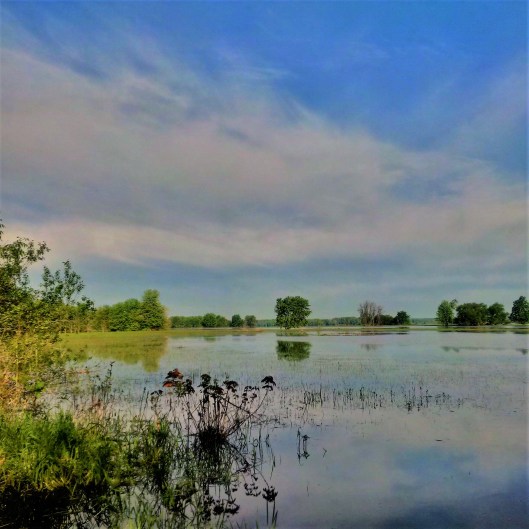
Ottawa River backwaters — photo by David Kitz

Who is this son of man—this great hope of the people of God? Clearly a man—a champion like David is needed. David defeated Israel’s enemies on all sides. He turned the nation into a great military and economic power. He laid the foundation for the prosperity that followed under the wise rule of Solomon his son. Asaph is writing several generations later when all that wealth has been squandered and there is a dearth of godly leadership.

Who can save us now? The answer lies in the son of man. Jesus continually referred to himself as the Son of Man. He used that phrase thirty times in the Gospel of Matthew. All too often we are busy looking for a political savior. But what we need more than anything is the one and only true Savior. His name is Jesus Christ. He saves us body, soul and spirit from the corruption that is in the world.

Response: LORD God, on so many levels our nation is in a mess. We need a Savior to emerge. Jesus, you are the great Son of Man. I turn my heart to you. Govern my thoughts and my actions every day. Amen.

Your Turn: Who is governing you—governing your heart and mind?

Forgive our Sins for Your Name’s Sake

30 Tuesday Jan 2018

Posted by davidkitz in Bible, Devotionals, Psalm 79, Psalms

≈ 4 Comments

Tags

foreign armies, intergenerational sins, Jerusalem, Lord, mercy, minorities, national sins, Savior, sins

Reading:                                      Psalm 79

(Verses 8-13)
Do not hold against us the sins of past generations;
may your mercy come quickly to meet us,
for we are in desperate need.
Help us, God our Savior,
for the glory of your name;
deliver us and forgive our sins for your name’s sake.
Why should the nations say,
“Where is their God?”
Before our eyes, make known among the nations
that you avenge the outpoured blood of your servants.
May the groans of the prisoners come before you;
with your strong arm preserve those condemned to die.
Pay back into the laps of our neighbors seven times
the contempt they have hurled at you, Lord.
Then we your people, the sheep of your pasture,
will praise you forever;
from generation to generation
we will proclaim your praise
(NIV).

Reflection
Psalm 79 began with the psalmist lamenting that Jerusalem had been invaded by foreign armies. Destruction and bloodshed were everywhere. O God, the nations have invaded your inheritance; they have defiled your holy temple, they have reduced Jerusalem to rubble (Psalm 79:1). Now at the conclusion of this psalm there is a plea for God’s help and mercy. Do not hold against us the sins of past generations; may your mercy come quickly to meet us, for we are in desperate need.

2017-06-04b

Ottawa River backwaters, Orleans, ON — photo by David Kitz

It becomes clear from this psalm and other passages in scripture that there are personal sins and there are corporate or national sins. Here specifically the psalmist is reflecting on the sins of the nation. Both personal and national sins can be intergenerational. They are passed down from generation to generation with terrible consequences. The father who disrespects and abuses his wife is far more likely to raise a son who does the same to his partner.
The nation that mistreats racial, religious or ethnic minorities within its borders can expect dire national consequences. The LORD hears the cries of the oppressed. He heard the cries of the people of Israel when they were enslaved in Egypt, and the LORD hasn’t suddenly changed. His ears are still open to the cries of any people who cry out to Him for mercy.

But as for us, we need to recognize our collective or national sins even as we recognize and repent of our personal sins. Why should the nations say, “Where is their God?” As always, our God is watching us. He is watching over the nations and He sees how we treat our neighbors here and around the world.

Response: LORD God, deliver us and forgive our sins for your name’s sake. Forgive the sins we have committed against minorities within our borders.  You hold us accountable. Show us your mercy.  Amen.

Your Turn: Does the LORD care only about us, or all people? How can we reflect God’s love for all?

← Older posts
Newer posts →

Psalms 365: Develop a Life of Worship and Prayer

Psalms 365 Volume II

Psalms 365 vol 3
— Psalms 365 Volume III

Psalms

Recent posts

  • Acting as though God Doesn’t Exist April 10, 2026
  • Betrayal & Trust April 9, 2026
  • The Third Day April 8, 2026
  • What About Spiritual Hygiene? April 8, 2026
  • Jesus Walked Along with Them April 7, 2026
  • How the mighty have fallen April 7, 2026
  • Their Words Seemed Like Nonsense April 6, 2026

Calendar

April 2026
M T W T F S S
 12345
6789101112
13141516171819
20212223242526
27282930  
« Mar    

Blog Posts

Comments

  • davidkitz on Jesus Walked Along with Them
  • davidkitz on Jesus Walked Along with Them
  • Kristi on Jesus Walked Along with Them

Blog at WordPress.com.

Privacy & Cookies: This site uses cookies. By continuing to use this website, you agree to their use.
To find out more, including how to control cookies, see here: Cookie Policy
  • Subscribe Subscribed
    • I love the Psalms
    • Join 1,383 other subscribers
    • Already have a WordPress.com account? Log in now.
    • I love the Psalms
    • Subscribe Subscribed
    • Sign up
    • Log in
    • Report this content
    • View site in Reader
    • Manage subscriptions
    • Collapse this bar
 

Loading Comments...