• Home
  • About
  • DavidKitz.ca
  • Youtube Videos
  • Books by David
  • Books on Amazon.com

I love the Psalms

~ Connecting daily with God through the Psalms

I love the Psalms

Tag Archives: Christ

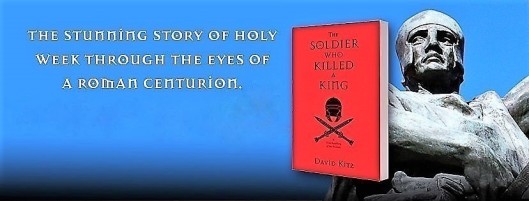
A Different Perspective on Christ’s Passion

15 Thursday Nov 2018

Posted by davidkitz in book review, Books by David Kitz, Psalms, The Soldier Who Killed a King

≈ Leave a comment

Tags

book, centurion, Christ, David Kitz, endorsements, Passion Week, Roman soldiers

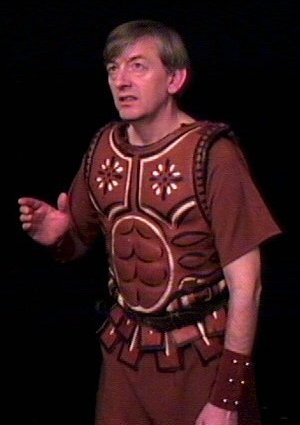
Take a moment to view and hear a portion of this award-winning novel.


DavidKitz_Reviews_Mar2018

DavidKitz_Reviews_Mar2018

For more information on the book visit: https://davidkitz.ca/centurion.php

For more information on the book purchase visit: https://www.davidkitz.ca/bookcart/index.php?route=product/product&path=62&product_id=58

or https://www.amazon.com/gp/product/0825444853?pf_rd_p=d1f45e03-8b73-4c9a-9beb-4819111bef9a&pf_rd_r=MDF7KQBS5SZGS214836H

For more information on the dramatization visit: https://davidkitz.ca/centurion.php

A River in the Desert

30 Monday Apr 2018

Posted by davidkitz in Bible, Devotionals, God's word, Psalm 105, Psalms

≈ 6 Comments

Tags

Abraham, Bruce Peninsula National Park, Christ, Christian, faith, Georgian Bay, life-giving water, Moses, promised land, redemption, Rock

Reading: Psalm 105  

(Verses 39-45)
He spread out a cloud as a covering,
and a fire to give light at night.
They asked, and he brought them quail;
he fed them well with the bread of heaven.
He opened the rock, and water gushed out;
it flowed like a river in the desert.
For he remembered his holy promise
given to his servant Abraham.
He brought out his people with rejoicing,
his chosen ones with shouts of joy;
he gave them the lands of the nations,
and they fell heir to what others had toiled for—
that they might keep his precepts
and observe his laws.
Praise the LORD (NIV).

Reflection
In the previous readings from Psalm 105, the psalmist described the LORD’s covenant relationship with His chosen people, the descendants of Abraham. The psalm then proceeds to outline the redemption and release of the people of Israel from cruel bondage and oppression in Egypt. Today’s reading celebrates God’s provision for them in the wilderness and their arrival in the Promised Land.

2017-08-24a

The waters of Georgian Bay, Bruce Peninsula National Park — photo by David Kitz

He brought out his people with rejoicing, his chosen ones with shouts of joy; he gave them the lands of the nations, and they fell heir to what others had toiled for—that they might keep his precepts and observe his laws.

There is a striking parallel between the Old Testament redemption of the people of Israel and the New Testament redemption of the Christian believer. Paul, the apostle draws our attention to this parallel experience in the tenth chapter of his first letter to the Corinthians. For I do not want you to be ignorant of the fact, brothers and sisters, that our ancestors were all under the cloud and that they all passed through the sea. They were all baptized into Moses in the cloud and in the sea. They all ate the same spiritual food and drank the same spiritual drink; for they drank from the spiritual rock that accompanied them, and that rock was Christ (1 Corinthians 10:1-4).

In today’s psalm portion we read: He opened the rock, and water gushed out; it flowed like a river in the desert. From Paul’s writing we understand that the opened rock was Christ. On the cross he was opened and water and blood gushed out. Life-giving—life-changing redemption flowed out to all who will receive him. Yet to all who did receive him, to those who believed in his name, he gave the right to become children of God—children born not of natural descent, nor of human decision or a husband’s will, but born of God (John 1:12-13).

Response: Father God, I live in thanksgiving for the rock that was opened for my redemption. By faith I receive you. Today, I drink in your new life and your redemptive purpose for me. Praise the LORD! Amen.

Your Turn: Is the Rock accompanying you as you travel through the wilderness of this life?

Send Your Spirit, LORD

23 Monday Apr 2018

Posted by davidkitz in Bible, Devotionals, Psalm 104, Psalms

≈ 2 Comments

Tags

Christ, church, faith, funeral, Jesus, Landestreu, meditation, praise the LORD, resurrection, Savior, sinners, spirit, the grave, the LORD

Reading:                                     Psalm 104              

 (Verses 27-35)
All creatures look to you
    to give them their food at the proper time.
When you give it to them, they gather it up;
when you open your hand, they are satisfied with good things.
When you hide your face, they are terrified;
when you take away their breath, they die and return to the dust.
When you send your Spirit, they are created,
    and you renew the face of the ground.
May the glory of the LORD endure forever;
    may the LORD rejoice in his works—
he who looks at the earth, and it trembles,
    who touches the mountains, and they smoke.
I will sing to the LORD all my life;
    I will sing praise to my God as long as I live.
May my meditation be pleasing to him,
    as I rejoice in the LORD.
But may sinners vanish from the earth
    and the wicked be no more.
Praise the LORD, my soul. Praise the LORD (NIV).

Reflection
Recently, my wife and I attended the funeral of my brother-in-law, Victor. He was a man of deep faith, who was always active in the church. At no point was he ashamed to call himself a follower of his Lord and Savior, Jesus Christ. Victor loved his Savior and I am sure his spirit rejoiced to see Jesus face to face.

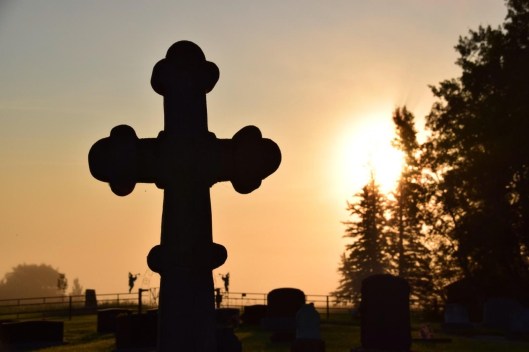
d-adam-4

Landestreu graveside sunrise — photo courtesy of Donald Adam

There is a line from today’s reading from Psalm 104 which is particularly relevant as we think about life and death: when you take away their breath, they die and return to the dust. When you send your Spirit, they are created, and you renew the face of the ground.

In context of this psalm, the author was speaking of all creatures, in other words the animal kingdom, but these words apply to all that breathe the breath of life, including humans. For Victor, who struggled for every breath during the last years of his life, the words of this psalm had true meaning. But the second part of this psalm reading is also pertinent in the context of a funeral: When you send your Spirit, they are created.

I believe in the resurrection of the dead. The grave is not the final end for those who have placed their faith in Christ. A great re-creation will happen. The grave could not hold Jesus, and a day is coming when it will not hold Victor, or any who have died in the faith. For the Lord himself will come down from heaven, with a loud command, with the voice of the archangel and with the trumpet call of God, and the dead in Christ will rise first (1 Thessalonians 4:16).  

Response: Father God, send your reviving Spirit. Come, Lord Jesus. I long for your return. Amen.

Your Turn: Do you believe in the resurrection of the dead? Who do you long to greet on the other side?

The Seasons Change

20 Friday Apr 2018

Posted by davidkitz in Bible, Devotionals, Psalm 104, Psalms

≈ 2 Comments

Tags

Christ, creatures, faith, faith in God, labor, lion, Lord, praise, renewal, resurrection, sea, seasons, spring, winter

Reading:                                    Psalm 104                                                                  

(Verses 19-26)
He made the moon to mark the seasons,
and the sun knows when to go down.
You bring darkness, it becomes night,
and all the beasts of the forest prowl.
The lions roar for their prey
and seek their food from God.
The sun rises, and they steal away;
they return and lie down in their dens.
Then people go out to their work,
to their labor until evening.
How many are your works, LORD!
In wisdom you made them all;
the earth is full of your creatures.
There is the sea, vast and spacious,
teeming with creatures beyond number—
living things both large and small.
There the ships go to and fro,
and Leviathan, which you formed to frolic there
(NIV).

Reflection
There is something to be said for routine and regularity. By that I mean the whole vast rhythm of life. Today’s reading from Psalm 104 eloquently reflects the rhythm of life from sunrise to sunset and the return to sunrise once again.

Elk WBurgess

The earth is full of your creatures — photo credit Warwick Burgess

This past weekend, though the calendar said mid April, we were hit hard by freezing rain, and arctic winds. Everyone is anxious for spring like weather to finally make an appearance. Enough of this snow and cold already! The seasons are changing. They always have. In this part of the world, all we can do is prepare for the transition; we can’t  speed its coming or prevent it from happening.

In reality, transitions are about rest and renewal. The setting sun lets us know that it’s time to stop our labor and get the rest that is essential for our well-being. In the same way as winter approaches trees and vegetation go dormant, but after a season of rest the great spring renewal will surely come. It always has, and so it will continue until the end of time.

In the same way there is a renewal promised to us at the end this life. Resurrection happens every spring and it will happen to this old clod of earth as well. That’s the great hope we have because of Christ. The word of God has been planted in our hearts and it will bear fruit now and in eternity, which has been promised to those who believe. Do you believe? Do you have faith in the changing seasons? Do you have faith in the One who created the seasons? 

Response: Father God, thank you for designing the days, months and seasons. I want to draw near to you in every season of life. How many are your works, LORD! You are worthy of all praise. Renew and refresh me in the seasons of my life.  Amen.

Your Turn: What is your favorite season? Why?

Constant Praise

12 Thursday Apr 2018

Posted by davidkitz in Bible, Devotionals, Psalm 103, Psalms

≈ 8 Comments

Tags

catharsis, Christ, circumstances, compassion, death, disease, Jesus, love, Maker, praise, praise the LORD, psalm of praise, redeem, stock market, the LORD, war, weather, world, worthy

   Reading: Psalm 103      
Of David.
(Verses 1-6)
Praise the LORD, my soul;
all my inmost being, praise his holy name.
Praise the L
ORD, my soul,
and forget not all his benefits—
who forgives all your sins
and heals all your diseases,
who redeems your life from the pit
and crowns you with love and compassion,
who satisfies your desires with good things
so that your youth is renewed like the eagle’s.
The LORD works righteousness
and justice for all the oppressed
(NIV).

Reflection
Psalm 103 begins by David calling on his soul to praise the LORD. Many see praise and worship as a purely cathartic response to the manifest goodness of God. Something good happens to us. Unexpectedly, we get a thousand-dollar check in the mail. Quite naturally our response is praise to God.

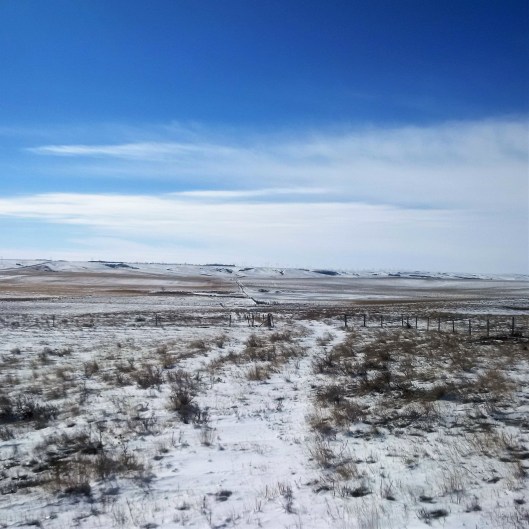
2018-04-02b

Along a prairie trail, north of Maple Creek, Saskatchewan — photo by David Kitz

For many people, praise to God never progresses beyond this natural, cathartic level. If God does not bless, no praise is forthcoming. Our praise for the LORD becomes, or simply remains circumstance dependent. But that was not the case with David. His praise extended beyond simple catharsis. He taught his soul to praise the LORD in all circumstances. True biblical praise and worship is after all a spiritual exercise, a discipline we grow in, just as we grow in the discipline of prayer.

The LORD, the object of our praise, does not change with our circumstances. He is forever the same. Jesus Christ is the same yesterday and today and forever (Hebrews 13:8). He is constant, hence our praise and worship of him should be constant, unaffected by weather conditions, world events, the gyrations of the stock market, our swings of mood or our personal situation.

Of course this constancy in praise is something the natural man simply rebels against. Our world needs to be right in order for us to praise God aright, or so we reason. The only problem with this logic is that the world has never been right since the Fall. Death, disease, war and misery have been raining down on the children of Adam, since wilful disobedience to God first took root among us. And this is one weather forecast, for all humanity, that is not about to change—not until Christ returns.

If we are waiting for a perfect world before we lift our voice in praise to God, we will never praise Him. In fact, if our eyes are on the world, or on ourselves, there will always be grounds to withhold our praise. But then, the whole purpose of praise and worship is to lift up our eyes. We desperately need to get our eyes off ourselves, off the world, and onto God our Maker. 

Response: Father God, I genuinely want to learn to praise you in all situations. You are always good, loving and worthy of praise. Along with David I declare, “Praise the LORD, my soul!” Amen.

Your Turn: Have you learned to praise God even in difficult times?

Excerpt 30 for Lent from The Soldier Who Killed a King

30 Friday Mar 2018

Posted by davidkitz in Books by David Kitz, Christ's Passion, Good Friday, Lent, The Soldier Who Killed a King

≈ Leave a comment

Tags

Christ, Creator, David Kitz, Elijah, Jesus, Jesus' last words, kingdom, pain, sacrilege, Son of God, the cross, The Soldier Who Killed a King

A journey to the cross is a journey to repentance. It’s a journey to deep personal change. Will you take this journey with me?

Date: Three o’clock in the afternoon, Friday, April 7, 30A.D.
Jesus’ final moments on the cross.

Here is the obscenity of crucifixion. Naked men are unwillingly mated to two wooden beams. They must thrust the whole of their bodies upward in excruciating pain, ever- increasing pain to catch their next breath—until all strength is drained away. Then death steals in.
This is the shame of the cross. Here is the depravity—a profane sacrilege inflicted upon the human body.
The ghastly rhythm of it was driving me mad.
Then in soul- wrenching anguish, his voice erupted. “Eli, Eli, lema sabachthani?”
“What does that mean?” I cried out into the darkness.
From beyond the military cordon came the answer. “My God, my God, why have you forsaken me?”
He had broken. The Christ hung broken. The cross had broken him. He too was human. We were all together now, a great crowd caught up in this drama. There was no us and them. We were together. We were caught between heaven and hell in this dark, surreal atmosphere.
It was dreadful. Centur Rep
Someone frantically yelled, “It’s Elijah! He’s calling Elijah.”
Exhaling.
Mounting up.
Ever-heightening pain.
Catching a breath.
Retreating.
From on the Mother’s Hill, a wail went up. It was steady, constant, a wave of woe flowing over the dark scene.
Exhaling.
Mounting up.
Ever-heightening pain.
Catching a breath.
Retreating.
“Will Elijah come?” someone asked. “Will he come?” Many of the hostile were even now on bended knees. The cavalrymen dismounted.
Exhaling.
Mounting up.
Ever-heightening pain.
Catching a breath.
Retreating.
“I thirst!” the king called out.
Claudius leaped to his feet. There was a jar of wine off to one side. The soldiers had been drinking freely from this. He ran over to it and got a sponge. He dropped the sponge into the jar of wine and then skewered it with a long reed. This he held up to dampen the lips of the donkey king.
But some yelled out, “Wait! Let’s see if Elijah will come and save him.”
Exhale.
Mounting up.
Ever-heightening pain.
Catch a breath.
Retreat.
The rarified air crackled with anticipation.
Exhaling.
Mounting up.
Ever-heightening pain.
Catching a breath.
Retreating.
Can the Creator—the God of heaven and earth—save him now?
Exhaling.
Mounting up.
Ever-heightening pain.
Catching a breath.
Retreating.
“It is finished!” he cried.
But there was no anguish in his voice. There was the ring of victory to it, as if he had caught with that last breath a glimpse—a glimpse of his kingdom. A glorious kingdom! He had gained the summit. Now with vigor renewed, he pushed up and forward one last time.Free WWe SHARABLE-1 (2)
Exhaling.
Mounting up.
Ever- heightening pain.
Catching a breath.
Retreating.
“Father . . .
“Into your hands . . .
“I commit . . .
“My Spirit.”
His head dropped. It was over.
As his chin hit his chest, the earth began to rumble. Low thrumming. Building . . . building . . .
The rock Skull began to move beneath my feet. And with it, my soul.
I fell to the ground.
The crosses began to vibrate and rock with the power of the quake. His head bobbed from side to side.
But he was dead.
He was dead!
Everyone was with me on bended knees.
Heaven had rendered its dark judgment. The sun had hidden its face. The very earth had answered back. The verdict was in.
I caught two huge breaths of air, and then for the whole world to hear, I cried out, “He really was the Son of God.”
He was the Son of God.
The sun broke through.
A rooster crowed.

American readers click this link to purchase The Soldier Who Killed a King.

Canadian readers click this link to purchase The Soldier Who Killed a King directly from the author.

Excerpt 29 for Lent from The Soldier Who Killed a King

29 Thursday Mar 2018

Posted by davidkitz in Books by David Kitz, Christ's Passion, Good Friday, Lent, The Soldier Who Killed a King

≈ 1 Comment

Tags

Christ, crucifixion, disciple, Golgotha, Jesus

A journey to the cross is a journey to repentance. It’s a journey to deep personal change. Will you take this journey with me?

Date: About noon, Friday, April 7 30A.D.
The crucifixion of Jesus.

Now there was movement on the Mother’s Hill. A middle-aged couple came down. Their heads were hanging. They clung to each other, supported each other, every step an anguish. They made their way before the encircling pikemen.
I knew who they were—knew why they had come. Here were the broken parents, broken beyond this world’s repair. I met them at the base of the hill, told them they had some time.
They advanced up the Skull. She fell, fell whimpering before her son. Thaddaeus. Boisterous soldiers fell silent and then walked off, right off the hill. The family was alone with their grief.
4485 TWITTER
Having witnessed this grim but welcoming reception, another party stepped off the Mother’s Hill and advanced to Golgotha. This was a group of five. The women clung to one another in couples. They were shepherded by a tall young man. His fresh face and scant beard bore witness to his youth. I recognized him. He had been with Jesus, had stood closest to him.
He introduced himself. He said his name was John. I received his party—ushered them by the outer ring of soldiers.
They were bowed by the sight. They clung to one another afresh, repulsed by the horror of what met their eyes.
After a few moments the young man came before two of the huddled older women. He stooped to speak with one of the women—the Christ’s mother, I assumed. Then with his arm about her shoulder, John advanced up the rock mound.
Jesus saw them.
He struggled.
“Woman . . . behold your son!”
There was a double- edged meaning here, almost too painful for words. At first I thought he was simply referring to himself—to his own wretched state. And perhaps on one level he was.
His body sagged. But then he thrust himself up and forward for another breath, and with his next words his meaning became clear. To the young man, to his disciple, he said, “Behold your mother!”
He had committed his mother into this disciple’s care. She fell to her knees. She trembled, unable to speak. Only wretched sobbing was heard from within the circle of the hill.
In due time I led both families off. They left willingly. This was too much to bear, too much to watch.
From his cross Animal watched the Mother’s Hill. But no one came. That’s when he broke—broke like a clay pot dropped onto the hard rock of the Skull.
He sobbed. He moaned.
His tears flowed like rivers into his dark, young beard.
But no mother came. No one came at all. Free WW-e FACEBOOK-2 (2)
The wind picked up. The sky grew dark. Then it grew darker yet. The horses began to neigh and paw the ground. In the distance a dog barked. It was a bark that changed to a howl but ended in a whimper. I looked about. I could see it on every face. It was fear. Raw fear. This was not the dark of cloud or storm. This was the sun covering, hiding its face from what it saw upon the earth.
A total darkness descended, as black as any night.
There was a discord here—a discord utter and complete. If heaven and earth had come into some perfect union—some perfect harmony—on the day Jesus arrived in this city, it was in blaring dissonance now. Blaring dissonance echoed off the empty chambers of my soul.
It was a deafening darkness.
The mocking crowds fell silent. The highway traffic stopped. All was still.
Silent.
Only the three men were heard. Heard in the darkness. Three men working to maintain this perverted thing called life.
Working.
Pushing up.
Up to catch a breath.

American readers click this link to purchase The Soldier Who Killed a King.

Canadian readers click this link to purchase The Soldier Who Killed a King directly from the author.


Excerpt 28 for Lent from The Soldier Who Killed a King

28 Wednesday Mar 2018

Posted by davidkitz in Books by David Kitz, Christ's Passion, Good Friday, Lent, The Soldier Who Killed a King

≈ Leave a comment

Tags

blood, bloodlust, Christ, crucifixion, David Kitz, Jesus, king, Messiah, pierced, repentance, The Soldier Who Killed a King

A journey to the cross is a journey to repentance. It’s a journey to deep personal change. Will you take this journey with me?

Date: Nine thirty in the morning, Friday, April 7 30A.D.
The crucifixion of Jesus.

I tipped the bucket to one side to get enough swill to fill the dipper. I offered it to Jesus. He took a sip, worked the liquid around in his mouth, discerned the true nature of this bitter potion, and then spit it out. It left a dark stain on the dull gray rock near his feet.
“It will dull the pain,” I said emphatically.
He raised his eyes. They locked with mine. I saw in him the same look, the samebiblical-fiction-award-2017_orig determination I saw on the first day I set eyes on him, the day he rode the donkey into this city. I could still see he had a destination in mind. Some mystical purpose he somehow felt compelled to fulfill.
I dropped my gaze. He must be a fool. In his condition, in this situation, he must be a fool. A fool who unnerved me, but a fool nonetheless.
Once more I offered the drink.
With lips pressed tight, he shook his head.
He was a fool. An arrogant fool! A fool who thinks he’s tough—who can handle this—who can take it straight.
We would see who’s tough. I would show him who’s tough!
Let the big show begin.
“Now, boys!” I called out to the crew. Still wearing the purple robe, he was snatched like a young child and slammed down onto the crossbeam.
A cheer went up.
My right hand seized the hammer from Octavio. My left fumbled, then dove into, the nail pouch.
I dropped my knee onto his fingers.
Stabbed the sharpened point of the spike into the base of the palm.
Raised the hammer.
Xchuuuung!
An enormous cheer went up from the crowd.
Blood spurted across my thigh.
Xchuuuung!
Xchuuuung!
Xchuuuung!
One in.
The Christ was silent. Still . . .
Octavio urged me on. “That’s it, Marcus!”
I sprang to my feet, remembering the full rush of battle. Then scrambled to the other arm. From just off the hill, in the throng, a chant began and established itself. “More. More. More. More.”
Knee on fingers.
“More!”
Spike jabbed in.
“More!”
Hammer raised.
“More!”
Xchuuuung!
“More!”
Xchuuuung!
“More!”
Xchuuuung!
Two in. The Christ was silent.
Still . . . He was still beneath the piercing blows.
I rose, panting. Heart pounding. Bloodied hand dripping. Seeing a stainfree area farther up my hairy arm, I wiped it across my sweat- drenched brow.
Octavio saluted me with a smile and a thumbs-up signal.
The crowd roared their approval.
This time it was Octavio who yelled, “Hoist him up.”
The Christ was dragged gasping—desperately gasping—to an upright position before the death mast.
Now they could see him, and the crowd went wild with frenzied excitement. Cheering. Clapping. Hooting. Bloodlust took hold.
The props were applied to the arms of the crossbeam.
A new chant went up. 4485 SHARABLE-2
“Raise him up!”
“Raise him up!”
“Raise him up!”
Octavio signaled, and the men in back lifted the beam on which the Christ was pinned above their heads.
Then we all saw it—saw the obvious. He was still clothed. The purple robe billowed out as it was caught by a sudden cold gust of wind. The sight of it brought all my frenzied demons to the fore.
I stepped before him, looked into his agonized face, and said, “You won’t be needing this . . . king of the Jews.”
Then to the cheers of my men, I spit into his face. I added my spittle to all the rest that had dried and was clinging to his beard.
I untied the royal robe and dropped it in a heap to my right. Finally, with a wicked smile, and to cheers all around, I snatched his breechcloth from off his loins.
I tossed it to Octavio. He held it up. A trophy!
We laughed. We all laughed. I
t was a laugh not our own.
I recognized it. It was Herod’s laugh.
When he had regained some composure, the head jailer started the final count.
“Ready . . . one . . . two . . . three . . . now!”
To chants of “Raise him up, raise him up,” the Christ, the Messiah, the king, was lifted up—up before the world.
His head twisted from side to side in writhing agony. His whip-sliced back slammed against the upright as he was dragged higher.
Then with a flesh-tearing lurch, the notch in the horizontal beam found its match in the vertical. The rope was flung around, then drawn tight, securing the two cross members as one.
The silent Christ hung. He hung naked and bleeding before a jeering world.
Only the last spike remained. Awkwardly, I fumbled for it.
But a creeping unease overshadowed me. I glanced over my shoulder. Claudius stood alone, off to the side. Silent . . . He was ghastly pale and silent, transfixed by the sight before him.
I handed the last nail and the hammer back to Octavio and said, “You do it.” He snorted his surprise, but then set quickly to his task.

American readers click this link to purchase The Soldier Who Killed a King.

Canadian readers click this link to purchase The Soldier Who Killed a King directly from the author.

Excerpt 27 for Lent from The Soldier Who Killed a King

27 Tuesday Mar 2018

Posted by davidkitz in Books by David Kitz, Christ's Passion, Lent

≈ 1 Comment

Tags

blood, Caesar, Caiaphas, Christ, crucify, David Kitz, Golgotha, high priest, innocent, Jesus, king, Lent, Messiah, Pilate, repentance, trial of Jesus, verdict

A journey to the cross is a journey to repentance. It’s a journey to deep personal change. Will you take this journey with me?

Date: Eight forty in the morning, Friday, April 7 30A.D.
The trial of Jesus ends. The verdict is delivered.

Pilate was already seated, ready to pronounce judgment. A thin smile was now on his face. The cunning Badger would make the most of his final moves. When Jesus was in position, he began. Once more he motioned in the direction of the Christ, and to all assembled he announced, “Here is your king.”
“Take him away!” came the instant response. “Take him away! Crucify him!”
There was vehement insistence coming from the crowd. Some began to hurl dust in theBiblical fiction winner 2017 air. This was verging on a riot, a point that was surely obvious to the governor, yet he played them on.
“Shall I crucify your king?” Pilate called back to the throng.
“We have no king but Caesar,” the Weasel spat back.
The Badger’s eyebrows shot up.
The governor smiled and nodded. It was a smile of triumphant satisfaction. We have no king but Caesar. The Badger mulled over these words. I knew he had waited years for these words. After all he had endured in this place, wasn’t it well worth hearing this confession from the high priest’s mouth?
Ironically, the governor had Jesus to thank for the high priest’s sudden conversion and submission to imperial Rome. This declaration would never have come forth from the Weasel’s lips, except to secure the conviction of the good Galilean. Caiaphas was willing to stoop before Rome in order to spill the blood of this prophet. Here was the true measure of his hatred for the Northern Messiah.
Pilate knew all this, and he drew a good measure of perverse satisfaction from it. He understood his foe.
He called for his personal attendant to bring a basin of water. Now he would lay the blame where the bloody blame belonged. With the attendant holding the basin before him, Pilate made a great show of washing his hands before the crowd, and with insistence in his voice, he declared, “I am innocent of the blood of this man.”
Here was the feint, the great pretend.
Next came the dodge.
With water still dripping from his hands, he looked out over the crowd and declared, “You yourselves see to it.”
He spoke as though he had abdicated—bore no responsibility for the blood that now trickled down Jesus’s back. He absolved himself of that and of all that would soon flow on Golgotha.
This Badger could throw a bit of dirt.
Free WW-e FACEBOOK-2 (2)
It was fitting for Annas the aged priest to respond. It was he who answered for the people. With his finger pointed at Jesus and his gaze fixed on him, he replied, “His blood be on us.” Then he paused as though looking down through the generations of time. “And on our children,” he added with a cold, sardonic stare.
Out on the street the people answered, “Yes!” They nodded their agreement with this verdict.

American readers click this link to purchase The Soldier Who Killed a King.

Canadian readers click this link to purchase The Soldier Who Killed a King directly from the author.

The Anointed One

05 Monday Mar 2018

Posted by davidkitz in Bible, Devotionals, Psalm 89, Psalms

≈ 3 Comments

Tags

anointed, Babylonians, Christ, crucified, David, Greek, Hebrew, Israel, Jesus, Jesus Christ, Jesus of Nazareth, king, Messiah, New Testament, Old Testament, psalmist, resurrection, the LORD

Reading:                                      Psalm 89

(Verses 46-52)
How long, LORD? Will you hide yourself forever?
How long will your wrath burn like fire?
Remember how fleeting is my life.
For what futility you have created all humanity!
Who can live and not see death,
or who can escape the power of the grave?
Lord, where is your former great love,
which in your faithfulness you swore to David?
Remember, Lord, how your servant has been mocked,
how I bear in my heart the taunts of all the nations,
the taunts with which your enemies, L
ORD, have mocked,
with which they have mocked every step of your anointed one.
Praise be to the LORD forever!
Amen and Amen
(NIV).

Reflection
Many people believe that Christ is Jesus’ last name. That is not the case. The Bible does not tell us Jesus’ family name. Often he is identified by the town that he is from—Jesus of Nazareth. So what then is the significance of the word Christ or Khristos in the Greek? Christ is a title. One might even call it a job description. It means the anointed one, the one who is designated by God to rule and reign over his people. The Greek word Khristos or Christ corresponds to the Hebrew word Mashiach or Messiah. The anointed one or Christ was and is the son of David who rules over the house of Jacob and the Israel of God. Just as David was anointed to be king of Israel, Jesus is anointed to be our king.

2018-02-05b

End of winter glory — photo by David Kitz

When we read Psalm 89 with the understanding that the anointed one is also the Christ, the psalm takes on a whole new layer of meaning. Yes, during the fall of Jerusalem to the Babylonians, the anointed one was mocked. But this is also true of Jesus, the anointed Son of David, who was led off to be crucified outside the city gate. These words were fulfilled in Christ: Remember, Lord, how your servant has been mocked, how I bear in my heart the taunts of all the nations, the taunts with which your enemies, LORD, have mocked, with which they have mocked every step of your anointed one.

But there is a significant difference between the Old Testament, anointed one, and our New Testament Christ. The psalmist asks this question: Who can live and not see death, or who can escape the power of the grave?

The implicit answer is that no one can escape death and the grave. But… but there is One—One, who tasted death on our behalf—One, who escaped the power of the grave. His name is Jesus. He is the Christ, the anointed One, and our Messiah. He is the One who by virtue of the resurrection is King now and forevermore.

Response: LORD God, I thank you for Jesus, the Christ, the anointed One. Thank you for your death, burial and resurrection. I join with the psalmist in saying, “Praise be to the LORD forever! Amen and Amen.”

Your Turn: In what way is Christ a job description? What job has he done and is he doing for you?

← Older posts
Newer posts →

Psalms 365: Develop a Life of Worship and Prayer

Psalms 365 Volume II

Psalms 365 vol 3
— Psalms 365 Volume III

Psalms

Recent posts

  • A House Divided March 15, 2026
  • Longing for God March 14, 2026
  • A New Command March 13, 2026
  • Altered by the Altar March 13, 2026
  • Judas Took the Bread March 12, 2026
  • Hope for the Downcast March 12, 2026
  • Jesus Washes His Disciples Feet March 11, 2026

Calendar

March 2026
M T W T F S S
 1
2345678
9101112131415
16171819202122
23242526272829
3031  
« Feb    

Blog Posts

Comments

  • R. Marshall on A House Divided
  • cjsmissionaryminister on Jesus Washes His Disciples Feet
  • davidkitz on Hope for the Downcast

Blog at WordPress.com.

Privacy & Cookies: This site uses cookies. By continuing to use this website, you agree to their use.
To find out more, including how to control cookies, see here: Cookie Policy
  • Subscribe Subscribed
    • I love the Psalms
    • Join 1,384 other subscribers
    • Already have a WordPress.com account? Log in now.
    • I love the Psalms
    • Subscribe Subscribed
    • Sign up
    • Log in
    • Report this content
    • View site in Reader
    • Manage subscriptions
    • Collapse this bar
 

Loading Comments...