• Home
  • About
  • DavidKitz.ca
  • Youtube Videos
  • Books by David
  • Books on Amazon.com

I love the Psalms

~ Connecting daily with God through the Psalms

I love the Psalms

Tag Archives: Mary

It’s all about DNA

15 Sunday Feb 2026

Posted by davidkitz in Books by David Kitz

≈ 3 Comments

Tags

angel Gabriel, Christians, David, DNA, Holy Spirit, James the brother of Jesus, Jesus, Joseph, king, King Herod, Mary, Messiah

James: the Lynchpin of Our Faith — Chapter 1

Have you ever wondered what your life would be like, if you grew up in a different family? I think we all have considered that thought. Maybe it occurred to you the first time you slept over at a friend’s house. You thought, what would it be like to grow up in this house, with this family? Would you be where you are today? Now stretch that thought a bit. What if you were born into a different nation, culture or religious tradition? Would you still be the same person? What would you be like, if you were raised by a low-caste family in southern India, or by Masai warriors in Kenya? We all know that our home and upbringing influence our adult life in a thousand different ways.

Photo by samer daboul on Pexels.com

Then there is the question of DNA. We also know that our genetic make-up impacts everything about us. Every cell and fiber in our body is programmed according to the genetic code inherited from our parents. That code determines more than just our eye colour and shoe size. It shapes facets of personality, disposition, and even subtleties such as our posture, the way we move, and the gestures we use. Of course the influences of nature and nurture, DNA, and upbringing were just as important in biblical times as they are today. We are who we are because of the complex interactions of heredity, family, and social influences. These same influences were at play in shaping the life of James

It is only natural that, following in this vein, the New Testament begins by highlighting heredity. The Gospel of Matthew starts with a recitation of the lineage of Jesus. Incidentally, since they were half-brothers by blood, this also would be the lineage of James. And to truly under stand James—to paint a portrait of him—we need to grasp the paramount role that his older brother played. With this purpose in mind, let’s examine Matthew’s account.

This is the genealogy of Jesus the Messiah the son of David, the son of Abraham:
Abraham was the father of Isaac,
Isaac the father of Jacob,
Jacob the father of Judah and his brothers,
Judah the father of Perez and Zerah, whose mother
was Tamar,
Perez the father of Hezron,
Hezron the father of Ram,
Ram the father of Amminadab,
Amminadab the father of Nahshon,
Nahshon the father of Salmon,
Salmon the father of Boaz, whose mother was Rahab,
Boaz the father of Obed, whose mother was Ruth,
Obed the father of Jesse,
and Jesse the father of King David. (Matthew 1:1–5)

The gospel writer’s purpose here is to establish the quintessential Jewishness of Jesus. He does this in the most organic way possible, by linking him back to the father of the Jewish nation, Abraham. Matthew’s
gospel is written to a Jewish audience and so by doing this, Matthew is saying to his fellow Jews, “Look folks, Jesus, the Messiah is one of us. Just like you, he can trace back his bloodline right to Abraham. We have
a common heritage and here it is spelled out in black and white.” With the next portion of the genealogy Matthew takes this message a step further:

David was the father of Solomon, whose mother had been Uriah’s wife,
Solomon the father of Rehoboam,
Rehoboam the father of Abijah,
Abijah the father of Asa,
Asa the father of Jehoshaphat,
Jehoshaphat the father of Jehoram,
Jehoram the father of Uzziah,
Uzziah the father of Jotham,
Jotham the father of Ahaz,
Ahaz the father of Hezekiah,
Hezekiah the father of Manasseh,
Manasseh the father of Amon,
Amon the father of Josiah,
and Josiah the father of Jeconiah and his brothers
at the time of the exile to Babylon. (Matthew 1:6b–11)

To the casual present-day reader, this list of names means next to nothing, but in Matthew’s time every educated Jewish boy or girl would recognize that this is the full pantheon of Jewish kings. Here are the great and not so great leaders of the Jewish nation—royal heroes and scoundrels all. By providing this list Matthew has just upped the ante. He is telling his Jewish readers, “Have a look at this. Jesus is a royal descendant from the line of David. He is no ordinary Jew. Surely, he is marked for a higher calling.”

Matthew continues:

After the exile to Babylon:
Jeconiah was the father of Shealtiel,
Shealtiel the father of Zerubbabel,
Zerubbabel the father of Abihud,
Abihud the father of Eliakim,
Eliakim the father of Azor,
Azor the father of Zadok,
Zadok the father of Akim,
Akim the father of Elihud,
Elihud the father of Eleazar,
Eleazar the father of Matthan,
Matthan the father of Jacob,
and Jacob the father of Joseph, the husband of Mary,
and Mary was the mother of Jesus who is called
the Messiah. (Matthew 1:12–16)

Matthew has laid out this catalog of patriarchs to establish Jesus’ provenance. This is his royal heritage. To his Jewish audience he is saying, “We all know that the coming Messiah—the promised one—is a descendant of David. Well, here is Jesus’ family tree. He springs from the right stock. He’s got the bona fides.”

But did you notice that surprising little twist at the end? We are introduced to “Joseph, the husband of Mary, and Mary was the mother of Jesus who is called the Messiah” (Matthew 1:16). That’s right! After that great, long, monotonous list of was the-father-of’s, there’s an abrupt change. Joseph was not the father of Jesus. The genetic link breaks down. “Mary was the mother of Jesus who is called the Messiah” (Matthew 1:16).

Matthew goes on to explain:

This is how the birth of Jesus the Messiah came about:
His mother Mary was pledged to be married to Joseph,
but before they came together, she was found to be
pregnant through the Holy Spirit. (Matthew 1:18)


It’s as though God is saying through Matthew that royal heritage is significant, but it isn’t good enough; the best human DNA isn’t good enough. It’s only human after all. For the Messiah we must look to a higher source—a divine source. “But before they came together, she was found to be pregnant through the Holy Spirit” (Matthew 1:18).

God intervened. God put some skin in the game. If the redemption of mankind was a rescue mission, then the Maker of the universe just got seriously committed. He inserted Himself into the human genome.

Divine DNA—Holy Spirit DNA. Think of that for a minute. Divine DNA, the very nature of God, is linked with human DNA in theperson of Jesus. “She [Mary] was found to be pregnant through the HolySpirit” (Matthew 1:18). If you find it difficult to wrap your mind aroundthat statement, you are not alone. Joseph had some difficulty with it too. In fact, he needed a bit of angelic dream therapy to convince him of the heavenly origin this pregnancy. Let’s return to Matthew’s account:

This is how the birth of Jesus the Messiah came about:
His mother Mary was pledged to be married to Joseph,
but before they came together, she was found to be
pregnant through the Holy Spirit. Because Joseph her
husband was faithful to the law, and yet did not want
to expose her to public disgrace, he had in mind to
divorce her quietly.

But after he had considered this, an angel of the
Lord appeared to him in a dream and said, “Joseph son
of David, do not be afraid to take Mary home as your
wife, because what is conceived in her is from the Holy
Spirit. She will give birth to a son, and you are to give
him the name Jesus, because he will save his people
from their sins.”

All this took place to fulfill what the Lord had said
through the prophet: “The virgin will conceive and
give birth to a son, and they will call him Immanuel”
(which means “God with us”).

When Joseph woke up, he did what the angel of
the Lord had commanded him and took Mary home
as his wife. But he did not consummate their marriage
until she gave birth to a son. And he gave him the
name Jesus. (Matthew 1:18–24)

In a normal human pregnancy, the father’s sperm, containing his DNA, unites with the mother’s DNA in the egg to form a new child (zygote). In Mary’s case, the Holy Spirit supplied the required male DNA, or its spiritual equivalent, to set the growth of the zygote (child) into motion.

Theologians have pondered and debated the topic of the virgin birth from the very foundation of the Christian faith. For unbelievers it is a huge stumbling block. How could this come about? It should not surprise us that those most intimately involved with this miracle—Mary and Joseph— would also have doubts and questions. They needed divine assurance and convincing proofs, even as many believers do today.

It’s easy for us who live in a postmodern world to assume that the ancients of biblical times lived in an age of faith where everyone was quick to believe in miracles and the supernatural intervention of God. But a careful reading of the New Testament tells quite a different story. Many struggled with their faith. There are skeptics who demand proof in every age. But how glorious it is when the skeptic has his questions answered, his doubts stripped away, and he finds himself confronted by the living God. This was the case with both Mary and Joseph.

In Luke’s gospel account, Mary’s encounter with the angel Gabriel quite logically sets off some serious questions and doubts. We are told that “Mary was greatly troubled at his [Gabriel’s] words and wondered
what kind of greeting this might be” (Luke 1:29).

Mary had just heard that she “is highly favoured,” and “the Lord is with her.” If she found that angelic greeting disturbing, or as some translations say “confusing,” I am sure she found Gabriel’s announcement
which followed even more troubling.

“Do not be afraid, Mary; you have found favor with
God. You will conceive and give birth to a son, and you
are to call him Jesus. He will be great and will be called
the Son of the Most High. The Lord God will give him
the throne of his father David, and he will reign over
Jacob’s descendants forever; his kingdom will never
end.”
“How will this be,” Mary asked the angel, “since

I am a virgin?” (Luke 1:30b–34)


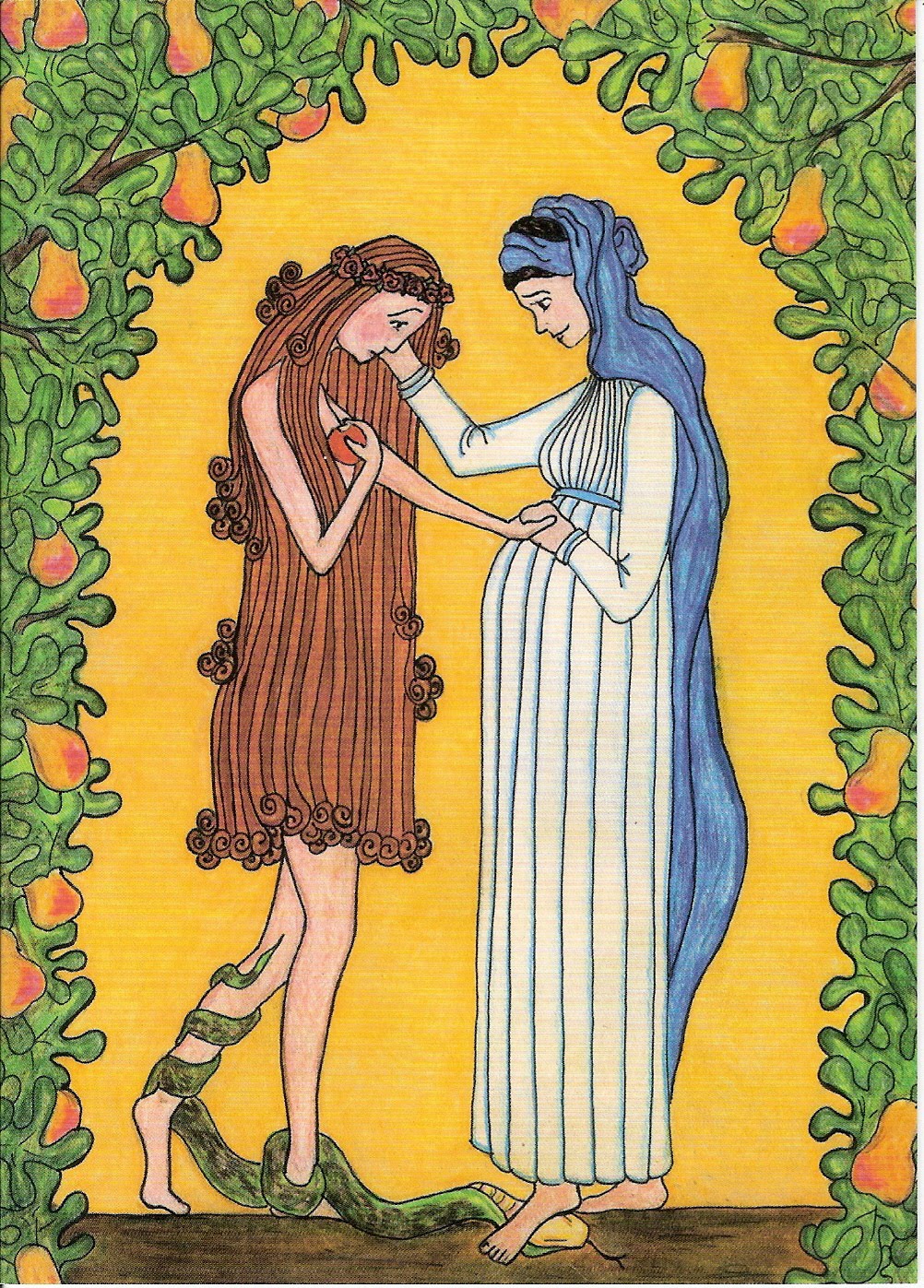
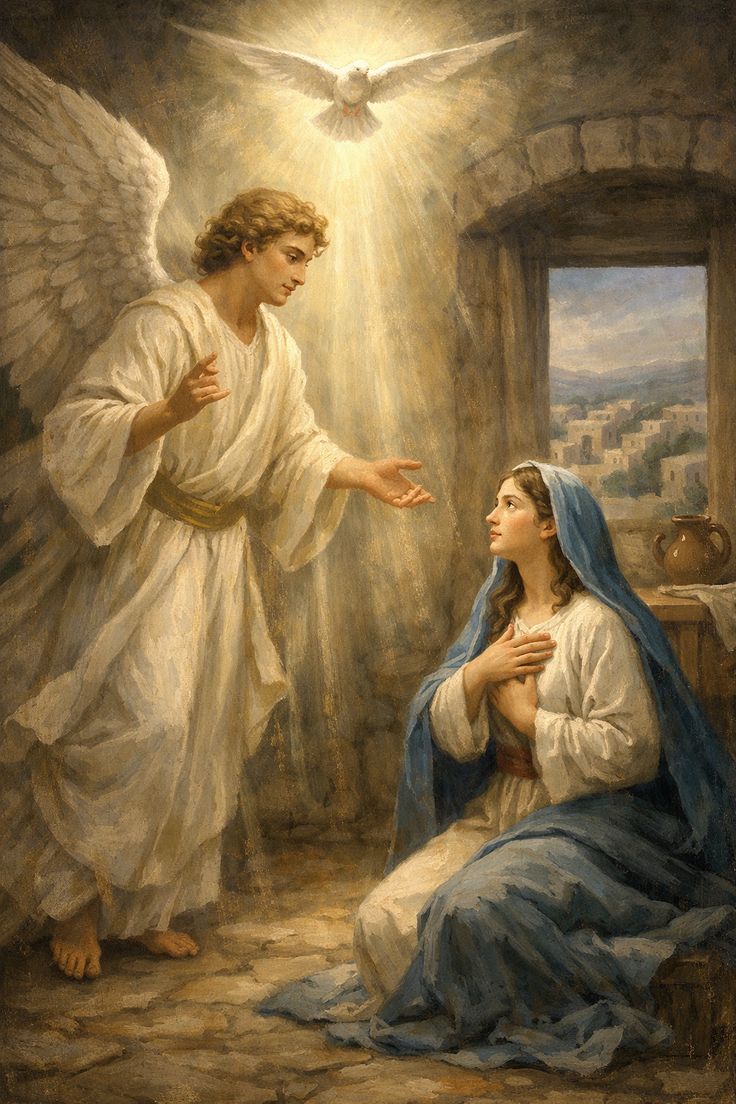
Evangelho — Lc 1, 26-38 AI Modified

Mary’s uncertainty is evident through her question. This girl without doubt knew about the birds and the bees and the normal ways and means that produce a pregnancy. Her question flowed logically from everything she knew about human reproduction. Would this promised-child come from her union with Joseph? That would certainly be the natural, predictable course of events, since she was already pledged in marriage to him. Can you imagine her surprise when she heard the angel’s response to her question?

The angel answered, “The Holy Spirit will come on
you, and the power of the Most High will overshadow
you. So the holy one to be born will be called the Son
of God. Even Elizabeth your relative is going to have a
child in her old age, and she who was said to be unable
to conceive is in her sixth month. For no word from
God will ever fail.” (Luke 1:35-37)

Mary is unequivocally told that God would be the father of this child, “so the holy one to be born will be called the Son of God.” This echoes what she had been told before she questioned Gabriel. Mary was told, “He will be great and will be called the Son of the Most High.” Undoubtedly, it takes time and repetition to fully grasp the implications of such statements. In Mary’s case it would take a lifetime. After all, this angelic announcement confounded her Jewish theology. How could God take on human flesh? It defied logic and the norms of human experience. While a Jewish Messiah was hoped for, even expected, who knew that it would come this way? From her own body no less?

To reassure Mary, Gabriel adds the news about Elizabeth’s pregnancy. This aged, barren woman was the last woman among her relatives that Mary would expect to be pregnant. If the miraculous pregnancy of Elizabeth was possible, then perhaps this divine conception via a virgin was possible too.

Mary’s response indicates the spark of faith was alive within her.

“I am the Lord’s servant,” Mary answered. “May your word to me be fulfilled.” Then the angel left her. (Luke 1:38)

Following this angelic visitation, Mary did not remain in her hometown, Nazareth, for long. Luke goes on to tell us that she went down to Zachariah and Elizabeth’s house in Judea. We are not told why she made this journey, but Mary probably hoped for confirmation that Gabriel’s words were true—that Elizabeth was indeed pregnant. If it was confirmation that she sought, it came upon her arrival.

When Elizabeth heard Mary’s greeting, the baby leaped in her womb, and Elizabeth was filled with the Holy Spirit. In a loud voice she exclaimed: “Blessed are you among women, and blessed is the child you will bear! But why am I so favored, that the mother of my Lord should come to me? As soon as the sound of your greeting reached my ears, the baby in my womb leaped for joy. Blessed is she who has believed that the Lord would fulfill his promises to her!” (Luke 1:41–45)

Elizabeth’s words confirm that the spark of faith in Mary was sufficient. She had believed the angel’s words—the Lord’s promise to her via Gabriel—and as a result conception had become reality. As the gospel writer John puts it, “The Word [Jesus] became flesh and made his dwelling among us” (John 1:14). In the coming days, God would become flesh within the womb of Mary.

Later, we see that this concept of power residing in spoken words becomes a prominent theme in Jesus’ ministry. When mixed with faith, the spoken word releases transformation, healing and the miraculous. Jesus speaks to the wind and the waves, and they obeyed him. With a simple spoken word, he heals the sick, restores sight to the blind and casts out demons. Time and again we hear him say, “Your faith has healed you,” as the afflicted walk away in perfect health (Matthew 9:22, Mark5:34, Mark 10:52, Luke 8:48, Luke18:42).

It is this potent mix of the spoken word and faith in the heart of the listener that brings forth amazing transformation. As it was at conception, so it continued through Jesus’ life—words and faith formed an astonishing blend. His words brought life; God’s word brings life.

Later we will see that James, the brother of Jesus, fully grasps this concept of power residing in the spoken word. It is a major theme in his writing, and he hammers it home like no other New Testament writer.

Is it legitimate to speak of divine DNA linking with human DNA to produce the God/man Jesus Christ? Deoxyribonucleic acid or DNA is a physical molecular structure after all, but the Bible asserts that God is a spirit. How could God, who is a spirit, have a physical component or discernible material structure?

If this question seems baffling, then consider this. For the last 50 years nuclear physicists have been trying to find the Higgs boson or ‘God particle’—that elusive element that gives everything in the universe its mass. After spending billions of dollars on the Large Hadron Collider near Geneva, Switzerland, and then creating millions of subatomic particle collisions, scientists have concluded that what we call nothing (totally empty space) is actually something. The God particle discovery announced on July 4th, 2012, is the theological equivalent of saying that God has substance.

For more than two thousand years, Christians have been arguing that God has substance. He took on substance at the conception of Christ in Mary’s womb. In an instant God took on human form. Godly characteristics found their full expression in a human form—first as a zygote, then a fetus, an infant, a child, an adolescent, and a man named Jesus. At every stage of development, he was both God and man. The essence and nature of God took on substance—a material form—and became incarnate. God was no longer only a spirit. He had a physical structure—a human form through which the world could see the express nature and character of God. As a human father expresses his nature and characteristics genetically through his offspring, so too the heavenly Father’s spiritual code was written into every molecule and fiber of Jesus’ being.

Furthermore, it bears noting that this God/man, Jesus Christ, was not a demigod in the Greek and Roman religious tradition of that period. He was simultaneously fully God and fully man, according to sound biblical interpretation and the earliest Christian conventions.

From a biblical perspective the divine nature of the child Jesus is undeniable. Jesus’ biological father was God, as clearly stated in Matthew and Luke’s gospel accounts. But why does Matthew bother listing his earthly, adoptive father’s genealogy if, as stated, Joseph had no DNA in the mix?

The answer appears to be threefold. First, nurture matters. An all-knowing God recognized that Joseph would act as an ideal father to the boy Jesus. Joseph would raise Jesus in the faith. He would love and discipline him in a godly way and educate him in what it means to be a man in Jewish society. Everything we know about child rearing points to the importance of the father figure in the home. This is especially true in the case of boys. Joseph played a very significant role in the life of Jesus. But Joseph played a crucial role in the life of James—crucial because he was the biological father of James. As the lives of these two boys develop, we will see the pivotal role this difference in DNA played.

Secondly, family lineage matters. In Western society we downplay the importance of family heritage. Rugged individualism is highly valued. But even today in Middle Eastern culture, a person’s family name and lineage are of great importance, even paramount. An individual’s life is always viewed in the context of family and family heritage. This is why such a high premium is placed on family honor. It is also why blood feuds go on for multiple generations, as families are locked into past modes of behavior and interaction. To fully introduce a person within such a society, one needs to provide their lineage. Matthew does just that by delineating Jesus’ heritage at the outset of his gospel account.

Finally, royalty matters. The long-awaited, promised Messiah was to come from the royal line of David. This was common knowledge to all Jews of this period. Hence, Matthew begins his gospel with these words: “This is the genealogy of Jesus the Messiah, the son of David, the son of Abraham” (Matthew 1:1). Similarly, in Joseph’s dream, recorded inthe first chapter, the angel does not address Joseph as the son of Jacob, Jacob being his immediate father, but rather as, “Joseph, son of David” (Matthew 1:29). Why jump fourteen generations back? Simply put, it’s because royalty matters.

Because royalty matters, it is the opening theme of Matthew’s first gospel narrative:

After Jesus was born in Bethlehem in Judea, during the
time of King Herod, Magi from the east came to Jerusalem
and asked, “Where is the one who has been born king of the Jews?
We saw his star when it rose and have come to worship him.”

When King Herod heard this he was disturbed,
and all Jerusalem with him. When he had called to
gether all the people’s chief priests and teachers of the
law, he asked them where the Messiah was to be born.
“In Bethlehem in Judea,” they replied, “for this is what
the prophet has written:

“‘But you, Bethlehem, in the land of Judah,
are by no means least among the rulers of Judah;
for out of you will come a ruler who will shepherd
my people Israel.’” (Matthew 2:1–6)

Because royalty matters, jealous King Herod had all the male infants under the age of two put to death in Bethlehem and its environs. Clearly this newborn king had the endorsement of heaven, since the appearance of a star marked his birth. Furthermore, the scriptures predicted his birth. The crafty Herod immediately sensed the threat to his dynastic rule.

In Luke’s gospel account we see that being a descendant of royalty mattered to Joseph. Why else would a resident of Nazareth make the long journey to Bethlehem for the sake of an imperial census, especially since his wife was in the final stages of pregnancy?

So Joseph also went up from the town of Nazareth in Galilee to Judea, to Bethlehem the town of David, because he belonged to the house and line of David. He went there to register with Mary, who was pledged to be married to him and was expecting a child. (Luke 2:4–5)

As you can see, it’s all about DNA—royal DNA—messianic DNA. It’s all about being from the right family, the right clan, and being born in the right place at the right time as a fulfillment of ancient biblical prophecy. It’s about divine DNA or its spiritual equivalent touching the right human DNA to trigger the birth of the Messiah—the God-man who came into the world.

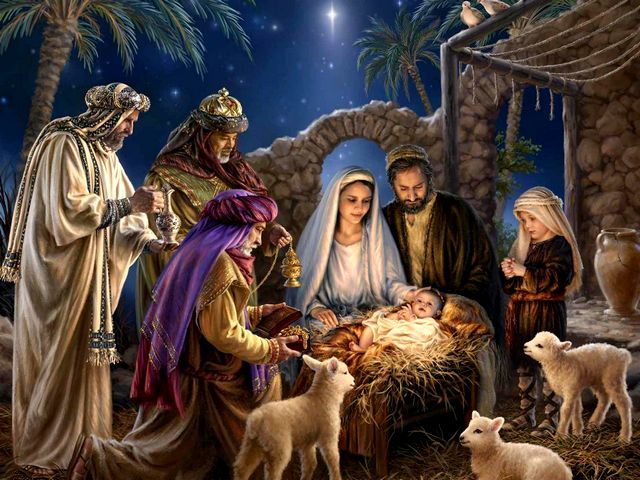
But the DNA that the Holy Spirit touched to trigger conception was Mary’s DNA. Luke provides us with a different genealogical list than Matthew as he traces back Jesus’ ancestors all the way to Adam and finally to God. (See Luke 3:23–38.) He does this because unlike Matthew, who is writing to a Jewish audience, Luke is writing to a Gentile audience. Luke wants his readers to understand that this Jewish Messiah is not just the Savior for Jews, but for all humankind. Of course, Luke goes on to describe the stable birth, the shepherd’s visit and the heavenly, angelic light and sound show that heralded the nativity of the Son of God.

Many Bible scholars believe that the differences between Matthew’s genealogical list and Luke’s list are due to Luke following Mary’s line of descent, while Matthew follows Joseph’s line. What is abundantly clear from both lists is that we are tracing the royal line of David, since at some point the lists merge and are identical.

Implicitly what both authors are saying by providing these lineages is that Jesus is the rightful heir of the Jewish throne. He is the long-awaited Messiah and the fulfillment of prophecy. His birth and arrival on the
scene mark a turning point in world history. God has stepped into human flesh and has come to live among us.

The gospel writer John puts it this way:

The Word became flesh and made his dwelling among us. We have seen his glory, the glory of the one and only Son, who came from the Father, full of grace and truth. (John 1:14)

James was born into this family, with this heritage, with this more-than-preeminent older brother. Talk about being overshadowed by an older brother! Like no one else on this planet James had the blessing, the challenge, and the curse of being overshadowed by the Almighty. And in human form, this Almighty was none other than his living, breathing, flesh, and blood older brother.


New from David Kitz

James—the brother of Jesus—who was this man? What evidence do we have that this “brother of our Lord” even existed?

David Kitz digs deep into archeology, family dynamics, church history, and the biblical texts. What emerges from his research is a portrait of a decisive, pivotal leader who embodied the will and character of Jesus Christ.

But how did James—James the unbeliever—transform to become a leader who changed the course of world history? In these pages you will uncover the answer and rediscover for yourself the life-changing power of the gospel.

To view further details or purchase directly from the author click here.

My Eyes Have Seen Your Salvation

28 Sunday Dec 2025

Posted by davidkitz in Psalm 25, Psalms

≈ Leave a comment

Tags

Gentiles, Holy Spirit, Israel, Jerusalem, Jesus, Mary, Messiah, praise the LORD, Prayer, Psalms, Simeon, temple, the LORD

I will praise the LORD!

Photo by Laura Garcia on Pexels.com


Reading: Psalm 25:1-7

https://davidkitz.blog/wp-content/uploads/2025/12/psalm-251-7-mix5final.mp3


Jesus Presented in the Temple

Now there was a man in Jerusalem called Simeon,
who was righteous and devout.
He was waiting for the consolation of Israel,
and the Holy Spirit was on him.

It had been revealed to him by the Holy Spirit
that he would not die
before he had seen the Lord’s Messiah.

Moved by the Spirit,
he went into the temple courts.
When the parents brought in the child Jesus
to do for him what the custom of the Law required,

Simeon took him in his arms
and praised God, saying:

   “Sovereign Lord, as you have promised,
you may now dismiss your servant in peace.
For my eyes have seen your salvation,
which you have prepared in the sight of all nations:
a light for revelation to the Gentiles,
and the glory of your people Israel.”

The child’s father and mother marveled
at what was said about him.
 
Then Simeon blessed them
and said to Mary, his mother:
“This child is destined to cause the falling
and rising of many in Israel,
and to be a sign that will be spoken against,

so that the thoughts of many hearts
will be revealed.
And a sword will pierce your own soul too.”
*
(Luke 2:25-35, NIV)

Para la publicación de Salmos 365 de hoy en español haga clic aquí.

bgbg_v4.3_1501818
* NEW INTERNATIONAL VERSION, COPYRIGHT ©1973, 1978, 1984, 2011 BY BIBLICA

Please pray for peace to return to Israel, Gaza, and Ukraine!

Volume I of Psalms 365: Develop a Life of Worship and Prayer won the Best Book of the Year Award from The Word Guild and Volume II has won the Best Devotional of the Year Award. For those who love God’s word, this three-book series is an ideal way to daily meet with the Lord. To purchase or for a closer look click here.

Available now…

James—the brother of Jesus—who was this man? What evidence do we have that this “brother of our Lord” even existed?

David Kitz digs deep into archeology, family dynamics, church history, and the biblical texts. What emerges from his research is a portrait of a decisive, pivotal leader who embodied the will and character of Jesus Christ.

But how did James—James the unbeliever—transform to become a leader who changed the course of world history? In these pages you will uncover the answer and rediscover for yourself the life-changing power of the gospel.

To view further details or purchase directly from the author click here.

The Magi Visit the Messiah

27 Saturday Dec 2025

Posted by davidkitz in Christmas

≈ 1 Comment

Tags

Bethlehem, gifts, Herod, magi, Mary, Messiah, praise the LORD, star, treasures, worship

I will praise the LORD!


The Magi Visit the Messiah

Then Herod called the Magi secretly
and found out from them
the exact time the star had appeared.

He sent them to Bethlehem and said,
“Go and search carefully for the child.
As soon as you find him,
report to me,
so that I too may go and worship him.”


After they had heard the king,
they went on their way,
and the star they had seen when it rose
went ahead of them
until it stopped over the place
where the child was.

When they saw the star,
they were overjoyed.

On coming to the house,
they saw the child with his mother Mary,
and they bowed down and worshiped him.
Then they opened their treasures
and presented him with gifts
of gold, frankincense and myrrh.

And having been warned in a dream
not to go back to Herod,
they returned to their country by another route.

(Matthew 2:7-12 NIV)*


Para la publicación de 
Salmos 365 de hoy en español haga clic aquí.

bgbg_v4.3_1501818
* NEW INTERNATIONAL VERSION, COPYRIGHT ©1973, 1978, 1984, 2011 BY BIBLICA

Please pray for peace to return to Israel, Gaza, and Ukraine!

Volume I of Psalms 365: Develop a Life of Worship and Prayer won the Best Book of the Year Award from The Word Guild and Volume II has won the Best Devotional of the Year Award. For those who love God’s word, this three-book series is an ideal way to daily meet with the Lord. To purchase or for a closer look click here.

Available now…

James—the brother of Jesus—who was this man? What evidence do we have that this “brother of our Lord” even existed?

David Kitz digs deep into archeology, family dynamics, church history, and the biblical texts. What emerges from his research is a portrait of a decisive, pivotal leader who embodied the will and character of Jesus Christ.

But how did James—James the unbeliever—transform to become a leader who changed the course of world history? In these pages you will uncover the answer and rediscover for yourself the life-changing power of the gospel.

To view further details or purchase directly from the author click here.
She Placed Him in a Manger

24 Wednesday Dec 2025

Posted by davidkitz in Advent

≈ 2 Comments

Tags

angel of the Lord, conceive, guidance, humility, Immanuel, Jesus, Joseph, marriage, Mary, prophet, Psalms, virgin

Today’s quote and prayer from
“Psalms 365: Develop a Life of Worship and Prayer

 Today’s Reading: Psalm 25:16-22

Listen to today’s reading by Jonathan Dent:

https://davidkitz.blog/wp-content/uploads/2025/12/psalm-2516-22-mix2final1.mp3

Lord Jesus,
whose birth we celebrate,
help me to be open and transparent before you.
Take away all my sins.
My hope is in you.
Protect me from the attacks of the enemy.
Deliver me from all my troubles,
my gracious Savior.
Amen.

— — — —


The Birth of Jesus

In those days Caesar Augustus issued a decree
that a census should be taken
of the entire Roman world.
 
(This was the first census that took place
while Quirinius was governor of Syria.)
 
And everyone went to their own town to register.

So Joseph also went up
from the town of Nazareth in Galilee to Judea,
to Bethlehem the town of David,
because he belonged to the house and line of David.

He went there to register with Mary,
who was pledged to be married to him
and was expecting a child.

While they were there,
the time came for the baby to be born,

and she gave birth to her firstborn,
a son.
She wrapped him in cloths
and placed him in a manger,
because there was no guest room available for them.
(Luke 2:1-7 NIV)*

Para la publicación de Salmos 365 de hoy en español haga clic aquí.

bgbg_v4.3_1501818
* NEW INTERNATIONAL VERSION, COPYRIGHT ©1973, 1978, 1984, 2011 BY BIBLICA

Pray for enduring peace in Israel and Gaza,
and continue to pray for peace to return to Ukraine and Russia!

Volume I of Psalms 365: Develop a Life of Worship and Prayer won the Best Book of the Year Award from The Word Guild and Volume II has won the Best Devotional of the Year Award. For those who love God’s word, this three-book series is an ideal way to daily meet with the Lord. To purchase or for a closer look click here.

Also available from David Kitz

American readers click this link to purchase The Soldier Who Killed a King.

Canadian readers click this link to purchase The Soldier Who Killed a King directly from the author.

They Will Call Him Immanuel

23 Tuesday Dec 2025

Posted by davidkitz in Advent

≈ 2 Comments

Tags

angel of the Lord, conceive, guidance, humility, Immanuel, Jesus, Joseph, marriage, Mary, prophet, Psalms, virgin

Today’s quote and prayer from
“Psalms 365: Develop a Life of Worship and Prayer

 Today’s Reading: Psalm 25:8-15

Listen to today’s reading by Jonathan Dent:

https://davidkitz.blog/wp-content/uploads/2025/12/psalm-258-15-mix2final.mp3


LORD God,
in humility I come before you.
I need your help
and guidance every moment of the day.
Teach me your ways in every circumstance I face.
Lord Jesus,
you are my Good Shepherd.
Amen.

— — — —


Joseph Obeys the Angel’s Command

All this took place to fulfill
what the Lord had said through the prophet:
 
“The virgin will conceive
and give birth to a son,
and they will call him Immanuel”
 (which means “God with us”).

When Joseph woke up,
he did what the angel of the Lord
had commanded him
and took Mary home as his wife.
 
But he did not consummate their marriage
until she gave birth to a son.
And he gave him the name Jesus.
(Matthew 1:22-25 NIV)*

Para la publicación de Salmos 365 de hoy en español haga clic aquí.

bgbg_v4.3_1501818
* NEW INTERNATIONAL VERSION, COPYRIGHT ©1973, 1978, 1984, 2011 BY BIBLICA

Pray for enduring peace in Israel and Gaza,
and continue to pray for peace to return to Ukraine and Russia!

Volume I of Psalms 365: Develop a Life of Worship and Prayer won the Best Book of the Year Award from The Word Guild and Volume II has won the Best Devotional of the Year Award. For those who love God’s word, this three-book series is an ideal way to daily meet with the Lord. To purchase or for a closer look click here.

Also available from David Kitz

American readers click this link to purchase The Soldier Who Killed a King.

Canadian readers click this link to purchase The Soldier Who Killed a Kingdirectly from the author.

Give Him the Name Jesus

22 Monday Dec 2025

Posted by davidkitz in Advent

≈ 5 Comments

Tags

angel of the Lord, David, divorce, God, Holy Spirit, hope in God, Jesus, Joseph, Mary, Messiah, Prayer, Savior, the LORD, truth

Today’s quote and prayer from
“Psalms 365: Develop a Life of Worship and Prayer

 Today’s Reading: Psalm 25:1-7

Listen to today’s reading by Jonathan Dent:

https://davidkitz.blog/wp-content/uploads/2025/12/psalm-251-7-mix5final.mp3


LORD God,
this is my prayer:
Show me your ways,
L
ORD, teach me your paths.
Guide me in your truth and teach me,
for you are God my Savior,
and my hope is in you all day long
(Psalm 25:4-5).
I pray in Jesus’ name.
Amen.

— — — —


An Angel Appears to Joseph

This is how the birth of Jesus
the Messiah came about:
His mother Mary was pledged
to be married to Joseph,
but before they came together,
she was found to be pregnant through the Holy Spirit.

Because Joseph her husband was faithful to the law,
and yet did not want to expose her to public disgrace,
he had in mind to divorce her quietly.

But after he had considered this,
an angel of the Lord appeared to him in a dream
and said,
“Joseph son of David,
do not be afraid to take Mary home as your wife,
because what is conceived in her is from the Holy Spirit.

She will give birth to a son,
and you are to give him the name Jesus,
because he will save his people from their sins.”
(Matthew 1:18-21 NIV)*

Para la publicación de Salmos 365 de hoy en español haga clic aquí.

bgbg_v4.3_1501818
* NEW INTERNATIONAL VERSION, COPYRIGHT ©1973, 1978, 1984, 2011 BY BIBLICA

Pray for enduring peace in Israel and Gaza,
and continue to pray for peace to return to Ukraine and Russia!

Volume I of Psalms 365: Develop a Life of Worship and Prayer won the Best Book of the Year Award from The Word Guild and Volume II has won the Best Devotional of the Year Award. For those who love God’s word, this three-book series is an ideal way to daily meet with the Lord. To purchase or for a closer look click here.

Also available from David Kitz

Holy Week as seen from a soldier’s perspective

American readers click this link to purchase The Soldier Who Killed a King.

Canadian readers click this link to purchase The Soldier Who Killed a King directly from the author.

My Spirit Rejoices in God My Savior

18 Thursday Dec 2025

Posted by davidkitz in Psalm 22, Psalm 23, Psalms

≈ 2 Comments

Tags

blessed, God my Savior, holy, Israel, Jesus, joy, Mary, mercy of God, Prayer, Psalm 23, Psalms, Savior, the cross, the humble, the LORD

Today’s quote and prayer from
“Psalms 365: Develop a Life of Worship and Prayer

 Today’s Reading: Psalm 24:1-6

Listen to today’s reading by Jonathan Dent:

https://davidkitz.blog/wp-content/uploads/2025/12/psalm-23-mix32final.mp3

 Lord Jesus,
I thank you for your suffering
and death on the cross.
Your blood cleanses my hands
and purifies my heart.
Today I want to seek you.
In your great mercy reveal yourself to me
and guide my steps,
my thiughts and my actions.
Amen.

— — — —


Mary Song—The Magnificat 

And Mary said:
“My soul glorifies the Lord
and my spirit rejoices in God my Savior,
for he has been mindful
    of the humble state of his servant.
From now on all generations will call me blessed,
for the Mighty One has done great things for me—
    holy is his name.
His mercy extends to those who fear him,
    from generation to generation.
He has performed mighty deeds with his arm;
    he has scattered those who are proud
in their inmost thoughts.

He has brought down rulers from their thrones
    but has lifted up the humble.
He has filled the hungry with good things
    but has sent the rich away empty.
He has helped his servant Israel,
    remembering to be merciful
to Abraham and his descendants forever,
    just as he promised our ancestors.”
(Luke 1:46-55 NIV)*

Para la publicación de Salmos 365 de hoy en español haga clic aquí.

bgbg_v4.3_1501818
* NEW INTERNATIONAL VERSION, COPYRIGHT ©1973, 1978, 1984, 2011 BY BIBLICA

Pray for enduring peace in Israel and Gaza,
and continue to pray for peace to return to Ukraine and Russia!

Volume I of Psalms 365: Develop a Life of Worship and Prayer won the Best Book of the Year Award from The Word Guild and Volume II has won the Best Devotional of the Year Award. For those who love God’s word, this three-book series is an ideal way to daily meet with the Lord. To purchase or for a closer look click here.

Also available from David Kitz

Holy Week as seen from a soldier’s perspective

American readers click this link to purchase The Soldier Who Killed a King.

Canadian readers click this link to purchase The Soldier Who Killed a King directly from the author.

Why Am I So Favored

17 Wednesday Dec 2025

Posted by davidkitz in Psalm 23, Psalms

≈ Leave a comment

Tags

blessed, Elizabeth, good shepherd, Holy Spirit, Jesus, joy, Mary, Prayer, Psalm 23, Psalms, the LORD

Today’s quote and prayer from
“Psalms 365: Develop a Life of Worship and Prayer

 Today’s Reading: Psalm 23

Listen to today’s reading by Jonathan Dent:

https://davidkitz.blog/wp-content/uploads/2025/12/psalm-23-mix32final.mp3


O LORD my God,
I want to follow you.
Dear Jesus,
be my Good Shepherd,
now and throughout this life
you have given me.
I love you because you first loved me.
I want the good life that comes from following you.
Amen.

— — — —

Deer on a snowy day near MacNutt, SK, photo by Char Kitz


Mary Visits Elizabeth

At that time Mary got ready
and hurried to a town in the hill country of Judea,
 
where she entered Zechariah’s home
and greeted Elizabeth.
 
When Elizabeth heard Mary’s greeting,
the baby leaped in her womb,
and Elizabeth was filled with the Holy Spirit.
 
In a loud voice she exclaimed:
“Blessed are you among women,
and blessed is the child you will bear!
 
But why am I so favored,
that the mother of my Lord should come to me?
 
As soon as the sound of your greeting
reached my ears,
the baby in my womb leaped for joy.
 
Blessed is she who has believed
that the Lord would fulfill his promises to her!”
(Luke 1:39-45 NIV)*

Para la publicación de Salmos 365 de hoy en español haga clic aquí.

bgbg_v4.3_1501818
* NEW INTERNATIONAL VERSION, COPYRIGHT ©1973, 1978, 1984, 2011 BY BIBLICA

Pray for enduring peace in Israel and Gaza,
and continue to pray for peace to return to Ukraine and Russia!

Volume I of Psalms 365: Develop a Life of Worship and Prayer won the Best Book of the Year Award from The Word Guild and Volume II has won the Best Devotional of the Year Award. For those who love God’s word, this three-book series is an ideal way to daily meet with the Lord. To purchase or for a closer look click here.

Also available from David Kitz

Holy Week as seen from a soldier’s perspective

American readers click this link to purchase The Soldier Who Killed a King.

Canadian readers click this link to purchase The Soldier Who Killed a King directly from the author.

The Power of the Most High

16 Tuesday Dec 2025

Posted by davidkitz in Psalm 22, Psalms

≈ 2 Comments

Tags

Elizabeth, God, gospel, Holy Spirit, Jesus, Mary, Messiah, Prayer, Psalms, redemption, Son of God, the LORD

Today’s quote and prayer from
“Psalms 365: Develop a Life of Worship and Prayer

 Today’s Reading: Psalm 22:27-31

Listen to today’s reading by Jonathan Dent:

https://davidkitz.blog/wp-content/uploads/2025/12/psalm-2227-31-mix3final.mp3


Father God,
thank you for the good news of the gospel.
Jesus is alive and reigns forever.
Help me to do my part
in bringing the message of your love
and redemption to the world.
I want to see people from all nations
turning to you in repentance and faith.
Amen.

— — — —


The Annunciation of the Coming Messiah—
Mary’s Response

“How will this be,”
Mary asked the angel,
“since I am a virgin?”

The angel answered,
“The Holy Spirit will come on you,
and the power of the Most High
will overshadow you.
So the holy one to be born
will be called the Son of God.

Even Elizabeth your relative
is going to have a child in her old age,
and she who was said
to be unable to conceive is in her sixth month.

For no word from God will ever fail.”

“I am the Lord’s servant,”
Mary answered.
“May your word to me be fulfilled.”
Then the angel left her.
(Luke 1:34-38 NIV)*

Para la publicación de Salmos 365 de hoy en español haga clic aquí.

bgbg_v4.3_1501818
* NEW INTERNATIONAL VERSION, COPYRIGHT ©1973, 1978, 1984, 2011 BY BIBLICA

Pray for enduring peace in Israel and Gaza,
and continue to pray for peace to return to Ukraine and Russia!

Volume I of Psalms 365: Develop a Life of Worship and Prayer won the Best Book of the Year Award from The Word Guild and Volume II has won the Best Devotional of the Year Award. For those who love God’s word, this three-book series is an ideal way to daily meet with the Lord. To purchase or for a closer look click here.

Also available from David Kitz

Holy Week as seen from a soldier’s perspective

American readers click this link to purchase The Soldier Who Killed a King.

Canadian readers click this link to purchase The Soldier Who Killed a King directly from the author.

You Have Found Favor with God

15 Monday Dec 2025

Posted by davidkitz in Psalm 22, Psalms

≈ 4 Comments

Tags

angel, annunciation, crucified, David, favor with God, God, Jesus, Mary, Messiah, Prayer, Psalms, resurrected, Savior, victory over death

Today’s quote and prayer from
“Psalms 365: Develop a Life of Worship and Prayer

 Today’s Reading: Psalm 22:22-26

Listen to today’s reading by Jonathan Dent:

https://davidkitz.blog/wp-content/uploads/2025/12/psalm-2222-26-mix2final.mp3


Father God,
thank you for victory over death, hell, and the grave
through your Son Jesus.
By faith his victory becomes my victory.
Hallelujah!
I praise you my crucified
and resurrected
Lord and Savior.
Amen.

— — — —


The Annunciation of the coming Messiah

But the angel said to her,
“Do not be afraid, Mary;
you have found favor with God.

You will conceive and give birth to a son,
and you are to call him Jesus.

He will be great
and will be called the Son of the Most High.
The Lord God will give him the throne
of his father David,

and he will reign over Jacob’s descendants forever;
his kingdom will never end.”
(Luke 1:30-33 NIV)*

Para la publicación de Salmos 365 de hoy en español haga clic aquí.

bgbg_v4.3_1501818
* NEW INTERNATIONAL VERSION, COPYRIGHT ©1973, 1978, 1984, 2011 BY BIBLICA

Pray for enduring peace in Israel and Gaza,
and continue to pray for peace to return to Ukraine and Russia!

Volume I of Psalms 365: Develop a Life of Worship and Prayer won the Best Book of the Year Award from The Word Guild and Volume II has won the Best Devotional of the Year Award. For those who love God’s word, this three-book series is an ideal way to daily meet with the Lord. To purchase or for a closer look click here.

New from David Kitz

James—the brother of Jesus—who was this man? What evidence do we have that this “brother of our Lord” even existed?

David Kitz digs deep into archeology, family dynamics, church history, and the biblical texts. What emerges from his research is a portrait of a decisive, pivotal leader who embodied the will and character of Jesus Christ.

But how did James—James the unbeliever—transform to become a leader who changed the course of world history? In these pages you will uncover the answer and rediscover for yourself the life-changing power of the gospel.

To view further details or purchase this or other books directly from the author click here.

← Older posts

Psalms 365: Develop a Life of Worship and Prayer

Psalms 365 Volume II

Psalms 365 vol 3
— Psalms 365 Volume III

Psalms

Recent posts

  • Generosity Is Never out of Season February 19, 2026
  • Givers & Takers February 19, 2026
  • Teach Me Your Paths February 18, 2026
  • Who holds you up? February 18, 2026
  • A Lesson from the Flowers February 17, 2026
  • Do not fret February 17, 2026
  • Minds Set on Things Above February 16, 2026

Calendar

February 2026
M T W T F S S
 1
2345678
9101112131415
16171819202122
232425262728  
« Jan    

Blog Posts

Comments

  • davidkitz on Teach Me Your Paths
  • K.L. Hale on Teach Me Your Paths
  • davidkitz on An Unflattering View of Yourself

Blog at WordPress.com.

Privacy & Cookies: This site uses cookies. By continuing to use this website, you agree to their use.
To find out more, including how to control cookies, see here: Cookie Policy
  • Subscribe Subscribed
    • I love the Psalms
    • Join 1,385 other subscribers
    • Already have a WordPress.com account? Log in now.
    • I love the Psalms
    • Subscribe Subscribed
    • Sign up
    • Log in
    • Report this content
    • View site in Reader
    • Manage subscriptions
    • Collapse this bar
 

Loading Comments...