• Home
  • About
  • DavidKitz.ca
  • Youtube Videos
  • Books by David
  • Books on Amazon.com

I love the Psalms

~ Connecting daily with God through the Psalms

I love the Psalms

Tag Archives: Jesus

Our Living Rock

28 Wednesday Jun 2017

Posted by davidkitz in Devotionals, Psalm 18, Psalms

≈ 7 Comments

Tags

David, God, Holy Spirit, Hopewell Rocks, intervention, Jesus, resurrection, Rock, Savior, the LORD

Reading:                                      Psalm 18

Verses 46-50

The LORD lives! Praise be to my Rock!
Exalted be God my Savior!
He is the God who avenges me,
who subdues nations under me,
who saves me from my enemies.
You exalted me above my foes;
from a violent man you rescued me.
Therefore I will praise you, L
ORD, among the nations;
I will sing the praises of your name.
He gives his king great victories;
he shows unfailing love to his anointed,
to David and to his descendants forever
(NIV).

Reflection
The joyful exuberance of the opening lines of this final reading from Psalm 18 is well worth reflecting upon. David exults, “The LORD lives! Praise be to my Rock! Exalted be God my Savior!”

cape breton 027

Hopewell Rocks, NB — photo by David Kitz


To my thinking, there’s nothing quite as dead as a rock. But here in the same breath, David praises the living LORD, his Rock and his Savior. Living rock seems to be a contradiction in terms, but our God is very much alive. He was alive and active in David’s life, and He is alive and active in your life as well—as active and alive as you allow Him to be. But the LORD also wants to be the Rock of stability in your life—the solid foundation from which you draw strength. A life anchored in God can withstand the storms of adversity and the test of time. The LORD is that stalwart mainstay that actively trains us for eternity.

Most importantly, our LORD saves. He saved David from all of his troubles. It was God’s intervention in David’s life that brought him the victory time after time. God was not content to sit in heaven and cheer from the sidelines. The LORD got involved in David’s life. He responded repeatedly to David’s cries for mercy and help.

If David had ample reasons to praise God and be thankful, we who live on this side of the cross, under the new covenant, have far more grounds for praise. God intervened directly for us. We have a Savior in Jesus, who left his throne in glory. He put His own skin in the game. The Father sent His one and only Son to live as a man, and then suffer and die on our behalf. And Jesus did not remain dead. God the Father raised him from the dead. Now with David we can say, “The LORD lives! Praise be to my Rock! Exalted be God my Savior!”

Response: Heavenly Father, thank you for sending Jesus. Thank you for his life, his death and his resurrection. I love you, Lord Jesus. You are the living Rock on which I can build my life. Through you I am more than a conqueror. Holy Spirit help me live this day in praise of my Savior. Amen.

Your Turn: Is the LORD your living Rock? Has He been your help? Has Jesus become your Savior? How will you honor Him today?

Eating and Drinking in God

15 Thursday Jun 2017

Posted by davidkitz in Psalm 16, Psalms

≈ 2 Comments

Tags

blood, communion, David, drinking, eating, eternal life, flesh, God, Jesus, New Testament, Paul, Psalms, Savior, the LORD

Reading:                                         Psalm 16

A miktam of David.

Keep me safe, my God, for in you I take refuge.
I say to the L
ORD, “You are my Lord;
apart from you I have no good thing.”
I say of the holy people who are in the land,
“They are the noble ones in whom is all my delight.”
Those who run after other gods will suffer more and more.
I will not pour out libations of blood to such gods
or take up their names on my lips.
L
ORD, you alone are my portion and my cup;
you make my lot secure.
The boundary lines have fallen for me in pleasant places;
surely I have a delightful inheritance.
I will praise the L
ORD, who counsels me;
even at night my heart instructs me.
I keep my eyes always on the L
ORD.
With him at my right hand, I will not be shaken
(NIV).

Reflection
In seed form all of the great truths of the New Testament are rooted in the Psalms. Psalm sixteen perfectly illustrates this little known fact. At the start of this psalm David declares, “You are my Lord; apart from you I have no good thing.”

2017-05-28j

Drinking in the peace of God — photo by David Kitz

In his epistle to the Romans, Paul writes, “For I know that in me (that is, in my flesh) nothing good dwells; for to will is present with me, but how to perform what is good I do not find.” His words are a rough paraphrase of David’s opening thoughts in Psalm 16. All of Romans chapter seven reflects our great need for our God and Saviour. Without Jesus there is no redemption and no hope for victory over sin. But with Paul we can joyfully conclude, “Thanks be to God, who delivers me through Jesus Christ our Lord!” (Romans 7:25).

We find ourselves in full agreement with David’s words, “LORD, you alone are my portion and my cup; you make my lot secure.” Our Savior is our portion and cup—our food and drink. He alone is our cup of salvation. Unless we eat and drink of Him we die. David eloquently expresses his communion with the LORD; David ate and drank in the LORD and so must we. In seed form David grasped the New Testament concept of communion.

Jesus was echoing David’s thoughts when he said, “Very truly I tell you, unless you eat the flesh of the Son of Man and drink his blood, you have no life in you. Whoever eats my flesh and drinks my blood has eternal life, and I will raise them up at the last day” (John 6:53-54).

Response: Heavenly Father, I want to live my life in constant communion with you. I want to live in your presence and eat and drink of you, Lord Jesus. I know apart from you I have no good thing. You are my portion and my cup. I give you thanks. Amen.

Your Turn: How are you eating and drinking in God today? How does that concept become a reality?

Christmas in June?

06 Tuesday Jun 2017

Posted by davidkitz in Psalm 10, Psalms

≈ 1 Comment

Tags

Bethlehem, Christ's birth, Christmas, Jesus, magi, Savior, seeking God, the LORD, wicked

Reading:                                          Psalm 10

Verses 1-4
Why, LORD, do you stand far off?
Why do you hide yourself in times of trouble?
In his arrogance the wicked man hunts down the weak,
who are caught in the schemes he devises.
He boasts about the cravings of his heart;
he blesses the greedy and reviles the L
ORD.
In his pride the wicked man does not seek him;
in all his thoughts there is no room for God
(NIV).

Reflection

As I write these thoughts on Psalm 10, we are a long way from Christmas. But there is a line in today’s reading that has me thinking about the Christmas season.

2017-05-28e

Take time to seek God — photo by David Kitz

The author of this psalm is describing the heart of those who are far from God. “In his pride the wicked man does not seek him; in all his thoughts there is no room for God.”

For many the celebration of Christ’s birth has become nothing more than a commercial bonanza completely devoid of any spiritual meaning. For them it is nothing more than a buying and selling frenzy—a pursuit of trinkets signifying nothing—nothing of eternal value.

No matter the season, we too can fall into a trap. Rather than seeking the LORD, we can find ourselves boasting about the cravings of our heart. As the psalmist says, we bless the greedy and in so doing, we revile the LORD.

No room for God… in today’s world? In a perverse way it seems rather appropriate. There was no room for God in Bethlehem on the night Jesus was born. No room for God… no room for the Maker and Savior of the universe! That sounds insane, but then it seems we live in a world gone mad.

For you and me, it doesn’t have to be that way. While there was no room for God incarnate in Bethlehem, the magi were busy seeking Him. Regardless of the season, you and I can set our hearts to be God seekers.

Response: Jesus, I seek after you. Open my eyes to see you at work today. Show up in my world today. I wait expectantly for you. Amen.

Your Turn: Have you seen Jesus in others? How can you seek God this week?

The Soldier Who Killed a King

01 Thursday Jun 2017

Posted by davidkitz in Books by David Kitz, Psalms

≈ 5 Comments

Tags

Canadian Bible Society, Christ, Christ's Passion, crucifixion, David Kitz, donkey-riding King, historic novel, Jesus, Kregel, Navigator Church Ministries, novel, Officers’ Christian Fellowship, One Way Ministries, resurrection, the cross

It’s very gratifying to have reputable people say good things about a book you have written. The following endorsements mean a lot to me:

“The best book I have read in years. A compelling read—I couldn’t put it down.” Doug Sprunt, One Way Ministries

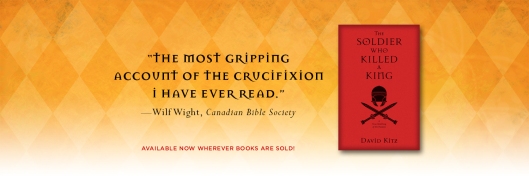
“The most gripping account of the crucifixion I have ever read.” Wilf Wight, eastern Ontario district director, Canadian Bible Society

Soldier 800kb

New from David Kitz and Kregel Publishing — now available for preorder

“I was at the foot of the cross. I stepped inside the empty tomb. This book took me there.” Robert DuBroy, cofounder of CHRI-FM, Ottawa, Ontario

“An awesome read: captivating, spellbinding, inspiring! Through the author’s masterful writing, the centurion stood out as a real and personable individual. . . . The book also helped me visualize Jesus, my Savior, and his person and work for the forgiveness of my sins, for my daily walk, and for the eternal life he has in store for all who believe.” Cliff Kentel, Prince of Peace Lutheran Church, Regina, Saskatchewan

“A readable and accurate novel about Jesus Christ’s last week on earth. David Kitz’s portrayal of the collision between pagan Rome and temple Judaism is completely plausible. And as a perfect antidote to the faux expertise of Dan Brown’s The Da Vinci Code, Kitz provides over a hundred endnotes and a handful of thumbnail biographies at the end of his book.” Joe Woodard, Calgary Herald

“Story has a way of capturing our attention and enabling truth to move from head to heart. David Kitz creatively unpacks the events of Passion Week as seen through a Roman centurion’s eyes. Through vivid word pictures, we see the whip-sliced back of our Savior and hear the pounding of each nail that affixed him to the cross. We walk these last steps of Jesus’s earthly ministry, leading to his death, burial, and triumphant resurrection from the dead. Kitz better helps us to do as the apostle John encourages: ‘See what great love the Father has lavished on us, that we should be called children of God!’ (1 John 3:1).” Dean Ridings, author of The Pray! Prayer Journal and communications director of Navigator Church Ministries

“This engaging, hard-hitting narrative is a distillation of Kitz’s study and prayer over fifty years as a pastor and educator, steeped in the wonder of this story. As a novelist, he reveals profound respect for the historical record through his characterization of Marcus Longinus, a Roman centurion who is unwillingly caught in the power struggles of the day. In contrast to the stench of these political machinations, the donkey-riding King emerges in the Roman world offering an entirely new way for humankind to be reborn. The Roman centurion is like us, caught between worlds. Who is king? Why? The Son of God shows unlimited compassion through healing the sick and feeding the hungry, and his purity catches the attention of the masses in a drama that still shakes the world, one aching, open, humble heart at a time.” Dr. Darlene L. Witte-Townsend, former professor of education, Johnson State College

“One of the most exceptional biblical fiction books I have ever read. I was struck by the everyday events and people affected by the dramatic climax of the cross, which Kitz presents on an equal level with Mel Gibson’s The Passion of the Christ. Extremely well documented historically and biblically, the narrative transports you back in time and evokes both grief and thanksgiving as you follow the soldier’s own emotional turmoil in grappling with the dramatic events of the darkest day in history. Like him you will be led to cry out in both despair and trust, ‘Surely this was the Son of God!’” Heather Goodwin, former manager of the Baptist Bookroom, New Brunswick

“David Kitz has written an intriguing book. Taking the point of view of the centurion who crucified Christ is new and fresh and gives the reader much to contemplate. Even though I knew the story, I felt compelled to read on to see how Kitz would unfold the drama. Excellently done!” Tami Waring, Officers’ Christian Fellowship, Maxwell-Gunter Air Force Base

For the month of June The Soldier Who Killed a King is available for preorder from Kregel Publishing for the early bird price of $10.99. The worldwide release date is July 25th.

Place your order today: http://www.kregel.com/fiction/the-soldier-who-killed-a-king/


Big God—Little Me

01 Thursday Jun 2017

Posted by davidkitz in Psalm 8, Psalms

≈ 10 Comments

Tags

David, eternal significance, God, heavens, insignificance, Jesus, majestic, portrait, Psalm, transcendent, true size, wonders

Reading:                                            Psalm 8

                 For the director of music. According to gittith. A psalm of David.

LORD, our Lord,
how majestic is your name in all the earth!
You have set your glory in the heavens.
Through the praise of children and infants
you have established a stronghold against your enemies,
to silence the foe and the avenger.
When I consider your heavens, the work of your fingers,
the moon and the stars, which you have set in place,
what is mankind that you are mindful of them,
human beings that you care for them?
You have made them a little lower than the angels and crowned them with glory and honor.
You made them rulers over the works of your hands;
you put everything under their feet: all flocks and herds,
and the animals of the wild, the birds in the sky,
and the fish in the sea, all that swim the paths of the seas.
LORD, our Lord,
how majestic is your name in all the earth (NIV).

Reflection

There’s something exquisitely beautiful about this psalm. Yes, in it we see the glory of the heavens, the sun, moon and stars—the vast array of heavenly bodies. But there’s more to it than that. This psalm is more than a pretty poetic picture of the heavens.

2017-05-28c

Lead me in your path — photo by David Kitz

It’s about perspective. In the grand scheme of things David grasps his true size—his insignificance. Beneath a canopy of stars, he has a transcendent moment—a God moment. He realizes the immensity of God. In the material realm you and I are just a transitory flicker across the face of time. That’s why David asks, “When I consider your heavens, the work of your fingers, the moon and the stars, which you have set in place, what is mankind that you are mindful of them, human beings that you care for them?”

In the vastness of the universe, what am I but a speck. Why would God even consider me? But He does! That’s the wonder of this psalm, and the wonder of our God. He is mindful of you and your concerns. God has crowned human beings—you and I—with glory and honor. When did that happen you might ask?

Well, it happened at creation. God placed humankind as the rulers of all creation. That’s a huge responsibility, a responsibility we have often failed to fulfill. But God reaffirmed His love and commitment to us at the cross. Jesus considered you so significant that he bled and died for you. Now that’s significance—eternal significance in the face of God’s own Son.

Response: Heavenly Father, Creator of the universe, thank you for considering me. Thank you for being mindful of my daily concerns. I bring them to you. Amen.

Your Turn: Have you had a transcendent moment—a God moment? How did that happen?

The Soldier Who Killed a King

21 Sunday May 2017

Posted by davidkitz in Books by David Kitz, Psalms

≈ Leave a comment

Tags

Caiaphas, centurion, David Kitz, Holy Week, Jesus, King Herod, Kregel, Longinus, Passion Week, Pontius Pilate, terrorist

A stunning story of Holy Week through the eyes of a Roman centurion

Soldier 800kb

New from David Kitz and Kregel Publishing — now available for preorder

Watch the triumphal entry of the donkey-riding king through the eyes of Marcus Longinus, the centurion charged with keeping the streets from erupting into open rebellion.

Look behind the scenes at the political plotting of King Herod, known as the scheming Fox for his ruthless shrewdness.

Get a front-row seat to the confrontation between the Jewish high priest Caiaphas and the Roman governor Pontius Pilate.

Understand as never before the horror of the decision to save a brutal terrorist in order to condemn the peaceful Jew to death.

If you’ve heard the story of Passion Week so often it’s become stale, now is the time to rediscover the terrible events leading from Jesus’s humble ride into the city to his crucifixion. The Soldier Who Killed a King will stun you afresh with how completely Christ’s resurrection changed history, one life at a time.

To pre-order directly from the publisher click on the link below:

http://www.kregel.com/fiction/the-soldier-who-killed-a-king/

Everything That Has Breath

19 Friday May 2017

Posted by davidkitz in Psalm 150, Psalms

≈ 7 Comments

Tags

breath, breath of God, breath of life, cymbals, dancing, hallelujah, Holy Spirit, Jesus, praise, Psalm, resurrection, the LORD

Reading:                                        Psalm 150

Praise the LORD.
Praise God in his sanctuary;
praise him in his mighty heavens.
Praise him for his acts of power;
praise him for his surpassing greatness.
Praise him with the sounding of the trumpet,
praise him with the harp and lyre,
praise him with timbrel and dancing,
praise him with the strings and pipe,
praise him with the clash of cymbals,
praise him with resounding cymbals.
Let everything that has breath praise the LORD.
Praise the LORD (NIV).

Reflection

We have reached the crescendo—the conclusion and the high point of the Book of Psalms. Hallelujah and praise the LORD!

img_20161004_132712_hdr

Petrie Island, Orleans, ON — photo by David Kitz

The word praise appears thirteen times in this final psalm. The number thirteen is suggestive of Jesus and his apostles. He is at the core—the very center of God ordained worship.

Eight forms or instruments of praise are listed in this psalm. Eight is the number of new beginnings. Seven suggests completeness, so we see that God rested on the seventh day. But eight signals a new start. In the same way, these eight means or instruments of praise do not represent a complete list. They simply suggest the varied ways in which we can express our praise to the LORD. We have only just begun to discover and explore the many ways in which we can show our gratitude to our Creator.

No one—no living being—is excluded from this call to praise. Let everything that has breath praise the LORD.

This call for all the breathing to praise the LORD is truly fitting. We received our original breath from the LORD. Then the LORD God formed a man from the dust of the ground and breathed into his nostrils the breath of life, and the man became a living being (Genesis 2:7). Now with our breath—our God-given breath—let us praise our Maker.

In the same way after his resurrection Jesus breathed on his disciples.  Again Jesus said, “Peace be with you! As the Father has sent me, I am sending you.” And with that he breathed on them and said, “Receive the Holy Spirit” (John 20:21-22).

We need the breath of God in us—the breath of the Holy Spirit in us to live—to truly live in the overcoming power and joy of the psalms. For the Holy Spirit’s presence I will praise the LORD!

Response: LORD God, I praise you. You are my strength and my song. Help me to discover new ways to praise you because you are good. Let my entire life reflect your redemptive presence in me. Amen.

Your Turn: Why are you breathing? Is praising God an integral part of your purpose?

A Double-Edged Sword

18 Thursday May 2017

Posted by davidkitz in Psalm 149, Psalms

≈ 4 Comments

Tags

crown of life, gender bias, God's word, heroes, Jesus, Old Testament history, praise, racial bias, rewriting history, Savior, spiritual warfare, sword of the Spirit, temptations, the LORD, word of God

Reading:                                          Psalm 149

(Verses 1-5)
May the praise of God be in their mouths
and a double-edged sword in their hands,
to inflict vengeance on the nations
and punishment on the peoples,
to bind their kings with fetters,
their nobles with shackles of iron,
to carry out the sentence written against them—
this is the glory of all his faithful people.
Praise the LORD (NIV).

Reflection

In society today there are moves afoot to rewrite history. Old monuments are being torn down or neglected. Places and buildings are being renamed because past victories or policies are now seen as oppressive or unjust. Many of the heroes of the past have lost their luster. In many cases there is sound reasoning that goes into justifying this change. Let’s face it; not every conquest was undertaken with pure motives. Not every government policy in the past was without racial or gender bias.

Tomb of David Entrance (1)

Statue of King David, the shepherd king, Jerusalem — photo by Lois Morrow

But are we wise when we judge people from a different era with the moral positions and perspectives of today? Do we carry our own set of biases that color our view of history? Of course we do.

We encounter the same issues when we look back at Old Testament history. It’s difficult for New Testament believers to justify Old Testament vengeance, genocide and slaughter. And yes, there’s plenty of that recorded in our Bibles. Today’s reading from Psalm 149 touches on this very point. The psalmist urges the infliction of vengeance on the nations and punishment on the peoples, to bind their kings with fetters, their nobles with shackles of iron. As followers of a gentle Jesus, who taught us to love our enemies, how are we to interpret and apply this call to action?

First, let’s realize that we are living under a new and better covenant with Jesus as our Lord and Savior. When he was arrested, Jesus told Peter to put away his sword. We do well when we heed that advice. The eager warmongers among us often need to take a chill pill. Jesus showed no tendencies to war.

But we do have a battle to fight, and we urgently need a double-edged sword. St. Paul calls it the sword of the Spirit, which is the word of God (Ephesians 6:17b). How effective are you in handling the word of God? How effective are you in battling the spiritual forces and daily temptations that are arrayed against you? With the praises of God in your mouth, and the sword of the Spirit in your hand, are you propelling your way to victory in the daily grind of life? Are the joy and peace of God reigning in your life?

Blessed is the one who perseveres under trial because, having stood the test, that person will receive the crown of life that the Lord has promised to those who love him (James 1:12).

Response: LORD God, I want to grow in my love for your word. Help me to use it wisely and deftly to the advance of your Kingdom. Lord Jesus, help me gain victory over spiritual forces that oppose me. Amen.

Your Turn: Are you developing competence in using the sword of the Spirit, which is the word of God?

I Miss Hallelujah!

16 Tuesday May 2017

Posted by davidkitz in Psalm 148, Psalms

≈ 2 Comments

Tags

Bible translations, Christmas, hallelujah, Hallelujah Chorus, Handel's Messiah, Jehovah, Jesus, praise, resurrection, the LORD, victory, Yahweh

Reading:                                         Psalm 148

(Verses 13-14)
Let them praise the name of the LORD,
for his name alone is exalted;
his splendor is above the earth and the heavens.
And he has raised up for his people a horn,
the praise of all his faithful servants,
of Israel, the people close to his heart.
Praise the LORD (NIV).

Reflection

Broadly speaking I like modern translations of the Bible over the traditional King James Version, but… But sometimes the old King James just sounds better, or more familiar. Here at the close of Psalm 148 we have a case in point.

IMG_20170506_131109

Orleans woods in spring — photo by David Kitz

The New International Version ends the psalm with these words: Praise the LORD. The King James Version ends the psalm with Praise ye the LORD. But a more literal translation or transliteration of this final phrase is Hallelujah! The footnotes to the New American Standard Bible point out that Hallelu means praise, while JAH is the abbreviated Hebrew name for God, which is often translated Jehovah or more accurately Yahweh.

Whenever you see the phrase praise the LORD, you are actually looking at a translation of the Hebrew word hallelujah!

Hallelujah is entirely absent from the New International Version of the Bible. It has also been scrubbed from most of the other modern translations. To put it bluntly, I miss hallelujah. It has an uplifting ring to it. Hallelujah skips off the tongue like a shooting star. It bursts forth from a thankful heart like fireworks on a summer night. 

For the Christian believer Christmas is the great Hallelujah! God has come to the earth and been born as a baby like you and me. This is the beginning of the great redemption story.

The resurrection is the second great Hallelujah! The Son of God was vindicated. His death was not in vain. He conquered death, our greatest foe, and now Jesus reigns on high forever. That calls for a hallelujah! And for good measure, let’s add praise the LORD too!

The one who at his birth was laid in a manger is the King of kings and the Lord of lords. As Handel’s Messiah proclaims, “He shall reign forever and ever. Hallelujah!” Let the hallelujahs resound from the earth to the heavens as we join in the song of the angels—the song of the ages.

Let them praise the name of the LORD, for his name alone is exalted; his splendor is above the earth and the heavens.

Response: LORD God, I praise you for sending Jesus. I praise you for your great plan of redemption. Jesus, I thank you for carrying my sins to Calvary. I rejoice in your resurrection victory. Hallelujah! Amen.

Your Turn: Do you enjoy Handel’s Hallelujah Chorus? What is your favorite expression of praise to God?

Praises from the Earth

15 Monday May 2017

Posted by davidkitz in Psalm 148, Psalms

≈ 1 Comment

Tags

creation, heaven, heaven on earth, heavens, Holy Spirit, Jesus, Kingdom of God, Lord's Prayer, praise, worship

Reading:                                        Psalm 148

(Verses 7-12)
Praise the LORD from the earth,
you great sea creatures and all ocean depths,
lightning and hail, snow and clouds,
stormy winds that do his bidding,
you mountains and all hills,
fruit trees and all cedars,
wild animals and all cattle,
small creatures and flying birds,
kings of the earth and all nations,
you princes and all rulers on earth,
young men and women,
old men and children (NIV).

Reflection

Psalm 148 began with a call for praise for the LORD from the angels, who are heaven’s messengers, from the heavenly hosts and all the heavenly bodies. In today’s reading, the psalmist expands this call for praise to all the creatures of the earth, the elements of nature, wind, cloud and ocean depths, and finally to all humanity.

IMG_20160425_153133

Azaleas in bloom, Victoria, BC — photo by David Kitz

There is a logical progression in this call for thunderous praise. The call begins with what is distant, the galaxies and the heavenly beings, and then it descends to the earth, and finally it touches humanity. It becomes personal. We are called to praise God. Will you join the swelling chorus?

John, the beloved, gives us a picture of what heaven’s praise party looks like.

Then I looked and heard the voice of many angels, numbering thousands upon thousands, and ten thousand times ten thousand. They encircled the throne and the living creatures and the elders. In a loud voice they were saying:

“Worthy is the Lamb, who was slain,
to receive power and wealth and wisdom and strength
and honor and glory and praise!” (Revelation 5:11-12).

Our Lord taught us to pray, “Our Father in heaven, hallowed be your name, your kingdom come, your will be done, on earth as it is in heaven” (Matthew 6:9b-10).

Surely, it is the will of God that He be praised and worshipped on earth just as He is around His throne in heaven. The purpose of God’s Kingdom—the Kingdom that Jesus came to establish—is to bring heaven to earth. God did not remain distant. In the person of Jesus, He came to dwell among us. He brought and is presently bringing the will of God to the earth through the Holy Spirit. For that Jesus is to be praised. Let all of creation praise Him—praise Him from the earth, because from it we were formed. Let the praise for our Lord ascend from you and me.

Response: LORD God, let your Holy Spirit be active among us. Help us to love and serve you and those around us. Help me to bring a little bit of heaven—a little bit of your will to the earth today. Amen.

Your Turn: How do you picture heaven? What does a little bit of heaven on earth look like to you?

← Older posts
Newer posts →

Psalms 365: Develop a Life of Worship & Prayer

Psalms 365 Volume II

Psalms 365 vol 3
— Psalms 365 Volume III

Now available:

Psalms

Recent posts

  • The LORD’s Appointment September 15, 2026
  • Jesus Heals a Blind Man at Bethsaida September 14, 2026
  • God’s Firestarters: Healing Pioneers September 14, 2026
  • Jesus Remains September 14, 2026
  • A Devotional Journey through the Epistle of James September 13, 2026
  • A Fresh Perspective That Sent Me Back to the Gospels September 12, 2026
  • Giving Grateful Praise September 12, 2026

Calendar

September 2026
M T W T F S S
 123456
78910111213
14151617181920
21222324252627
282930  
« Aug    

Blog Posts

Comments

  • davidkitz on A Throne of Cherubim
  • davidkitz on They Called on the LORD
  • atimetoshare.me on They Called on the LORD

Blog at WordPress.com.

Privacy & Cookies: This site uses cookies. By continuing to use this website, you agree to their use.
To find out more, including how to control cookies, see here: Cookie Policy
  • Subscribe Subscribed
    • I love the Psalms
    • Join 1,353 other subscribers
    • Already have a WordPress.com account? Log in now.
    • I love the Psalms
    • Subscribe Subscribed
    • Sign up
    • Log in
    • Report this content
    • View site in Reader
    • Manage subscriptions
    • Collapse this bar
Loading Comments...