• Home
  • About
  • DavidKitz.ca
  • Youtube Videos
  • Books by David
  • Books on Amazon.com

I love the Psalms

~ Connecting daily with God through the Psalms

I love the Psalms

Tag Archives: Jesus

I Lift Up My Eyes

10 Sunday Aug 2025

Posted by davidkitz in Psalm 121, Psalms

≈ Leave a comment

Tags

armor of God, Christ, Jerusalem, Jesus, lighthouse, Mount Calvary, pilgrimage, Prayer, Psalm 121, Psalms, the cross, the LORD, Zion

Psalm 121

A Song of Ascents

I lift up my eyes to the hills—
Where does my help come from?
My help comes from the LORD,
the Maker of heaven and earth.
He will not let your foot slip—
He who watches over you will not slumber;
Indeed, he who watches over Israel
will neither slumber nor sleep.
The LORD watches over you—
The LORD is your shade at your right hand;
The sun will not harm you by day,
nor the moon by night.
The LORD will keep you from all harm—
He will watch over your life;
The LORD will watch over your coming and going
both now and forever more.

Psalm 121 is a Song of Ascents, and as such it was a psalm, which was intended for use by pilgrims as they journeyed to Jerusalem. This particular psalm was most often sung or chanted as the pilgrims set out from Jericho. As they lifted up their eyes, the sharply rising hill country of Judah stretched off into the distance. Hill after hill rose up before them.

This final portion of the pilgrimage was truly an ascent. From the Dead Sea plain the road to Jerusalem climbs nearly five thousand feet. This is truly an ascent—an ascent from the Dead Sea, the lowest point on earth’s surface, to the heights of Mount Zion.

For the bone-weary pilgrims, who had already walked more than one hundred kilometres (60 miles) from Galilee, the sight of those distant hills must have brought a measure of aching discouragement. Here was a looming challenge. Could they make this final ascent? The opening question of this psalm was not a matter of poetic whimsy. It was spoken in earnest.

Photo by Marek Piwnicki on Pexels.com

“I lift up my eyes to the hills—where does my help come from?”

The weary pilgrim may well be asking, “Having come this far, can I complete this journey? Do I have enough energy—enough stamina to climb those hills? Will I be able to reach Zion? I am exhausted now—before I even start the ascent. I can’t do this on my own.”

“Where does my help come from?”

The psalmist’s answer resounds off those ancient hills. Even today, it echoes down through the ages and reverberates through the chambers of the heart. 

“My help comes from the LORD, the Maker of heaven and earth.”

I cannot make it on my own. Realistically, I am incapable of this final climb. Zion is unreachable in my own strength. But all things are possible with God. He is the Maker of heaven and earth. Surely the Maker of the earth can help me move across this tiny portion of the planet that He has formed. He is my help. My help comes from the LORD!

This bold profession from the psalmist reflects reality for all who have answered our Saviour’s call to walk in faith. We start from the lowest point. Jesus does not call us from the heights. He calls us from the Dead Sea—a place of both physical and spiritual death. Paul, the apostle, makes this perfectly clear.

As for you, you were dead in your transgressions and sins, in which you used to live when you followed the ways of this world and the ruler of the kingdom of the air, the spirit that is now at work in those who are disobedient. All of us also lived among them at one time, gratifying the cravings of our sinful nature and following its desires and thoughts (Ephesians 2:1-2).   

It is from this low point that we lift up our eyes. If we look at ourselves—at our sin steeped past—there is no hope. It is just as St. Paul says, we are dead in our transgressions and sins. If we lift up our eyes to the road ahead—to the upward-sloping road of righteousness—we will become discouraged. All we see are hills—obstacles as far as the eye can see. Holiness is not an innate human response. The way is hard; the climb is steep, even impossible. There is no hope there. No, we must lift our eyes higher yet. We must look past the hills, and to the LORD, the Maker of heaven and earth. 

“Where does my help come from? My help comes from the LORD, the Maker of heaven and earth.”

How high are you lifting your eyes? If we look to the LORD, there is hope. Through Him, the way becomes possible. In Him there is grace for the journey. Through his love and mercy, we are no longer spiritually dead. We have a new life—a new life in Christ. The road ahead has in fact been prepared for us. It is as Paul asserts, “But because of his great love for us, God, who is rich in mercy, made us alive with Christ even when we were dead in transgressions—it is by grace you have been saved” (Ephesians 2:4-5).

Having been born again through faith, it is Christ who now walks with us on this earthly pilgrimage. We can leave behind the Dead Sea region with all its life draining futility. We can leave behind the fetid sea of sin. But we are not travelling alone now. Our forerunner, our brother, the King, is walking with us.

He is walking beside me. When I lift up my eyes, He comes into view.

As I walk on, His words are my constant comfort and encouragement. Jesus speaks to the pilgrim, “I am the light of the world. Whoever follows me will never walk in darkness, but will have the light of life” (John 8:12).

Here in this psalm, we have our LORD’s sure promise.

“He will not let your foot slip—he who watches over you will not slumber; indeed, he who watches over Israel will neither slumber nor sleep.”

For the weary Jewish pilgrim, a foot slip was no small mishap. If a foot slipped and an ankle twisted, the journey was over. There was no point in proceeding. Why add more agonizing miles to the journey? Why inconvenience others with your injury? The pilgrim would find a safe place to rest and recover, perhaps at an inn, while the others in his party would proceed to Zion.

A pilgrimage to the house of God — MacNutt, Saskatchewan — photo by David Kitz

The Christian pilgrim’s constant prayer should be, “Do not let my foot slip. Let my step be firm; let my path be straight.”

This is why our Lord taught us to pray, “Lead us not into temptation, but deliver us from the evil one” (Matthew 6:13).

The LORD is always alert to that prayer. It’s His prayer and it’s His desire to answer it. We can rest assured that He will watch over us. We can rest—yes—truly rest. We can put our minds at ease, because He will not. He will not rest. He will not slumber or sleep. Like a mother keeps vigil over a desperately sick child, so the LORD will watch over every move we make—every time we stir—so constant is His care.

Those, who are saved by grace, can find rest in His grace. He will not let your foot slip. His goal is your goal. He longs to welcome you to Zion, to the House of God, to your eternal home.

So it then follows that “the LORD watches over you—the LORD is your shade at your right hand; the sun will not harm you by day, nor the moon by night.”

Interestingly, Jesus told one of his best-known parables about this particular journey—the journey from Jerusalem down to Jericho. In truth, it’s the pilgrim’s journey of Psalm 121 done in reverse. We know it as the parable of the Good Samaritan. From this parable we discover that the descent from Jerusalem to Jericho was not only steep and treacherous. It was also fraught with danger. The steep hills, rills and canyons were ideal hideouts for highway robbers. They could pounce on the unsuspecting traveller from behind any one of ten thousand rocks. One never knew what danger might lurk around the next sharp curve in the road. Ambushes on this route were common. It was wise to travel in a group. The lone traveller was an easy target for marauding thieves.

When we decide to follow Christ, we instantly become a target for Satan’s attack. He and his demonic minions lie in wait for the unsuspecting faith pilgrim. The lone-believer can quickly become the wounded-and-dying-believer. The struggling-believer may soon become the fallen-believer—fallen and half dead.

We are our brother’s keeper. There is safety in numbers. We are to journey together. So with this in mind,

Let us hold unswervingly to the hope we profess, for he who promised is faithful. And let us consider how we may spur one another on toward love and good deeds. Let us not give up meeting together, as some are in the habit of doing, but let us encourage one another and all the more as you see the Day approaching (Hebrews 10:23-25).

In addition, we need the LORD’s protective shield round about us. We need His promise. “The LORD is your shade at your right hand; the sun will not harm you by day, nor the moon by night.”

Roman armor — photo by David Kitz

Pray for the LORD’s round the clock protection. Put on the full armor of God. The LORD’s pilgrim is also the LORD’s warrior against spiritual forces of darkness. The apostle Paul reminds us,

Take up the shield of faith, with which you can extinguish all the flaming arrows   of the evil one. Take the helmet of salvation and the sword of the Spirit, which is the word of God. And pray in the Spirit on all occasions with all kinds of prayers and requests. With all this in mind, be alert and always keep praying for all the saints (Ephesians 6:16-18). 

As you do all these things on your upward journey “the LORD will keep you from all harm—He will watch over your life; the LORD will watch over your coming and going both now and forever more.”

It’s amazing how much distance you can cover on foot, when your pace is steady, and when you make a straight path, or a direct line to your objective. I was reminded of this truth just this afternoon. Once again, I am back in Chicago for some drama events. Once again, I went for a walk along scenic Lincoln Park on the shore of Lake Michigan. But unlike my leisurely stroll of last summer, today from the outset, I set a pace—a brisk pace—and I had an objective in mind.

My objective was a lighthouse at the end of a concrete peer that juts out into the aquamarine waters of the lake. Having set my sights on this lighthouse, I made a beeline for it. For me, taking the most direct route, sometimes meant stepping off the well-worn path and heading off across country.  

Following Christ is like that. If we have him in our sights, the well-worn path that others follow may not be for us. Those other paths bring us to other destinations. They may even bring us close to the Lighthouse, but not to the Lighthouse.

When you lift up your eyes, lift them to the one you are following. Lift them to Jesus. Then let your feet follow the most direct path to him, regardless of how others are walking. If your pace is steady and unwavering, and if your course is straight, the miles will fly by.

Cape Breton, N.S. lighthouse — Photo by David Kitz

The distance flew by for me. I reached my objective, the lighthouse, so quickly that I set another objective. This was another lighthouse still farther up the shore. I maintained my pace and again I took the most direct route. Again, I was surprised by the speed at which I covered the distance. When I reached this second objective, a whole new vista opened up. New opportunities presented themselves.

If you fix your eyes on Christ, he will bring you to the summit of the next hill. A new adventure—a new vista awaits.

When I look back over the years of my faith pilgrimage, I can see that my progress has not always been steady or direct. There have been distractions. My pace has been erratic. Other paths—well-worn paths—have intersected with the direct path to Christ. At times I have drifted down those intersecting paths.

But then, I lift up my eyes. I lift my eyes to the hill—the hill of my salvation. There is a cross on that hill. Though Jesus’ hands are pinned, he beckons me closer. I fix my eyes on him. He draws me up—up the round stone hill of Calvary.

Let us throw off everything that hinders and the sin that so easily entangles, and let us run with perseverance the race marked out for us. Let us fix our eyes on Jesus, the author and perfecter of our faith, who for the joy set before him endured the cross, scorning its shame, and sat down at the right hand of the throne of God (Hebrews 12:1-2).

“Jesus, draw me to the summit. I fix my eyes on you.”

A new vista awaits.

Bringing Life to the Psalms

  1. In our urban environment, we live in an artificial world—a world planned for the automobile. It seems many of us have forgotten why the LORD gave us legs, yet we talk about our walk of faith. This week plan a walk. Be sure to take Jesus with you. Ask him to speak to you on the way. Remember the resurrected Christ joined his disciples as they walked to Emmaus.
  2. Have you ever been distracted from the path? Was it immediately obvious that you had left the path God had called you to walk? What brought you back? Did a particular event trigger your return?
  3. In a world of flashing distractions, how do we keep our eyes fixed on Jesus? In your walk of faith, when your pace is steady and progress is readily apparent, what sort of things are you doing?
  4. Are you your brother’s or sister’s keeper? Have you helped someone recently in their faith walk? Have you needed help? Open, honest communication is essential. Satan attacks and silences believers, but our Father invites us to speak to Him and to each other.
  5. Reread Psalm 121. What is God saying to you by His Spirit?

Today’s post is Chapter 24 from the book Psalms Alive! Connecting Heaven & Earth by David Kitz. To find out more or purchase click here.


Your Eternal Destiny

08 Friday Aug 2025

Posted by davidkitz in Psalm 131

≈ 2 Comments

Tags

Bible, contentment, Father God, God, humility, Jesus, love each other, Prayer, Psalms, quiet life, work

Today’s quote and prayer from
“Psalms 365: Develop a Life of Worship and Prayer”
by David Kitz

Reading: Psalm 131

Father God,
help me to change.
I want to become more like Jesus.
He was the servant of all.
Help me to avoid the pitfall of pride.
Teach me how to quiet my soul
and be content in you.

Amen.

— — — —

Now about your love for one another
we do not need to write to you,
for you yourselves have been taught
by God to love each other.

And in fact,
you do love all of God’s family
throughout Macedonia.
Yet we urge you, brothers and sisters,
to do so more and more,

and to make it your ambition
to lead a quiet life:
You should mind your own business
and work with your hands,
just as we told you,

so that your daily life
may win the respect of outsiders
and so that you will not be dependent
on anybody.

(1 Thessalonians 4:9-12
NIV)*

Para la publicación de Salmos 365 de hoy en español haga clic aquí.

bgbg_v4.3_1501818
* NEW INTERNATIONAL VERSION, COPYRIGHT ©1973, 1978, 1984, 2011 BY BIBLICA

Please pray for peace to return to Israel, Gaza, Iran, and Ukraine!

Volume I of Psalms 365: Develop a Life of Worship and Prayer won the Best Book of the Year Award from The Word Guild and Volume II has won the Best Devotional of the Year Award. For those who love God’s word, this three-book series is an ideal way to daily meet with the Lord. To purchase or for a closer look click here.

A gripping read from David Kitz.
Is a return-to-Jesus revival possible in our time?
This book points the way forward.

Humility Determines Destiny

08 Friday Aug 2025

Posted by davidkitz in Psalm 131, Psalms

≈ Leave a comment

Tags

Bible, child, children, content, contentment, devotion, humility, Jesus, meek, mother, peace, Prayer, pride, Psalms, wisdom

Today’s Devotion from Psalms 365 by David Kitz

Reading: Psalm 131

A song of ascents. Of David.

My heart is not proud, LORD,
    my eyes are not haughty;
I do not concern myself with great matters
    or things too wonderful for me.
But I have calmed and quieted myself,
    I am like a weaned child with its mother;
    like a weaned child I am content.
Israel, put your hope in the LORD
    both now and forevermore
(NIV). *

Photo by Arina Krasnikova on Pexels.com

Reflection
In my personal quiet time this morning I highlighted this verse. When pride comes, then comes disgrace, but with humility comes wisdom (Proverbs 11:2).

The wisdom that comes with humility is a rare commodity in today’s world. It appears that the crude bravado of boasting egocentrics is winning the day. Every field of human endeavor has its loudmouthed champions—men who heap scorn on meeker souls.

But Jesus has a message that runs completely contrary to this approach. In his Sermon on the Mount, he said, “Blessed are the meek, for they will inherit the earth” (Matthew 5:5). On another occasion, the disciples asked Jesus this question, “Who, then, is the greatest in the kingdom of heaven?”

This is Jesus’ response. “Truly I tell you, unless you change and become like little children, you will never enter the kingdom of heaven. Therefore, whoever takes the lowly position of this child is the greatest in the kingdom of heaven. And whoever welcomes one such child in my name welcomes me.” (See Matthew 18:1-5).

Jesus turns this world’s operating system on its head. He heaps honor on the weak, the humble and the vulnerable. He praises the soul of the weaned child—the one who takes the position of humility. Of course, Jesus is right. The folly of the proud ends in disgrace, but the humility of the meek ends in honor and a glorious inheritance.

Your eternal destiny is determined by your humility. These words of Jesus are an ominous warning:  “Truly I tell you, unless you change and become like little children, you will never enter the kingdom of heaven.”

I need to become like the weaned child of Psalm 131. Can I truthfully say these words? “My heart is not proud, LORD, my eyes are not haughty” (v. 1a). Have I “calmed and quieted myself? And am I “like a weaned child with its mother?” (v. 2). Am I content? Becoming like the weaned child requires change. I need to change. Jesus asks me to change. How about you?

Response: Father God, help me to change. I want to become more like Jesus. He was the servant of all.  Help me to avoid the pitfall of pride. Teach me how to quiet my soul and be content in you. Amen.

Your Turn: How are you learning to quiet your soul before God? What brings you peace and contentment?

Para la publicación de Salmos 365 de hoy en español haga clic aquí.

bgbg_v4.3_1501818
* NEW INTERNATIONAL VERSION, COPYRIGHT ©1973, 1978, 1984, 2011 BY BIBLICA


Please pray for peace to return to Israel, Gaza, and Ukraine!

Volume I of Psalms 365: Develop a Life of Worship and Prayer won the Best Book of the Year Award from The Word Guild and Volume II has won the Best Devotional of the Year Award. For those who love God’s word, this three-book series is an ideal way to daily meet with the Lord. To purchase or for a closer look click here.

A gripping read from David Kitz.
Is a return-to-Jesus revival possible in our time?
This book points the way forward.
For details click here.

The Punishment That Brought Us Peace

07 Thursday Aug 2025

Posted by davidkitz in Psalm 130, Psalms

≈ Leave a comment

Tags

Bible, God, healed, healing, Jesus, Prayer, prophetic, Psalms, redeem, Redeemer, repentance, the LORD

Today’s quote and prayer from
“Psalms 365: Develop a Life of Worship and Prayer”
by David Kitz

Reading: Psalm 130:5-8

Father God,
I thank you for your prophetic word
because it points to Jesus.
Lord Jesus,
thank you for laying down your life to redeem me,
and all who bow before you in repentance.
Amen.

— — — —

Surely he took up our pain
    and bore our suffering,
yet we considered him punished by God,
    stricken by him, and afflicted.
But he was pierced for our transgressions,

    he was crushed for our iniquities;
the punishment that brought us peace was on him,
    and by his wounds we are healed.
We all, like sheep, have gone astray,

    each of us has turned to our own way;
and the LORD has laid on him
    the iniquity of us all.
(Isaiah 53:4-6
NIV)*

Para la publicación de Salmos 365 de hoy en español haga clic aquí.

bgbg_v4.3_1501818
* NEW INTERNATIONAL VERSION, COPYRIGHT ©1973, 1978, 1984, 2011 BY BIBLICA

Please pray for peace to return to Israel, Gaza, Iran, and Ukraine!

Volume I of Psalms 365: Develop a Life of Worship and Prayer won the Best Book of the Year Award from The Word Guild and Volume II has won the Best Devotional of the Year Award. For those who love God’s word, this three-book series is an ideal way to daily meet with the Lord. To purchase or for a closer look click here.

A gripping read from David Kitz.
Is a return-to-Jesus revival possible in our time?
This book points the way forward.

Waiting for a Redeemer

07 Thursday Aug 2025

Posted by davidkitz in Psalm 130, Psalms

≈ Leave a comment

Tags

communion with God, devotion, Jesus, listening prayer, Messiah, Prayer, prophetic, Psalms, Redeemer, Savior, silence, the LORD, waiting for the LORD

Today’s Devotion from Psalms 365 by David Kitz

Reading: Psalm 130:5-8

I wait for the LORD, my whole being waits,
    and in his word I put my hope.
 I wait for the Lord

    more than watchmen wait for the morning,
    more than watchmen wait for the morning.
Israel, put your hope in the LORD,
    for with the L
ORD is unfailing love
    and with him is full redemption.
He himself will redeem Israel
    from all their sins
(NIV). *

Photo courtesy of L. Kranz.

Reflection
Psalm 130 can be divided into three distinct sections: the confessional approach, the wait, and the LORD’s response. In yesterday’s reading, we looked at the confessional approach. The psalmist came before his God and poured out his heart. In desperation he pleaded for mercy and forgiveness. At the same time, he acknowledged the extreme mercy of God. He knows full well that this God forgives the undeserving.

Now, the psalmist waits: “I wait for the LORD, my soul waits, and in his word I put my hope. My soul waits for the Lord more than watchmen wait for the morning, more than watchmen wait for the morning” (v. 5-6).

This is the step that is most frequently missing in our communion with God. We cannot wait; we rush on. We have things to do, people to see, a life to live. We have no time to wait for the LORD’s response. But without waiting, we cannot hear the LORD speaking to our hearts. The rush of life takes over. We do not hear our Savior speak the words of divine pardon. Prayer is reduced to one way communication. We speak into the silence and allow no time for the God of silence to answer back.

But in his time of silence, the psalmist heard from God. In this third section of the psalm, the author is no longer addressing the LORD in prayer. Now he addresses us. The wait is over. God has spoken, and now the psalmist rises to his feet. He has a message from the LORD for us—the Israel of God.

Israel, put your hope in the LORD, for with the LORD is unfailing love and with him is full redemption (v. 7).

For Israel, there was a long wait. The promised Messiah was a long time in coming. The centuries slipped by. Generation after generation passed on, but the word of the LORD stood firm. A Redeemer was coming. With an uncanny accuracy the Old Testament prophets foretold the coming of the Christ. Many of those prophetic words are found within the Psalms. The Lord Jesus is our fount of hope—our Redeemer. He is love and the source of unfailing love. It is he who with his blood redeemed us, body, soul and spirit. In the person of Jesus, God took on human flesh. On the cross he fulfilled these words. “He himself will redeem Israel from all their sins” (v. 8).

Response: Father God, I thank you for your prophetic word because it points to Jesus. Lord Jesus, thank you for laying down your life to redeem me, and all those who bow before you in repentance. Amen.

Your Turn: Are you taking time to listen for the voice of God in prayer? How has the Holy Spirit spoken to you in the past?

Para la publicación de Salmos 365 de hoy en español haga clic aquí.

bgbg_v4.3_1501818
* NEW INTERNATIONAL VERSION, COPYRIGHT ©1973, 1978, 1984, 2011 BY BIBLICA


Please pray for peace to return to Israel, Gaza, and Ukraine!

Volume I of Psalms 365: Develop a Life of Worship and Prayer won the Best Book of the Year Award from The Word Guild and Volume II has won the Best Devotional of the Year Award. For those who love God’s word, this three-book series is an ideal way to daily meet with the Lord. To purchase or for a closer look click here.

A gripping read from David Kitz.
Is a return-to-Jesus revival possible in our time?
This book points the way forward.
For details click here.
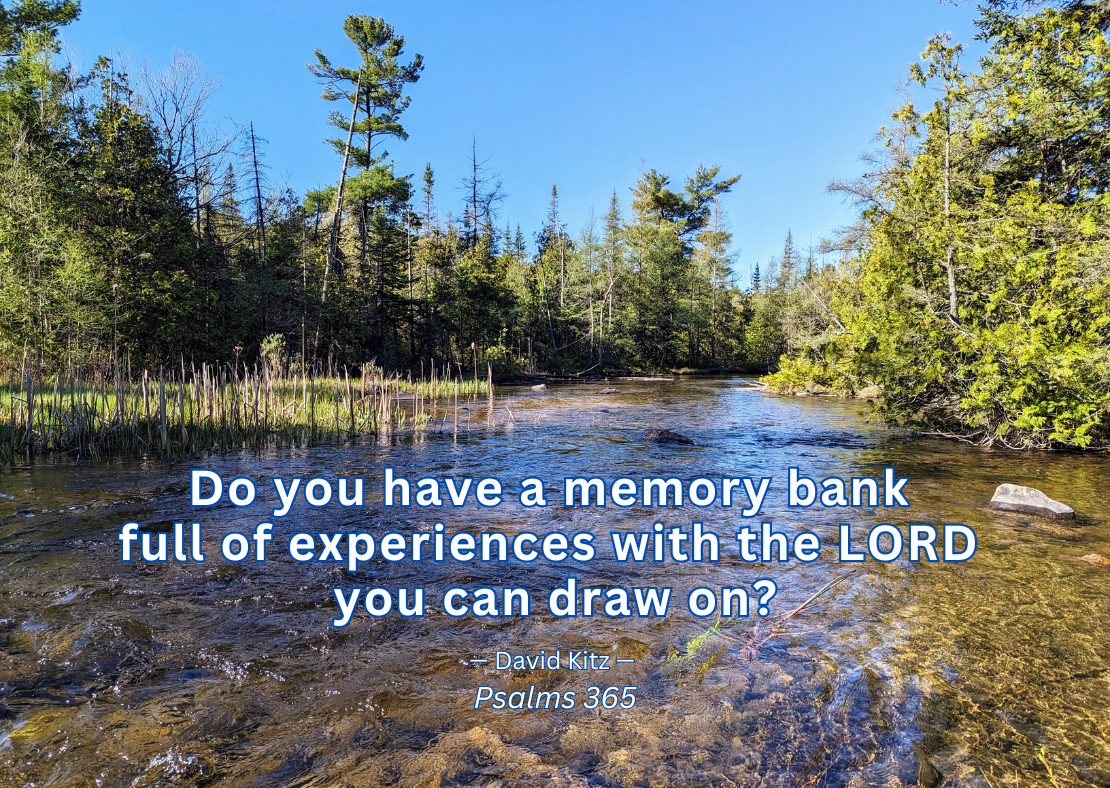
He Went to His Father

06 Wednesday Aug 2025

Posted by davidkitz in Psalm 130

≈ Leave a comment

Tags

Bible, blood of Jesus, Father God, forgiveness of sins, Jesus, mercy of God, Prayer, prodigal, Psalms, the LORD

Today’s quote and prayer from
“Psalms 365: Develop a Life of Worship and Prayer”
by David Kitz.


Reading: Psalm 130:1-4

Father God,
I thank you for forgiveness.
I have failed you many times,
but you are rich in mercy.
You are a patient God.
Thank you for destroying the record of my sins.
Thank you for the blood Jesus shed
so I could be washed clean.
Amen.

— — — —

So he got up and went to his father.

“But while he was still a long way off,
his father saw him
and was filled with compassion for him;
he ran to his son,
threw his arms around him and kissed him.

“The son said to him,
‘Father,
I have sinned against heaven
and against you.
I am no longer worthy to be called your son.’

“But the father said to his servants,
‘Quick! Bring the best robe
and put it on him.
Put a ring on his finger
and sandals on his feet.

Bring the fattened calf and kill it.
Let’s have a feast and celebrate.

For this son of mine was dead
and is alive again;
he was lost and is found.’
So they began to celebrate.
(Luke 15:1-3
NIV)*

Para la publicación de Salmos 365 de hoy en español haga clic aquí.

bgbg_v4.3_1501818
* NEW INTERNATIONAL VERSION, COPYRIGHT ©1973, 1978, 1984, 2011 BY BIBLICA

Please pray for peace to return to Israel, Gaza, Iran, and Ukraine!

Volume I of Psalms 365: Develop a Life of Worship and Prayer won the Best Book of the Year Award from The Word Guild and Volume II has won the Best Devotional of the Year Award. For those who love God’s word, this three-book series is an ideal way to daily meet with the Lord. To purchase or for a closer look click here.

A gripping read from David Kitz.
Is a return-to-Jesus revival possible in our time?
This book points the way forward.

With You There Is Forgiveness

06 Wednesday Aug 2025

Posted by davidkitz in Psalm 130

≈ Leave a comment

Tags

Bible, devotion, forgiveness of sins, God, holiness, Jesus, mercy of God, moral poverty, Prayer, sins, the LORD, transgression

Today’s Devotion from Psalms 365 by David Kitz

Reading: Psalm 130:1-4

A song of ascents.

Out of the depths I cry to you, LORD;
Lord, hear my voice.
Let your ears be attentive
to my cry for mercy.
If you, LORD, kept a record of sins,
Lord
, who could stand?
But with you there is forgiveness,
so that we can, with reverence, serve you
(NIV). *

Reflection
Psalm 130 is a perfect example of a psalm that brings us into the private inner sanctum of communion with God. Here is a portrait of a fallen man—a man on his knees before his Maker, the eternal One. Hear him now as he agonizes in prayer, “Out of the depths I cry out to you, O LORD; Lord, hear my voice. Let your ears be attentive to my cry for mercy” (v. 1-2).

The opening lines of this psalm leave little doubt as to what has transpired. The psalmist has failed; he has missed the mark. He has transgressed, yet again. There is an abject poverty of spirit reflected in these words—a poverty that almost makes us cringe.

We do not know what sin, or list of sins has brought the psalmist to this wretched state. The transgression is left unstated. Was it anger, malice, or unbridled lust? Was it pride, greed or wilful dishonesty? Was this a transgression of the mind, of the tongue, of action or inaction? God knows.

I am always somewhat skeptical of those who claim they could never commit this or that sin. I think we rarely comprehend the depravity of our own hearts. Pushed into wrong circumstances, in the wrong environment, with the wrong peer group, who can plumb the depths to which a man or woman may sink? I can identify with the psalmist. I have added my own pile of dung to this world’s heap of moral filth. I too have found myself in the psalmist’s position, sobbing out these words, “Out of the depths I cry out to you, O LORD; Lord, hear my voice. Let your ears be attentive to my cry for mercy.“

But despite my failings, despite my moral poverty, this great God—this God of holiness—is approachable. He is a God of mercy. The psalmist reminds himself and the LORD of His merciful nature with these words: If you, LORD, kept a record of sins, Lord, who could stand? But with you there is forgiveness, so that we can, with reverence, serve you (v. 3-4).

I need daily reminders of God’s forgiveness and mercy. God the moral accountant is also the LORD of forgiveness. No one does forgiveness better than God. When we confess our sins, He destroys the record. What accountant does that?

Response: Father God, I thank you for forgiveness. I have failed you many times, but you are rich in mercy. You are a patient God. Thank you for destroying the record of my sins. Thank you for the blood Jesus shed so I could be washed clean. Amen.

Your Turn: Have you been guilty of digging up the record of your sins—sins that have been forgiven? What do you do to be reminded of God’s mercy and forgiveness?

Para la publicación de Salmos 365 de hoy en español haga clic aquí.

bgbg_v4.3_1501818
* NEW INTERNATIONAL VERSION, COPYRIGHT ©1973, 1978, 1984, 2011 BY BIBLICA

Please pray for peace to return to Israel, Gaza, and Ukraine!

Volume I of Psalms 365: Develop a Life of Worship and Prayer won the Best Book of the Year Award from The Word Guild and Volume II has won the Best Devotional of the Year Award. For those who love God’s word, this three-book series is an ideal way to daily meet with the Lord. To purchase or for a closer look click here.

A gripping read from David Kitz.
Is a return-to-Jesus revival possible in our time?
This book points the way forward.
For details click here.

I Will Not Neglect Your Word

03 Sunday Aug 2025

Posted by davidkitz in Psalm 119, Psalms, Psalms Alive!

≈ 2 Comments

Tags

Bible, faith in God, God's word, Jesus, meditating on God's word, meditation, memorization, praise, Psalm 119, Righteousness, the LORD, word of God

Psalm 119:12-16

Praise be to you, O LORD;
Teach me your decrees.
With my lips I recount
all the laws that come from your mouth.
I rejoice in following your statutes
as one rejoices in great riches.
I meditate on your precepts
and consider your ways.
I delight in your decrees;
I will not neglect your word.

Psalm 119 is the longest psalm in the Bible. It is also an acrostic poem, which in this case means each stanza of this poetic psalm begins with a different letter of the Hebrew alphabet. The section above for instance, begins with the letter Beth, which roughly corresponds to our letter B. Also, within each alphabetic stanza are eight verses, which all begin with the same Hebrew letter. In this way the psalm’s composer works his way through the entire twenty-two letters of the Hebrew alphabet. This psalm is in fact a remarkable literary composition, which was originally structured to be memorized, like the alphabet. Unfortunately, for the English reader, much of the elaborate, intricate beauty of this psalm is lost the moment it is translated from its original tongue.

The theme of this psalm is consistent throughout. It is a poetic testimony in praise of God’s holy, unchanging word. Here we find the alpha and omega of the psalms—a literary tribute to the A to Z wonder of God’s word. Every letter trumpets the salutary goodness of God’s written word. Charles Spurgeon, the nineteenth century theologian, has called Psalm 119, “A pearl island, or better still, a garden of sweet flowers.”[1]

Here in Psalm 119, we find these immortal words of comfort and encouragement, “Your word is a lamp to my feet and a light for my path” (Psalm 119:105).

Throughout the ages the saints of God have found that light for the journey comes streaming through the written pages of the word of God. Where can we turn in times of despair? How can we scale mountains of fear? How can we cross an ocean of worry? In this sin-darkened world, the word of God stands secure. It sends out a beam of radiant truth to light the traveller’s path. Is it any wonder then that the psalmist declares, “I have put my hope in your word” (Psalm 119:147b).

The light of your presence, LORD — photo by David Kitz

While Psalm 119 shouts out the eternal praises of God’s word, it does so, from a kneeling position. There is an unmistakable posture to this psalm. It rings most true, when it is spoken by a worshipper on his knees. This is a psalm filled with humble supplication. It is humble supplication that kneels and bows low before the Holy One of Israel.

There is an earnest pleading in this psalm that springs from the realization that apart from God and His Holy Word, personal holiness and salvation are impossible. Hence, we have the opening question that frames this stanza, “How can a young man keep his way pure?” 

But in His mercy the LORD has provided a response: “Praise be to you, O LORD; teach me your decrees.”

Unless God teaches me His decrees, I stumble through life lost, without direction, meaning or purpose. In reality, the eat, drink and be merry philosophy that governs the actions of so many in this world, simply springs naturally from their lost state. Hedonism is after all a rather logical response, if life has no meaning or purpose, or if our souls have no eternal destiny.

But to the soul that has heard God’s whisper in the wind or caught a glimpse of His unfading glory in the setting sun, hedonism has lost much of its allure. The soul that takes the long view—that sees beyond the grave—lives life in a different light. We are called to live on a higher plain—a plain that is sustained and nourished by God’s life-giving, life-invigorating Word.

So, in humility with the psalmist, we cry out to the LORD, “Teach me your decrees.”

Now, aware of our fallen position—from a position of need—we cry out to the LORD, “Teach me your decrees.”

The arrogant and self-satisfied are unfamiliar with this prayer. It has no resonance within them. This is the prayer of the hungry and the thirsty. It is Jesus, the word incarnate, who takes it upon himself to personally answer this prayer. Through the beatitudes he answers the cry of our heart, “Blessed are those who hunger and thirst for righteousness, for they will be filled” (Matthew 5:6).

There is a righteousness that does not spring from our performance or our merit. It does not come from observing the law. It comes directly from the crucified and risen Christ, the one who knew no sin. This righteousness—the righteousness of Christ—is credited to our account by faith.  So then as the apostle Paul asserts, “we have believed in Jesus Christ, that we might be justified by faith in Christ and not by the works of the law; for by the works of the law no flesh shall be justified” (Galatians 2:16 NKJV).

Did the writer of Psalm 119 understand the true source of holiness, or was he simply trying to achieve holiness through his own human effort? Is the psalmist’s focus on the law of the LORD and His commands and decrees, just a misdirected reflection of legalistic Old Testament thinking? For today’s believers, who look back in history from this side of the cross, this is a valid question.

On this point, the psalmist’s prayer in later in Psalm 119 is truly insightful. Notice both his choice of words and his posture in supplication, “May your unfailing love come to me, O LORD, your salvation according to your promise; then I will answer the one who taunts me, for I trust in your word” (Psalm 119:41).

Clearly the psalmist saw his need for salvation—salvation that comes freely from a God of grace and unfailing love. Secondly, in the same way as New Testament believers find salvation, the psalmist puts his trust in the word of God and the LORD’s sure promises—promises that include the coming of a Saviour-Redeemer. Satan’s taunts are no match for the believer who has put his faith in the LORD and His word.

Bridge across the Assiniboine River — photo courtesy of Donald Adam

Biblical revelation is progressive through time. The full revelation of God’s way of redemption was not revealed to the Old Testament prophets. They saw in part and prophesied in part concerning the coming of our Lord and Saviour, Jesus Christ. But the partial nature of their revelation does not invalidate their testimony or the authority of their words. Even as the above passage reveals, they saw the way of salvation with an uncanny accuracy—an accuracy that was Holy Spirit breathed.

In fact, the apostle Peter validates the ministry of the Old Testament writers by declaring of these men that they “spoke from God as they were carried along by the Holy Spirit” (2 Peter 1:21).

Again, Peter confirms the authority of the Old Testament scriptures by quoting the words of Isaiah, “All men are like grass and their glory is like the flowers of the field; the grass withers and the flowers fall, but the word of the Lord stands forever” (1 Peter 1:24- 25).

If the word of the LORD stands forever, why do so many Christians discount the Old Testament scriptures? They maybe scriptures, but we discount them. They have been dumped into the half-off bin at the back of our scriptural storehouse. They’re in the front of the Bible, but for many of us, they are in that unused, unread portion. Mentally, we have moved them to the back forty. They have become the back forty-four—out of sight and out of mind. 

But the words of Psalm 119 break into our mind. Here we have some radical thinking—a radical all out devotion to God’s word.

“With my lips I recount all the laws that come from your mouth. I rejoice in following your statutes as one rejoices in great riches.”

In my mind, recounting something with my lips sounds a lot like a rehearsal. Have you rehearsed God’s laws? Doing a rehearsal with my lips sounds a lot like recitation. Have you recited God’s laws? And how can anyone recite something without memorizing it? Have you committed portions of God’s word to memory?

Photo by Thirdman on Pexels.com

Memorization is a skill that has fallen by the wayside. At one time it was routinely taught and practised at our schools. Alas, in many classes, at many schools, those days are long gone. For many years the church was the last bastion of memorization. But in many churches, here too, this skill has fallen by the wayside. As a result, God’s word has fallen by the wayside. 

In recent years the birds of the air have had plenty to devour, because God’s people have forgotten how to hide the word of the LORD in their hearts. But Satan’s emissaries have been busy doing double duty. Not only have they been snatching away the word of God, they also have been filling the empty spots in our minds. They have been planting illicit images where God’s word should be growing.

Is it any wonder then that the church is anaemic? The Spirit-infused bread of life has not been digested and incorporated into the church, the earthbound corpus Christi.  

Memorization is hard work; it takes discipline. A disciple embraces discipline. Are you a disciple in the body of Christ? Then you will discover there is a joy that comes through incorporating God’s word more fully into your mind and into your life.   

The psalmist found a wellspring of joy in the word of God. Hear his words, “I rejoice in following your statutes as one rejoices in great riches.”

Light shines on the righteous and joy on the upright in heart — photo by David Kitz

Memorization very naturally leads to incorporation. The word becomes part of us, just as the food we eat. God’s word is lived out—expressed daily through our lives. We follow the written word—the statutes—and in so doing we are following Christ. After all, it was Jesus who told his disciples, “If you love me, you will obey what I command” (John 14:15).

When we obey, the word becomes fully alive in us. As it was at Christ’s conception, once again, the word becomes incarnate. But this time, God’s word is alive in us—alive in our earthen vessels.

Are you rich with this world’s wealth? Or are you rich in God’s word? Are you finding joy in following Jesus’ commands? If you are discovering that joy, a wonderful promise awaits you. Jesus said, “If anyone loves me, he will obey my teaching. My Father will love him, and we will come to him and make our home with him” (John 14:23).

The empty spot in the garden of our heart will be filled. Jesus will live there through the power of His Word. Your heart will become His dwelling place.

Meditating on God’s word makes room for Jesus in our mind. The psalmist did not only know the secret of a clean mind, he also knew how to keep his mind occupied, healthy and active. Hear him again, “I meditate on your precepts and consider your ways.”

Unlike mind emptying transcendental meditation, biblical meditation fills the mind with God’s holy word. Our mind becomes a garden of life—a garden of sweet flowers—bringing glory to God our Creator.

Autumn sunflowers, Churchbridge, SK — photo by David Kitz

By meditating on God’s word and His ways, we put into practice the apostle Paul’s, advice to us, “Whatever is true, whatever is noble, whatever is right, whatever is pure, whatever is lovely, whatever is admirable—if anything is excellent or praiseworthy—think about such things” (Philippians 4:8).

As we meditate on these things and put them into practice, the God of all peace will be with us. He resides in His Word. His presence in us will manifest itself through an ever-increasing measure of spiritual power, when we open our hearts and our minds to meditate on His word. Then we will find joy coming to us through God’s word. The psalmist’s confession will become our own. “I delight in your decrees.”

“I will not neglect your word.”

For me, these words have become a daily challenge, and a personal commitment. I will not neglect God’s word. When I am walking in His garden, Jesus finds me there.

[1] The Treasury of David, Psalms 111-150 (Classic Reflections on the Wisdom of the Psalms, Volume 3) by Charles H. Spurgeon, Henderson Publishing, 2005.

Bringing Life to the Psalms

  1. Memorization and meditation are sisters. Both practices bury God’s word more deeply in our minds. The buried seed of God’s word germinates, grows and bears fruit. Why not commit yourself to memorize God’s word? Psalm 119 Beth is a wonderful place to begin this life changing practice.
  2. When the word of God takes root in our hearts, we become living epistles—letters from God to a lost generation. You are the only Bible many in this world will ever read. Take a moment to read 2 Corinthians 3:1-3. What do those around you see when they read your life?
  3. Is the Old Testament in your scriptural deep-discount bin? What relevance does it have for your life today? Have there been instances when an Old Testament passage or story significantly impacted your life? What steps can be taken to honor the whole of God’s word more fully in our churches today?
  4. Take time to read all of Psalm 119. Highlight those verses that particularly speak to your heart. Review these same passages later in the day or the week. Take time to think on these things. By doing so, you are meditating on God’s word.

Today’s post is Chapter 23 from the book Psalms Alive! Connecting Heaven & Earth by David Kitz. To find out more or purchase click here.


Like a Little Child

01 Friday Aug 2025

Posted by davidkitz in Psalm 127

≈ Leave a comment

Tags

Bible, children, faith, Jesus, Kingdom of God, Prayer, Psalms, welcoming children, worth

Today’s quote and prayer from
“Psalms 365: Develop a Life of Worship and Prayer”
by David Kitz.


Reading: Psalm 127

Father God,
 I want to see the true worth of my children.
Help me to pass on values
and lessons of faith to them.
I thank you for them.
They are a gift from you
of immeasurable worth.
Amen.

— — — —

People were bringing little children to Jesus
for him to place his hands on them,
but the disciples rebuked them.

When Jesus saw this,
he was indignant.
He said to them,
“Let the little children come to me,
and do not hinder them,
for the kingdom of God belongs to such as these.

Truly I tell you,
anyone who will not receive the kingdom of God
like a little child
will never enter it.”

And he took the children in his arms,
placed his hands on them
and blessed them.

(Mark 10:13-16
NIV)*

Para la publicación de Salmos 365 de hoy en español haga clic aquí.

bgbg_v4.3_1501818
* NEW INTERNATIONAL VERSION, COPYRIGHT ©1973, 1978, 1984, 2011 BY BIBLICA

Please pray for peace to return to Israel, Gaza, Iran, and Ukraine!

Volume I of Psalms 365: Develop a Life of Worship and Prayer won the Best Book of the Year Award from The Word Guild and Volume II has won the Best Devotional of the Year Award. For those who love God’s word, this three-book series is an ideal way to daily meet with the Lord. To purchase or for a closer look click here.

A gripping read from David Kitz.
Is a return-to-Jesus revival possible in our time?
This book points the way forward.

Some Fell on Rocky Places

31 Thursday Jul 2025

Posted by davidkitz in Psalm 126, Psalms

≈ Leave a comment

Tags

Bible, good soil, gospel, Jesus, joy, Prayer, Psalms, salvation, seed planting

Today’s quote and prayer from
“Psalms 365: Develop a Life of Worship and Prayer”
by David Kitz.

Photo by L. Kranz


Reading: Psalm 126

Father God,
I thank you for times of great joy,
when we experience your salvation
and your felt presence.
Help me to sow the seeds
of your gospel message today.
Lord, bring a harvest
through Jesus.
Amen.

— — — —

Then he [Jesus] told them many things in parables,
saying: “A farmer went out to sow his seed.

As he was scattering the seed,
some fell along the path,
and the birds came and ate it up.

Some fell on rocky places,
where it did not have much soil.
It sprang up quickly,
because the soil was shallow.

But when the sun came up,
the plants were scorched,
and they withered because they had no root.

Other seed fell among thorns,
which grew up and choked the plants.

Still other seed fell on good soil,
where it produced a crop—
a hundred, sixty or thirty times what was sown.

Whoever has ears, let them hear.”
(Matthew 13:3-9
NIV)*

Para la publicación de Salmos 365 de hoy en español haga clic aquí.

bgbg_v4.3_1501818
* NEW INTERNATIONAL VERSION, COPYRIGHT ©1973, 1978, 1984, 2011 BY BIBLICA

Please pray for peace to return to Israel, Gaza, Iran, and Ukraine!

Volume I of Psalms 365: Develop a Life of Worship and Prayer won the Best Book of the Year Award from The Word Guild and Volume II has won the Best Devotional of the Year Award. For those who love God’s word, this three-book series is an ideal way to daily meet with the Lord. To purchase or for a closer look click here.

A gripping read from David Kitz.
Is a return-to-Jesus revival possible in our time?
This book points the way forward.

← Older posts
Newer posts →

Psalms 365: Develop a Life of Worship and Prayer

Psalms 365 Volume II

Psalms 365 vol 3
— Psalms 365 Volume III

Psalms

Recent posts

  • From the Bottom of the Dry Well January 13, 2026
  • They Do Not Know What They Are Doing January 12, 2026
  • Don’t Step into the Hate Trap January 12, 2026
  • A Fortress of Salvation January 11, 2026
  • Finishing Well and Growing in Fruitfulness  January 11, 2026
  • I Call to You for Help January 10, 2026
  • Above All Gods January 9, 2026

Calendar

January 2026
M T W T F S S
 1234
567891011
12131415161718
19202122232425
262728293031  
« Dec    

Blog Posts

Comments

  • davidkitz on I Call to You for Help
  • I Call to You for Help – QuietMomentsWithGod on I Call to You for Help
  • davidkitz on Finishing Well and Growing in Fruitfulness 

Blog at WordPress.com.

Privacy & Cookies: This site uses cookies. By continuing to use this website, you agree to their use.
To find out more, including how to control cookies, see here: Cookie Policy
  • Subscribe Subscribed
    • I love the Psalms
    • Join 1,379 other subscribers
    • Already have a WordPress.com account? Log in now.
    • I love the Psalms
    • Subscribe Subscribed
    • Sign up
    • Log in
    • Report this content
    • View site in Reader
    • Manage subscriptions
    • Collapse this bar
 

Loading Comments...