• Home
  • About
  • DavidKitz.ca
  • Youtube Videos
  • Books by David
  • Books on Amazon.com

I love the Psalms

~ Connecting daily with God through the Psalms

I love the Psalms

Tag Archives: Jesus

A Lament over Sin

21 Thursday Sep 2017

Posted by davidkitz in Bible, Devotionals, Psalm 38, Psalms

≈ 1 Comment

Tags

amazing grace, Blame, blaming God, confess, David, depression, Jesus, lament, lamentation, pop-psychology, repentance, responsibility, sorrow, sorrow over sin

Reading:                                      Psalm 38

A psalm of David. A petition.
(Verses 1-8)
LORD, do not rebuke me in your anger
or discipline me in your wrath.
Your arrows have pierced me,
and your hand has come down on me.
Because of your wrath there is no health in my body;
there is no soundness in my bones because of my sin.
My guilt has overwhelmed me
like a burden too heavy to bear.
My wounds fester and are loathsome
because of my sinful folly.
I am bowed down and brought very low;
all day long I go about mourning.
My back is filled with searing pain;
there is no health in my body.
I am feeble and utterly crushed;
I groan in anguish of heart
(NIV).

Reflection

Psalm 38 is a psalm of personal lamentation. The psalmist, David, laments the state of his personal and spiritual health. Notes of joy and triumph are absent from this psalm; instead we find David in a state of deep melancholy.

img_20161004_132712_hdr

Petrie Island, Orleans, ON — photo by David Kitz

What is the cause of this melancholy—this depression verging on despair? David attributes his current ill health to sin. He has sinned and is bearing the consequences of his sin. His words of confession make this perfectly clear. Because of your wrath there is no health in my body; there is no soundness in my bones because of my sin. My guilt has overwhelmed me like a burden too heavy to bear.

What a refreshingly different approach to one’s problems! Rather than blaming others or blaming God, David takes responsibility for his self-inflicted difficulties. How different from the pop-psychology of today! Rather than deal with the sin issue we are often advised to pop a pill, blame a parent, a colleague or society in general. Rather than take our problems to God the world encourages us to indulge ourselves with another bottle, another doughnut or another spouse, meanwhile, our putrid load of sin piles ever higher.

David was on the right track when he confessed his sin to the LORD. He laments, “My wounds fester and are loathsome because of my sinful folly.”

Thanks be to God! He can handle our sinful folly. He sent Jesus to die on the cross to wipe away our sins. Healing, forgiveness and redemption are available through the blood Jesus shed.

Response: LORD God, I thank you for Jesus. I am thankful that I can put my complete trust in you. You forgive me and cleanse me from all my sins. I am saved by your amazing grace not by my effort. Amen.

Your Turn: When was the last time you truly lamented over sin in your life?

The LORD of Salvation

20 Wednesday Sep 2017

Posted by davidkitz in Bible, Devotionals, Psalm 37, Psalms

≈ 1 Comment

Tags

blood, faith, forgiveness, good works, grace, Jesus, mercy, Righteousness, salvation, sinners, the LORD

Reading:                                      Psalm 37

(Verses 35-40)
I have seen a wicked and ruthless man
flourishing like a luxuriant native tree,
but he soon passed away and was no more;
though I looked for him, he could not be found.
Consider the blameless, observe the upright;
a future awaits those who seek peace.
But all sinners will be destroyed;
there will be no future for the wicked.
The salvation of the righteous comes from the LORD;
he is their stronghold in time of trouble.
The L
ORD helps them and delivers them;
he delivers them from the wicked and saves them,
because they take refuge in him
(NIV).

Reflection
Today’s reading is the concluding portion of Psalm 37. As noted previously, this entire psalm contrasts the life of the righteous person with the individual who pursues a life of sin and illicit gain. The righteous will receive their reward and the man who does evil will be destroyed.

242 (3)

Autumn colors in Japan — photo by David Kitz

We all reap what we sow. If we sow seeds of selfishness, hate and discord, we will reap a harvest of ruin. Paul, the apostle, gives us this warning, “Do not be deceived: God cannot be mocked. A man reaps what he sows. Whoever sows to please their flesh, from the flesh will reap destruction; whoever sows to please the Spirit, from the Spirit will reap eternal life” (Galatians 6:7-8).

We can readily conclude that the good man will live because of his goodness. In other words, the righteous person will be saved because of his righteous deeds. But that’s not what this psalm teaches. In fact, the idea that one is saved because of one’s righteousness runs contrary to the message of this psalm and the entire counsel of Holy Scripture. The psalmist clearly states, “The salvation of the righteous comes from the LORD.”

We are not saved by our righteousness. We are saved by the LORD. It is because of His great mercy that we are saved. This aligns with New Testament teaching as Paul declares, “For it is by grace you have been saved, through faith—and this is not from yourselves, it is the gift of God— not by works, so that no one can boast” (Ephesians 2:8-9).

Yes, we are called to live righteous lives and to do good works, but let’s not deceive ourselves into thinking that by these means we will earn our way to heaven. Jesus is the way to heaven. Our feeble efforts won’t take us very far. We need His forgiveness and the power of His redeeming blood. We are saved because we take refuge in Him.  

Response: LORD God, I thank you for Jesus. I am thankful that I can put my complete trust in you. I am saved by your amazing grace not by my effort. Hallelujah! Lord Jesus, you are the way, the truth and the life (John 14:6). Amen.

Your Turn: Have you relied on your righteousness rather than God’s grace?

What is my Motivation?

19 Tuesday Sep 2017

Posted by davidkitz in Bible, Devotionals, Psalm 37, Psalms

≈ 4 Comments

Tags

God, hope, Jesus, justice, Nathan Cirillo, National War Memorial, peace, Righteousness, terrorist, the LORD, truth, violence

Reading:                                      Psalm 37

(Verses 30-34)
The mouths of the righteous utter wisdom,
and their tongues speak what is just.
The law of their God is in their hearts;
their feet do not slip.
The wicked lie in wait for the righteous,
intent on putting them to death;
but the LORD will not leave them in the power of the wicked
or let them be condemned when brought to trial.
Hope in the LORD and keep his way.
He will exalt you to inherit the land;
when the wicked are destroyed, you will see it
(NIV).

Reflection
A few years ago, here in Canada’s capital we saw aspects of this psalm play out in real time. David, the psalmist states, “The wicked lie in wait for the righteous, intent on putting them to death.” A terrorist, with planned intent gunned down Corporal Nathan Cirillo, while he stood guard before the National War Memorial. This cowardly act highlights the contempt of those who celebrate evil, for those who stand for righteousness, truth and justice. The contrast between those who love peace and those who revel in violence is stark indeed.

IMG_20170608_080007

Wild rose — photo by David Kitz

The mouths of the righteous utter wisdom, and their tongues speak what is just. The law of their God is in their hearts; their feet do not slip.

When evil raises its brutal head, we need not be intimidated. We need to take heart. When we stand on the side of truth, justice and love, we do not stand alone. God is with us. He is on our side. He has our back. As the psalmist declares, we need to, “Hope in the LORD and keep his way.”

The way of the LORD is the way of love. Jesus said to his disciples, “No one has greater love than this—that one lays down his life for his friends” (John 15:13 NET). Jesus then went on to demonstrate that supreme love by laying down his life on the cross for our redemption.

The question we need to continually ask ourselves is what is my motivation? Am I motivated by love or am I driven by hate? Am I drawing close to the God of love and hope? Is my life a demonstration of God’s redeeming love, or am I only concerned about my selfish interests?

Corporal Nathan Cirillo laid down his life in the service of his country. Which god will you serve? Will you serve the god of self, or the selfless God—the God whose hands were pierced for you? The choice is yours.

Response: LORD God, we live in a very troubled world. When evil rises, we put our trust in you. Help me to walk in the way of love. Surround me with your peace. Keep those who serve their country safe. I pray in Jesus name. Amen.

Your Turn: How can you honor those who lay down their lives in the service of their country? What makes their sacrifice special for you?

Knowing God

11 Monday Sep 2017

Posted by davidkitz in Bible, Devotionals, Psalm 36, Psalms

≈ 4 Comments

Tags

Jesus, knowing God, Lord, meditation, miraculous powers, Prayer, prophetic, Righteousness, Rockcliffe Park, the Father's will, will of God

Reading:                                     Psalm 36

(Verses 10-12)
Continue your love to those who know you,
your righteousness to the upright in heart.
May the foot of the proud not come against me,
nor the hand of the wicked drive me away.
See how the evildoers lie fallen—
thrown down, not able to rise!
(NIV)

Reflection
Do you know God? Are you well acquainted with Him and His ways? Are you in regular conversation with Him? I ask these questions because in this concluding portion of Psalm 36 David prays, “Continue your love to those who know you, your righteousness to the upright in heart.”

2017-08-16g

The view to the north from Rockcliffe Park — photo by David Kitz 

Knowing God is or should be the great quest of our lives. This is our raison d’etre—our reason for being. We were created to know and love God. The Garden of Eden was first and foremost a place of communion with God. Yet so often we see ourselves running from God, or ignoring His invitation to draw close.

Jesus gives us this warning, “Not everyone who says to me, ‘Lord, Lord,’ will enter the kingdom of heaven, but only the one who does the will of my Father who is in heaven. Many will say to me on that day, ‘Lord, Lord, did we not prophesy in your name and in your name drive out demons and in your name perform many miracles?’ Then I will tell them plainly, ‘I never knew you. Away from me, you evildoers!’ (Matthew 7:21-23).

From Jesus statement here, there appear to be two requirements for entering the Kingdom of Heaven: doing the will of the Father and knowing Jesus. I would argue that truly knowing Jesus helps us to discover and do the will of the Father. If you know someone really well you know what they want—what will please them—without even asking. We need to aim for that kind of intimacy with God.

We come to know the mind of God because we have drawn close to the heart of God through time spent with Him. Two-way prayer and meditation on His word acquaints us with God’s will and His ways—ways that do not change according to the whim of man.

God is not impressed by our prophetic or miraculous powers. He is not impressed by our power over demons. These after all are gifts from Him. God is impressed by our obedience as we seek His face and do His will.

Our God is faithful. He will continue His love to those who know Him. His righteousness will constantly flow to the upright in heart.

Response: LORD God, give me a humble heart that seeks after you. Show me your ways, O Lord. Give me a hunger for your word. I want to know you more and more. Help me to do the Father’s will today. In Jesus’ name, I pray. Amen.

Your Turn: How do you get to know God better? What practices or activities grow your faith and knowledge of God?

Blessed Are the Peacemakers

05 Tuesday Sep 2017

Posted by davidkitz in Bible, Devotionals, Psalm 35, Psalms

≈ 4 Comments

Tags

America, attack, Christian, David, enemies, forgiveness, forgving, Gaza, Holy Land, Israel, Jesus, peace, peacemakers, Philistines, retaliation, rockets, strength, turning the other cheek, war, weakness

Reading:                                     Psalm 35

(Verses 22-25)
LORD, you have seen this; do not be silent.
Do not be far from me, Lord.
Awake, and rise to my defense!
Contend for me, my God and Lord.
Vindicate me in your righteousness, L
ORD my God;
do not let them gloat over me.
 Do not let them think, “Aha, just what we wanted!”
or say, “We have swallowed him up”
(NIV).

Reflection
There’s an old saying, “The more things change, the more they stay the same.” That certainly is true of the conflict in the Holy Land. About 3,000 years ago, in David’s time the Kingdom of Israel was in a struggle for survival. Chief among its enemies were the Philistines along the Gaza coast. On the day when I originally wrote this post, Israel’s chief enemy Hamas was firing rockets into Israel from the Gaza coast.

2017-08-13

Peaceful Petrie Island morning — photo by David Kitz

David’s words from Psalm 35 have a present day resonance. LORD, you have seen this; do not be silent. Do not be far from me, Lord. Awake, and rise to my defense! Contend for me, my God and Lord. Many in present day Israel are praying this prayer with the fervour of those who are being attacked.

But the residents of Gaza could pray this prayer with equal fervour. Their homes and businesses are also under bombardment. Where is God in all this suffering? Whose side is He on? Many in the Christian community affirm with great confidence that God is on the side of Israel. Does that make God complicit in the deaths of innocent children in Gaza?

Jesus gave this counsel to his disciples, “You have heard that it was said, ‘Eye for eye, and tooth for tooth.’ But I tell you, do not resist an evil person. If anyone slaps you on the right cheek, turn to them the other cheek also” (Matthew 5:38-39). Present day Israel (and America for that matter) has a well-established policy of hard-hitting retaliation when attacked. What are the long term consequences of this policy? Is the conflict resolved or is it inflamed?

Jesus’ admonition to turn the other cheek goes unheeded. Most feel that turning the other cheek implies weakness. In reality it requires far more strength, but in the end it yields the peaceable fruit of righteousness—not a righteousness that insists on its own way—but a righteousness that sees both sides of an issue and works hard for peace and reconciliation.

Jesus asks us to do the far harder thing. Retaliation is easy. It’s the natural response. Forgiving when we are wronged, that requires far more effort. Whose side is God on? He is on the side of peace. That’s something worth fighting for.

Response: Blessed are the peacemakers, for they will be called children of God (Matthew 5:9). LORD God, help me to be a local peacemaker in my world today—someone who builds bridges between people and communities. Amen.

Your Turn: Forgiveness and turning the other cheek works on a personal level. Can it work on an international level as well?

I Stand Accused

01 Friday Sep 2017

Posted by davidkitz in Bible, Devotionals, Psalm 35, Psalms

≈ 1 Comment

Tags

Absalom, abuse, accuser, beaten, David, demonic, God, Green's Creek, Jesus, Judas, lies, messianic, prophetic, Roman soldiers, Satan, Savior, sins, the cross, victory

Reading:                                      Psalm 35

(Verses 11-16)
Ruthless witnesses come forward;
they question me on things I know nothing about.
They repay me evil for good
and leave me like one bereaved.
Yet when they were ill, I put on sackcloth
and humbled myself with fasting.
When my prayers returned to me unanswered,
I went about mourning as though for my friend or brother.
I bowed my head in grief as though weeping for my mother.
But when I stumbled, they gathered in glee;
assailants gathered against me without my knowledge.
They slandered me without ceasing.
Like the ungodly they maliciously mocked;
they gnashed their teeth at me
(NIV).

Reflection
There is a prophetic, messianic element to today’s Psalm 35 reading. This psalm is attributed to David, and historically on several occasions, close friends viciously turned on David. During Absalom’s rebellion David was betrayed not only by his son, but also by his confidants, who repaid his kindness with evil. He was openly mocked and tormented by Shimei, son of Gera, as he fled Jerusalem. See 2 Samuel 16:5-14. Though this is part of David’s experience, this psalm portion also has its prophetic fulfilment in the slanderous betrayal of Christ.

2017-08-16c

The muddy waters of Green’s Creek — photo by David Kitz

Matthew records that, “The chief priests and the whole Sanhedrin were looking for false evidence against Jesus so that they could put him to death. But they did not find any, though many false witnesses came forward” (Matthew 26:59-60).

After being betrayed by Judas, his own disciple, Jesus was mocked, stripped and beaten by Roman soldiers (Matthew 27:27-31). While nailed to a cross the crowd hurled abuse at him. In the same way the chief priests, the teachers of the law and the elders mocked him. “He saved others,” they said, “but he can’t save himself! He’s the king of Israel! Let him come down now from the cross, and we will believe in him. He trusts in God. Let God rescue him now if he wants him, for he said, ‘I am the Son of God.’” In the same way the rebels who were crucified with him also heaped insults on him (Matthew 27:41-44).

The shrieking crowds of hell heaped abuse onto our Savior. Those same demonic crowds are ready to hurl their accusations at us when we stumble. Satan, our accuser, delights in tormenting us by bringing up the sins of our past. He mocks our efforts at change, insisting that it can’t be done. But he is wrong—dead wrong.  I can do all this through him who gives me strength (Philippians 4:13).

The Accuser only has power over us if we listen to his lies. Our victory is in the risen Christ!

Response: Jesus, you are my victory when the enemy accuses me. I put my trust in your redeeming blood. Help me to stand firm against the taunts of the enemy. Amen.

Your Turn: Have you put your trust in Jesus? He can change a wayward heart.

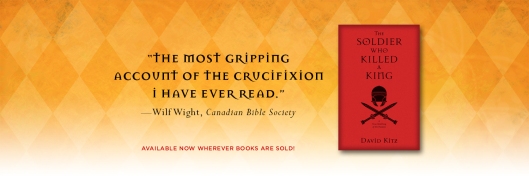
REVIEW OF: The Soldier Who Killed a King

31 Thursday Aug 2017

Posted by davidkitz in Books by David Kitz, Psalms

≈ 6 Comments

Tags

author, Barabbas, Bible, Canadian Bible Society, centurion, Christian, crucifixion, David Kitz, Easter, gospel, historic novel, historical research, Jesus, Passion Week, plot, Roman centurion, terrorist, The Soldier Who Killed a King

REVIEW OF: The Soldier Who Killed a King
SUB-TITLE: A True Retelling of the Passion
PUBLISHER: Kregel Publishing, 2017, 285 pages Soldier book
CLASSIFICATION: Historical Christian fiction
ISBN: 978-0-8254-4485-2
AUTHOR: David Kitz

BY: Wilf Wight, Director, (retired)
Eastern Ontario District
Canadian Bible Society

Maybe it is because I am left-handed, or maybe it demonstrates impatience, but when I first pick up any book, I invariably flip to the concluding pages. Call me a cheater if you will, but I am looking for a conclusion worthy of the time required to read the book! When I turned to the back of The Soldier Who Killed a King, the concluding pages of this story accomplished what every well-written book should do. The author reached back into the plot for a brief review and then projected the reader toward the future. In this case, the plot obviously had elements of violence and suffering which were being transformed through forgiveness and healing. And the future held promise of hope and excitement.

My attention next is concentrated on the first couple of chapters. Has the author grasped my attention in the opening paragraphs? Was sufficient detail given to introduce the plot, while only hinting at more intrigue to follow? Were the characters being carefully introduced in a way that begged my investigation? Yes, the author passed the basic tests. He had been successful in reaching out to me and I wanted to read this book!

Our western world has had major exposure to the Christian Gospel and most readers know at least something of what has come to be known as Holy Week, the week between Palm Sunday and Easter. However, the Bible makes only passing reference to two of the main characters in the story, the Centurion (military officer) who carried out the crucifixion and Barabbas (the convicted murderer) released by the authorities. The author seizes upon this opportunity to give them personalities, develop their thoughts and articulate their opinions. This proved to be a clever and effective tool to experience the unfolding of the drama in a fresh perspective.

For readers who have the mistaken idea that the biblical account is far removed from reality, here is fiction that will help them discover truth. As the author effectively paints the picture of the process of first century justice, political influence and compromise become realities. We cringe as the sentence is carried out by the most cruel and violent method. This is the most gripping account of the crucifixion that I have ever read! One could almost hear the hammer fall, feel the pain, sense the dishonor and share the guilt of that scene. After reading the description of the crucifixion of the first two victims, I hesitated, in fact halted.  I was not sure if I wanted to tackle the third one—that of the Christ. And yet, despite the graphic description of this horrible experience, the author accomplished his goal without resorting to gross descriptions of the mangled human body.

We are confronted with the enigma of the Christ. He is the one who has demonstrated miraculous power to heal the lame and restore sight to the blind. He is the one who gently took children on his knee to teach them. Yet he set aside the exercise of his powers to submit to the terror of the Cross. The terrorist, Barabbas, was released—set free from prison and back into society—as the peoples’ alternative choice. And the sentence was carried out under Pilate’s  orders by the Soldier. Through the eyes of these two characters we see another perspective, which does not usually come to the mind of the worshiper during Passion Week.

One device the author uses effectively is the introduction of each chapter with a day and time orientation. In this way the unfolding of the drama is situated on the calendar. Those who know the biblical account realize that Friday is coming but that is not the end of the story because Easter Sunday will be the revelation of the resurrected Christ.

As we approach the chapter dealing with Easter Sunday, the reader is rewarded with the hope and excitement of an amazing new day. The darkness of the crucifixion is not forgotten but rather dims in the light of the resurrection. The despair of death is replaced by the hope of new life. The willing submission of Jesus, the Donkey King, to the soldiers is now recast as the power of the One who can forgive and restore.

The concluding pages of the story bring us to a climax, so well-crafted and tensioned that I dare not give it away.

The epilogue provides further details of the main characters of the plot, gleaned from historical research. The endnotes reference biblical and other texts, which document the main course of events. The author has done his homework. His account of these events is well researched and credible.

4485 TWITTER


Help in the Battles We Face

31 Thursday Aug 2017

Posted by davidkitz in Bible, Devotionals, Psalm 35, Psalms

≈ 10 Comments

Tags

armor of God, authorities, David, devil, devil's schrmes, escape, Green's Creek, Jesus, New Testament, Old Testament, Ottawa River, resurrection, salvation, sin, spiritual forces, spiritual warfare, St. Paul, sword of the Spirit, the cross, the LORD, victory, word of God

Reading:                                     Psalm 35

(Verses 7-10)
Since they hid their net for me without cause
and without cause dug a pit for me,
may ruin overtake them by surprise—
may the net they hid entangle them,
may they fall into the pit, to their ruin.
Then my soul will rejoice in the L
ORD
and delight in his salvation.
My whole being will exclaim,
“Who is like you, L
ORD?
You rescue the poor from those too strong for them,
the poor and needy from those who rob them”
(NIV).

Reflection
Paul the apostle reminds us that as believers in the Lord Jesus Christ, we are engaged in spiritual warfare. Put on the full armor of God, so that you can take your stand against the devil’s schemes. For our struggle is not against flesh and blood, but against the rulers, against the authorities, against the powers of this dark world and against the spiritual forces of evil in the heavenly realms. Therefore put on the full armor of God, so that when the day of evil comes, you may be able to stand your ground, and after you have done everything, to stand (Ephesians 6:11-13).

2017-08-16a

Green’s Creek Point on the Ottawa River — photo by David Kitz

The conflicts that David experienced in the Old Testament, reflected in the words of this portion of Psalm 35, are mirrored in the spiritual warfare experienced by New Testament believers. Make no mistake—the devil and his cohorts have dug a pit to trap you; they spread their nets to ensnare you in sin and degradation. But as was true for David, the LORD has also provided a way of escape for you and me. Once again Paul reminds us of this: No temptation has overtaken you except what is common to mankind. And God is faithful; he will not let you be tempted beyond what you can bear. But when you are tempted, he will also provide a way out so that you can endure it (1 Corinthians 10:13).

The LORD has equipped us with the armor of God and He has provided a way of escape, so then with David we can rejoice in the victory the LORD will bring.

Then my soul will rejoice in the LORD and delight in his salvation. My whole being will exclaim, “Who is like you, LORD? You rescue the poor from those too strong for them, the poor and needy from those who rob them.”

Satan is a thief and a robber, who robs us of victory, peace and joy. But like David and Paul we can overcome. Victory is possible because the victory has already been won for us at the cross, and it was confirmed on resurrection morning at the empty tomb. “Thanks be to God, who delivers me through Jesus Christ our Lord!” (Romans 7:25).

Response: Heavenly Father, I thank you that you have provided armor so that I can stand against the wiles of the devil. I praise you for the power of your holy word. I have victory through your blood, Lord Jesus. Amen.

Your Turn: In your battle against sin are you using “the sword of the Spirit, which is the word of God?”

What does God look like?

28 Monday Aug 2017

Posted by davidkitz in Bible, Devotionals, Psalm 34, Psalms

≈ 7 Comments

Tags

Ark of the Covenant, brokenhearted, Creator, David, Gatineau, God, human body, image of God, Jacques Cartier Park, Jesus, Mercy Seat, picturing God, righteous, seeing God, seeking God, Sistine Chapel, the LORD

Reading:                                     Psalm 34

(Verses 15-18)
The eyes of the LORD are on the righteous,
and his ears are attentive to their cry;
but the face of the L
ORD is against those who do evil,
to blot out their name from the earth.
The righteous cry out, and the LORD hears them;
he delivers them from all their troubles.
The L
ORD is close to the broken-hearted
and saves those who are crushed in spirit
(NIV).

Reflection
In the previous post on Psalm 34 I asked the question, “How do we God?” Remember David invites us in Psalm 34:8 to “Taste and see that the LORD is good.”

2017-08-09i

Wooden horses, Jacques Cartier Park, Gatineau, Quebec — photo by David Kitz

As this psalm continues David again invites us to take a closer look at God. He reminds us that, “The eyes of the LORD are on the righteous, and his ears are attentive to their cry; but the face of the LORD is against those who do evil to blot out their name from the earth.”

In this passage David depicts the LORD as having eyes, ears and a face. I always have trouble picturing God. This inability does not stem from a lack of imagination. It comes from the knowledge that God is a spirit. How do you picture something that has no physical substance or form?

But picturing God comes with further difficulties. We are specifically forbidden to create an image or likeness of God. The God of the Hebrews sat on the Mercy Seat on the Ark of the Covenant between two cherubim. But there was no image or statue there. To create an image or statue would be blasphemous. For that reason I find Michelangelo’s painting on the ceiling of the Sistine Chapel offensive. I am not offended by the depiction of a naked Adam. I’m offended by the portrayal of an old grey-haired man as God. How dare he create an image of God? I am similarly troubled by any artistic rendering of God the Father. God is so far beyond human that to render Him as having a human form demeans His Majesty.

But that’s what makes the incarnation so spectacular. This God of no fixed form took on material reality. In the person of Jesus, He became a man with eyes, ears and a human face. The God who sees all and hears all limited himself to a human body. The Creator took on the form and limitations of a creature—limitations that encompass betrayal, pain and death. In the body of Jesus, the Creator God, who sees and hears, experienced our reality—our humanity.

The psalmist, David declares, “The righteous cry out, and the LORD hears them; he delivers them from all their troubles. The LORD is close to the brokenhearted and saves those who are crushed in spirit.”

The LORD is close to the broken-hearted because in the form of Christ his heart was broken. He experienced the pain that touches you and more. His eyes are on you. He is listening when you cry out.

Response: Hear my prayer, Lord. I seek your face. Be my healer, my redeemer and deliverer. In Jesus’ name, who defeated death, I pray. Amen.

Your Turn: Do you have a picture of God? How does God look to you?

How Do I Taste God?

25 Friday Aug 2017

Posted by davidkitz in Bible, Devotionals, Psalm 34, Psalms

≈ 7 Comments

Tags

blessed, blood, body, body and blood, C.S. Lewis, cat and mouse, fear, fearing God, five senses, flesh, God, Green's Creek, Jesus, John Ortberg, Know Doubt, Lion of the tribe of Judah, refuge, sacrifice, taste, the LORD, touch

Reading:                                     Psalm 34

(Verses 8-14)
Taste and see that the LORD is good;
blessed is the one who takes refuge in him.
Fear the L
ORD, you his holy people,
for those who fear him lack nothing.
The lions may grow weak and hungry,
but those who seek the L
ORD lack no good thing.
Come, my children, listen to me;
I will teach you the fear of the L
ORD.
Whoever of you loves life
and desires to see many good days,
keep your tongue from evil
and your lips from telling lies.
Turn from evil and do good;
seek peace and pursue it
(NIV).

Reflection
What a strange command! David begins this portion of Psalm 34 by urging us to “Taste and see that the LORD is good.”

2017-08-16a

Green’s Creek Point on the Ottawa River — photo by David Kitz

One can logically argue that of the five senses taste is the most intimate. I can see, hear, and even smell someone at a distance. Touch of course requires direct contact, but to taste someone or something, I must take it or them into my mouth. That’s intimate.

How then do I, “Taste and see that the LORD is good?” If I can’t see, hear, smell or touch the LORD, how can I possibly taste Him? David goes on to state, “Blessed is the one who takes refuge in him [the LORD]. Notice David did not say we are blessed if we take refuge with the LORD. We are to take refuge in Him. That requires a higher level of intimacy—a marital kind of intimacy.

Do I taste and see that the LORD is good? Do I take refuge in Him? Do I actively seek God? John Ortberg in his book Know Doubt tells us that C.S. Lewis said that speaking of man’s search for God always sounded to him like speaking of the mouse’s search for the cat. The mouse hides from the cat because he fears the cat may require his life. We avoid God for the same reason. If you find God, He may ask for your life. Are you willing to give it up to Him?

But Jesus was willing to give his life for you. He willingly suffered, bled and died on a cross so that you might have eternal life. The big cat—the Lion of the Tribe of Judah—lay down his life for the mouse, even a mangy mosacriuse like me. That’s real love. Now Jesus invites us to come and dine. Jesus said, “Whoever eats my flesh and drinks my blood has eternal life, and I will raise them up at the last day. For my flesh is real food and my blood is real drink. Whoever eats my flesh and drinks my blood remains in me, and I in them” (John 6:54-56).

Response: Heavenly Father, thank you for sending Jesus. Thank you, Jesus for laying down your life for me. Through the sacrifice of your body and blood I can truly taste and see that the LORD is good. Amen.

Your Turn: Do you seek God or avoid Him? Why?

← Older posts
Newer posts →

Psalms 365: Develop a Life of Worship and Prayer

Psalms 365 Volume II

Psalms 365 vol 3
— Psalms 365 Volume III

Psalms

Recent posts

  • Thankful Hearts April 2, 2026
  • Jesus Before Pilate April 1, 2026
  • A Great Summoning! April 1, 2026
  • With Him in the Garden March 31, 2026
  • Two Fates from One Choice March 31, 2026
  • The High Priest Questions Jesus March 30, 2026
  • The Psalmist is Wrong! March 30, 2026

Calendar

April 2026
M T W T F S S
 12345
6789101112
13141516171819
20212223242526
27282930  
« Mar    

Blog Posts

Comments

  • cjsmissionaryminister on Thankful Hearts
  • davidkitz on With Him in the Garden
  • With Him in the Garden – QuietMomentsWithGod on With Him in the Garden

Blog at WordPress.com.

Privacy & Cookies: This site uses cookies. By continuing to use this website, you agree to their use.
To find out more, including how to control cookies, see here: Cookie Policy
  • Subscribe Subscribed
    • I love the Psalms
    • Join 1,381 other subscribers
    • Already have a WordPress.com account? Log in now.
    • I love the Psalms
    • Subscribe Subscribed
    • Sign up
    • Log in
    • Report this content
    • View site in Reader
    • Manage subscriptions
    • Collapse this bar
 

Loading Comments...