James: the Lynchpin of Our Faith — Chapter 7
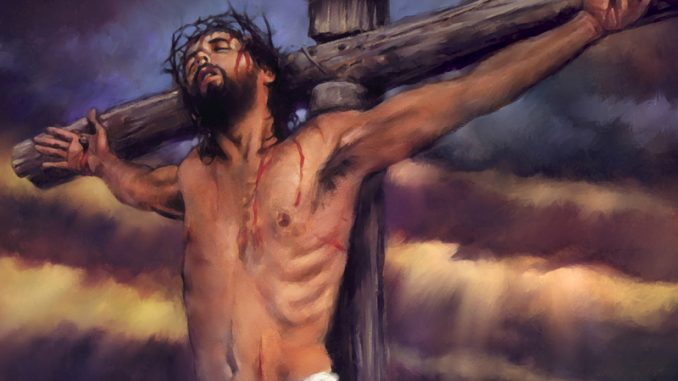
At this point many readers may feel that this rift in Jesus’ natural family is overstated. Theologians and Bible scholars generally have not raised this matter, and it certainly is not a point of common discussion among believers, or a Sunday sermon topic within churches today. However, when one takes the time to connect the dots—make the links—the biblical record is quite clear. Jesus came from a dysfunctional family. A massive family rift existed between Jesus and his half-brothers, and James was at the crux of this division. No event brings this out more clearly than the crucifixion of Jesus.
But before we connect that final dot, let’s review the evidence of this rift as it has been presented thus far:
• Jesus was rejected by the people of his hometown, Nazareth,
and barely escaped being thrown off the cliff on which the
town was built. (Luke 4:16–30; see also Matthew 13:54–58
and Mark 6:1–6.)
• According to John, the gospel writer, Jesus’ brothers did not
believe in him or his divine mission. See John 7:1–13.
• At a point early in Jesus’ three-year ministry, his brothers and
his mother came to get Jesus because they believed he was out
of his mind. In response, Jesus identified his followers as his
true family. (Luke 4:16–30; see also Matthew 13:54–58 and
Mark 6:1–6.) Jesus taught a counter-cultural gospel of spiritual
rebirth into God’s family. (John 1:11–13 and John 3:1–21.)
• Membership in this new spiritual family required a radical
loyalty to Christ, which superseded the importance of one’s
blood relatives. (Matthew 10:34–39; see also Luke 14:26–27.)

Mackenzie King Estate, Gatineau Park — photo by David Kitz
The picture that emerges is quite clear. Following his baptism by John, Jesus left home and assumed a new identity—his true identity. He no longer identifies as the son of Joseph. He is the Son of God, even as the voice coming from heaven identified him at his baptism. (See Matthew 3:17, Mark 1:11, Luke 3:22.) His birth family, or at least the male members of it, have rejected him as insane or possibly demon possessed. They stand aloof from him, and none of them are numbered among his followers.
Mary finds herself caught in the middle, torn between her faith in and love for her firstborn, and the fierce rejection he has engendered among her other sons. She knows the secret of his divine conception and the prophetic words that were spoken over him. She witnessed the miracles and the angelic confirmation that surrounded the events of his birth. Mary believes—no, she knows—that her son Jesus is the Son of God. At her prompting, he performed his first miracle at Cana (John2:1–12). Yet here she finds herself caught in the middle of this storm of opposition—opposition within her own family. Owing to this opposition, she can only follow Jesus at a distance. She is not numbered among the women who supported and accompanied Jesus and his roving apostolic band as recorded in Luke’s Gospel:
After this, Jesus traveled about from one town and village to another, proclaiming the good news of the kingdom of God. The Twelve were with him, and also some women who had been cured of evil spirits and diseases: Mary (called Magdalene) from whom seven demons had come out; Joanna the wife of Chuza, the manager of Herod’s household; Susanna; and many others. These women were helping to support them out of their own means. (Luke 8:1–3)
Undoubtedly, Mary followed the reports of Jesus’ ministry with great interest. Repeatedly the gospel accounts record how the news of Jesus’ miraculous signs and healings spread throughout the entire region of Galilee and Judea. These reports would spur Mary to even greater faith. Surely the biblical prophecies were coming true. Her son was the long-awaited Messiah. His miraculous powers testified to his divinity. For Mary and thousands of others, hope tingled in the air. Israel’s day of deliverance was drawing nigh.
It is amid this air of expectant hope that Mary set out from Galilee to celebrate the Passover in Jerusalem. This annual pilgrimage was a well-established family tradition (Luke 2:41–42). Undoubtedly, she travelled in the company of one or more of her adult sons: James, Joseph, Simon, or Judas (Jude). No middle-aged woman at that time would undertake such a pilgrimage on her own.
Above all, Passover was and is a family celebration of the deliverance of the firstborn from the angel of death. It is a time for families to gather together. For Mary this journey would have brought back memories of that journey years earlier with her twelve-year-old firstborn, Jesus. Due to the rupture in relations recorded earlier, he was not part of the family gathering now. Jesus was with his new family, his disciples. He was going about “his Father’s business” (Luke 2:49).
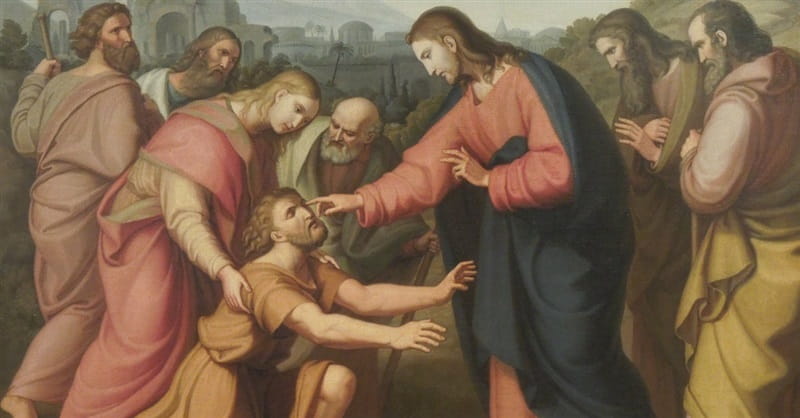
But his presence amidst the festive throng stirred their collective faith as never before. They sensed the anticipation. Surely, the long-awaited kingdom of God was at hand. On the final morning of their journey, as they left Jericho for the ascent to Jerusalem, their hopes were confirmed. To the astonishment of all, Jesus performed one of his greatest miracles. Mark’s gospel gives us the most lucid account:
As Jesus and his disciples, together with a large crowd, were leaving the city, a blind man, Bartimaeus (which means “son of Timaeus”), was sitting by the roadside begging.
When he heard that it was Jesus of Nazareth, he began to shout, “Jesus, Son of David, have mercy on me!”
Many rebuked him and told him to be quiet, but he shouted all the more, “Son of David, have mercy on me!”
Jesus stopped and said, “Call him.”
So they called to the blind man, “Cheer up! On your feet! He’s calling you.” Throwing his cloak aside, he jumped to his feet and came to Jesus.
“What do you want me to do for you?” Jesus asked him.
The blind man said, “Rabbi, I want to see.”
“Go,” said Jesus, “your faith has healed you.” Immediately he received his sight and followed Jesus along the road. (Mark 10:46–52)
The effect that this demonstration of heaven-sent power had upon the crowd cannot be overestimated. This was divine confirmation. The Messiah had come—was walking among them now! Deliverance was at hand. Surely, Jesus was the promised son of David—the anointed one—the Christ.
Wikimediacommons
That morning Jesus did more than open the eyes of a beggar; he opened the eyes of the pilgrims to his divine call and mission. And as they continued their journey, that beggar, Bartimaeus, was walking, talking, living proof of the Messiah’s power. A blind beggar, healed and set free, embodied the Passover pilgrims’ hopes and dreams. They too could be set free from the bondage of Roman rule. Anything was possible. The kingdom of God was among them. The rightful king of the kingdom was walking the dusty road with them.
As they reached the outskirts of Jerusalem, the excitement built to a crescendo. Jesus climbed on the back of a commandeered donkey, and the crowd began to hail him as king. In doing this, he and his followers signaled that he was the coming Messiah-King, the Christ, spoken of in Old Testament prophecy ((Zechariah 9:9).
Many people spread their cloaks on the road, while others spread branches they had cut in the fields. Those who went ahead and those who followed shouted,
“Hosanna!”
“Blessed is he who comes in the name of the Lord!”
“Blessed is the coming kingdom of our father David!”
“Hosanna in the highest heaven!” (Mark 11:8–10)
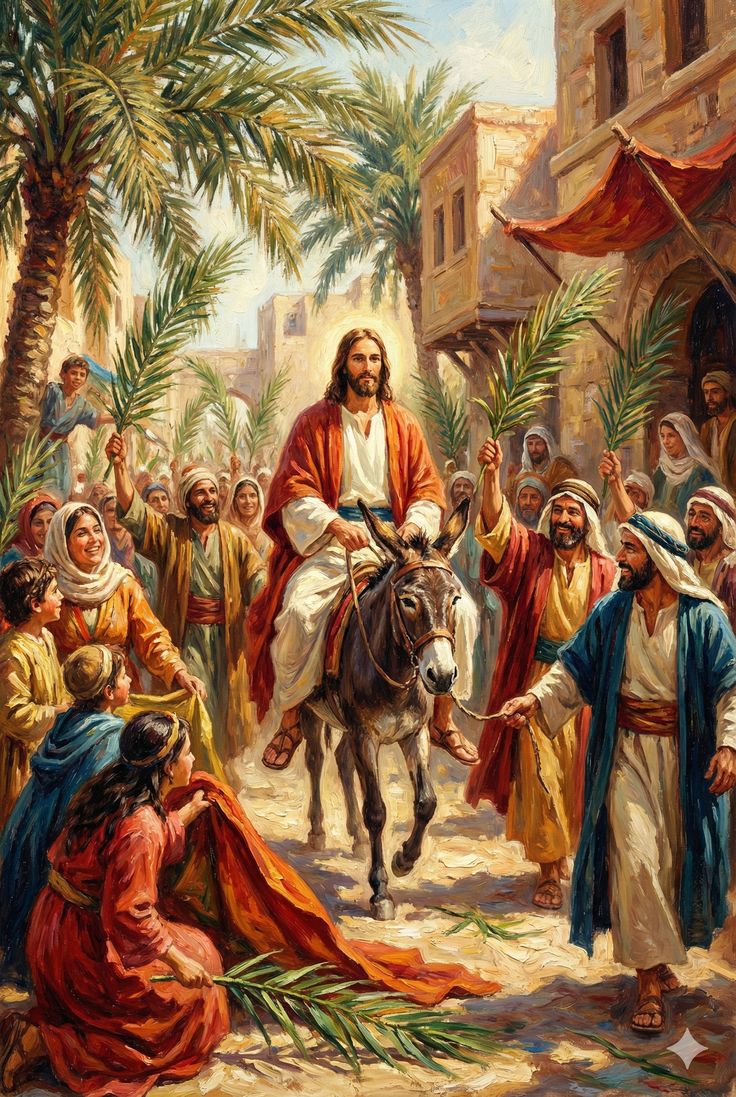
Mary’s heart must have swelled with pride as this image unfolded. Her firstborn was being hailed as king! Before her very eyes the words of the angel Gabriel—the words of the annunciation—were coming true.
He will be great and will be called the Son of the Most High. The Lord God will give him the throne of his father David, and he will reign over Jacob’s descendants forever; his kingdom will never end. (Luke 1:32–33)
Only Caiaphas, the high priest, and Pontius Pilate, the Roman governor, stood in the way. All too soon these aspirations of greatness came crashing down. The soft power of a spiritual kingdom collided with the brute force of Rome. Though this grand arrival set all of Jerusalem in a stir, Matthew 21:10–11, the powers that be were not about to surrender authority and control to a so-called prophet from Nazareth.
Upon his arrival Jesus launched a coup. But the coup was not against the Romans. Instead, it was against the temple authorities. Jesus set about cleansing the temple compound of marketers and moneychangers, and then he turned it into his center for healing and teaching. See Matthew 21:12–17. The high priestly clan would countenance none of this. The crafty Caiaphas plotted revenge. See John 11:47–53.
The week that began with a king on a donkey ended with a king on a cross.
For Mary the more ominous words of another prophet were about to come true. At the infant Jesus’ dedication in the temple, the prophet Simeon had said to Mary, “And a sword will pierce your own soul too” (Luke 2:35b). The cruelest cut was yet to come.
Sunday’s elation transitioned to midweek apprehension and finally Friday’s death and despair. An incomprehensible reversal—an unfathomable descent into hell—that’s what Mary experienced.
Her midmorning arrival at the foot of her son’s cross evokes a level of pathos that breaks the bounds of description.
Near the cross of Jesus stood his mother, his mother’s sister, Mary the wife of Clopas, and Mary Magdalene. When Jesus saw his mother there, and the disciple whom he loved standing nearby, he said to her, “Woman, here is your son,” and to the disciple, “Here is your mother.” From that time on, this disciple took her into his home. (John 19:25–27)
Jesus committed his mother into the care of John, his dearest disciple, “the disciple whom he loved.” This was the spoken will of a dying man, and according to the text above, Mary and John carried out Jesus’ will. Mary moved into John’s home.
This event raises a whole series of questions:
• Why would Jesus commit his mother into the care of his
disciple?
• Why would Mary agree to this new living arrangement?
• Where were Jesus’ brothers? Why are they not with their
mother at the foot of the cross?
• What was the motive and basis for this new living arrangement?
None of this makes sense unless there was a deep rift—an estrangement—between Jesus and his brothers. As we have already seen, such an estrangement was evident early on in Jesus’ ministry. His crucifixion brought this rift fully into the open. Here was the climax—the final cut. The family is torn asunder. As for Mary, she has irrevocably aligned herself with Jesus, her firstborn.
But where is James in all this? Where are the other half-brothers? It is unimaginable or highly unlikely that James was not present in Jerusalem for this Passover. The Passover was a family celebration, and with Joseph’s death, and Jesus’ abandonment or abdication of his family responsibilities, James was now the head of the home. Since we know Mary did not come to Jerusalem with Jesus and his apostolic band, we must conclude that she came with James. As the oldest son of Joseph, it was his responsibility to lead the family in the sacred celebration of deliverance from the bondage of Egypt through the blood of the Passover lamb.
It is reasonable to believe that while Jesus was celebrating his last Passover meal and instituting the communion sacrament with his spiritual family—his disciples in Jerusalem—James was leading the Passover celebration with Mary his mother and Jesus’ natural family members at another location in the city. The house of Joseph was divided.
James was not present at the communion table because clearly there was no spiritual union between him and Jesus. By instituting this sacrament Jesus established a link between his imminent death—as the paschal lamb offered up for the sins of the world—and the ancient Jewish Passover ritual. But there is a deeper meaning in this blood sacrifice that warrants further exploration.
Using the emblems of bread and wine, Jesus commanded his disciples to eat his body and drink his blood. Though his words should be interpreted figuratively or spiritually, (John 6:63) they nonetheless represent a drastic departure from orthodox Jewish teaching. Human sacrifice is universally condemned under the Old Covenant, and though the meat of the sacrificial animal or paschal lamb was consumed, by a direct command of God the blood must never be. “And wherever you live, you must not eat the blood of any bird or animal. Anyone who eats blood must be cut off from their people” (Leviticus 7:26–27).
The prohibition is sharp.
According to John’s Gospel, Jesus introduced this teaching about eating his body and drinking his blood in the town of Capernaum in Galilee, prior to instituting the sacrament at his last Passover in Jerusalem. Not surprisingly, his teaching was roundly rejected at that time.
Jesus said to them, “Very truly I tell you, unless you eat the flesh of the Son of Man and drink his blood, you have no life in you. Whoever eats my flesh and drinks my blood has eternal life, and I will raise them up at the last day. For my flesh is real food and my blood is real drink. Whoever eats my flesh and drinks my blood remains in me, and I in them. Just as the living Father sent me and I live because of the Father, so the one who feeds on me will live because of me. This is the bread that came down from heaven. Your ancestors ate manna and died, but whoever feeds on this bread will live forever.” He said this while teaching in the synagogue in Capernaum. (John 6:53–59)
The thought of eating human flesh and drinking human blood is disgusting, repulsive, and strictly forbidden in religious law. The response of the faithful in Capernaum should surprise no one. “On hearing it, many of his disciples said, ‘This is a hard teaching. Who can accept it?’” (John 6:60)
John goes on to report the effect that this teaching had on his followers. “From this time many of his disciples turned back and no longer followed him” (John 6:66).
The question that naturally springs to mind is: Why introduce such a disturbing teaching? Why attempt to overthrow centuries of religious law?
Clearly Jesus must have attached a great deal of significance to this doctrine. It was not peripheral; it was at the core of his teaching. Furthermore, it was at the core of his teaching because it was at the core of his being. It was about his DNA—divine eternal DNA being transferred to his followers. This is why Jesus says, “Whoever eats my flesh and drinks my blood remains in me, and I in them. Just as the living Father sent me and I live because of the Father, so the one who feeds on me will live because of me” (John 6:56–57).
Eternity was written into Christ’s DNA, and to have eternal life, his followers must have eternal DNA. Eternal DNA is found in the blood of Christ. That is why in the sacrament he offers his blood to his followers. In his blood is the life of God. In communion, on a symbolic spiritual level, we become partakers in the DNA of Christ.
To impart eternal life to his disciples, which is only available through his shed blood, Jesus overturns the centuries’ old Levitical prohibition against consuming blood:
For the life of a creature is in the blood, and I have given it to you to make atonement for yourselves on the altar; it is the blood that makes atonement for one’s life. (Leviticus 17:11)
Not only did Jesus’ followers need to partake in his divine DNA, but they also needed to be cleansed by and forgiven through the sacrifice of his body. His shed blood atones for their sins, making them acceptable to God their Father. The writer of the Book of Hebrews makes this concept clear when he states, “In fact, the law requires that nearly everything be cleansed with blood, and without the shedding of blood there is no forgiveness” (Hebrews 9:21–23).
Forgiveness and eternal life are available now through the body and blood of Christ for all who believe. But at this point in our narrative James does not believe. He stands outside the family of God as described by his half-brother, the Lamb of God. James has not experienced a spiritual rebirth. To him this talk of consuming his brother’s flesh and blood is the gibberish of a madman—or worse yet, highhanded blasphemy.
While Jesus instituted the holy sacrament, James, the firstborn son of Joseph, celebrated the Jewish Passover in the traditional way. As a dutiful mother and the family matriarch, Mary would be present with James. But her heart was with Jesus—her firstborn. After all, this memorial celebration was all about the firstborn who was protected from the Angel of Death by the blood of the Passover lamb.
The spiritual family and the natural family of Jesus celebrated the Passover in strikingly different ways. For the most part, this is a difference that continues to this day, as Passover and the celebration of the Eucharist mark the dividing line between the Jewish and Christian faith.
The very next morning, though James was present in the city, he refused to come with his mother to the foot of the cross. As his half-brother Jesus, the Lamb of God, hung dying, James would not climb the hill of Golgotha to bid him farewell. That is how intense the animosity he felt toward Jesus was. James shunned and despised Jesus in the moment of his greatest suffering—in the moment of his death.
Undoubtedly, before Mary arrived at the foot of the cross, there was an intense and heated conversation between her and James. This conversation is not recorded in scripture; it happened off-camera, so to speak. But it’s not difficult to imagine the issues at play.
Mary is caught in the jaws of this horrific turn of events. Mary’s soaring hopes and dreams for her messianic son have come crashing to the ground. Her faith is shattered. Heaven’s promise has turned into hell—an intensely personal hell. In her grief, her only thought is to spend a few final minutes with the child she bore, the child she nursed and loved—the son of her most cherished dreams.
James on the other hand is seized with a mixture of anguish and rage. He sees his brother’s crucifixion as a natural consequence flowing from the words and actions of a dangerously deluded mind. He had tried to put an end to this messianic delusion—to take charge of his brother early in his ministry—all to no avail (Mark 3:20–35). Now his worst nightmare has come to pass. And what had all this talk of the kingdom of God accomplished? It led directly to death on a Roman cross—an outcome that was entirely predictable. Wasn’t this the reason he tried to take charge of Jesus? But the deluded fool would have none of it. He refused to listen to his family and the voice of reason.
As seen through the eyes of James, the sins of Jesus were numerous and stunningly heinous. He abandoned his family responsibilities. He rejected the wise counsel of his family members; in fact, he rejected his entire family (Mark 3:33–35). From the earliest days of his ministry, Jesus was a deranged rebel, who opposed the highest religious authorities in the land (Mark 3:22). Furthermore, he had the audacity to take his opposition to authority to the highest level. He denounced the strict and pious Pharisees, men whose legal scruples James admired. But not content with mocking the religious establishment from the sidelines, Jesus invaded the temple courts with his deluded hordes and challenged the authority of the high priest in his own precinct. Is it any wonder that Caiaphas reacted as he did?
But here is the most grievous of all his transgressions. Jesus had delusions of grandeur—of Deity. How could James’ brother—his flesh and blood brother—be God? Deity come in the flesh? Preposterous! Such an idea was beyond scandalous. It was the height of blasphemy. And James was proven right in this assessment when the Jewish high council, the Sanhedrin, reached its verdict in Jesus’ trial (Mark 14:61b–64).
What might James have thought at this moment? Death on a cross was too kind an outcome for such a fool—such a bastard!
And now Mary, the mother of this bastard—yes, and his own mother too—wants to say farewell to her bastard. Well, let her go. She was the mother of this bastard, and for reasons that totally confounded James, she had urged Jesus on in this course of action—this blasphemous folly to the shame and disgrace of the entire family.
Let her go. Let her go crying to her humiliated, bastard son. Wasn’t she the mother of this catastrophe—this affront to the Jewish faith? She was the source and the root cause of all the dissension in the family. From the moment of Jesus’ conception to this very instant, Mary had brought disrepute and an immeasurable dishonour to the house of Joseph.
Let the b*tch go to her bastard now, he must have thought. (I derive no pleasure in using these derogatory terms. Strong, insulting language is used here to signal the complete breakdown of the family relationship.) But in all likelihood, James also let Mary know that if she went to see Jesus, she was unwelcome in his home. If she went crying to him—if she sided with him—she too was an outcast.
This is a look into the mind of James on the day Jesus died.
Well, Mary made her decision. She walked to the foot of the cross. But she did not come forward alone. She came with other believers, her sister, “Mary the wife of Clopas, and Mary Magdalene.” See John 19:25. At last Mary has fully entered the circle of Jesus followers. She made a courageous and conscientious decision to associate herself with the family of God. She aligned herself with her firstborn.
Why did Jesus commit his mother into John’s care? Without this background, this decision makes no sense because Mary has four remaining sons—and daughters, as well. According to rabbinical law and practice, the oldest son was required to be her provider in her declining years as a widow. The decision to commit Mary to John’s care only makes sense in view of the scenario that has just been described. Mary needs a new home and a new family because she has been rejected by her remaining children, her own flesh and blood.
Mary stood before Jesus as a homeless widow without a family. She is not an orphan in the traditional sense of the word, but with the death of Jesus, she will become an orphan from her natural family. Therefore, Jesus entrusts her into John’s care.
With her arrival at the cross, Mary has taken on a new identity in the fullest sense imaginable, even as Jesus did when he was baptized. She has left the household of Joseph and joined the household of God. She will be forever known as the mother of the Son of God.
Jesus would not leave his mother in the care of an unbeliever, so he entrusted her to John, his dearest disciple.
There is a profound spiritual dynamic at work here. Jesus is signaling to all that spiritual birth takes precedence over natural birth. In his eternal kingdom, the spiritual family and spiritual DNA trump the natural family and natural DNA.
For Mary this was the final cut. She was cut off from her natural family and grafted into the family tree of God.
New from David Kitz
James—the brother of Jesus—who was this man? What evidence do we have that this “brother of our Lord” even existed?
David Kitz digs deep into archeology, family dynamics, church history, and the biblical texts. What emerges from his research is a portrait of a decisive, pivotal leader who embodied the will and character of Jesus Christ.
But how did James—James the unbeliever—transform to become a leader who changed the course of world history? In these pages you will uncover the answer and rediscover for yourself the life-changing power of the gospel.
To view further details or purchase directly from the author click here.


 There was agreement among the apostles, the elders, and the whole church on this matter.